I. INTRODUCTION
South America's political transitions from the 1980s have long provided one of the central historical narratives of the transitional justice field.Footnote 1 Through the dissemination of approaches and expertise, experiences in this region had a profound impact on understandings of the goals, legality and viability of transitional justice policies.Footnote 2 Many of the policy choices and legal approaches pursued within South America before and during transitions from dictatorship hinged on the granting of amnesty to perpetrators of international crimes and gross human rights violations.Footnote 3 These amnesties were intended to shield murderers and torturers from investigation and prosecution permanently. Their enactment influenced understandings of the nature of the compromises that may need to be made during transition. The evolution of the transitional justice field beyond the ‘paradigmatic’ transitions from dictatorship that took place in South America to encompass efforts to deal with violent pasts during or after armed conflict, in postcolonial States or even in democracies, have prompted growing reflection on the extent to which transitional justice's theoretical underpinnings need to be rethought to address these diverse settings.Footnote 4 However, despite the growing caution about the over-dominance of South American experiences in shaping the field, some scholars and activists have claimed that the success of legal challenges to limit some of South America's amnesties are reflective of a normative shift away from amnesty that is applicable beyond this region. This article evaluates these claims under three themes relating to: the legality of amnesties under international law, the durability of past amnesties, and the desirability of enacting amnesties in the future.
Part II of this article provides a brief historical background concerning the use of amnesties in South America. Part III draws on an extensive comparative analysis of judicial and legislative measures to evaluate the existence of a regional trend to overturn past amnesties. It describes the measures that have been taken in some States to narrow or annul past amnesties, and it is argued that although a trend to erode past amnesties exists, it is not yet universally applicable across the region. After establishing the existence of this regional trend, the article draws upon the case law of the Inter-American Court of Human Rights to interrogate its parameters. It is argued that this trend represents only an outright rejection of amnesties for international crimes and gross violations of human rights enacted during transitions from dictatorship. It further argues that within the region there is a continued acceptance of the need for limited amnesties and that other leniency measures, even for the most serious crimes, may be viewed as a necessary component of transitions from conflict to peace. Part IV evaluates claims made in the literature and policy reports concerning the significance of South America's trend for the legality, durability and desirably of amnesties in the region and internationally. It argues that the unique dynamics of South America's transitions and the resulting amnesty laws limit the extent to which any consequences of this trend are generalizable to other parts of the world. The article concludes by reflecting on the consequences of overstating or distorting the significance of events in this region to support the existence of a broader normative shift.Footnote 5
II. HISTORICAL USE OF AMNESTIES IN SOUTH AMERICA
To fully appreciate the momentous nature of the erosion of amnesty within South America over the past two decades, it is necessary to consider the historical use of amnesty laws within this region. Although many South American nations have repeatedly relied upon amnesties to address political crises since independence from colonial rule, this section will focus on the amnesties that have been subject to sustained legal challenges in recent years. In doing so, it will outline key phases in amnesty enactment and implementation across the region.
The first phase in South America's recent amnesty history relates to civil society mobilization in favour of amnesties. During the 1970s, local activists mobilized to demand that amnesty be granted to political prisoners and exiles.Footnote 6 According to the UN Sub-Commission on the Prevention of Discrimination and Protection of Minorities, among the ‘pioneers’ of these amnesty campaigns ‘were the Amnesty Committees in Brazil, the International Secretariat of Jurists for Amnesty in Uruguay (SIJAU) and the Secretariat for Amnesty and Democracy in Paraguay (SIJADEP)’.Footnote 7 For these groups, amnesty was a ‘symbol of freedom’ and they were able to mobilize ‘large sectors of public opinion’ within the region to support their demands.Footnote 8 In addition, these campaigns engaged diasporas and international human rights actors.Footnote 9 The impact of these campaigns on the international stage is demonstrated by the 1983 decision of the UN Sub-Commission on Minorities to commission a study to investigate the role that amnesty laws ‘could have for the safeguard and promotion of human rights and fundamental freedoms’.Footnote 10
The amnesty campaigns during the first phase secured the release of political prisoners; however, often at the cost that amnesty was also extended to State officials.Footnote 11 The granting of amnesty to State agents marks the second phase in South America's history of amnesties. During this phase, in some countries amnesties were enacted during dictatorial rule to shield the apparatchiks of regimes responsible for gross human rights abuses, such as torture, enforced disappearances and extrajudicial executions, from investigation and punishment. These laws are often characterized as ‘self-amnesty’ laws, even though in some cases they also extended to opponents of the regime. For example, Chile's 1978 Amnesty Act provided amnesty to ‘all individuals who performed illegal acts … during the state of siege’, a formulation which seemingly encompassed those involved in left-wing guerrilla organizations.Footnote 12 However, in practice, Chile's amnesty predominantly benefited State actors as many members of guerrilla organizations had already been killed or forced into exile at the time of the law's enactment.
The second phase also encompasses amnesties enacted during the early days of political transitions by some newly elected governments in response to pressure from still powerful armed forces.Footnote 13 Examples of such amnesties include the Full Stop LawFootnote 14 and the Law of Due ObedienceFootnote 15 enacted in Argentina and Uruguay's Expiry Law.Footnote 16 In this second phase, amnesties were often described by their proponents as necessary to ensure democratic stability and reconciliation.Footnote 17
The third phase corresponds to the early responses of victims and civil society groups to the broad impunity cast by the amnesty laws for human rights abusers. Despite the official justifications for amnesty, victims and survivors continued to demand truth and justice for past crimes and denounced the amnesty laws as impunity. As the enactment of the amnesty laws had largely foreclosed access to national justice processes, some victims and human rights activists brought complaints to the Inter-American human rights system and the UN Human Rights Committee. The resulting jurisprudence influenced the evolving status of amnesties under international human rights law.Footnote 18 Although these international cases continue, from the mid-1990s the developments at the international level fed into national political debates and legal challenges against the amnesty laws within South America, which mark the final phase in the region's history of amnesties, which will be explored in Part III.
III. A REGIONAL TREND TO REJECT AMNESTY?
The success of legal challenges to South America's past amnesties in narrowing or annulling the effects of these laws has led some scholars to proclaim the existence of a regional trend. For example, Roht-Arriaza has observed, ‘Even if the evidence worldwide is more ambiguous, a rejection of amnesty seems to be the overwhelming trend in this region.’Footnote 19 This section explores the existence of this trend. It sets out how it is interpreting a trend, before reviewing the main forms of successful challenges to amnesties for international crimes and serious human rights violations within South America. It then contrasts these processes with the endurance of amnesties in Brazil and Suriname. The next section overviews the prevalence of these strategies across the region and argues that there is sufficient evidence for the existence of a regional trend. After establishing the existence of this trend, the final section in Part III will cast light on its parameters through analysing the case law of the Inter-American Court of Human Rights. It will argue that the trend represents an outright rejection of amnesties for international crimes and gross human rights violations enacted during transitions from dictatorship, but that limited amnesties that exclude gross human rights violations can be permissible provided that the limitations are applied in practice. It further argues that for transitions from armed conflict, alternative sanctions even for gross human rights violations may be permissible provided that they are conditioned on offenders contributing to truth, justice and reparations.
A. What Is a Trend?
A trend is usually understood as a regular change in data over time. This means that a trend cannot be identified from an individual example, but instead must result from a series of events that are moving in the same direction. Furthermore, it is not sufficient to look only at changes from one year to the next, but instead consideration must be paid to the longer time period. For example, to identify whether there was a trend of rising or falling crime rates, it would not be appropriate to consider simply whether crime rates had risen or fallen within a 12-month period as either year may have had usually high or low rates. Similarly, with respect to the narrowing of amnesty laws, it would not be sufficient to consider an isolated court decision within one country as evidence as a trend as this could be reversed, particularly in legal systems like those in South America, which do not have binding systems of precedent. Instead, it is necessary to explore over a longer period whether most countries within the region are moving in the direction of rejecting their past amnesties for international crimes and gross human rights violations. The analysis below will consider developments in the region from the mid-1990s until the present day.
B. Strategies to Erode Past Amnesties
Victims, lawyers and civil society activists challenging past amnesties in South America have gradually developed multiple strategies to restrict the application of amnesty laws to certain categories of offences and in some cases ‘to challenge the legitimacy of the amnesty per se on the basis of constitutional or international legal norms’.Footnote 20 This section outlines the six main forms of successful challenges including four distinct approaches used before national courts, as well as petitions to the Inter-American human rights system and working with legislators to achieve legislative reforms. Although this section broadly tries to present the challenges in chronological order based on when they were successful, it should be noted that some early strategies continued to be used in later cases, that some of these strategies are used concurrently and individual cases may employ multiple strategies.
Firstly, legal strategies were used to limit the effects of amnesties in preventing investigations into enforced disappearances. Disappearances are inherently clandestine crimes, which were systematically perpetrated by State officials during military rule in several countries. The granting of amnesty for these crimes cast a further shroud of denial over the fate of the victims. In challenging this secrecy, victims did not seek to alter the scope of the amnesty laws but instead argued that investigations should be held before amnesty could be applied. These complaints were among the earliest to limit the scope of amnesty application in Argentina and Chile. In Argentina, applications were made that the families of those who had disappeared had a right to truth about their relatives’ fate under international human rights law. Following the 1994 constitutional reforms that gave constitutional status to Argentina's international legal obligations, these arguments found support in the lower courts, but faced resistance from the Supreme Court, which held that the amnesty laws prevented the reopening of investigations.Footnote 21 This prompted some victims to petition the Inter-American Commission on Human Rights. In the resulting friendly settlement,Footnote 22 Argentina accepted its obligation to investigate. This led the way to the opening of ‘truth trials’ in which domestic courts investigated and documented enforced disappearances, notwithstanding the continued bar on prosecution and punishment created by Argentina's amnesty laws.Footnote 23
Concurrently, in Chile, similar arguments were made before the domestic courts. Although the Chilean Supreme Court was initially unreceptive and applied the amnesty law to prevent investigations, it reversed its position in the 1998 Enrique Poblete Case, following changes in the composition of the Court. In its ruling, the Court found that investigations to determine individual responsibility were required under both domestic law and the Geneva Conventions, which it found to be applicable to the period of military rule.Footnote 24 Again, this approach did not remove the amnesty law, but it delayed its application until the facts of the case had been investigated and those suspected of responsibility could be identified. This approach did not amend or annul past amnesty laws but with respect to enforced disappearances, they narrowed the scope of the impunity considerably by acknowledging the disappearance and requiring investigations to be conducted and perpetrators to be identified.
The second form of legal strategy used to limit the application of amnesties was to demand that national courts apply exceptions explicitly provided in amnesty legislation at the time of promulgation. Although South American amnesties were generally broadly framed, all excluded some types of offences or crimes committed outside specified dates. Until the 1990s, these exceptions were rarely enforced and instead courts often expanded the scope of the amnesty beyond what was provided for in the legislation. However, the exceptions began to be enforced more regularly in the late 1990s, with the result that many criminal proceedings reopened because of narrower judicial interpretation without the need to amend or annul the amnesties. For example, the amnesty laws enacted in Argentina in 1986 and 1987 excluded ‘crimes of change of civil status and kidnapping and hiding of minors’.Footnote 25 The egregious nature of these offences coupled with Argentina's ratification of the Convention on the Rights of the Child created a more receptive environment for the prosecution and punishment of those responsible for these offences than for other human rights abuses.Footnote 26 Among the exclusions to the Chilean amnesty law was the limitation that it only covered offences committed between 11 September 1973 and 10 March 1978, whereas the dictatorship endured until 1990. During the early years of the transition, this exception had little effect as cases related to the military dictatorship were handled by the military courts, which failed to conduct rigorous investigations.Footnote 27 However, from 2000, the Supreme Court began to transfer jurisdiction over human rights trials to civilian courts, which began to enforce the amnesty's temporal limits more stringently.Footnote 28
Limitations also featured in Uruguay's 1986 amnesty law. For example, Article 4 of the amnesty law required the Executive to investigate enforced disappearances. However, in practice, an absence of political will meant that the Executive applied the amnesty to prevent investigations. Victims responded by bring legal challenges to force the Executive to fulfil its obligations under Article 4. These challenges were initially unsuccessful but following a change in government, in 2000 a lower court relied on international law to order the Executive to conduct investigations.Footnote 29 The decision was upheld by the Court of Appeals.Footnote 30 Following these decisions, the new government created the Comisión para la Paz to fulfil its obligations.Footnote 31 These examples show that domestic courts could limit the application of amnesties by enforcing exceptions, without altering the scope of the amnesty laws.
In contrast, the third legal strategy to challenge past amnesties encouraged judges to interpret broadly framed amnesty laws more narrowly in light of developments in international law and domestic legal reforms that gave greater recognition to international law. These reinterpretations differed from the first strategy as they were intended to allow not just investigations of enforced disappearances, but investigations and prosecutions of a wider range of human rights violations. For example, in Chile the Supreme Court gradually became receptive to arguments that the international legal duty to prosecute international crimes and gross human rights violations meant that the amnesty could no longer be applied to such crimes.Footnote 32 In addition, courts in Argentina, Chile and Uruguay began to accept arguments based on the international law doctrine that enforced disappearances are ongoing crimes that continue to be committed until the victim is located or their remains are found, and hence cannot fall within the temporal limits of amnesty legislation.Footnote 33
In addition to encouraging judicial reinterpretations based on international law, in Uruguay plaintiffs encouraged courts to reinterpret the amnesty to exclude any categories of offenders or offences that are not explicitly mentioned as eligible for amnesty. For example, in the Elena Quinteros case, the plaintiffs successfully argued that the amnesty could not apply to crimes committed by civilians, even though this exclusion was not included in the amnesty legislation.Footnote 34 In the subsequent years, similar arguments were successfully used to prevent the application of the amnesty to crimes committed outside Uruguay.Footnote 35 The judicial reinterpretations developed in Argentina, Chile and Uruguay reopened the possibility of prosecutions for offences that had long been covered by the amnesty laws. However, as the amnesty laws remained in effect and the legal systems of the countries concerned do not have a system of binding precedent, these changes were potentially reversible unless the interpretations were enshrined in legislation or the amnesties were annulled.Footnote 36 As a result, the remaining three legal strategies represent more direct challenges to the continued legality of past amnesties.
Building on the success of the other legal strategies, the fourth legal strategy used to challenge past amnesties is to request that national courts declare amnesty legislation to be unconstitutional. National constitutions frequently regulate the power of legislative or executive bodies to enact amnesties. In addition, amnesties may conflict with national constitutions where fundamental rights or international legal obligations have constitutional status. The most high-profile decisions finding that an amnesty is unconstitutional were issued by Argentine courts in the Julio Simón case. In this case, a local non-governmental organization argued that since the introduction of Argentina's amnesty laws, international human rights law, which had been incorporated into the Argentine constitution in 1994, had developed to preclude amnesties for crimes against humanity and that consequently, the amnesties for such crimes are unconstitutional. A lower court judge agreed and in 2001 found that the amnesties were ‘null and void’.Footnote 37 This decision was appealed to the Supreme Court, which in 2005 upheld the lower court's decision.Footnote 38 This decision, which was issued after the legislative annulment of the amnesty laws, maintained that the amnesties violated the constitutional provisions that gave constitutional status to Argentina's treaty obligations and in particular violated the State's obligation to investigate, prosecute and punish those responsible for violations of the right to life, torture and enforced disappearances. More recently, Uruguayan courts have grappled with the constitutionality of the 1986 amnesty law. In a 2009 case (just a few days before a referendum on the amnesty law), the Supreme Court unanimously declared that the amnesty was unconstitutional as its enactment had violated Uruguay's separation of powers and the law had failed to pass by a required supermajority. The Court further found that the amnesty breached Uruguay's human rights commitments.Footnote 39 Under Uruguay's legal system, this ruling did not annul the amnesty law, as it was not binding in subsequent cases. Complete annulment required the enactment of legislation, which was passed in 2011.
In addition to challenges before national courts, the fifth legal strategy to undermine past amnesties entails petitioning the Inter-American human rights system. As noted above, following the enactment of amnesty laws across the region, during the early years of the transitions, victims and human rights campaigners turned to the Inter-American Commission on Human Rights and the United Nations Human Rights Committee to seek accountability for human rights violations. The reports of these bodies were important for developing authoritative opinions on the status of amnesties under international human rights law and for applying pressure to transitional States to make greater efforts to fulfil victims’ rights. However, these bodies do not issue binding judgments, therefore in considering the fifth legal strategy we will focus on the Inter-American Court, which began to consider amnesties in cases presented to it by the Commission from 1997. As will be explored below, the regional human rights court has heard cases relating to the compatibility of amnesties for serious human rights violations with the American Convention on Human Rights. This has led to an extensive body of jurisprudence rejecting unconditional amnesties for these offences. However, only in Peru has this resulted directly in the amnesties’ annulment. The 2001 Barrios Altos case concerned two amnesty laws enacted in Peru in 1995 under President Fujimori, which offered broad impunity to State officials who committed serious human rights violations.Footnote 40 In its ruling, the Inter-American Court proclaimed the following general statement on amnesties, which it has reiterated throughout its subsequent amnesty case law:
all amnesty provisions, provisions on prescription and the establishment of measures designed to eliminate responsibility are inadmissible, because they are intended to prevent the investigation and punishment of those responsible for serious human rights violations such as torture, extrajudicial, summary or arbitrary execution and forced disappearance, all of them prohibited because they violate non-derogable rights recognized by international human rights law.Footnote 41
The Court then focused directly on the Peruvian amnesty laws and the provisions of the Convention. It found that the legal effects of these laws resulted in violations of Articles 1(1) and 2 of the Convention, which require States parties to ensure and guarantee Convention rights and harmonize domestic law with their Convention obligations. It also found that amnesties for serious violations violate the right to a fair trial enshrined in Articles 8(1) of the Convention by inhibiting victims’ access to justice and the right of victims to judicial protection provided by Article 25.Footnote 42 Following from these determinations of the amnesties’ incompatibility with the Convention, the Court concluded by proclaiming that
Owing to the manifest incompatibility of self-amnesty laws and the American Convention on Human Rights, the said laws lack legal effect and may not continue to obstruct the investigation of the grounds on which this case is based or the identification and punishment of those responsible, nor can they have the same or a similar impact with regard to other cases that have occurred in Peru, where the rights established in the American Convention have been violated.Footnote 43
This ruling enabled the reopening of cases that had been closed by the amnesty laws. This was possible even though the Peruvian government did not enact legislation to formally annul the amnesty laws as under the Peruvian constitution, international human rights law and the jurisprudence of the Inter-American Court automatically form part of domestic law.Footnote 44 This was not the case in other South American countries, where giving effect to an Inter-American Court decision declaring a national amnesty to be null and void would require domestic legislation.
This brings us to the final strategy to remove past amnesty laws: legislative annulment. To date, this has only occurred in Argentina and Uruguay. Firstly, in Argentina, civil society organizations pressured politicians to annul the amnesty laws from the mid-1990s, with the result that despite some political opposition from right-wing parties, Law No 29.952 was promulgated on 15 April 1998.Footnote 45 This law derogated the amnesties with the effect that they were removed from the statute books. This did not have retrospective effect,Footnote 46 which meant that the amnesties could no longer bar the opening of new cases, but cases previously closed by the amnesties could not be reopened. Due to the limited consequences of derogation, demands for annulment continued. Following a change in government in 2003, Law No 25.779 was enacted.Footnote 47 This law declared that Argentina's amnesties were null and void. The Supreme Court in its 2005 judgment in the Julio Simón case upheld its constitutionality. This allowed for the reopening of cases that had previously been closed by the amnesty.
In Uruguay, there had long been civil society demands to annul the 1986 amnesty, but these only gained political traction following the Inter-American Court's 2011 ruling in the Gelman case that the provisions of the amnesty that impede the investigation and punishment of serious violations of human rights have no legal effect.Footnote 48 After this judgment, the Uruguayan president promulgated Law No 18.831.Footnote 49 Article 1 of this law re-establishes the State's exercise of its prosecution powers over crimes of ‘State terrorism’ committed before 1 March 1985. In addition, Article 2 revokes any statutes of limitations for these crimes and Article 3 provides that these offences are crimes against humanity in accordance with the international treaties to which Uruguay is a party. Following ‘a flood of legal suits’ relating to past human rights violations,Footnote 50 the military defendants challenged the constitutionality of Law 18.831. The resulting Supreme Court decision upheld the constitutionality of Article 1 of Law 18.831, but deemed Articles 2 and 3 to be unconstitutional. As a result of this decision, the amnesty continued to be without legal effect, but statutes of limitations could be applied to dictatorship-era offences that are deemed to be ordinary crimes rather than crimes against humanity. This has been viewed as a partial rollback on moves towards greater accountability with Uruguay.Footnote 51 For example, Amnesty International has proclaimed that ‘In effect, the Supreme Court decision brought the Expir[y] Law back to life.’Footnote 52
This section has demonstrated that a range of legal strategies have successfully been employed since the mid-1990s to limit the effects of past amnesties in Argentina, Chile, Peru and Uruguay. In Argentina, Peru and Uruguay, these processes eventually led to the amnesties’ annulment. In all four cases, the legal developments have paved the way for the reopening of trials against hundreds of offenders. However, these dramatic changes have not been replicated in all countries in the region.
C. Regional ‘Outliers’
A notable outlier in regional efforts to limit past amnesties is Brazil, where social movements have preferred to use political advocacy rather than legal strategies when campaigning for greater human rights compliance.Footnote 53 As a result there have been fewer legal challenges to the 1979 amnesty law than in other countries in the region. An exception is a petition to the Supreme Court brought by the Lawyers’ Association of Brazil arguing that granting amnesty for torture exceeded the scope of 1979 amnesty law and violated Brazil's constitution and international legal obligations. The Supreme Court refused to revoke the amnesty by seven votes to two. The decision emphasized the importance of the amnesty to the peaceful transition and four justices described it as a ‘landmark of democratization’.Footnote 54 The Court further argued that even if the amnesty violated the Constitution, it could only be annulled through legislation.Footnote 55 To date, no such legislation has been adopted, despite the decision of the Inter-American Court in the Gomes-Lund case.Footnote 56 A number of reasons have been put forward to explain Brazil's anomalous status including the lower numbers of people killed by the dictatorship and the application of the amnesty law to release political prisoners (as well as benefit perpetrators), resulting in less public support for annulment than in other countries.Footnote 57 In addition, as will be explored in Part IV, the past amnesty law in Suriname has also not been eroded and instead, was expanded in April 2012 to ensure that its scope extended to crimes against humanity.
D. Is There a Regional Trend?
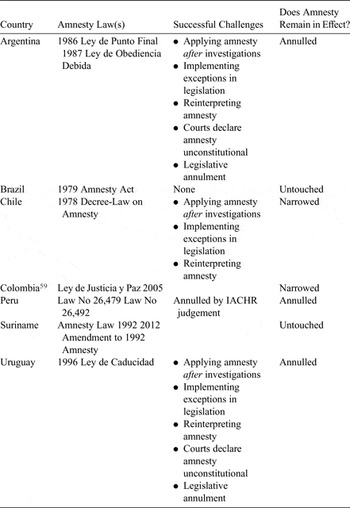
From the preceding sections we can see that the effects of amnesty laws enacted for international crimes and gross human rights violations in South America have been substantially reduced since the 1990s through multiple legal strategies. These strategies gradually shifted in their ambition from efforts to limit the effects of amnesties without challenging their scope; to efforts to narrow the scope of amnesties through reinterpretation; to direct challenges to the constitutionality of the amnesties and measures to annul them. In several countries, multiple forms of these strategies have been employed. However, not all countries that have experienced legal challenges have progressed to annulling their past amnesties, and in some countries, past amnesties remain untouched. As a result, as shown in Table 1, experiences of narrowing and annulling amnesties are not uniform across South America.
Table 1 indicates that amnesty laws remain in effect in over half the countries being considered in this analysis. Nonetheless, it is possible to argue that there is a regional trend towards narrowing the scope of amnesties for past human rights violations, given that in addition to the annulments of the amnesties in Argentina, Peru and Uruguay, Chile's amnesty law has been narrowed. In addition, as will be explored below, the development of this trend may have been one of the contributing factors leading Colombia to move towards limited forms of amnesty and alternative sanctions in seeking to encourage paramilitaries and combatants to end their armed conflicts. This leaves only two countries in the region where broad amnesties for international crimes and gross human rights violations remain intact. In the following section, we will tease out the precise parameters of the trend towards narrowing past amnesties by looking in more detail at the Inter-American Court's case law. Although the trend has evolved primarily from actions at the national level, the Inter-American Court has played a significant role in driving and shaping this trend through its case law on amnesties, which has established regional standards and been cited by national courts in the region.Footnote 58
Successful domestic challenges to amnesty laws by South American country

E. The Inter-American Court of Human Rights and the Parameters of the Regional Trend
From Castillo-Páez v Peru in 1997, the Inter-American Court has developed a detailed and extensive case law on the compatibility of amnesties with the American Convention on Human Rights. This body of work articulates robust and influential criticisms of amnesty laws. In the early years, the Court's judgments focused on the egregious nature of the self-amnesty laws in Peru and Chile.Footnote 60 In its most recent judgments, the Court has dropped its focus on self-amnesty laws as this description is not an easy fit for Brazil's amnesty law that benefited diverse groups of people and had a broad plurality of support, or for amnesties such as Uruguay's that were enacted following democratic elections. Instead, its determinations are now based on the nature of the substantive violations, and in a series of decisions relating to transitions from dictatorship in Peru, Chile, Brazil and Uruguay, the Court has repeatedly found that where unconditional amnesty extends to international crimes and gross violations of human rights (principally torture, extrajudicial executions, enforced disappearances and crimes against humanity), it is incompatible with the Convention.Footnote 61 In doing so, the Court has made clear that contextual issues such as whether the amnesty was enacted by a democratically elected government or was upheld in a national referendum have no bearing on its compatibility with the Convention.Footnote 62
To support its position on the legality of amnesty laws, the Court has developed progressive interpretations of the duties of States parties to ensure and guarantee rights enshrined in the Convention, to harmonize national legislation with their obligations under the Convention and to ensure that victims have rights to access the courts and judicial protection. These interpretations go beyond the approaches adopted by other universal and regional systems and beyond the rights of victims in legal proceedings in the domestic law of many States parties.Footnote 63 The Court further relied on international law sources that are external to its area of competence including the positions articulated by other human rights monitoring bodies, international criminal tribunals and hybrid courts, and national courts. However, the Court ‘cherry-picked’ sources that support its position, and evidence that contrasts with it, such as the continued willingness of States in other parts of the world to enact amnesty, was not discussed in its judgments.Footnote 64
In developing its consistent rejection of unconditional amnesties for international crimes and gross human rights violations, the Court has created a clear red line between amnesties that are permissible under the American Convention and amnesties that are not. However, within these parameters, it appears that the Court may be willing to look favourably upon limited amnesties that exclude gross human rights violations from their scope and alternative sanctions even for the most serious offences, particularly where such measures result from efforts to end an internal armed conflict. The remainder of this section will consider these two approaches in turn.
Limited amnesties have arisen in the Court's case law with respect to Guatemala, Suriname and more recently Chile. As noted above, the Court has consistently stated that unconditional amnesties for serious offences are inadmissible. Through its case law we can discern that, at a minimum, limited amnesties should exclude extrajudicial executions, enforced disappearances, torture and crimes against humanity from their scope in order to be permissible. However, as we have seen above, States have pursued divergent approaches to limiting the scope of amnesties, with some limitations being included in the text of an amnesty at the time of its promulgation and others evolving as a result of judicial interpretation. The Court's case law on limited amnesties is less developed than its rulings on unconditional amnesties for serious offences, and the cases outlined below suggest that it may take the following factors into account when evaluating the compatibility of limited amnesties with the Convention. It will assess the nature of the limitation in the amnesty text and in practice to determine if the limitations have been consistently applied. Where it finds that the limitations have not been enforced, and as a result, a limited amnesty has been used to prevent investigations and prosecutions of gross human rights violations, it will find the amnesty to be in breach of the Convention. However, if it is not proven that an amnesty has been used to prevent investigation and prosecution of gross human rights violations, the Court has refrained from finding that the existence of the amnesty per se constitutes an autonomous violation of the enacting State's international obligation to harmonize its domestic law with the Convention. This has occurred both where the amnesty is limited by legislation (Guatemala) and by judicial interpretation (Chile). This suggests that the Inter-American Court's approach may permit past amnesties to remain in effect provided that in practice they are no longer applied to gross human rights violations.
Limited amnesties first arose in the Court's case law, shortly after its landmark 2001 decision in the Barrios Altos case,Footnote 65 when it was confronted with a series of cases related to the 1996 National Reconciliation Law that resulted from Guatemala's 1996 peace agreement.Footnote 66 This law granted amnesty for conflict-related offences, but excluded genocide, torture, enforced disappearances, or other crimes that cannot be subject to statutes of limitations.Footnote 67 In its judgments, the Court repeatedly declined to evaluate the types of limitations that may be necessary to make an amnesty compatible with the American Convention. However, given that in each instance, the Court only called upon the States to refrain from extending the amnesty to disappearances, it can be concluded that amnesties should exclude such crimes to be permissible.
Limited amnesties again arose in the Case of the Moiwana Community v Suriname, which concerned a 1986 massacre of civilians in a civil war. In 1992, the Surinamese government promulgated Amnesty Act 1989 which granted amnesty for certain criminal acts, with the exception of crimes against humanity. In 1993, this amnesty was applied to discontinue criminal investigations into the massacre, which was not characterized as a crime against humanity by national judges. The Inter-American Court's reasoning referred to its findings in the Barrios Altos case and invoked ‘general principles of international law’ to state that no amnesty law ‘may impede the State's compliance with the Court's orders to investigate and punish perpetrators of human rights violations’.Footnote 68 In keeping with this approach, the Court characterized the violations in the case as extrajudicial executions and stated that amnesties for such crimes are inadmissible.Footnote 69 It then called upon Suriname to remove all obstacles de jure and de facto that prevent the investigation, prosecution and punishment of these crimes.Footnote 70 This Court did not address whether Suriname's limited amnesty law would comply with the Convention if it were enforced as specified in the legislation. However, the judgment suggests that in assessing limited amnesties, it seems likely that the Court will scrutinize both the promulgated amnesty text and how it is has been implemented in practice. Where there is evidence that limitations have not been applied and that instead the amnesty has been extended to gross human rights violations, the Court will find the amnesty to be in breach of the Convention.
The question of how limited amnesties are applied again arose before the Court in Tiu Tojín v Guatemala. In these proceedings, the Inter-American Commission expressed concerns that there was a lack of certainty in the scope of Guatemala's amnesty due to the discretion left to national courts to determine whether certain acts constituted political offences eligible for amnesty or crimes that are excluded from the amnesty.Footnote 71 The Inter-American Court only addressed these concerns briefly noting that the State had not applied the amnesty to the present case, and that consequently, ‘The possibility of this happening is not a matter that the Court may decide upon in this stage of the proceedings.’Footnote 72 The discretion left to the courts of Guatemala in determining how to interpret limitations to amnesties contrasts with a more restrictive approach adopted by the Court in the 2006 Almonacid-Arellano decision on the Chilean amnesty law.
The facts of Almonacid-Arellano differ from Tiu Tojín with respect to the amnesty as, in this instance, the military courts had applied the amnesty to prevent effective investigation and prosecution of an extrajudicial execution. In its ruling, the Inter-American Court acknowledged the interpretations developed by Chile's civilian courts in the years after this case had been closed to narrow the application of amnesty in practice. However, it then highlighted that murder and other serious violations are not excluded from the text of the amnesty legislation. It noted that the absence of legislative changes to exclude these crimes could create uncertainty ‘because the criterion of the domestic courts may change, and they may decide to reinstate the application of a provision which remains in force under the domestic legislation’.Footnote 73 It therefore declared that the amnesty ‘has no legal effects’.Footnote 74 It then gave separate consideration to Article 2 of the American Convention that requires states to harmonize their domestic law with the Convention. The Court found that the continued existence of the amnesty law ‘constitutes in and of itself a violation of the Convention and generates international liability of the state’.Footnote 75 It therefore ordered Chile to annul legislation that violates the Convention.Footnote 76 Chile has not complied with this order at the time of writing.Footnote 77
The status of the Chilean amnesty law under the American Convention on Human Rights came before the Court once again in the 2013 García Lucero case. In presenting this case to the Court, the Inter-American Commission on Human Rights maintained that the failure of the Chilean State to adapt its domestic law to the Convention by annulling the amnesty had violated the rights of Mr García Lucero and his family to judicial guarantees and judicial protection.Footnote 78 It consequently called upon the Court to find that the failure to annul the amnesty violated Articles 1(1) and 2 of the Convention. The Court, however, declined to do this. The Court's discussion of the amnesty began by noting Chile's failure to comply with its earlier order to annul the amnesty law,Footnote 79 and restating its ruling in Almonacid-Arellano that the amnesty cannot constitute an obstacle to the investigation and prosecution of crimes against humanity, including torture. It then once again noted the interpretations developed by the Chilean judiciary to limit the scope of the amnesty. Turning to the facts of the case, the Court found that the continued existence of the amnesty had not been proven to have prevented or impeded in the investigation of torture, which was the subject of this case, as the judicial interpretations had been used to ensure that the amnesty was not applied.Footnote 80 Consequently, despite Chile's non-compliance with its previous order to annul the amnesty through legislation, the Court stated that it ‘does not find it appropriate to rule on the State's international responsibility as a result of the existence of Decree Law No. 2,191’.Footnote 81 The difference in approach from Almonacid-Arellano can be explained by the fact that the Court does not generally treat Articles 1(1) and 2 as autonomous provisions, preferring instead to only find violations of these articles in combination with violations of substantive rights protected by the Convention.Footnote 82
This Court's approach in Tiu Tojín and García Lucero indicates that where it cannot be proven that an amnesty was applied to international crimes or gross human rights violations that are subject to proceedings before the Court, the Court will find that it is not appropriate for it to consider the legality of the amnesty. The case law shows that the Court will take this approach whether the limitations are derived from legislation or judicial interpretation. This suggests that where amnesties are limited to cover only less serious offences, they will not be deemed as violating the American Convention on Human Rights provided that these limitations are applied in practice.
The Court's acceptance of limited amnesties that exclude gross human rights violations could allow for bifurcated approaches that prioritize prosecution and punishment for serious violations, while permitting non-judicial approaches for less serious offences. Although this acceptance has not been stated explicitly in any of the judgments of the Court, a Concurring Opinion by the President of the Court, Judge García-Sayán in the 2012 El Mozote v El Salvador, that was adhered to by four other judges, explored the possibility directly. Judge García-Sayán began by distinguishing the Salvadoran amnesty from amnesties previously considered by the Court by arguing that amnesties that are enacted as part of negotiations to end a non-international armed conflict may require different handling than amnesties resulting from the transitions from dictatorship.Footnote 83 In particular, he argued that States transitioning from armed conflict must seek to harmonize their duties to deliver criminal justice and negotiated peace. He then explored the ways in which harmonization could be achieved. For example, he distinguished between international crimes and other human rights violations arguing that
facts that can be categorized as war crimes or crimes against humanity in the definitions of the Statute of the International Criminal Court should merit being processed specifically and with priority, and this is not necessarily the same for the other crimes or human rights violations.Footnote 84
He continued with this distinction in a later passage by arguing that priority should be given to prosecuting ‘those responsible for the most serious violations’, and using ‘other mechanisms’ to deal with less serious cases.Footnote 85 Judge García-Sayán does not specify what he means by other mechanisms, but as will be discussed below, he refers to the possibility of alternative sanctions for serious offences. From this and his assertion that conflict-related amnesties need to be considered in a different way by the court, it can be inferred that he may also view some form of limited amnesties for less serious cases as permissible.
The second area of flexibility within the regional trend on amnesties can be discerned from the case law of the Inter-American Court of Human Rights relating to the use of alternative sanctions even for the most serious offences as part of transitions from conflict. These measures can be distinguished from the broad, unconditional amnesties used in South America's transitions from dictatorship as rather than seeking to prevent any investigations or accountability for past human rights violations, these forms of leniency are conditional on suspects cooperating with investigative processes, and if appropriate, being convicted and facing reduced sentences or other sanctions for their actions.Footnote 86 The Court's approach to alternative sanctions has been developed in response to Colombian legislation enacted to balance the need to disarm combatants with the State's obligations to meet victims’ rights to truth, justice and reparations.
During the Colombian armed conflict, successive governments tried to use amnesty laws and alternative sanctions to encourage non-State armed groups to disarm and demobilize.Footnote 87 Until 2005, these laws did not require former combatants to contribute to truth, justice or reparations to victims. However, this changed with the enactment of the Justice and Peace Law.Footnote 88 This change can in part be credited to adverse rulings by the Inter-American Court of Human Rights in cases relating to gross human rights violations resulting from collusion between Colombian State forces and right-wing paramilitaries that had been brought before the Inter-American human rights organs. For example, in the 2004 Case of 19 Merchants, the Court held that
the State must abstain from using figures such as amnesty, provisions on prescription and the establishment of measures designed to eliminate responsibility, as well as measures intended to prevent criminal prosecution or suppress the effects of a conviction.Footnote 89
It also ordered the Colombian authorities to investigate and punish those responsible for the massacre of the 19 merchants and pay reparations to the victims.Footnote 90 As with the Court's wider body of case law on amnesties, this ruling signalled that the Court would find that unconditional amnesties for gross human rights violations to be in breach of the American Convention on Human Rights. In addition, Hilbrecht argues that this ruling influenced the decision of the Uribe government to incorporate measures to address victims’ rights into the demobilization process.Footnote 91 In the resulting Justice and Peace Law, the Colombian government provided that right-wing paramilitaries who surrender, disarm, provide information or cooperate in the dismantling of the group to which they belonged, refrain from further criminal activity, submit to expedited criminal proceedings, and contribute to reparations for victims can be eligible for alternative sanctions.Footnote 92 Under this scheme, convicted persons, including those found responsible for crimes against humanity, are sentenced to a term of between five and eight years only, depending on the seriousness of their crimes and their cooperation in clarifying the facts of these crimes.Footnote 93
The compatibility of alternative sanctions for serious offences with the American Convention on Human Rights arose in La Rochela Massacre v Colombia.Footnote 94 The petitioners in this case argued that these forms of leniency constituted a ‘concealed amnesty’.Footnote 95 This position had previously been rejected by the Colombian Constitutional Court, which had found that as these measures did not prevent criminal investigation and prosecution, but merely provided for alternative penalties, they could not be compared with an amnesty.Footnote 96 In its judgment, the Inter-American Court neither declared that the Justice and Peace Law was an amnesty nor that it violated the American Convention on Human Rights. However, given that the Law was only at the early stages of implementation at the time of the judgment and that no judicial decisions had been issued, the Court decided to set out, based on its case law, some principles that should accompany its implementation.Footnote 97 With respect to prosecution and punishment, these principles were that ‘the State should observe due process and guarantee the principles of expeditious justice, adversarial defense, effective recourse, implementation of the judgment, and the proportionality of punishment’.Footnote 98 Given that alternative sanctions entail offenders receiving substantially reduced sentences, the issue of proportionality is particularly significant with respect to gross human rights violations. The Court provided the following analysis of how proportionality should be applied:
the punishment which the State assigns to the perpetrator of illicit conduct should be proportional to the rights recognized by law and the culpability with which the perpetrat[or] acted, which in turn should be established as a function of the nature and gravity of the events. … such that criminal justice does not become illusory.Footnote 99
As the Court did not state that the sentences of five to eight years provided for by the Justice and Peace Law violate the Convention, it seems that these arrangements are permissible under the Convention even for crimes against humanity where they are part of efforts to resolve an armed conflict provided that other conditions are met.
The question of alternative sanctions was also considered by Judge García-Sayán in his Concurring Opinion in the 2012 El Mozote case, who argued that with respect to efforts to end non-international armed conflicts
it is necessary to devise ways to process those accused of committing serious crimes …, in the understanding that a negotiated peace process attempts to ensure that the combatants choose peace and submit to justice. Thus, for example, in the difficult exercise of weighing and the complex search for this equilibrium, routes towards alternative or suspended sentences could be designed and implemented; but, without losing sight of the fact that this may vary substantially according to both the degree of responsibility for serious crimes and the extent to which responsibility is acknowledged and information is provided about what happened.Footnote 100
He continued by considering alternative sanctions more broadly than just sentence reductions, stating that in seeking to reach negotiated settlements to end civil wars ‘Reduction of sentences, alternative punishments, direct reparation from the perpetrator to the victim, and public acknowledgment of responsibility are other ways that can be considered’ to fulfil States’ international legal obligations.Footnote 101 Although Justice García-Sayán's opinion was not reflective of the views of the whole Court, it nonetheless suggests that in efforts to end armed conflicts, there may be scope of flexibility in the forms of punishment imposed in response to gross violations of human rights.
The above analysis can be used to interpret the following parameters of the regional trend on amnesties. Firstly, States parties to the American Convention on Human Rights are prohibited from granting broad, unconditional amnesties for gross human rights violations, such as torture, enforced disappearances, extrajudicial executions and crimes against humanity. These forms of amnesty in Argentina, Chile, Uruguay and Peru have experienced the most sustained challenges within the regional trend. Secondly, the trend does not amount to a rejection of all forms of amnesty as the Inter-American Court's case law indicates that limited amnesties that exclude serious violations may be permissible under the Convention, provided that the limitations are applied in practice. Thirdly, the principles developed by the Court in the La Rochela case and the views expressed in Judge García-Sayán's Concurring Opinion indicate that the Court may be willing to distinguish between amnesties enacted during or after dictatorship, and amnesties or alternative sanction measures developed to end violent conflict. However, it can be inferred that for amnesties or alternative sanctions to be permissible, they must impose conditions on individual combatants to disarm, demobilize, renounce violence, contribute to truth recovery and provide reparations to victims.
IV. THE SIGNIFICANCE OF SOUTH AMERICA'S REGIONAL TREND FOR INTERNATIONAL LAW AND POLICY ON AMNESTIES
After establishing the existence of the regional trend and its parameters, Part IV interrogates the significance of this trend in relation to claims made in academic literature and policy reports relating to the legality of amnesties under international law, the durability of past amnesties and the desirability of new amnesties.
A. Legality
Amnesty erosion in South America has been viewed by some commentators as contributing to the crystallization of international legal standards prohibiting amnesties for international crimes and gross human rights violations. Although these arguments are not widespread in the literature, broadly speaking, they take two forms. Firstly, they focus on the adoption of progressive legal reasoning by domestic courts in South America and argue that this can be influential for judges in other fora. For example, in reflecting on the reliance on international law in the Julio Simón case in Argentina, Bakker argued that it ‘can be expected to have a positive impact on the evolving trend in the region’.Footnote 102 Secondly, the annulment or narrowing of amnesties is interpreted as a form of State practice and opinio juris that contributes to the evolution of customary international law. This section will consider each of these arguments in turn.
Firstly, as outlined in Part III, domestic courts in Argentina, Chile and Uruguay have adopted a number of innovative legal strategies to erode amnesties. Arguments made in academic literature regarding the significance of these judgments for international law focus in part on these judgments as setting out persuasive interpretations of applicable international legal standards. For example, in the Julio Simón case, the Argentine Supreme Court considered the existence of a duty to prosecute international crimes. Several JusticesFootnote 103 argued that based on the norms of treaty and customary law, the prohibition on international crimes such as genocide, war crimes and crimes against humanity had attained jus cogens status prior to the Second World War.Footnote 104 The Court further argued that this status meant not just that such crimes were prohibited but also that States have a duty to prosecute them. As Argentina's amnesty laws prevented prosecutions for crimes against humanity, they were consequently interpreted as being contrary to international law. In reaching this conclusion, the Court eschewed traditional interpretations of customary international law that emphasize the existence of a consistent State practice based on opinio juris supporting the norm.Footnote 105 Instead, it adopted a more progressive approach,Footnote 106 which places greater emphasis on the decisions of international courts and UN Resolutions to evidence international legal standards.
While there appears to be a growing consensus in international law that the prohibition on crimes against humanity has attained jus cogens status,Footnote 107 it is contested whether the existence of a duty on States to refrain from committing crimes against humanity in turn implies that the duty to prosecute such crimes has also reached jus cogens status, and particularly whether it had attained this status in the 1970s or earlier.Footnote 108 Furthermore, it is far from established that a customary prohibition on amnesties for crimes against humanity can be automatically inferred from the existence of a duty to prosecute these crimes.Footnote 109 In adopting this approach, the Argentine Supreme Court placed itself at the vanguard of efforts to interpret international law in ways that limit the scope for amnesties.
While this judgment has been cited in other fora, including the Inter-American Court of Human RightsFootnote 110 and the Extraordinary Chambers of the Courts of Cambodia,Footnote 111 its approach to customary international law has not be universally accepted by courts within the region. For example, in its 2013 ruling on the constitutionality of the amnesty annulment, the Uruguayan Supreme Court found that crimes against humanity did not become part of Uruguayan law until 2006. Consequently, it found that the Uruguayan legislature had no right to retrospectively declare that crimes committed during the 1973–1985 dictatorship constituted crimes against humanity.Footnote 112 As a result, as discussed above, the Court declared that Articles 2 and 3 of Law 18.831 were unconstitutional. Similarly, the Brazilian Supreme Court based its 2010 decision to uphold the constitutionality of the amnesty in part on its finding that no norm requiring States to prosecute crimes against humanity existed prior to the enactment of the 1979 amnesty law. In sum, this analysis argues that some domestic courts in South America have adopted progressive interpretations of international law, and that such interpretations have been viewed as persuasive authorities by international courts. This demonstrates the potential of these domestic legal decisions to contribute to the formation of international law. However, it cautions that such progressive interpretations have exceeded the comfort zone of courts elsewhere in the region, which have relied instead on more traditional interpretations of the evolution of international law.
Secondly, it has been argued that the annulment of amnesty laws in some South America countries ‘is significant … because patterns of state practice ultimately form the basis of customary international law’.Footnote 113 Where states take deliberate steps to narrow or annul amnesties, particularly where they express that they are doing so to comply with international legal obligations, this can constitute State practice. However, to move from identifying individual examples of State practice to determining the existence of a rule in customary international law is normally understood to require the identification of a sufficient body of ‘extensive’ and ‘consistent’ State practice.Footnote 114 There are two possibilities for the regional trend discussed above to contribute to the formation of customary international law.
The regional trend could be interpreted as evidence to support an emerging international legal rule requiring that the legal effects of past amnesties enacted during transitions from dictatorship for international crimes or gross human rights violations be removed. This approach would certainly find support in the decisions of international human rights monitoring bodies that call upon States to amend or annul past amnesty laws.Footnote 115 However, as we will discuss below, outside South America there is limited State practice to support the existence of such a rule.
Alternatively, the trend within South America to erode amnesties could be viewed as contributing to a broader rule in customary international law that amnesties are not permissible for international crimes and gross human rights violations. Evidence for this rule could be sought from a wider range of sources including provisions in international treaties relating to amnesties, national legislation on amnesties, State practice in relation to mediating peace agreements or otherwise supporting or rejecting amnesties in other countries, UN resolutions on amnesties and judgments of national and international courts on the legality of amnesties. If the trend within South America is situated within this wider range of global State practice, what is revealed is a range of contrasting evidence in which there is some State practice and opinio juris supporting a rejection of amnesties in international law, but there is also contrary evidence such as the consistent refusal by States to include prohibitions on amnesties in international treatiesFootnote 116 and the continued use of amnesties in many parts of the world, which will be discussed below.
B. Durability
The overturning of amnesties that were once intended to be permanent in South AmericaFootnote 117 has prompted claims to be made in academic literature and policy reports regarding the significance of this trend for undermining the durability of amnesties in general. Here, durability refers to the ability of a past amnesty to remain in effect on a permanent basis without facing substantial limitations to its scope. For example, the UN Office of the High Commissioner on Human Rights (OHCHR) has proclaimed
experience has shown that amnesties that foreclose prosecution or civil remedies for atrocious crimes are unlikely to be sustainable, even when adopted in the hope of advancing national reconciliation rather than with the cynical aim of shielding depredations behind a fortress of impunity.Footnote 118
Similarly, based on their dataset of trials and truth commissions in Latin America, Sikkink and Booth Walling contended, ‘Our research calls into question some basic assumptions in the transitions literature, including … that choices about amnesties and trials taken in the post-transition period are likely to be stable and durable.’Footnote 119 The observations of the OHCHR and Sikkink and Booth Walling suggest that were experiences in South America to be generalizable to other parts of the world, we would see the erosion of long-standing amnesties for serious human rights abuses enacted elsewhere and we would expect that any new amnesties enacted in the future would not be sustainable. However, there is little evidence as yet to support such expectations.
Outside South America, there are examples of criminal trials being conducted for cases that had previously been closed by amnesty laws. For example, the Extraordinary Chambers of the Courts of Cambodia found that it had jurisdiction to try Ieng Sary, a former leader of the Khmer Rouge regime despite a 1994 amnesty and pardon,Footnote 120 and the Special Court of Sierra Leone tried some of those believed to be ‘most responsible’ for the abuses of the civil war despite an amnesty resulting from the 1999 Lomé Peace Accord.Footnote 121 However, in both these instances, prosecutions were limited to a small number of high-ranking perpetrators, and the vast majority of combatants continued to benefit from the amnesties including those responsible for serious offences. Furthermore, these experiences represent isolated examples of trials being opened despite past amnesties. A large-n analysis of challenges to 63 amnesties for human rights violations committed by State agents enacted in 34 countries between 1974 and 2011 has shown that ‘Outside the [South American] region, it is rare for past amnesties even for the most serious offences to be annulled, however, a small number have been limited in a few cases.’Footnote 122 Similarly, in reflecting on the ‘persistence of amnesties’, Jeffery has observed that ‘It remains the case that most perpetrators of human rights violations granted amnesties in the past can rest secure in the knowledge that it is highly unlikely that they will ever face prosecution for their crimes.’Footnote 123 Consequently, in many parts of the world, the vast majority of past amnesties remain in effect and have not had their scope limited to exclude serious crimes.
In addition to the lack of evidence supporting an international move towards overturning past amnesties for human rights violations, many of the explanations of the drivers of the regional trend posited in academic literature highlight factors that are specific to South America. For example, the nature of South America's amnesties differs from those enacted in other parts of the world. In this region, amnesties were generally extended to the most egregious offences and often lacked procedural legitimacy as they were ‘self-amnesties’ enacted by repressive regimes or were demanded by outgoing military rulers as a concession to enable to transition to take place. In contrast, a large-n comparative study of amnesties around the world has found that self-amnesties have not been widely used in other regions, and it is much more common for transitional States to amnesty opponents of the State instead of or in combination with State actors.Footnote 124 Furthermore, South American States have been fortunate in making more progress towards democratic consolidation than many transitional societies in other regions, and the democratic regimes were in place for some time before the amnesty challenges were successful.Footnote 125 Although the experience of democratization has been patchy across the region,Footnote 126 democratic consolidation is one of the most commonly invoked explanations for amnesty erosion.Footnote 127 This process is thought to remove obstacles that prevented prosecution during the early years of the transition through, for example, institutional reform of the armed forces and the judiciary, and constitutional and other rule of law reforms.Footnote 128 Furthermore, experiences in several South American countries indicate that changes in government following democratic elections can contribute to creating a supportive political environment for unpicking past amnesties.
In addition to factors that are internal within the region's States, there are a number of regional dynamics that are not replicated in other world regions. For example, just as the abuses that characterized military rule had regional dimensions through the cooperation between military regimes in Operación Condor,Footnote 129 there have also been regional dynamics in the challenges to past amnesties. The phrase ‘Condor-in-reverse’ has been coined to denote cross-border cooperation between those involved in prosecuting human rights abusesFootnote 130 and civil society cooperation in monitoring the progress of human rights trials and exchanging experiences regarding successful litigation strategies.Footnote 131 In addition, the efforts to end impunity have been supported by the work of the Inter-American Court of Human Rights, which has developed a more substantial and progressive body of case law on amnesties than exists in other regions.
As the narrowing of South America's amnesties has not been widely replicated in other regions, using these experiences as a basis to predict that amnesties elsewhere will no longer be durable is unpersuasive. Instead, the explanation for this trend most likely lies in dynamics specific to this region. This suggests that where amnesties result from very different contexts and take different forms, we should not necessarily expect them to be overturned in the years following the transition. However, despite the paucity of evidence, assumptions about the durability of past amnesties have in turn fed into assertions about the desirability of new amnesties.
C. Desirability
In addition to having been interpreted as spelling the end for the durability of long-standing amnesties for serious violations, the erosion of South America's amnesties has also been argued to have made it less likely that unconditional amnesty laws for serious human rights violations will be enacted in the future. For example, Méndez has suggested, ‘Over the years, the struggle against impunity has succeeded in limiting the effect of amnesties, … by making the enactment of broad, blanket amnesties a thing of the past.’Footnote 132 This section will evaluate this observation by considering the enactment of new amnesty laws for serious crimes in the years since the late 1990s when the trend in South America began to evolve.
Although the democratic transitions in South America brought a sharp decline in the number of new amnesty laws being enacted in the region, broad, unconditional amnesties have not disappeared entirely. For example, in August 2010, the Peruvian government adopted Legislative Decree No 1097, which empowered the Executive to close investigations into human rights abuses that are older than three years, which would have prevented prosecutions for hundreds of cases from the 1980s and 1990s. Following pressure from local human rights campaigners and the Inter-American Commission, Decree 1097 was repealed by the Peruvian parliament.Footnote 133 An amnesty was also enacted in Suriname to block prosecutions. Here in 2007, an amnesty bill was submitted to parliament by the opposition National Democratic Party (NDP) to extend the scope of an earlier amnesty to cover crimes against humanity committed during the 1985–92 Bouterse dictatorship.Footnote 134 When this amnesty was proposed, former dictator Desi Bouterse and chairman of the NDP was on trial for murder. He subsequently became president of Suriname. Before this trial could conclude, in 2012 parliament passed the amendment to extend the earlier amnesty to cover serious violations.Footnote 135 Unlike Peru, the most recent Surinamese law remains in effect. Both these laws are a continuation of previous uses of amnesty within the region to ensure impunity for serious human rights violations and as such cast doubt on claims that broad, unconditional amnesties are a thing of the past.
In contrast, the Colombian use of alternative sanctions to encourage combatants to disarm, discussed above, represents a significant shift from the historical use of broad, unconditional amnesties in the region given that it requires that perpetrators undergo an individual accountability process and contribute to truth and reparations for victims. This shift can be seen as a product of the development of the regional trend, as well as a response to the positions adopted by the Inter-American Court of Human Rights and the International Criminal Court.Footnote 136 Given the parameters of the regional trend outlined above, it is significant that the 2015 agreement between the Colombian government and left-wing guerrillas FARC on the Creation of a Special Jurisdiction for Peace allows for limited amnesty for political and connected crimes, as well as alternative sanctions for persons responsible for gross human rights violations who admit responsibility and disclose the truth about their actions.Footnote 137
At the international level, the evidence is similarly mixed regarding whether there is a shift away from the enactment of unconditional amnesties for serious violations. For example, a comparative analysis of the enactment of new amnesty laws from 1999 to 2011 conducted using the Amnesty Law Database found that over this period, ‘states are only slightly more likely to exclude serious human rights violations from the amnesty law than to include them’.Footnote 138 Recent amnesty laws that have been agreed or granted for international crimes include Afghanistan 2009,Footnote 139 Libya 2012,Footnote 140 Myanmar 2008,Footnote 141 Yemen 2011,Footnote 142 Philippines 2014,Footnote 143 and Ukraine 2015.Footnote 144 While some of these laws are similar to the worst kinds of amnesty in South America in that they have been used to shield abusers during transitions from dictatorship, others have been used like Colombia's leniency approaches to halt the violence during ongoing conflicts and to broker peace negotiations.
The examples discussed above indicate that at best the evidence that broad, unconditional amnesties ‘have become a thing of the past’ is mixed. We have seen a reduction in their use and have witnessed the adoption of more conditional forms of leniency for human rights abusers in some contexts. However, broad, unconditional amnesties continue to be enacted in different parts of the world. Cumulatively, these developments suggest that there is still some acceptance of that some forms of amnesty may be useful in helping societies move beyond their violent pasts. Overly broad claims regarding the significance of the regional trend on the desirability of amnesties around the world risk obscuring the continued reliance of States on amnesties for serious offences and as the following section argues does little to identify factors that may prompt the trend towards amnesty erosion in South America to spread to other parts of the world.
V. CONCLUSION: THE RISKS OF REGIONAL OVERREACH?
This article has demonstrated that there is a regional trend within South America to narrow or annul past amnesties for international crimes and gross human rights violations. However, it has found that this trend is not universally applicable across the region as evidenced by the persistence of Brazil's amnesty law and the 2012 amendment of Suriname's amnesty to encompass crimes against humanity. In addition, drawing on the case law of the Inter-American Court of Human Rights, the article has found that within the parameters of this regional trend, States retain two forms of flexibility in designing amnesty laws that are compatible with the American Convention on Human Rights. Firstly, the Inter-American Court's case law suggests that where the scope of an amnesty is limited to exclude gross human rights violations this may comply with the Convention, provided that the limitations are applied in practice. Secondly, a distinction seems to be emerging in the Court's case law regarding its handling of amnesties resulting from transitions from dictatorship and transitions from conflict. Principles developed by the Court relating to the reduced sentences applied in Colombia to encourage combatants to disarm indicate that even for gross human rights violations, the Court may not require perpetrators to serve lengthy sentences provided that they contribute to truth and reparations for victims. The need for the Court to adopt a flexible approach in assessing measures taken by States to balance their obligation to prevent further violations by bringing a conflict to end with their obligations to victims of past violations was most recently and persuasively argued by Judge García-Sayán in his Concurring Opinion in the El Mozote case.Footnote 145 Cumulatively, these observations suggest that although there is a regional trend to limit past amnesty laws, this trend does not represent a wholesale rejection of amnesty and an embrace of penal sanctions for all instances of serious human rights violations. Instead, it represents a partial and nuanced move away from certain forms of amnesty towards more limited and conditional approaches that relate to the different roles that amnesty can play within different types of transitions.
This article has further highlighted that within academic literature and international policy reports on amnesty laws, the erosion of South America's amnesty laws has been interpreted as having a global significance in shaping international legal norms on amnesty laws and altering State practice in retaining past amnesties and enacting new amnesty laws. However, through situating the South American trend of amnesty erosion within global approaches to amnesty, the article has found that the regional trend goes beyond State practice in other parts of the world. This is because it is rare to see past amnesties being annulled or limited outside South America and around the world amnesties continue to be enacted even for the most serious offences. As a result, although there may be a trend to move away from certain forms of amnesty within South America, this article has advocated caution in extrapolating the extent to which this regional trend can be viewed as reflective of a broader normative shift. Instead, it has argued that the distinctive approach adopted in South America is likely to result from dynamics that are specific to the region such as the history of violence, the forms of amnesty adopted, the subsequent progress towards democracy and the robust position adopted by the Inter-American Court on Human Rights on the most egregious forms of amnesty.
As noted in the introduction, the experiences of the early years of South America's political transitions had a dominant and enduring impact on the evolution of the transitional justice field. It has been argued that as the field expanded to encompass new forms of transition and societies with very different social, legal, political and economic backgrounds, the utility of the theorizations drawn from South American experiences began to be challenged and undermined by the need to be responsive to new contexts.Footnote 146 In this light, the endurance of applying lessons drawn from South America to the field more broadly can arguably be characterized regional overreach, in which scholars overstate the explanatory or normative force of events in the region. In a similar manner, this article posits that claims being made about the global significance of the regional trend are another example of regional overreach in which lessons drawn from South America are inappropriately generalized as having a global significance.
For anti-impunity campaigners there are clear benefits to invoking South America's rejection of amnesty laws as indicative of a global normative shift. For example, it can provide evidence to support arguments that international legal standards restricting the use of amnesties for international crimes and gross human rights violations have become more clearly defined, entrenched and complied with by States. Furthermore, publicizing the erosion of amnesties within South America could provide inspiration to those seeking to limit the effects of past amnesties within other parts of the world.
However, there are also a number of risks to overstating the significance of South American amnesty erosion. For example, the claims evaluated in this article have tended to be made in general, abstract terms. In doing so, they obscure the range of legal, political and social factors within States and across the region that made it possible for some of South America's amnesties to be gradually unpicked. If these experiences are to be replicated elsewhere, it is not sufficient to assert the existence of global legal norms restricting the use of amnesties. Instead, limiting the effects of amnesty is likely to require a multi-pronged approach that addresses the full range of obstacles to accountability that exist within transitional societies. Furthermore, without such an approach, the limiting of a past amnesty may be reduced to a symbolic measure that does not result in the reopening of large numbers of previously closed cases.
In addition, the assertion of general claims on the significance of the regional erosion of amnesty risks obscuring the gradual, creative approaches that have been adopted to limit past amnesties. Amnesties are not necessarily static, unchanging instruments. Their scope may alter during a transition in response to changes in the political context. Such changes may mean that reopening criminal investigations may not always require that past amnesties be entirely annulled. Fully annulling amnesties may face a number of political and legal challenges within transitional societies and may not have the support of the populace as indicated by the failure of referenda in Uruguay in 1989 and 2009 to obtain the required majority to annul the amnesty.Footnote 147 Allowing space for more creative approaches may allow transitional societies to adopt less divisive policies to coming to terms with past crimes.
Furthermore, where an amnesty is annulled years after its enactment, this does not mean that it was ‘unnecessary or unwise at an earlier moment in the transition, and for years or decades thereafter’.Footnote 148 There is limited evidence on the impact of amnesties or prosecutions on the success of political transitions. However, the evidence that exists suggests that allowing for gradual, balanced approaches may have a positive impact on improving human rights and achieving democracy. For example, a large-n, quantitative, comparative study conducted by Olsen et al. to measure the impact of transitional justice processes on human rights and democracy found that where trials or amnesties were implemented in the absence of other transitional justice mechanisms, neither proved to ‘have a statistically significant effect in improving human rights and democracy’.Footnote 149 In contrast, where transitional States used both trials and amnesty, the combination produced ‘stronger democracies and human rights records’.Footnote 150 Amnesties and trials can be combined and sequenced in a number of ways, but these findings suggest that amnesties may play a useful role in the early stages of a transition in bringing stability and creating conditions in which reforms can be made in order to enable prosecutions to take place.
Finally, presenting the events in South America as illustrative of a normative shift away from amnesty may contribute to a ‘compliance gap’,Footnote 151 in which States are unwilling to adhere to norms asserted by international courts, UN human rights bodies or legal scholars. Outside of this region, the reluctance of States to include explicit treaty provisions prohibiting amnesties and the continued use of amnesties in other parts of the world indicates that States elsewhere are wary of endorsing a universal prohibition on amnesties for serious crimes. While it is acknowledged that complete compliance with international law, particularly with respect to human rights standards,Footnote 152 may be unobtainable, the assertion of rigid standards with which States are unlikely to comply risks undermining the effectiveness of international law. Instead, it is important to recognize that events in South America do not constitute a rejection of all forms of amnesty. Instead, the regional trend appears to be evolving towards a more nuanced position in which limited amnesties and alternative punishments may continue to be permissible. Acknowledging this enduring space for flexibility when grappling with amnesty laws may help to create standards with which States are more likely to comply.