The Certeinty of Astronomicall Determinations depends upon these three things, The accuracy of the Celestiall observations. and. the skill & diligence of the person that makes them.Footnote 1
So began John Flamsteed at a lecture, the sixth in the series, delivered at Gresham College in London on 26 October 1681. The first Astronomer Royal went on to caution his listeners that
some very ingenious & curious men … [who are] ill accommodated with the necessary helpes for observation … [and who have] slipt the principle opportunityes & so ill managed such others as have presented themselves that theire notes serve onley to perplex not to assist the Skilfull Astronomer …Footnote 2
This paper is about Flamsteed's notion of the skilful astronomer – what made a skilful astronomer, how one could recognize a skilful astronomer, and what differentiated a skilful astronomer from the curious and ingenious individuals whose pretensions to astronomical know-how undermined good astronomical work. Looking at Flamsteed's epistemology, scholars have typically stressed Flamsteed's emphasis on the importance of technological advances in astronomical praxis in the pursuit of advancing knowledge.Footnote 3 Scant attention has been paid to the sorts of behaviour that befitted the skilful astronomer according to Flamsteed.Footnote 4 The certainty of astronomical measurements, Flamsteed reminded the attendees at Gresham College, depended on the skill and diligence of the astronomer in addition to accurate observation. Individuals who failed to incorporate the technological advances (‘principle opportunityes’) of astronomy or who failed to properly mobilize those technologies served as counterpoints to Flamsteed and other individuals whose work merited the advance of astrometry.
The improvement of precision astronomy made specific demands of the skilful astronomer. Where independent verification could be used by Kepler to prove Galileo's claims regarding the existence of the moons of Jupiter, finding the exact location of celestial bodies, the metaphysical status of which were not in question, placed weightier demands on astronomers who held pretensions to exactitude in their observations.Footnote 5 This paper argues that Flamsteed justified his claims of achieving unprecedented accuracy in celestial measurements specifically on his capacity to manage various visual technologies. Rather than basing the veracity of his claims on the quality of his eyesight, Flamsteed saw the telescope as a way of elevating the quality of an observer's eyesight such that it rendered obsolete the importance of the individual's ability to see well. For Flamsteed, the telescope ‘perfected’ vision, making the real work of the astronomer the coordination of events that made an accurate observation possible. The coordinating activities of the astronomer may be broken down into at least three principal and overlapping categories: the ability (1) to incorporate instruments into one's research that could genuinely merit advances in astronomical knowledge, (2) to discriminate between good-quality instruments and bad ones, and (3) to calibrate instruments such that inherent mechanical errors, or errors that might develop in instruments over time, could be accounted for and, if possible, corrected. For Flamsteed this was the work of the skilful astronomer, and it was in this role that he understood his ability to advance astronomical knowledge.Footnote 6
In his essay on how early modern scientists dealt with discrepant results, Jed Z. Buchwald holds that, for astronomers,
while instruments and measuring devices were often created by local craftsmen … [o]ne might think that disputes over numbers would … revolve in perpetuity [because of the non-standardization of instruments] with little possibility of resolution other than by social fiat. For the most part we find nothing of the kind. Astronomers for example did produce different stellar coordinates from the time of Tycho onwards, but we rarely find any disputes over whether or not observer x worked his apparatus correctly in producing number y. There was a great deal of discussion concerning ways to improve the accuracy and precision of instruments, and these did take into account what the later observer thought to be the range of trust to be placed in previous results.Footnote 7
Buchwald, however, does not clarify that the ‘range of trust placed in previous results’ is of two sorts: first, the trust placed in the quality of an astronomer's instruments, and second, the trust placed in an astronomer's ability to operate, manage and maintain those instruments. Regarding the former, trust was not usually extended to the craftsmen who manufactured the astronomer's instruments. Instead, it is more accurate to say that there was an expectation that gentlemen-astronomers were capable of appropriately selecting skilled craftsmen and ensuring that their work resulted in sufficiently accurate instrumentation. This was an expectation about the quality of an astronomer's instruments, and it was an expectation that astronomers actively worked to fulfil; it was not a basic level of trust that was freely bestowed upon astronomers. Regarding the second sort of trust implied by Buchwald's statement, consider the warrant issued to Flamsteed in late 1710 on behalf of Queen Anne commanding the appointment of permanent interlopers to the Royal Observatory:
Her Majesty commands … for the improvement of astronomy and navigation, to appoint the President, and in his absence the Vice-President of the Royal Society … to be constant Visitors of the Royal Observatory. And for the better enabling you to make the necessary observations for these ends, directions are likewise given for repairing, erecting, or changing Her Majesty's instruments in the said Observatory.Footnote 8
As a consequence of Isaac Newton and Flamsteed's bitter rivalry, this order was issued at the behest of Newton, then president of the Royal Society, as a way of forcing Flamsteed to relinquish his autonomous management of the Royal Observatory. Significantly, ‘repairing, erecting … [and] changing’ the observatory's instruments were the main responsibilities that the Astronomer Royal lost as a result of Newton's intrusion. In this case, the range of trust placed in the Astronomer Royal did not extend to his ability to incorporate the appropriate instruments into his research, or to his ability to discriminate or calibrate the instruments at the Royal Observatory. Specifically, doubts about Flamsteed's ability to achieve those ends provided the pretence for Newton to impose the supervision of the Royal Society on Flamsteed's solitary bastion of uranology. The following study shows not only how Flamsteed tried to diminish this sort of doubt by working to create and maintain a public identity for himself based on fulfilling the expectations of the skilful astronomer, but also that it was specifically by fulfilling these expectations that Flamsteed advertised his capacity to produce a comprehensive star catalogue that could legitimately supplant the work of his astronomical forebears.
The technological cutting edge of late seventeenth-century astrometry and the privilege of information
Between the Object and Eye-glass, at the focal distance of the Eye-glass … place two fine Hairs or Threads across, so as to be seen clearly when you look through the Eye-glass. Let there be an aperture near these cross hairs, that the light of a Candle may shine on them, in the night, when you look at a star. It is convenient that the Eye-Glass and Cross-Hairs or Threads should be lodged in a short lesser Tube by themselves, so as to go into, and slide backward and forward, in the end of the larger tube; whereby you may set the Eye-Glass and Cross-Strings nearer unto, or farther off from the Object-Glass. Footnote 9
With the exception of a few fleeting passages relating to the installation of lenses into a tube, these lines constitute the instructions William Derham, a clergyman-cum-amateur-scientist, offered in an appendix to his book The Artificial Clockmaker, for the construction of a simple telescope.Footnote 10 Derham wrote these instructions with the intention of giving a lay audience a way of using ‘a telescope for the governing of … Watch[s] by [observation of] the fixed stars’.Footnote 11 This was part of Derham's larger project of sharing his learning with ‘those, whose business the Mechanik part is’, about the ‘Artificial [i.e. theoretical] part of … the Automatical Computation of time’.Footnote 12 What is most surprising about Derham's instructions for the construction of a simple telescope is that the installation of a crosshair features as the most important part of the device's construction. Indeed, the actual building of the tube and the installation of the lenses received scarcely any attention in Derham's account. Understandably, by the end of the seventeenth century when Derham was writing, those topics did not merit much attention as the basic construction of a telescope would have been well known. Derham, however, was not offering an account of how to simply observe the night sky; instead, he was offering the reader an opportunity to learn, albeit in an elementary way, how to measure the passage of celestial bodies through the night sky. This required a device, no matter how rudimentary, with which one could divide what one saw through a telescopic sight into different parts. Derham's instructions illustrate how, by the end of the seventeenth century, the telescope had moved from being an instrument of discovery to one of measurement.Footnote 13 This change came with the proliferation of micrometers among astronomers in the early 1670s, an event that was closely tied to the rise of an aspiring astronomer eager to build his reputation.Footnote 14
When, in 1673, a little more than a quarter-century before Derham published his instructions for constructing a telescope, the Scottish mathematician James Gregory began establishing an observatory in St Andrews equipped with the most modern and sophisticated instruments, he contacted Flamsteed through their mutual acquaintance, John Collins. Writing to Flamsteed for the first time, Gregory confessed, ‘There is nothinge I am more Curious for then Micrometers; For I perceive by some things, That I have seen of yours, that you understand Extroardinarilye to manage.’Footnote 15 Gregory was excitedly referring to a letter Flamsteed wrote to G.D. Cassini that was published in the Philosophical Transactions early in the summer of 1673.Footnote 16 In his letter, Flamsteed revealed the exceptional accuracy with which he could measure celestial bodies through the expert handling of a filar micrometer – a device that, when inserted in the focal plane of a telescope, can be used to measure the image viewed through the telescope by moving two reticles nearer or farther apart by means of the threading on a screw. He reported that by fastening his micrometer to a fourteen-foot telescope he could reliably divide ‘a single … [inch] into 3507 parts’.Footnote 17 This unprecedented precision could be used, Flamsteed showed, not only for accurately locating fixed stars, but also for determining planetary parallax.Footnote 18 When asked about the device by Gregory, Flamsteed responded with a detailed description of the micrometer, explaining different design flaws and the best techniques for calibrating the device. He stressed that the micrometer was utterly essential for any astronomical work that aspired to correct what ‘Ticho has often misplaced’.Footnote 19 He insisted, ‘Your Pendulums you will finde exceedeing usefull, but not for Measuring small distances, in which I am confident they will not performe neare soe exactly as the Micrometer.’Footnote 20 The instrument in this case, along with Flamsteed's capacity to successfully manage its production and its use, would come to be central to how he presented his astronomical praxis to others.
Flamsteed's work with the micrometer, and more importantly the ways in which he communicated information about the device, demonstrate how the astronomer engaged in a sophisticated process of scientific identity formation by strategically publicizing and restricting information about his instruments and his methods of producing, managing, and calibrating those instruments. When it was to his tactical advantage, Flamsteed openly and readily shared his expert knowledge of the micrometer in order to ward off doubts about the extraordinary accuracy he claimed to be able to achieve with the device. This meant that he had to show that his privileged understanding of the micrometer made him acutely aware of the differences between adequately and inadequately manufactured devices and of the methods by which one could skirt the errors that might creep into one's use of the device. On other occasions, Flamsteed was more tight-fisted with information about the micrometer, strategically guarding his reputation as a skilful astronomer or throwing into relief the differences between his work and the work of those ‘very ingenious & curious men … [who are] ill accommodated with the necessary helpes for observation’.Footnote 21
Flamsteed and the micrometer
William Gascoigne, writing to William Oughtred in 1639, reported that after a spider cast its web in the field of view of his telescope, it came upon him to devise a mechanism that he could insert into his telescopic sights so as to be able to measure celestial distances.Footnote 22 Although Gascoigne developed and put his invention to use, none of his work was published, and after his death in 1644 the invention was all but forgotten. The first published account of a micrometer appeared independently of Gascoigne's discovery when Christiaan Huygens described in his Systema Saturnia (1659) how he inserted objects of measured apertures into the viewing field of his telescope in order to determine the diameter of celestial bodies. The micrometer, however, only received serious attention when in 1666 Adrian Auzout sent a letter to Henry Oldenburg, the secretary of the Royal Society and editor of the Philosophical Transactions, describing his invention of an instrument that could be inserted into the field of view of a telescope in order to measure celestial distances with exceptional accuracy.Footnote 23 When this letter was published in the Philosophical Transactions, it sparked a number of vehement responses proclaiming the English priority of the invention. Robert Hooke and Christopher Wren both argued that the invention was theirs, but Richard Towneley was ultimately able to establish Gascoigne's priority when he presented the inventor's manuscripts.Footnote 24 When Flamsteed informed Cassini in 1673 that ‘by the aid of … [the Townelian micrometer] a single … [inch] is divided into 3507 parts’ (Figure 1), he was showing that it was through his work with the instrument that he improved significantly on Auzout's vague claim six years previously that ‘Monsieur [Jean] Picard et moy … pouvons, prendre les diametres jusques aux secondes, parceque nous pouvons diviser un pied en 24 000 [sic] ou 30 000 parties’.Footnote 25 Gregory's excitement about the micrometer is understandable considering that Flamsteed's early work with the device was the technological cutting edge of the early 1670s, when the micrometer's capacity for precision was a promising yet largely unfamiliar advancement in astronomical technology.Footnote 26
Towneley's micrometer. Robert Hooke, Philosophical Transactions (1667) 2, frontispiece. ©The Royal Society.

It was a fortunate and enviable circumstance for Flamsteed, an aspiring astronomer in the early 1670s, to have been able to work at first hand with Gascoigne's recently resurfaced invention. By way of contrast, Hevelius, far removed from Paris and London, tried to acquire a micrometer for his observatory in Danzig from as early as November 1668.Footnote 27 Despite his persistent requests to Oldenburg, Hevelius was still unacquainted with the device by the early 1680s.Footnote 28 The importance of Flamsteed's early acquisition of the micrometer did not escape the young astronomer. Even much later in his life when Flamsteed recalled the events that led to his rise to the position of Astronomer Royal, his early acquisition of the micrometer did not fail to feature in his recollections.Footnote 29 In the spring of 1670, upon his first visit to London to meet the ingenious gentlemen with whom he had been corresponding about astronomical matters, Flamsteed received the Towneley–Gascoigne micrometer as a gift from Sir Jonas Moore, His Majesty's Surveyor of the Ordnance.Footnote 30 The significance of Moore's gift exceeded simple material support for Flamsteed's gestating research programme. As the inheritor of the Towneley–Gascoigne micrometer, Flamsteed was also to become the heir to Gascoigne's technical legacy. The mantle of Gascoigne's achievements (along with the achievements of other northern astronomers from earlier in the century, such as William Crabtree and Jeremiah Horrocks) was, as it were, picked up by Flamsteed. Moore's gift was thus not only important for its material contribution to Flamsteed's work; it also held immense symbolic value and, as Frances Willmoth maintains, ‘confirmed Flamsteed's position in the line of succession from the “Northern Astronomers”’.Footnote 31 Moore's gift was a significant step forward for the legitimization of Flamsteed's work as an astronomer. Following Peter Dear's claim that ‘the legitimacy of the knowledge claimed by astronomy [in the early modern period] depended on the discipline's continuing practice’, we are reminded that continuity was based on ‘customary praxis’ and ‘routine’. However, Dear continues, ‘innovation … [was] the highest expression of creative continuity’.Footnote 32 It was not enough, therefore, for Flamsteed to be the recipient of the Towneley–Gascoigne micrometer if he wanted his work to advance beyond the accomplishments of earlier astronomers – Moore's gift was saddled with the responsibility of improvement.
Writing to Collins in 1672, the mutual acquaintance of Moore and Flamsteed, Flamsteed enthusiastically held, ‘I am much indebted to Mr. Jonas Moore for that micrometer, where with I have made those observations, which in your opinion I beleive never had theire equalls.’Footnote 33 Despite his enthusiastic acclaim of Moore's gift, Flamsteed's early impressions of the Towneley–Gascoigne micrometer were not completely laudatory. Writing a few months earlier to Oldenburg, Flamsteed remarked how he failed to make an observation of a star crossing behind the moon, because ‘Mr. Townley's micrometer was not convenient for the observeing [sic] this transit by reason of the shortnesse of his pointers [i.e. the reticles]’.Footnote 34 This failing of the Towneley–Gascoigne micrometer, Flamsteed went on to explain, could be remedied by the design he envisaged for an improved device. Less than two years after receiving the Towneley–Gascoigne micrometer Flamsteed wrote to Oldenburg about these improvements:
Not findeing that Mr. Townlys Micrometer is so devised as to be convenient for some observations I intend I have devised a new one in which I can have threed [i.e. thread] sights or others as I please and parallel threeds disposed perpendicular to the ostensors … and I hope by it to escape some inconveniences and faults which in the use of our micrometer at present wee frequently undergoe and commit.Footnote 35
Flamsteed's early work with the micrometer thus involved differentiating what he perceived to be the useful from the frustrating qualities of the instrument. And, as is clear from his correspondences with Oldenburg, and later with Towneley, Flamsteed was not bashful about sharing his findings. Improving upon Towneley's device, however, proved more difficult for Flamsteed than expected. In the same letter to Oldenburg, Flamsteed explained that the thread pitch of the screws that were manufactured for Towneley's device were of such outstanding fineness that ‘our smith despaires of makeing mee such good screwes as Mr. Townlys are’.Footnote 36 Nearly all screws at this time were manufactured by hand using some combination of lathes, chasers, dies (called screw-boxes or screw-plates), and files. The fineness and axial dimensions of thread pitch were thus the direct result of the skill of the manufacturer.Footnote 37 Still in Derby at the time, Flamsteed's access to skilled artisans was limited, retarding his work on improving the Towneley–Gascoigne micrometer. Eventually, Flamsteed went to the same artisan Towneley himself used, Humphrey Adamson, in order to acquire screws of a similar quality.Footnote 38 Flamsteed recognized early on from his experience with Towneley's micrometer that the upper limit of accuracy that his micrometer was capable of achieving was a direct consequence of the thread pitch of the screws used to draw the pointers across the field of view of the telescope in which the device was installed.Footnote 39
The micrometer became equivalent to the screws that were use to move the reticles, making the problem of thread pitch a central concern for Flamsteed.Footnote 40 His ability to distinguish between fine and coarse thread pitches became his chief preoccupation in distinguishing between micrometers of superior and inferior quality. Since Flamsteed's claims of extraordinary accuracy rested on his use of the micrometer, showing the scientific community that his devices were made with screws of an exceptionally fine pitch became a critical aspect of maintaining his credibility. In late 1676, Flamsteed received a letter from Towneley on behalf of Cassini, who charged the newly appointed Astronomer Royal with the task of sending a micrometer to Paris of equal quality to the one with which he reported to have made his observations. Knowing that this was not a simple task and that if he failed his credibility would be tarnished, Flamsteed hesitated at first and suggested to Towneley,
it were better to send one of yours then of my contrivance for I would not have a bad one sent over into France and I am confident yours are much better made then mine … for Humphrey [Adamson] has not made the screws of mine so good as I would have them and I can not at this distance from London procure him to follow my directions.Footnote 41
In spite of his protests, Flamsteed eventually agreed to oversee the manufacture of Cassini's micrometer. At first the process faltered as the Astronomer Royal reported that he could not find a suitable artisan to craft the device according to his precise instructions.Footnote 42 Adamson did not see fit to try his hand again since Flamsteed thought that he did not manufacture the screws for his own micrometer as well as those made for Towneley's.Footnote 43 Thomas Tompion, the famous clockmaker, was backed up with work and could not offer to complete the project in a reasonable amount of time. Flamsteed found a third option, Mr Thomas Fowle, who was responsible for Halley's instruments on his expedition to St Helena. Fowle's work, however, did not proceed apace, frustrating Flamsteed. Fowle's first attempts to manufacture the fine screws needed for the micrometer ‘fayled’, which Flamsteed reported ‘a little discouraged him [Fowle]’.Footnote 44 It is significant that Flamsteed reported Fowle's failure to Towneley as it shows that Flamsteed portrayed the difference between success and failure as a decision – one which he imposed upon the craftsman. Failure was thus represented to be the fault of the artisan whereas success was the result of Flamsteed's ability to distinguish a satisfactory product from one that was inadequate.Footnote 45 Flamsteed's attitude toward artisanal labour echoes a common tension between natural philosophers and artisans: artisans tended to want to raise their social rank through their work, and natural philosophers tended not to want to have their scientific reputations tied to artisanal labour.Footnote 46
Under Flamsteed's attentive supervision, the micrometer was finally made ready and sent to Cassini. Flamsteed's considerable anxiety over the production of this instrument is understandable if we consider that it was his responsibility to ensure the quality of the instrument. There was a typical expectation placed on the person who oversaw the construction of an instrument for a distant colleague. Molyneux, for example, expressed to Flamsteed, who offered to oversee the construction of the instruments for an observatory in Dublin, that ‘I doubt not but you will take Care that the Instrument[s] be made accurately, and for this I shall wholy reley upon you’.Footnote 47 There is good reason to think that Flamsteed's work with the micrometer was being carefully scrutinized by his colleagues abroad. In a letter to Oldenburg, Henri Justel pressed the editor of the Philosophical Transactions to explain ‘how Mr. Towneley's device was made’.Footnote 48 Sceptical of the ability to move the reticles with a high level of accuracy, Justel stressed his concern that if, as he understood it, the reticles are moved ‘by means of gearing’, then it would follow that the screw controlling the ‘two needles’ would have to be ‘exceptionally accurate [for] the slightest inequality would be greatly magnified’.Footnote 49 The difficulty in manufacturing threads of an exceptionally fine pitch that did not deviate from the axis of the screw-pin was thus apparent to Flamsteed's French colleagues. They were sufficiently doubtful about the ability to manufacture such a screw that they regarded such a device as the one that Towneley described in the Philosophical Transactions as ‘impossible’.Footnote 50 If, therefore, Flamsteed delivered a second-rate instrument to Cassini with screws of a considerably inferior thread pitch, it would have cast into doubt the quality of Flamsteed's ability to judge the quality of his own instruments and thereby put into question the credibility of Flamsteed's celestial measurements.
Availing artisans to craft screws of an adequate thread pitch was not Flamsteed's only concern in maintaining the credibility of his claims regarding the micrometer. Fortifying the credibility of his claims demanded that Flamsteed account for the exceptional precision of his device by explaining his manner of reliably graduating the fine threads of the screw. Flamsteed, ever the skilful astronomer, proudly advertised his technique of graduating the screw of his micrometer by featuring it in an early draft of his ‘Praeface to my caelestiall Observations’, sent to Moore in 1674, shortly before Flamsteed was appointed to the position of Astronomer Royal.Footnote 51 This draft foreshadowed the grand preface that Flamsteed would later write for his Historia Coelestis Britannica that would only be published posthumously. Echoing its younger cousin in its grandiose vision of the place of Flamsteed's work in the history of astronomy, Flamsteed began by writing to his patron that since Kepler ‘the Restitution of Astronomy [has] gone but slowly forward’.Footnote 52 Flamsteed continued by revealing that this pace would soon quicken as a result of his work with the micrometer, thus basing the extraordinary accuracy of his work on Moore's contribution to his research programme.Footnote 53 ‘I have attained’, Flamsteed claimed, ‘to the praeciseness of 5 seconds, which what proportion it beare to the praecisenesse attaineable in the ancient or moderne instruments’.Footnote 54 Holding that he had reliably achieved the preciseness of five seconds was a bold claim, and it was one that Flamsteed used a considerable portion of this early preface to explain by describing his method of graduating the screw of his micrometer. After determining how many revolutions of the screw were required to open and close the dividers an inch, Flamsteed recounted, he found that the fineness of his screw differed significantly from Towneley's, whose screw was cut from the same ‘box’ and thus could not be naturally suspected of such a great discrepancy.Footnote 55 Flamsteed then calculated afresh the number of turns required to open the dividers an inch, but found that the screw for his micrometer was still somewhat more precise than Towneley's. Not wanting to rely on these results since the discrepancy might appear to be the result of ineptitude or negligence, Flamsteed took to a more rigorous form of calibration:
And therefore August the 5th following haveing chosen a level place in the open feild I setled my bigger tube [telescope] upon it and from the object glasse forward with a surveyors chaine I measured 908 feet, 7 inches, at which distance exactly a crosse to the chaine I placed a very substantiall ruler with black marks in white upon it, at 1, 3, 6, 36, 72, and 108 inches distance: I drew out the tube to 165½ inches long [i.e. focusing the telescope] where I could best see the object.Footnote 56
Counting the number of revolutions of the screw it took to place each of the different measurements on the ruler between the dividers of the micrometer, Flamsteed reasoned trigonometrically how many revolutions would result in the dividers of the micrometer opening to an inch. This was a way of cross-referencing his earlier method of counting the number of revolutions of the screw it took to open the dividers of the micrometer an inch, and from this Flamsteed confirmed that the screw of his micrometer was indeed of a finer pitch than the one used by Towneley. The implication was that the error belonged to Adamson, the craftsman who manufactured the screws from the same die. It was the work of the astronomer to discover and account for the discrepancy, and it was his work in this capacity, Flamsteed assured Moore, that credited his claim that he could reliably measure five seconds of arc.
From the micrometer's re-emergence in the late seventeenth century, Hevelius, operating his observatory in Danzig, was curious about the degree of precision that Western European astronomers boasted about achieving through their use of the instrument. From as early as 1668, Hevelius began requesting that Oldenburg organize the manufacture of such a device and have it sent the breadth of Europe to Hevelius's observatory. Hevelius's demands fell on deaf ears, and it was only once Edmond Halley arrived in Danzig to settle the dispute that had arisen between Hevelius and Hooke over the benefits of telescopic sights that Hevelius first became acquainted with the device.Footnote 57 After Halley's visit, however, Hevelius confessed to Flamsteed that he was not sufficiently acquainted with the device to know how to properly affix a micrometer to his telescopes:
I would very much like to know of what length the telescope is into which you are accustomed to insert that micrometer, and by what method it is secured into the tube; I noticed 4 screws but I do not understand how this ought to be done.Footnote 58
By the time Hevelius was writing this letter early in 1682, Flamsteed, who had been working with and advocating the use of the micrometer for more than a decade, considered Hevelius's questions an exercise in banality. The tone of Flamsteed's response to Hevelius's questions about what were to Flamsteed commonplace astronomical practices was appropriately snarky and supercilious: ‘I [am] accustomed to apply the micrometer’, Flamsteed began, ‘I reply of any [length] whatever … This I first learned by experience and then proved by optical reasoning.’Footnote 59 Questioning even the didactic efficacy of sending Hevelius a telescope with a micrometer properly fitted, Flamsteed sardonically pressed Hevelius to excuse his apparent inability to do the necessary work of the skilful astronomer:
Mr. Halley, having returned from Danzig, reported to me that he had left such an instrument with you there, fitted to a tube and eye glasses in the customary manner. I thus had no doubt that you would correctly understand how (or more conveniently) it can be fixed to a telescope of any length whatever.Footnote 60
It was not for lack of the necessary resources that Hevelius did not understand how to use the device, Flamsteed pushed Hevelius. The fault was that of the astronomer. Specifically, it was Hevelius's technical ineptitude that barred him from successfully incorporating the device into his work. After finally indulging Hevelius's requests with a full account of how to install the instrument and how to calibrate it, Flamsteed teasingly closed his description of the micrometer by admitting that he was ‘fearful of dwelling too much upon such a simple matter’.Footnote 61
The condescending tone of Flamsteed's response to Hevelius should be thought of in the context of Hevelius's stubborn reluctance to use the telescope for positional astronomy. Only six months before writing to Hevelius, Flamsteed recounted in his lectures at Gresham College how ‘the World was almost persuaded to believe that all observations made with glasses [are] more doubtfull & uncerteine’ than those made with the naked eye.Footnote 62 The micrometer, or Gascoigne's development of including ‘a needle third [thread], or point placed into common Focus [with a telescope]’, permitted that ‘the diameters & distances of the planets might be … exactly measured’.Footnote 63 Flamsteed saw Hevelius's rejection of telescopic sights as a rejection of the micrometer as well.Footnote 64 By condescending to Hevelius because of his ignorance regarding the micrometer, Flamsteed was rebuking Hevelius by highlighting the differences in their astronomical praxis. Where Hevelius was bound to the ‘customary praxis’ of the Tychonic tradition, Flamsteed understood himself to be ‘the highest expression of creative continuity’ in the history of astronomy since Tycho, because of his ability to excel beyond the ‘routine’ of tradition.Footnote 65 In this sense, Flamsteed saw his work as being both continuous and discontinuous with Tycho's. Tycho was one of Flamsteed's principle role models, and Flamsteed was always quick to pardon the Noble Dane's errors based on the difficulty Tycho had in aligning the sights of his instruments.Footnote 66 Where, however, Flamsteed claimed that his own work surpassed Tycho's because of his use of telescopic sights and micrometric devices, the implication for Flamsteed was that Tycho would have adopted the same technologies as a way of ameliorating his own observational techniques should he have been in Flamsteed's position. In this sense, Flamsteed figured himself as the legitimate heir of Tycho's legacy, both continuing and surpassing Tycho's work.
In 1698, when Flamsteed confidently wrote to John Wallis, the Savillian Professor of Geometry at Oxford, that he had successfully detected stellar parallax, he grounded his certainty specifically on his use of telescopic and micrometric technology:
the shape of the sights in Tycho's and [Giovanni Battista] Riccioli's instruments (constructed according to their standard) was such, and the breadth or aperture of the slits (through which the sighting took place) was so great, that it was difficult to avoid an inaccuracy of a whole minute … The invention of the telescope … introduced a useful remedy for this deficiency of sights. As far as we know, the first to use it for recording distances was an ingenious young man, William Gascoigne … Following in his footsteps, I used his inventions in conjunction with my own instruments … [to demonstrate that] the parallax of the earth's great orbit is perceptible.Footnote 67
Convinced that Flamsteed had succeeded, Wallis published Flamsteed's letter in his Opera Mathematica.Footnote 68 Later, however, after Jacques Cassini decisively refuted Flamsteed's claim, the Astronomer Royal grudgingly admitted his error in a letter to Christopher Wren. This letter remained private during Flamsteed's lifetime, suggesting that Flamsteed did not want to publicly admit that his theory of parallax was wrong.Footnote 69 Such an admission would have seriously jeopardized Flamsteed's larger astronomical project because it would have necessarily called into question Flamsteed's capacity to satisfy the role of the skilful astronomer. Writing to Wren, Flamsteed claimed that his error must have stemmed from his instruments, and as a consequence he committed, ‘I shall return to my stock of night observations to seek out such as are most proper for discovering the Error of the Instrument.’Footnote 70 As Williams points out, however, although Flamsteed assured Wren that he would return to the issue of stellar parallax once he had discovered and corrected the error in his instruments, ‘there seems to be no evidence that he ever did return to the problem of detecting parallax. A likely explanation is that he could not find an instrumental cause for the systematic discrepancy because it did not exist’, or because he was unable of detecting it.Footnote 71 This episode offers a particularly acute example of Flamsteed's general strategy of self-fashioning. Where at first Flamsteed defended his claim to have detected stellar parallax based on his work as a skilful astronomer, Cassini's refutation of his claim led him to draw on the same kind of strategy as a way of licking his wounds. However, as Flamsteed could not discover how his instruments had led to the error, he suppressed his failing as a skilful astronomer by keeping his letter to Wren from the public eye and by otherwise ignoring Cassini's refutation of his theory of parallax.
Salvaging reputations with visual rhetoric
Janet Vertesi, in her recent study of the images in Johannes Hevelius's Machina Coelestis Pars Prior (1673), argues that Hevelius used the illustrations in this volume to represent himself as a ‘keen-eyed’ observer as well as an adept and authoritative technician who could be seen ‘at [his] instruments in the process of repair, assembly, or slight alignment’ (see Figures 2 and 3).Footnote 72 Following in the tradition established by Tycho of licensing one's astronomical authority through the publication of detailed textual and visual descriptions of one's observatory and instruments, the images in Hevelius's Machina were meant to give ‘a glimpse into Hevelius's distant observatory, with a stunning visual catalogue of his instruments and detailed descriptions of their construction and his observational techniques’.Footnote 73 Although Hevelius's actual star catalogue, Machina Coelestis Pars Posterior, only appeared in 1679, the publication of the first volume of his Machina six years earlier was a strategic move. After Hevelius's observations of the positions of a comet in 1665 became highly contested by Auzout, Hevelius's instruments and observational techniques came increasingly under the suspicion of the European astronomical community.Footnote 74 The early publication of the first part of Hevelius's Machina was meant to resuscitate Hevelius's public image. The images in Machina Coelestis Pars Prior were accordingly employed as a ‘programme of visual rhetoric’ that ‘produced and supported [Hevelius's] authoritative persona’.Footnote 75 Hevelius used the early publication of the first volume of his Machina, in other words, as an extended preface meant to legitimate his observations by creating and maintaining his identity as an authoritative and credible witness to the night sky.Footnote 76
Hevelius peers through his quadrant. Hevelius, Machina Coelestis Pars Prior (1673). Courtesy of Posner Memorial Collection, Carnegie Mellon University Libraries, Pittsburgh, PA.
Notice the agreement between Hevelius's body and the quadrant. Their shapes complement one another – it is not clear where Hevelius's body ends and the machine begins. Also notice how the buttons on Hevelius's coat echo the teeth on the quadrant. Hevelius, Machina Coelestis Pars Prior (1673). Courtesy of Posner Memorial Collection, Carnegie Mellon University Libraries, Pittsburgh, PA.
Operating within the same tradition of publishing detailed visual and textual descriptions of his instruments and observational techniques as a strategy for rebuilding his credibility, the preface to Flamsteed's posthumous Historia Coelestis Britannica (1725) was designed to serve a similar restitutive function for the public image of the Astronomer Royal. In the latter stages of his career, Flamsteed became increasingly obsessed with delivering his reputation from the indignities it had suffered as a result of the heightening antagonism between himself, Newton and Newton's cohort in the years before the publication of his long-awaited star catalogue. In 1709, Flamsteed's name alone was left off the register of members who would continue their fellowship with the Royal Society for the following year. Officially, the reason for Flamsteed's ousting was ‘on account of his not having paid up his [dues in] arrears’.Footnote 77 This was, as Feingold explains, particularly damning for Flamsteed because in the same year eighteen other fellows of the Royal Society were granted an exemption on the need to settle their past dues, an exemption that Flamsteed himself had benefited from for ‘more than thirty years!’Footnote 78 Later, in 1712, Flamsteed's public image suffered another injury when his observations from countless nights’ work, the very materia of his star catalogue, were wrested from him and published out of his control. Further, the 1712 edition of Flamsteed's star atlas was prefaced with a notoriously pejorative account of the Astronomer Royal drafted by his once-friend, Edmond Halley.Footnote 79 In his preface, Halley applauded his own efforts to amend Flamsteed's mistakes, saying, ‘Not infrequently he [Halley] had to correct and amend errors in the positions of fixed stars made through the fault of the writer [Flamsteed].’Footnote 80 Halley haughtily assured readers that his contribution was ‘by far the most important part of the whole work’.Footnote 81 In response, Flamsteed maintained not only that it was ‘a malicious preface of Halley's that was wrote’, but also that Halley's role as editor of his work resulted in the catalogue being ‘absolutely spoyled, [and] the Abstracts of my Observations are very sorrily done, so that it will become a Shame to our Nation to have them seen in any Publick Library’.Footnote 82 The preface to the 1725 edition of his star catalogue, which was meant to supersede the corrupted 1712 publication, was ‘expressly drawn up [by Flamsteed] for his own vindication’.Footnote 83 Similar to Hevelius, Flamsteed used the preface of his star catalogue to rebuild the credibility of his research and of himself in the eyes of his peers and for posterity.
In the following section, I contrast the visual strategies employed by Hevelius in his Machina with those used by Flamsteed in the preface to his Historia in order to demonstrate how Flamsteed used visual rhetoric as a way of distinguishing his work – the work of the skilful astronomer – from the work of those astronomers who have ‘slipt the principle opportunityes’ offered by technological advancement and, as a result, have been unable to deliver themselves from the limitations of Tychonic astronomy.Footnote 84 Where Hevelius hinged the rhetorical efficacy of his images (and of his larger strategy of self-fashioning) on his body and his ability to see well, Flamsteed's strategy shifted the responsibility of making an accurate observation from the individual observer's ability to see well to the astronomer's ability to coordinate the circumstances in which anyone (at least hypothetically) could make and record an accurate observation. Telescopic technology was central to Flamsteed's strategy because, for Flamsteed, the telescope regularized vision, effectively rendering an individual's ability to see with exceptional accuracy an obsolete consideration. For Flamsteed, the ability to genuinely surpass Tycho's achievements hinged not on the individual observer's visual acuity, but on the astronomer's ability to coordinate, manage and organize his instruments.Footnote 85
Hevelius, Flamsteed and different ways of picturing astronomical machines
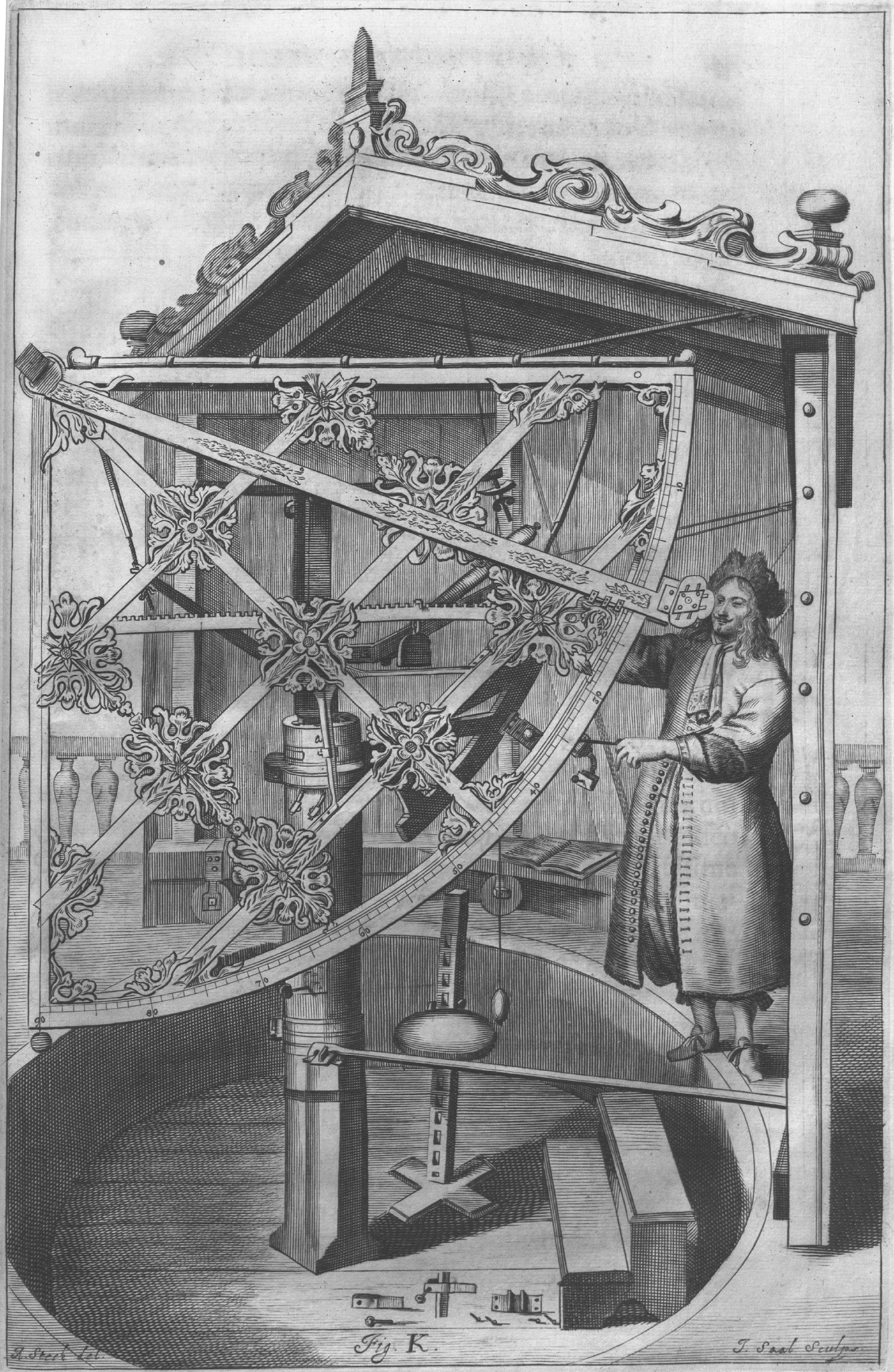
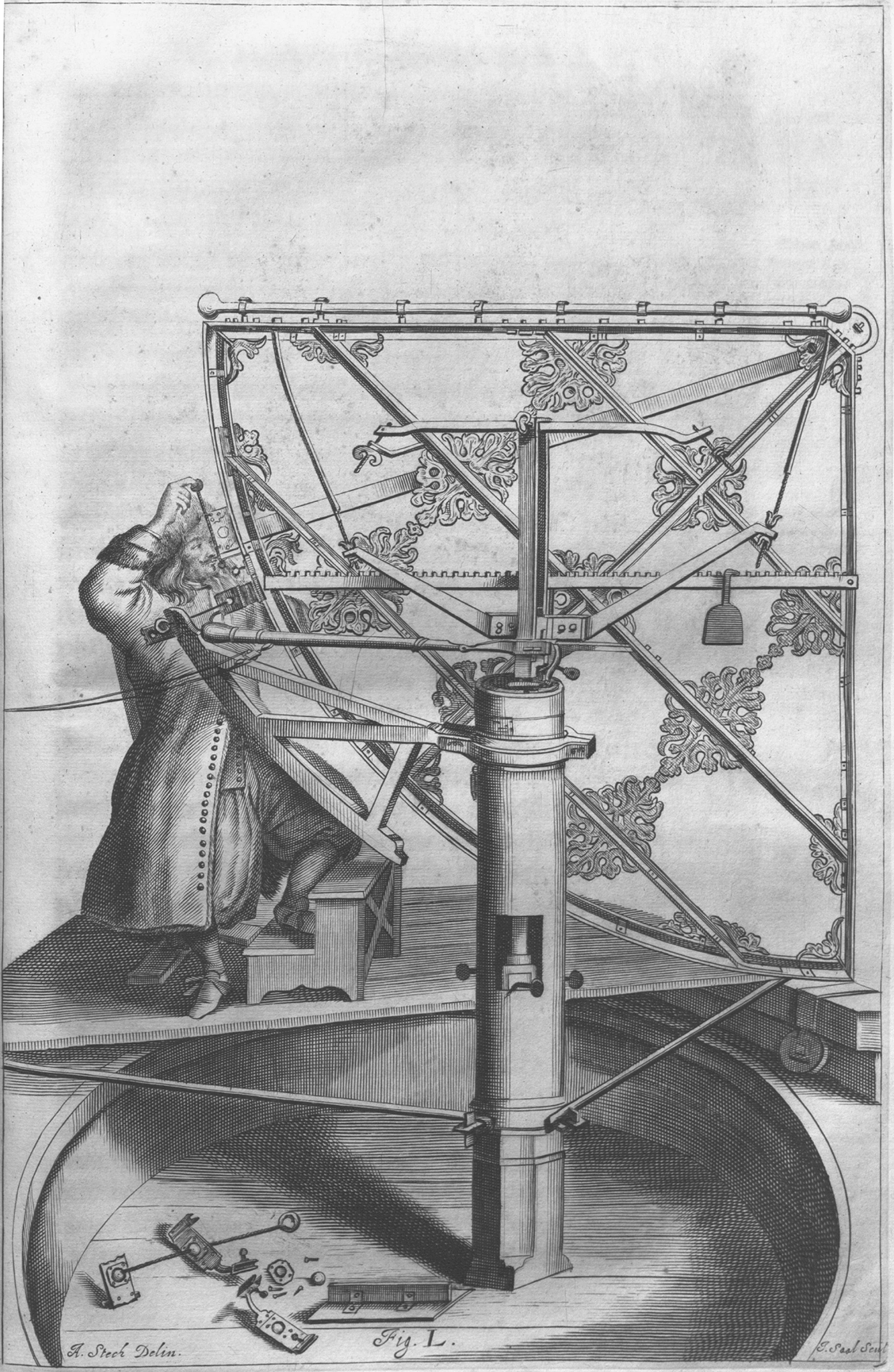
As Vertesi points out, one of Hevelius's chief visual strategies was to strike an analogy between himself and Tycho, raising his own status to a mythical level similar to that of the Noble Dane. Hevelius effected this analogy by rendering himself extravagantly dressed and his instruments impressively decorated, reminding viewers of his high social rank.Footnote 86 This strategy also harked back to the famous image of Tycho working with his mural quadrant in his Astronomiae instauratae mechanica (1598) (Figure 4). More signicantly, however, the mythology articulated in the images in Machina was rooted in Hevelius's omnipresence and his powerful gaze. In each of the images that prominently feature human figures, Hevelius is seen physically and visually engaged with his machines. His hands tinker while his eyes peer steadfastly through the eyepiece of the instruments. These images articulate a mythology about Hevelius by depicting Hevelius minding his instruments and engaging in observation. The centralized action of his body animates the devices. The ornamentation on the limb of his quadrant gives a ballistic quality to Hevelius's vision. The embossed flourishes on the alidade appear as if they are almost being emitted from Hevelius's gaze. The power of his vision passes beyond the threshold of his body and activates the instruments. Astronomical work proceeds from Hevelius's body to the machines without pause. The two figures, machine and astronomer, are elaborately intertwined: the machines are, as it were, extensions of Hevelius's body. The long line and frequency of buttons on Hevelius's coat, for instance, are echoed by the long series of teeth on the instrument (see Figure 3). Similarly, the angle of Hevelius's bent knee is traced by the metal curves of the instrument, and the angle of his upraised arm encloses his face in the instrument, giving the impression that there is no break between body and apparatus. Associations between these images and Hevelius's body would only have been heightened for early modern audiences, because it was widely known that Hevelius drew and engraved the plates for his Machina himself. Thus not only was Hevelius's body graphically at the centre of each image, but each image was an index of the gestures of Hevelius's labour. Hevelius's individuality is central to each vignette. The images impress upon the viewer that Hevelius, the particular individual, is trustworthy because he is technically competent and of honourable social rank, and that his observations are to be trusted by virtue of the extraordinary acuity and resolving power of his eyes.Footnote 87 He was, as it were, a sage-observer whose embodied skills justified the legitimacy of his celestial measurements.Footnote 88 This mythology earned Hevelius a number of flattering epithets: ‘the sharp-seeing Hevelius’, ‘the Prussian Lynx’, and the ‘keen-eyed [Hevelius]’.Footnote 89
Tycho Brahe, Tychonis Brahe Astronomiae instauratae mechanica (1602). Reproduced by permission of the Osler Library of the History of Medicine, McGill University.
Hevelius's fantastic visual skill became all the more certain for his contemporaries once Halley visited Hevelius's observatory in Danzig in order to settle the dispute between Hevelius and Hooke over the usefulness of telescopic sights in positional astronomy. According to Hooke, it was impossible for normal human vision to descry any angle greater than half a minute of arc.Footnote 90 In 1674, Hooke published the experiment that he used to determine this optical threshold in a tract he wrote condemning Hevelius's rejection of telescopic sights for positional astronomy. The dispute between Hooke and Hevelius only came to an end five years later when Halley arrived in Danzig and reported to Flamsteed, ‘But as to the distances measured by the sextants, I assure you I was surpriz'd to see so near an agreement in them, and had I not seen, I could have scarce credited the relation of any.’Footnote 91 According to Halley, the greatest discrepancy between his observations and Hevelius's was no greater than 10″. Similar to the images in the first part of Hevelius's Machina, Hevelius had to be seen in the act of observation in order to conclude that there should be ‘no more doubt about his Veracitye’.Footnote 92 Although he may have been a competent technician and of high social rank, the credibility of his astronomical measurements rested on the grounds that Hevelius, the individual, possessed exceedingly powerful visual skills.
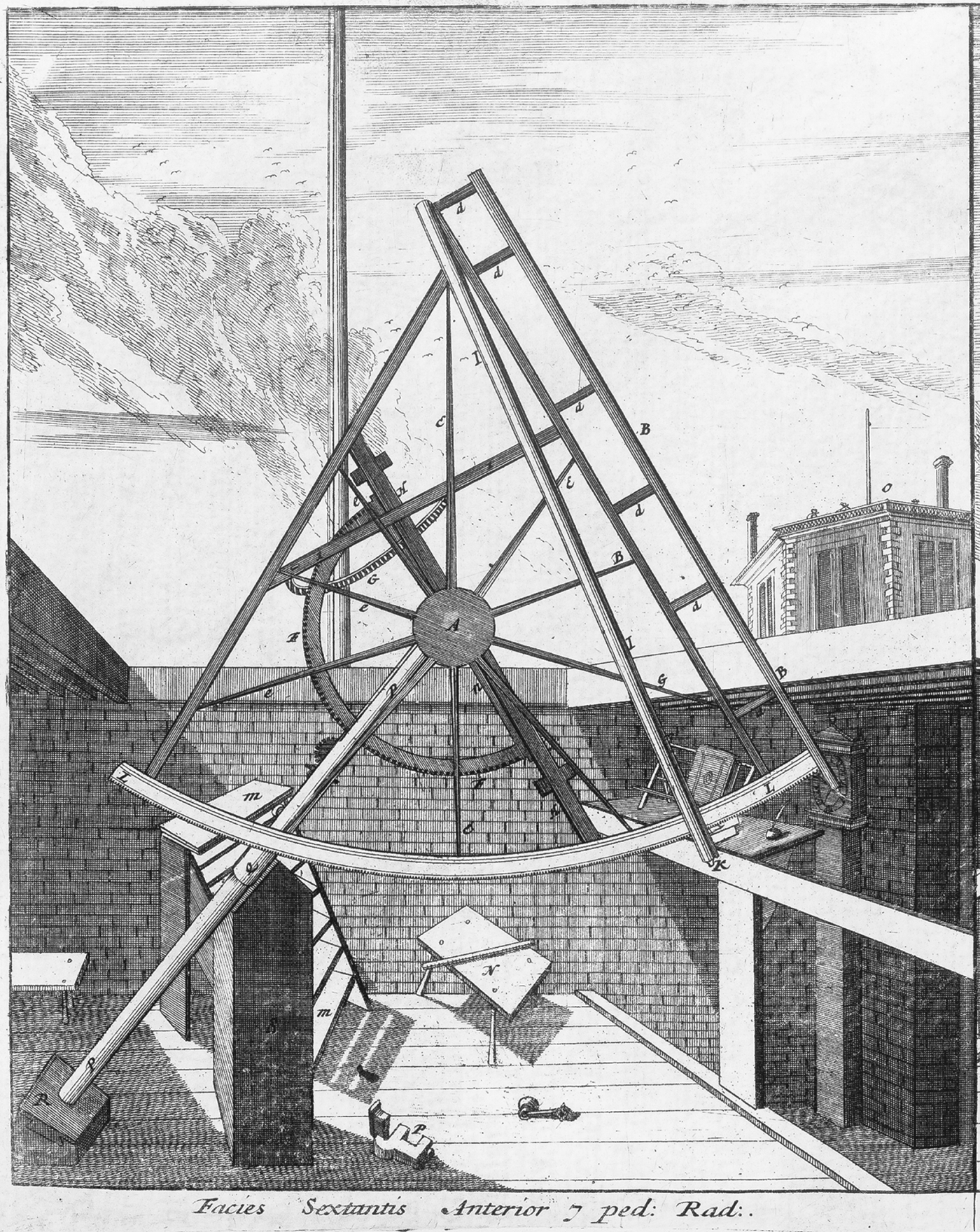
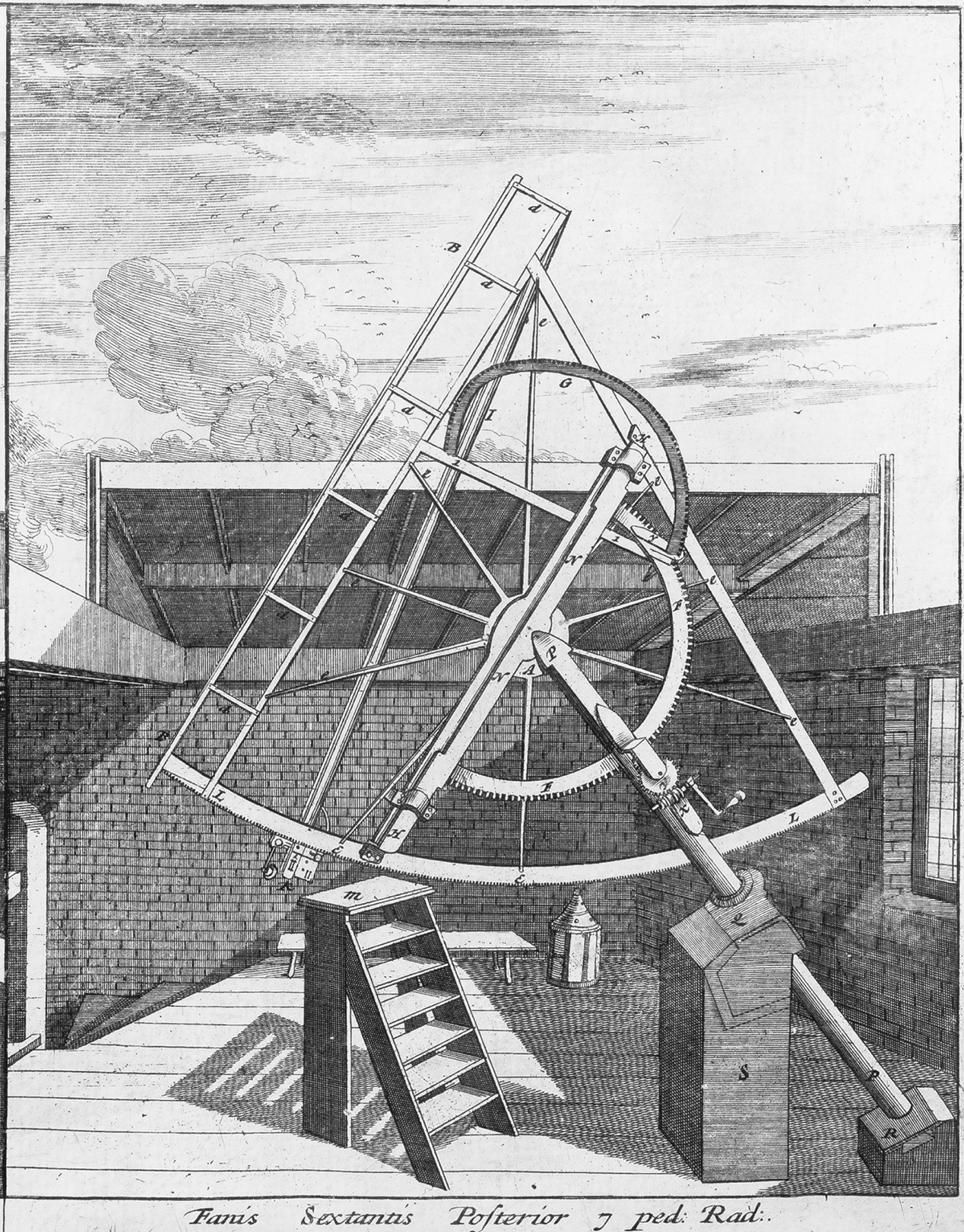
Flamsteed, who vociferously disagreed with Hevelius's arguments against the use of telescopes for positional astronomy, worked hard to emphasize the differences in astronomical praxis between himself and the controversial ‘star of Danzig’.Footnote 93 The few images published in Flamsteed's 1725 Historia speak to this cleavage (Figures 5–7).Footnote 94 Most strikingly, there are no people, let alone explicit representations of the Astronomer Royal, in the images published in the Historia. The machines depicted in these images rest unused and unaccompanied. They soberly represent Flamsteed's two most successful observing apparatuses. Two of the three images were etched by Francis Place (Figures 5 and 6). They depict the anterior and posterior views of the sextant built from Flamsteed's own design by ‘Master Tompion, the most outstanding craftsman of his age’.Footnote 95 Place's etchings are part of a larger series that was commissioned by Jonas Moore (Flamsteed's friend and patron) to visually celebrate the establishment of the Greenwich Observatory shortly after Flamsteed began his work there.Footnote 96 The etchings were completed by 1680, about forty-five years before the 1725 publication of Flamsteed's Historia. None of the other Place etchings were published with the 1725 Historia, however. Of Places's original twelve etchings, only four were of instruments; the others were of plans or views of the newly built Greenwich Observatory. The exact reason for the exclusion of the other ten etchings is unknown, but we can reason that their omission was either deliberate or because they were simply thought to be unimportant.Footnote 97 In either case, we can say that the idea of including the other Place etchings was at best deemed to be irrelevant and at worst harmful to the project of vindicating Flamsteed's scientific identity. In any event, it is significant that the only two of the original twelve Place etchings that were published with the 1725 publication of Flamsteed's star catalogue were of the instruments that Flamsteed professed in his preface to have used earnestly as a part of his research at Greenwich. These were also among the few etchings in Place's series for which Flamsteed wrote descriptions.Footnote 98 Moreover, the images that were included in the 1725 Historia, in contrast to the images in Hevelius's Machina, depict no human figures. In fact, the implied observer is conspicuously absent, with the instruments scattered almost carelessly on the ground and the pen resting ready in the inkwell. The Place etchings suggest that someone is moments away from walking into the frame to make an observation and record it.
Flamsteed's seven-foot sextant, built by Thomas Tompion in 1676. Notice the instruments strewn on the floor and the pen resting in the inkwell. Francis Place, ‘Facies Sextantis Anterior’, in Flamsteed, Historia Coelestis Britannica, vol. 3 (1725), facing p. 164. Courtesy Archives and Special Collections Department, New Mexico State University.
Flamsteed's seven-foot sextant, built by Thomas Tompion in 1676. Francis Place, ‘Fanis Sextantis Posterior’, in Flamsteed, Historia Coelestis Britannica, vol. 3 (1725), facing p. 164. Courtesy Archives and Special Collections Department, New Mexico State University.
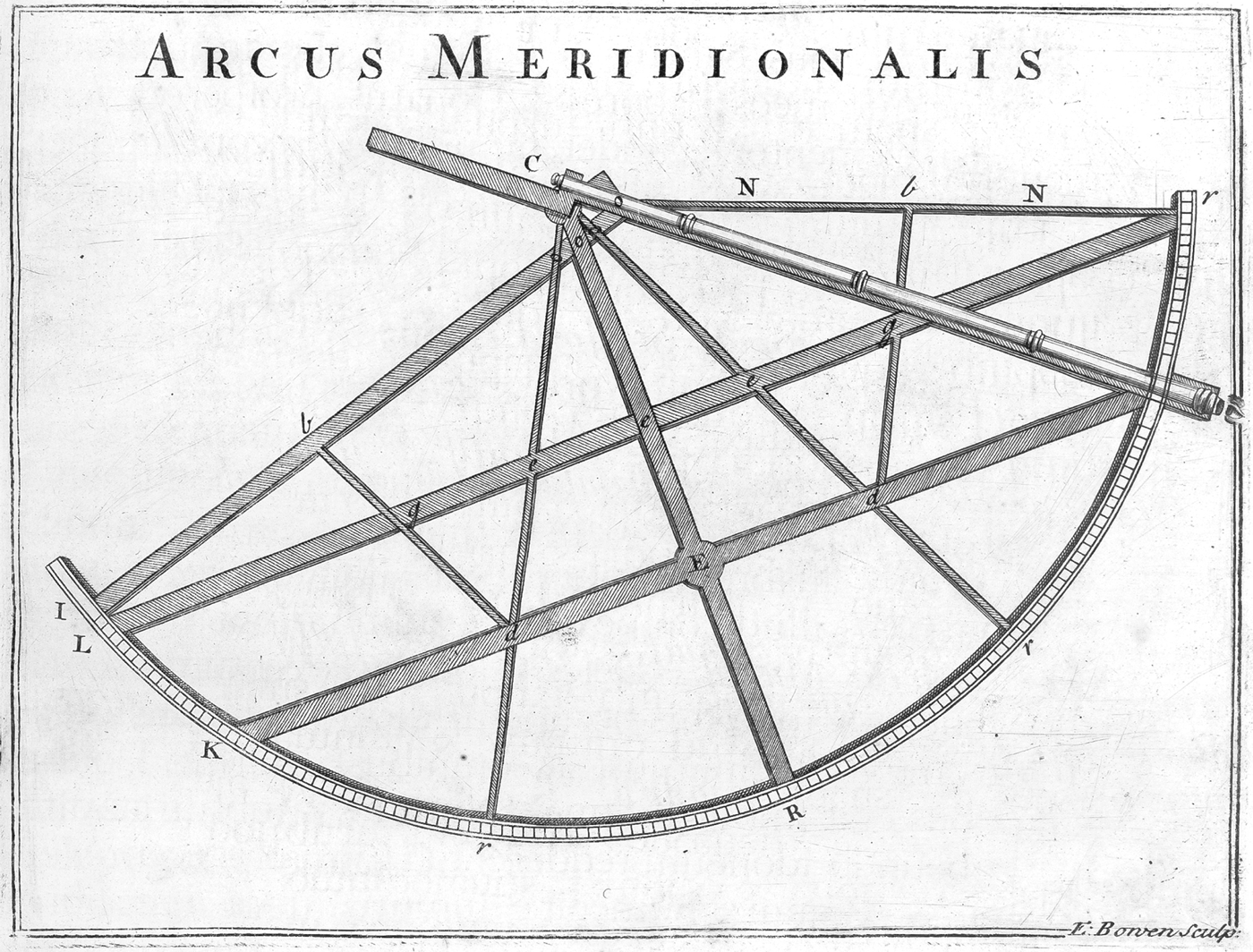
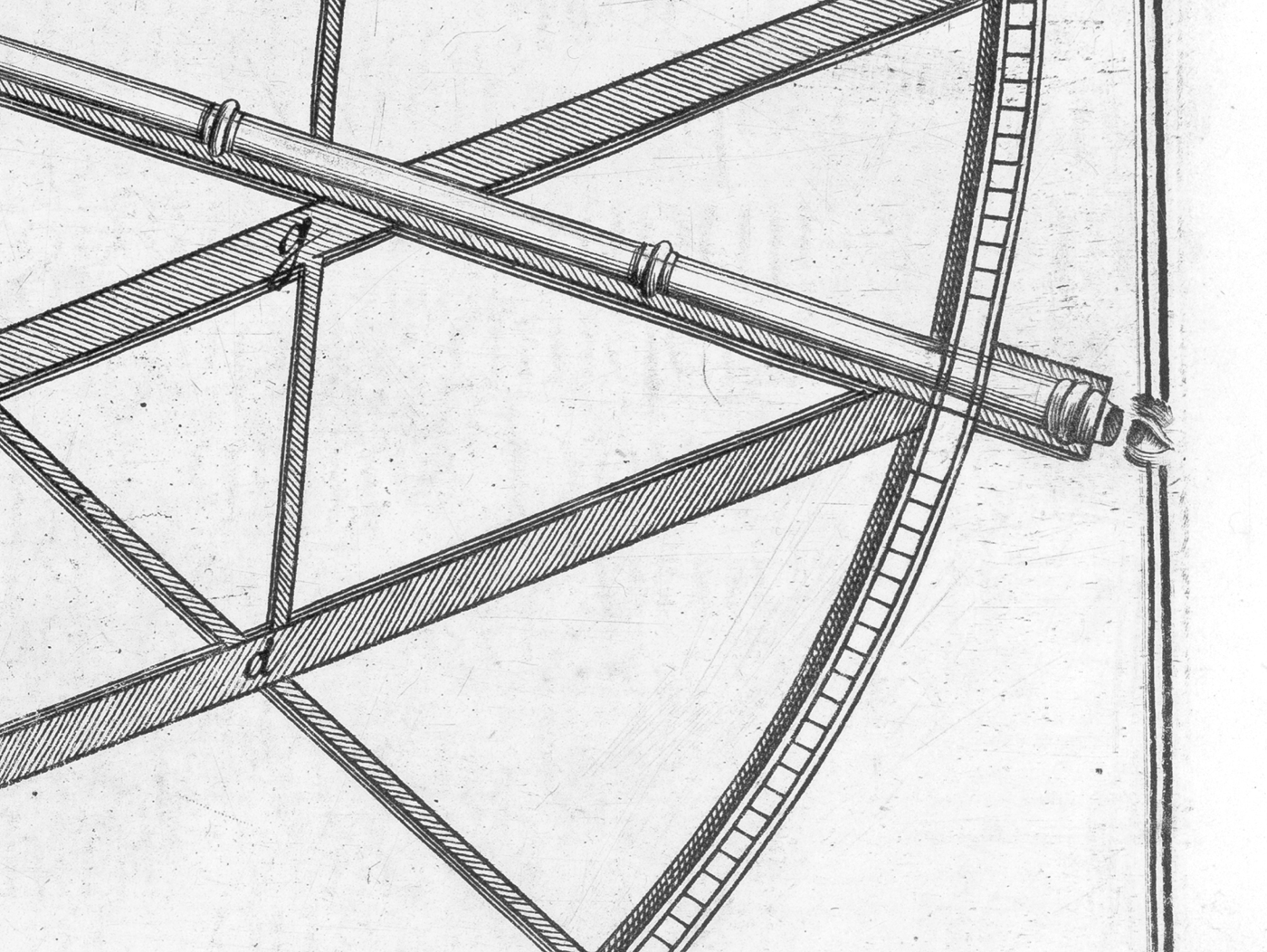
The same is not exactly true for the third image (Figure 7) that was included in the 1725 Historia. This image is of the seven-foot mural arc built for Flamsteed by Abraham Sharp. After Sharp completed the arc, Flamsteed maintained ‘that when even the most skilled craftsmen saw and examined it, they acknowledged that they themselves could not have executed it with greater precision’.Footnote 99 Like the other two images of Flamsteed's seven-foot sextant, the image of Sharp's mural arc does not include any embodied observers. Instead, on the far right-hand edge of the image there is a single eye, making an observation through the telescope affixed to the mural arc (Figure 8). The significance of the disembodied eye, like the conspicuous absences in the Place etchings, is that these images do not imply any particular observer. Where for Hevelius the credibility of his observations was predicated on him, the ‘keen-eyed’ observer, witnessing the night sky, for Flamsteed credibility as a reliable witness did not rest on the quality of his eyesight in particular. For Hevelius, who refused to use telescopes for positional astronomy, credibility was necessarily predicated on the quality of his eyes and of his body. Flamsteed, whose conviction in the efficacy of telescopes was steadfast, freed, as it were, his body and his visual acuity from the responsibility of seeing correctly. To be sure, Flamsteed's unrelentingly poor health was well known to anyone who communicated with him. This reputation was no doubt accompanied by the knowledge that Flamsteed's observations were regularly made by his assistants, making the telescope and his fixation on the mechanical precision of his instruments a convenient way of rendering his body inessential to the acts of observing and recording. Even in Flamsteed's letter to John Wallis that described what Flamsteed claimed to be the veritable measurement of stellar parallax and that was later published in Wallis's Opera Mathematica, Flamsteed readily admitted that even his assistant, Abraham Sharp, ‘had keener eyesight than I have’.Footnote 100 Flamsteed's readiness to diminish the quality of his eyesight in relation to the eyesight of his assistant, who, Flamsteed was careful to point out, was responsible for the construction of his mural arc, is a telling example of Flamsteed's broader strategy of self-fashioning. Flamsteed, who was engaging in the same enterprise as Hevelius – to improve upon the observations made by Tycho – held that ‘the majority of errors in Tycho's catalogues quite indubitably arose from the difficulty from aligning stars accurately through plain sights’.Footnote 101 This problem, for Flamsteed, could be overcome by fitting telescopic sights to one's observing arcs. The telescope was, therefore, not only a way of ensuring that Flamsteed himself could measure the night sky with greater precision, but also a way of ensuring that any able-bodied observer could, at least hypothetically, see the same thing.
Flamsteed's mural arc, made by Abraham Sharp in 1668. ‘Arcus Meridionalis’, in Flamsteed, Historia Coelestis Britannica, vol. 3 (1725), facing p. 164. Courtesy Archives and Special Collections Department, New Mexico State University.
Detail of the eye peering into the telescope mounted on Flamsteed's mural arc. ‘Arcus Meridionalis’, in Flamsteed, Historia Coelestis Britannica, vol. 3 (1725), facing p. 164. Courtesy Archives and Special Collections Department, New Mexico State University.
The mode of visual self-presentation in Flamsteed's Historia rejected the example set by Hevelius in favour of a scientific identity that displaced the burden of seeing correctly and measuring accurately from the astronomer's body. For Flamsteed, credibility as an astronomer was not predicated on superhuman perceptual skills. The identity that Flamsteed worked to create for himself was based on his understanding of the astronomer as a skilful technician rather than as a sage-observer. The technical know-how and labour of the skilful astronomer supplanted the hyper-accurate vision of the mythical sage whose vision was occult and thus unreliable.Footnote 102 Since, for Flamsteed, ‘telescopes particularly provide the means of achieving ultimate perfection’, the issue raised by the variable quality of different individuals' eyesight was resolved by the introduction of the telescope into observational astronomy.Footnote 103 Machines superseded the fallible body of the observer as the vehicle through which observations were made. Consequently, machines, rather than perceptual skills, figured at the centre of Flamsteed's praxis.
Mechanical uncertainty and metal instruments
The problem of seeing correctly thus became one of technical skill insofar as the certainty of one's observations rested on the quality of one's instruments and the ability to adroitly manage those instruments. To this effect, Flamsteed held that
it would not be too hard to measure an angle or a distance in the heavens, to a high degree of accuracy, if we could establish with certainty that an arc of a circle can be divided with sufficient accuracy by human artifice. But there remains doubt as to whether this can be done.Footnote 104
Instruments, for Flamsteed, were characteristically untrustworthy.Footnote 105 As was common among natural philosophers in the period, Flamsteed did not want to have his reputation ‘bound to the manual skill of a hired craftsman’.Footnote 106 Certainty rested on the astronomer's ability to find and correct the errors of his instruments.Footnote 107
Writing to William Molyneux, who was to come under the informal tutelage of the Astronomer Royal, Flamsteed encouraged the work of his admittedly inexpert apprentice by instructing him that when taking the height of celestial bodies short of the meridian, he should
note also the time when they comes to the same height againe past it and to calculate the apparent houres from both for if the errors are not found the same by both (as it seldome happens they are where the Latitude is not exactly knowne or if the instrument you use be faultily divided) however the meane amongst them shall be the true error at the Middle time betwixt both observations.Footnote 108
Flamsteed even admits that ‘this method I have frequently used to be sure of my times’. Although, ‘Now’, he assures Molyneux, ‘I find I need not, haveing [sic] both gotten the exact latitude of this place, and error of my Instrument.’Footnote 109 While Flamsteed acknowledged that averaging several observations is less preferable than knowing the error of your instruments and thereby being able to make single observations with certainty, his confession of having taken the ‘meane’ of past observations illustrates how, in the absence of sufficient mechanical expertise, one did not have adequate reason to prioritize one observation over another.Footnote 110 Being able to determine the coordinates of a celestial body with confidence was not, in other words, a matter of making a judgement about the quality of one observation over another. Certainty required the astronomer to demonstrate the ability to find the errors that would inevitably arise in their instruments, regardless of how well they were constructed, and compensate for those errors in a systematic way.
As opposed to Flamsteed, Hevelius never took averages of his observations, despite the fact that he normally recorded no less than four different positions for the same star.Footnote 111 Although the specific criteria that Hevelius used in order to prioritize one measurement over another are not available, it is certain that when Hevelius published his Machina Coelestis Pars Posterior (1679) and his Prodromus Cometicus (1665) the numbers he decided to use were ‘the direct result of a singular observation and accordingly required an act of judgment on Hevelius’ part rather than the rote application of a numerical algorithm’.Footnote 112 Before publishing his star coordinates, Hevelius, or possibly one of his assistants, would exercise his or her sage judgement by marking off in red ink the best measurements that were recorded for each star. Determining the coordinates of a star with certainty was, for Hevelius, something that could be judged by reason. Conversely, for Flamsteed, to be certain of the position of a star was to be certain of the deviation of one's instruments. Observing the precise location of a star was thus something that became self-evident when looking through the properly adjusted sights of a telescope. We might therefore think of the dis-analogy between Hevelius and Flamsteed sketched out above to be one wherein the role of the observer changed from one who reasons data to one who registers it.Footnote 113 Flamsteed was thus left to exercise his ability as a skilful astronomer in order to uncover and compensate for the mechanical errors that inevitably appeared in his instruments.
Wooden instruments, Flamsteed explained in his preface, were liable to ‘distortions and contractions’ due to the effects of weather on wood.Footnote 114 Using metal instruments, however, created new problems that Flamsteed needed to discover for himself. After using his seven-foot metal sextant (Figures 5–6) for some time, Flamsteed ‘found that the thread on the screws had worn down the edge of the limb’.Footnote 115 This presented a problem for Flamsteed because he used a graduated screw to determine the degrees of arc on his sextant. Once he found that the screw had worn down the teeth on the alidade, Flamsteed could no longer accurately calculate degrees of arc by the number of times he rotated the screw. In order to correct this problem, Flamsteed found a way of cross-referencing his measurements:
I dismantled the sextant, engraved the degree scale along the rim … And I further calculated the table of ‘revolves’ for the screw and divided the arcs of the corresponding parts into degrees and minutes. With these, I was more readily able to investigate whether the parts of the revolutions of the screw matched the degrees and minutes marked off on the limb, and if any error crept in, I was able to correct it.Footnote 116
Using independent ways of measuring arc, Flamsteed explained to his readers that he found that on occasion the measurements he made with the screw ‘erred by almost a whole minute’.Footnote 117 Having identified the discrepancy, Flamsteed then recalibrated the screw to correct for this error.Footnote 118 Despite his efforts, Flamsteed eventually found that the weight of the alidade moving back and forth had ‘changed the position of the perpendicular [arm] by an indefinite quantity’.Footnote 119 The difficulties that arose due to the weight of metal instruments was to become a persistent problem for Flamsteed.
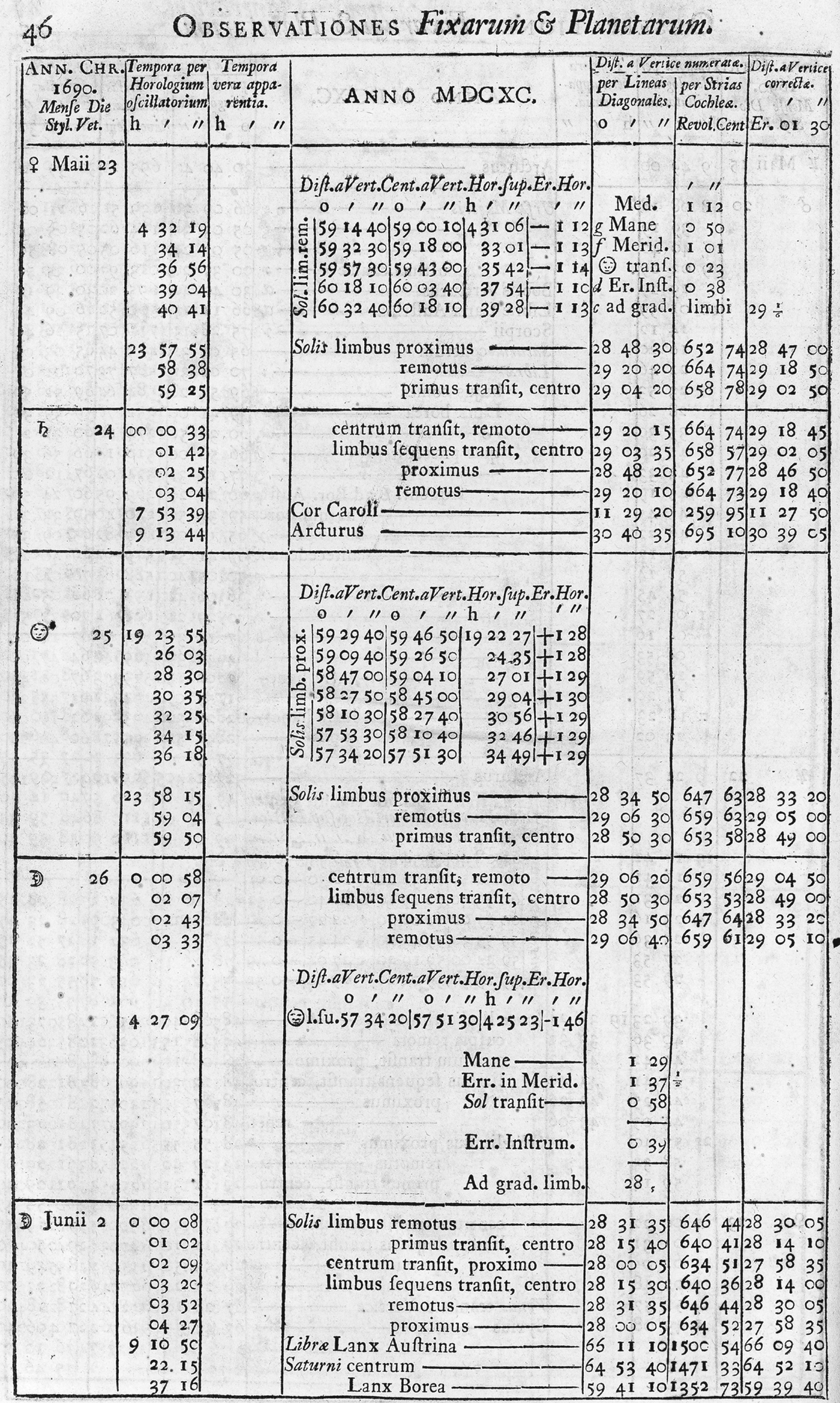
The following sextant that Flamsteed had built also proved to be fragile, and its structure required constant reinforcement. This problem continued until Abraham Sharp built for Flamsteed a seven-foot mural quadrant, which, according to Flamsteed, was reputed by the most skilled craftsmen to be unequalled in its precision (Figure 7).Footnote 120 By dividing the rim of the instrument and graduating the screw that moved the alidade, and by checking these graduations against each other, Flamsteed was confident in the accuracy of the instrument's graduations. After three months, however, Flamsteed explained that he found that the ‘distances of those stars crossing the meridian from the zenith to the South are much too great, and those to the North are much too small’.Footnote 121 Although the discrepancy was slight, Flamsteed noticed that over time the problem increased at the same rate. Before long, Flamsteed told his readers, he reasoned that the south part of the wall on which the mural quadrant was placed ‘subsided every year, and that the errors of the instrument grew a little each year’.Footnote 122 Confronted with the dilemma of choosing between instruments that were either too weak and warped or ones that gradually shifted their foundations due to their great weight, Flamsteed measured over the course of a year the rate at which the wall sank, allowing him to predict the changing error of the sextant over time. From this he recalculated the error of the instrument on a regular basis, and he recorded in his Historia, ‘at the head of each page of observations performed with the instrument’, the changing error of the mural arc (Figure 9).Footnote 123 This was meant to be both a testament to Flamsteed's honesty and a mark of his skill in calibrating instruments by finding and accounting for the errors that inevitably appeared in all instruments. Whether or not the south side of Flamsteed's meridional wall was actually sinking at a fixed rate is unimportant. That Flamsteed proudly advertised the problems he discovered in his instruments in his preface shows that he based the credibility of his astronomical work on his ability to successfully both account and correct for the errors in his instruments.
This table gives the locations of the fixed stars that Flamsteed recorded with Sharp's mural arc. Notice that the top of the far-right column of the table includes the deviation Flamsteed calculated for his sextant at the time of these observations. The right-hand column gives the corrected locations. Flamsteed, Historia Coelestis Britannica, vol. 2 (1725), p. 46. Courtesy Archives and Special Collections Department, New Mexico State University.
Conclusion
The debate that arose between Hevelius and Hooke over the effectiveness of using telescopic sights for positional astronomy forced the scientific community to take sides and define what Voula Saridakis has termed ‘the appropriate characteristics of astronomical practice and the appropriate activities of the astronomer’.Footnote 124 In this context, Flamsteed's reliance on the telescope as a means of seeing correctly, twinned with his attempts to legitimate the unprecedented accuracy of his work by emphasizing his proficiency in managing astronomical instruments, should be seen as his way of taking sides in this controversy. More heuristically, however, we might think of Flamsteed's emphasis on the importance of the technical literacy of the astronomer to be gesturing to a sort of mechanical turn in the history of astronomical observation. This is not to say that demonstrating a sort of technical proficiency was not a crucial component of legitimating the work of Hevelius as well as other, earlier astronomers. Rather, Flamsteed's character-building campaign merely shifted the emphasis onto the sorts of behaviour that actually counted toward the positional astronomer's ability to generate new knowledge. The originality of the scientific persona that Flamsteed worked to project was that it offered the telescope as a mechanical vehicle through which different individuals' eyesight could be regularized, thereby disassociating the body of the observer from the responsibility of seeing correctly and shifting the praxis of astronomy from the act of seeing to the organization of events that made seeing possible.
This was the inheritance of the Greenwich Observatory in the eighteenth century. When, in 1774, Nevil Maskelyne attempted to observe Newtonian gravitation by measuring the ‘attraction of mountains’ in Scotland, he was also, as Nicky Reeves has shown, demonstrating the accuracy of his zenith sector.Footnote 125 For Maskelyne, however, not only was this a demonstration of the accuracy of his zenith sector, but also his descriptions of the exercise served to demonstrate his ability to detect and correct slippages in the accuracy of his device. Commensurate with Flamsteed warning his readers of the way in which Abraham Sharp's seven-foot mural quadrant sank gradually into its foundations, demanding the utmost caution of the astronomer, Maskelyne warned his readers of the attention one must pay to his instrument on a boggy Scottish hillside to adjust ‘for gradual changes of the wooden frame’.Footnote 126 In 1796, however, when Maskelyne discovered the ‘personal equation’, he also decisively overturned the assumption that the telescope regularized the act of observing astronomical phenomena, leading to a more rigorous process of mechanizing observation. While the discovery of the personal equation invalidated Flamsteed's assumptions about the relationship between the telescope and the body of the observer, it also enlarged the range of responsibilities of the skilful astronomer to include the bodies of the individuals conducting observations.Footnote 127 The incorporation of the body of the observer under the jurisdiction of the skilful astronomer, the so-called ‘mechanization of observation’, in the period that followed the discovery of the personal equation was thus more the augmentation of a pre-existing historical process than the inauguration of a new historical process.Footnote 128
Flamsteed's specific approach to licensing his astronomical authority suggests that there may be something of a prehistory to what Daston and Galison have called the emergence of ‘mechanical objectivity’ in the mid- to late nineteenth century, a historical process that was closely tied to the rise of photography in scientific image-making practices.Footnote 129 Simon Schaffer's, and more recently Jimena Canales's, work on the personal equation in the late eighteenth and early nineteenth centuries demonstrates the connection between astronomy and the pre-photographic process of the ‘mechanization of observation’.Footnote 130 Flamsteed's attitude toward the work of the positional astronomer – trying to observe and record discreet moments in time by divesting the act of observation of the individuality of the person making the observation – is suggestively parallel to Daston and Galison's treatment of ‘mechanical objectivity’ as a kind of epistemic virtue or regime.Footnote 131 The two terminologies are similarly parallel – mechanical objectivity versus the mechanization of observation – and their difference may very well be rooted more in the idiosyncratic vocabularies of different subdisciplines than in their identification of different historical trends. Where the former focuses on photography and image making, the latter focuses on the problem of recording observed astronomical phenomena in time. If we wish to find a precursor to the rise of mechanical objectivity in the nineteenth century, the process of the mechanization of observation looks to be a promising, yet sorely under-researched, candidate. The cultural and epistemic investment in the telescope, pendulum clock and micrometer may very well have more in common with photography than we think.