An important question motivating empirical research on political representation is the nature of the relationship between descriptive and substantive representation (see Pitkin Reference Pitkin1967). In the context of research on women's representation, the existence of a positive connection between these two forms of representation is often interpreted to mean that electing women to Congress results in legislative behavior promoting women's interests. Scholars have tested, and largely confirmed, this proposition using data on roll call votes and bill sponsorship.
In addition, scholars and women's groups alike have shown that congresswomen bring gendered perspectives to debates, representing women across America. Yet there has been limited systematic research substantiating these latter claims.
We analyze House floor speeches, an important but understudied aspect of legislative behavior that has the potential to enhance women's representation. Speeches provide a venue in which congresswomen can voice the “uncrystallized interests” of women, drawing upon their life experiences to bring women's perspectives to bear on the issues of the day (Mansbridge Reference Mansbridge1999). Indeed, Mansbridge (Reference Mansbridge1999, 635–36) argues that “the open-ended quality of deliberation gives communicative and informational advantages to representatives who are existentially close to the issues.”
In our analysis of congressional speech, we ask how two identities—gender and partisan—condition the extent to which members of Congress represent women's interests on the House floor by invoking gendered rhetoric.Footnote 1 Congresswomen represent not only their own constituents but also women outside their districts (Carroll Reference Carroll and Simon Rosenthal2002; Mansbridge Reference Mansbridge1999), and women's life experiences and persistent underrepresentation in Congress give congresswomen extra incentives to address women's interests when debating and discussing the issues of the day.
Members' partisan identities, however, may complement or compete with their gender identities. The contemporary Congress is characterized by high levels of partisan polarization. As the parties have polarized, the divergence in opinion between Democratic and Republican party elites on all policy issues, including support for “women's issues,” has also grown significantly (e.g., Rohde 1991; Sanbonmatsu Reference Sanbonmatsu2002; Wolbrecht Reference Wolbrecht2000). The extent to which partisan and gender identities jointly or independently shape members' attention to women's interests is thus an open question.
Most research on sex differences in members' substantive representation of women has focused on support for women's issues in roll call votes and bill sponsorship. We focus instead on a different question concerning women's representation: how members' gender and partisan identities affect their use of gendered rhetoric in their speeches on the House floor from the 103rd Congress to the 110th Congresses (1993–2008). In doing so, we let members of Congress, through their words, indicate the issues that are in the interests of women. Analyzing more than 30,000 one-minute speeches—speeches that can be about any topic a member chooses—from 1993 to 2008, we find that congresswomen in both parties are significantly more likely than men to discuss women in these speeches. We also analyze speeches delivered during debates over the most significant legislation in four Congresses—speeches where we might expect fewer instances of gendered rhetoric because of the specificity of the issue under consideration. Our analyses demonstrate that congresswomen's one-minute speeches and speeches during major legislative debates enhance women's representation, as congresswomen of both parties draw attention to women's interests to a much greater extent than do congressmen. Furthermore, we find that sex differences in members' propensity to invoke gendered rhetoric are greater than partisan differences, even in a polarized era.
POLITICAL AND THEORETICAL BACKGROUND
Gender, Partisanship, and Women's Representation
Women's underrepresentation in the U.S. House of Representatives is stark, even as the number of women in the House increased from 28 to 72 between 1992 and 2008. Serving in an overwhelmingly male-dominated institution gives congresswomen extra incentives to represent women's interests in the legislative process. Indeed, most congresswomen indicate that they not only represent their constituents in Congress but also act as surrogate representatives for women across America (Carroll Reference Carroll and Simon Rosenthal2002). At the same time, women in the electorate are more likely than men to indicate a preference for descriptive representation on the basis of gender, indicating that a female representative would be more likely to share their concerns on issues (Rosenthal Reference Rohde1995).
Most, but not all, of the scholarship analyzing the link between descriptive and substantive representation finds that women legislate in ways that promote women's interests. The theoretical basis for this connection has been articulated by many scholars. In 1981, Sapiro observed: “The very term ‘representation of women’ is usually taken very specifically to mean increasing the number of women in political office because of the assumption that women in power would be more responsive to women's interests than men would be” (Reference Sapiro1981, 710). An important rationale for congresswomen's greater likelihood of acting on behalf of women is grounded in women's common socialization, experiences, and perspectives (Reingold Reference Reingold2000). Along those lines, women have unique and valuable contributions to offer, and women constitute a distinct political group whose identifiable interests need to be addressed (Mezey Reference Mezey, Adell Cook, Thomas and Wilcox1994). The underlying assumption, then, is that because they experience a sense of mutuality with other women and share distinctive, gender-specific concerns, congresswomen are more likely than their male counterparts to vote in support of, and focus on, issues of importance to women.
A growing body of research shows that women legislators are more likely to represent women in the legislative process than are male legislators. Most of this research has focused on support for women's issues bills, such as child care, women's health, access to abortion, domestic violence prevention, and pay equity (Burrell Reference Burrell1994; Carroll Reference Carroll and Simon Rosenthal2002; Dodson Reference Dodson, Thomas and Wilcox1998, Reference Dodson2006; Gelb and Palley Reference Gelb and Lief Palley1996; Gerrity, Osborn, and Mendez Reference Gerrity, Osborn and Morehouse Mendez2007; Norton Reference Norton1999; Swers Reference Swers1998, Reference Swers2002; Thomas 1994). Instead of focusing on specific substantive policy outputs as these scholars have, however, we analyze women's representation through members' gendered rhetoric in their speeches.
Mansbridge (Reference Mansbridge1999) delineates the importance of the link between descriptive and substantive representation during deliberation. When new policy debates occur over “uncrystallized issues,” descriptive representatives are particularly likely to engage in substantive representation by bringing their personal knowledge of, and experiences with, gender dynamics to debates. As scholars have pointed out, women's position in society means that most policies have a differential impact on women (Carroll Reference Carroll1994; Wolbrecht Reference Wolbrecht2000). Any policy proposal could arguably have disparate effects on women and men because of the gendered nature of society, the economy, the workforce, the armed services, the family, and the provision of health care.
A member's gender identity, however, is only one of many influences on his or her legislative behavior. Party identification is the best predictor of a member's overall voting record and ideology (Poole and Rosenthal Reference Poole and Rosenthal1997), and scholars have found that Democratic partisanship and a liberal ideology sometimes trump gender differences in explaining legislative support for women's issues (Reingold Reference Reingold2000; Swers Reference Swers2002). Given that the Democratic Party is more supportive of both reproductive rights and social welfare spending than is the Republican Party (Sanbonmatsu Reference Sanbonmatsu2002; Wolbrecht Reference Wolbrecht2000) and that Democratic voters are more likely to be women (e.g., Kaufmann and Petrocik Reference Kaufmann and Petrocik1999), this is not surprising.
Members have incentives to toe the party line in the contemporary period characterized by strong party leaders (Rohde 1991). In an era of party polarization—particularly when Republicans enjoy majority party control—Republican congresswomen face extra incentives to demonstrate support for the party platform since congresswomen are viewed as more liberal than congressmen, regardless of their actual voting records (Koch Reference Koch2002; McDermott Reference McDermott1997). Swers observes changes among Republican congresswomen from the 103rd to the 104th Congress as Republicans gained majority party control. House Republican leaders became more concerned about their members' policy positions once they controlled the agenda, and the newly elected Republican congresswomen in the 104th Congress were less supportive of women's issues than the Republican women already serving. Republican congresswomen seeking to prove their partisan credentials to party leaders and constituents may, therefore, not support the policies traditionally defined as women's issues. We therefore compare Democratic congresswomen, Republican congresswomen, Democratic congressmen, and Republican congressmen, asking the extent to which each group focuses on women's interests in their speeches. Ultimately, by taking into account members' sex and party, we seek to develop a richer understanding of women's representation in the modern Congress.
Analyzing gendered rhetoric across a wide range of speeches provides an opportunity to capture Republican congresswomen's efforts to bring women's interests to policy debates that may otherwise go undetected. Scholars have shown that since the 1980s, the national parties have polarized on some women's issues, such as the Equal Rights Amendment and abortion rights, with growth in Democratic support and Republican opposition (Sanbonmatsu Reference Sanbonmatsu2002; Wolbrecht Reference Wolbrecht2000). Even if Republican congresswomen are not sponsoring bills in support of these particular issues they may still be bringing women's interests to the congressional debate. Shogan (Reference Shogan2002), for instance, finds that Republican congresswomen are more likely than Democratic congresswomen to talk about the effect of taxes on working women. Since taxation is not classified as a women's issue, this form of representation is likely not captured in analyses of bill sponsorship or roll call votes restricted to women's issues.
House floor speeches are an important part of the legislative process. They give members a voice in the policymaking process, providing opportunities for members to highlight important or otherwise overlooked implications about the issues of the day. Members across a range of institutional roles use opportunities to speak on the House floor to advance their goals. Both parties use speeches to communicate specific policy positions to their members and the Washington policy community (Harris Reference Harris2005). Speeches are also one of the only venues for members who are less central to the policymaking process to weigh in (Maltzman and Sigelman Reference Matlzman and Sigelman1996). Rank-and-file members trying to curry favor with party leaders may display their loyalty by advocating the party position. Members also rely on speeches to accrue electoral advantages through advertising and position taking (Mayhew Reference Mayhew1974), targeting their constituents and the media. Legislative debate on important legislation is often disseminated well beyond the halls of Congress, in quotes by print reporters, on the television news, and, more recently, in online posts.
Floor speeches also provide opportunities for members to communicate issue-specific knowledge to one another. This is particularly important for descriptive representatives seeking to represent their group substantively. During this “horizontal communication” among deliberating members, according to Mansbridge (Reference Mansbridge1999, 644), “A descriptive representative can draw on elements of experiences shared with constituents to explore the uncharted ramifications of newly presented issues and also to speak on those issues with a voice carrying the authority of experience.”
Since members often raise new issues and explain their policy positions through floor speeches, we are able to capture how gender factors into the policy-making process in ways that may not be evident in analyses of roll call votes or bill sponsorship, enhancing our understanding of the ways in which members of Congress represent women. An excerpt of a speech in the 109th Congress from Representative Ginny Brown-Waite (R-FL) illustrates this point:
I rise today to express my solidarity with the courageous women of Afghanistan. This past weekend, Afghani women once again made history as their country held their second round of free and fair elections to select a national parliament and provincial assemblies. Despite threats of retaliation and retribution, 580 women stood for election. These 580 women have risen up to be leaders of their land, in a country that just 4 years ago prohibited women from participating in national life. (Congressional Record H8107-8, 2005)
Brown-Waite is bringing women's interests to the debate on Afghanistan on the floor of the House. An analysis of her roll call votes on the war in Afghanistan, however, would not identify this form of women's representation because the votes would not be coded as women's issues.
At times, in an attempt to gain advantage among independent-leaning women in the electorate, leaders of either party may encourage congresswomen to speak about how a party-supported policy proposal affects women. Even as partisan considerations may occasionally increase congresswomen's use of gendered debate, bringing women's interests to the fore in a male-dominated policy-making process is nonetheless valuable for women's representation.
Research on Gender and Representation in Congressional Speech
As Swers (Reference Swers2002, 97) argues, the House floor is the “most public battleground in the policymaking process,” and thus presents a promising opportunity for further analysis of women's representation in the legislative process. Scholars have examined sex differences both in speech content and in speech participation rates. The content analyses typically focus on selected debates or a limited time span, leaving open questions about the extent to which partisan and sex differences exist across a range of issues and congresses.
Studies of debate participation provide mixed evidence of women's representation. Pearson and Dancey (2011) provide evidence that congresswomen deliver more floor speeches than do congressmen, but they do not systematically analyze speech content. Hall (Reference Hall1996) finds that congresswomen were more active than congressmen on the House floor during the Job Training Partnership Act of 1982 and on the Older Americans Act, both of which were on the agenda of the Congressional Caucus for Women's Issues because of their provisions that would specifically help women. Gerrity, Osborn, and Mendez (2007), however, in an analysis of the legislative activities of dyads of congresswomen and congressmen from the same party representing the same House districts in succession in the 105th, 106th, and 107th Congresses, find no statistically significant differences in the frequency of speeches focused on women's issues.Footnote 2 In an analysis of speech participation in the Senate in 1999–2000, Osborn and Mendez (Reference Osborn and Morehouse Mendez2010) find no sex differences in the level of attention devoted by senators to most of the policy issues that they define as women's issues. They do, however, find that women senators are more likely to speak about health and family issues.
Research reveals important differences in the ways that congresswomen and congressmen debate social policy. In their speeches during debates over abortion coverage for women insured by Medicaid, for example, congresswomen are significantly more likely to discuss women's health and women's rights, while congressmen are more likely to discuss legal and moral issues (Levy, Tien, and Aved Reference Levy, Tien and Aved2001). When it comes to crime policy, women legislators in Colorado conceptualize the problems and solutions differently than their male counterparts do, focusing on societal context rather than individual actions and instrumental solutions (Kathlene Reference Kathlene1995). Swers (2002) provides anecdotal evidence that congresswomen point to their experiences as women and mothers during debates on women's issues amendments, but she does not systematically analyze the frequency or content of floor speeches. Walsh (Reference Walsh and Simon Rosenthal2002) analyzes floor debate on five bills in the 104th Congress (1995–96) and finds that congresswomen are more likely than congressmen to expand the frames discussed during debate on policy issues, to mention marginalized constituencies, and to invoke personal experiences.
Shogan (Reference Shogan2002) assesses partisan differences in the content of every speech delivered in 1997 by the 16 Republican congresswomen and 34 Democratic congresswomen serving at that time. She finds that 11% of all congresswomen's speeches mentioned specific concerns of women, but her analysis reveals no partisan differences in the frequency with which congresswomen's speeches invoked women. She does, however, find partisan differences in the issues that congresswomen connect to women, with Republican women more likely to discuss the effects of the economy on women and Democratic women more likely to discuss welfare policy. Shogan (Reference Shogan2002) analyzes only speeches delivered by congresswomen, however, and so her findings do not provide insight into sex differences in members' gendered rhetoric. Given the expectation that both party and gender identities may shape women's representation, it is important to examine men and women of both parties to understand the extent to which identities shape behavior in tandem or isolation. Through an analysis of more than 30,000 speeches from 1993 to 2008, we seek to expand scholarly understanding of how women in both parties voice women's interests in Congress.
HYPOTHESES, DATA, AND METHODS
On the basis of theoretical expectations that congresswomen have incentives to speak on behalf of women's interests, we hypothesize that congresswomen are more likely than congressmen to speak about women in both one-minute floor speeches and in floor speeches during the most important legislative debates. In a polarized era, however, we expect that partisanship will condition the relationship between a member's gender and efforts to promote women's interests. To test these propositions, we compare the content of speeches among four groups: Democratic congresswomen, Democratic congressmen, Republican congresswomen, and Republican congressmen. We hypothesize that
H1:
Congresswomen are more likely than congressmen to focus on women in their speeches.
H2:
Democrats are more likely than their same-sex Republican colleagues to focus on women in their speeches.
Floor speeches offer a fruitful avenue for studying representation, as they provide opportunities for members to voice women's interests in ways not detected through other analyses of women's substantive representation.
We analyze the content of all one-minute speeches from the 103rd Congress to the 110th Congress (1993–2008) using a new data set linking these speeches to information about members of Congress, including their sex, party, and the Democratic share of the two-party presidential vote in their district. The 103rd Congress (1993–94) and the 110th Congress (2007–8) had Democratic majorities; the other Congresses (1995–2006) had Republican majorities. Differences in party control translate into differences in the policy agenda and, by extension, in the focus of speeches on the policy issues of the day. Congresswomen comprised 11% of the 103rd Congress, with their numbers gradually increasing to 17% of the 110th Congress. Yet even as the number of women increased from 47 in 1993 to 72 in 2008, there was more attention to gender diversity in the 103rd Congress in the wake of the big gains in 1992′s “Year of the Woman” elections, and Democratic majority leaders in the 103rd Congress were more responsive to the agenda of the Congressional Caucus for Women's Issues than GOP majority leaders were in subsequent congresses (Dodson Reference Dodson2006; Swers Reference Swers2002).
One-minute speeches provide rich new data with which to analyze members' representational priorities. Members' opportunities to speak on the House floor are often limited. Legislating in the House is governed by special rules that set strict time limits on debate on major legislation and, increasingly often, on the number of amendments that members may offer. Members' opportunities to speak out about topics of their choice—for example, offering commentary on politics, on policy, or on issues of importance to their constituents—are often confined to one-minute speeches, morning hour, and special orders. One-minute speeches are particularly significant because of their common use and their place at the beginning of each legislative day, when members and the policy community are watching the House floor on C-SPAN. Members use them to explain their support for or opposition to the issues ahead or to highlight constituents' concerns and accomplishments.
After the opening prayer, the Pledge of Allegiance, and the approval of the previous day's Journal, any member may seek recognition to “make a speech on a subject of his or her choice not exceeding one minute in duration” (Dreier Reference Dreier1999). The Speaker determines the number of one minutes each day, and members speak in the order they arrive on the floor, alternating by party. Members' opportunities to give one-minute speeches, then, are contingent upon their willingness to arrive early and wait on the House floor, rather than on party leaders' or other gatekeepers' decisions. Members who are institutionally disadvantaged, such as junior members, minority party members, women, “backbenchers,” and non–committee chairs, are especially likely to take advantage of this unconstrained time (Maltzman and Sigelman Reference Matlzman and Sigelman1996; Morris Reference Morris2001; Pearson and Dancey Reference Pearson and Dancey2011; Rocca Reference Rocca2007). One-minute speeches, then, offer opportunities for congresswomen to voice the interests of an underrepresented group.
The value of analyzing speeches that cover a wide variety of topics is that we allow members, through their words, to identify the issues that they believe affect women, instead of predefining a set of issues as women's issues. Our method of identifying gendered rhetoric, however, does leave certain unanswered questions. Would our results be consistent if we only analyzed speeches that pertained to specific policy issues? Do Democratic and Republican women interject gendered rhetoric into different types of policy debates? To shed light on these questions, we also analyze debates on the most important pieces of legislation considered in the 103rd (1993–94), 104th (1995–96), 109th (2005–6), and 110th (2007–8) Congresses. Analyzing these four Congresses provides us with two Democratic-controlled Congresses and two Republican-controlled Congresses, one of each during unified party control of the Congress and White House and one of each during divided party control. In contrast to one-minute speeches, the debate on legislation generally pertains to a particular policy issue. Analyzing key debates over these eight years provides ample variation in the policies under consideration and the political context. It is worth noting, however, that even as polarization has risen in each Congress since 1993, the entire period we study is characterized by high levels of polarization between the parties (Theriault 2008).Footnote 3
The Congressional Record is available online, but speeches must be downloaded into text files and separated by member. To assess the extent to which members' speeches focus on women, we used a content analysis program, Linguistic Inquiry and Word Count, or LIWC, developed by linguist Pennebaker and his colleagues (Pennebaker, Booth, and Francis Reference Pennebaker, Booth and Francis2007). In our analyses of congressional speeches, we created the dictionary category “women,” which includes mentions of woman, women, woman's, women's, girl, girl's, girls, girls', female, female's, females, females', servicewoman*, and servicewomen*, with the asterisk picking up extensions of the stem words. LIWC searched the speeches for any usage of these words and coded them in our “women” category. We then generated a count of the number of times a member mentioned one of our specified key words. Using a word count program allows us to avoid the thorny issue of preclassifying certain issues as women's issues and instead allows the members themselves, through their words, to determine which issues are of substantive importance to women. Ultimately, as we demonstrate in the following, this leads to the discovery of representational acts that the extensive literature on gender differences in roll call voting and bill sponsorship may overlook.
Admittedly, automated content analysis can miss some of the nuances of legislative debate. The advantage of using an automated content-analysis program is that it allows us to analyze large quantities of speeches while developing objective, usable measures of the frequency of the word women in members' speeches. Instead of selecting a subset of debates, or a sample of one-minute speeches, we can analyze thousands of speeches and thus maximize the number of members we can analyze, as well as the number of speeches per member. The ability to analyze thousands of floor speeches, across multiple issue domains and legislative settings, allows us to uncover unexpected areas where the importance of gender might emerge, such as the speech about Afghanistan by Representative Brown-Waite.Footnote 4
RESULTS
One-Minute Speeches
To test the link between descriptive and substantive representation in members' speeches, we turn to an analysis of the content of these speeches. Given that one-minute speeches typically address a varied array of topics, the mention of women in a one-minute speech could be in reference to a policy proposal's likely impact on women, to injustices committed against women, or to a particular woman's accomplishments, or it could focus on women in some other way.
Our analysis of the content of members' speeches is restricted to those members who actually participated in debate. The number of members who gave at least one one-minute speech ranges from 381 in the 103rd Congress (1993–94) to 278 in the 107th Congress (2001–2). Congresswomen spoke more than congressmen in every Congress. On average, women's one-minute speeches constituted 2,111 words per Congress, compared to men's 1,364 words.Footnote 5 In an analysis of sex differences in congressional speech participation, we argue that women's underrepresentation in the U.S. Congress, coupled with the related challenges that female legislators face in a predominantly male institution, explain congresswomen's tendency to deliver more floor speeches than their male counterparts do (Pearson and Dancey Reference Pearson and Dancey2011).
The mean number of times that members discuss women ranges from 1.2 times in the 104th Congress (1995–96), which marks the first Congress after Republicans won the majority in 1994, to 3.34 times in the 103rd Congress, which follows the 1992 elections when the number of women in Congress nearly doubled and attention to women's issues increased (Dodson Reference Dodson2006). Congresswomen interject gendered rhetoric more often in their one-minute speeches than do congressmen (p < 0.05 in all Congresses). The average number of times congresswomen mention women ranges from a high of 14.43 in the 103rd Congress to a low of 3.4 times in the 105th Congress (1997–98). Congressmen show less variation across time, with congressmen, on average, mentioning women less than twice in their one-minute speeches in every Congress. At the bivariate level, in only two Congresses—the 103rd and 104th—is there a statistically significant difference between the two parties (p < 0.10), with Democrats mentioning women more often than Republicans.
We use multiple regression to test our hypotheses systematically. The dependent variable in each analysis is the “women” word count in members' speeches. Because this variable is a non-negative count, we employ a count model. Specifically, we use a negative binomial regression model because, unlike Poisson models, negative binomial models allow the conditional variance to exceed the conditional mean, which is true of our data (Long Reference Long1997, 230–33). In our multiple regression analyses, we include controls for “men” (and the words that are associated with it)Footnote 6 as members sometimes refer to “men and women” in their speeches and, in doing so, are not focusing on women in particular. We also control for the total number of words in members' speeches to ensure that if any group mentions women more often, it is not simply because they deliver more speeches.
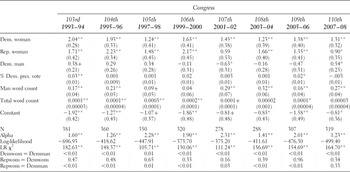
We also control for Democratic presidential vote share in each member's district. Democratic congresswomen represent districts with higher percentages of Democrats than Democratic congressmen do (Palmer and Simon Reference Palmer and Simon2008), and it is possible that high numbers of Democratic women in a member's constituency, rather than the gender identity of the member herself, motivates gendered rhetoric. Finally, our models include our key variables of interest: party and sex. Since we are interested in assessing how the interaction of gender and partisan identities shapes member behavior, we include a dummy variable for three categories of members: Democratic women, Republican women, and Democratic men. Republican men thus serve as the base category. The use of these dummy variables allows us to examine sex differences in women word count within each party, as well as partisan differences in women word count among congresswomen and congressmen. The results of eight separate negative binomial regression models are presented in Table 1.
Predicting “women” word count in one-minute speeches (negative binomial regression models)

Notes: The dependent variable is woman word count in one-minute speeches.
+p < 0.10; *p < 0.05; **p < 0.01
Table 1 provides strong support for the hypothesis that congresswomen are significantly more likely to interject gendered rhetoric in their one-minute speeches than are congressmen. The statistically significant coefficients for Republican women in seven of eight Congresses reveal that Republican women are more likely to mention women in their speeches than are Republican men, all else equal. Democratic women are also more likely than Republican men to mention women, and the difference is statistically significant at p < 0.01 in all eight Congresses. Finally, the last three columns show the results of testing the statistical significance of the differences between the coefficients for the key dummy variables in the model. In all eight Congresses, Democratic congresswomen mention women more than Democratic congressmen do (p < 0.01), and in all but the 110th Congress, Republican congresswomen are significantly more likely to mention women than are Democratic congressmen. Ultimately, across eight different Congresses, congresswomen from both parties are significantly more likely to draw attention to women's interests in their speeches than are their male counterparts.
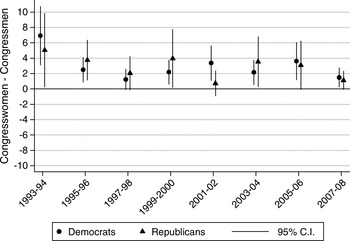
To demonstrate the substantive significance of the results, we plot the predicted word count difference between congresswomen and congressmen of the same party in Figure 1.Footnote 7 The difference is calculated holding the control variables at their mean values for each Congress. Positive values indicate that congresswomen speak about women more often than men do. Democratic women reference women 2.92 more times, on average, than do Democratic men across the eight Congresses, with a maximum average difference of 6.92 in the 103rd Congress and a minimum of 1.23 in the 105th Congress. The difference between Republican women and Republican men (2.91) is virtually identical to the difference between Democratic women and Democratic men. Again, it is the 103rd Congress in which the largest difference between women and men occurs, with Republican congresswomen mentioning women 5.04 more times than Republican congressmen. The smallest difference between Republican congresswomen and congressmen comes in the 107th Congress, when Republican congresswomen mention women, on average, 0.72 more times than do Republican congressmen (p > 0.10).
Sex differences in predicted “women” word count.

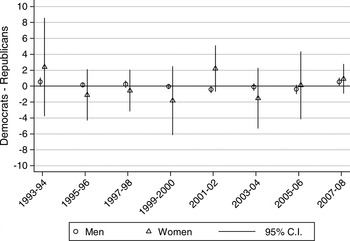
When we display partisan differences in predicted word counts in Figure 2, there is no consistent evidence of partisan differences. With the remaining control variables in the model held at their mean values, the 95% confidence intervals for the predicted count differences between the parties overlap zero in 15 of 16 cases. Positive values indicate that Democrats are more likely to discuss women. The observed differences between congresswomen produce no support for the partisan hypothesis, as there are no statistically significant differences between Democratic and Republican congresswomen in any of the eight Congresses. In two of the eight Congresses (103rd and 110th), Democratic congressmen mention women more often than their Republican counterparts do (p < 0.10).Footnote 8 In these two cases, the predicted difference in mentions of women is below two. In the 107th Congress, however, Republican men are more likely than Democratic men to mention women (p < 0.10), and there are no significant partisan differences in the remaining five Congresses.
Party differences in predicted “women” word count.

A cross-party comparison further illustrates the lack of a partisan effect on gendered rhetoric. Our hypotheses predicted that women and Democrats would be more likely to discuss women during debates. If these two identities had equivalent effects, then we would expect Democratic congressmen and Republican congresswomen to use gendered rhetoric at similar rates. The coefficient for Republican women, however, is significantly larger than the coefficient for Democratic men in seven of eight Congresses. Even in the 109th Congress, when the average Republican woman's voting record was just as conservative as her male GOP counterpart's (Frederick Reference Frederick2009), Republican women mention women, on average, 2.1 more times than do Democratic men. In addition, the difference between Democratic and Republican women's use of gendered rhetoric is statistically insignificant in all Congresses, even as polarization has increased over time.Footnote 9 In sum, sex differences, but not party differences, explain variation in the frequency with which members discuss women in their House floor speeches.
Congresswomen's discussion of women in their one-minute speeches spans a range of issues and perspectives. At times, we observe that women of both parties discuss similar issues from similar perspectives. Research shows that congresswomen of both parties prioritize breast cancer prevention and research (Dodson Reference Dodson2006; Kedrowski and Sarow Reference Kedrowski, Stine Sarow and Simon Rosenthal2002), a trend we also observe in our reading of congresswomen's one-minute speeches. In the 103rd Congress, ideologically conservative Republican Congresswoman Barbara Vucanovich (R-NV), for example, shared her own story: “A decade ago, I discovered I had breast cancer, a disease for which there was no cure. Ten years later there still is no cure and breast cancer continues to frighten women and men of all ages. . . . This month and next, I will be hosting Breast Cancer Public Education Fairs in my own State of Nevada designed to educate women on breast self-examination and mammography, as well as the status of legislation in the Halls of Congress” (Congressional Record H7386, 1993). In the same Congress, ideologically liberal Democratic Congresswoman Patricia Schroeder (D-CO) also encouraged American women to be screened: “The women in this body have been trying very hard to get American women to, please, go for mammograms and cancer screening. We know that breast cancer is now an epidemic in America, killing one out of eight, up from one out of nine. Mammograms and early detections can save lives” (Congressional Record H1075, 1994).
Congresswomen, however, are typically divided along party lines when it comes to abortion rights (Dodson Reference Dodson2006; Levy, Tien, and Aved Reference Levy, Tien and Aved2001; Swers Reference Swers2002). Not surprisingly, we also found several examples of Democratic (and a few Republican) congresswomen speaking in defense of abortion rights and Republican congresswomen speaking against abortion rights during their one-minute speeches, often focusing on the impact of abortion on women (see Levy et al. Reference Levy, Tien and Aved2001). For example, Congresswoman Sheila Jackson-Lee (D-TX) argued: “Banning the safest abortion option imposes an undue burden on a woman's ability to choose, and the life of the mother and the health of the mother, and the mother's ability to give birth in the future” (Congressional Record H4953, 2003). Congresswoman Louise Slaughter (D-NY) stated: “I rise to express my outrage at a dangerous antiwoman provision in this omnibus bill. I know that it is not going to be changed, but I do want all women in America to know what is coming for them. Let us say a woman is the unfortunate victim of a partial spontaneous abortion. . . . Presently, the law requires that a woman be taken care of; but even if a woman's life is at stake, even if she is going to die, the hospital does not have to do it” (Congressional Record H10919, 2004).
On the opposing side of the debate, many Republican congresswomen discuss the impact of abortion on women in their antiabortion one-minute speeches. For example, Marsha Blackburn (R-TN) argued: “Abortion has been a tragedy for many women here in the U.S., and it will carry with it the same hurt and trauma when it's used abroad” (Congressional Record H6832 2007). In a tribute to Susan B. Anthony echoed by many Republican congresswomen, Congresswoman Sue Myrick (R-NC) stated: “I rise today to honor Susan B. Anthony and her contributions to the struggle for women's rights many, many years ago. . . . She opposed abortion because she championed equal rights for all. She did not see a difference in fighting for women's rights and protecting the right to life for all children. She fought for both” (Congressional Record H742 2002).
Speeches during Significant Legislative Debates
When members give one minutes, they may discuss whatever topic they choose. We show that in these speeches, congresswomen from both parties are consistently more likely to discuss women than are congressmen. We analyze gendered rhetoric during debates over the most important floor votes. Every year since 1945, Congressional Quarterly has identified around a dozen votes as “key votes.” These are the votes considered the most important in each session because they represented a major controversy, because they were a matter of presidential or political power, or because of their potentially great impact on the lives of Americans (see Cranford Reference Cranford2006). Given their significance, these are also the debates most likely to be covered by the media. The topics vary in each session, ranging from the annual budget process to transportation to ethics issues to contentious social issues. We collected every speech given during debates on key votes in the 103rd, 104th, 109th, and 110th Congresses. At least one of our key words that make up the “women” category is mentioned in 82% of the key debates (92 out of 112). The average number of times one of our words is mentioned in a debate is 19.2 in the 103rd, 13.5 in the 104th, 23.3 in the 109th, and 8.7 in the 110th.
Unlike the protocol for one minutes, members speaking during a debate on a bill and its amendments are not necessarily recognized to speak on a first-come, first-served basis. The floor managers are typically the committee chair(s) and ranking minority party member(s) most involved in crafting the legislation, and they coordinate with party leaders. If there are more requests than time, floor managers determine which members speak, often thinking strategically about making the best case for or against a particular policy. Nonetheless, most members are accommodated, and all members are able to submit remarks during debate. To avoid any potential bias caused by the floor manager's selection process and the potential exclusion of certain types of members, we include members' remarks inserted in the Congressional Record.
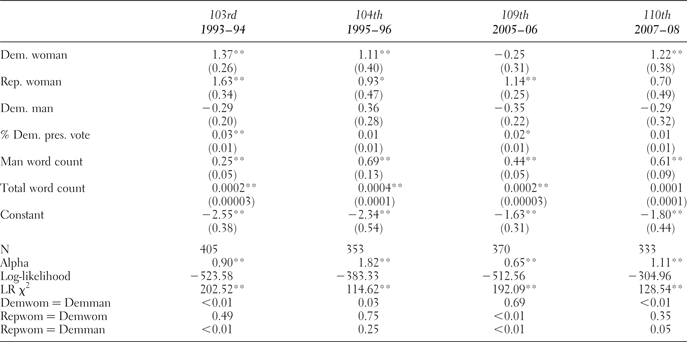
We present results from four separate negative binomial regression models in Table 2. The models use the same control variables from our previous analyses. The results from the debates over the most important legislation in each Congress are generally consistent with the results from the one-minutes models. In three out of four Congress—103rd, 104th, and 110th—Democratic women speak more about women during key debates than do Democratic men. Republican women similarly speak more about women than do Republican men in three out of four Congresses: the 103rd, 104th, and 109th, with a positive but not statistically significant (p < 0.15) coefficient in the 110th Congress.
Predicting “women” word count in key vote debates (negative binomial regression models)
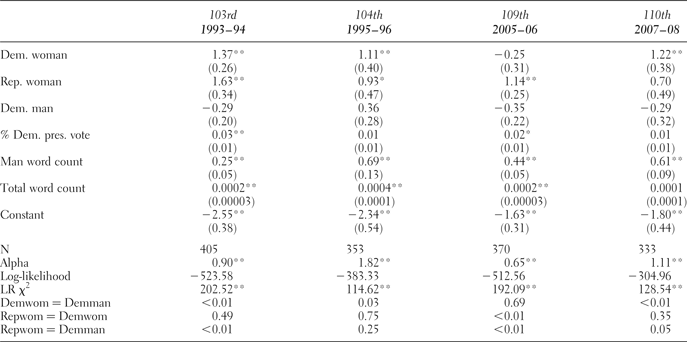
Notes: The dependent variable is woman word count in key vote debates.
+p < 0.10; *p < 0.05; **p < 0.01
Our results again demonstrate that sex differences better explain the use of gendered rhetoric than do partisan differences. Democratic men and Republican men speak about women at statistically indistinguishable rates in all four Congresses. By contrast, Republican women mention women more than do Democratic men in three out of four Congresses, with the largest differences coming in the 103rd and 109th Congresses, where Republican women mention women 2.1 and 2.0 more times, respectively, than do Democratic men.Footnote 10
During debate over the Family and Medical Leave Act in the 103rd Congress, for example, many congresswomen highlighted the bill's effects on women, and some drew upon their personal experiences. Congresswoman Cardiss Collins (D-IL), for example, stated: “In my district covering parts of Chicago and some of its western suburbs, 46 percent of all families are headed by single women. Having been a single parent, I can appreciate the dilemma of these mothers when one of their children becomes seriously ill and they face losing their jobs in order to attend to their parental duties” (Congressional Record H421 1993). Congresswoman Olympia Snowe (R-ME) argued: “The bill before the House today represents a moderate and appropriate response to the dramatic changes in the American work force as women and single parents compose an ever larger proportion of employees in many companies” (Congressional Record H390 1993).
The 109th Congress, during which Republican women invoke gendered rhetoric more frequently than do Democratic women, is the only Congress where we observe a statistically significant difference in the rate at which Republican and Democratic congresswomen evoke women during debate. In the same Congress, we observe partisan differences in gendered debate over the Iraq War, where Republican congresswomen used the debate as an opportunity to focus on the benefits of the war in Iraq for Iraqi women. For example, Congresswoman Jean Schmidt (R-OH) spoke of the liberation of Iraqi women as a reason to be proud of the U.S. military action in Iraq:
Mr. Speaker, I rise today to celebrate the new freedoms women have recently discovered in the Middle East, freedoms that the hardworking heroes in uniform have given them, freedoms they now not only cherish but themselves will fight for. There are 50 million new lovers of freedom in Iraq and Afghanistan. Their liberation from oppression should compel every freedom-loving citizen on Earth to rejoice. I too am so proud of the freedom we as a Nation have brought to the oppressed. However, some were more oppressed than others. Women had no voice, no opportunity, no hope, no dreams. All of that is changing, changing because we have championed the cause of freedom. Millions of young girls this very day are getting something they dared not dream about a few short years ago: an education. Today, women are voting. They are also serving as legislators in town councils and places where, before our commitment to liberation, they dared not even look a man in the face. They have been liberated. We are their liberators. We can and should be proud. Yes, more needs to be done, but in lands where women were treated worse than cattle, a revolution is occurring, a revolution of respect, a liberation of lives. Our actions have made the lives of millions of women not just better on the margins but have actually given them hope, endowed them with freedom, and dared them to dream. (Congressional Record H4142 2006)
Given most Democrats' opposition to the war in Iraq, Democratic congresswomen had no reason to express the potential benefits of the war on the lives of Iraqi women. The Iraq War debate suggests that, while congresswomen speak about women at roughly equal rates, gender identities sometimes work in concert with partisan identities to influence the extent to which they talk about women on the House floor.
The Iraq War debate is not the only debate during which congresswomen of one party proved more likely to mention women on issues supported by their party. In the 110th Congress, Democratic congresswomen mentioned women 0.72 more times, on average, than did Republican congresswomen in a debate over increasing the minimum wage (p < 0.10). Congresswoman Lois Capps (D-CA), for example, used the debate to highlight how women, in particular, stood to benefit from a minimum wage increase: “Women lag far behind men in terms of earnings. Nearly two-thirds of all minimum wage workers are women, many raising children” (Congressional Record H281 2007). Congresswoman Marcy Kaptur (D-OH) took a similar stance, noting, “The minimum wage is a women's working issue, and it is an issue for our children with over 1.4 million working mothers across this country who earn the minimum wage” (Congressional Record H281 2007).
The results from the analysis of debates over key votes provides further evidence that congresswomen of both parties are significantly more likely than congressmen to interject gendered rhetoric during debate. A close reading of members' speeches, however, indicates that scholars should proceed cautiously when analyzing the extent to which congresswomen represent women's interests. Although Republican and Democratic congresswomen prove equally likely to reference women in their speeches on topics of their choice, when we confine our analysis to debate in some key specific issue areas, partisan differences emerge.
DISCUSSION AND CONCLUSION
Our findings reveal a strong link between women's descriptive and substantive representation manifested in gendered rhetoric during members' floor speeches. We show that congresswomen in both parties are more likely than congressmen to discuss women in their speeches. Thus, speeches provide a venue for congresswomen to voice the “uncrystallized interests” of women across a range of issues (Mansbridge Reference Mansbridge1999). As part of their efforts to act as surrogate representatives for women across America, congresswomen use floor speeches as a way to bring women's perspectives to bear on the issues of the day (e.g., Carroll Reference Carroll and Simon Rosenthal2002). Women's stark underrepresentation provides them with extra incentives to ensure that women's perspectives, accomplishments, or grievances are highlighted on a range of topics that occur at the beginning of the legislative day and during legislative debate on key issues. Expanding studies of representation beyond substantive policy outputs to floor speech offers promise for scholarship on representation.
Our analysis also broadens the study of sex differences in congressional speech by analyzing multiple Congresses and thousands of speeches that cover multiple policy areas. Using the word-count measure allows us to quantify the different rates at which congressmen and congresswomen speak about women on the House floor in more than 30,000 speeches. Admittedly, this method may miss some instances where members talk about issues of importance to women without using one of our specified key words. For example, when members speak during debates over policies such as the Family and Medical Leave Act—legislation that disproportionately affects women—we do not code the speeches for gendered rhetoric if they mention families and workers rather than women specifically. Instead, we rely on members to link policies to women explicitly. The trade-off is that our method of searching for specified key words allows us to uncover acts of substantive representation in areas we did not expect. Our method also provides a useful, objective measure of the number of times members discuss women in their floor speeches, and it could be applied to other domains, such as the members' mentions of the president, their district, or political parties.
Just as women in America are not monolithic, neither are congresswomen. Mansbridge's (1999, 636) analysis of the value of descriptive representation of women makes it clear that women of both parties are needed to represent the heterogeneous views, experiences, and interests of women in America. The majority of women in the electorate identify as Democrats (e.g., Kaufmann and Petrocik Reference Kaufmann and Petrocik1999), and the same is true of women in Congress. But reflecting the conservative minority of Republican women in the electorate, during the past 15 years there has been an increase in ideologically conservative Republican congresswomen whose roll call votes are more similar to those of their male counterparts than to those of Democratic congresswomen (Dodson Reference Dodson2006; Frederick Reference Frederick2009; Gertzog Reference Gertzog2004; Swers Reference Swers2002). When the entire universe of issues that members raise in one-minute speeches and key policy debates are considered, however, the partisan differences in congresswomen's efforts to represent women's interests are less likely to appear than they are in different types of studies of women's representation that focus on specific policy outputs in specific policy domains. By allowing congresswomen, through their words, to identify the ways in which they advocate on behalf of women, we discover that congresswomen in both parties are more likely than men to discuss women in their speeches on policies ranging from Afghanistan to women's health. Electing more women to Congress will thus enhance the representation of women in the policymaking process across a range of issues.