Introduction
Current stresses on populations of Arctic animals include pollution, habitat loss, and diminution of pack ice due to global climate change. These threats have prompted ecological, physiological, and molecular research to study how Arctic species may respond to rapid environmental change. Recent genetic analyses have begun to reveal the evolutionary history of various Arctic species, data that may inform effective conservation efforts in a diminishing circumpolar habitat.
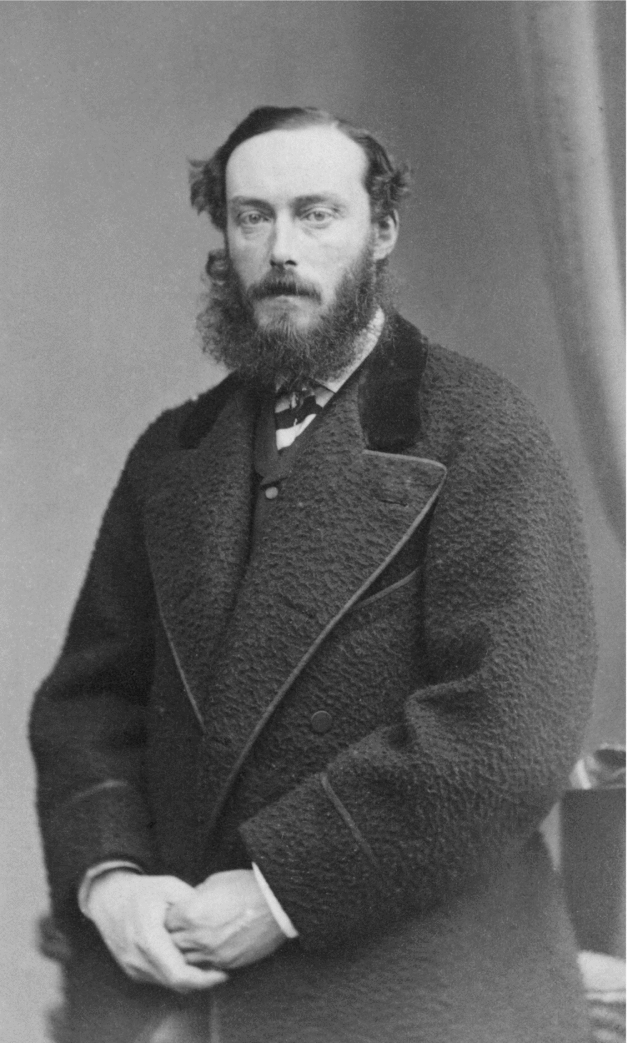
This contemporary focus on the evolutionary history of Arctic species has historic roots. A correspondence between a little known yachtsman and hunter named James Lamont (Fig. 1) and the naturalist, Charles Darwin, on examples of natural selection, prompted Lamont to write about walrus and polar bear adaptations and evolution during the heady days surrounding the publication of Darwin's On the origin of species. In these writings, Lamont foreshadowed recent findings from phylogenetic studies.
Sir James Lamont of Knockdow. The date of the photograph and photographer are unknown, but the photo was probably taken by McLean and Company, London, as it closely resembles a photo of Lamont in Lamont (Reference Lamont1950). With permission from the Royal Geographical Society IBG.

A dilettante geologist
In 1861, there appeared in London an Arctic travel adventure entitled Seasons with the sea-horses. The book's author, a Scot named James Lamont (1828–1913) had, at the age of 21, inherited a fortune including estates in Scotland and the West Indies. This allowed the purchase of a yacht for hunting expeditions further afield (Capelotti Reference Capelotti2013: 34–45; Lamont Reference Lamont1950: 6–7). Lamont became a member of the Royal Geographical Society, the Scottish Geographical Society, and the Geological Society. His daughter, Augusta Lamont, wrote in a brief biography that her father had a great ‘interest in new theories advanced by geologists in the mid nineteenth century’ (Lamont Reference Lamont1950: 20).
Seasons was a first-person chronicle of Lamont's two voyages around the Svalbard (referred to by Lamont as Spitzbergen [sic]) archipelago in the summers of 1858 and 1859. The cruises were primarily hunting enterprises, as evidenced by a frontispiece of a harpooner poised to thrust into a herd of walrus. Lamont imagined Svalbard as an ideal site to study Lyell's ‘theory of the gradual upheaval of the land in that remote part of the world’ (Lamont Reference Lamont1861: 2). His intent was to conduct a geographical survey and collect geological and biological samples for museum acquisitions and scientific societies in the United Kingdom. The book was dedicated to the preeminent geologist of the day, and a fellow Scot, Charles Lyell: ‘A copy of your delightful Principles of geology has been my unvarying and instructive companion during ten years of adventurous wanderings, during which everything I have seen seems to me entirely confirmatory of your Geological views. . . I shall esteem myself fortunate if any of the observations contained in it shall be the means of rivetting [sic] or strengthening a link in the beautiful chain of evidence by which you have in such a masterly manner demonstrated the perfect adequacy of present causes to remodel the surface of the earth (Lamont Reference Lamont1861: dedication page).
The fulsome acknowledgement reflects the influence of Lyell's work reaching back to Darwin's possession of the book during the voyage of Beagle from 1831–1836. It was Darwin's botany professor at Cambridge, John Henslow, who advised the young man to take the book with him, though he cautioned Darwin to ‘on no account to accept the views therein advocated.’ Henslow, like Darwin, had reservations about Lyell's thoughts on uniformitarianism, and his ‘insistence that the earth's changes were not necessarily progressive in nature’ (Browne Reference Browne1995: 187). Uniformitarianism propounded that all of the same forces of the past operated in the present (‘present causes’), and that organisms did not progress from simple to complex beings but always existed in a steady, non-varying state exactly as they are found today.
The summer of 1858
Lamont's first journey north was brief but memorable. ‘In August, 1858,’ he wrote in Seasons, ‘while cruising in my yacht the Ginevra . . . I was induced, by the accounts I received of reindeer and other game to be met with in Spitzbergen, to make a trip across from Hammerfest to that country. It being late in the season before we got there, our stay was very short. . . I however saw enough of Spitzbergen to convince me that the wonderful sport, and of a most original description, was to be obtained there by anyone who would go at the proper season, with a suitably equipped vessel and proper boats, manned by a crew of men accustomed to the ice and to the pursuit of the walrus and seal’ (Lamont Reference Lamont1861: 1–2).
The summer was momentous for Darwin as well, for on 18 June he received an essay and letter written by Alfred Russel Wallace, at the time resident in Ternate in the Mollucas. To Darwin's dismay, Wallace had independently arrived at the notion of natural selection, ultimately forcing a reluctant Darwin into print. The resulting publications of the two men quashed the concept of uniformitarianism, so far as it referred to biology, and all others proposing the fixity of species over time. In August 1858, while Lamont was sailing in Svalbard, Darwin's and Wallace's joint paper entitled, ‘On the tendency of species to form varieties; on the perpetuation of varieties and species by natural means of selection’ was published in the Journal of Proceedings of the Linnean Society of London on 20 August 1858. A month earlier the paper had been read aloud by the Cambridge ornithologist, Alfred Newton, at a gathering of the Linnean Society. Upon returning from the Svalbard cruise, Lamont too would have read about the progressive development of species by a mechanism called natural selection.
While Darwin embarked on the writing of On the origin of species, Lamont prepared for a new Arctic cruise, one he would ‘go about. . .in a more systemic way’ (Lamont Reference Lamont1861: 3).
The Svalbard Cruise of 1859
Seasons was largely a chronicle of Lamont's second Arctic cruise, a four-month hunt in and around Svalbard in 1859. ‘46 walruses, 88 seals, 8 polar bears, 1 white whale, 61 reindeer, total, 204 head’ were killed by the end of the hunting season. Lamont added, as an aside, that ‘we sank and lost about 20 Walruses and 40 Seal’ (Lamont Reference Lamont1861: 297). It was a small measure of the vast hunt in the islands, and Lamont himself estimated that ‘one thousand walruses and twice the number of bearded seals are annually captured . . . exclusive of those which sink or may die of their wounds’ (Lamont Reference Lamont1861: 176).
In early October 1859, while Lamont's schooner offloaded furs, blubber, ivory, and specimens in Scotland, Darwin was correcting the last of the page proofs of his book. Final revisions were returned to Darwin's publisher, John Murray, on 10 October (de Beer Reference de Beer1964: 154). Darwin had written to Murray that: ‘. . .I feel bound for your sake and my own to say in clearest terms that if after looking over part of the MS you do not think it likely to have a remunerative sale I completely and explicitly free you from your offer’ (Huxley Reference Huxley and Darwin1958: xi). Darwin need not have worried. On 24 November 1859, booksellers bought the entire first printing of 1,250 copies, while its author waited ‘for the storm to break over his head’ (de Beer Reference de Beer1964: 155).
As Lamont returned to Knockdow, the revolutionary ideas in Origin were at the forefront of newspaper and journal reviews and debates public and private. Lamont himself quickly applied Darwinian concepts to bird populations in Scotland and Norway; becoming a ‘disciple’ of Darwin (Lamont Reference Lamont1871). On 23 February 1860, he initiated a correspondence with Darwin (Lamont Reference Lamont1860). The issue was Darwin's paragraph (Reference Huxley and Darwin1958: 48) on the species status of the British grouse:
Several experienced ornithologists consider our British red grouse as only a strongly-marked race of a Norwegian species, whereas the greater number rank it as an undoubted species peculiar to Great Britain. A wide distance between the homes of the two doubtful forms leads many naturalists to rank them as distinct species; but what distance, it has been well asked, will suffice; if that between America and Europe is ample, will that between Europe and the Azores, or Madeira, or the Canaries, or between the several islets of these archipelagos, be sufficient?
Lamont wrote with characteristic aplomb (Lamont Reference Lamont1860):
. . .I may mention with deference that I do not think you have made the most of (Page 49) the similarity between our British red grouse and the Norwegian species: I have shot many thousands of British grouse and many hundreds of Norwegian Ripas, and may therefore be permitted to express my opinion viz. that not the smallest doubt exists on my mind as to their being merely ‘strongly marked varieties’ of the same species – the difference in their plumage being caused by the necessity for the British grouse to assimilate his plumage to the colour of brown heath, whereas the Norwegian Dal-ripa must more resemble grey rocks, birch-bushes (and snow in the winter) in order to protect his life from the numerous hawks, gulls, and ravens frequenting that country: these birds exactly resemble one-another in their size, their voice, their flight, and their general habits: and I have a few times killed a British grouse so white as exactly to resemble an accidently rather dark Dal-Ripa. . .”
To Darwin's comment, ‘When a species, owing to highly favourable circumstances, increases inordinately in number in a small tract, epidemics - at least, this seems generally to occur with our game animals - often ensue; and here we have a limiting check independent of natural selection’ (Darwin Reference Darwin1958: 68), Lamont provided a specific example (Lamont Reference Lamont1860):
Your remarks about an overstock of ‘game’ causing epidemics will be fully borne out by any observant game preserver or any intelligent gamekeeper.
I have no doubt that the grouse-disease so prevalent in Scotland for 13 or 14 years back was caused by nothing else than high preservation (aided by 2 or 3 wonderfully favorable breeding seasons consecutively) having got up a stock of grouse which the soil was unable to supply with a sufficiency of something essential to their existence: I have always suspected that this something was insects: it clearly was not for want of heather as has been nonsensically written, because in 1846–47 when it commenced there was heather enough to have kept all the grouse in Cowal on this estate, and yet they were dying in the hundreds. It may be worthy of observation that during that winter of ‘46–‘47 the grouse in this district first commenced the practice of coming down to the stubble-fields and low grounds as if in quest of something wh. they could not find in sufficient quantities on the hills : they have ever since more or less continued that habit, but previous to ’46 it was unknown in this district. . .
Lamont then amplified his thoughts by drawing on his experiences in Svalbard:
. . .It is a common remark all over Britain that the ‘game is becoming much wilder’: this seems to me very easy of explanation when we consider that formerly the greatest danger to game-birds was from hawks and their greatest security from them lay in cowering as much as possible, but now from the gradual extermination of hawks & and the frequency of shooters and goodness of guns, their principal danger is from the latter, and they are no doubt gradually finding out from generation to generation that their best mode of security is to fly off whenever they see a man. . .
. . .I have passed the last two summers in hunting in Spitzbergen and the great ice-fields lying around it: I shot 100 Reindeer there, and I am almost certain that many of these deer had never seen a human being in their lives before, because these were some so ridiculously tame as to come up – even to windward – to look. . .
This letter ends abruptly at ‘to look,’ and is clearly incomplete. Absent also is the first page, which would have included a salutation, date, and location, consistent with the other Lamont-Darwin letters. The three existing pages had been separated from one another as revealed by differential weathering of the paper and fading of the ink (observation by the author when examining the letters at the Cambridge University Library, January 2014). As Lamont's discourse moved to reindeer behaviour in Svalbard, one can only wonder what the missing page(s) contained.
Darwin took notice of Lamont's letter for a number of phrases were underlined by the recipient (shown above). The letter reflected Lamont's understanding of the process of natural selection as the cause of variations in plumage colour that adapted the birds to their local environments and hence reduced predation; behavioural plasticity in response to environment change; and the effect of disease on controlling population growth. Lamont's introductory letter provided Darwin with independent confirmation of the ideas proposed in Origin as well as additional data from the field, in this case, a specific example of natural selection occurring in wild bird populations in Scotland; all this while Darwin was besieged by criticism. Darwin was intrigued, and perhaps grateful, when he responded to Lamont on 5 March 1860 from Down House (Darwin Reference Darwin1860) .
Dear Sir,
I am much obliged for your long and interesting letter – You have indeed good right to speak confidently about the habits of wild Birds & Animals; for I should think that no one besides yourself has ever sported in Spitzbergen & South Africa! It is very curious & interesting that you should have arrived at the conclusion that so called ‘Natural Selection’ had been efficient in giving their peculiar colours to our grouse – I shall probably use your authority on the similar habits of our Grouse & the Norwegian Species.
I am particularly obliged for your very curious fact-of-the effect produced by the introduction of the Lowland Grouse on the wildness of the grouse in your neighbourhood – It is a very striking instance of what crossing will do in affecting the character of a breed. Have you ever seen it stated in any sporting work that game has been become wilder in this country? I wish I could get any sort of proof of the fact, for your explanation seems to me equally ingenious & probable. I have witnessed in S. American a nearly parallel case with that which you mention in regard to the reindeer in Spitzbergen, with the C. campestris of La Plata; it feared neither man nor the sound of shot of a Rifle, but it was terrified at the sight of a man on horseback; everyone in that country always riding. - As you are so great a Sportsman perhaps you will kindly look to one very trifling point for me, as my neighbours here think it too absurd to notice – Namely whether the feet of birds are dirty, whether a few grains of dirt do not adhere occasionally to their feet. I especially want to know how this is in the case of birds like Herons and Waders which stalk in the mud – You will guess that this relates to dispersal of seeds – which is one of my greatest difficulties – My health is very indifferent - & I am seldom able to attend the Scientific meetings, I sincerely hope that I may sometime have the pleasure of meeting you-
Pray accept my cordial thanks for very kind letter, & believe me. Dear Sir.
Your obliged servant
Charles Darwin
Arctic hunter as scientist
The complementary letter from a naturalist of Darwin's stature no doubt inspired Lamont. The early pages of Seasons reiterated themes from the initial correspondence with Darwin and indicate to the reader that the work was intended as more than the story of a hunt:
we took several walks in the mountains [around Hammerfest], and shot a few ducks, ptarmigans, and ripas for the table. I have shot many hundreds of these two last-named birds throughout Norway, and I have not the smallest doubt on my own mind that they are both identical in species with our Scottish ptarmigan and red-grouse, being merely, as Mr. Darwin would say, ‘strongly marked varieties,’ altered by geographical conditions, such as the greater cold and the necessity for the protection of a plumage more resembling the country they frequent. I have very little doubt that, if the dal-ripas were taken to Scotland, or the red-grouse to Norway, a few generations would be sufficient to cause them to resemble exactly the variety existing in the country to which they were transferred (Lamont Reference Lamont1861: 17–18).
On his second Arctic cruise Lamont instructed the sailing master of Ginevra ‘to employ his personal leisure in collecting and carefully labelling fossils and shells, and also small bags of gravel from different elevations, as well as some specimens of whales’ bones and driftwood from the highest elevations he could find them on’ (1861: 29), the mission being to search for evidence of Lyell's ‘theory of the gradual upheaval of the land’ (1861: 2). Lamont himself ‘found part of a whale's skeleton at an elevation of 40 ft (12 m) or upwards above the sea. The bones were a good deal decayed, and were partly overgrown with moss, as if they had lain there for many years’ (Lamont Reference Lamont1861: 108). Other bones were found at elevations up to 200 ft (61 m) above sea level. Whereas the sailors had told Lamont that the ‘sea was going back,’ he instead insisted that the ‘whole of Spitzbergen has been gradually rising within the last few hundred years, and that this upheaval is still continuing.’ Lyell, in Principles of geology, had calculated that the seashore of Norway had risen by four ft (1.22 m) per century (Lamont Reference Lamont1861: 202–204). Assorted rocks, fossils, bones, and shells collected on the expedition were later donated to the museum of the Geological Society, and the results published in the Quarterly Journal of the Geological Society the following year.
Interspersed throughout Seasons were many astute observations about the biology of the Arctic fauna. When Lamont wrote: ‘We saw two huge Mysticeti, or “right whales,’ lazily rolling on the surface and blowing sonorously, at one or two miles’ distance. . . The sea here swarms with incredible numbers of minute Medusae, on which these whales were probably feeding when we saw them. The animalculae also seem to be affording an inexhaustible banquet to gulls and guillemots by the thousand’ (Lamont Reference Lamont1861: 269), he was revealing a basic knowledge of the Arctic food web. Other passages revealed Lamont as a keen observer of animal behaviour:
The pursuit of the great Spitzbergen seal (Phoca barbata), although it lacks the wild excitement of the chase of the sea-horse, is a very delightful amusement. The great seal will never allow himself to be ‘caught napping; I do not think I ever saw a sleeping seal which did not, about once in every three or four minutes, raise his head from the ice, and look uneasily around, so that he cannot be harpooned in his sleep, like his more lethargic congener the walrus. I imagine this greater watchfulness on the part of the seals to arise from the greater cause they have to apprehend being ‘stalked’ by the bears, while taking their siestas (Lamont Reference Lamont1861: 55–56).
Lamont had developed a biologist's instincts. The biological themes in Seasons encompassed animal behaviour, prey-predator relations, community structure, food webs, thermoregulatory adaptations, and comparative anatomy, the observations spanning animals from marine invertebrates to birds and mammals. Moreover, the following passages reveal that Lamont was familiar with the works of other evolutionary theorists like Jean-Baptiste Lamarck and Robert Chambers, the author of Vestiges of the natural history of creation (1844). Vestiges was a provocative bestseller of its day for broaching ‘the most touchy subject it treated, the creation of new species by transmutation’ (Secord Reference Secord2000: 109), so much so that it was originally published anonymously, as Chambers later revealed, ‘to protect his family and his reputation’ (Secord Reference Secord2000: 371). As both Chambers and Lamont had residences in Edinburgh and were members of the Geological Society, it is possible that they were acquaintances.
Thus, from Lamont's firsthand observations of the Arctic biota and his awareness of early evolutionary works, he was now able to comment presciently on two major Arctic fauna, the polar bear and walrus:
It seems to me that an attentive study of the Arctic Fauna is capable of throwing great light upon the debated questions in Natural History.
I am aware that I am now treading upon very dangerous grounds, and that what I say will be severely criticised; but I will ‘take a header’ into the deep waters of controversy at once, and unhesitatingly avow my belief that an attentive study of the Arctic animals is capable of mightily strengthening the theory of progressive development, first suggested by the illustrious Lamarck, and since so ably expounded and defended, under somewhat modified forms, by the author of the Vestiges of creation and by Mr. Charles Darwin.
There, Messieurs les Critiques, is a chance for you! Pitch into him; jump down his throat; tear him in pieces; the Atheist ! The Lamarckian ! the disciple of the atrocious author of the ‘Vestiges,’ &e. &e. &e.
I acknowledge with humility my presumption in entering upon so profound a question in Natural History; but although I make no pretensions to the character of a scientific naturalist, still I have had the opportunities such as few have enjoyed, of observing and studying the habits and mode of life of strange animals in many strange countries; and the more I observe nature, and ponder on the subject, the more do I become convinced that Almighty God always carries out his intentions with regard to the animal creation, not by ‘direct interpositions’ of His will, nor by ‘special fiats of creation,’ but by the slow and gradual agency of natural causes.
It might naturally be expected that in such inclement regions, and where so little vegetation exists as in the Arctic zone, there must be only a very few living animals, and those few of a dwarfish and miserable nature; but, on the contrary, no portion of the surface of the globe more abounds in animal life, from the minute animalculae – which, although too small to be seen in detail without a microscope, are yet in the aggregate so numberless as to discolour the ocean – to the huge walrus and the vast mysticetus with his congeners. All this life hangs together from link to link in a beautiful chain : thus the different animalculae prey on one another; the shrimps and the small fishes prey on the larger animalculae; the seals and walruses and the numerous sea-fowl prey on the shrimps and the fishes; the bear preys on the seal and the walrus, and the fox on the sea-fowl” (Lamont Reference Lamont1861: 271–273).
‘Taking a header into the controversy,’ Lamont thought in depth about the natural history of the polar bear (Ursus maritimus):
The Polar bear seems to me to be nothing more than a variety of the bears inhabiting Northern Europe, Asia, and America; and it surely requires no very great stretch of imagination to suppose that this variety was originally created, not as we see him now, but by individuals of Ursus arctos in Siberia, who finding their means of subsistence running short, and pressed by hunger, ventured on the ice and caught some seals. These individuals would find that they could make a subsistence in this way, and would take up their residence on the shore, and gradually take to a life on the ice. Polar bears in the present day are often carried on the ice to Iceland, and even to within swimming distance of Northern Norway, so there is no impossibility in supposing that the brown bears, who by my theory were the progenitors of the present white bears, were accidentally driven over to Greenland and Spitzbergen by storms or currents. Individual bears of U. arctos are found frequently of a silvery grey colour, and such bears are known in Norway as ‘silver bears.’ Then it stands to reason that those individuals who might happened to be palest in colour would have the best chance of succeeding in surprising seals, and those who had most external fat would have the best chance of withstanding the cold. The process of natural selection would do the rest, and Ursus arctos would, in the course of a few thousands, or a few millions of years, be transformed into the variety at present known as Ursus maritimus.
It may be urged against this that ‘there is no reason, if my theory is true, why brown are not still occasionally taking to a Polar life, catching seals and turning white’ (?) The answer is easy: the ground is already occupied by the variety of bear formed by Nature, acting through the process of natural section, for catching seals. The seals are so shy that even the existing white bears have difficulty in living, and a brown bear, although he may eke out his means of subsistence by occasionally still catching a seal on the shores of Siberia, would have no chance of succeeding in the struggle for life if he were to set off on a seal-hunting expedition, and to enter into competition with his white congeners, who are already formed and fitted by Nature, through countless generations, for that particular mode of life*” (commentary on the asterisk is later) (Lamont Reference Lamont1861: 273–275).
Lamont next conjectured on the origins of the walrus (Odobenus rosmarus rosmarus):
I think that appearance and the very existence of the walrus are among the strongest and most incontestable proofs to be found in the handwriting of Nature throughout all the animal kingdom in support of the theory of creation by slow and gradual causes, and in opposition to that of abrupt, unnatural, and uncalled-for interpositions of the Divine will.
There are very few or no animals in the world which seem to me to constitute so clear and well-defined a link between two different and distinct races; and I can hardly understand how any reflecting and unprejudiced person can attentively study the habits of the walrus when alive, or even attentively examine his skeleton when dead, without coming to the conclusion that he forms a plain and unmistakable link between animals inhabiting the land and cetaceans or whales.
The origin of the walrus is a much more difficult and complicated problem to solve, than to account for the divergence from the original stock of the white bear; but nevertheless, I think the walrus must have originated in much the same sort of way as that by which I have attempted to explain the origin of U. maritimus; only, for the creation of the walrus, I must claim the indulgence of my opponents to grant me a few more millions of that cheapest of all commodities, past years. I require this little extension to enable me to make good my argument, because the walrus differs far more from any known animals, living or extinct, than does the white from the brown bear; also, I have stated that I conceive the Polar bear to have become a Polar bear by living on seals, and it is therefore to be supposed that the seal and the walrus were originated first.
In reference to the fact of a black bear having been seen swimming for hours with his mouth open catching insects in the water, like a whale, Mr. Darwin states (page 184), that
Even in so extreme a case as this, if the supply of insects were constant, and if better adapted competitors did not already exist in the country, he can see no difficulty in a race of bears being rendered by natural selection, more and more aquatic in their structure and habits, with larger and larger mouths till a creature was produced as monstrous as a whale.
I see no difficulty in it either, but it is certainly a very extreme case to put, and there is much less difficulty in believing that the thing should have come to pass in a more gradual manner – by steps, as it were.
‘Suppose then the case of a bear (or any other large land animal, existing or extinct) living on the border of the then existing Polar sea. We can easily fancy that in the struggle for existence perpetually going on, this bear – or whatever he was – may have been compelled to take to the sea shore and prey upon shell-fish amongst other things. At first he would only go into shallow water, but he would become emboldened, by success and habit, to go deeper and deeper; even in the lifetime of one individual this would happen, and he would acquire the habit of digging shells up with his feet or his teeth – at first probably with his feet, but latterly, when he came to picking shells in a foot or two of water, he would require to see what he was about, and he would use his teeth. Natural selection would now come into play, and as those animals that had the best and longest teeth would succeed best, so they would have the best chance of transmitting these peculiarities to their descendants. The tusks of the walrus are not, as I mentioned before, a pair of extra teeth, but merely an enlargement or extraordinary development of the eye-teeth, and I think it is easy to conceive that any large carnivorous animal driven by necessity to subsist on shell-fish under water would, in a few thousands of generations, acquire tusks.
Also, he would soon learn to dive, and to hold his breath under water, and from generation to generation he would be able to stay longer below. As he would have very little use for his legs they would soon become abortive as legs, and grow more into the resemblance of fins; the hind legs would somewhat resemble the tail of a fish and would do duty for that organ, so his real tail would almost disappear as is the case with the seal and walrus (Lamont Reference Lamont1861: 275–279).
. . .It is needless to recapitulate the description of the manner in which I humbly conceive it possible these mighty animals might have been developed, as the cases hypothetically put before must have explained my meaning sufficiently; and my utmost hope is that the suggestions and remarks I have thrown out about the appearance and habits of animals so little known may assist in enabling other better qualified advocates of the great theory of progressive development by means of natural selection, to work it out to demonstration (Lamont Reference Lamont1861: 282).
In a footnote, indicated by the asterisk above, Lamont stated:
It will be obvious to any one that I follow Mr. Darwin in these remarks: and although the substance of this chapter was written in Spitzbergen, before the ‘Origin of Species’ was published, I do not claim any originality for my view; and I also cheerfully acknowledge that, but for the publication of that work in connection with the name of so distinguished a naturalist, I never would have ventured to give to the world my own humble opinions on the subject (Lamont Reference Lamont1861: 275).
Since none of Lamont's logbooks, notebooks, or diaries chronicling the voyages of 1858 and 1859 survive, it is impossible to confirm or refute when, or if, Lamont had any seminal thoughts on natural selection, independent of Darwin and Wallace, prior to the publications of the joint Wallace-Darwin paper and Origin. Yet one thing is certain. Lamont had read Origin prior to writing his initial letter to Darwin in February1860 as the intent of the letter was to address specific points raised in Origin on the British grouse. Augusta wrote of her father, ‘It is a matter for regret that one who had varied and interesting experiences kept no written record of his doings and observations other than what is contained in the two books (author insertion: Seasons with the sea-horses, 1861 and Yachting in the Arctic seas, 1876) above-named dealing with his Arctic voyages. Writing was distasteful to him, and he seldom put pen to paper unless roused by some controversial topic which impelled him to enter the lists in support often of the less popular point of view’ (Lamont Reference Lamont1946: 76–77).
Having aligned himself with the transmutationists, Lamont sent a copy of Seasons to Darwin sometime prior to 25 February 1861, though no letter accompanying the gift is known to exist. The book illustrated to the naturalist a number of cases of natural selection at work in Arctic species. On 25 February [1861?] a letter from Darwin to Lamont (Darwin Reference Darwin1861) expressed his gratitude:
Dear Sir,
I am extremely much obliged for your very kind present of your beautiful work ‘Seasons with the Sea-Horse,’ – and I have no doubt that I shall find much interesting from so careful and acute an observer as yourself
Dear Sir
Yours sincerely obliged_
Charles Darwin
P.S. I have just been cutting the leaves of your book & have been very much pleased and surprised at your note about what you wrote in Spitzbergen _ As you thought it out independently, it is no wonder that you so clearly understand Natural Selection which so few of my Reviewers do or pretend not to do.
I never expected to see anyone so heroically bold as to defend my bear illustration_ But a man who has done all that you have done must be bold! It is laughable how often I have been attacked and misrepresented about this Bear _ I am much pleased with your remarks and thank you cordially for coming to the rescue.
Darwin's letter alludes to the ‘bear-whale’ passage in the first edition of Origin that was the source of much exaggeration, misconstruction, and ridicule by Darwin's critics and was consequently omitted from later editions of the work.
Lamont returned to the Arctic for another series of hunting/surveying expeditions from Svalbard east to Novaya Zemlya from 1869 to 1871, voyages described in Yachting in the Arctic seas (Lamont Reference Lamont1876). There are no references to Darwin or any mention of new observations of natural selection acting on Arctic species, but this was not because Lamont had given up on natural selection. Lamont continued to follow Darwin's career, as shown by his letter of 23 August 1871 (Lamont Reference Lamont1871):
Dear Sir,
I have lately returned from an Arctic Cruise during which I had with me your late work on the Ascent of Man.
I need not say how much pleasure I derived from its perusal. As you will perhaps remember that 10 years ago I was one of your earliest disciples and believers.
I was much struck with your remarks about Cystophora Cristata – the bladder nosed seal. I shot 600 of these in the month of June, and was very much with the extraordinary peculiarity in question _ but I regret that I can throw no light on the (two words were unintelligible to author during transcription) of what it might be. I think it must be a mere sexual distinction, and it undoubtedly exists in a rudimentary state in the females.
I have seen the old bulls when angry or excited blow it up as big as a foot-ball, and it quivers in the act of inflation like a child's ball of thin india-rubber.
I had much discussion with other people to whom the animal is familiar, as to the use of the appendage _ but the only rational opinion I heard from anyone was that it was of the same use as a turkey cock's wattles were to him!
I have brought home several of the heads of the seals in pickle, and if you should care to have one it would give me great pleasure to forward it to you in a keg.
I am yours very truly
J. Lamont
Despite the erroneous reference to the book as the Ascent of man, Darwin found Lamont's observations of the bladder-nosed seal (Cystophora cristata) credible as he incorporated part of last letter almost verbatim into the second edition of The descent of man (Darwin Reference Darwin1882: 528). Darwin wrote: ‘I am assured by Mr. Lamont who killed 600 of these animals, the hood is rudimentary in the females, and it is not developed in the males during youth.’ It now commonly known that hood of Cystophora cristata is an example of sexual dimorphism and inflated by mature males for mate attraction and aggressive displays towards other males, especially during breeding season.
As there was no known correspondence between the two men after 1871, it could not be determined whether Darwin accepted the offer of a pickled seal head.
James Lamont and current thinking on polar bear and walrus evolution
The primary motive behind the 1859 cruise to Svalbard was the acquisition of blubber, ivory, skins, fur, and meat to be sold for profit. Yet, due to the impression made by Origin, Lamont developed the eye of a biologist. Consequently, Seasons became an early account of the polar ecosystem in the days before biology or ecology were distinct disciplines of study. Lamont's observations of the Arctic fauna, in particular those adaptations of the polar bear and walrus to their environment, were full of insight, often accurate, and portentous.
Recent studies on ancient and extant polar bear DNA have confirmed Lamont's supposition that polar bear diverged from the brown bear lineage. Depending on the bear DNA sampled and genetic techniques used, the timing of the polar bear split from its progenitor is highly variable (Hailer and others Reference Hailer, Kutschera, Hallström, Klassert, Fain, Leonard, Arnason and Janke2012; Krause and others Reference Krause, Unger, Nocon, Malaspinas, Kolokotronis, Stiller, Soibelzon, Spriggs, Dear, Briggs, Bray, O’Brien, Rabeder, Matheus, Cooper, Slatkin, Pääbo and Hofreiter2008; Miller and others Reference Miller, Schuster, Welch, Ratan, Bedoya-Reina, Zhao, Kim, Burhans, Drautz, Wittekindt, Tomsho, Ibarra-Laclette, Herrera-Estrella, Peacock, Farley, Sage, Rode, Obbard, Montiel, Bachmann, Ingólfsson, Aars, Mailund, Wiig, Talbot and Lindqvist2012; Yu and others Reference Yu, Li, Ryder and Zhang2007), as was Lamont's prediction of ‘a few thousands, or a few millions of years.’ Lamont erred in surmising that the walrus was a transitional form between a land animal and a cetacean, however his idea that the walrus originated from a ‘bear (or any other large land animal, existing or extinct) living on the border of the then existing Polar sea’ was correct. Recent molecular studies suggest a monophyletic origin for the pinnepids and a closer alignment to an ursine-like ancestor than to the mustelids (Luan and others Reference Luan, Ryder, Davis and Zhang2013). Moreover, early pinniped fossils like Enaliartos, a flippered, marine form, and Puijila, a transitional terrestrial form with putative webbed appendages (Rybczynski and others Reference Rybczynski, Dawson and Tedford2009) predate the earliest polar bear fossils. Lamont's statement: ‘I have stated that I conceive the Polar bear to have become a Polar bear by living on seals, and it is therefore to be supposed that the seal and the walrus were originated first,’ might, according to the fossil record and current phylogenetic dating, have credence.
Conclusions
A serendipitous coalescence of events in the 1850s allowed James Lamont to conjecture on the natural selection of Arctic fauna, thoughts that one hundred and fifty years later have been shown by present-day researchers to possess fair accuracy. A significant personal income allowed Lamont to cruise to remote regions and observe rare species in the wild. His wide interest in geology, geography, natural history, in conjunction with an understanding of the writings of Lamarck, Chambers, and Darwin, provided Lamont with insights on transmutation and nascent evolutionary theory. Also important was Darwin himself, a man with an insatiable curiosity and interest in collecting evidence from around the globe to support the universality of his ideas. Finally, it was the encouraging correspondence with the naturalist that prompted the Scottish adventurer to neatly fit his observations of Arctic fauna into Darwin's larger framework of natural selection.
Acknowledgments
This work was supported by a Penn State Faculty Development Grant awarded to the author. The author would like to thank Dr. P. J. Capelotti for the introduction to the correspondence between James Lamont and Charles Darwin. Additional thanks are extended to the curators of the Darwin Correspondence Project housed at the University of Cambridge Library for allowing the author access to the original letters of correspondence between James Lamont and Charles Darwin; and to the curators at the National Library of Scotland in Edinburgh for permission to study the Lamont family papers. Finally, the author thanks Joy Wheeler for her kind assistance in obtaining photographs of James Lamont from the Picture Library at the Royal Geographical Society, London.