Based on the previous ten to fifteen years of bilingual research it is now clear that bilingual language processing is fundamentally language non-selective in nature. That is, despite a bilingual's intuitions, both languages are active and influence language processing, even when the intention is to communicate in a single language. For example, when bilinguals are presented with cognates, words that have the same meaning and highly similar form across languages (e.g., piano/piano in English–Spanish), processing time is reduced relative to non-cognate control words (e.g., pencil). Effects of cross-language activation have also been observed for words that do not have the same degree of lexical and semantic overlap as cognates such as interlingual homographs, which do not share meaning (fin which means “end” in Spanish) (e.g., Dijkstra, Van Jaarsveld and Ten Brinke, Reference Dijkstra, Van Jaarsveld and Ten Brinke1998; Dijkstra, De Bruijn, Schriefers and Ten Brinke, Reference De Bruijn, Dijkstra, Chwilla and Schriefers2000), and cross-language orthographic neighbors (words that share all but one letter across languages such as dine/cine in English and Spanish) (Van Heuven, Dijkstra and Grainger, Reference Dijkstra, Van Jaarsveld and Ten Brinke1998; Jared and Kroll, Reference Jared and Kroll2001). Non-selectivity has also been demonstrated in domains beyond visual word recognition such as auditory processing (e.g., Pallier, Colomé and Sebastián-Gallés, Reference Pallier, Colomé and Sebastián-Gallés2001), speech production (e.g., Hermans, Bongaerts, De Bot and Schreuder, Reference Hermans, Bongaerts, De Bot and Schreuder1998), and sentence comprehension (e.g., Altarriba, Kroll, Sholl and Rayner, Reference Altarriba, Kroll, Sholl and Rayner1996; Schwartz and Kroll, Reference Schwartz and Kroll2006).
Despite the pervasive support for non-selectivity, issues remain regarding the specific nature of cross-language activation. First, there must be some constraints exerted on cross-language activation, otherwise how is it that bilinguals manage to communicate in a single language? What constraints are exerted on this activation that allows the bilingual to ultimately select the appropriate word from the appropriate language?
Since words are most often encountered within a meaningful linguistic context, we examined what influence a sentence context would have on cross-language activation flow. We hypothesized that the specific type of lexical candidates that become activated from the non-target language would be modified by the presence or absence of a linguistic context, such as a sentence. More specifically, we predicted that, when a word is embedded in a sentence that biases its meaning, lexical access of that word would be more semantically-driven relative to when that word is presented in isolation. As a consequence, the lexical competitors that become activated from the non-target language, prior to the completion of lexical access, should be semantically related to the word rather than related in form. In contrast, when words are presented in isolation, processing is less likely to be as semantically driven thus, in this case, the activated lexical competitors should be related in form rather than meaning. In addition to these predictions regarding the nature of activation, we also predicted that the presence of a sentence context would alter the magnitude of cross-language activation. Based on recent studies (e.g., Van Hell, Reference Van Hell1998; Elston-Güttler, Gunter and Kotz, Reference Elston-Güttler, Gunter and Kotz2005; Schwartz and Kroll, Reference Schwartz and Kroll2006) we expected to observe less effects overall of the activation of the non-target language in a highly biasing sentence context relative to a single word context. We therefore predicted that context would have a direct and fundamental impact on the processes of lexical access.
Such findings would have important implications for current models of bilingual lexical processing and further our understanding of how contextual information interacts with activation within the bilingual lexicon. Furthermore, the present study has implications for general models and theories of lexical access that extend beyond issues related to bilingualism: much of the research to date on the effects of sentence context and lexical access has concentrated on the recognition of within-language, form-identical homographs. Since bilinguals have two, very different lexical entries for most concepts, we do not need to rely on homographs which have other lexical characteristics (i.e., inflated lexical frequency) that can confound findings. Before describing this study in more detail, we first review recent, relevant research on the effects of sentence context on lexical access. As will become evident in this review, while there is a long history of research on the effects of sentence context for monolingual reading, very few studies have examined this question for bilingual reading.
Effects of sentence context on lexical access: Monolingual investigations
A central issue in monolingual investigations of sentence processing has been determining whether the top–down processes of sentence comprehension interact directly with lexical access of individual words. For example, does the semantic information provided by the sentence context “Before going to bed his mother would always read him a bedtime___” aid in the lexical access of “story”? Or, are the bottom–up processes of lexical access completely encapsulated and thus unaffected by the top–down processes of sentence comprehension? While there is general agreement that context aids in the interpretation of words, there is still debate concerning the time-course with which selection of the appropriate meaning takes place and how early in the process of lexical access context can exert its effect. According to context-independent theories, sentence context does not exert a direct effect on the processes of lexical access. Instead, the effects of a sentential context are assumed to occur after initial lexical access has already been completed. Thus, multiple lexical candidates are initially activated, without any influence from context and the eventual selection of the appropriate meaning occurs only after the word has been accessed (e.g., Swinney, Reference Swinney1979; Onifer and Swinney, Reference Onifer and Swinney1981). Such a theory would predict that, in the present study, the presence of a sentence context would not directly affect the nature and magnitude of cross-language lexical activation.
According to context-dependent theories, on the other hand, the conceptual representations of sentences that readers build have an early influence on lexical access. Thus, language processing is seen as being highly interactive, such that lexical knowledge, world knowledge and the semantic and syntactic information provided by a sentence interact with the bottom–up processes that drive lexical access (e.g., Stanovich and West, Reference Stanovich and West1983; Simpson and Kreuger, Reference Simpson and Kreuger1991; Tabossi and Zardon, Reference Tabossi and Zardon1993).
Increasing evidence from a variety of paradigms such as eye-movement monitoring and the use of event-related potentials, supports more of a combination of both context-dependent and context-independent processes (e.g., Morris, Rayner and Pollatsek, Reference Morris, Rayner and Pollatsek1990; Rayner and Morris, Reference Rayner and Morris1991; Dopkins, Morris and Rayner, Reference Dopkins, Morris and Rayner1992; Binder and Morris, Reference Binder and Morris1995; Folk and Morris, Reference Folk and Morris1995; Sereno, Brewer and O'Donnell, Reference Sereno, Brewer and O'Donnell2003). The re-ordered access model (Duffy, Morris and Rayner, Reference Duffy, Morris and Rayner1988) is considered a hybrid theory and has been largely based on studies examining how ambiguous words that map on to more than one meaning within a single language (e.g., pitcher) are processed in sentence context. According to this model, the extent to which the multiple meanings of an ambiguous word compete is dependent on the relative time-course of their activation. The time-course of activation, in turn depends on the relative frequency of the alternative meanings and the contextual support provided by the sentence. In the absence of a biasing context, the relative frequency of the alternative meanings determines the order (or relative speed) of their activation. However, a strong biasing context can reorder this activation. Thus, according to this model, initial word access is affected by both lexical and sentential factors. The model can effectively accommodate many of the different findings from monolingual studies of sentence processing. It is important to study whether this model can be applied to the understanding of bilingual sentence processing and the dynamics of cross-language lexical competition. In this paper we discuss how this model, in addition to bilingual models, can be used in the interpretation of our bilingual experiments.
Effects of sentence context on lexical access: Bilingual investigations
As described above, findings from monolingual studies suggest that a sentence context does have a direct effect on lexical access, and when sufficient information is provided, it can alter the relative activation of an ambiguous word's different meanings. What about the bilingual case? It would seem most parsimonious to assume that a sentence context would affect bilingual lexical processing in a similar way. However, bilinguals are not simply two monolinguals in one (Grosjean, Reference Grosjean, De Groot and Kroll1997) and there are a number of factors that are relevant in bilingual processing that simply do not exist in the monolingual case. For example, bilinguals are proficient in two completely different language systems, which more often than not, follow very different syntactic structures and phonology. It is possible that these language-wide differences provide linguistic cues not available to monolinguals that may be sufficient to completely eliminate lexical competition. We can call this a “strong context-dependent” hypothesis. On the other extreme, one might predict that a sentence context, no matter how constraining or biasing, does not have any effect at all on cross-language activation. We can call this a “strong context-independent” hypothesis. As discussed below, emerging evidence does not support either extreme, but rather a hybrid of both context dependent and independent processes (much like what has been discovered in monolingual research).
Although the majority of studies that have provided support for cross-language non-selective activation have been based on isolated word recognition tasks such as lexical decision and word naming (e.g., Gollan, Forster and Frost, Reference Gollan, Forster and Frost1997; Van Heuven et al., Reference Van Heuven, Dijkstra and Grainger1998; Dijkstra et al., Reference Dijkstra, De Bruijn, Schriefers and Brinke2000; De Bruijn, Dijkstra, Chwilla and Schriefers, Reference De Bruijn, Dijkstra, Chwilla and Schriefers2001; Jared and Kroll, Reference Jared and Kroll2001; Dijkstra and Van Hell, Reference Dijkstra and Van Hell2003; Schwartz, Kroll and Diaz, Reference Schwartz, Kroll and Diaz2007), there have been a few, recent studies that have examined how non-selectivity is modulated by context (Van Hell, Reference Van Hell1998; Elston-Güttler, Reference Elston-Güttler2000; von Studnitz and Green, Reference von Studnitz and Green2002; Greenberg and Saint-Aubin, Reference Greenberg and Saint-Aubin2004; Elston-Güttler et al., Reference Elston-Güttler, Gunter and Kotz2005; Schwartz and Kroll, Reference Schwartz and Kroll2006). One consistent finding across these studies has been that the presence of a sentence context, in and of itself, is not sufficient to eliminate effects of non-selective, cross-language activation. For example, both Van Hell (Reference Van Hell1998) and Schwartz and Kroll (Reference Schwartz and Kroll2006) observed facilitated processing of cognates when these were embedded in low-constraint contexts. Another consistent finding from these studies is that, when the sentence context biases the meaning of the target words, processing of those targets appears to be language-selective. For example, the cognate facilitation observed by Van Hell (Reference Van Hell1998) and Schwartz and Kroll (Reference Schwartz and Kroll2006) in low-constraint sentences was completely eliminated when the same words were embedded in high-constraint sentences.
These findings provide compelling evidence that a sentence context can constrain the overall degree of cross-language lexical activity. Interestingly, unlike their findings for cognates, Schwartz and Kroll (Reference Schwartz and Kroll2006) did not observe any effects of cross-language activation on the processing of interlingual homographs (e.g., fin) in either low- or high-constraint sentences. They argued that, since interlingual homographs only share lexical form and not semantics, they are unlikely to be co-activated in a task such as sentence comprehension that encourages semantically-driven processing. This interpretation implies that context can have an effect not only on the degree of cross-language lexical activity, but also the nature of that activity.
Although it appears that a sufficiently constraining sentence context may allow for selective access to the target language, it is important to point out that it is not always possible to rule out initial non-selective activation, which is then followed by suppression of the non-target lexicon (see Greenberg and Saint Aubin, Reference Greenberg and Saint-Aubin2004). This concern has recently been addressed in a study in which both reaction time (RT) and event-related-potential (ERP) data were collected from German–English bilinguals performing a sentence comprehension/lexical decision task in the L2. On critical trials, the sentences ended in an interlingual homograph and the target was related in meaning to the non-target, L1 meaning of the homograph. There was no evidence in either RT or ERP patterns that the non-target reading of interlingual homographs were at all activated in a language-pure, L2 task (Elston-Güttler et al., Reference Elston-Güttler, Gunter and Kotz2005).
Despite the uncertainty in tasks other than ERP regarding initial non-selectivity, we feel an understanding of the overall time course of activation, even as it extends beyond initial word recognition, is important for building our theories and models of lexical processing and reading. We feel this is particularly true since individual differences in post-lexical suppression processes are a critical component of overall reading speed and fluency. Thus, in the present study, we selected a task well-suited for examining post-lexical suppression: the semantic-verification task. Within our variation of this task, participants had to suppress non-target, lexical information activated from the L1 in order to correctly reject unrelated, prime–target pairs (e.g., needing to suppress barco in order to reject bark–BOAT as an unrelated pair).
The Bilingual Interactive Activation Plus (BIA+) Model
The BIA+ model is a bilingual model of lexical representation and activation and makes explicit assumptions regarding the role of context on cross-language activation (Dijkstra and Van Heuven, Reference Dijkstra and Van Heuven2002). According to this model, lexical information from a bilingual's two languages is represented in an integrated lexicon, in which there is language non-selective activation. The model makes a distinction between a word identification system (the lexicon) and a task/decision system. While the task/decision system is affected by extra-linguistic factors such as task demands and participant expectations, the word identification system is directly affected only by linguistic factors such as lexical, syntactic and semantic information. Since the lexical identification system is hypothesized to be affected by linguistic context, the presence of a sentence context can possibly constrain the degree to which effects of non-selectivity are observed and can even directly affect what information becomes activated in the non-target language.
The BIA+ architecture also includes within the lexicon a set of language nodes which act as language tags, or representations of language membership. They do not directly affect the relative activation of words within a given language, and act solely as an additional representational layer. This architecture implies that the language membership of the input string does not allow for language selective activation during the initial stages of lexical access. This is consistent with the observation that the presence of a sentence and context, in and of itself, is not sufficient to constrain effects of cross-language activation findings (e.g., Van Hell, Reference Van Hell1998; Schwartz and Kroll, Reference Schwartz and Kroll2006).
Findings from the present study contribute to the BIA+ model, by demonstrating that sentence context has an impact on both the overall magnitude and nature of cross-language activation. Furthermore, unlike previous out-of-context studies on which the model is based, in the present study we make a distinction between form-related and semantically related lexical candidates to see if these are differentially activated according to context.
The present study
Using a mediated-priming paradigm, we tested the hypothesis that the context of bilingual lexical processing will influence the type of lexical competitors that become active from the non-target language. More specifically, we predicted that form-related words from the non-target L1 (e.g., bark/barco) would become more strongly activated in isolated, single-word contexts relative to sentence contexts. Conversely, we predicted that semantically related words (e.g., boat/barco) would be most strongly activated in sentence contexts relative to single-word contexts. In Experiment 1 we tested for the differential activation of form-related words by presenting prime words (e.g., bark) followed by target words that were the translations of their form-related competitor (e.g., bark (barco): BOAT). In this way, we tested for the activation of the form-related competitor (e.g., barco) without directly presenting it or any other word from the non-target language. Half of the participants were first presented with a sentence that strongly biased the prime word's meaning while the other half were presented with the prime word without any preceding context. We reasoned that, if the presentation of a prime word like bark produces cross-language activation of a form-related competitor (barco), then this would be evident in the processing of its translation (BOAT).
In Experiment 2 we tested for differential activation of semantically related words from the non-target L1 by presenting prime words (e.g., boat) followed by targets that were similar in orthographic form to the translation equivalent of the prime [boat (barco): BARK]. Thus, to test for the activation of semantically related competitors from the non-target language we simply reversed the primes and targets from Experiment 1. In this case we reasoned that, if the presentation of a prime word like boat produces activation of its translation equivalent (barco) this should be evident in the processing of a target that looks like the translation (BARK). Half of the participants were first presented with a sentence that strongly biased the prime word's meaning while the other half were presented with the prime word without any preceding context.
It is interesting to note that a similar mediated-priming paradigm has been implemented in a recent study examining semantic priming in early and late bilinguals (Silverberg and Samuel, Reference Silverberg and Samuel2004). In that study, Spanish–English bilinguals performed lexical decisions on target words (e.g., TORNILLO) that shared orthographic form with the translation equivalent of a previously-presented prime word (e.g., bull = toro). The authors observed significant facilitative priming on mediated trials, but only for early bilinguals. In the present study we expected to observe significant priming since the bilinguals had all acquired L2 early. However, we expected this priming to reflect interference. More specifically, activation of the mediating prime is likely to bias a “yes” response, due to increased general lexical activity. In a lexical decision task, this increased lexical activity facilitates the appropriate, “yes” response. However, in the semantic verification task implemented here, the appropriate response is “no”.
Experiment 1
Method
Participants
Eighty-eight UTEP undergraduate students originally participated in the experiment. However, data from 30 participants was excluded because they failed to meet the performance criterion (any participant with a mean percent error rate exceeding 30% within either the related or the unrelated trials was excluded), leaving a final sample size of 58. We believe that this high exclusion rate was due to the timing of the experiment, which took place at the end of the academic semester.Footnote 1 Experiment 2, reported below, took place at the start of the academic semester and the exclusion rate was much lower. All participants received credit for their participation.
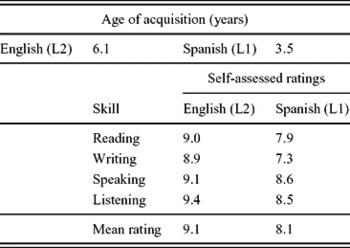
Participants in this study were highly proficient bilingual speakers of Spanish and English. Table 1 summarizes their language experiences and self-assessed proficiency ratings from a Language History Questionnaire (LHQ) that they completed. Responses from the LHQ indicated that most of the participants (34) were native speakers of Spanish, having acquired Spanish first and before the age of five. Sixteen of the remaining participants were early, simultaneous bilinguals, having acquired both Spanish and English before the age of five. Only seven participants were native speakers of English and one participant reported being a native speaker of Kannada, Hindi and English.
Language experiences and self-assessed proficiency ratings of the Spanish–English bilingual participants (n = 58) of Experiment 1. Self-assessed ratings based on a scale 1–10.

Materials
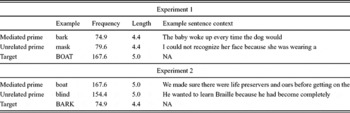
See Table 2 for examples of word stimuli. Materials consisted of 42 semantically related prime–target word pairs (e.g., water–LIQUID) and 42 unrelated pairs. Within the unrelated pairs, target words were paired with either a completely unrelated prime word (e.g., mask–BOAT) or by a prime word that shared a form-mediated relationship through Spanish, the L1 [e.g., bark (barco): BOAT]. The completely unrelated primes were matched in frequency and length with the primes that shared a Spanish form-mediated relationship. A complete list of all critical prime, target and mediators is provided in the Appendix, which also shows the corresponding orthographic similarity between pairs. The materials were randomly split into two sub-lists such that no participant saw the same target word twice. Each list contained 42 related trials requiring a “yes” response and 42 unrelated trials requiring a “no” response. The unrelated trials consisted of 21 trials with completely unrelated primes and 21 trials in which the primes shared a mediated relationship with the targets through Spanish.
An illustration of critical materials and their lexical properties for Experiments 1 and 2.

For half of the participants, prime words were preceded by the presentation of a sentence frame that strongly biased the meaning of the prime word (e.g., “The baby woke up every time that the dog would__”). The mean length of the sentences was 9.5 words. These sentences were of high semantic constraint (mean production probability = 0.83), and were constructed to strongly bias the prime word. The same pairs of words from the single-word condition were used in the sentence condition.
Procedure
Participants were randomly assigned to either the single-word or sentence-context condition. When participants arrived at the lab they were greeted in English (L2). Instructions were presented on a computer LCD display in English. These instructions were read to the participants out-loud. Participants in the single-word condition were told that they would see a word in English followed by another word, in English, in a red colored font. They were asked to decide, as quickly and accurately as possible, whether the two words were related in meaning. Participants in the sentence context condition were given similar instructions except they were told that they would first see a sentence frame with the last word missing. After reading the sentence frame they were asked to make a key press to see the final word. After that final word they were told they would see one more word, in a red colored font, and they were asked to decide if the final word of the sentence and the final, follow-up word were related in meaning. In both conditions “yes” responses were made with a right-hand key press and “no” responses with a left-hand key press.
Each trial was initiated by the presentation of a fixation point (“+”) in the center of the screen. This fixation remained on the screen until the participant made a key press to indicate that he/she was ready. In the single-word condition this fixation was replaced with the prime word for 250 milliseconds (ms). The target was then presented until the participant made a response. In the sentence context condition, the fixation was replaced with the sentence frame and remained on the screen until the participant made a button response. The prime word was then presented for 250 ms, followed by the target word which remained on the screen until the participant made a response. In this way the timing of the prime and target presentation in the two context conditions were the same, the only difference was that in the sentence-context condition a sentence preceded the prime. Once the experiment was finished, participants completed a language history questionnaire in which they reported their experiences with English and Spanish and rated their proficiency in the two languages.
Task considerations
Before proceeding to a discussion of the results, we would like to address some issues related to the mediated priming task. There have been a number of bilingual studies demonstrating cross-language, semantic priming (e.g., Chen and Ng, Reference Chen and Ng1989; De Groot and Nas, Reference De Groot and Nas1991; Tzelgov and Eben-Ezra, Reference Tzelgov and Eben-Ezra1992; Kotz and Elston-Güttler, Reference Kotz and Elston-Güttler2004). However, priming tasks in general have come under scrutiny due to the possible influence of post-lexical, strategic processing (see Neely, Reference Neely, Besner and Humphreys1991). This is problematic since priming is assumed to reflect automatic spreading activation. In the present study, we took several measures to address this potential problem. First, the SOA between prime and target was 250 ms; a time frame deemed too short for post-access strategies to intervene (Schwanenflugel and Rey, Reference Schwanenflugel and Rey1986). Second, we implemented a mediated priming paradigm, in which there was no direct relationship between the primes and targets. For example, if participants in the present study were operating in a truly language-selective fashion there should have been no detectable relationship between a prime word like “bark” and a target like “BOAT”.
Another task-related issue, relevant to bilingual research, is the possibility that participants might engage in a translation strategy, in which they translate the prime in order to more quickly respond to the target. This is of most concern when either (a) the prime is actually in a different language than the target or (b) the prime has a direct semantic relationship with the target (e.g., nurse ⇒ DOCTOR), or (c) translating the prime cues the correct response. None of these criteria apply to the present study. First, the participants had no reason to translate the prime words. They did not know until after the task that the study had anything to do with bilingualism or knowledge of Spanish, since the task was done completely in English. Second, there was no direct semantic relationship between the prime and the target. Third and finally, a translation strategy would be counterproductive since, on critical trials, the targets should have been rejected. The crux of our theoretical argument is that, if translation equivalents were active, they became so, not through an intentional strategy to do better at the task, but rather as a result of automatic cross-language activation. Finally, if there is non-selective activation of the mediator, executing a correct response will involve initial activation of the lexical competitors followed by suppression.
Results and discussion
Language history questionnaire data
The data from the language history questionnaires are summarized in Table 1 above. On average, participants acquired Spanish at around three years of age and English somewhat later, around the age of six. For part of the questionnaire the participants rated their proficiency in their L1, Spanish and L2, English on a scale of 1 to 10, with 10 representing the highest proficiency. Overall the participants rated their proficiency quite high in both Spanish (M = 8.1) and English (M = 9.1). However, they consistently rated their English skills higher than their Spanish skills, t1(1, 57) = 3.09, p < .05, suggesting that they had become more dominant in their L2. This shift in language dominance from the L1 to the L2 is commonly observed at the University since most of the students complete their academic work in their L2. Participants also estimated how frequently they communicated in their two languages on a scale of 1 to 8, with 1 representing “once a month or less” and 8 representing “daily”. Their responses indicated that they communicated slightly higher in English on a daily basis with a mean rating of 7.8 for English and 7.5 for Spanish, t(1, 57) = 2.08, p < .05.
Data trimming procedures
Mean RTs for each participant for correct trials were calculated. RTs that were either faster than 400 ms or slower than 4000 ms were counted as outliers and excluded from analyses. Furthermore, RTs that were more than 2.5 standard deviations above or below a given participant's mean RT were counted as outliers and excluded as well. This led to an exclusion of 3.2% of all trials. Any participant who had a greater than 30% error rate on either the completely unrelated trials or related trials was excluded. As mentioned in the “participants” section, this led to the exclusion of 30 participants.
Reaction time data
In single-word context, the overall, mean “yes” decision latencies for related pairs (M = 1255.9) were significantlyFootnote 2 faster than “no” decision latencies for the control, unrelated pairs (M = 1646.6), [t1(33) = 6.22, p < .05); t2(82) = 5.32, p < .05 but not in sentence context, (“yes” M = 1481.4, “no” M = 1550.8), [t1(23) = 1.63, p > .05; t2(82) = 2.49, p < .05].
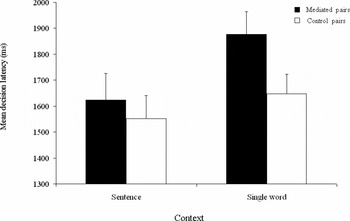
The mean decision latencies for the completely unrelated, control and unrelated mediated conditions in both single-word and sentence contexts are illustrated in Figure 1. A 2 [prime condition (unrelated control versus mediated)] × 2 [context (single word versus sentence)] mixed, ANOVA was performed on the participants' means. The analysis on latencies revealed a main effect of prime condition, [F1(1, 56) = 18.98 MSE = 34022.07, p < .05; F2(1, 41) = 7.86, MSE = 64,052.0, p < .05], indicative of the slower reaction times for Spanish-mediated primes relative to completely unrelated primes. This was qualified by a two-way interaction with context, [F1(1, 56) = 5.143, MSE = 34,022.07, p < .05; F2(1, 41) = 1.36 MSE = 120,134.20, p = 0.25]. This interaction reflected the fact that the difference between the critical and control decision latencies was greater in single-word context than in sentence context. Follow-up paired t-tests performed with a Bonferroni correction indicated that, in single-word context, the difference between critical and control unrelated conditions was statistically significant, [t1(33) = 4.72, p < .05; t2(41) = 2.44, p < .05], while, in sentence context, this difference was not significant, [t1(23) = 1.60, p > .05; t2(41) = 0.76, p > .05].
Mean decision latencies, in milliseconds, for critical, mediated pairs and control, unrelated pairs in single-word and sentence contexts for Experiment 1.

Error rate data
In single-word context the mean percent error rates for related pairs (inaccurate rejections) (M = 6.5) were not significantly different from control, unrelated pairs (false positives) (M = 7.0), [t1(33) = 0.38, p > .05; t2(82) = 1.10, p > .05]. In sentence context, however, percent error rates for related pairs were higher (M = 12.2) than for control, unrelated pairs (M = 7.3) and this difference was significant [t1(23) = 2.1, p = .05; t2(82) = 2.38, p < .05].
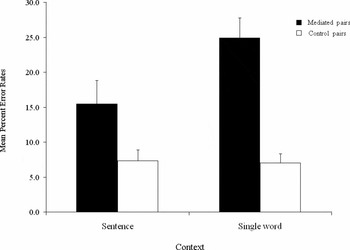
The mean error rates for the completely unrelated, control and unrelated, mediated conditions in both single-word and sentence contexts are illustrated in Figure 2. A 2 [prime condition (unrelated control versus mediated)] × 2 [context (single word versus sentence)] mixed ANOVA was performed on the participants' mean percent error rates. Analyses performed on the error rate data revealed a main effect of prime condition [F1(1, 56) = 57.133, MSE = 83.65, p < .05; F2(1, 41) = 26.50, MSE = 310.62, p < .05], reflecting the higher error rates for the Spanish-mediated primes compared to the completely unrelated primes. This main effect was further qualified by a two-way interaction with context, [F1(1, 56) = 8.06, MSE = 83.65, p < .05; F2(1, 41) = 8.00, MSE = 150.84, p < .05]. This interaction reflected the fact that the difference between the critical and control error rates was greater in single-word context than sentence context. Follow-up paired t-tests performed with a Bonferroni correction indicated that, in single-word context, the difference between critical and control unrelated conditions was statistically significant, [t1(33) = 7.05, p < .05; t2(82) = 5.04, p < .05], as well as in sentence context, [t1(23) = 4.16, p < .05; t2(82) = 3.04, p < .05].
Mean percent error rates for critical, mediated pairs and control, unrelated pairs in single-word and sentence contexts for Experiment 1.

To sum up the findings from Experiment 1: Participants had the most difficulty (longer latencies and higher error rates) in rejecting the critical, mediated prime–target pairs when the primes were presented in isolation relative to when the same primes were presented at the end of a sentence. Decision latencies for the mediated pairs were significantly longer than control pairs only when the prime words were presented in isolation. Although significant interference was observed in the error rates for form-mediated pairs in sentence context, the magnitude of this interference was smaller than that observed in single-word context. These findings support our hypothesis that form-based competitors are less likely to be strongly activated in a context that emphasizes deeper, semantic processing.
Experiment 2
In Experiment 1 we saw evidence that form-based competitors from the L1 (e.g., bark/barco) were more strongly activated in single-word contexts relative to sentence context, supporting our initial hypotheses. The goal of Experiment 2 was to test whether the opposite pattern would be observed for semantically-based competitors from the L1 (e.g., boat/barco). More specifically, we reasoned that since sentence comprehension involves greater semantic activation than single-word identification, semantically-based competitors would be most strongly activated when preceded by a highly-biasing sentence context.
Methods
Participants
Sixty-five UTEP undergraduate students originally participated in the experiment. However, data from six participants was excluded due to high error rates (the same criteria as Experiment 1were implemented), producing a total sample size of 59. All participants received course credit for their participation.
Participants in this experiment were highly proficient bilingual speakers of Spanish and English. Table 3 summarizes their language experiences and self-assessed proficiency ratings from the LHQ. Responses from the LHQ indicated that most of the participants (33) were native speakers of Spanish, having acquired Spanish first and before the age of five. Twenty-two of the remaining participants were early, simultaneous bilinguals, having acquired both Spanish and English before the age of five. Only three participants were native speakers of English and one participant reported being a native speaker of French.
Language experiences and self-assessed proficiency ratings of the Spanish–English bilingual participants (n = 59) of Experiment 2. Self-assessed ratings based on a scale 1–10.

Materials
In this experiment we switched the order of presentation of our prime and target words. In this way we tested for the activation of mediators that were semantically related to the prime (e.g., the prime–target pair boat–BARK tests for the activation of barco). See Table 2 for examples of the critical word stimuli. Materials consisted of 42 semantically related prime–target word pairs (e.g., liquid–WATER) and 42 unrelated pairs. There were two types of unrelated prime–target word pairs; pairs in which the prime and target were completely unrelated (unrelated controls) (e.g., blind–BARK) and pairs in which the primes and targets shared a semantically-mediated relationship through the L1 [boat (barco) – BARK]. The completely unrelated primes were matched in frequency and length with the primes that shared a semantically-mediated relationship. As mentioned earlier, a complete list of all critical prime, target and mediators is provided in the Appendix, which also shows the corresponding orthographic similarity between pairs. The materials were randomly split into two sub-lists such that no participant saw the same target word twice. Each list contained 42 related trials requiring a “yes” response and 42 unrelated trials requiring a “no” response. The unrelated trials consisted of 21 trials with completely unrelated primes and 21 trials in which the primes shared a semantically-mediated relationship with the targets through Spanish.
For half of the participants, prime words were preceded by the presentation of a sentence frame that strongly biased the prime word (e.g., “We made sure there were life preservers and oars before getting on the”). In this condition, the prime word (e.g., boat) was always the last word of the sentence, followed by the target word (e.g., BARK). The mean length of the sentences was 9.6 words. As in Experiment 1, these sentences were of high semantic constraint (mean production probability = 0.80), and were constructed to strongly bias the prime word. The same pairs of words from the single-word condition were used in the sentence condition.
Procedure
The procedure was the same as Experiment 1.
Results and discussion
Language history questionnaire data
The data from the language history questionnaires are summarized in Table 3 above. On average, participants acquired Spanish at around three years of age and English somewhat later, around the age of six.
Overall, participants rated their proficiency quite high in both Spanish (M = 8.3) and English (M = 9.2). How-ever, as in Experiment 1, they rated their English skills higher than their Spanish skills, t1(1, 59) = 3.43, p < .05, suggesting that they had become more dominant in their L2. Participants also indicated that they communicated equally frequently in both languages on a daily basis with a mean rating of 7.8 for English and 7.7 for Spanish, t1(1, 59) = 1.04, p = .30.
Data trimming procedures
Mean RTs for correct trials were calculated for each participant. RTs that were either faster than 400 ms or slower than 4000 ms were counted as outliers and excluded from analyses. Furthermore, RTs that were more than 2.5 standard deviations above or below a given participant's mean RT were counted as outliers and excluded as well. This led to an exclusion of 3.2% of all trials. Furthermore, any participant who had a greater than 30% error rate on either the completely unrelated trials or related trials was excluded. As mentioned in the “participants” section, this led to the exclusion of six participants.
Reaction time data
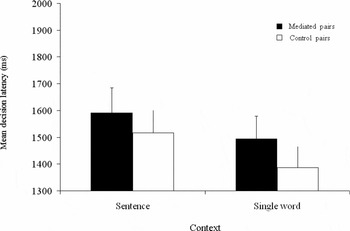
Mean “yes” decision latencies for related pairs (M = 1095.0) were significantly faster than “no” decision latencies for the control, unrelated pairs in single-word context (M = 1387.1), [t1(31) = 6.08, p < .05; t2(82) = 8.09, p < .05 and in sentence context (“yes” M = 1392.1, “no” M = 1516.1), [t1(26) = 2.04, p = .05; t2(82) = 0.69, p > .05].
The mean decision latencies for the completely unrelated (control) and unrelated, mediated conditions in both single-word and sentence contexts are illustrated in Figure 3. A 2 [prime condition (unrelated control versus mediated)] × 2 [context (single word versus sentence)] mixed ANOVA was performed on the participants' latency means. This analysis revealed a main effect of prime condition, [F1(1, 57) = 9.68, MSE = 24902.69, p < .05, F2(1, 41) = 4.65 MSE, = 66,395.15, p < .05], indicative of the slower reaction times for the mediated pairs relative to completely unrelated pairs. The two-way interaction between prime condition and context was not significant, [F1(1, 57) = .28, MSE = 24902.69, p = .60; F2(1, 41) = 1.29, MSE = 57,476.74, p > .05]. The lack of an interaction reflected the fact that the magnitude of the difference in mean decision latency between the unrelated and mediated prime–target pairs did not differ significantly across the single-word and sentence contexts. Thus, contrary to our predictions, significant interference from the semantically-based mediator was observed in single-word context.
Mean decision latencies, in milliseconds, for critical, mediated pairs and control, unrelated pairs in single-word and sentence contexts for Experiment 2.

Error rate data
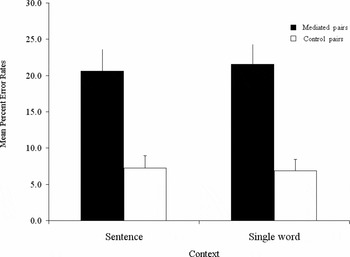
In single-word context the mean percent error rates for related pairs (inaccurate rejections) (M = 6.9) were not significantly different from control, unrelated pairs (false positives) (M = 6.8), [t1(31) = 0.04, p > .05; t2(82) = 0.41, p > .05]. In sentence context, however, percent error rates for related pairs were higher (M = 12.5) than for control, unrelated pairs (M = 7.2) and this difference was significant, [t1(25) = 2.2, p < .05; t2(82) = 2.22, p < .05].
The mean error rates for the completely unrelated, control and unrelated, mediated conditions in both single-word and sentence contexts are illustrated in Figure 4. A 2 [prime condition (unrelated control versus mediated)] × 2 [context (single word versus sentence)] mixed ANOVA was performed on the participants' mean percent error rates. This analysis revealed a main effect of prime condition [F1(1, 57) = 77.71, MSE = 74.53, p < .05; F2(1, 41) = 22.54, MSE = 237.38, p < .05], reflecting the higher error rates for the semantically-mediated primes compared to the completely unrelated primes. The two-way interaction, between prime condition and context, was not significant, [F1(1, 57) = .17, MSE = 74.53, p = .68; F2(1, 41) = 2.30, MSE = 116.45, p > .05]. The lack of an interaction reflected the fact that the difference in error rates between the critical, mediated pairs and control pairs was not higher in sentence context, relative to single-word context. This once again suggested that the semantically-based Spanish mediators were strongly activated in single-word context as well as in sentence context.
Mean percent error rates for critical, mediated pairs and control, unrelated pairs in single-word and sentence contexts for Experiment 2.

To sum up the findings from Experiment 2: Participants' performance showed interference (longer latencies and higher error rates) for the critical, mediated prime–target pairs in both single-word and sentence contexts. Furthermore, significant interference of a similar magnitude was observed in the error rates for semantically-mediated pairs in both single-word and sentence contexts. These findings do not support our hypothesis that semantically-based competitors are more likely to be strongly activated in a sentence context relative to a single-word context. We discuss potential reasons for this unexpected pattern in the General Discussion.
General discussion
The purpose of this study was to examine what impact a linguistic context has on the nature of cross-language activation. According to the BIA+ model, (Dijkstra and Van Heuven, Reference Dijkstra and Van Heuven2002) activation within the bilingual lexicon can be directly affected by a linguistic context. Based on the assumption that sentence-level information (e.g., semantic and syntactic) is processed in a language non-selective way, the authors proposed that such information can have an impact on lexical activation. Findings from this study support this assumption. In the RT patterns of both Experiments 1 and 2 we observed attenuated cross-language mediated priming (in the form of interference) when primes were presented after a sentence context relative to when they were presented in isolation. This general finding fits nicely with other recent studies that have observed attenuating effects of sentential context on cross-language activation (e.g., Van Hell, Reference Van Hell1998; Elston-Güttler et al., Reference Elston-Güttler, Gunter and Kotz2005; Schwartz and Kroll, Reference Schwartz and Kroll2006).
However, the goal of the present study was to examine whether sentence context would have a more specific effect on cross-language activation by influencing the particular types of lexical competitors that become active for selection. We predicted that lexical competitors that shared form (such as orthography and phonology) would be more strongly activated in single-word contexts than in sentence contexts. This hypothesis was supported by the interaction observed in Experiment 1 for both RTs and error rates. We also predicted that lexical competitors that shared semantics would be more strongly activated in sentence context relative to single-word contexts. This hypothesis was not supported. In Experiment 2 significant, interference effects were observed in isolated word context as well as sentence context. The magnitude of this interference did not differ statistically across the two contexts. This suggests that the effects of sentence context on lexical activation is more general in nature; it decreases the overall magnitude of activation but does not have a differentially constraining effect on form-based versus semantically-based competitors.
However, it should be noted that the magnitude of interference observed was attenuated by sentence context only in Experiment 1, in which primes and targets were based on a form-mediated relationship. When primes and targets shared a semantically-mediated relationship (Experiment 2), the magnitude of interference was similar in both single-word and sentence contexts. This is important because it supports the general notion that the type of lexical link shared between cross-language words will influence how strongly these words are co-activated. More specifically, the pattern suggests that, while form-based competitors received less activation when there is a linguistic context such as a sentence, semantically-based competitors continued to be strongly activated irrespective of context. Thus, we see evidence that semantically-based, cross-language lexical links are particularly resilient to potentially constraining effects of sentence context. This is consistent with the BIA+ which assumes that information provided by context can directly affect lexical-semantic activation within the lexicon.
The present findings, particularly those of Experi-ment 2, are consistent with those of Silverberg and Samuel (Reference Silverberg and Samuel2004). In that study, the lexical decision performance of early Spanish–English bilinguals reflected semantically-mediated priming from an L2 prime (e.g., bull) to an L1 target (e.g., TORNILLO). The present study extends these findings to a language-pure context, in which the L1 was not explicitly present in the stimulus materials (i.e. both primes and targets were L2 words).
Implications/extension of monolingual theories
We feel that it is important to maintain the “cross-talk” between monolingual and bilingual research by reflecting on how patterns of performance observed with bilinguals might or might not be easily accommodated into existing, monolingual theories and frameworks. In Experiment 1 we tested for the activation of words from the non-target L1 that were similar in form to prime words (but not identical) but mapped onto completely different meanings (e.g., bark/barco). The reader will recall that the major tenets of the re-ordered access model, proposed by Duffy and colleagues, are based primarily on studies that have examined processing of within-language homographs. Within-language homographs represent cases in which the same orthographic representation maps onto two, distinct semantic representations and an analogy can thus be drawn between these within-language homographs and cross-language form related words. Since the re-ordered access model predicts that all representations of ambiguous words are co-activated, it would predict that in Experiment 1, the prime word bark would lead to co-activation of the meaning of barco, which is boat. The model would also predict that, since the L1 meaning (boat) is the most dominant meaning, it would compete for selection with the subordinate L2 meaning (the sound a dog makes), which is supported by the sentence context. In this way the model might predict a cross-language subordinate bias effect.
In Experiment 1 we observed significant, interference effects in error rates in sentence context, supporting this prediction. However, the magnitude of this interference was attenuated in sentence context and furthermore, no interference effects were observed in the reaction time data from sentence context. One possibility is that the combined constraints imposed by the sentence and by the fact that the competitor was from a separate language were sufficient to allow for selective access. Another possibility is that, since the form competitors were not orthographically identical, activation of the competing semantic representation was not strong enough to influence processing. The implication for the reordered access model is that the degree to which non-selective, exhaustive activation of all potential representations persists in sentence context may depend critically on whether the lexical competitor is identical or only highly similar in form. This underscores the important contribution that bilingual lexical research can make toward current theories and models of lexical access.
In Experiment 2 we tested for cross-language activation of lexical competitors that shared semantics exclusively and not form (i.e., translation equivalents). These would be most analogous to within-language synonyms (e.g., couch–sofa). Although studies supporting the reordered-access model have not examined the processing of synonyms, recent work on monolingual lexical access suggests that the existence of a highly-familiar synonym delays processing, suggesting that lexical access is influenced by feedback activation from semantics to orthography (Pecher, Reference Pecher2001). These findings are compatible with the strong interference effects observed in Experiment 2. It should be noted that, in the monolingual study, target words were presented in isolation. The present study adds to these findings by demonstrating that feedback activation from lexical semantics is quite powerful and resilient to any potentially constraining effects of sentence context.
In future research the major findings from the present study should be linked to individual differences in reading skill. According to the structure building framework, proposed by Gernsbacher and colleagues (e.g., Gernsbacher, Reference Gernsbacher1990, Reference Gernsbacher and Bower1991, Reference Gernsbacher and Britton1996, Reference Gernsbacher and Medin1997; Gernsbacher and Faust, Reference Gernsbacher and Faust1991a, Reference Gernsbacher and Faust1991b, Reference Gernsbacher, Faust and Dempster1995), there are important individual differences in how efficiently readers can suppress non-target semantic representations of ambiguous words. While both more and less skilled readers show early, non-selective activation of all potential meanings, only the more skilled readers are able to later suppress the competing alternative at longer intervals (Gernsbacher, Varner and Faust, Reference Gernsbacher, Varner and Faust1990). In the present study we demonstrated that there is cross-language, semantic activation of the non-target language in sentence context. Future studies should examine how the added competition introduced from this activation contributes to variation in bilinguals' abilities to suppress contextually inappropriate meanings while reading in the dominant and less dominant languages. Finally, it should be noted that the concept of lexical suppression is compatible with the notion of inhibitory control as a critical component of lexical identification performance (e.g., Green, Reference Green1998). Future research should focus on bridging the gaps that exist between these different models, providing a more unified understanding of the role that inhibition plays across monolingual and bilingual lexical processing.
Appendix. Lexical characteristics for critical prime, target and mediator word stimuli