


INTRODUCTION
Ice avalanches have repeatedly caused damage and loss of lives in the Alps (Röthlisberger 1978). How often a particular glacier can produce ice avalanches is, amongst other factors, determined by the long^rm net accumulation in the glacierized area above the starting zone of the ice avalanches. However, mass balance measurements done above 3 500 m a.s.l. on Alpine glaciers are extremely scarce (Haeberli and Alean 1985). The present study investigates the relationship between ice avalanche activity and mass balance of a high altitude hanging glacier in the Swiss Alps.

OBSERVATIONS AND ANALYSIS OF PHOTOGRAPHS
From May 1982 till August 1982 and from November 1982 till September 1983, the 350 m long ice cliff at the lower end of the southern hanging glacier of the Mönch (SHM, Figure 1), Bernese Alps, Switzerland, was photographed every day if visibility permitted from the Jungfraujoch research station. The attitude range of the SHM is 3 660 to 4 070 m a .s.I.; ice avalanches are the predominant form of mass loss of this glacier and are deposited on the Jungfraufirn/ Aletschgletscher. Runout distances and other characteristics are the objectives of a more general study on ice avalanches (Alean 1984). Snow avalanches occur also but were only rarely detected on photographs since they were released predominantly in bad weather when no photography was possible.
62 avalanches were recorded and mapped. The thicknesses of the avalanche deposits could only be roughly estimated (camera-glacier distance: 1000 m) at between 0.5 m for very small and 2 m for larger avalanches. The volume of the smallest recognisable avalanches was about 500 m3; the largest observed was 60 000 m3 Because of large ice blocks in the deposits, ice avalanches could often be detected after snow falls also.
Fortunately, the volume determinations done by mapping the deposits could be checked; the cliff had developed a large lamella, 240 m long, volume 280 000 m’, by May 1982. During the time of observation, 36 avalanches broke off from the lamella, thus gradually consuming it, until it had totally disappeared by September 1983. The total volume of the avalanche deposits originating from the lamella was determined as 403 000 m3, or 44% more than the volume of the lamella itself. Ice avalanche deposits may be somewhat less dense than glacier ice. Additionally, some snow entrainment is likely to occur in the runout zone and occasionally small snow avalanche deposits might get covered by ice avalanches. Therefore, the larger volume of the ice avalanche deposits compared to the one of the lamella need not only be caused by systematic overestimations of the thicknesses of the avalanche deposits. The volume determinations, therefore, are at least approximately correct.
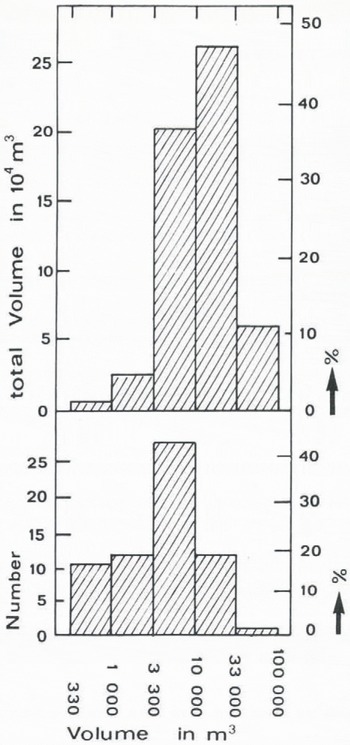
However, small ice avalanches might not be noticed. A simple statistical analysis of the frequency of all the recorded avalanches (ie from the whole of the cliff) shows that even if small avalanches do occur frequently, their contribution to the mass flux is quite small (Figure 2). Therefore, even quite a large number of ice avalanches with volumes smaller than 3 000 m3 do not considerably affect the mass flux from the cliff as determined by avalanche observations.
No significant annual variation in ice avalanche activity from the SHM could be detected. Not even the presence of the lamella seemed to cause a variation in the rate of ice loss from the cliff. It is possible that the lamella did not undergo acceleration despite its leaning over the cliff. This may be attributed to the fact that ice avalanches gradually consumed the foremost parts of the lamella thus removing those parts which would have otherwise made it less and less stable. The observed rate of ice loss may, therefore, be representative for at least a few years.
Earlier photographs from precisely known positions do not indicate any noticeable change in the surface elevation of this glacier during the past decade. Also, trigonometric altitude measurements of an annually repositioned stake (P) at 3 505 m a.s.l. on the Jungfraufirn have shown no trend in surface elevation changes from 1942 to the present (Aellen, personal communication). Since the stake is only 550 m from the SHM’s cliff, it adds to the evidence that the surface elevation of the SHM also does not change. Therefore, since it is assumed that the SHM’s volume has remained constant during the past decade, the ice loss from the cliff should roughly represent the total net accumulation above the cliff over the past few years. Melting within the cliff face is assumed to be of minor importance.
MAIN RESULTS AND THEIR INTERPRETATION
The total volume of all avalanches recorded during the 390 day observation period was 509 000 m3 or 476 000 m3 per year. Since the observations suggest that the total volume of the ice avalanche deposits is about 44% larger than the volume of ice which broke off, the ice loss from the cliff was estimated to have been 331 000 m3 (±25%). The glazierized surface area of the SHM being 136 000 m3, and taking 0.8 g/cm3 as the ice density, this gives an average specific net accumulation of roughly 2 m WE. Snow which is deposited on the SHM and subsequently removed by snow avalanches is -in accordance with the definition of net accumulation -not included in this value.
For comparison, the net accumulation of the SHM was also estimated by independent methods:
a) Direct measurements at P yielded a specific mass balance of +2.94 m WE for the period 1950-80 (Aellen and Röthlisberger 1981).
b) Photographs of the ice cliff taken from P show clear summer horizons in the firm stratigraphy. At 2 places in the cliff the average net accumulation of the past 3 years (1979/80 to 1981/82) was estimated by measuring the thickness of the annual layers, assuming a density of 0.7g/cm3 (Oescheger and others 1977). On average, a net accumulation of 3.8 m WE was found. This value must be higher than the average for the whole SHM, since the observed firn layers form in the lowest and flattest part (slope: 18°) where small snow avalanches from the higher and steeper parts of the SHM (slope: 45°) are often deposited.
Thus the specific mass balance of the SHM as determined by recording ice avalanches (2 m WE) is at least roughly correct, although the accuracy is probably not better than ±25%.
CONCLUSIONS
Determination of the mass balance of high altitude hanging glaciers seems possible if these glaciers produce ice avalanches which can be recorded photographically. This method may be the only viable one on high glaciers which are otherwise too dangerous or inaccessible. The major volume of ice is lost from such glaciers by relatively large ice avalanches although smaller avalanches occur more frequently. Ice avalanches from high hanging glaciers such as the SHM do not seem to occur more frequently in any one particular season.
ACKNOWLEDGEMENTS
Prof Dr H Röthlisberger and Dr W Haeberlj critically read the manuscript. S Baumann and F Gabriel took the photographs from the Hochalpine Forschungsstation Jungfraujoch. Pamela Alean helped prepare the text.



