Introduction
In the United States, as of October 2, 2012, synthetic Met was restricted to 1, 1, and 1.5 kg per metric tonne (2, 2, and 3 lbs per short ton) of feed for organic laying hens, broilers, and turkeys and other poultry, respectively, and its use may be banned entirely in the near future (USDA, 2012c). All other synthetic amino acids (AA) have already been banned for use in organic production (USDA, 2012b). Synthetic Met is the last remaining AA allowed for use in organic poultry diets because it is a key dietary supplement for upholding poultry growth and production and, if its use is limited or banned, producers would experience increased feed costs, cannibalism and reduced performance. Methionine deficient laying hen diets can lead to poorer feed efficiency, lower albumen, yolk, and egg solid weight, and reducing egg size (Schutte et al., Reference SCHUTTE, VAN WEERDEN and BERTRAM1983; Shafer et al., Reference SHAFER, CAREY and PROCHASKA1996; Ambrosen and Petersen, Reference AMBROSEN and PETERSEN1997; Elwinger et al., Reference ELWINGER, TUFVESSON, LAGERKVIST and TAUSON2008). Additionally, impaired plumage development and increased feather pecking have resulted from inadequate dietary Met in laying hens (Ambrosen and Petersen, Reference AMBROSEN and PETERSEN1997; Elwinger et al., Reference ELWINGER, TUFVESSON, LAGERKVIST and TAUSON2008). For broilers, decreased feed intake, weight gain, feed efficiency, uniformity, and breast meat yield have been measured, as well as increases in fat pad deposition and a shift in thigh and wing yield, when inadequate dietary Met is provided (Leclercq, Reference LECLERCQ1983; Carew et al., Reference CAREW, MCMURTRY and ALSTER2003; Vieira et al., Reference VIEIRA, LEMME, GOLDENBERG and BRUGALLI2004; Corzo et al., Reference CORZO, KIDD, DOZIER III, SHACK and BURGESS2006). Similar negative impacts on body weight, feed intake, and feed efficiency can be observed when turkey diets are deficient in Met (Balloun, Reference BALLOUN1962; Christmas and Harms, Reference CHRISTMAS and HARMS1979; Gonzales-Esquerra et al., Reference GONZALES-ESQUERRA, VÁZQUEZ-AÑÓN, HAMPTON, YORK, FEINE, WUELLING and KNIGHT2007).
It is possible to use dramatic increases in dietary crude protein (CP) in organic poultry diets to meet the Met requirements of the birds without using synthetic Met (Pesti, Reference PESTI2009). However, high CP diets are very costly, increase litter moisture, N excretion, and NH3 emissions, and can be harmful to the birds due to excessive N intake (Ward et al., Reference WARD, MCNABB and MCNABB1975; Chandra et al., Reference CHANDRA, SINGH, SONI and AHUJA1984; Burley, Reference BURLEY2009; Meluzzi et al., Reference MELUZZI, SIRRI, TALLARICO and FRANCHINI2001; Liang et al., Reference LIANG, XIN, WHEELER, GATES, LI, ZAJACZKOWSKI, TOPPER, CASEY, BEHRENDS, BURNHAM and ZAJACZKOWSKI2005; Roberts et al., Reference ROBERTS, XIN, KERR, RUSSELL and BREGENDAHL2007; Burley, Reference BURLEY2012). The objective of this review is to look at conventional, as well as alternative, feed ingredients that may aid in providing a solution to the limited allowance of synthetic Met in organic poultry diets.
Ingredient restrictions for organic poultry
The United States Department of Agriculture (USDA) National Organic Program (NOP) regulations define a National List of Allowed and Prohibited Substances for use in the production of organic food products. Ingredients allowed for use in organic poultry diets in the United States, as defined by this list, include organically produced agricultural products, natural, non-synthetic substances (i.e. enzymes and probiotics), and approved synthetic substances (Blair, Reference BLAIR2008; USDA, 2012a; 2012b). No genetically modified grain or grain-by-products are allowed in these diets, nor are animal by-products, except for certified organic milk or egg products and fish, insects, worms, and other ‘natural’ ingredients as defined by NOP standards. Plant-derived ingredients must come from certified organic crops and no chemical extraction processes may be used in feed manufacturing. Additionally, no hormones, antibiotics, synthetic parasiticides, synthetic or fermentation derived pure AA, nor any other non-approved drugs may be added to these diets (Blair, Reference BLAIR2008; Fanatico, Reference FANATICO2010).
Natural ingredient sources for methionine
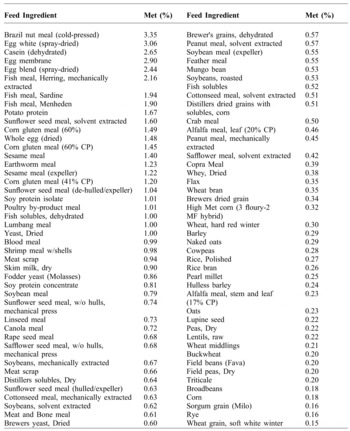
The total Met content of various plant- and animal-based feed ingredients is given in Table 1. This comprehensive list of ingredients is ranked in ascending order of quantity of methionine on an ‘as is’ percentage basis. Enhancing Met concentration in plants has been attempted by selectively breeding species commonly used as feed ingredients for poultry diets. Traditional plant breeding techniques have been used to enhance protein content of soybeans; however, although total soybean protein concentrations were successfully elevated, the sulphur AA content remained low, regardless of protein level (Burton et al., Reference BURTON, PURCELL and WALTER1982; Wilcox and Shibles, Reference WILCOX and SHIBLES2001). Researchers have identified both spontaneous and induced mutant soybean lines that reduced or eliminated 7S globulin (TSAA-poor protein) content, potentially enhancing the concentrations of TSAA-rich proteins in these plants (Kitamura and Kaizuma, Reference KITAMURA and KAIZUMA1981; Teraishi et al., Reference TERAISHI, TAKAHASHI, HAJIKA, MATSUNAGA, UEMATSU and ISHIMOTO2001). Currently, these soybean lines are not available to the organic market.
Total methionine content various feed ingredients on a percentage basis (‘as is’).

Almquist (Reference ALMQUIST1946); Gerpacio and Castillo (Reference GERPACIO and CASTILLO1979); Degussa (1990); NRC (1994); Coats (Reference COATS2005); Burley (Reference BURLEY2012); Rembrandt Enterprises, Inc. (2010; 2012); USDA (2012d); Anderson et al. (Reference ANDERSON, MACISAAC and SAFAMEHR2012); Jacob (Reference JACOB2013).
High Met corn (3 floury-2 MF hybrid), a naturally selected hybrid, is reported to contain 53% more CP than conventional corn and 0.32% Met versus 0.18% Met for conventional varieties (Jacob et al., Reference JACOB, LEVENDOSKI and GOLDSTEIN2008; Fanatico, Reference FANATICO2010). It has been shown that using this hybrid in diet formulations can meet the Met requirements of floor-reared Bovan Brown pullets in their starter, grower, and finisher phase diets (from 0 to 112d of age) without the need for synthetic Met supplementation (Jacob et al., Reference JACOB, LEVENDOSKI and GOLDSTEIN2008). However, it has lower crop yields (and hence higher cost per tonne) and higher moisture than conventional corn, making it more prone to fungal toxin development (i.e. aflatoxin) that can negatively impact poultry (Blair, Reference BLAIR2008; Fanatico, Reference FANATICO2010).
Brazil nuts (Berthollectia excelsa) are a commodity imported to North America from the Amazon Basin and are available as organic certified (Sun et al., Reference SUN, LEUNG and TOMIC1987). Brazil nuts contain approximately 67 to 70% total oil content, 14 to 17% crude protein, and are an excellent source of Mg, P, Se, linoleic acid, and sulphur AA (Sun et al., Reference SUN, LEUNG and TOMIC1987; Venkatachalam and Sathe, Reference VENKATACHALAM and SATHE2006). Prior to being used as a feedstuff for poultry, Brazil nuts must be de-shelled and may be pressed into a meal to reduce its high fat content and improve its CP levels. Burley (Reference BURLEY2012) found that cold-pressed organic certified Brazil nut meal (51.08% CP and 3.35% Met ‘as is’) could entirely replace the need for synthetic Met in both laying hen and broiler diets. When Brazil nut meal was included in 22 to 34 week Hy-Line Brown laying hen diets at 5.90%, without the addition of synthetic Met, greater percent egg shell, increased egg specific gravity, and lower feed costs, $/dozen eggs, and $/kg egg were found compared to an organic corn/soybean meal (SBM) control diet that did include synthetic Met. Additionally, lower feed intake, improved feed conversion, and lower feed costs and $/kg bled carcass, breast, and sum of parts weight were found for 0 to 21 d old Cobb x Ross 308 male broiler chickens that were fed diets containing 4.26 to 5.50% Brazil nut meal, without the addition of synthetic Met, compared to an organic corn/SBM meal control diet without any synthetic Met. These studies demonstrated that Brazil nut meal is a viable and economical alternative to using synthetic Met; however, its supply is limited and therefore may be restricted to small scale applications.
Corn gluten meal is a by-product of corn that is particularly rich in CP (60.2%) and Met (1.49%), but low in Lys (1.03% compared to 2.96% for solvent extracted, de-hulled SBM) (NRC, 1994). Lysine was found to be the first limiting AA in this feedstuff, whereas Met was the ninth (Peter et al., Reference PETER, HAN, BOLING-FRANKENBACH, PARSONS and BAKER2000). Corn gluten meal is relatively rich in xanthophyll pigments (up to 300 mg/kg), which are beneficial in enhancing egg yolk colour and yellow skin for broilers (Blair, Reference BLAIR2008). However, organic availability is very limited (Fanatico, Reference FANATICO2010).
Expeller pressed sesame seed (Sesamum indicum) meal (41% CP ‘as is’) is another Met-rich oilseed meal of interest for use in organic poultry diets (NRC, 1994). Sesame seed meal has lower Lys (0.91%), but higher Met content (1.22%) than expeller pressed SBM, which has 2.37 and 0.55% Lys and Met, respectively (NRC, 1994; Evonik Industries, 2010). Diarra and Usman (Reference DIARRA and USMAN2008) reported that soaked sesame seeds can replace up to 12.50% SBM in peaking laying hen diets without impacting egg production or quality without synthetic Met inclusion. However, Met-rich fish meal was also included across all diets in this study, indicating that sesame seeds alone may not be able to meet Met requirements without synthetic AA. Sesame seed meal contains high levels of phytate and oxalates in its hulls, which are difficult to remove, and these compounds can reduce palatability as well as mineral and protein digestibility (Blair, Reference BLAIR2008).
Sunflower seeds (Helianthus annuus L.) are available commercially both from conventional and organic production practices. Hulls cannot be removed by poultry; therefore, the seed cannot be fed whole and must be de-hulled and be ground and/or pressed prior to feeding (Fanatico, Reference FANATICO2010). Hulled sunflower seed meal (SSM) is higher in Met (0.63%), but lower in Lys content (1.01%) than expeller SBM, which has 0.55 and 2.37% Met and Lys, respectively (Evonik Industries, 2010). Rao et al. (Reference RAO, NAGALAKSHMI and RAJU2005) found that hulled SSM could entirely replace SBM in broiler diets and up to 30% in layer diets in a cost-effective manner without sacrificing growth or production. De-hulled SSM has been shown to be effective at replacing up to 50% of SBM in broiler and laying hen diets (provided that adequate Lys is supplied in these diets) (Ravindran and Blair, Reference RAVINDRAN and BLAIR1992). De-hulled expeller pressed SSM is free of fibrous hulls, which dilute bird diets. As a result, it contains 1.04% Met, which is higher than the reported value of 0.63% Met for hull-on expeller pressed SSM) (Table 1) (Evonik Industries, 2010). Therefore, de-hulled expeller-pressed SSM may be an excellent alternative ingredient for meeting Met requirements of organic poultry. When used in the formulation of an organic broiler starter diet without synthetic Met inclusion, de-hulled SSM (approximately 44% CP; 1.04% Met) had the capacity to reduce CP from 36.05 to 28.71%, and diet costs were reduced from $1,058 to $1,006/ton when used at a approximately 22% inclusion rate in the diet compared to a corn/soybean meal based organic diet without synthetic Met (Burley, Reference BURLEY2013). This de-hulled SSM diet improved BW, gain, and feed conversion compared to a commercial non-organic diet that included synthetic Met at typical levels (Burley, Reference BURLEY2013). Although de-hulled SSM proved an excellent ingredient for the purpose of replacing synthetic Met, SSM with hulls is extremely high in crude fibre (approximately 26%), which greatly dilutes its nutritive value (27% CP) compared to the de-hulled product discussed above. Using SSM with hulls in 0 to 44 d old broiler diets resulted in reduced BW, gain, and bled weight, when using a limited level of 1 kg/metric tonne (2 lb/short ton) synthetic Met, compared to an organic control diet with higher, more typical levels of synthetic Met, which were approximately 1.5 kg/metric tonne (3 lb/short ton) for starter diets and progressively lower amounts for grower and finisher phases (Burley, Reference BURLEY2013).
The available energy content of cereal grains is influenced greatly by fibre content; therefore, hulless varieties of oats/barley have much higher energy and are better suited for poultry and other monogastrics than their hulled counterparts (Maurice et al., Reference MAURICE, JONES, HALL, CASTALDO, WHISENHUNT and MCCONNELL1985; NRC, 1994; Anderson et al., Reference ANDERSON, MACISAAC and SAFAMEHR2012). Naked oats and hulless barley are comparable in metabolisable energy (ME) to corn, but have greater CP and AA content, with Met at 0.39, 0.24, 0.18 g/100 g material (‘as is’ basis) for naked oats, hulless barley, and corn, respectively (Maurice et al., Reference MAURICE, JONES, HALL, CASTALDO, WHISENHUNT and MCCONNELL1985; NRC, 1994; Anderson et al., Reference ANDERSON, MACISAAC and SAFAMEHR2012; USDA, 2012b). Maurice et al. (Reference MAURICE, JONES, HALL, CASTALDO, WHISENHUNT and MCCONNELL1985) demonstrated that lower levels of synthetic Met were required in 0 to 7 week broiler diets as dietary naked oat inclusion was increased and replaced corn, with no synthetic Met needed by three to seven weeks, when dietary CP was held constant. Similar findings were noted for hulless barley (Sharifi et al., Reference SHARIFI, SHARIATMADARI and YAGHOBFAR2012). Previous research indicated that 0 to 44 d broiler diets containing naked oats at 25% of the diet supplemented with only 1 kg/metric tonne (2 lb/short ton) synthetic Met could maintain BW, gain, feed intake and conversion, and processing yields compared to birds fed an organic diet with an unlimited level of synthetic Met (Burley, Reference BURLEY2013). These naked oat diets also cost $183 less per ton of feed (for all dietary phases), $0.24 less per kg bled weight, $0.91 less per kg breast weight, and $0.32 less per kg sum of parts weight compared to an organic diet with high CP and no synthetic Met. Unfortunately, both naked oats and hulless barley contain mixed-linked β-glucans as their predominant non-starch polysaccharides, which have been shown to increase gut content viscosity and lead to reduced nutrient utilisation and growth depression in chickens in a concentration and age-dependent manner with younger birds most significantly affected (Annison and Choct, Reference ANNISON and CHOCT1991; Sharifi et al., Reference SHARIFI, SHARIATMADARI and YAGHOBFAR2012). However, these impacts could potentially be diminished by use of organically-approved enzymes, which needs to be further explored.
Pearl millet is higher in CP (15.7%) and Met (0.25%) than corn, but has a lower ME value of 2,675 kcal/kg (NRC, 1994). Mehri et al. (Reference MEHRI, POURREZA and SADEGHI2010) demonstrated that pearl millet could effectively replace up to 75% corn grain in the diets of 44 to 56 week old laying hens without negatively impacting egg quality or production. Egg weight was depressed when pearl millet replaced 100% of corn, which could have been due to lower linoleic acid levels in this ingredient (0.84%) versus corn (2.2%), since linoleic acid plays a significant role in egg size (NRC, 1994; Mehri et al., Reference MEHRI, POURREZA and SADEGHI2010).
Potato protein concentrate (1.67% Met) is an excellent quality protein source (76% CP). It is also highly digestible (92.5% based on in vitro analysis). However, it is not commonly available as a certified organic ingredient. Additionally, it is currently used as an ingredient in human food production, which would likely make its use as a feedstuff for livestock very costly and limited in supply (Blair, Reference BLAIR2008).
Inedible egg products from grading and breaking facilities diverted from human consumption due to cracks, leakers, blood/meat spots, etc., are a constant by-product of the egg industry. Dried inedible egg is an excellent source of Met, with levels of 3.06, 2.44, and 1.48 g per 100 g for spray-dried egg white, spray-dried egg blend (70:30 albumen:yolk), and dried whole egg on an ‘as is’ basis (Table 1; Rembrant Enterprises Inc., 2010; 2012; USDA, 2012b). Burley (Reference BURLEY2012) found that when spray-dried egg white (SDEW) and spray-dried egg blend (SDEB), which is 70:30 albumen:yolk, were used at approximately 7 to 9% of the diet to entirely replace synthetic Met in 22 to 34 week old hen diets, feed intake was reduced, egg quality was improved, and manure ammonia emissions were greater than hens fed non-egg containing control diets. Egg production and egg size were not significantly different than the control diets and SDEW and SDEB diets cost $210 and $435 less per ton than conventional organic diets, respectively. This resulted in the production cost per dozen eggs being $0.35 and $0.73 lower for SDEW and SDEB diets, respectively, compared to the conventional organic diet, making the egg-based diets more profitable (Burley, Reference BURLEY2012). Al-Harthi et al. (Reference AL-HARTHI, EL-DEEK and ATTIA2011) similarly found that diets containing 5% autoclaved dried whole egg had no negative impact on egg production or egg quality for 25 to 41 week old laying hens; however, these egg containing diets did produce the positive effect of lowering yolk cholesterol. Mast et al. (Reference MAST, LEACH and MACNEIL1984) found that dried inedible whole egg had a positive impact on production performance when included in broiler diets at rates of up to 10%. However, Burley (Reference BURLEY2012) conversely found that 0 to 21 d old Cobb x Ross 308 male broiler chickens fed diets containing these two egg products (without synthetic Met, but meeting Met requirements) had poorer feed intake and conversion, growth, and processing weights compared to birds fed the non-egg containing control diets. In both the layer and broiler studies completed by Burley (Reference BURLEY2012), supplemental D-biotin was needed in egg product-containing diets to provide for the birds’ requirements and to neutralize avidin, which is a biotin-binding protein that remains active when product pasteurisation is inadequate. Egg products have to be processed for adequate durations of time and at high enough temperatures to inactivate avidin and other growth-diminishing protease inhibitors found in raw eggs if they are to be used as a poultry feedstuff on a commercial scale. Additionally, inedible eggs have to be sourced from organic layers to be used as a feedstuff for organic poultry.
Casein, the solid residue from acid/rennet coagulation of milk in cheese production, is high in CP (87.2%), highly digestible (84 to 99% for various AA) and has a considerably higher Met content of 2.65% (NRC, 1994; Evonik Industries, 2010). However, it has a poor Met to Cys ratio (12.6:1 versus a more favourable 60:40 ratio), which may not provide enough Cys to meet the bird's requirement (NRC, 1994). Casein has to be sourced from organic milk to feed organic poultry.
A variety of fish meal products are commercially available (e.g. Herring, Menhaden, Anchovy, etc.). Fish meal is considered a non-synthetic, non-agricultural product and, therefore, may be included in organic poultry diets if it has been preserved using a natural antioxidant such as tocopherol, rather than a synthetic preservative like ethoxyquin (USDA, 2012d). Fish meal is high in CP and Met (1.63 to 2.16% on an ‘as is’ basis); however, it can only be used at low levels for feeding poultry due to the potential for it to cause gizzard erosion and to impart off-flavours into meat and eggs due to volatile compounds in the residual oil (Fry et al., Reference FRY, VANWALLEGHEM, WALDROUP and HARMS1965; Janssen, Reference JANSSEN1971; Koehler and Bearse, Reference KOEHLER and BEARSE1975; NRC, 1994).
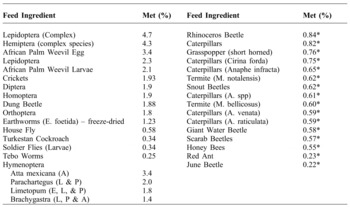
Using earthworms, insects, and larvae as a poultry feedstuff has been of interest for many years. Earthworms, insects, mealworms, and additional species of interest as Met-rich protein sources for poultry diets are listed in Table 2 (Finke et al., Reference FINKE, SUNDE and DEFOLIART1985; Despins and Axtell, Reference DESPINS and AXTELL1994; Fanatico, Reference FANATICO2010). Earthworms are naturally favoured by poultry and have been shown to support bird growth and production similar to or better than conventional protein sources, such as meat and fish meals, when used as the main dietary protein fed either whole or as a meal (El Boushy and Van der Poel, Reference EL BOUSHY and VAN DER POEL2000). One species sold commercially for composting, Eisenia foetida (‘red wigglers’), contain 1.5 to 3.6 g Met/100 g protein, comparable to levels found in traditional animal protein sources (McInory, Reference MCINORY1971; Fosgate and Babb, Reference FOSGATE and BABB1972; Taboga, Reference TABOGA1980; Sabine, Reference SABINE1981). There are possible negative organoleptic properties of egg and meat products from poultry fed earthworms, as well as the potential for heavy metal accumulation and microorganism contamination of earthworms from soil (Romero et al., Reference ROMERO, BOU-MAROUN, REPARET, BLANQUET and CAYOT2009; Fry et al., Reference FRY, VANWALLEGHEM, WALDROUP and HARMS1965; Koehler and Bearse, Reference KOEHLER and BEARSE1975; Gish and Christensen, Reference GISH and CHRISTENSEN1973; Hartenstein et al., Reference HARTENSTEIN, NEUHAUSER and COLLIER1980). However, modern commercial production of Eisenia foetida in controlled environments greatly reduces these concerns.
Methionine content of commonly eaten insects on a percentage basis.

*Estimated Met content
Burley (Reference BURLEY2013); DeFoliart (Reference DEFOLIART1992); Banjo, et al. (2006); Finke (Reference FINKE2004)
Recent efforts to develop a means of producing L-Met from non-GMO microbial fermentation have not been successful. The main issues with production of L-Met using microorganisms are that a high yielding strain has not yet been identified and the end product of L-Met production creates severe feedback inhibition of the synthesis process (Gomes and Kumar, Reference GOMES and KUMAR2005). Corynebacterium glutamicum and C. lilium have been noted as particularly promising for producing L-Met since this feedback inhibition mechanisms has been reported to be weaker than in other species (Gomes and Kumar, Reference GOMES and KUMAR2005). Additionally, algae is of interest as a Met-rich feedstuff with a Met content of 1.33%; however, production and harvesting presents many challenges and algae also have the potential to accumulate heavy metals from the surrounding environment (Fanatico, Reference FANATICO2010).
There are currently two phytoadditive herbal Met products on the market: Methiorep and Meth-o-Tasr® (both manufactured in India). Kalbande et al. (Reference KALBANDE, RAVIKANTH, MAINI and REKHE2009) found that certain constituent herbs of Methiorep namely, Allium Sativum, A. cepa, Phaseolus mungo, Mucuna pruriens and others have a potential to provide a source of Met in diets. Results from feeding the herbal supplement Methiorep indicate that it appears to replace DL-Met effectively in the diet of commercial broiler birds when used at the rate of 10 g/kg diet, resulting in similar performance for birds fed the two different supplements. However, this and several other studies with comparable findings all reported observing these effects when herbal Met was supplemented to basal diets that were already adequate in Met (primarily using fish meal) or the dietary composition was not disclosed (Halder and Roy, Reference HALDER and ROY2007; Chattopadhyay et al., Reference CHATTOPADHYAY, MONDAL and ROY2006; Waskar et al., Reference WASKAR, RAVIKANTH, MAINI and REKHE2010). Therefore, it is difficult to fully ascertain the benefit of herbal Met versus synthetic Met as a supplement to a basal diet deficient in Met. An equal number of studies have conversely found that herbal Met (either Methiorep or Meth-o-Tasr®) could not serve as an effective replacement for DL-Met in broiler or laying hen diets when these supplements were added to Met deficient diets (Salome et al., Reference SALOME, DAFWANG and BAWA2010; Yuan et al., Reference YUAN, KARIMI, GOODGAME, LU, MUSSINI and WALDROUP2012; Igbasan et al., Reference IGBASAN, IBRAHIM and OSHO2012; Igbasan and Olugosi, Reference IGBASAN and OLUGOSI2013). It is recommended that these products be approached with caution if they are being considered for use in commercial practice.
Conclusions
This review addresses the issue of synthetic Met use in the United States being recently limited to 1, 1, and 1.5 kg/metric tonne (2, 2, and 3 lb/short ton) in organic laying hen, broiler, and turkey and other poultry diets, respectively. Explored herein are numerous alternative animal and plant-based ingredients that could be used in future efforts to meet the Met requirements of organic poultry even with the current restriction on dietary synthetic Met inclusion. Through the use of these alternative ingredients, production losses (if Met requirements are not met), greater feed costs, and detrimental environmental impacts (from high CP diets) may potentially be reduced or eliminated.