


Introduction
Museums and other institutions housing osteological collections have come under scrutiny for the ethically problematic methods through which many of these remains were acquired (Robbins Schug et al. Reference Robbins Schug, Halcrow and De La Cova2025). Investigations into the origin of human remains collections have often revealed practices that, by today’s ethical standards, are at least questionable, if also not outright illegal and encompassing plundering, looting and grave robbery (Aranui et al. Reference Aranui, Fforde, Pickering, Turnbull, Knapman, Keeler, Fforde, McKeown and Keeler2020; Buikstra et al. Reference Buikstra, DeWitte and Agarwal2022). This has a strong influence on the institutional and ethical implications of these collections. The provenance of human remains collections therefore needs critical examination, as many individuals were acquired from what can broadly be defined as violent contexts.
Acquisition contexts encompass the factors that led to human remains being accessed to collections. In exceptional cases, these factors may be directly responsibility for an individual’s death. Acquisition through direct violent means was more characteristic of anatomy collections and curiosity cabinets than of museum collections (Jones & Whitaker Reference Jones and Whitaker2020; Mitchell et al. Reference Mitchell, Boston and Chamberlain2011; Redies et al. Reference Redies, Fröber, Viebig and Zimmermann2012). Here, more commonly, societal structures determined and influenced interest that led to acquisition: individuals from marginalized racial, ethnic, or lower socio-economic groups were disproportionately often targeted for collection (De La Cova Reference De La Cova, Mant and Holland2019; Sholts Reference Sholts2025).
Violent contexts therefore include circumstances that directly contributed to death, such as shootings and executions, as well as structural forces that disrupted political and economic systems, functioning as forms of ‘social injustice’ (Galtung Reference Galtung1969). This structural violence, operating through society’s embedded frameworks, was shaped by and acted upon individuals differently depending on their social status and the prevailing moral contexts of their time.
Awareness of the general ethical challenges facing researchers studying the remains of deceased individuals is constantly growing (Robbins Schug et al. Reference Robbins Schug, Halcrow and De La Cova2025). Ultimately, this is also mirrored in the development of national, international and institution-specific ethical research and grant application guidelines. This article contributes to the ongoing debate surrounding the ethical status of human remains collections by examining violence in the acquisition process of selected human remains curated at the Department of Anthropology, Natural History Museum Vienna (DA-NHMW) (Berner Reference Berner2022).
At the DA-NHMW, roughly 40,000 inventory numbers are currently being curated. Before the end of the Austro-Hungarian monarchy in 1918, 3,500 of these were catalogued as originating from former Austrian crown lands. An additional 2,900 inventory numbers originate from other international contexts. The remains of these ‘non-domestic’ individuals were collected by state-approved ship excursions, merchants, scientists, clerics and other (local) intermediaries as well as DA-NHMW staff (Berner Reference Berner2022; Eggers et al. Reference Eggers, Herewini, Mamaku and Schölnberger2021; Schattke et al. Reference Schattke, Olivares, Molina, Menéndez and Eggers2023). Such diverse methods of acquisition were common in Austria in the mid-nineteenth to early twentieth centuries, where ethnographic and natural objects were collected in parallel for the different departments of the NHMW (Spörker & Pawlowsky Reference Spörker and Pawlowsky2024). Compared to ethnographic material, human remains cannot, however,just be considered as mere ‘objects’, as they are loaded with cultural and emotional agency depending on origin and context (Olivares et al. Reference Olivares, Schattke, Molina, Berner and Eggers2023), up to becoming political actors after their death (Geller & Suri Reference Geller and Suri2014).
The aim of this paper is therefore twofold: firstly, we want to draw up a list of violent acquisition contexts potentially present in an osteological museum collection. This is done on the basis of the preserved archival situation at the NHMW, using some of the oldest parts of the osteological collection of the DA-NHMW as an example. Secondly, we examine the individuals identified from these contexts to determine whether some osteological markers, previously identified in bioarchaeological literature as potentially indicative of violent lived experiences, are present. We aim to determine whether the presence of such markers suggests that these individuals originated from contexts characterized by violence. This is also done to evaluate whether these markers can be reliably used to cross-reference individuals back to violent acquisition contexts.
Previous literature has focused on identifying osteological markers indicating violence in the general bioarchaeological record, with a focus on archaeological assemblages (Blevins et al. Reference Blevins, McGrane, Lory, Arroyo and Buikstra2023; Danforth et al. Reference Danforth, Cook, Funkhouser, Hester, Guzik, Stojanowski, Murphy and Klaus2017; Klaus Reference Klaus, Martin and Harrod2012). Our aim now is to understand if a similar concept can be applied to museum surroundings and mostly regarding crania and not the whole skeleton: if and how violence is reflected in museum-curated individuals, if it is possible to differentiate between different categories of violence and if so, which markers would be the most diagnostic. In particular, Galtung’s threefold framework of violence—interpersonal, structural and cultural—is followed, with the latter being reframed as epistemic violence to reflect the specific power dynamics inherent in scientific knowledge production (Galtung Reference Galtung1969). Academic practice functions as a culture that determines whose experiences are rendered legible, and on whose terms.
It is not the aim of this article to conduct a definitive ethical assessment of contexts of violence. Neither do we have any intention of arriving at any kind of ethical justification or moralization of the potential contexts identified within this article. Instead, our focus is on the evaluation, contextualization and cross-referencing of archival and osteological data in a large museum collection. For this we aim to identify which violent acquisition contexts exist, which markers and circumstances might point to them, and to raise awareness about the diversity of violence and its interconnectedness with social norms.
This is also happening as recent restitutions occurring at the DA-NHMW have sparked our interest to understand the complex provenance of our collection on a deeper, more theoretical level (Eggers et al. Reference Eggers, Herewini, Mamaku and Schölnberger2021). By integrating bioarchaeological analysis with archival provenance research, we seek to uncover the complex and often violent histories associated with the individuals in our care (Berner et al. Reference Berner, Eggers, Klostermann, Koger and Sauer2022; Olivares et al. Reference Olivares, Schattke, Molina, Berner and Eggers2023).
A second motivation for the examination of these complexities is Austria’s restrained role in the colonial expansion of Western empires, its start often associated with Columbus in 1492 ce. Austria never had as strong colonial success compared to other past European empires, but still participated in scientific and commercial colonial networks around the globe. Its attempts to establish its own colonies were either short-lived, as in the Nicobar Islands, or more focused on other European countries, as in Bosnia-Herzegovina. Here, academic circles debate whether it is appropriate to refer to it as colonialism, dubbing it also Binnenkolonialismus (Ruthner Reference Ruthner2024; Sauer Reference Sauer2012). Therefore, our third and final aim is that our findings will not only shed light on the diverse acquisition processes of a European institution without actively manifested colonial ambitions, but will ultimately contribute directly to the development of ethical curation management practices for the DA-NHMW. In order to do so, it is essential to be familiar with a collection in great detail and at multiple levels of practical and theoretical understanding.
Material and methods
This study investigates the different violent contexts of acquisition practices of a European museal institution without overt colonial ambitions. A quantitative assessment of the accumulation of different osteological markers is conducted, followed by an investigation into the qualitative distribution of these markers. As we expect that different contexts of violence also leave distinct skeletal signatures, we want to test whether the presence of certain osteological markers enables the prediction of the primary acquisition context (interpersonal, structural, or epistemic violence) of human remains in museum collections.
Violence as a framework within bioarchaeology and museology
Violence is applied as a framework to label and classify acquisition context based on the surroundings of the accession of the human remains. It draws on Johan Galtung’s understanding of violence as a steady companion to life and his classification into three distinct causes. Situated in a triangle with the edges presenting the primary position, each cause is overlapping and interfering with each other in the geometric middle of the triangle: interpersonal violence (IV), structural violence (SV) and something Galtung coins as cultural violence. These causes interact, interfere and also peak to different extents in context to each other, and are heavily depending on the bodily and metaphysical levels of lived experiences of an individual within society.
The one most inherent among these three causes is probably interpersonal violence (IV). In the case of daily life as well as osteological collections, IV is potentially the most visible, characterized by direct physical evidence left in the skeletal record through physical trauma that becomes visible through fractures.
Structural violence (SV), on the other hand, is embedded less directly into daily interactions. Instead, it is communicated through societal structures to the individual, that is also experienced through direct interpersonal interaction. For osteological collections, this mostly originates from the context that was collected from, as much as the interest in classifying humans into categories, leading to interest not only in more local and western populations but also the colonialist ‘otherness’ assumption for populations from colonies (Blakey Reference Blakey1987).
Lastly, Galtung identifies cultural violence, which is something that we would like to consider as epistemic violence (EV) when dealing with academic contexts. This highlights how science is a culture of knowledge production with its own standards and field-depending. Much like moral frameworks, methods of knowledge production provide certain individuals with the power of ‘speaking the truth’. This is evidently centred in today’s way of practising science (Dotson Reference Dotson2011; Peréz Reference Peréz2019), where human remains are often interpreted through frameworks that prioritize scientific narratives. This often happens at the expense of local or Indigenous epistemologies, especially when it comes to disregarding burial practices or other acts of care for the dead (Chami et al. Reference Chami, Simba and Stoecker2023; Olivares et al. Reference Olivares, Schattke, Molina, Berner and Eggers2023). As a result, the human remains themselves become sites of epistemic violence, where interpretations of identity, health and (genetic) ancestry are shaped by the curators and their institutional power, potentially without the input or consent of the communities from which the remains originate (Aranui et al. Reference Aranui, Fforde, Pickering, Turnbull, Knapman, Keeler, Fforde, McKeown and Keeler2020).
Drawing from here, we will research how these contexts are mirrored in the acquisition, study and curation of human remains. This three-fold perspective acknowledges that violence is experienced at an individual, rather than a collective, level. This is in contrast to traditional valuation logic of natural history collections, where the diversity of specimens represented was considered to be of greater scientific value than the individual significance of a single object (Caruso et al. Reference Caruso, Geiger, Luger and Rößner2018). To learn more about the historic circumstances of acquisition, we consulted archival data: archival data indicating provenance was taken from the inventory catalogue of the DA-NHMW, supplemented by the Archive for the History of Science at the NHMW (AfW-NHMW) for further contextual information and acquisition records, and, where applicable, the War Archives of the Austrian National Library (AT-OeStA/KA). This study describes an osteological museum collection using only osteological markers on the cranium that have been previously reported to be associated with certain violence categories found in different bioarchaeological contexts.
Scope and hypothesis
This study investigates the different violent contexts of acquisition practices of a European museal institution without overt colonial ambitions and its representation in both the archival and osteological record. We conduct a quantitative assessment of the accumulation of osteological markers, followed by an investigation into their qualitative distribution. We test whether the presence of certain osteological markers enables the prediction of the primary acquisition context (interpersonal, structural, or epistemic violence) of individuals curated in museums, expecting different contexts of violence to leave their own distinct skeletal signatures.
The assumption is that osteological markers align with their corresponding violence categories: trauma markers should predominate in interpersonal violence (IV) contexts, pathological stress markers in structural violence (SV) contexts, and taphonomic changes with curatorial and scientific alterations in epistemic violence (EV) contexts. This approach allows us to verify whether these markers yield comparable results across different collections and can reliably predict acquisition contexts. Specifically for a museum collection, we assess to what extent osteological markers reflect embodied experiences of violence, whether different forms of violence can be distinguished osteologically and which indicators are most diagnostically reliable for contextualizing violence categories in museal craniological collections. To minimize bias, osteological recording was conducted blindly, and a six-month gap between recording skeletal markers and conducting archival analysis of historical contexts was maintained.
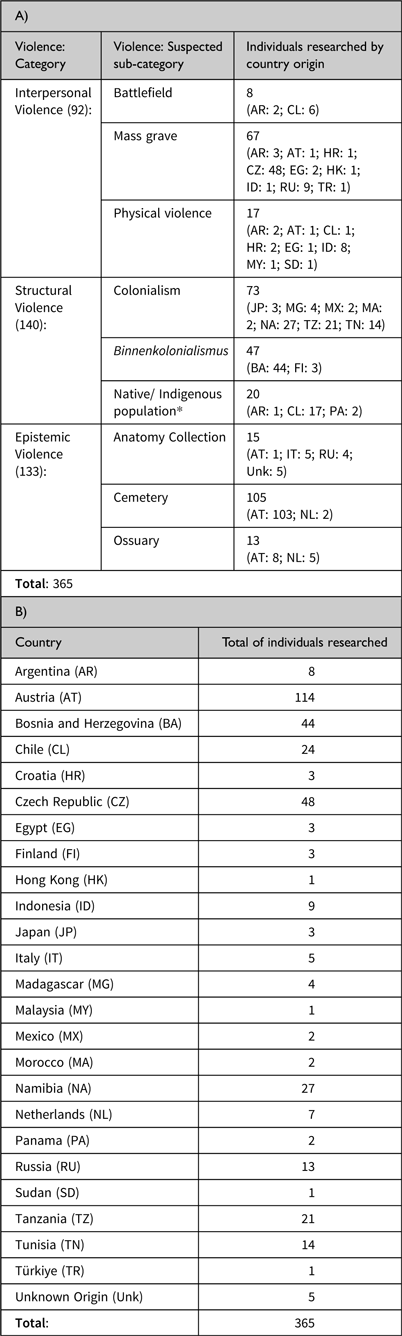
The study is based on a total of n=365 selected human remains from the collections of the Department of Anthropology, Natural History Museum Vienna (see Table 1A). Only individuals inventoried before 1935 are considered, as afterwards mostly individuals from local Austrian archaeological contexts were inventoried (Eggers et al. Reference Eggers, Herewini, Mamaku and Schölnberger2021).
Details of total number of n=365 individuals researched in this study. A) Individuals listed and classified according to their categorization into contexts of violent origin based on information gained from the inventory catalogue; B) Individuals listed according to their origin based on today’s geopolitical borders.
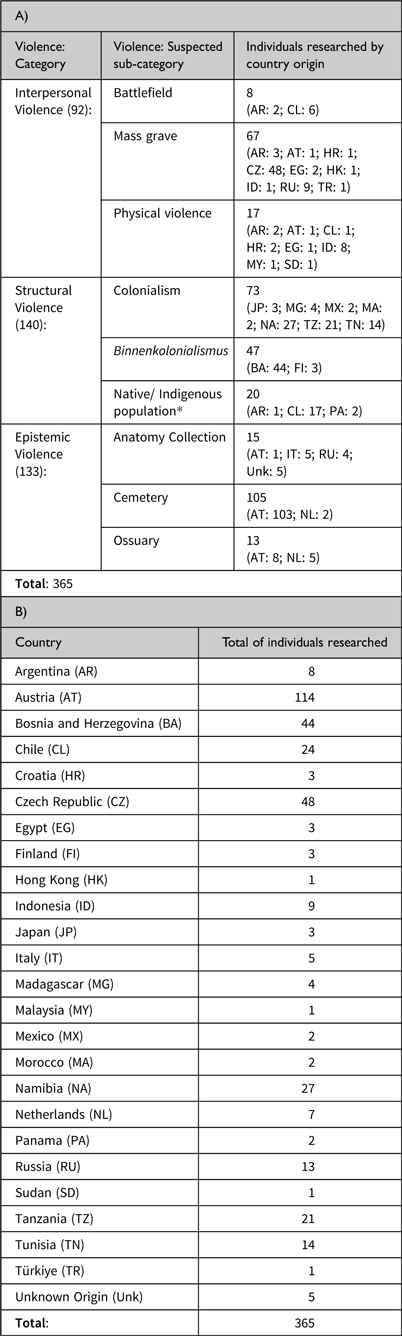
Table 1 Long description
The table is divided into two main sections: Panel A and Panel B. Panel A categorizes individuals researched by contexts of violent origin, while Panel B lists individuals according to their origin based on today’s geopolitical borders. Panel A has three main categories: Interpersonal Violence, Structural Violence, and Epistemic Violence. Each category is further divided into sub-categories with the number of individuals researched listed by country origin. For example, under Interpersonal Violence, the sub-category Mass grave includes individuals from countries like Argentina, Austria, Croatia, Czech Republic, Egypt, and others. Panel B lists the total number of individuals researched by country. For instance, Austria has 114 individuals researched, Bosnia and Herzegovina has 44, and so on. The table provides a detailed breakdown of the individuals researched, categorized by violent contexts and country of origin.
*If there were known, region-specific frameworks for dealing with Indigenous remains from this context, these were adhered to. For example, no human remains were included in the research that are theoretically subject to NAGPRA, even if they are currently curated outside the USA, or, in this case, Austria.
The individuals for this study have been selected based on their entry description in the inventory catalogue for a precise representation of their assigned group, either reflecting IV, SV or EV (IV: n=92, SV: n=140, EV: n=133). They were assigned only one of these categories. The assignment was made on a first-mentioned basis: if the inventory entry mentioned the specific context first, then it was assigned to that context, even if by further research the individual would later also apply to a second or third context. This was based on the significance of the first mention and previous research showing that DA-NHMW curators did order the inventory methodically rather than arranging it randomly (Kremmler Reference Kremmler2024). It must be acknowledged that the tripartite classification used here is ultimately driven by what the archival record does or does not document. Individuals assigned to structural or epistemic violence contexts are not necessarily free from interpersonal violence, or vice versa; rather, their archival record does not explicitly document it. The SV and EV categories therefore function analytically as a proxy for cases where interpersonal violence is not the primary documented acquisition context, and this limitation must be kept in mind when interpreting the osteological results. As archival research is extremely time-consuming, and often hindered by incomplete data records, only roughly 100 individuals per context were selected that represented cases where additional archival information was found that validates the provenance and circumstances of acquisition of the individuals.
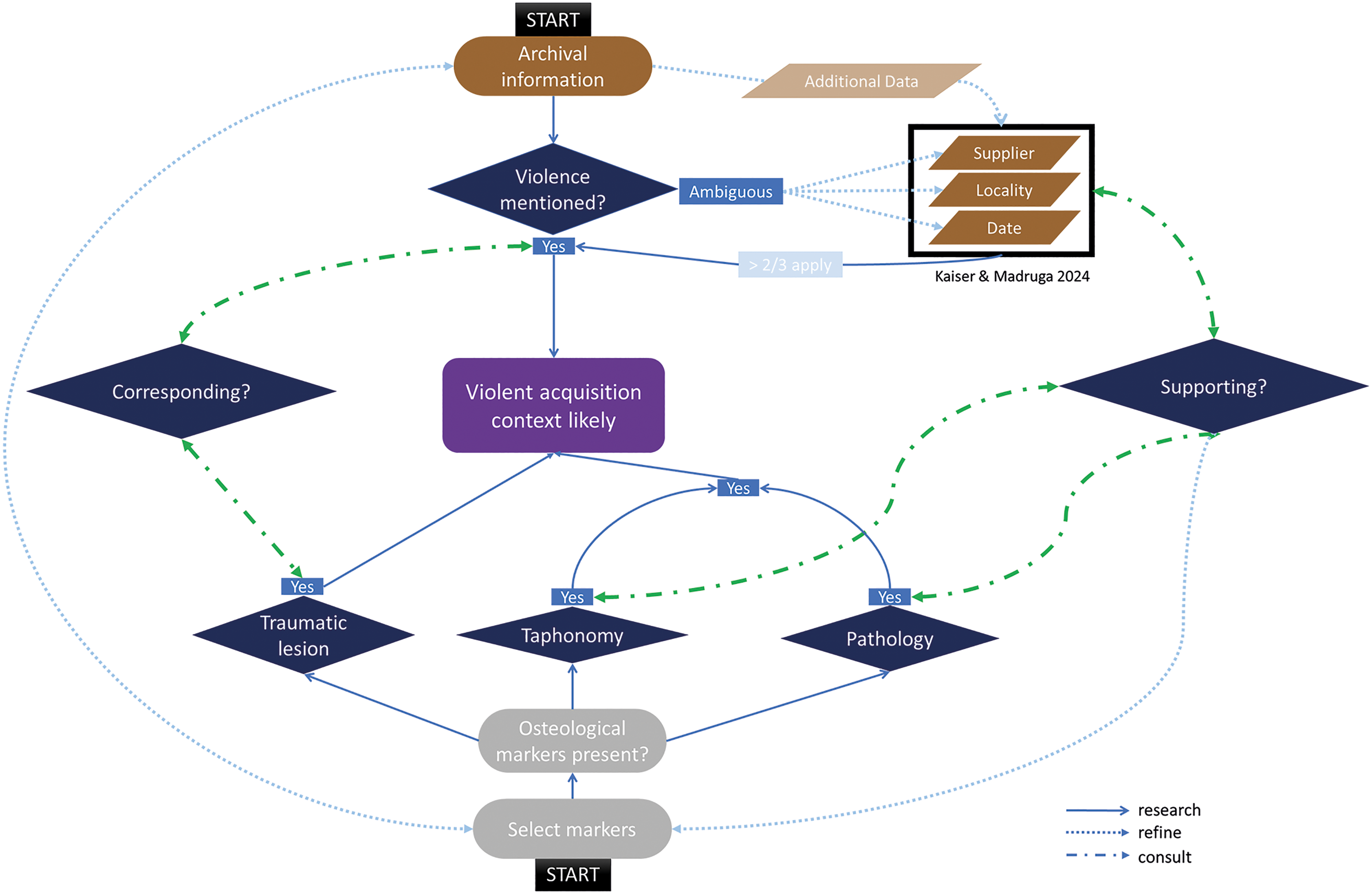
We have visualized our research process for the sample collection in a flowchart (see Figure 1), detailing our systematic process of investigating human remains in museum collections in order to establish their provenance and origin. Originally proposed by Kaiser and Madruga (Reference Kaiser and Madruga2024) for ethnographic objects from colonial contexts, it is a summary of the decisions and evidence that need to be considered when researching violent contexts in museum collections. It also represents our two research paths in which we confronted the sample, each path’s beginning indicated by the ‘START’ section. The archival component incorporates key data, such as supplier information, geographic locality, acquisition dates and inventory records. Meanwhile, the osteological analysis focuses on context-specific skeletal markers, with interpretations refined through consultation with the archival findings.
Flow chart to account for decisions that need to be made to define for a violent acquisition context in a human remains collection. The distinction between supplier, locality and date was first made by Kaiser and Madruga (Reference Kaiser and Madruga2024). The style of the line indicates how the different lines of evidence from the archival and skeletal analysis should be treated.
Thus n=365 individuals were included in the study based on information presented in the inventory catalogue. All individuals are only present as crania because of historic collection preferences. They originate from 22 different countries based on today’s geopolitical borders (see Table 1B). For five individuals, no exact geographic location could be assigned. However, based on the inventory catalogue, their origin could be narrowed down to Europe, likely from universities. All analyses were conducted using R (version 4.5.0) and RStudio (version 2024.12.1+563).
Historic contextualization
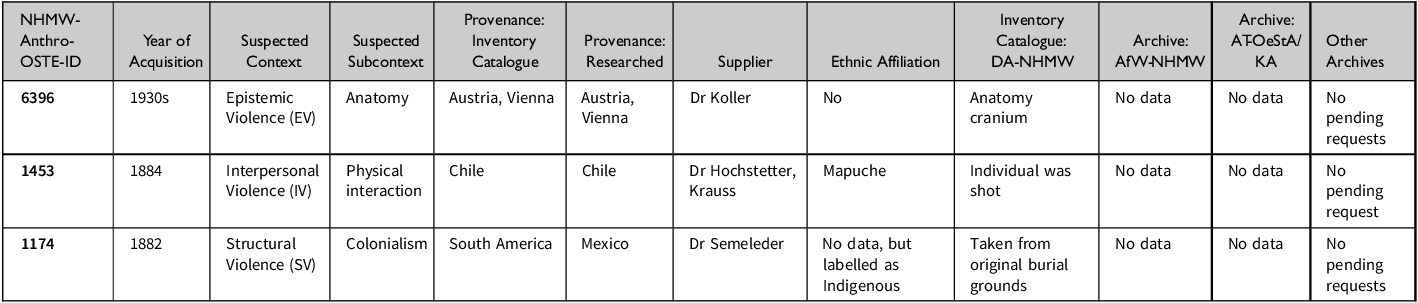
The individuals for this study were selected based on their inventory catalogue entry and were assigned to the first-mentioned context of violence (IV, SV or EV) (Table 1). This was done based on assuming the significance of the first mention (Kremmler Reference Kremmler2024). Additional information to verify the acquisition context was also retrieved from the internal DA-NHMW note repository (Zettelkasten), as well as the Archive for the History of Science at the NHMW (AfW-NHMW) and the War Archives of the Austrian National Library (Österreichisches Staatsarchiv – Kriegsarchiv, AT-OeStA/KA). An example provided for every context can be seen in Table 2. It is important to emphasize that the assignment of individuals to any of these contexts ultimately cannot be verified and was made on the basis of the available and analysed data.
Checklist for researched provenance information using three concrete examples from the convolute of 365 individuals analysed herein. This information has been gathered for each individual from external and internal archival sources. Each context is represented by an example as part of the data.
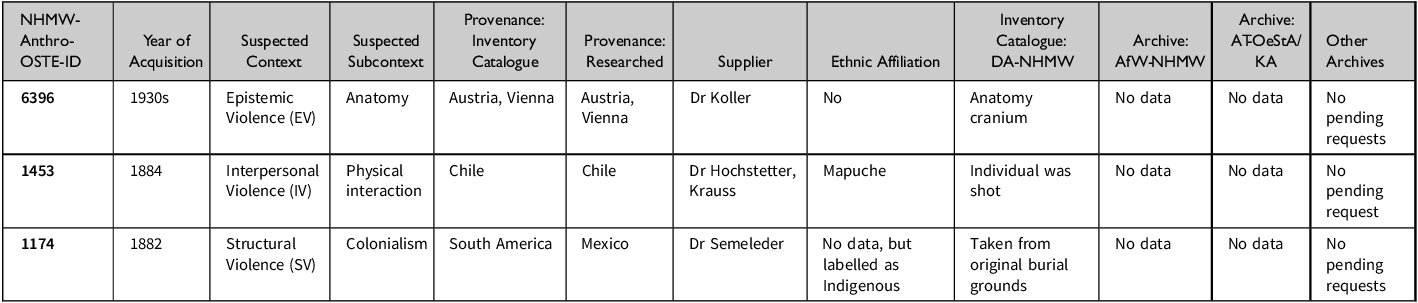
Table 2 Long description
A table with 365 rows and 11 columns detailing the provenance and context of acquisition for various individuals in a study. The columns are NHMW-Anthro-OSTE-ID, Year of Acquisition, Suspected Context, Suspected Subcontext, Provenance: Inventory Catalogue, Provenance: Researched, Supplier, Ethnic Affiliation, Inventory Catalogue: DA-NHMW, Archive: AfW-NHMW, Archive: AT-OeStA/KA, and Other Archives. Row 1: 6396, 1930s, Epistemic Violence (EV), Anatomy, Austria, Vienna, Austria, Vienna, Dr Koller, No, Anatomy cranium, No data, No data, No pending requests. Row 2: 1453, 1884, Interpersonal Violence (IV), Physical interaction, Chile, Chile, Dr Hochstetter, Krauss, Mapuche, Individual was shot, No data, No data, No pending request. Row 3: 1174, 1882, Structural Violence (SV), Colonialism, South America, Mexico, Dr Semeleder, No data, but labelled as Indigenous, Taken from original burial grounds, No data, No data, No pending requests.
Following their contextualization, the human remains were categorized as originating from one violent background. A direct example for interpersonal violence is NHMW-Anthro-OSTE-ID 1453, an individual from Chile whose inventory entry documents death by gunshot wound, making the acquisition context one of direct lethal interpersonal violence (see Table 2). Structural violence is illustrated by the 27 individuals originating from present-day Namibia and the 21 from present-day Tanzania, both acquired during periods of active German colonial administration, when the collection of human remains from colonized populations was embedded in broader structures of racial science and political domination (see Table 1). Within the present sample, epistemic violence is exemplified by NHMW-Anthro-OSTE-ID 1174, an individual taken from their original burial grounds in Mexico and catalogued with an Indigenous ethnic label, and by NHMW-Anthro-OSTE-ID 6396, an anatomy cranium from Vienna acquired through institutional medical practice without documented consent (see Table 2). Anatomy collections and ossuaries both represent contexts in which individuals were reduced to objects of study or spatial convenience, stripped of their personal identities in the service of institutional or scientific needs. The people within them rarely had a say in how their remains were used, reflecting a broader pattern in which the powerful, whether medical institutions or the Church, determined the fate of the dead on their own terms.
Osteology
After assignment to one context, the individuals were assessed for osteological markers potentially representing violence. This was done blindly and six months after classification, meaning that the individual’s background was not known by the examining bioarchaeologists at the time of analysis. Given the presumed sensitive background of the collections, all applied methods are non-destructive. Because of past collection preferences, all individuals were only present as crania or calvaria.
All individuals except sub-adults were estimated for biological sex by the methods provided by Ferembach et al. (Reference Ferembach, Schwidetzky and Stloukal1980), with pre-defined age categories modified according to Buikstra and Ubelaker (Reference Buikstra and Ubelaker1994). Because the estimation method based on cranial sutures can be inaccurate (Beauthier et al. Reference Beauthier, Lefevre and Meunier2010), Brothwell’s molar abrasion sheet was included if an inspection of the molars was possible and not hindered through a glued-together jaw (Brothwell Reference Brothwell1981). Sub-adults were attributed to age-at-death classes by the status of their dental eruption according to the London Tooth Atlas of Development (AlQahtani et al. Reference AlQahtani, Hector and Liversidge2010). Individuals were age-estimated after thorough consideration of a combination of all observed traits.
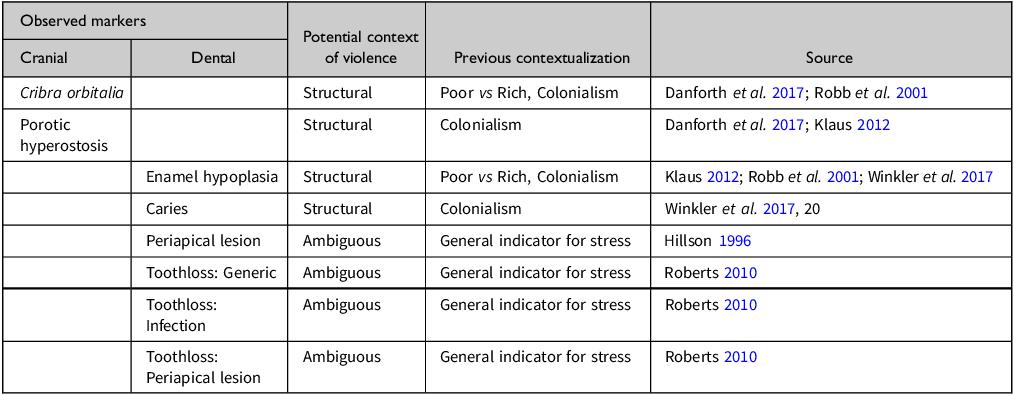
Pathological changes can serve as indicators of how individuals were affected by violence within the systems they inhabited, as they reveal how their bodies internalized and responded to systemic structures that shaped their lived experiences. For example, socio-economic structures may have a physiological effect in the form of poverty, causing illness through mechanisms such as chronic stress, malnutrition and limited access to healthcare (Farmer Reference Farmer2004). Health is mostly studied through general markers of stress, combining them with a contextualization within the population to understand their causation better (Agarwal & Glencross Reference Agarwal and Glencross2011; Klaus Reference Klaus, Martin and Harrod2012). This causation provides the link to violence that is systematically and structurally experienced. For each individual, certain health markers selected from those reported to reflect stress were assessed. This was done on the assumption that the presence of these health markers, if properly contextualized with data from the archival research, reflect structural violence (see Table 3). Concerning the wide range of pathological changes observable on the teeth, a focus was put on what has been described as the ‘big three’: linear enamel hypoplasia, caries and dental attrition (Nelson Reference Nelson, Irish and Scott2015). Because of the absence of postcranial elements, other unspecific stress markers included were porotic hyperostosis on the frontal and parietal bones and cribra orbitalia in the eye sockets (Brickley Reference Brickley2018).
Overview of pathological recordings and their assignment to potential contexts of violence. Added are also key words referring to the contexts in which the markers have been studied before.
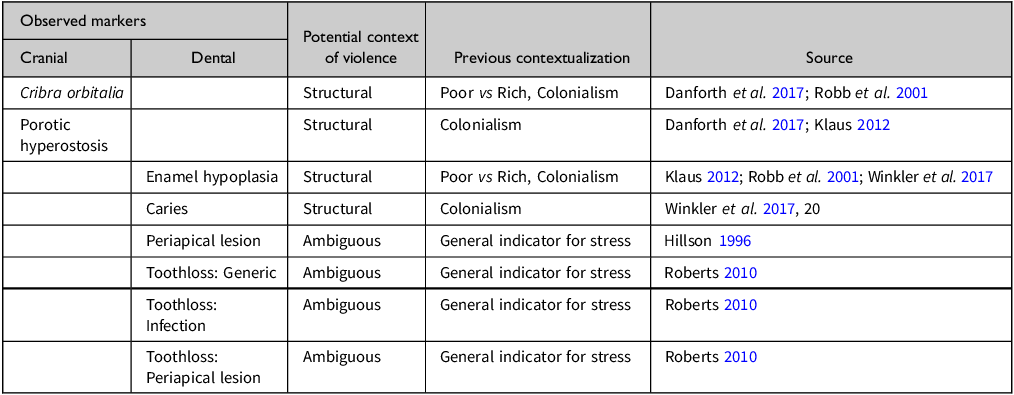
Table 3 Long description
A table summarizing pathological markers, their potential contexts of violence, and previous contextualizations. The table has four columns: Observed markers, Potential context of violence, Previous contextualization, and Source. The Observed markers column is divided into Cranial and Dental rows. The Cranial markers listed are Cribra orbitalia and Porotic hyperostosis. The Dental markers listed are Enamel hypoplasia, Caries, Periapical lesion, Toothloss: Generic, Toothloss: Infection, and Toothloss: Periapical lesion. The Potential context of violence column lists Structural for Cribra orbitalia, Porotic hyperostosis, Enamel hypoplasia, and Caries, and Ambiguous for Periapical lesion, Toothloss: Generic, Toothloss: Infection, and Toothloss: Periapical lesion. The Previous contextualization column lists Poor vs Rich, Colonialism for Cribra orbitalia, Colonialism for Porotic hyperostosis, Poor vs Rich, Colonialism for Enamel hypoplasia, Colonialism for Caries, and General indicator for stress for Periapical lesion, Toothloss: Generic, Toothloss: Infection, and Toothloss: Periapical lesion. The Source column lists references for each marker. Row 1: Cribra orbitalia, Structural, Poor vs Rich, Colonialism, Danforth et al. 2017; Robb et al. 2001. Row 2: Porotic hyperostosis, Structural, Colonialism, Danforth et al. 2017; Klaus 2012. Row 3: Enamel hypoplasia, Structural, Poor vs Rich, Colonialism, Klaus 2012; Robb et al. 2001; Winkler et al. 2017. Row 4: Caries, Structural, Colonialism, Winkler et al. 2017, 20. Row 5: Periapical lesion, Ambiguous, General indicator for stress, Hillson 1995. Row 6: Toothloss: Generic, Ambiguous, General indicator for stress, Roberts 2010. Row 7: Toothloss: Infection, Ambiguous, General indicator for stress, Roberts 2010. Row 8: Toothloss: Periapical lesion, Ambiguous, General indicator for stress, Roberts 2010.
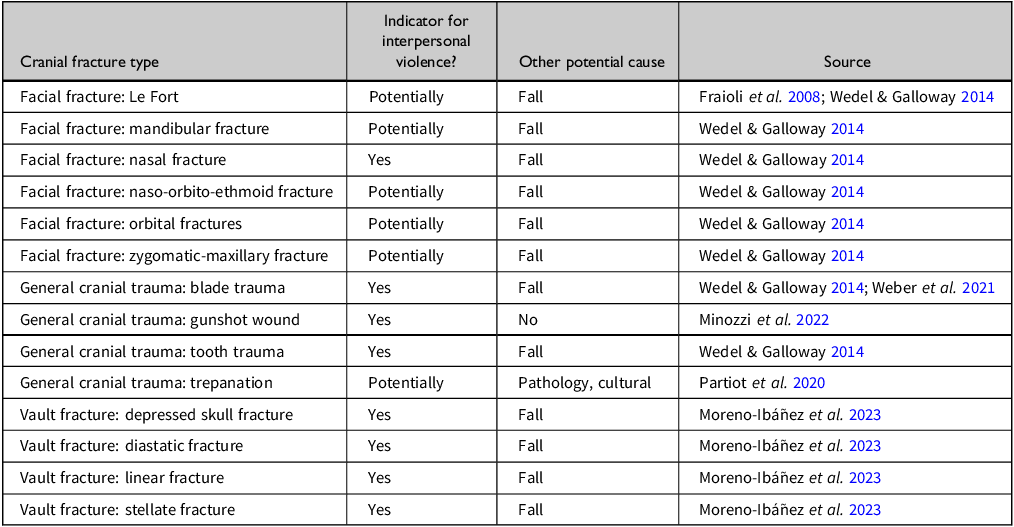
As the sample only consists of cranial elements, the diagnostic focus was put on cranial fractures (see Table 4). As differential diagnosis between trauma is additionally hindered through the poor preservation caused by certain archaeological excavation circumstances, differentiating between interpersonal violence and accidents is difficult (Wedel & Galloway Reference Wedel and Galloway2014).
Fracture type, lines and detailed trauma recorded listed in this study that might represent markers for interpersonal trauma, including differential diagnosis.
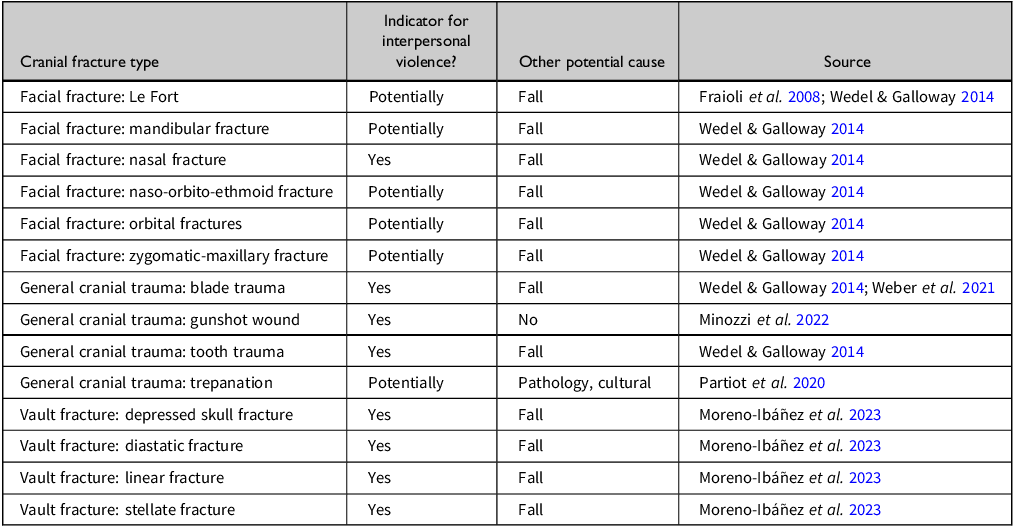
Table 4 Long description
The table has five columns: Cranial fracture type, Indicator for interpersonal violence, Other potential cause, and Source. It contains 12 rows, each detailing a specific type of cranial fracture. Row 1: Facial fracture: Le Fort, Potentially, Fall, Fraioli et al. 2008; Wedel & Galloway 2014. Row 2: Facial fracture: mandibular fracture, Potentially, Fall, Wedel & Galloway 2014. Row 3: Facial fracture: nasal fracture, Yes, Fall, Wedel & Galloway 2014. Row 4: Facial fracture: naso-orbito-ethmoid fracture, Potentially, Fall, Wedel & Galloway 2014. Row 5: Facial fracture: orbital fractures, Potentially, Fall, Wedel & Galloway 2014. Row 6: Facial fracture: zygomatic-maxillary fracture, Potentially, Fall, Wedel & Galloway 2014. Row 7: General cranial trauma: blade trauma, Yes, Fall, Wedel & Galloway 2014; Weber et al. 2021. Row 8: General cranial trauma: gunshot wound, Yes, No, Minozzi et al. 2022. Row 9: General cranial trauma: tooth trauma, Yes, Fall, Wedel & Galloway 2014. Row 10: General cranial trauma: trepanation, Potentially, Pathology, cultural, Partiot et al. 2020. Row 11: Vault fracture: depressed skull fracture, Yes, Fall, Moreno-Ibáñez et al. 2023. Row 12: Vault fracture: diastatic fracture, Yes, Fall, Moreno-Ibáñez et al. 2023. Row 13: Vault fracture: linear fracture, Yes, Fall, Moreno-Ibáñez et al. 2023. Row 14: Vault fracture: stellate fracture, Yes, Fall, Moreno-Ibáñez et al. 2023.
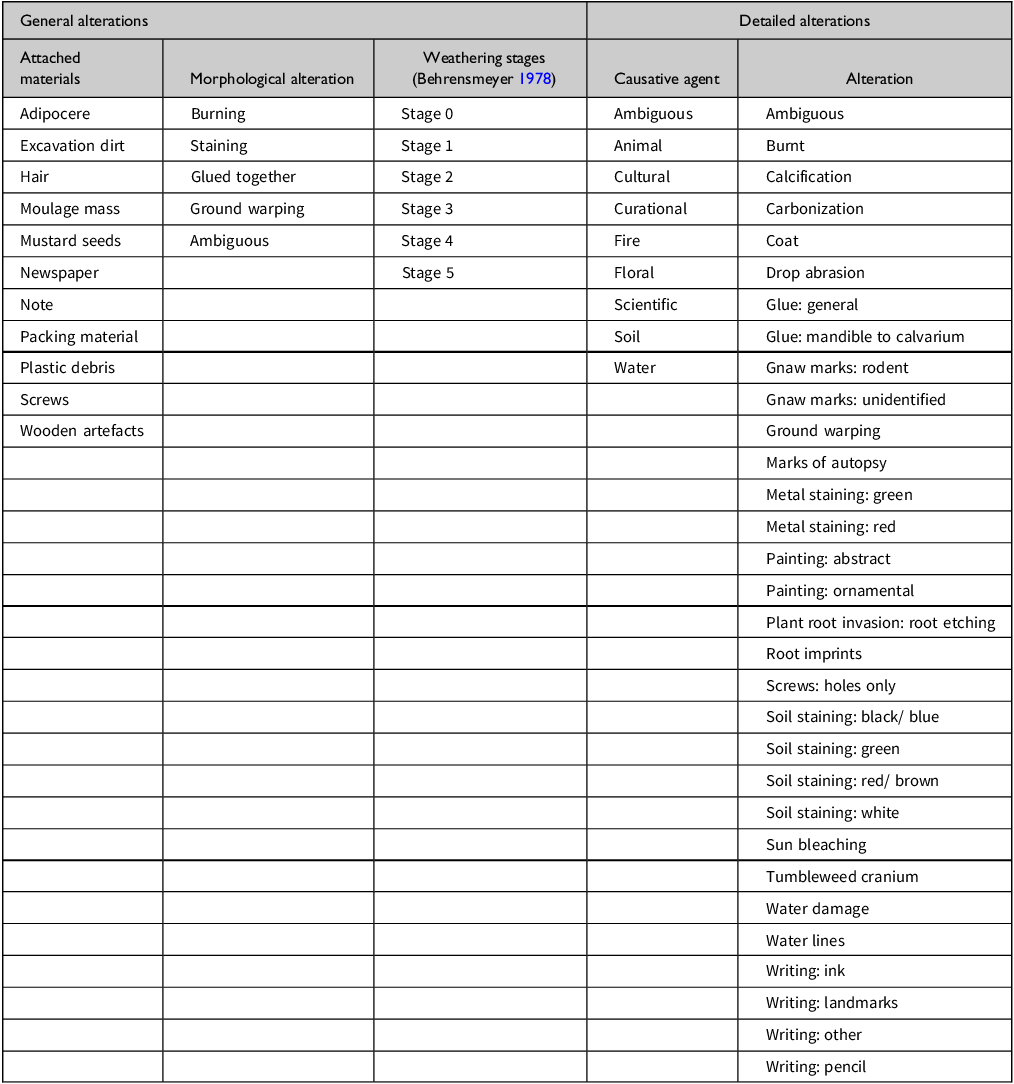
Taphonomy refers to the study of post-mortem processes acting on bones, encompassing the analytical study and interpretation of natural and non-naturally-caused processes, e.g. by erosion, animal gnawing, sun bleaching, curational interventions, funerary traditions, changes and alterations visible on the bone on an individual level, providing further contextual information (Schultz Reference Schultz and Dirkmaat2012). Its application is therefore more general, and it may provide general ideas about the cause of alterations of bone surfaces, including handling and curational efforts (Paolello & Klales Reference Paolello and Klales2021). Adherent material to the bone surfaces was studied, as well as morphological alterations and changes of the bone itself (see Table 5). Detailed changes could account for all causative agents, for example an accompanying note could contain information about display (causative agent: curatorial—cataloguing, labelling, restoration, display, storage, conservation decisions), but also about further sampling information (causative agent: scientific). The detailed changes were considered to be potential markers for different contexts of violence. While a variety of taphonomy alterations was recorded, for the later analysis curatorial and scientific causative agents were included in the analysis to account for epistemic violence. Every recorded alteration has been assigned a causative agent.
Taphonomic influences recorded if present on the bone. Differentiated between general alterations to the bone and detailed alterations, for which the causative agent needed to be identified. Any detailed changes were considered to be markers for different contexts of violence. Every recorded alteration has been assigned a causative agent.
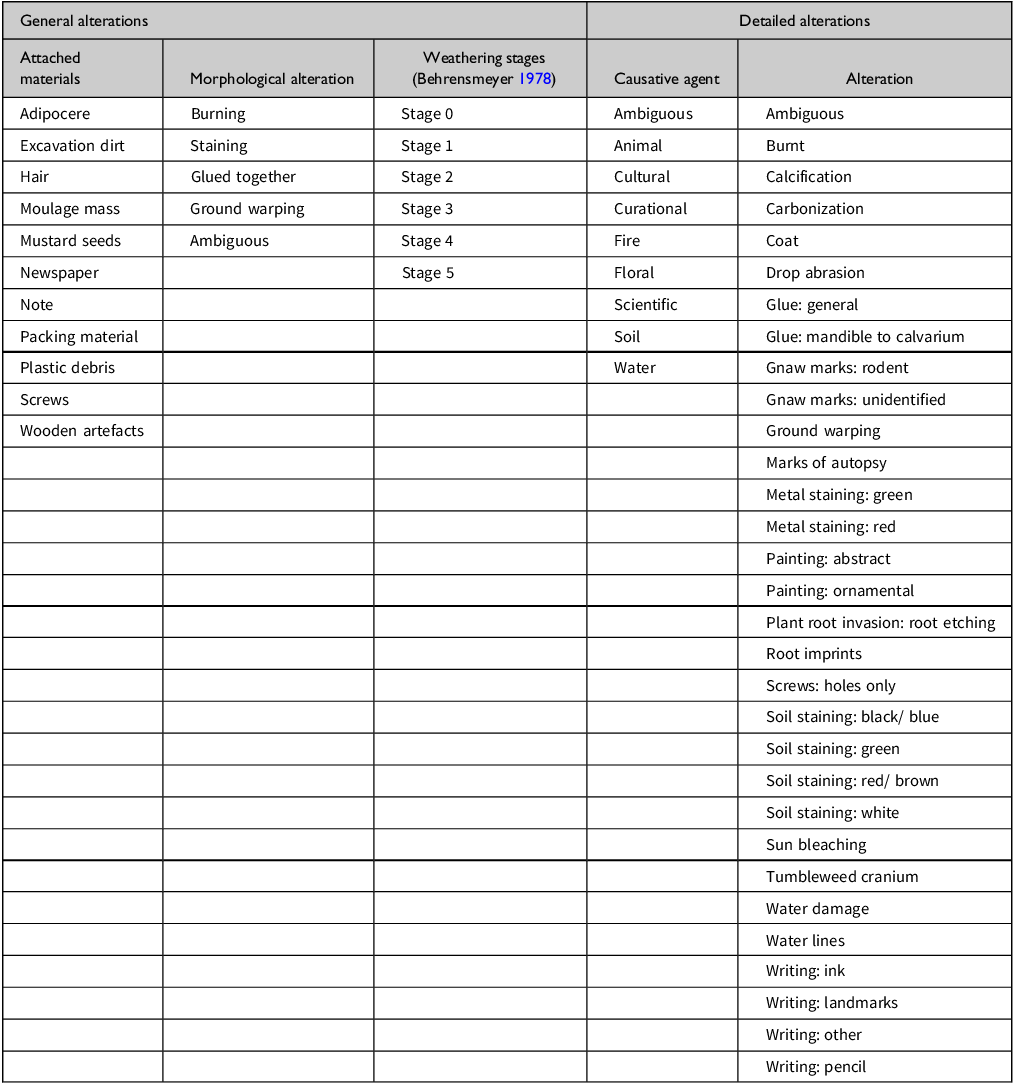
Table 5 Long description
A table categorizing bone alterations by attached materials, morphological changes, weathering stages, causative agents, and specific alterations. The table has two main sections: General alterations and Detailed alterations. General alterations include attached materials such as adipocere, excavation dirt, hair, moulage mass, mustard seeds, newspaper, note, packing material, plastic debris, screws, and wooden artefacts. Morphological alterations include burning, staining, glued together, ground warping, and ambiguous. Weathering stages are labeled from Stage 0 to Stage 5. Detailed alterations include causative agents such as ambiguous, animal, cultural, curational, fire, floral, scientific, soil, and water. Specific alterations include burnt, calcification, carbonization, coat, drop abrasion, glue: general, glue: mandible to calvarium, gnaw marks: rodent, gnaw marks: unidentified, ground warping, marks of autopsy, metal staining: green, metal staining: red, painting: abstract, painting: ornamental, plant root invasion: root etching, root imprints, screws: holes only, soil staining: black/blue, soil staining: green, soil staining: red/brown, soil staining: white, sun bleaching, tumbleweed cranium, water damage, water lines, writing: ink, writing: landmarks, writing: other, and writing: pencil. Each row in the table lists the attached material, morphological alteration, weathering stage, causative agent, and specific alteration.
Results
Following an initial assessment of each individual’s provenance and estimated age-at-death and sex, we proceeded to evaluate the markers of violence associated with each specific context (see Tables 3–5). The sample consists of three main groups of violence with subgroups. For contexts of interpersonal violence, this includes battlefields (n=8), mass graves (n=67) and acts indicating that interpersonal violence caused the individual’s death (n=17). Structural contexts could be found in Binnenkolonialismus (n=47), colonialism (n= 73), and individuals primarily being labelled as having an Indigenous ethnicity (n=20). Lastly, contexts of epistemic violence were represented in the origin of human remains for educational anatomical purposes (n=15), originating from cemeteries (n=105), but also ossuaries (n=13).
Of 365 individuals, 170 showed some type of traumatic alteration to the bone (Changes: Yes or Ambiguous). Of these, 105 alterations across 80 individuals were most likely caused by excavation, curation, or general post-excavation handling of the human remains, evidenced by fresh, rather new bone breaks and tool marks consistent with mechanical damage, and were therefore classified as taphonomic in origin and occurring postmortem. The remaining 40 entries across 30 individuals were classified as interpersonal violence- or surgery-related, with an additional 87 entries remaining of Unknown aetiology. Two individuals showed antemortem stab wound with signs of healing, and one further stab wound was recorded perimortem without healing. All cases had not been reported as such in the inventory catalogue. Surgical interventions were identified in 15 cases: 6 calotte openings (Head Cut), 3 trepanations, all perimortem and deriving from an anatomical collection context, and 2 cases of Human Scalp Marks consistent with surgical opening of the cranium.
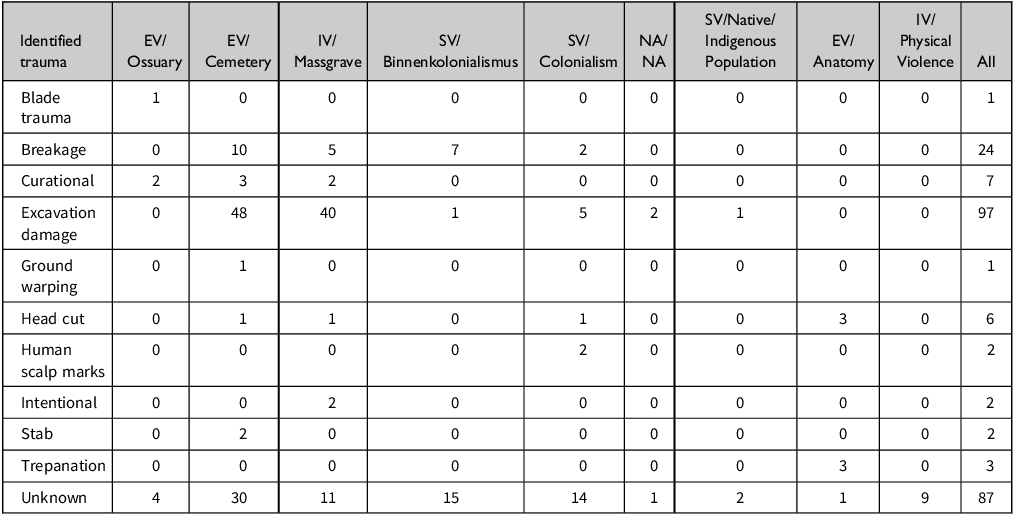
The distribution of markers varied markedly across collection contexts, reflecting both the distinct biographical histories of the individuals and the taphonomic conditions associated with each (Table 6). Excavation damage was most prevalent in the EV/Cemetery (n=48) and IV/Massgrave (n=40) sub-collections, consistent with the mechanical disturbance expected in densely occupied burial grounds and hastily interred mass graves respectively, where close bone proximity and excavation conditions increase the likelihood of tool contact. Curational damage was confined to EV contexts (Ossuary: n=2, Cemetery: n=3, Massgrave: n=2), suggesting post-excavation handling in institutional storage as the primary source, independent of original depositional context. Surgical interventions were almost exclusively associated with the EV/Anatomy subcollection, which accounted for all three trepanations and three of six anatomical head openings, confirming that these modifications reflect anatomical preparation practices rather than perimortem events in the strict bioarchaeological sense.
Identified trauma and the violent context in which they appeared.
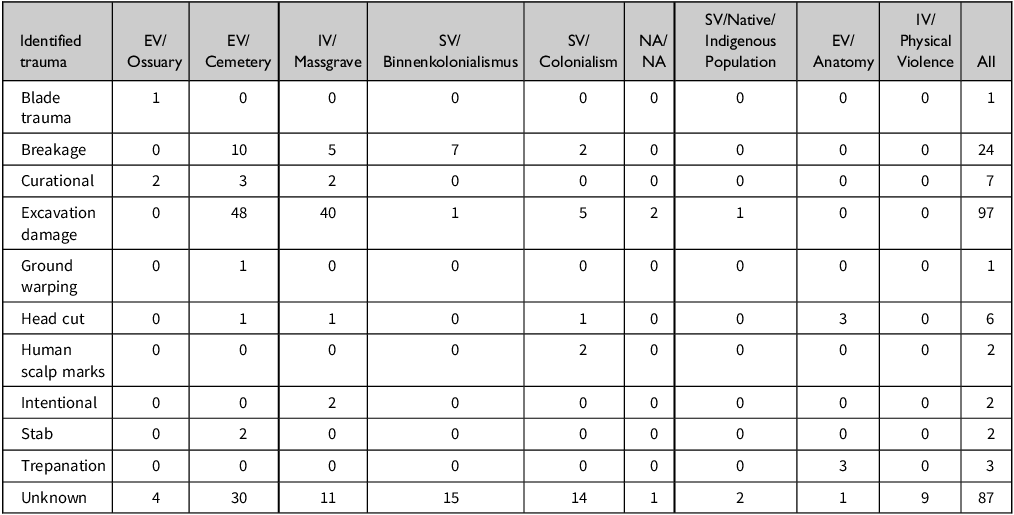
Table 6 Long description
A table showing the distribution of identified trauma across various collection contexts. The table has 10 rows and 10 columns. The columns are labeled as follows: Identified trauma, EV/Ossuary, EV/Cemetery, IV/Massgrave, SV/Binnenkolonialismus, SV/Colonialism, NA/NA, SV/Native/Indigenous Population, EV/Anatomy, IV/Physical Violence, and All. The rows are labeled with different types of trauma: Blade trauma, Breakage, Curational, Excavation damage, Ground warping, Head cut, Human scalp marks, Intentional, Stab, Trepanation, and Unknown. Each cell contains a numerical value representing the count of identified trauma in each context. Notable trends include high counts of Excavation damage in EV/Cemetery and IV/Massgrave, and high counts of Unknown trauma across all contexts.
While the pathological analysis is restricted to cranial elements and the analysis of stress markers only, these were recorded in 233 individuals, with dental pathology as the most prevalent category: caries was identified in 88 individuals (171 entries), antemortem tooth loss with signs of infection (AMTL-Infection) in 41 individuals (82 entries), periapical lesions in 49 individuals (99 entries), and enamel hypoplasia as a marker of childhood physiological stress in 48 individuals (158 entries). Porotic hyperostosis, indicative of anaemia or nutritional stress, was the most frequently identified non-dental condition, present in 61 individuals (76 entries). Cribra orbitalia was recorded in 48 individuals. Periostitis or periosteal new bone formation, reflecting systemic or localized infection, was identified in 2 individuals, with 1 showing active woven bone.
Taphonomic markers were recorded across 318 individuals, yielding 1,633 individual entries. Curational agents represented the largest single category (n=882), reflecting the extensive institutional handling histories of the collections, and included writing in ink (n=488), pencil (n=31), and landmark notations (n=49), as well as screws and screw-holes (n=117 combined), glue (n=35) and applied coatings. Soil-derived changes constituted the second largest category (n=254), indicative of variable burial conditions across the sampled contexts. Adherent materials were present in 178 entries, including excavation dirt (n=81), newspaper (n=9) and mustard seeds (n=7), the last of these being consistent early practices to estimate cranial volume capacity. Sun bleaching was identified in 16 instances, and three cases of animal gnawing were recorded.
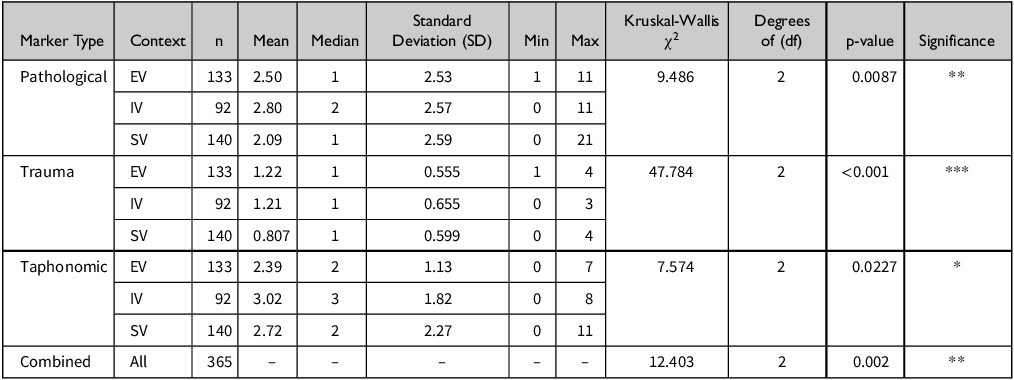
Predicting an individual’s contextual origin based on osteological markers, as proposed, revealed varying potential between the measured variables (see Table 7).
Summary statistics for pathological, trauma, and taphonomic markers across acquisition contexts characterized by epistemic (EV), interpersonal (IV) and structural (SV) violence in a museum collection.
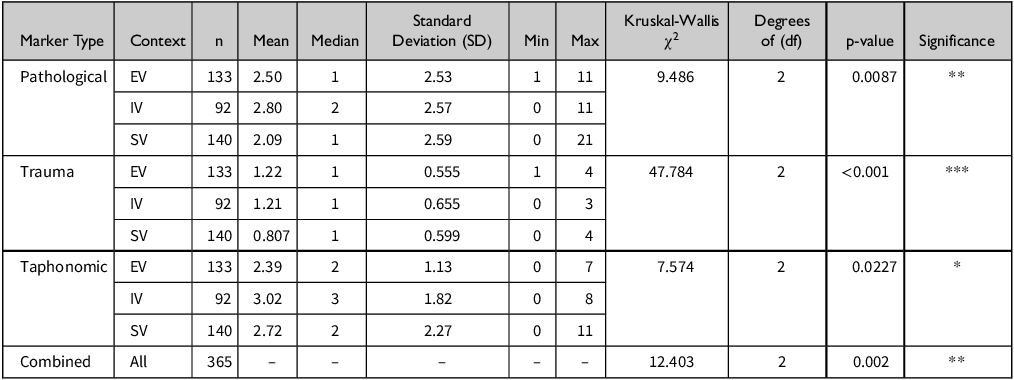
Table 7 Long description
The table presents summary statistics for pathological, trauma, and taphonomic markers across three acquisition contexts: epistemic violence (EV), interpersonal violence (IV), and structural violence (SV). The table is organized into four main sections: Pathological, Trauma, Taphonomic, and Combined. Each section contains rows for EV, IV, and SV contexts, with columns for Marker Type, Context, n, Mean, Median, Standard Deviation (SD), Min, Max, Kruskal-Wallis χ2, Degrees of Freedom (df), p-value, and Significance. Row 1: Pathological, EV, 133, 2.50, 1, 2.53, 1, 11, 9.486, 2, 0.0087, **. Row 2: Pathological, IV, 92, 2.80, 2, 2.57, 0, 11, 9.486, 2, 0.0087, **. Row 3: Pathological, SV, 140, 2.09, 1, 2.59, 0, 21, 9.486, 2, 0.0087, **. Row 4: Trauma, EV, 133, 1.22, 1, 0.555, 1, 4, 47.784, 2, <0.001, ***. Row 5: Trauma, IV, 92, 1.21, 1, 0.655, 0, 3, 47.784, 2, <0.001, ***. Row 6: Trauma, SV, 140, 0.807, 1, 0.599, 0, 4, 47.784, 2, <0.001, ***. Row 7: Taphonomic, EV, 133, 2.39, 2, 1.13, 0, 7, 7.574, 2, 0.0227, *. Row 8: Taphonomic, IV, 92, 3.02, 3, 1.82, 0, 8, 7.574, 2, 0.0227, *. Row 9: Taphonomic, SV, 140, 2.72, 2, 2.27, 0, 11, 7.574, 2, 0.0227, *. Row 10: Combined, All, 365, -, -, -, -, -, 12.403, 2, 0.002, **. The table provides a detailed comparison of the mean, median, standard deviation, minimum, and maximum values for each marker type and context, along with the results of the Kruskal-Wallis test, including the χ2 value, degrees of freedom, p-value, and significance level.
Note: Significance levels: *** p < 0.001, ** p < 0.01, * p < 0.05, n.s.=not significant. Post-hoc pairwise comparisons (Bonferroni-corrected): Pathological markers showed significant difference between IV–SV (p=0.0091); trauma markers showed significant differences between SV–EV (p < 0.001) and SV–IV (p < 0.001); taphonomic markers showed significant difference between EV–IV (p=0.0017). Combined marker analysis: χ²=12.403, df=2, p=0.002.
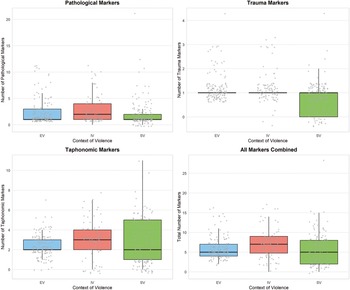
The presence of pathology markers demonstrated significant between-group differences (p=0.0087), with notable variation across EV (M=2.50, SD=2.53), IV (M=2.80, SD=2.57), and SV (M=2.09, SD=2.59) context. Post-hoc analysis revealed that only the IV/SV comparison reached significance after Bonferroni correction (p=0.0091). The presence of trauma markers showed highly significant variation between groups (p <0.001), with distinct distributions across EV (M=1.22, SD=0.555), IV (M=1.21, SD=0.655), and SV (M=0.807, SD=0.599) contexts. Pairwise comparisons indicated that SV differed significantly from both EV (p <0.001) and IV (p <0.001), while EV and IV showed no significant difference. Taphonomic alterations exhibited no significant differences between groups (p=0.0227), with comparable means across EV (M=2.39, SD=1.13), IV (M=3.02, SD=1.82), and SV (M=2.72, SD=2.27) contexts. The combined marker analysis also revealed significant group differences (p=0.002). The observed patterns therefore indicate that trauma markers show the strongest discriminatory power for predicting contextual origin, followed by pathology markers, while taphonomic alterations also show predictive value for group classification (see Figure 2).
Overview over boxplots distribution of osteological markers by context of violence. Boxplots show median, quartiles, and individual data points for pathological, trauma, taphonomic, and combined markers.
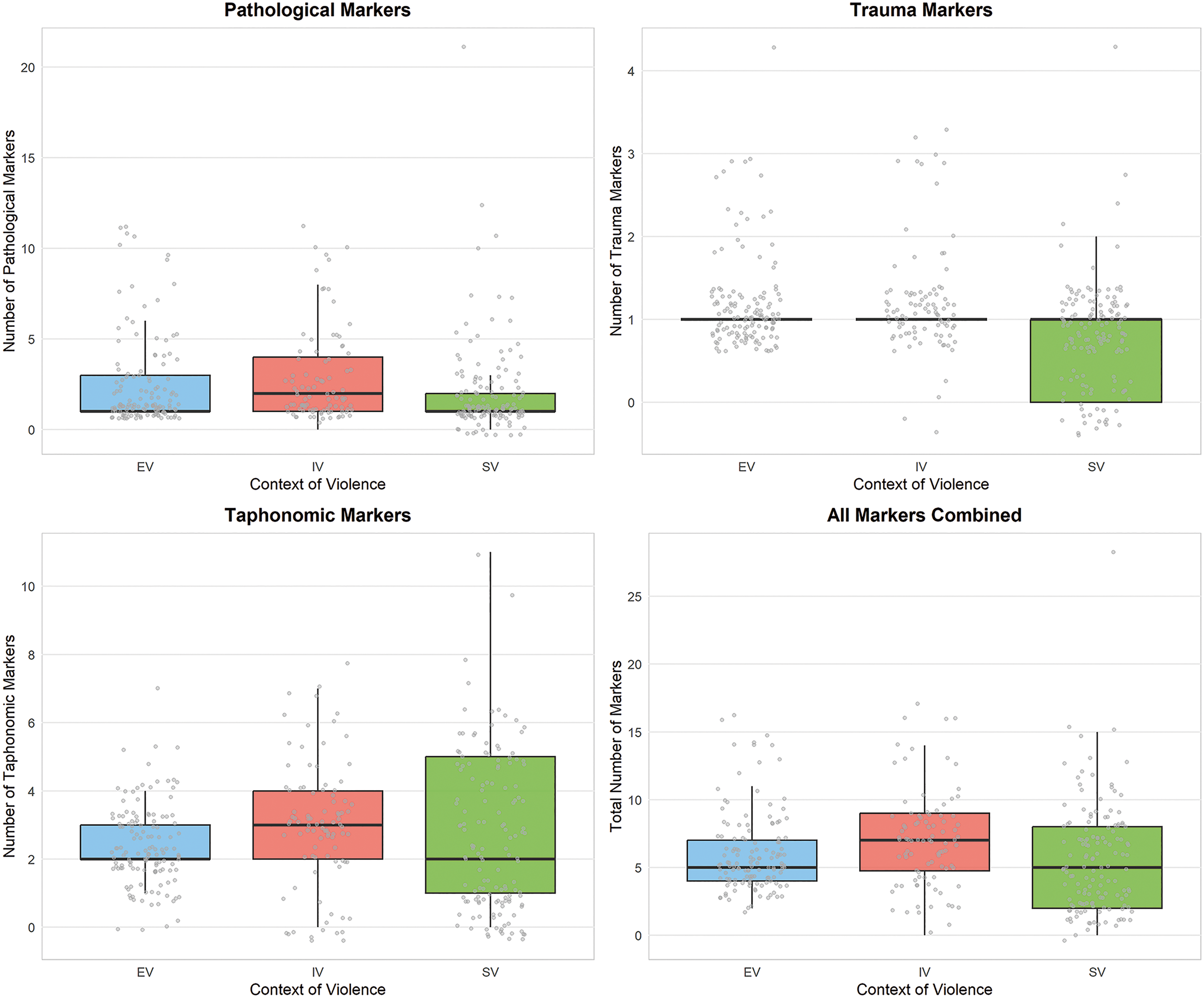
Figure 2 Long description
The image contains four box plots depicting the distribution of osteological markers by context of violence. Each box plot shows the median, quartiles, and individual data points for different types of markers. Panel A: Pathological Markers. This box plot shows the number of pathological markers across three contexts of violence: EV, IV, and SV. The y-axis represents the number of pathological markers, and the x-axis represents the context of violence. Panel B: Trauma Markers. This box plot shows the number of trauma markers across the same three contexts of violence. The y-axis represents the number of trauma markers, and the x-axis represents the context of violence. Panel C: Taphonomic Markers. This box plot shows the number of taphonomic markers across the three contexts of violence. The y-axis represents the number of taphonomic markers, and the x-axis represents the context of violence. Panel D: All Markers Combined. This box plot shows the total number of markers across the three contexts of violence. The y-axis represents the total number of markers, and the x-axis represents the context of violence.
Discussion
The aim of this study was to analyse human remains from violent acquisition contexts in order to identify characteristic osteological markers and, ultimately, to determine which markers could be used to predict group affiliation of collections with unknown contexts based on these markers. To avoid replicating patterns of structural and epistemic violence, we applied local ethical guidelines when present. This mostly meant avoiding the destructive analysis of human remains. Additionally, if there were known, region-specific frameworks for dealing with indigenous remains in this context, these were followed. For example, human remains covered by NAGPRA were not included in the research.
The skeletal alterations in this sample reflect the complex taphonomic and contextual histories of institutionally held human remains. The high proportion of taphonomic damage underscores the need to differentiate postmortem handling systematically from perimortem violence before any analysis, as conflating these categories risks inflating apparent rates of interpersonal trauma. The trepanations, identified exclusively within the anatomical collection subcontext, raise interpretative questions regarding timing: although coded as perimortem, perioperative mortality cannot be excluded, and the absence of healing precludes definitive ante- versus perimortem assignment. Of the trauma cases, the single healed stab wound represents the most unambiguous evidence of survived interpersonal violence, yet neither this nor the two further healed parietal wounds were documented as such in the inventory catalogue. Similarly, two individuals whose archival records attributed cause of death to gunshot wounds showed no corresponding skeletal evidence, likely owing to the preservation of crania only.
The health profile of this sample is characterized by a high prevalence of dental pathology and metabolic stress indicators. The elevated frequency of caries and periapical lesions alongside AMTL-Infection suggests that dental disease often progressed to systemic involvement, reflecting both the high-carbohydrate diets documented archaeologically in many of the source populations and the absence of effective dental intervention. The two cases of possible treponematosis are noteworthy, given the colonial collection contexts represented in the sample, and while the differential diagnosis remains tentative on morphological grounds alone, they warrant further investigation through palaeoproteomics or aDNA analysis. The overall low frequency of periostitis and active infection markers relative to dental disease may reflect the selective preservation of crania over postcranial elements, which bear the majority of periosteal reactions in systemic infection, and prevalence figures for infectious disease should therefore be interpreted as conservative underestimates.
The taphonomic profile of this sample is dominated by curational rather than depositional agents, a pattern that directly reflects the institutional biographies of these collections rather than their original burial environments. The high frequency of ink and pencil writing, screws and glue residues attests to decades of collection management practices that have materially altered the surfaces of the crania and complicate both morphological assessment and stable isotope or aDNA sampling strategies. The presence of mustard seeds as adherent material in seven cases is a contextually specific finding, as this substance was historically used as packing material in central European burials and ossuaries, and may assist in narrowing provenance for otherwise undocumented specimens. Overall, the taphonomic data reinforce that crania from institutionally curated collections carry layered alteration histories that are not reducible to burial context alone.
General contributions of this analysis
Based on the statistical and descriptive analyses, several key findings regarding violence patterns in this osteological dataset can be discussed.
The analysis demonstrates that different violence types produce distinct osteological signatures. Trauma markers showed the strongest discriminatory power (p < 0.001), effectively distinguishing structural violence from epistemic and interpersonal contexts. Pathological (p=0.0087) and taphonomic markers (p=0.0227) provided additional diagnostic value. This suggests that, despite some overlapping, different forms of violence leave distinguishable osteological signatures, potentially enabling forensic and bioarchaeological identification of violence contexts in future analyses.
Assessing provenance is time-consuming work, and societal definitions of what constitutes violence are never universal as they evolve across time and perspective. Flagging individuals as coming from a violent context and then examining the circumstances further using violence as an overarching analytical framework allows for a structured initial assessment without drawing premature normative conclusions, and also limits potential objective biases. The approach presented here therefore provides a context-sensitive way to help researchers navigate through ethically complex material issues. In our new proposed adaptation flowchart for human remains from violent contexts, the focus is on violent acquisition contexts considering a combination of archival and osteological data. Here, violence is not merely an object of inquiry, but a critical lens through which to expose historical power imbalances, epistemic violence, and material traces such as inscriptions left on human remains (Roque Reference Roque2021). Such a lens promotes transparency by relieving researchers of the pressure to make immediate judgements in favour of informed, context-sensitive interpretation. While the workflow shows how to analyse both sets of skeletal and archival data on their own, with the osteological part ideally being carried out without knowledge of the archival part to promote objectivity, a consultation between these contexts in the later process of provenance research is essential. Previous research has shown that, while general stress markers can indicate violence, context-specific markers provide more reliable evidence (Baten & Steckel Reference Baten, Steckel, Steckel, Larsen, Roberts and Baten2018; Klaus Reference Klaus, Martin and Harrod2012). Continuous integration of both datasets is therefore methodologically essential: skeletal markers require context-specific interpretation to be meaningful, making a constant refinement and consultation between osteological findings and archival documentation crucial for valid analysis. The flowchart illustrates the relationship between archival and osteological evidence, showing how the two types of analysis inform and refine each other when trying to assess provenance.
While violence therefore remains difficult to study quantitatively, the study still contributes to the understanding of the diverse ways violence can come into place in an osteological museum collection. Violence is so heavily entangled and ramified in our society that it is also difficult to disentangle in the collection and is subject to historical change. It is also crucial to understand that violence is not inherently negative, but has been part of human behaviour for a long time (Walker Reference Walker2001). This perspective offers a comprehensive understanding of the diverse manifestations of violence and its significance.
Under the heading ‘take[ing] stock and moving forward’, and framed as a call-to-action rather than a traditional review, Buikstra et al. (Reference Buikstra, DeWitte and Agarwal2022) present an overview of the most pressing discussions in bioarchaeology. The authors also briefly touch on the importance of not only researching violence, but also critically considering ethics in bioarchaeological best practices. This complex issue is not a new one; it is linked to the origins of biological anthropology and its social and political abuse (Blakey Reference Blakey1987; Reference Blakey2021; Robbins Schug et al. Reference Robbins Schug, Halcrow and De La Cova2025). Three case studies have recently explored three different contexts of human remains collections and how researchers have tried to use them ethically (Zuckerman et al. Reference Zuckerman, Marklein, Austin and Hofman2024). Although the studies presented there did not include a museum collection, our analysis extends an additional example to which we can attach our research to respond to the call for informed research made in both articles. By choosing to begin our research from a standpoint of violence, we are acknowledging an issue, while at the same time providing informed research grounds for interpretation, as morality and ethics not only change and evolve over time, but also depend on the researcher (Zuckerman et al. Reference Zuckerman, Marklein, Austin and Hofman2024).
From our understanding, those being served by our research are the individuals themselves. By setting up an example for other curators through our flow chart on how to collect and interpret data for a museum collection, we are proposing a replicable workflow applicable to future research projects where the information comes first and the normative interpretation through the researcher second. This also makes it easier for researchers who are unfamiliar with the complex topic of ethical human remains collection management to understand what to consider when researching provenance. It is also an effective way for visiting researchers—of which there are many at an osteological museum—to gain an understanding of the collection and learn more about it.
Learnings from and for the DA-NHMW
As mentioned before, the epistemological use of human remains in academic research has raised ethical concerns, leading to extensive discussions on the historical development of the field itself and the accompanying development of guidelines (Robbins Schug et al. Reference Robbins Schug, Halcrow and De La Cova2025). However, most of these discussions have taken place within anglophone academia and cannot be directly applied to European contexts. While some concerns, like wanting to respect the deceased’s and their families’ wishes, might be universal, others are influenced by historical, cultural and social differences that vary from country to country. It is therefore essential to diversify and consider ethical approaches to ensure that they are contextually and culturally appropriate.
Austria is a particularly exemplary, if not unique, case in this debate. Although it played a relatively minor role in colonial expansion compared to the United Kingdom, Germany or France, Austria was nevertheless deeply involved in scientific research that benefited from colonial exploitation (Sauer Reference Sauer2012). Institutions such as the DA-NHMW house international collections that reflect this entanglement, showcasing Austria’s complicated, but also complicit, role in these networks. Ultimately, Austrian academia studying human remains requires a nuanced engagement with these ethical debates, drawing inspiration from international debates to engage critically with global ethical issues, while also addressing its own historical and social contexts.
The DA-NHMW is currently in the process of developing its own guidelines to ensure the future ethical treatment of its collections. Previously, internally and externally proposed projects had to follow the recommendations of the Deutsche Museumsbund as well as the recently published guidelines from the Austrian Commission on provenance research (Deutscher Museumsbund Reference Museumsbund2021; Fine et al. Reference Fine, Ha-Eiros and Kasarhérou2023). This analysis also serves the DA-NHMW’s own interest, as it explored the various contexts present in its own collections that it needs to consider. More generally, it highlights the importance of understanding the objectives and limits of provenance research and bioarchaeology, the necessary cultural sensibility as well as transparent communication and responsibility when dealing with heritage. This approach might inspire and influence other institutions and nations with similar (historic) backgrounds that are currently lacking comparable guidelines.
Limitations
For this dataset, only cranial elements were available, considerably limiting the range of analysable markers. This is not only because of the osteological paradox, where it has been acknowledged that the presence of human remains surviving in the earth is also determined and biased through external factors (Wood et al. Reference Wood, Milner and Harpending1992), but also because of collection preferences favouring cranial elements.
Additionally, this study included only a small fraction (about 10%) of the DA-NHMW’s international collection (n=3500 total), as many specimens lack adequate osteological preservation or provenance documentation, were already restituted, or are the object of other studies. It should also be considered that individuals may not have actually experienced violence as documented in their provenance, and that observed markers could result from other factors.
Lastly, the boundaries between the three violence categories are not mutually exclusive: individuals may have experienced multiple forms of violence simultaneously, and the assignment to a single primary category reflects the constraints of the archival record rather than the lived reality of the individuals concerned.
Conclusion
The present study provided valuable insights into the complexities involved in studying violence within osteological museum collections.
Importantly, different violence contexts produced distinguishable osteological signatures, with pathological and trauma markers varying significantly between epistemic, interpersonal and structural violence types, while taphonomic alterations remained uniform. The development of a novel flow chart emphasizes the importance of consistently integrating archival data with osteological analysis during provenance research. Especially some of the discrepancies shown here between the archival and osteological records underscore the necessity of consulting both sources in tandem, as neither alone is sufficient to reconstruct the full circumstances of an individual’s life, death, or the violence they experienced. It offers practical guidance on the systematic integration of archival and osteological evidence.
The study advocates expanding methodological approaches in bioarchaeology to include museum-based assemblages as valid analytical units. Such collections, though lacking traditional contextual integrity, may reveal patterns invisible in conventional site-based analyses. Rather than dismissing museum collections as methodologically problematic, researchers should develop analytical frameworks that account for their unique characteristics while extracting meaningful bioarchaeological insights. In this context, it also emphasizes the need for intensive provenance research when dealing with collections of human remains, but also the diverse acquisition contexts that can be found here, showing for the first time that for a museum with a rather atypical, non-colonial past, such as Austria, the circumstances of acquisition are potentially not as different from those reported as in contexts such as Germany, the United Kingdom or France. This study should be interpreted as a snapshot of the broader situation within the DA-NHMW collection, and as one that highlights the complexities and challenges of linking skeletal markers to historical violence in a museum context.
Acknowledgements
CS would like to thank Karin Wiltschke-Schrotta for granting unlimited access to the collections that made this research possible. Additionally, the authors would like to acknowledge the comments made by Daniel Schütz on an earlier project, particularly regarding the statistical analysis to be conducted, which ultimately contributed to the development of this paper.
Ethical statement
All present ethical requirements and standards for the examination of skeletal human remains of and at the DA-NHMW were followed during the research process. No further ethical approvals were sought.


 Open access

