Implications
Bone weakness is an important problem in fast-growing pigs that increases culling rate in breeding animals and affects the thriftiness of fattening pigs. Low-phosphorus (P) pig diets supplemented with the enzyme phytase resulted in increased bone ash, bone calcium and bone P contents. However, a combination of phytase and 25-hydroxyvitamin D3 did not improve the bone strength and mineral status compared to offering these feed additives separately in low-P pig diets.
Introduction
Pig diets based on cereals usually require supplementation with inorganic phosphorus (P), because of the low availability of the total P (tP), which is mainly present in the form of phytate (Ravindran et al., Reference Ravindran, Bryden and Kornegay1995). It has become common practice to use feed additives such as phytase, to increase the digestibility of phytate-P to monogastric animals, decreasing the need for P supplementation to diets and decreasing the tP content in manures (Brady et al., Reference Brady, Callan, Cowan, McGrane and O’ Doherty2003; Maguire et al., Reference Maguire, Sims, McGrath and Angel2003).
Leg weakness is an important problem in fast-growing pigs (Jørgensen, Reference Jørgensen1995) that increases culling rate in breeding animals and affects the thriftiness of fattening pigs (Stern et al., Reference Stern, Lundeheim, Johansson and Andersson1995). Calcium (Ca) and P play an important role in the skeletal development of pigs. However, the levels that result in maximum growth rate are not necessarily adequate for bone mineralisation. The requirements for maximising bone strength and bone ash concentration are at least 1 g/kg higher than the requirements for maximum rate of efficiency of gain (Cromwell et al., Reference Cromwell, Hays, Chaney and Overfield1970).
Vitamin D can be produced in the skin by the action of sunlight. However, in confinement housing, dietary enrichment is required. Cholecalciferol (vitamin D3) is hydroxylated in the liver to the 25-hydroxy form (25-OH-D3) and is further hydroxylated in the kidney to either 1,25-dihydroxy-D3 or 24,25-dihydroxy-D3 (NRC, 1998). By feeding the vitamin D3 metabolite, 25-OHD3, the necessary hydroxylation step in the liver is avoided. Vitamin D3 metabolites in chicks have been shown to improve Ca and P utilisation, much like vitamin D3 (Biehl and Baker, Reference Biehl and Baker1997). Fritts and Waldroup (Reference Fritts and Waldroup2003) demonstrated that 25-OHD3 was more metabolically potent on a unit basis than cholecalciferol for supporting body weight. Furthermore, vitamin D3 metabolites when supplemented to poultry diets already adequate in vitamin D3 are very effective in improving leg disorders and in enhancing the utilisation of phytate-P and trace minerals (Biehl et al., Reference Biehl, Baker and DeLuca1998). However, little research has been conducted in relation to feeding 25-OHD3 to swine.
The hypothesis of the current experiment was that the combination of phytase and 25-OHD3 in a low-P pig diet will act additively to increase performance, bone strength and mineral status compared to offering these feed additives separately. The objective of this experiment was to examine the effect of phytase and 25-OHD3 in low-P diets on pig performance, nutrient digestibility, carcass characteristics, bone strength and mineral status in grower–finisher pigs.
Material and methods
All procedures described in this experiment were conducted under experimental licence from the Irish Department of Health in accordance with the Cruelty to Animals Act 1876 and with the European Communities (Amendments of the Cruelty to Animals Act 1976) Regulations, 1994.
Experimental diets
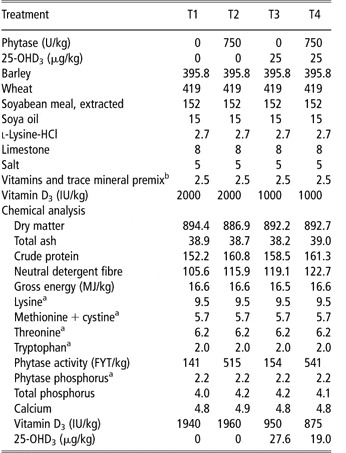
The experiments were designed as a 2 × 2 factorial comprising of four dietary treatments. All diets were based on wheat, barley and soyabean meal. The dietary treatments were as follows: T1, low-P diet; T2, T1 + phytase; T3, T1 + 25-OHD3; and T4, T1 + phytase + 25-OHD3 diet. The P concentration was 4.0 g/kg tP, 1.8 g/kg digestible P (digP) and 4.8 g/kg total Ca, below the recommended NRC (1998) standards for grower-finisher pigs (4.5 g/kg tP, 1.9 g/kg digP and 5.0 g/kg Ca for 50 to 80 kg pigs). The diets were formulated to have identical concentrations of digestible energy (13.8 MJ/kg) and total lysine (9.5 g/kg). All amino acid requirements were met relative to lysine (Close, Reference Close1994). Phytase (Ronozyme®, DSM Nutritional Products Ltd, Ayrshire, UK) was included at two dietary concentrations, 0 and 750 U/kg. A unit is defined as the quantity of enzyme that liberates 1 μmol of inorganic P/min from 1.5 mmol/l of sodium phytate at pH 5.5 and 37°C. In all, 25 μg of 25-hydroxycholecalciferol (DSM Nutritional Products Ltd) was used to replace 1000 IU of vitamin D3 (based on the manufacturer’s recommendation) in the diets including 25-OHD3. The composition and analysis of experimental diets are shown in Table 1. Diets were fed in 4.5 mm pellets. Phytase was included before pelleting and pelleting temperature was 70°C. Each diet was made at the beginning of the experiment in 2 × 5 tonne batches. Feed samples were taken at diet manufacture and throughout the experimental period for chemical analysis.
Composition and chemical analysis of experimental dietsFootnote *

25-OHD3 = 25-hydroxyvitamin D3.
* g/kg unless stated otherwise
a Calculated values; Sauvant et al. (Reference Sauvant, Perez and Tran2004).
b Provided per kg of complete diet: 3 mg retinol, 40 mg α-tocopherol, 25 mg copper as copper II sulphate, 100 mg iron as iron II sulphate, 100 mg zinc as zinc oxide, 0.3 mg selenium as sodium selenite, 25 mg manganese as manganous oxide and 0.2 mg iodine as calcium iodate on a calcium sulphate/ calcium carbonate carrier.
Animals and management
Performance study
A total of 352 Large White × (Large White × Landrace) pigs (192 males and 160 females) with an initial live weight of 42 kg (s.d = 2.5 kg) and approximately 13 weeks of age were used in this performance study. The pigs were blocked on the basis of live weight and allocated at random to one of the four dietary treatments. The pigs were penned in mixed groups of 11 (six males and five females) and were stocked at 1.0 m2 per pig with eight replicates per treatment. Before the experiment, pigs received standard commercial feeding (6.0 g/kg tP, 3.5 g/kg digP and 7.0 g/kg Ca) and management. The house was mechanically ventilated to provide an ambient temperature of 18°C. Each pen had a solid floor lying area with access to slats at rear. Individual single space feeders with water nipples were present in all pens providing an ad libitum supply of both food and water. Animals were individually tagged and weighed on days 0, 32 and 66 of the experiment. All the pigs were removed for slaughter on day 66 of the experiment.
Carcass analysis
Backfat thickness was measured at 6 cm from the edge of the split back at the level of the third and fourth last ribs using the Hennessy grading probe (Hennessy and Chong, Auckland, New Zealand). The lean meat content was estimated according to the following formula (Department of Agriculture and Food, 1994):

where x is fat depth (mm) and y is muscle depth (mm).
Further carcass data were determined by the application of the following equations:


After slaughter, the third and fourth metacarpals were removed from the two front feet (two pigs per pen, one male and one female that were randomly chosen) for assessment of bone strength, ash, P and Ca levels. All metacarpals collected were individually stored at −20°C to prevent desiccation until required for analysis.
Total tract apparent digestibility and mineral balance study
Twenty-four finishing boars, with an initial live weight of 50 kg were used in this experiment. The digestibility and mineral balance study was carried out in conjunction with the performance experiment using pigs of same genetic stock and of similar live weight and previous history. The boars were blocked on the basis of live weight and litter of origin and were randomly assigned to the four dietary treatments used in the performance experiment. The boars were allowed a 21-day dietary adaptation period, weighed and transferred to individual metabolism crates that facilitated total but separate collection of urine and faeces. The pigs were given a further 6 days to acclimatise to the metabolism crates before collections began. A 7-day collection period followed to facilitate an apparent digestibility and mineral balance study. The daily feed allowance (DE intake = 3.44 × (live weight)0.54 (Close, Reference Close1994) was divided over two meals. Water was provided with the meals in a 1 : 1 ratio. Between meals, fresh calcium-free water was provided for ad libitum. The metabolism crates were located in an environmentally controlled room, maintained at a constant temperature of 22°C (+/−1.5°C). Following the collection period, blood samples were collected from the jugular vein using 10 ml collection tubes. The samples were centrifuged at 2500 r.p.m. for 10 min and serum was separated and stored frozen until analysis.
Laboratory analysis of samples
The dry matter of the feed and faeces were determined following drying for 72 h at 55°C according to the Association of Official Analytical Chemist (1995). Feed and faeces were ground through a 1-mm screen (Christy and Norris hammer mill, Ipswich, UK) and analysed for ash after ignition of a known weight of concentrates or faeces in a muffle furnace (Nabertherm, Bremen, Germany) at 550°C for 4 h. The neutral detergent fibre (NDF) content of both the feed and faeces was determined using a Fibertec extraction unit (Tecator, Sweden) according to the method of Van Soest et al. (Reference Van Soest, Robertson and Lewis1991). The gross energy (GE) of the feeds and faeces samples was measured using an adiabatic bomb calorimeter (Parr Instruments, Moline, IL, USA). The nitrogen (N) content of the diets, urine and faeces samples was determined as Kjeldahl N X 6.25 using the LECO FP 528 instrument (Leco Instruments Ltd, Stockport, UK) in order to estimate the N intake, urinary N and faecal N. The N content of fresh faeces was analysed by the macro-Kjeldahl technique using a Buchii digestion distillation apparatus (Buchi, Flawil, Switzerland). Phytase activity of the diets was measured according to the method reported by Brady et al. (Reference Brady, Callan, Cowan, McGrane and O’ Doherty2003) and the cholecalciferol concentration was measured as described by Mattila (Reference Mattila1995).
Bone strength was measured according to the method reported by Brady et al. (Reference Brady, Callan, Cowan, McGrane and O’ Doherty2003). After the determination of the bone strength, the Ca and P concentrations were determined. Approximately 5 g of crushed bone was weighed and placed in an oven at 104°C for 16 h to determine the dry matter weight. The sample was then ashed at 650°C in a muffle furnace and the ash was digested in aqua regia (HCL–HNO3 mixture). The P concentration was measured using the method of Cavell (Reference Cavell1955). The Ca concentration was measured by atomic absorption spectrophotometry (Varian 50 AA spectrophotometer, New York, NY, USA).
The determination of Ca and P contents of feed, faeces, urine and plasma was carried out as follows: approximately 2 g of dried feed and faeces were mineralised by dry combustion at 550°C for 4 h. The ash was digested in aqua regia (HCL–HNO3). Feed and faecal, urinary and plasma Ca determination was calculated using a Varian 50 AA atomic absorption spectrophotometer. Feed and faecal P concentrations were determined spectrophotometrically using the method of Cavell, (Reference Cavell1955). Urinary P was determined using the method of Fiske and Subbarow (Reference Fiske and Subbarow1925). Inorganic P in plasma was determined using a Randox Laboratory Diagnostic kit REF PH1016 (Randox Laboratories Ltd Co. Antrim, UK). Analyses of all samples were performed in duplicate.
Statistical analysis
The data were analysed as a 2 × 2 factorial using the general linear model procedure of the Statistics Analysis System Institute (1985). The model included the effects of phytase and 25-OHD3 and the interaction between phytase and 25-OHD3. Pig performance data were adjusted for initial live weight at the beginning of the experiment by covariance analysis. Initial metabolic live weight (live weight0.75) was included as a covariate in the model for the digestibility and mineral balance study. The carcass data were adjusted for slaughter weight by covariance analysis. The individual pen acted as the experimental unit. Data in the tables are presented as least-square means.
Results
The endogenous phytase content of T1 and T3 was 141 and 154 U/kg, respectively. The phytase activity in diets T2 and T4 were 515 and 541 U/kg, respectively. The 25-OHD3 concentrations in diets T3 and T4 were 27.6 and 19 μg/kg, respectively.
Performance study
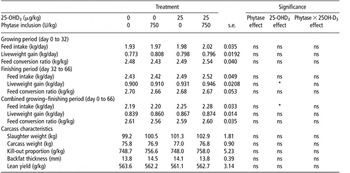
Diets supplemented with 25-OHD3 resulted in higher (P < 0.05) average daily gain (ADG) during the finishing period and average daily feed intake (ADFI) during the combined growing–finishing period (Table 2). The inclusion of phytase in the diets had no effect on pig performance throughout the experiment. Neither phytase nor 25-OHD3 inclusion had any effect on carcass characteristics.
Effect of dietary treatment on pig performance and carcass characteristics (LSM ± s.e.)

ns = not significant (P > 0.05).
*P < 0.05.
Ash digestibility, P and Ca metabolism, bone and serum analysis
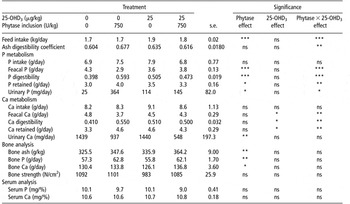
There was a significant interaction between phytase and 25-OHD3 on faecal P (P < 0.001), faecal Ca, urinary P (P < 0.001) and on the apparent digestibility of ash (P < 0.01), P (P < 0.001) and Ca (P < 0.001; Table 3). Pigs fed phytase diets only had significantly higher urinary P and lower faecal P than pigs fed non-phytase diets, as well as a higher digestibility of ash (P < 0.01) and P (P < 0.001). However, when the combination of phytase and 25-OHD3 were offered, no effects were detected on faecal P, urinary P or on the digestibility of ash and P compared with 25-OHD3 diets. Pigs fed phytase diets only had significantly lower faecal Ca and a higher digestibility of Ca (P < 0.01) than pigs fed non-phytase diets. However, when the combination of phytase and 25-OHD3 were offered, no effects were detected on faecal Ca or Ca digestibility compared with 25-OHD3 diets only.
Effect of dietary treatment on phosphorus (P) and calcium (Ca) metabolism, bone and serum analysis (LSM ± s.e.)

ns = not significant (P > 0.05).
*P < 0.05; **P < 0.01; ***P < 0.001.
There was an interaction between phytase and 25-OHD3 inclusions on P and Ca retention (P < 0.01). Pigs fed phytase diets only had significantly higher retention of Ca and P than pigs fed non-phytase diets. However, when the combination of phytase and 25-OHD3 were offered, there was no effect on either Ca or P retention. Pigs offered phytase diets had significantly higher bone ash (355.9 v. 330.7 g/kg; s.e. = 0.638; P < 0.01), bone P (62.5 v. 56.5 g/kg; s.e. = 0.127; P < 0.01) and bone Ca (135.3 v. 128.3 g/kg; s.e. = 0.249; P < 0.05) concentrations compared with non-phytase diets.
Coefficient of total tract apparent digestibility and N balance study
There was no effect of phytase or 25-OHD3 on apparent digestibility of dry matter, organic matter, N and GE, as well as having no effect on the N balance (data not shown). However, pigs offered phytase diets had higher NDF digestibility (0.529 v. 0.477; s.e. = 0.0105; P < 0.05) than pigs offered non-phytase diets.
Discussion
After pelleting, the phytase activity in these diets without microbial phytase averaged 141 and 154 U/kg. When 750 FYT/kg of phytase was added, the diets should contain approximately 900 U/kg of diet. However, after pelleting, the phytase activities in the diet were 515 and 541 phytase U/kg, which represents approximately 0.57 to 0.6 of the expected values, respectively, for the phytase diets. The feed samples in this experiment were analysed for phytase activity 4 months after compounding of the diets. Microbial phytase activity in feeds has been shown to decrease by 10% to 15% in feeds stored at room temperature for more than 4 months (BASF, 1991). The delay in analysis along with pelleting is probably the explanation for the lower phytase activity in the current diets.
The efficacy of supplemented phytase for improving pig performance and bone mineralisation and reducing excretion of both Ca and P has been well documented (Simons et al., Reference Simons, Versteegh, Jongbloed, Kemme, Slump, Bos, Wolters, Beudeker and Verschoor1990; Jongbloed et al., Reference Jongbloed, Morz, Kemme, Geerse and Van Der Honing1993; Lei et al., Reference Lei, Ku, Miller, Yokoyama and Ullrey1993; Brady et al., Reference Brady, Callan, Cowan, McGrane and O’ Doherty2002). Therefore, it is not surprising that 750 U/kg Peniophora lycii phytase in low-P diets in the current experiment resulted in a significant increase in P and Ca digestibility with a proportional improvement of 0.49 and 0.22, respectively, compared with unsupplemented low-P diets. Similarly, Veum et al. (Reference Veum, Lui, Bollinger and Ledoux1996) reported proportional increases of 0.30 to 0.40 in P digestibility. In addition, pigs offered phytase diets only had increased P and Ca retentions with proportional improvements of 0.33 and 0.26, respectively, compared with unsupplemented low-P diets. The improvement in P digestibility and retention following supplementation of microbial phytase resulted in significant reduction in faecal P output. Supplementation of low-P diets with microbial phytase is an effective way of decreasing faecal P output with proportional decreases of 0.32 in faecal P in response to phytase supplementation compared with unsupplemented low-P diets.
Homeostasis of blood P is maintained by resorption of P from the renal tubes in the kidney. However, high dietary levels of P may overwhelm the system and some of the P spills into the urine (Crenshaw, Reference Crenshaw1996). Faecal P excretion is attributed to inherently poor P availability, while urinary P losses are considered indicative of excessive digP levels in diets (Selle and Ravindran, Reference Selle and Ravindran2008). In the current experiment, the observed increase in urinary P in pigs offered phytase-based diets can be ascribed to excessive digP intake of the pigs, based on the results of the mineral balance study.
The vitamin D derivative 25-OHD3 in low-P pig diets resulted in proportional improvements in P and Ca digestibility of 0.27 and 0.08, respectively, compared with unsupplemented low-P diets. However, the effect was almost 50% of that of phytase. Mohammed et al. (Reference Mohammed, Gibney and Taylor1991) reported that vitamin D3 or its derivatives have the potential to hydrolyse phytate. Roberson and Edwards (Reference Roberson and Edwards1994) demonstrated in poultry that a combination of both phytase and 1-25-(OH)2D3 resulted in greater efficiency than either compound added alone. However, in contrast to results obtained in poultry (Edwards, Reference Edwards1993; Roberson and Edwards, Reference Roberson and Edwards1994; Biehl et al., Reference Biehl, Baker and DeLuca1995), the combination of these feed additives resulted in no further improvement in Ca and P retentions in this study, but even in a lower effect than of phytase alone.
The lack of response to the combination of phytase and 25-OHD3 may indicate an inhibitory effect of 25-OHD3 on phytase efficacy. Similar results have been reported in broilers. Mitchell and Edwards (Reference Mitchell and Edwards1996) showed that there were interactions between phytase and 1, 25 (OH)2D3 supplementation when different levels were fed. For percentage of tibia ash, the increase produced by phytase was lower, when 1, 25 (OH)2D3 was present and vice versa; the effect of 1, 25 (OH)2D3 was lower when phytase was supplemented. Similarily, Biehl et al. (Reference Biehl, Baker and DeLuca1995) suggested that the optimal level of phytase was much lower when 1α-OHD3 was present in the diet.
Ca and P homeostasis are maintained by the actions of vitamin D3, parathyroid hormone (PTH) and calcitonin on the small intestine, kidneys and bone (Li et al., Reference Li, Che, Wang, Hong and Thacker1998). When the level of Ca in the blood is low, the parathyroid gland is stimulated to secrete more PTH, which induces the kidney to produce more 1-25-(OH)2D3, which in turn enhances the intestinal absorption of Ca and P and P reabsorption from the kidney and bone (Mc Donald et al., Reference Mc Donald, Edwards, Greenhalgh and Morgan2002). In this study, serum Ca and P homeostasis were maintained, as there was no significant difference in serum Ca or P between treatments. As the homeostatic mechanism that controls serum Ca and P, serum concentrations of these minerals are not reliable indicators of dietary adequacy. However, bone ash, Ca, P and bone strength are a better indication of Ca and P status. In this experiment, phytase diets yielded proportional improvements of 0.08, 0.10 and 0.05 in bone ash, bone P and bone Ca, respectively, compared with unsupplemented phytase diets. These improvements may be attributed to the increase in digestibility and retention of Ca and P, increasing bone mineralisation and as a result decreased excretion of both Ca and P. Veum et al. (Reference Veum, Lui, Bollinger and Ledoux1996) reported increased metacarpal ash concentrations and breaking force by phytase supplementation. Surprisingly, there was no effect in metacarpal bone strength as a result of phytase supplementation despite the increase in ash, Ca and P concentrations in the bone.
Phytase feed enzymes have the capacity to enhance growth performance of pigs offered P-deficient diets (Selle and Ravindran, Reference Selle and Ravindran2008). In the current experiment, the inclusion of phytase in the diet had no effect on pig performance. This lack of effect on growth performance maybe due to the adequate digP intake of the pigs, based on the results of the mineral balance study. However, it also indicates that the levels of digP required that result in maximum growth rate are not necessarily adequate for bone mineralisation. The requirements for maximising bone strength and bone ash concentration are at least 1 g/kg higher than the requirements for maximum rate of efficiency of gain (Cromwell et al., Reference Cromwell, Hays, Chaney and Overfield1970). In the current experiment, the significant increase in ADGs of pigs offered 25-OHD3 diets cannot be attributable to increased utilisation of phytate P. However, it may be attributed to the increase in ADFI observed throughout the experiment.
Bruce and Sundstøl (Reference Bruce and Sundstøl1995) reported that ileal digestibility of crude fibre was not affected by phytase in pigs fed a high-fibre diet. However, results from the current experiment indicate that at low dietary P levels, phytase diets increased NDF digestibility compared with non-phytase diets. This may be due to two reasons. First, there is a possibility that the phytase may improve the accessibility of microbial enzymes to dietary fibre and improve NDF fermentation in that way. Second, the increase in NDF digestibility may have been due to the slight difference in NDF content of the diets.
Conclusion
In conclusion, diets containing supplemental phytase significantly increased bone ash, bone calcium and bone P compared with pigs offered unsupplemented phytase diets. There was no advantage to offering a combination of phytase and 25-OHD3 on bone strength or mineral status compared to offering these feed additives separately.