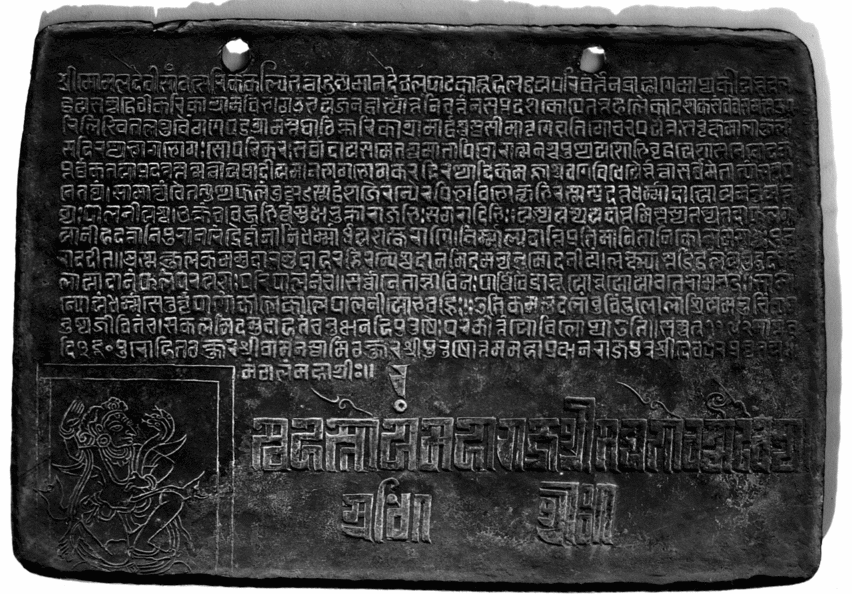
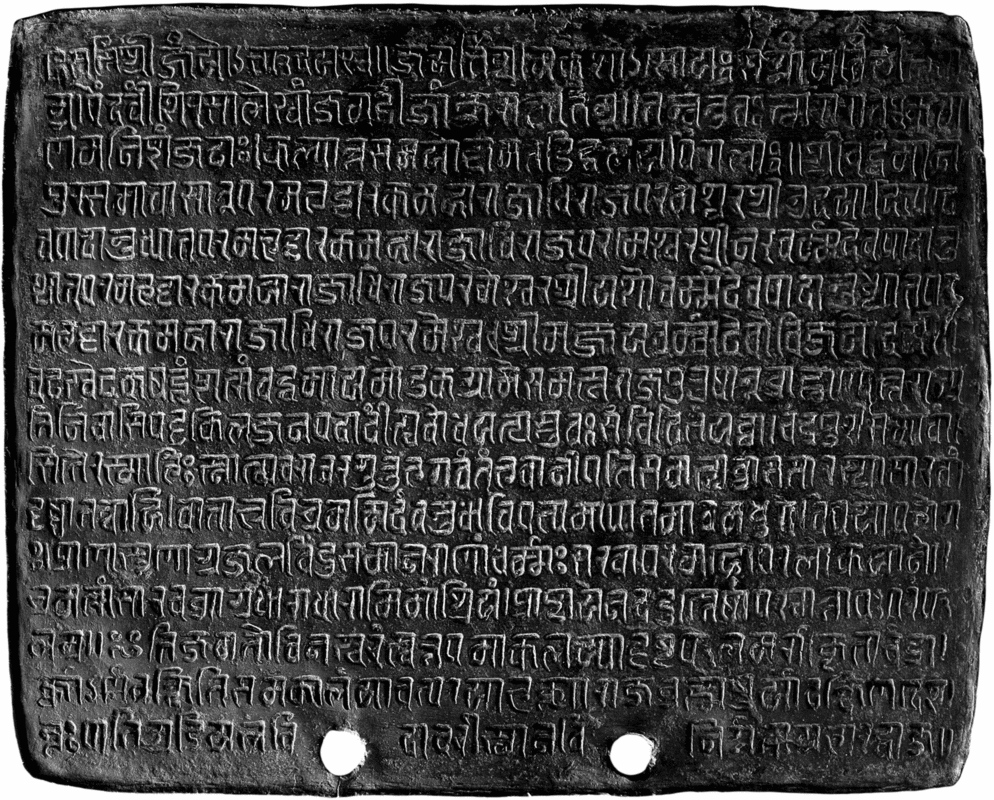
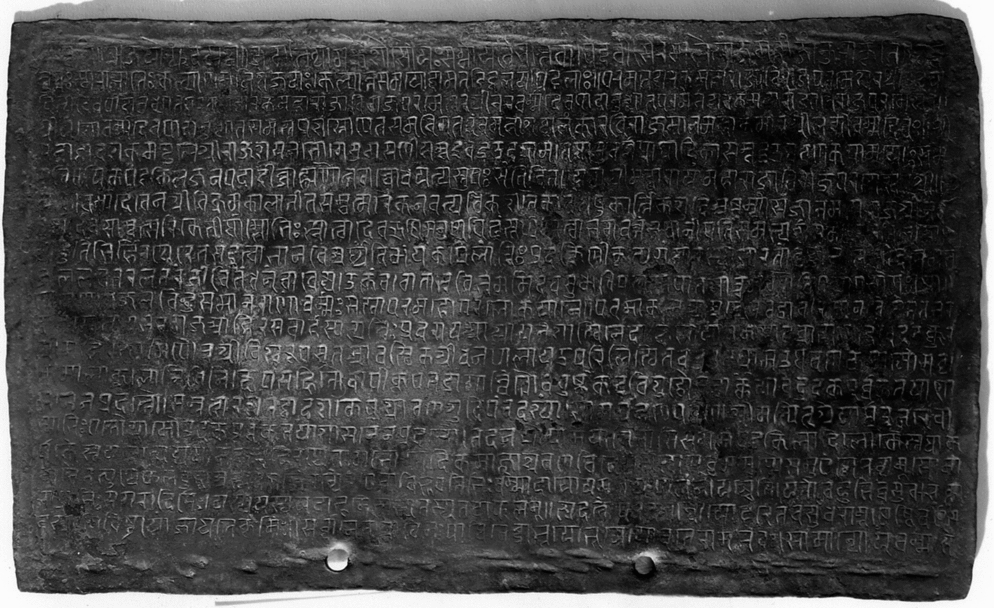
The opening essay in this special issue by Daud Ali surveys the historiography of the medieval and touches on some of the key problems of interpretation and periodisation in Indian history. However, Ali's paper does not address the Paramāras of central India and their part in building a strong kingdom in the heart of the country for several centuries. Because an introduction to the dynasty's history is essential for situating the articles that follow, this paper will survey the leading role played by the Paramāras in the history of India over the four hundred years of their political existence. This paper also provides an opportunity to contextualise the three Royal Asiatic Society copper-plates of the Paramāra dynasty now kept in the British Museum; they are illustrated in the pages that follow (Figs 1–3).
Royal Asiatic Society Charter of Yaśovarman dated VS 1192. British Museum, London, Asia 1967,1018.1. Collected by James Tod at Ujjain and presented to the Society in 1824. Trivedi, Inscriptions of the Paramāras, no. 38.

Royal Asiatic Society Charter of Jayavarman, undated. British Museum, London, Asia 1967,1018.2. Collected by James Tod and presented to the Society in 1824. Trivedi, Inscriptions of the Paramāras, no. 39.

Royal Asiatic Society Charter of Lakṣmīvarmadeva dated VS 1191 and 1200. British Museum, London, Asia 1967,1018.3. Collected by James Tod and presented to the Society in 1824. Trivedi, Inscriptions of the Paramāras, no. 40.

Most probably beginning as subordinates of the Rāṣṭrakūṭa monarch in the ninth century ce,Footnote 1 the residue of the Paramāra dynasty was at last subsumed into the Delhi Sultanate in the early fourteenth century.Footnote 2 Over this time, the Paramāras ruled various territories, including Mālava proper as well the districts adjacent to Vidiśā in the east, Ratlāma in the west, and parts of Hoshangābād in the south-east. Besides the imperial dynasty of Mālava, there were several other Paramāra houses. These held control, more or less at the same time, over parts of Gujarāt and Rājasthān. The Paramāras who ruled the Arbuda maṇḍala had their capital at Candrāvatī at the foot of Mount Ābū. Their history is investigated below by Dániel Balogh who presents a previously unknown copper-plate charter of the dynasty. The Paramāras of Bhīnmāl-Kirāḍū, in Rājasthān, were not an altogether separate dynasty but represent a branch of the house that ruled from Ābū. Their records indicate that they had close ties with the Cauḷukyas of Gujarāt, as did the rulers headquartered at Candrāvatī. Another branch of Ābū is known as the Paramāras of Jālor. Like the Paramāras of Bhīnmāl-Kirāḍū, they were overtaken by the Cāhamānas by the end of the twelfth century. In the territory of Vāgaḍa, finally, an off-shoot of the imperial Paramāra house of Mālava rose to prominence from about the middle of the tenth century ce. Located in the Dungarpur area of Rājasthān, the capital of this house was at Arthūṇā, also known as Utthapanaka, Utthūnaka and Ārāthūnaka. Unlike the branches mentioned above, they were loyal to the Paramāras of Mālava. The history of these houses adds much to our understanding of the political texture of medieval India but is beyond the immediate scope of the present essay.
Origin and Homeland
There is ample evidence in the form of literature, foreign accounts, material remains, monuments, coins and inscriptions for the history of the Paramāras, although inevitably some key points remain shrouded in mystery. As to their origins, the bardic traditions of the Rājputs regard them as ‘fire-born’ and so belonging to the Agnikula.Footnote 3 In some later inscriptions the name of the progenitor of the family is mentioned as Dhūmarāja instead of Paramāra.Footnote 4 The name indicates that the sacrificial fire, from whence the dynasty arose, gave rise to a cloud of smoke which assumed the form of a hero called Dhūmarāja. The Agnikula myth has misled some scholars to think that the Paramāras belong to Hūṇa-Gujara stock while evidence supports the proposal that they were, in fact, Kṣatriyas.Footnote 5 On the basis of the expression tasmin kule in the Harsolā inscription, and the use of the Rāṣṭrakūṭa titles Amoghavarṣa, Śrīvallabha and Pṛthvīvallabha for Vākpatirāja, D. C. Ganguly suggested that the Paramāras were members of the imperial Rāṣṭrakūṭa house.Footnote 6 However, these titles actually refer to the succession or inheritance of power, just as the Rāṣṭrakūṭas themselves adopted the titles Śrīvallabha, Pṛthivīvallabha and so forth from the Western Cauḷukyas whom they had overthrown. It seems possible that since the ultimate origin of the Paramāras had been forgotten in the course of time, composers of the texts and epigraphs were obliged to follow the general conventions of the age for assigning the origin of the family to a mythical or legendary hero.Footnote 7
Like their origin, no specific information is available regarding the place where Paramāras settled prior to their take-over of Gujarāt. However, their association with Rāṣṭrakūṭas tends to show that their homeland was somewhere in the Deccan, whereas the Agnikula legend suggests their original home was around Ābū. Even today there is a place at the foot of Mount Ābū that is said to be the fire-pit or Agnikuṇḍ where the sacrifice giving rise to the Agni lineage was performed. The places mentioned in early inscriptions certainly do suggest that the Paramāras had their earliest association with Gujarāt. They later moved to Mālava and its neighbouring territories from where later records are found in considerable number.
Early Paramāras: Upendra to Sīyaka
Information on the early Paramāra rulers, from Upendra to Vairisiṃha is rather scanty. The political destiny of the first kings was interlocked with the Pratihāra-Rāshṭrakūṭa struggle. The Mālava region bore the brunt of the clash because its geographical position lay directly between these two great powers. As regards the genealogy of the early Paramāra rulers and their successors, there is some divergence in the sources, leading scholars to form different opinions. The Harsolā grantsFootnote 8 report Bappaiparāja, his successor Vairisiṃha and his successor Sīyaka; while the Dharampur, Ujjain and Gaonri grantsFootnote 9 record Kṛṣṇarāja in the place of Bappaiparāja, quite plausibly because the two were identical. The Navasāhasāṅkacarita records Upendra after the eponymous Paramāra, who is said to have been followed by some kings, who are not named (tad anyeṣu), and after them three rulers, namely, Vākpati, his son Vairisiṃha, and his son Sīyaka, in due succession.Footnote 10 The use of the expression “some other kings” by Padmagupta in the Navasāhasāṅkacarita suggests that he had no specific information about the family's genealogy. The same genealogical sequence, with the addition of some names, is given in the Udaypur praśasti.Footnote 11 They are Upendrarāja, his son Vairisiṃha-Vajraṭa, his son Sīyaka, his son Vākpati, his son Vairisiṃha-Vajraṭa, his son Śrī Harṣa and his son Vākpati. The identification of Upendra of this list with Kṛṣṇarāja of the grants is accepted.Footnote 12 When he is identified with Bappaiparāja, then there is only Vairisiṃha, Sīyaka and Vākpati in order after Upendra.Footnote 13
The first historic king, Upendra, is mentioned by Padmagupta merely as the originator of the dynasty. He earned wide fame and was particularly noted for performing multitudes of sacrifices and for “composing his own eulogy by erecting pillars of victory on the earth bounded by four oceans”.Footnote 14 The Udaypur praśasti positively says that he was the founder of the reigning house who “gained a high order of kingship by his own valor”.Footnote 15 Some scholars have identified the king Upendra defeated by Rāṣṭrakūṭa Indra III (as mentioned in the Navasāri grant of 914 ce) with this king, while others put Upendra much earlier. Accordingly, the identification with the adversary of Indra has been questionedFootnote 16 and, in our view, rightly so because the evidence places Upendra earlier at the head of the genealogy list.
The description of Vairisiṃha in the Navasāhasāṅkacarita is only vague and conventional. The Udaypur praśasti tells us that people called him by another name, namely Vajraṭasvāmin, and that by him “famous Dhārā was vindicated when he slew the crowd of his enemies with the sharp edge (dhārā) of his sword”.Footnote 17 The enemies he claims to have slain may be identified with the Gurjara-Pratihāras of Kannauj. But because the Pratāpagaḍh inscription of Mahendrapāla,Footnote 18 dated 945–46 ce, confirms that in or before these years some portion of Mālava was recovered by Mahendrapāla, the conclusion must be that in the latter part of his reign Vairisiṃha was pushed out of Mālava toward Gujarāt. Thus, Dhārā, which may have been temporarily occupied by Vairisiṃha in the beginning, slipped from his hands in his last days.Footnote 19
Vairisiṃha's son and successor was Sīyaka, alias Harṣa and Siṃhabhaṭa. He issued three copper-plate grants.Footnote 20 Two of them, dated in 949 ce, were issued from Harṣapura and the third, of 969 ce, was issued from Ahmedābād. The grants mention him with the feudatory title mahāmāṇḍalikacūḍāmaṇi as well the sovereign title mahārājādhirāja, probably showing that he enjoyed the position of a semi-independent chief who was entitled to issue land-grants under his own authority. His achievements are also recorded. After inflicting a defeat on Yogarāja, the lord of the Kheṭaka maṇḍala and a chief of the Cāpotkaṭa Avanivarman II, whose principality must have been somewhere to the west of the Māhī river, Sīyaka made the grants.Footnote 21 His adversary may be the same as mentioned in the Navasāhasāṅkacarita as the Lord of Rudrapāṭī defeated by Sīyaka.Footnote 22 He also overpowered the Hūṇas, one of whose principalities then lay around Mandasaur.Footnote 23 The Navasāhasāṅkacarita tells us that Sīyaka “slaughtered the Hūṇa princes and turned their harem into a dwelling place for widows”.Footnote 24 Sīyaka killed the Hūṇa prince, identified as successor of Jejjapa,Footnote 25 and captured some Hūṇa territory, as known from the Moḍī fragmentary inscription which says that he “enjoyed the earth that was sprinkled over by the blood of the Hūṇas”.Footnote 26
Sīyaka's victories inspired him to throw off the yoke of the Rāṣṭrakūṭas for which he also found encouragement in the death of Kṛṣṇa III in 967 AC. With Kṛṣṇa III succeeded by his younger brother Khoṭṭiga, Sīyaka went into open revolt, initiating a military expedition toward the Deccan. Although Sīyaka's kinsman of the Vāgaḍa branch, who had come to his assistance, died a heroic death at Khalighaṭṭa on the Narmadā, the Paramāras were ultimately victorious. Sīyaka's crushing advance proceeded to the imperial Rāṣṭrakūṭa capital at Mānyakheṭa where the treasury was plundered and the city sacked. This incident is mentioned in the Udaypur praśasti which says that Harṣadeva, who “equalling the snake-eater (garuḍa) in fierceness, took in battle the wealth of king Khoṭṭiga”.Footnote 27 The end result of this Paramāra attack was the death of Khoṭṭiga in the same year, i.e. 972 ce. The event is also mentioned by Dhanapāla who composed the Pāiylacchīnāmamālā in 972–73 ce when Mānyakheṭa was being “looted by the king of Mālava”.Footnote 28 For these reasons, Sīyaka may be regarded as the de-facto founder of the Paramāra kingdom in Mālava. He left behind a vast extent of territory from the Māhī region in the west, to the Betwā in the east, to the edge of Rājasthān in the north and the Narmadā region in the south. Padmagupta states that Sīyaka “adopted the life of an ascetic and clothed himself in the grass-robe of a royal sage”,Footnote 29 indicating a possibility that after he returned from the invasion of the Rāṣṭrakūṭa capital he relinquished the kingdom in favour of his son Vākpati.
Imperial Ambitions: Vākpati, Sindurāja and Bhoja
The Paramāras had become independent rulers by 974 ce but independence brought with it fresh problems. Battles with their neighbours intensified and these developed into a tripartite struggle between the Cauḷūkyas, the Cāhamānas and the Paramāras. The aggressive foreign policy of the Paramāra rulers, who were fanatical in their ambition to establish themselves as universal kings or cakravartins, further extended the geographical scope of conflict. In this struggle, the Paramāras won the first round and Vākpati Muñja, also called Utpala, extended his territories as far as the fortress of Chitor in the north, Lāṭa in the west, Tripurī in the east, the Deccan in the south and the Gangetic plain in the far north.Footnote 30 The Udaypur praśasti suggests that Vākpati's ambition was to vanquish all the rulers of the directions in the manner of a traditional digvijaya. This validated his success as a military leader and justified his use of the imperial titles paramabhaṭṭāraka mahārājādhirāja parameśvara and his assumption of the epithets Amoghavarṣa, Pṛthvīvallabha and Śrīvallabha.
The successes of Vākpati are confirmed by diverse sources. These may be briefly summarised. The Kalacuri king Yuvarāja was easily defeated, as the Kauthem grant of Vikramāditya V states that “Utpala destroyed the power of the Caidyas, the king of the Cedis”.Footnote 31 The Bijāpur inscription of DhavalaFootnote 32 records that “Vākpati destroyed Āghāṭa, the pride of Medapāṭa” and caused the Guhila prince to flee the battle field and seek the protection of the Rāṣṭrakūṭa king Dhavala of Hastikuṇḍī (Hathūṇḍī). This shows that in the north Vākpati had come in conflict with the contemporary Guhila ruler Śaktikumāra of Mewāḍa. After this success, Vākpati led his army into the bordering region of Gujarāt, a large part of which was then governed by Mūlarāja I. The Bijāpur inscription tells us that his armies, bereft of a leader, sought refuge with the Rāṣṭrakūṭa Dhavala. The importance of the event is indicated by the fact that Kṣemendra alluded to the miserable plight of the Gurjara king in his Aucityavicāracarcā (vv. 9–10). After conquering Mūlarāja, Vākpati marched through the Lāṭa region and succeeded in defeating Bārappā, a general of the Cauḷukya king Tailapa, who was killed in the process. He then marched into Māravāḍa. D. C. Ganguly opines that in his expedition Vākpati also conquered the region around Ābū and divided it among the Paramāra princes, namely his sons Araṇyarāja, Candana and his nephew Dūsala.Footnote 33 Vākpati's invasion of Hūṇa territory is recorded in the Kauthem grant.Footnote 34 The Ganori plates of 982 record his donation of land in the Hūṇa-maṇḍala, issued after the victory. The Udaypur praśasti reports that Vākpati had subdued the Karṇāṭas – a general term for rulers in the Deccan – and Merutuṅga states that Vākpati defeated Tailapa six times.Footnote 35 But however much Vākpati may have gained success against Tailapa, he ended his life fighting in the Deccan between 993 and 998.Footnote 36 And on the western front, the struggle with Cauḷūkyas that was started during his reign ended only with the extinction of both dynasties.
The next ruler, Sindhurāja, attempted to maintain the magnificence of the Paramāra house and to extend its dominions.Footnote 37 He assumed the titles Kumāranārāyaṇa and Navasāhasāṅka. Sindhurāja's court poet Padmagupta mentions him as Avantiśvara, Mālavarāja and Paramamahībhṛta, and records his victories over the king of Kuntala and the countries of the Hūṇas, Vāgaḍa, Murala, Lāṭa, Aparānta and Kosala. The narration of successes over these powers is casual and only the victory over the king of Kuntala is substantiated by the Udaypur praśasti.Footnote 38 That he recovered authority over the south, which was seized by king Tailapa, is shown by the categorical assertion of Padmagupta.Footnote 39 It is not obvious, however, that he came into actual contact with the Western Cauḷukya ruler Satyāśraya. As for the Hūṇas, possibly he has contributed to the campaign of his brother. For his victory over the people of Vāgaḍa, it may be assumed that he beat the attempt of Kaṅka's son Caṇḍapa who tried to renounce his subordination to the main branch. The country of the Muralas is normally recognised as Kerala. In the view of P. Bhatia, after his victory over Aparānta, Sindhurāja pushed further and defeated the Muralas.Footnote 40 But because Sindhurāja's ruled for a short period it seems more likely that Muralas came into conflict with him, as feudatories or allies of the Western Cauḷukyas or of the Śilāhāras. His adversary from Lāṭa was Bārappā's son Goṅgirāja. He is mentioned in a copper-plate grant of 1050 as one who relieved his own land like Viṣṇu,Footnote 41 a statement which signifies the assertion of his authority over his parental throne and land. The Cauḷukya ruler Cāmuṇḍarāja also may have clashed with Sindhurāja. The Vaḍanagar praśasti of Kumārapāla dated 1151 affirms that Sindhurāja, together with his elephant forces, made such a cowardly retreat on seeing the armies of Cāmuṇḍarāja that his well-established fame was lost as a result.Footnote 42 The Kumārapālacarita goes so far as to say that Sindhurāja was killed by Cāmuṇḍarāja, but this assertion in a fourteenth-century document has to be discounted in view of the epigraphic evidence. That the Śilāhāra prince Aparājita allied himself with Sindhurāja in the campaign in Bastar shows that the reference to the conquest of Aparānta or north Koṅkaṇa is simply conventional. A. S. AltekarFootnote 43 held that Aparājita – who in the Bhādān copper-plate grant of 997 regretfully refers to the overthrow of the Rāṣṭrakūṭa but, had not recognised Cauḷukya supremacy till that year – may have thought it best to secure an alliance with the Paramāras. Sindhurāja's victory over Kosala, if accepted as actual, would have been against KaliṅgarājaFootnote 44 or Yayāti Mahāśivagupta.Footnote 45
The Sās Bahū temple inscription of Mahipāla dated 1092 tells us that the Kacchapaghāta ruler Kirtirāja had conquered in battle the countless hosts of the prince of Mālava. The defeat inflicted by this ruler on the Paramāra forces was so crushing that the invading troops fled away, leaving even their spears, which were collected by the townsmen for thatching the roofs of their houses.Footnote 46 The Mālava ruler mentioned in this account was once identified by scholars as the Paramāra Bhojadeva and it was surmised that it would have been impossible for a minor chief like Kirtirāja to inflict this terrible shock on the invading forces without the assistance of the Candella king Vidyādhara.Footnote 47 But in light of the likely date for the accession of Kirtirāja in circa 985, it seems more probable that the Mālava ruler who was conquered in the battle was Sindhurāja.Footnote 48
Sindhurāja was succeeded by Bhoja. The Udaypur praśasti makes a general statement regarding his military exploits: “he resembled Pṛthu and ruled the earth from Kailāsa to Malaya hills and up to the mountains of the setting and the rising sun,” and further that “his mercenaries conquered the Karṇāṭas, the lord of Lāṭa, the king of Gūrjara, the Turuṣka, chief among whom were the lord of the Cedis, Indraratha, Toggala and Bhima”.Footnote 49 These statements are supported by the Kālvaṇa grant of his feudatory Yaśovarman, which claims for Bhoja victory over the lord of Karṇāṭa, Lāṭa, Gūrjara, Cedi and Koṅkaṇa.Footnote 50 Bhoja, in alliance with Gāṅgeya Kalacuri and Rājendra Cōḷa, had some preliminary success in his war against the Western Cauḷukyas, but in the end the combined forces appear to have been repulsed. This is shown by a Western Cauḷukya record of 1028 AC that says Jayasiṃha routed the elephant squadron of Cōḷa, Gāṅgeya and Bhojadeva.Footnote 51 In this struggle, Jayasiṃha appears to have been helped by his vassal Bācirāja, about whom it is said that his victorious arms put Bhoja to embarrassment.Footnote 52 In his south-eastern expedition, Bhoja inflicted defeat on Indraratha, the Somavaṃśī ruler of Ādinagara and a vassal of the Gaṅgas of Kaliṅga. Since Gāṅgeyadeva and Rājendra also claim to have vanquished this ruler of Ādinagara (in two inscriptions dated 1018 and 1025),Footnote 53 it seems that Bhoja fought this battle in alliance with them. However the alliance with Gāṅgeya did not last long and Bhoja soon inflicted a defeat on the later. His victory over the Kalacuri king is evidenced by the Pārijātamañjarī tablet inscription found at Dhār.Footnote 54
Kīrtirāja, Bhoja's contemporary in Lāṭa (known to us from his Surat grant of 962),Footnote 55 was defeated and brought into subjection, a fact signified by a statement recorded in a copper-plate grant of Trilocanapāla, viz. that “during his reign his fame was for the time taken away by his enemies”.Footnote 56 Further south, Bhoja invaded Koṅkaṇa and the territory of the Śilāhāra ruler Arikesarin alias Keśirāja.Footnote 57 He accepted the supremacy of Bhoja sometime before 1020, when Bhoja celebrated his victory over Koṅkaṇa.Footnote 58 The Miraj plates dated 102445 indicate, nonetheless, that Bhoja's occupation of Koṅkaṇa was momentary.Footnote 59
The Udaypur praśasti records that Bhoja defeated the Turuṣkas, but the material on this point is scanty, leading scholars to differ in their opinions, including the view that Bhoja did not come into direct conflict with Muslim forces.Footnote 60 To the immediate north of Mālwa, it is generally believed that Bhoja penetrated into part of the Kacchapaghāta kingdom, but was repulsed by Kīrtirāja. However, the latest findings, noted above, indicate that this incident took place in the time of Sindhurāja. Conflict with the Kacchapaghātas is nonetheless hinted at in the Dubkuṇḍ inscription of 1088 which says that “the highly intelligent king, the illustrious Bhojadeva had widely celebrated the skill shown in the management of horses and chariots of Abhimanyu”.Footnote 61 H. C. Ray saw in this a veiled hint of Abhimanyu's subordination to Bhoja.Footnote 62 The statement in the Mahobā inscription that “Bhoja and Kalacuri Chandra (Gāṅgeya) waited upon the Candella prince Vidyādhara, the master of warfare, who had caused the destruction of the king of Kānyakubja, and who was lying on a couch” hints at Bhoja's political relations with the Candellas.Footnote 63 According to V. V. Mirashi, this refers to Bhoja's alliance with the Candellas in the expedition led by Vidyādhara in which the Kannauj ruler Rājyapāla was killed.Footnote 64 Some late sources inform us that Cāhamāna Vākpatirāja II had inflicted a defeat on Bhoja, and it is surmised that Bhoja made an attack on the Cāhamāna in the time of Viryarāma to avenge this defeat and, after killing him, occupied his capital.Footnote 65 The Tilakawāḍā grant of 1046 tells us that Bhoja received help from his feudatory Śūryāditya in his struggle against Sāhavāhana, a Chambā prince.Footnote 66
This summary of Bhoja's campaigns show he was a great warrior who attempted to extend his power far and wide.Footnote 67 His imperialistic policy, which included starting a large Śaiva centre at Bhojpur that aimed to surpass every temple in India in size and splendour, proved ultimately unsuccessful and fatally weakened the Paramāra empire.Footnote 68 The Cauḷukyas under Someśvara I captured and burnt the capital at Dhār, occupying also the hill-fort at Māṇḍū.Footnote 69 Bhoja was compelled to abandon the city and was captured by Guṇḍamaya, Someśvara's general. On other flanks, Bhīma Cauḷukya formed an alliance with Karṇa, the Kalacuri king, and they proceeded against Mālava from the west and east respectively. Undone by these set-backs, Bhoja died, leaving the kingdom in anarchy. The Vaḍanagar praśasti 51 informs us that the invaders seized Dhār, “the capital of the Mālava cakravartin” and dethroned Jayasiṃha, the immediate successor of Bhoja.Footnote 70
Paramāras after Bhoja
The dethroned prince Jayasiṃha, with the aid of the Western Cauḷukya Someśvara's second son Vikramāditya, ultimately succeeded in driving away the allied forces of his enemies, and was established on the throne of Mālava.Footnote 71 For this help Jayasiṃha was extremely loyal to Vikramāditya. But when Someśvara II became the Cauḷukya ruler, he suspected a conspiracy against him by his younger brother Vikramāditya with Jayasiṃha.Footnote 72 He made an alliance with the Gaṅga chief Udayāditya and the Hoysala prince Ereyaṅga to punish both of them. It seems possible by the expression naṣṭe svāmini that Jayasiṃha was killed in the struggle that ensued. At this critical time Bhoja's brother Udayāditya managed the situation, and acted “like a holy boar”, that is, supported the lands of the kingdom as the Varāha incarnation supported the earth goddess.Footnote 73 The Sehore grant of Arjunavarman dated 1213Footnote 74 describes that with his fierce arms he exterminated mighty kings maintaining powerful armies. But Cauḷukya Vikramāditya VI led a successful campaign and annexed a part of the Mālava territory to the south of Godāvarī.Footnote 75 On western flank, Karṇa, the Cauḷukya, also invaded Mālava and achieved some initial successes before being driven back. To strengthen his position, Udayāditya made matrimonial alliances with the Guhila, Kalacuri, Vāghelā and Solaṅkī houses.
Udayāditya had two key sons, namely Lakṣmadeva and Naravarman, according to the Nāgpur Museum stone inscription (dated 1104–05 ce).Footnote 76 This record describes the various military campaigns of Lakṣmadeva in a metaphorical way, as he is said to have subjugated the earth in all directions. In the east, he threatened the lord of Gauḍa, defeated the armies of Aṅga and Kaliṅga and occupied Tripurī; in the south, he subjugated the Cōḷas and some other tributaries and invaded the Pāṇḍya country and Ceylon; in the west, he achieved victory over the Timingalas and other tribes living in the Maināka mountain, and in the north he vanquished the Turuṣka and the Kīras. There is a possibility that Udayāditya placed both his sons in charge of the eastern and western regions of his territory, conferring on them the full power of viceroys. This is why both of them were making donations in their own authority in his lifetime. Thus the military achievements attributed to Lakṣmadeva in the Nāgpur Museum stone inscription are all to be dated in the time of his father, and certainly before 1082.Footnote 77
The Dewās grantFootnote 78 indicates that Naravarman was the immediate successor of his father Udayāditya. The Kamed inscription of 1082 records the donation of a plot of land by Naravarman for perpetually burning a lamp for his brother Lakṣmadeva.Footnote 79 This undoubtedly shows that Lakṣmadeva had died some time before 1082. The depictions of Naravarman in some of the later inscriptions as a great military leader, undertaking a digvijaya in all directions, appears purely conventional because he was not in a position to have a strong hold over his kingdom.Footnote 80 Indeed, he was conquered by many rulers. The Candella Sallakṣaṇavarman is reported to have “snatched the royal fortune of the Mālavas”Footnote 81 and been defeated by the Cāhamāna rulers Ajayarāja and Arṇorāja.Footnote 82 The Talwāḍā inscription of the Cauḷukyas also claims that Jayasiṃha “humbled the pride of Naravarman”.Footnote 83 In his last days, Naravarman's kingdom appears to have become much circumscribed, and some of his subordinates may also have caused trouble which he could not suppress.Footnote 84 This situation probably accounts for Naravarman's inability to finish the temple at Vidiśā, as noted by O. P. Mishra elsewhere in this issue.
Dynastic misfortunes continued in the time of Naravarman's son Yaśovarman, the end result being that Jayasiṃha of western India became the dominant ruler overall. The Dohad inscription of 1139 states that Jayasiṃha put the king of Mālava in prison.Footnote 85 The Gālā grant also records Jayasiṃha's success against Yaśovarman by naming him Avantinātha, the “Lord of Avanti”.Footnote 86 On the eastern front, the Candella king Madanavarman had already penetrated into the area along the River Betwā, sometime before 1134, when he issued his Augāsi grant. Shortly after, with the favour of Jayasiṃha Siddharāja, Yaśovarman seems to have obtained his release and also regained a portion of his kingdom, as indicated by his grant of 1135 (illustrated here in Fig. 1). He is called mahārāja in the Jhālrāpāṭan inscription of 1142, indicating, in all probability, subordination to the Cauḷukyas.Footnote 87
Yaśovarman was succeeded by his eldest son Jayavarman. His donations from the camp of Candrapurī and Vardhamānapura are mentioned in the charter illustrated here in Fig. 2. This suggests that, taking advantage of the intrigues and dissentions in the Cauḷukya court in the later years of Jayasiṃha, Jayavarman came out of his eastern retreat and succeeded in reoccupying Dhār, or at least a portion of his ancestral kingdom. This is further attested by the titles of a paramount sovereign attached to his name in his grant.Footnote 88 However, Cauḷukya Jagadekamalla II, and Hoyasala Viṣṇuvardhana and Narasiṃha, all refer to victory over Mālava in their inscriptions.Footnote 89
Meanwhile, one Ballāla is known to have siezed power and ruled Avanti from the capital at Dhār.Footnote 90 The Cauḷukya king Kumārapāla's feudatory Yaśodhavala was compelled to take up the sword against Ballāla and slew him in the struggle. After annexing a portion of Mālava, Kumārapāla assumed the title of Avantinātha, just like his predecessor. As a consequence, the country of Mālava was once again integrated into the Cauḷūkya kingdom in the fifth decade of the twelfth century.Footnote 91 Due to this pressure, the Paramāra princes were compelled to move eastward to the region of Bhopāl, Vidiśā and Hoshangābād, where they maintained an independent existence. They assumed the unostentatious title of mahākumāra, and in the inscriptions issued by them they are styled as samadhigatapañchamahāśabdālaṃkāravirājamānamahākumāra. Their relations with the Cauḷūkyas of Gujarāt during this period are not known.
Inscriptions mention Yaśovarman successor's as Jayavarman (also known as Ajayavarman), Lakṣmīvarman and Trailokyavarman.Footnote 92 It seems that Jayavarman was forced to leave the newly-created principality in the Bhopāl region due to some sort of political disturbance. It is not unlikely that the root-cause was the occupation of eastern Mālava by the Candella king Madanavarman. This obliged Jayavarman to move to the west, towards Dhār, which he reoccupied for a short time. Ultimately, however, he lost his life in his struggle with the Cauḷukyas. After the fall of Jayavarman, his younger brother Lakṣmīvarman fought with the Candellas and pushed them away from the principality which originally belonged to his father. He made a gift of some places lying in the same Mahādvādaśaka maṇḍala. His brother Lakṣmīvarman confirmed these gifts when he reoccupied the territory, as shown by the Mau stone inscription.Footnote 93
The Bhopāl grant of 1144, another confirmation of a previous donation, records that after Jayavarman, the mahākumāra Lakṣmīvarmadeva had obtained sovereignty by the favour of his sword (illustrated here in Fig. 3).Footnote 94 Lakṣmīvarman was succeeded by his son Hariścandra, during whose minority Trailokyavarman widened his power as a chief.Footnote 95 Hariścandra came to clash with the Cauḷukyas of Gujarāt. The first of his grants shows that the Mahādvādaśaka maṇḍala was a part of his kingdom in 1157; but sometime later and certainly before 1163 AC, it was wrested from him by the Cauḷukya Kumārapāla, whose inscription of that year is found in the same maṇḍala.Footnote 96 It seems that Hariścandra recovered this region some time before 1178 AC, when he issued his Pipliānagar grants.Footnote 97 These mention his donation of two villages in the Nilagiri maṇḍala, which touches the Mahādvādasaka maṇḍala on the south-east.
No political event of the reign of Hariścandra's son Udayavarman is so far known. The inscriptions of the Paramāra mahākumāras dating from 1144 to 1200 indicate that none of the princes made an attempt to revive the fallen fortunes of the family. But in a period of internal dissensions and confusion in the Cauḷukya kingdom, a heroic effort was made by Vindhyavarman, the son of Jayavarman, to avenge the defeat of his father.Footnote 98 Some of the statements show that Vindhyavarman after all succeeded in liberating a substantial part of his ancestral domain, sometime before 1190. But Vindhyavarman had to suffer a reverse at the hands of the Yādava king Bhillama V and the Hoyasala king Ballāla.Footnote 99 His son Subhaṭavarman inherited the warlike spirit of his father. His success in the Gujarāt region is attested by epigraphic and literary records, but despite winning battles, he could not make any territorial gains because Bhīma again made his country and kingdom stable.Footnote 100
Arjunavarman, the son of Subhaṭavarman, had the epithet trividhavīra, that is a hero of war, generosity and religion (dharmadānayuddhavīra).Footnote 101 The Pipliānagara and Sehore inscriptions corroborated by the drama Pārijātamañjarī of his court poet Madana record that this ruler vanquished the Cauḷukya mahīmahendra Jayasiṃha and captured Jayaśrī – a play on words meaning both victory and the daughter of the king of Gujarāt.Footnote 102 Merutuṅga, writing in the early fourteenth century, calls him the destroyer of Gujarāt and records that he completely overran the kingdom.Footnote 103 One of Arjunavarman's grants, dated 1213, was issued by the king from his camp in Bhṛgukaccha, the capital of Lāṭa, which indicates that this country was part of the kingdom of Mālava at the time.Footnote 104 With the help of the Lāṭa chief Siṃha and the feudatory Sallakṣaṇasiṃha, Arjunavarman also defeated the forces of Yādava Siṃhaṇa.Footnote 105 But Siṃhaṇa launched a counter-attack on Lāṭa in which Arjunavarman was signally defeated and lost his life.Footnote 106
It appears that Devapāla, the next Paramāra, continued the fight with the Yādava ruler but after some battles, a treaty was concluded between the rival parties.Footnote 107 In the latter part of Devapāla's reign, Sultanate forces proceeded to Ujjain and Iltutmish appointed a governor at Vidiśā. Muslim occupation of this place was, however, temporary. The Māndhātā inscription of 1274 records that Devapāla killed an adhipati of the Mlechchhas, the governor of Vidiśā.Footnote 108 According to Hammīramahākāvya, a text written in the fifteenth century by Nayacandra Sūri, the Cāhamāna ruler Vāgbhaṭa put Devapāla to death when he came to know that he was conspiring to kill him at the instigation of the Sultan of Delhi.Footnote 109 Devapāla's son Jaitugi, who assumed the title of Bālanārāyaṇa,Footnote 110 was unable to maintain the Paramāra kingdom as reconstituted by Arjunavarman and Devapāla and had to face invasion from all sides: the Yādavas from the south, Sultanate armies from the north, and the Vāghelas from the west.Footnote 111
These attacks drained the resources of Mālava and hastened the downfall of the Paramāras. Jaitugi's younger brother Jayavarman (also known as Jayasiṃha) withstood continued attacks at the hands of the Yādava king Mahādeva and his son Rāmacandra.Footnote 112 The Rāhatgaḍh stone inscription of 1256, which is the first Paramāra record in the western part of the Sāgar District, shows that Jayavarman captured this region from the Yādavas who had held it from the time of Siṃhaṇa.Footnote 113 Moreover, when the Cāhamāna king Jaitasiṃha raided some of the northern territories of Mālava, Jayavarman retired to Māṇḍū, showing he controlled key parts of eastern Mālwā.Footnote 114 Arjunavarman II was a weak ruler and in his time the kingdom was weakened by internal dissention and fell prey to invasion.Footnote 115 The Hammīramahākāvya states that in the course of his digvijaya, Hammīra reached Ujjain and Dhār, defeated the Paramāra ruler Bhoja II, encamped at the former of these cities where he worshipped Mahākāla.Footnote 116 As noted elsewhere in this volume, this Bhoja may be a literary convention of the 1400s rather than an actual figure. He should, as a consequence, be excused from the dynastic sequence. The actual ruler of Mālwā at the turn of the thirteenth century, known from various sources, was named Kokā or Gogā.Footnote 117 He offered stiff resistance to cAyn al-Mulk Mūltānī, who was sent at the head of an army from Delhi in 1305, but against the superior forces of the Sultanate, and the diplomatic skill of Mūltānī who effectively detached the petty chiefs by offering the preservation of their estates, the Paramāras could not maintain a unified military front. The capture of Dhār and the installation of a governor there by Delhi signalled the extinction of the Paramāra dynasty. The central Indian nobility nonetheless continued as subordinates of the Sultanate and are known from a number of later records, for example, the votive inscriptions at the entrance to the temple at Udaypur.Footnote 118