INTRODUCTION
Tube-dwelling anemones (Anthozoa: Ceriantharia) are organisms that live in benthic marine communities either in shallow or deep waters (Carlgren, Reference Carlgren1912). The tubes produced by these animals vary between Ceriantharia groups and apparently are related to the habit of the species (Stampar et al., Reference Stampar, Beneti, Acuña and Morandini2015). Due to a number of morphological and molecular features outlined in den Hartog (Reference den Hartog1977) and Stampar et al. (Reference Stampar, Maronna, Kitahara, Reimer and Morandini2014a), the subclass Ceriantharia is divided in two clades: Penicilaria and Spirularia. The most peculiar group within Spirularia is the family Cerianthidae Milne-Edwards & Haime, 1852, that is defined by lacking specialized nematocyst-bearing internal structures called acontioids or cnidorages (den Hartog, Reference den Hartog1977). This family is composed of four genera known from adults and larvae (Ceriantheomorphe Carlgren, 1931, Ceriantheopsis Carlgren, Reference Carlgren1912, Cerianthus Delle Chiaje, 1841 and Pachycerianthus Roule, 1904), and several ‘genera’ known only from larval forms (Tiffon, Reference Tiffon and Grassé1987; Daly et al., Reference Daly, Brugler, Cartwright, Collins, Dawson, Fautin, France, McFadden, Opresko, Rodriguez, Romano and Stake2007).
The genus Ceriantheopsis was described based on Ceriantheopsis americana (Agassiz in Verrill, Reference Verrill1864), a species found in large numbers in some areas of the USA Atlantic Coast (Shepard et al., Reference Shepard, Theroux, Cooper and Uzmann1986). There are only two other described species, C. austroafricana Molodtsova et al., Reference Molodtsova, Griffiths and Acuna2011 and C. nikitai Molodtsova, Reference Molodtsova2001, both from the Atlantic coast of the African continent (Temperate Southern Africa Zone – cf. Spalding et al., Reference Spalding, Fox, Allen, Davidson, Ferdaña, Finlayson, Halpern, Martin, McManus, Molnar, Recchia and Robertson2007) (Molodtsova et al., Reference Molodtsova, Griffiths and Acuna2011).
Within the Warm Temperate South-western Atlantic (after Spalding et al., Reference Spalding, Fox, Allen, Davidson, Ferdaña, Finlayson, Halpern, Martin, McManus, Molnar, Recchia and Robertson2007) there is only one uncertain record of Ceriantheopsis (Cerianthus americana) by Hertwig (Reference Hertwig1882) from the Uruguayan coast. However, the identification of the specimen was only performed by examination of the external morphology, as the diagnostic characters for identification of genera and species are related to internal anatomy (see more in Molodtsova et al., Reference Molodtsova, Griffiths and Acuna2011; Stampar et al., Reference Stampar, Morandini and Silveira2014b). For this geographic area there are also some Cerianthidae records without specific identification (see Scarabino, Reference Scarabino, Menafra, Rodríguez-Gallego, Scarabino and Conde2006).
The aim of this work is to describe a species of the genus Ceriantheopsis based on both morphology and anatomy of specimens collected in Argentina and Brazil, emphasizing that this is the first species of this genus for this biogeographic region (Warm Temperate South-western Atlantic).
MATERIALS AND METHODS
Specimens were collected by scuba diving from Quequén Port (two specimens), Buenos Aires province, in very thin grained and soft clay close to the northern breakwater (Escollera Norte), or obtained from dredging (Projeto Camarão – st 776) on the coast of Santa Catarina (one specimen), Brazil. Collected polyps were preserved in 4% seawater-buffered formaldehyde solution for morphological studies. Many additional photographic records noted based on images taken during regular scuba diving operations of the Laje Viva NGO (www.lajeviva.org.br) – COTEC 41097/2007 to delimit the shallow distributional area (less than 50 m). Comparative specimens from the American Museum of Natural History (AMNH) collection (Ceriantheopsis americana) and a specimen of Ceriantheopsis austroafricana collected in Cape Town (South Africa) were also examined. The holotype and one paratype were deposited in the cnidarian collection of Museu de Zoologia da Universidade de São Paulo (MZUSP).
Morphological study
The anatomical study of the polyps and cnidome was based on criteria defined by several authors (van Beneden, Reference van Beneden1897; Carlgren, Reference Carlgren1912; den Hartog, Reference den Hartog1977; Tiffon, Reference Tiffon and Grassé1987; Stampar et al., Reference Stampar, Maronna, Vermeij, Silveira and Morandini2012). Two whole animals were cut apart through the ventral side (opposite to the siphonoglyph) using surgical scalpels, then the dissected polyp was fastened using acupuncture needles.
The classification of cnidae followed den Hartog (Reference den Hartog1977) and England (Reference England1991), but nomenclature was based solely on Molodtsova et al. (Reference Molodtsova, Griffiths and Acuna2011). Thirty measurements (undischarged capsules) were taken from each cnida type out of each body region of the holotype and paratype specimens. The cnidome was analysed under a Nikon Eclipse 80i microscope with phase contrast. All parts of the body were analysed separately so that contamination would be avoided. The two parts of mesenterial filaments (cnidoglandular tract and ciliated tract) were analysed together using 30 measurements from each part. Cnidae that showed no overlap in sizes were tested via Mann–Whitney test in order to check the consistency of divergence between species. Four specimens of Ceriantheopsis americana (AMNH 730/AMNH 3451) from Jamaica and USA (Florida) and one specimen of Ceriantheopsis austroafricana from Cape Town, South Africa were also examined for comparison.
RESULTS AND DISCUSSION
SYSTEMATICS
Class ANTHOZOA Ehrenberg, 1834
Subclass CERIANTHARIA Perrier, 1883 (see details in Stampar et al., Reference Stampar, Maronna, Kitahara, Reimer and Morandini2014a)
Suborder SPIRULARIA den Hartog, Reference den Hartog1977
Family CERIANTHIDAE Milne Edwards & Haime, 1852
Genus Ceriantheopsis Carlgren, Reference Carlgren1912
Type species – Ceriantheopsis americana (Agassiz in Verrill, Reference Verrill1864) by subsequent designation (Carlgren, Reference Carlgren1912: p. 24).
Distribution: The genus is restricted to the Atlantic Ocean (Caribbean Sea, Gulf of Mexico, US Coast and South Africa Coast).
Diagnosis Cerianthids with alternating sterile and fertile mesenteries. Second protomesenteries fertile, reaching aboral pole. Metamesenteries arranged in mBMb. Length of all but M-metamesenteries diminishes toward multiplication chamber. Length of M-metamesenteries of first 2–4 quartets can increase toward the multiplication chamber. M3 and further mesenteries can diminish towards multiplication chamber (Carlgren, Reference Carlgren1912).
Ceriantheopsis lineata sp. nov.
Figures 1–4
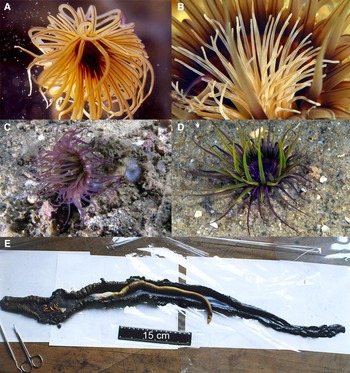
Ceriantheopsis lineata sp. nov.: (A) Live image of the holotype from Quequén, Argentina (MZUSP 2686), (B) Live specimen at Laje de Santos, São Paulo, Brazil, image only (photo from Noeli Lara Ribeiro), (C) Live specimen at Laje de Santos, São Paulo, Brazil, image only (photo from Armando de Luca Jr); (D) Live specimen from off Paranaguá, Paraná, Brazil, image only (photo from Marcelo Krause) and (E) General view of the holotype in the long tube (MZUSP 2686).

Graphical representation of the arrangement of mesenteries Ceriantheopsis lineata sp. nov. MC, Multiplication chamber; dm – Directives, M – M-mesenteries, m – m-mesenteries, B – B-mesenteries, b – b-mesenteries, TP – Terminal pore and S – Siphonoglyph.

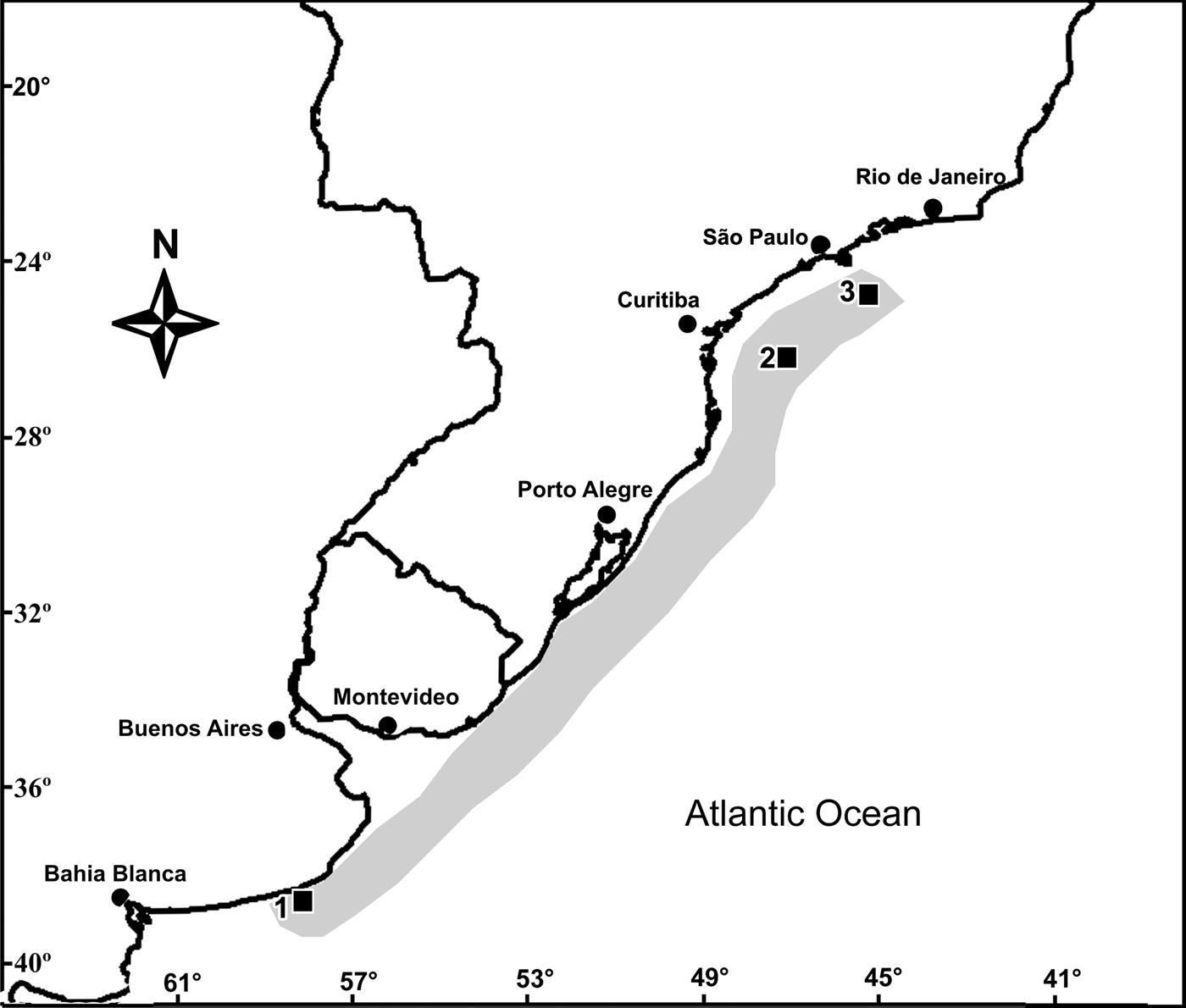
Estimated distributional area of Ceriantheopsis lineata sp. nov. along the Warm Temperate South-western Atlantic (Grey line). 1 – Quequén, Argentina (Holotype); 2 – off Joinville (Paratype) and 3 – Laje de Santos, Brazil (photographic records).

Cnidome of Ceriantheopsis lineata sp. nov. (A) ptychocysts I, scale bar 40 µm; (B) ptychocysts II, scale bar 20 µm; (C) holotrichs, scale bar 20 µm; (D) microbasic b-mastigophores I, scale bar 15 µm; (E) microbasic b-mastigophores II, scale bar 18 µm; (F) microbasic b-mastigophores III, scale bar 16 µm; (G) microbasic b-mastigophores VI, scale bar 30 µm.

TYPE MATERIAL (2 specimens)
Holotype: MZUSP 2686, adult specimen (29 cm long), ~12 m depth, Quequén Port (38°34′41.39″S, 58°41′49.80″W), Quequén, Buenos Aires, Argentina, G. Pastorino coll. (10/xii/2008) (I). See pictures of the animal inside the tube (Figure 1E).
Paratype: MZUSP 2687, adult specimen (18 cm long), 130 m depth, offshore Joinville (26°19′00″S 47°00′00″W), Santa Catarina, Brazil, Projeto Camarão (st 776) coll. (12/xii/1969) (II).
COMPARATIVE MATERIAL EXAMINED
AMNH 730, Ceriantheopsis americana, Jamaica; AMNH 3451, Ceriantheopsis americana, USA (Florida). First author collection, Ceriantheopsis austroafricana, from Waterfront (33°54′29″S 18°25′6″E) (10/v/2013), 8 m, Cape Town, South Africa.
DIAGNOSIS
Marginal tentacles with a dark longitudinal line. Two mesenteries attached to siphonoglyph, absence of directive labial tentacle and four types of microbasic b-mastigophores.
Description (based on MZUSP 2686 and 2687 specimens)
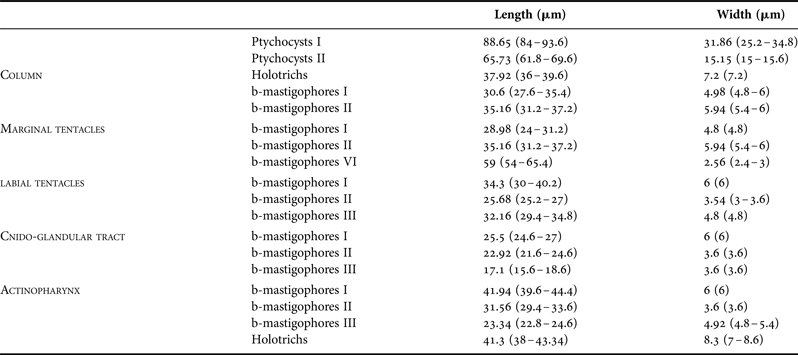
Long (up to 300 mm long) and thin (10–20 mm width) cerianthid; 48–68 brown, purple or green marginal tentacles (40–45 mm in preserved specimens), one dark line over tentacle length (Figure 1), arrangement 1212.1212.1212, with more than 8 pores per tentacle, unpaired labial tentacle absent; 40–60 brown to purple labial tentacles (up to 10 mm long in preserved specimens), arrangement 4231.4231.4231, unpaired labial tentacle absent; pleated stomodeum extending over 1/5 to 1/6 of total body length, hyposulcus 5 mm long, hemisulci distinct; siphonoglyph narrow, connected only to directives; free part of sterile directive mesenteries almost the same length of siphonoglyph, without mesenterial filament. Second protomesenteries almost reaching aboral pole, fertile, bearing ciliated tract with bundle of craspedonemes, followed by very short cnido-glandular tract and long (~70% of the mesentery) craspedion tract. Third protomesenteries sterile, longer than half directives, with craspedonemes. M and m-metamesenteries long, fertile; M1 reach 2/3 of total body length and M2 reaching almost aboral pore (longer than M1), with bundle of craspedonemes; B and b-mesenteries, sterile, with almost same length; see Figure 2 for schematic arrangement of mesenteries. The cnidome of the species (Figure 4) is composed of spirocysts, holotrics, microbasic b-mastigophores (four types) and ptychocysts distributed as shown in Table 1.
Cnidome of Ceriantheopsis lineata sp. nov. based on two specimens, the holotype (MZUSP 2686) and paratype (MZUSP 2687); data based on 30 measurements of each type, values are presented as the mean and range in parentheses.

Distribution – from Argentina, Quequén (Buenos Aires) to Brazil, Laje de Santos (São Paulo) (Figure 3). The southernmost record is Quequén (Buenos Aires) and the northernmost record is from Laje de Santos, São Paulo state. On the coast of Argentina (higher latitudes) specimens can be observed at shallow waters (less than 10 m) in mud. Specimens from Brazil were recorded in much deeper areas (30–130 m) and coarser sediment (fine to medium sand).
Etymology – The specific name ‘lineata’ (Latin linea), female, is an allusion to the longitudinal central line on marginal tentacles.
Colour variation – The colour of marginal tentacles vary from yellowish-brown to a deep purple or pale green but always with a dark longitudinal line. The labial tentacles are always very similar to predominant colour of marginal tentacles.
Tube symbiosis – Phoronida specimens were found on tubes of Ceriantheopsis lineata sp. nov., at Laje de Santos (Brazil), but not identified like the ones observed by Stampar et al. (Reference Stampar, Emig, Morandini, Kodja, Pinto and Silveira2010) over Ceriantheomorphe brasiliensis. Other epizoic animals like the bryozoan colonies were not found, as described by Vieira & Stampar (Reference Vieira and Stampar2014) for Pachycerianthus schlenzae.
Holotype description (MZUSP 2686) (Figures 1 & 2)
Elongated polyp, 28 cm long, 25 mm diameter just below marginal tentacles and 10 mm near aboral end. Marginal tentacles 67, arranged in two pseudocycles, 35–40 mm long and 6–5 mm in diameter near the base, brown with a darkish longitudinal line. The space between cycles of marginal and labial tentacles brown coloured. Labial tentacles 49, about 15 mm long, brown with a white longitudinal line, directive labial absent, arrangement of marginal tentacles 1212.1212.1212… and labial tentacles 4231.4231.4231… . Oral disk 25 mm wide, stomodeum 60 mm long, light brown, siphonoglyph narrow and elongate with 2 mesenteries attached, hyposulcus 5 mm long with short hemisulci 2 mm long. Free part of directive mesenteries inconspicuous, without mesenterial filament. Second protomesenteries almost reach aboral pole, fertile, bearing ciliated tract with bundle of craspedonemes. Third protomesenteries sterile, longer than half directives, with craspedonemes. M and m-metamesenteries long, fertile; M1 reach 2/3 of total body length and M2 reaching almost aboral pore (longer than M1), with bundle of craspedonemes; B and b-mesenteries, sterile, with almost same length.
Morphological remarks
The observed specimens of Ceriantheopsis lineata sp. nov. varied much more on the colouration of tentacles than in relation to internal anatomy. The mesenteries have the same size ratio in relation to column length of the observed specimen. The small specimen (MZUSP 2687) has fewer mesenteries and tentacles. The mesenterial filaments have from 0.5 to 5 mm in length and these are always arranged in the upper region of the mesentery. The amount of these structures varies greatly between mesenteries of the same type in the same specimen. The single paratype has different column length in relation to holotype; however the ratio between the length of mesenteries and column length is the same. The arrangement of the tentacles was also constant in both observed specimens.
Some specimens were taken out from the tube and maintained alive during several days in laboratory inside an artificial tube (PVC) where the animal reconstructed the tube in less than 2 days. It is consistent with information about the reconstruction of the tube of Ceriantheomorphe brasiliensis (see more in Stampar et al., Reference Stampar, Beneti, Acuña and Morandini2015).
Comparison with other Ceriantheopsis species
MORPHOLOGICAL ASPECTS
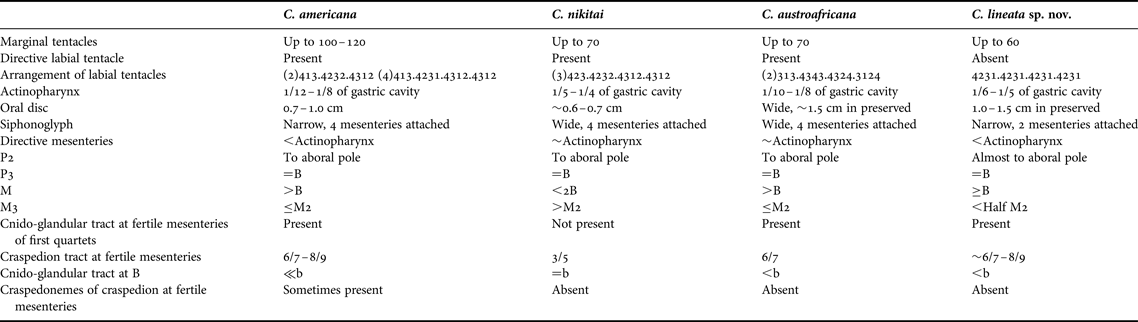
A review of the three species of the genus was recently performed by Molodtsova et al. (Reference Molodtsova, Griffiths and Acuna2011), and a comparison of Ceriantheopsis lineata sp. nov. is possible. With this new species, the genus Ceriantheopsis again confirmed to be restricted to Atlantic waters, two species occurring in the African coast and other two from the American coast.
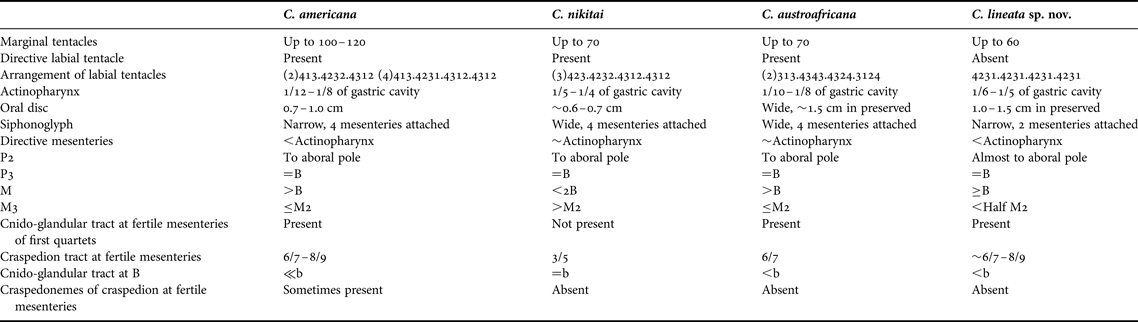
The first morphological trait that was possible to compare is the number of marginal tentacles. Based on this feature there are two different observed patterns; more than 100 (C. americana) and fewer than 70 (other three species) tentacles. A second character that can be used to distinguish species is the presence of directive labial tentacle. This feature is observed in all species of Ceriantheopsis, except C. lineata sp. nov. (Table 2). Another interesting characteristic is the number of mesenteries attached to the siphonoglyph region. Ceriantheopsis lineata sp. nov. has only 2 mesenteries while all other species have 4 mesenteries attached to the siphonoglyph (Table 2). The presence of an exclusive type of b-mastigophore (type VI) nematocyst can also be assigned as a defining character of Ceriantheopsis lineata sp. nov. (Table 2).
Comparison of anatomical features of the valid species of Ceriantheopsis (modified from Molodtsova et al., Reference Molodtsova, Griffiths and Acuna2011).
Nomenclatural remarks
As previously mentioned, the genus Ceriantheopsis was created by Carlgren, Reference Carlgren1912 to accommodate the described species Cerianthus americanus. However, this modification was performed without the specific name being suited to the agreement of correct gender. Names ending in ‘—opsis’ are feminine (ICZN – Article 30.1.2 – Examples; International Commission on Zoological Nomenclature, 1999). Thus, two specific names (C. americanus and C. austroafricanus) of the genus need to be suitable for this gender concordance. Thus, the genus composition should be as listed below.
Ceriantheopsis americana (Agassiz in Verrill, Reference Verrill1864)
Ceriantheopsis austroafricana Molodtsova et al. Reference Molodtsova, Griffiths and Acuna2011
Ceriantheopsis lineata sp. nov.
Ceriantheopsis nikitai Molodtsova, Reference Molodtsova2001
ACKNOWLEDGEMENTS
We would like to thank Dr Estefania Rodríguez (American Museum of Natural History) for providing specimens. We are grateful to Dr Mark Gibbons (Western Cape University) and Michael Farquhar (Two Oceans Aquarium) for the help with African specimens. We are also indebted to Dr Aline Benetti and Dr Luiz Ricardo L. Simone (Museu de Zoologia – USP) by their assistance in the curation of materials. We are also thankful to Noeli Lara Ribeiro, Marcelo Krause and Armando de Luca Jr (Nautilus Dive Center) for remarkable images, Dr Dale Calder (Royal Ontario Museum) for the help about nomenclature concordance and two anonymous reviewers for useful comments.
FINANCIAL SUPPORT
SNS was supported by CAPES through Programa de Pós-Graduação em Zoologia, IBUSP. This work was partly supported by São Paulo Research Foundation (FAPESP 2012/01771-8 to SNS, and 2010/50174-7 to ACM), and CNPq 481549/2102-9 to SNS, 301039/2013-5 and 476339/2013-8 to ACM. This is a contribution of the NP-BioMar, USP.