To date, there has been surprisingly little scholarly interest in the manner in which Einfühlung and the filmic medium interact. Despite the fact that the advent of film in 1895 roughly coincided with what was the peak of popular interest in the notion of Einfühlung, no attention was paid at the time to the nascent medium within those debates and relatively little has been devoted to it since then within studies of Einfühlung. This is not to say, however, that the role of empathy in film spectatorship has been neglected ever since then. Despite the fact that “empathy” is often simply used as a translation of Einfühlung,Footnote 1 the two terms have come to have distinct meanings and disciplinary affiliations, with the former primarily being associated with the realm of psychological and social scientific research and the latter viewed as an issue of (usually only historical) importance for aesthetic theory in general, and for art history in particular. Although the manner in which both affect and somatic response may come about during film viewing is taken up within contemporary discussions of empathy, an understanding of Einfühlung in its historical context has been neglected.Footnote 2
Einfühlung rose to prominence during the last third of the nineteenth century and examined a variety of forms of intense involvement with aesthetic objects. Whether studies of empathy make mention of Einfühlung as empathy's precursor, or not, with only few exceptions, contemporary accounts focus on the forms of empathy that are instilled by our alignment with animate – and mainly human – figures and thereby overlook the broader, often more abstract sense of engagement with the world and with the aesthetic object that was central to Einfühlung as it was historically understood.Footnote 3 Contemporary accounts therefore tend to neglect the more fundamental questions raised by the moving image itself for aesthetic theory, contemplation and more broadly, the powerful engagement with the world that was suggested by Einfühlung.
In an observation made in 1937 Erwin Panofsky highlighted the peculiar capacity of the filmic experience to, quite literally, move the viewer. In a famous passage (quoted here by Siegfried Kracauer) Panofsky writes:
In a movie theater . . . the spectator has a fixed seat, but only physically . . . . Aesthetically, he is in permanent motion, as his eye identifies itself with the lens of the camera which permanently shifts in distance and direction. And the space presented to the spectator is as movable as the spectator is himself. Not only do solid bodies move in space, but space itself moves, changes, turning, dissolving and recrystallizing. (Kracauer [1947] Reference Kracauer1974, 6)Footnote 4
The spatial fluidity of the spectatorial situation has profound implications for an understanding of the manner in which Einfühlung might be transcribed onto filmic reception: if one takes Panofsky's account seriously, film not only introduces a naturalistic space in which the viewer may imagine him or herself situated; the moving image offers access to a kind of kaleidoscopic space in which the viewer may lose his privileged status as subject and may be permitted to move as object among other objects. Panofsky's depiction of the manner in which filmic space may both envelop and enthrall the viewer to the point of his or her own projection into that space, either as “a solid body” or even as a less coherent component in the kaleidoscope, is both reminiscent of Einfühlung while it also prefigures more contemporary forms of intense corporeal involvement.
Such features of filmic experience as these are central to current accounts of the experiences of “immersion” or “presence.” Immersion in particular seems lately to have become something of a placeholder for a very wide range of experiences of intense sensory engagement with other objects. It will be the goal of this paper to consider the extent to which such experiences as these are brought about by means of an intersection of Einfühlung, synaesthesia, and immersion. As such I will begin by examining some early conceptions of Einfühlung that arose in the mid- to late nineteenth century, and given these historical foundations, I will consider how contemporary discussions of the nature of the moving image resonate with those early theories of Einfühlung, despite the fact that no direct links between them have been established to date. I will offer the following three hypotheses, inspired by these early aesthetic theories of Einfühlung: first, that the illusory effects of the moving image are not dependent on the naturalistic representational qualities of a given image or image environment; second, that the fundamental intermodality of human perception is a far more relevant factor in immersive experience than generally believed; third, that illusion and abstraction are not opposites, but each may contribute in their own fashion to a sense of spatial presence.
What has gone unremarked in much contemporary theorizing about forms of immersion within film and media theory, is that these questions grapple with issues that were at stake within the debates around the notion of Einfühlung in the late nineteenth and early twentieth century. Rather than following the line of investigation that emphasizes either the distinction between the illusory and the real, or the oscillation between awareness and abandon, which are more commonly the province of discussions of “immersion” or “spatial presence,” I propose instead that we re-examine how such a compelling spatial involvement with the world (in both aesthetic and everyday situations) is facilitated by the manner in which perception and imagination are engaged by a particular moving image. A particularly valuable resource in such an examination can be found within several contributions that have been made in the field of psychology. I will take up the perspectives of affect and visual involvement offered by one of the primary architects of the psychological aesthetic theory of Einfühlung in Germany, Theodor Lipps, in addition to more recent work by the psychologists Daniel Stern and Ivo Kohler, in order to better illuminate the internal processes that may contribute to such profound feelings of engagement.
Einfühlung and involvement with the world
In the last years of the eighteenth century both Herder and NovalisFootnote 5 employed the verb sich einfühlen to describe, in the former case, the attempt to vividly imagine past eras and foreign culture, and in the latter, the desire to commune with nature in such an all-encompassing manner that a thorough intermingling occurs. However, while Herder's contribution is oftentimes overlooked, in an influential overview text from 1894 entitled “Zur Genesis eines ästhetischen Begriffs,” Theobald Ziegler identified Novalis as the originator of the notion and Ziegler's account of the term's origins has tended to be replicated since (Ziegler Reference Ziegler1894, 113–20, 116).Footnote 6 It was in this period in particular, in the latter third of the nineteenth century and the first years of the twentieth, that Einfühlung rose to its greatest prominence, a product of the dynamic overlap between philosophical aesthetics and the nascent field of psychology, a dual, indeed even divided, allegiance that still reverberates to some extent within its successor, the term “empathy,” today. Indeed, it is helpful to distinguish between these “pre-scientific” approaches to Einfühlung and those that followed: early practitioners of experimental psychology (such as Wilhelm Wundt or Edward Titchener) sought to test these hypotheses that had been developed in the realm of aesthetic theory, and in doing so, demarcated the parameters of the new science of psychology. It is particularly due to the tensions produced by this overlap that Einfühlung has gained something of a new lease on life in recent years and may offer new perspectives for interdisciplinary research into both affect and the perception of space.
The work of the German psychologist and philosopher Theodor Lipps explicitly attempted to bridge this line of demarcation. That Lipps is referred to as both a philosopher and a psychologist is due to the position he held at the Ludwig-Maximilians-Universität in Munich, a position that underwent a transition during his tenure there, a shift which marked an evolution in the understanding of the areas of study proper to each of these disciplines. Thus Lipps was known officially as the Inhaber des Lehrstuhls für systematische Philosophie (systematic philosophy) and later as Inhaber des Lehrstuhls für Psychologie und Philosophie (or for psychology and philosophy). Regarded as the father of the first scientific theory of Einfühlung, his innovation was to apply its tenets not only to inanimate objects (as an explanation of aesthetic response) but also to other living beings, and in particular as a means of accounting for the manner by which humans may apprehend the feelings of other humans. However, while Lipps’ contribution continues to be cited as the precursor to contemporary notions of empathy,Footnote 7 the breadth of his claims and those of the “pre-scientific” approaches is often ignored.
Lipps sought to describe an inclination he believed was common to all humans to quite literally feel into (i.e. sich einfühlen) or empathize with other creatures and objects, whether they be animate, inanimate, or indeed phenomena such as atmospheres, colors, or sounds. Lipps's famous formula that aesthetic enjoyment should be understood to be objectified self-enjoyment,Footnote 8 made this broad application possible. In other words: in the form of things we perceive an analogy to the expressive quality of the vitality of the human body.Footnote 9 According to Lipps, the basic inclination to this kind of broad engagement with the world (i.e. this kind of Einfühlung) is based on an involuntary, instinctive mimicry of others. He describes its effect on the viewers of dancers who themselves begin to sway or rock, or else in what he terms the sympathetic tension, or internal mimicry felt by the observer of a tightrope walker. Although there are many social prohibitions in place that prevent such uninhibited mimicry, it nonetheless often emerges from the body unbidden and quite unconsciously and as such is experienced, according to Lipps, as a projection into another. He writes:
Even this, my own striving, I perceive as part of the movement that I am viewing. I experience it as something that belongs to that movement implicitly. I feel myself to be striving with this movement, even striving with the kinaesthetic movement image that corresponds to the visually observable movement and thus feel myself to be striving in effect together with that movement. To put it in more general terms, I feel myself to be striving to complete a movement. (Lipps Reference Lipps1903a, 120)Footnote 10
This automatic form of sympathetic experience is at the heart of Einfühung. The experience of vitality is key here in that Lipps understands every object to be a potential agent: “thus every object is, for me, an individual, perhaps not as a consequence of a logical perspective but rather as a psychological fact. A multifaceted kind of activity is exuded by the object and as such a unified self is felt to be within that object” (Lipps Reference Lipps1903b, 196).Footnote 11 This perspective has consequences for the manner in which one perceives the forms of objects. He continues,
I give expression to this kind of Einfühlung in everyday life when I say that the line stretches or bends, surges up and away again, confines itself; and when I say that a rhythm strives or refrains, is full of tension or resolution etc. This is all my own activity, my own vital, internal movement, but one that has been objectified. (Lipps Reference Lipps1903b, 196)Footnote 12
Thus it would not be correct to say, with Lipps, that one is concerned with the objective, given world or with the characteristics of the things in it, but rather one is occupied with characteristics of one's own embodied engagement with that world and its things, in short: with the sensations, activities, and atmospheric moods that come about through this engagement.
In Lipps's book Raumästhetik und geometrisch-optische Täuschungen spatial experience is examined in detail and architecture is introduced as an object of Einfühlung. There, Lipps links the Doric column to a striving energy, claiming that
the forceful act of composure and erectness demonstrated by the Doric column is pleasing for me, just as it is pleasing to me to compose and straighten myself, an activity that I recollect. . . . I sympathize with the bearing exhibited by the Doric column or with its internal vitality, because I recognize a mode of bearing that is both natural and pleasurable to me. Thus all enjoyment of special forms, and we might add all aesthetic enjoyment in general, is a product of an uplifting, sympathetic sensation. (Lipps [1897] Reference Lipps1966, 7)Footnote 13
The Doric column is thus an example for a positive striving that leads to what Lipps terms “positive” Einfühlung, one that is always perceived as a life affirming aesthetic impulse. Life and activity are synonymous for Lipps: “for what I empathize with [or feel into] is life in general. And life is energy and internal activity, striving and achieving” (Lipps Reference Lipps1906, 100).Footnote 14Einfühlung thus implies the sensation of kinship with a kinetic driving force.
Einfühlung and Film
Despite the fact that the introduction of the moving image to the public in 1895 seems to have provoked the sensation of partaking of just such a kinetic driving force to which many contemporaneous reports attest (and I will return to these reports below), any correspondence between the more visceral qualities of film viewing and Einfühlung, particularly in its more traditional, “pre-scientific” formulations, remains virtually unexplored. There is, however, one very notable exception to this neglect: film scholar Scott Curtis's contribution to a volume published in German in Reference Curtis, Kast, Imorde, Curtis and Koch2009 entitled Einfühlung. Zu Geschichte und Gegenwart eines ästhetischen Konzepts, following an interdisciplinary conference that had taken place three years earlier in Berlin considering the relevance of Einfühlung for aesthetic theory today.Footnote 15 In his text, “Einfühlung und die frühe deutsche Filmtheorie,” (or Einfühlung and Early German Film Theory) Curtis reviews several brief texts on aesthetic experience and film that were published in the first two decades of the twentieth century, through the lens of the Einfühlung debates in all their historical complexity. He cites a range of material here from essays by writers who were primarily known as journalists, such as Walter von Molo, Alfred Polgar, Walter Serner, and Kurt Pinthus, to Georg Lukács's “Gedanken zu einer Ästhetik des Kinos” (Thoughts toward an Aesthetic of the Cinema) from 1911 as well as Ernst Bloch's 1914 examination of the experience of the cinema entitled “Die Melodie im Kino oder immanente und transzendentale Musik” (On Melody in the Cinema). It is particularly the text by Lukács though, as Curtis points out, that sees in the experience of the cinema an alternative to the tradition of Innerlichkeit and thus points the way to a new, emancipatory aesthetic (anticipating similar arguments by both Siegfried Kracauer and Walter Benjamin more than ten years later). By emphasizing the attention paid avant-la-lettre by Einfühlung's theorists to the significance of the viewer's embodiment for aesthetic experience in general, Curtis highlights the overlap between these two historical discourses and thus the profound challenge that the filmic medium, both through its movement and its synaesthetic appeal, posed to the parameters of what constituted that aesthetic experience. What is notable is that this challenge was already apparent to those viewers of early cinema whose texts Curtis cites. Although “empathy aesthetics” as he calls it (a direct translation of die Einfühlungsästhetik) envisage the body as the site at which art and understanding occur, but not as an active participant in aesthetic experience, Curtis argues that the experience of the cinema contests the separation between contemplation and physical response and thus the particular conceptualization of aesthetic experience which had been part and parcel of the Einfühlung debate as it stood at cinema's inception. Taking up Georg Lukács's opposition between the “soul” or an appeal to Innerlichkeit, as the realm serviced by the theater, and the “soullessness” or “pure action” that was the province of the cinema, Curtis suggests that any contemporary reconsideration of Einfühlung needs to re-evaluate the manner in which the movement of the cinematic image leads to a complex alternation between contemplation and distraction, between embodiment and disembodiment, between here (in the film theater) and there (in the film itself).Footnote 16 This paper seeks to contribute to a better understanding of precisely this issue.
One other contribution to that same conference and the subsequent volume made by the architectural historian, Juliet Koss, deserves mention in this context, since she similarly highlights the temporal overlap of the advent of film and Einfühlung (see Koss Reference Koss, Kast, Imorde, Curtis and Koch2009). However, in this text (which is a translation with some revisions of her text, Koss Reference Koss2006), Koss only peripherally takes up the implications of Einfühlung for an account of film's aesthetic impact. She describes, instead, what she considers to be an unbridgeable gap between the experience of contemplation associated with the art of the nineteenth century and Einfühlung, and that of the distraction, Siegfried Kracauer's term (see Kracauer Reference Kracauer and Levin1995), that was, to his mind, a central characteristic of film viewing. It is important to note that, far from being pejorative (as Koss implies in her text), in Kracauer's view the experience of distraction offered by the cinema marks a turning point in aesthetic experience, which might have revolutionary potential, in that it points out a critical practice embedded within aesthetic experience that is particularly well-suited to examining the art and media of the twentieth century. Overlooking this crucial emancipatory aspect implicit in Kracauer's position on film, Koss describes the advent of cinema as the death knell for Einfühlung; it is precisely the “shallow, passive, weak-willed” (Koss Reference Koss2006, 152) film viewer, wholly absorbed by the on-screen narratives (ibid.), who is most at home in the cinema, and stands in her account in marked contrast to the subject implicit in the Einfühlungsästhetik. Koss's attention to the birth of the cinema seems to be first and foremost a result of her interest in tracing the class-based implications of contemplation contained within the theories of Einfühlung: cinema provides the populist foil for the elitist Einfühlung.
Koss's examination of the relationship between film and Einfühlung is not significantly expanded within her book, Modernism after Wagner, which was published in 2010.Footnote 17 Although the chapter entitled “The Specter of Cinema” again highlights the temporal proximity of the advent of cinema and the Einfühlung debates, rather than examining the complexities of filmic space experienced during a film projection, Koss focuses her attention on the sociology of early cinema audiences, and the architectural strategies (and the implicit notions about the needs of the cinema-goer) undergirding the development of early film theaters. The challenges that cinema posed to traditional configurations of aesthetic experience by way of its emotional and somatic impact cannot be adequately discussed without an examination of the manner in which the filmic medium both replicates and creates space. Film's continual mingling of the representational with the more formal, even abstract qualities of the areas of light and darkness that make up the moving image itself, undoubtedly contributes to the visceral effects it is oftentimes capable of producing in its viewer. Herein lies my own focus with respect to a re-evaluation of the significance of Einfühlung for film aesthetics.
The Abstraction of the Moving Image
Rather than focusing attention on the circumstances of the human figures depicted in filmic narratives, or the movement of those figures or other objects through space, this paper seeks to address the potential for complex spatial engagement that is offered by the moving image, even when there is no human figure in sight, or in the case of filmic abstraction. Although this space cannot be entered physically, cinematic space is strangely absorbing. It calls forth a host of complex responses and seems to be at the root of visceral effects that can be overwhelming, even while their perceptual source may remain somewhat inscrutable. The sense of space made accessible while viewing the moving image should not be understood merely as a reproduction of architectural space, a simple documentation of space as a container of objects, in which various activities occur. Despite consisting of nothing more than oscillating areas of light, dark, bright or in-between, the spatial experience offered by the filmic medium has a striking palpability. In short, the cinema introduces a very different spatial experience from that offered by any other medium and thus carries with it a multiplicity of spatial capacities all of which beg to be considered within the context of the notion of Einfühlung.
However, the abstraction that is named both in the title of this paper and obliquely described above should not be understood to solely refer to the tradition of non-objective art in general and the various recorded histories of non-representational filmmaking from the 1920s onwards more specifically, but rather to the effects and potentialities of non-illusionistic form in film as a moving-image medium. Furthermore, any mention of abstraction in the same breath as Einfühlung automatically recalls the title of a work that is, perhaps, most readily associated with Einfühlung's legacy, particularly within the discipline of art history and other fields of aesthetic inquiry: Abstraktion und Einfühlung. Wilhelm Worringer's fantastically successful dissertation, first published in 1907 (and in print continuously ever since), offered an early account of the experience of abstraction in art (hence its popularity, particularly among artists at the time of its publication), which Worringer posited as the diametrical opposite of the experience of Einfühlung. The logic of this opposition has been contested recently by several authors. In her previously mentioned book, for instance, Juliet Koss points out quite correctly that Einfühlung as it had been set out by Worringer's forerunners in the debate, provided an avant la lettre (albeit implicit) account of abstraction in that the most basic elements of perception, such as horizontal lines or vertical lines, rather than the semantic content of images, are the focus of analysis. For instance, referring to Robert Vischer, Koss writes,
In this late-nineteenth-century context, the representational nature of these objects was never questioned, his [Vischer's] examples include Albrecht Dürer's Four Apostles. But in combining psychology, optics, fine art, and the notion of universal spectatorship, the discourse of Einfühlung that Vischer and others developed unwittingly helped set the terms for the theory and practice of visual abstraction. The “pure form” of the twentieth century was embedded within an idea of embodied perception. (Koss Reference Koss2010, 70)
This issue has, in fact, been taken up at much greater length within recent German scholarship. The close relationship between abstraction and Einfühlung is the subject of a highly regarded book-length study by Jutta Müller-Tamm, entitled Abstraktion als Einfühlung, from 2005 which examines the function that Einfühlung (or as she terms it, in a broader sense, “projection”) had for aesthetics, philosophy, and psychology throughout the nineteenth century. With Worringer's work in mind, Müller-Tamm argues that abstraction is a form of projection, rather than its polar opposite.Footnote 18
Early Cinema
In the very few written accounts of the experience that have survived, the individuals who belonged to film's first audiences often highlight the degree to which the simplest elements of the filmic image had the power to transfix. The rustling leaves of trees, the smoke emerging from a smokestack, the water pulsating and crashing onto shore: these were the motifs that made a lasting impression around the turn of the twentieth century. Even the earliest film viewers understood that the medium introduced a very different spatial experience from that offered by any other medium. For instance, film theorist Siegfried Kracauer's description of his own first experience with film is a testament to exactly this kind of fascination. He recalled,
I was still a young boy when I saw my first film [Kracauer was born in 1889]. The impression it made upon me must have been intoxicating, for I there and then determined to commit my experience to writing. . . . I immediately put on a shred of paper, Film as the Discoverer of the Marvels of Everyday Life, the title read. And I remember, as if it were today, the marvels themselves. What thrilled me so deeply was an ordinary suburban street, filled with lights and shadows, which transfigured it. Several trees stood about, and there was in the foreground a puddle reflecting invisible house façades and a piece of the sky. Then a breeze moved the shadows, and the façades with sky below began to waver. The trembling upper world in the dirty puddle—this image has never left me. (Kracauer [1960] Reference Kracauer1997, li)
Kracauer's account of his experience has often been viewed as a description of the way in which film offers a very powerful kind of realist representation, an engagement with the world in a naturalistic sense; however, it might be more productively viewed as a description of the type of perceptual experience film offers to its viewers. “The trembling upper world in the dirty puddle” offers a replication, but one that is muddied, obscured, kinetically altered – in a word, dispersed.
In his numerous texts exploring the astonishment experienced by those viewers and their particular form of engagement with what he dubbed the “cinema of attraction,” film scholar Tom Gunning has noted the degree to which that fascination was predicated on an abstract form of involvement. Blending the semantic identification of an undulating object (such as “waves,” “smoke,” or “the leaves of a tree”) with a pure kinetic pleasure that caused that object to dissolve into rhythmic intensity, the “cinema of attractions” offered both an alternative form of visual pleasure and pointed to film's capacity to offer an aesthetic experience quite separate from the impulse towards semantic cohesion implicit in narrative film. It additionally suggests that, from the beginning, the filmic image's capacity for realist representation has perhaps distracted from other qualities inherent to the moving image that may have provided the basis for a form of involvement with the image comparable with Lipps's account of Einfühlung.
A Trip Down Market Street
Consider the example of a short film, known as “A Trip Down Market Street” (fig. 1):Footnote 19 This document was filmed in 1906 in San Francisco (only days before the catastrophic earthquake destroyed the city) with a fixed camera perched at the front of a cable car as it travels through space towards the vanishing point, which eventually can be seen to be located approximately where the Ferry Building stands. During the (roughly) real-time travels of the camera through this space, humans, animals and vehicles cross the path of the cable-car at random, often seeming to misjudge the speed of that cable-car and just barely move out of its path in time, creating a surprising amount of suspense in a short film that would seem to depict nothing more than an everyday street scene. Such “phantom rides” (as they were called) as this, shot by a camera positioned in a moving vehicle, whether a car, subway or passenger train, have enjoyed a more recent revival within film and media scholarship in recent years and have been called upon in a wide variety of texts, to act as the precursor to virtual reality, and as the paradigmatic example of the kind of spatial immersion available to viewers of film. In Raymond Fielding's account of motion picture realism, for instance, depth perception is achieved in an additive fashion, with various apparatuses speaking to each of the senses individually. In fact, for Fielding, it was the Trip to the Moon Ride introduced at Disneyland in the 1950s that was the pinnacle of motion picture realism: in an updated version of the Hales Tours attractions of the beginning of the twentieth century, Disneyland offered a similar kind of “phantom ride” representing a trip to the moon in a movie theatre decorated like a spaceship that shook and tilted.
A Trip Down Market Street (Anonymous 1906, 13:52 minutes).

In a similar fashion, contemporary notions of immersion have been largely contingent on the attempt to recreate the elements of the external world as completely as possible in order to allow the viewer to be inserted in some fashion into that ever more holistic spatial construct. In formulations from Oliver Grau's to Alison Griffith's, immersive media are generally defined by and are said to acquire their affective power through their ability to suggest a three-dimensional space that envelops the viewer or user.Footnote 20 However, this emphasis on realist strategies has been a hindrance to a better understanding of immersion's and indeed spatial perception's, fundamental connection, not to an apparatus or indeed even to a particular illusory mode of representation, but rather to perceptual capacities that are quite independent of the audio-visual technology employed. Nonetheless the notion of realism that is at the heart of the majority of treatments of immersion, whether it be filmic or based upon a more interactive setting such as computer games or virtual reality apparatuses, is based on the additive replication of three-dimensional space. In other words: the more spatially detailed a work is, the more immersive it will be.
I would like to question the assumption that involvement and immersion are dependent on the specific apparatus-basedFootnote 21 qualities of a given medium (that is, its dispositif) by offering some alternative examples of moving images; additionally, the part played by abstraction in spatial involvement deserves a closer examination. Two things are important to note here: one is that the trappings of “genuine” travel (such as “real” kinaesthetic stimuli) would seem to be unnecessary to produce for the viewer a sense of sharing in the velocity of the moving image. The Austrian Psychologist Ivo Kohler already noted in Reference Kohler and Metzger1965 that
Perception allows itself to be quite easily deluded . . . when stimuli are simulated (as is the case for instance . . . in scenes which have been filmed with a moving camera or a zoom lens, or else when there are pans or tilts in which the background is undifferentiated and so on). . . . That kinaesthetic information regarding the movement of one's own body was utterly lacking in such cases as these was amazingly quite insignificant. (Kohler Reference Kohler and Metzger1965, 630)Footnote 22
Furthermore, in Kohler's brief examination of the manner in which the senses somehow cooperate within consciousness to provide information about one's surroundings, he emphasizes that, “even when the stimuli would seem to be visual, it is difficult to distinguish between the information provided by vision and that which is contributed by the other senses and integrated into a vivid whole” (ibid., 619). Kohler highlights the extent to which consciousness effects a blending of the senses. The impact of this everyday amodality of the senses deserves closer attention as well.
The Avant-garde and Immersive Experience
Consider a second example: the reworking of my first example, “A Trip Down Market Street,” provided by Ernie Gehr's Eureka from 1974, which slows the original material by half. While the chaotic street scene from the original film is no less suspenseful, the wear and tear on the film material itself becomes all the more perceptible to the viewer. Thus despite the fact that the viewer here may be oscillating between surface and depth perception – an oscillation which is usually viewed as the on-off switch of immersive experience – the movement towards the vanishing point is still inevitable, and may not even be key to the spatial experience offered by this film. While the image is ostensibly less realistic because it is slowed, it is nonetheless equally spatially engrossing.
On this basis, and this is the second point that should be emphasized here, I would like to introduce some doubt into the assumption that it is the illusory depiction of three-dimensional space which creates immersion, or moreover, that the ever greater “perfection” of that representation will lead to ever more spatial engagement and immersion. Instead the extent to which our experience of moving images takes on a degree of plasticity would seem to be equally a product of our own perceptual apparatus independent of this particular illusory “quality.” Indeed an intense spatial involvement can come about independent of three-dimensional “realism” or indeed, in a strict sense, of representation, and is likely to be, in general, a product of intermodal perception or amodal representation, and is, more specifically, related to such compound effects as intensity, vitality, and rhythm.
Einfühlung and Spatial Memory
In 1858 the philosopher and physician Rudolf Hermann Lotze described a phenomenon that he called a “Theory of Internal Co-experience.” It was in the second of his three-volume work Microcosm that he wrote:
The world becomes alive to us through this power to see in forms the joy and sorrow of the existence that they hide. . . . No form is so unyielding that our imagination cannot project its life into it. We do not only partake of the particular senses of being alive which are closest to our own, the joyous flight of the singing bird or the graceful fleetness of the gazelle; we do not pull on the heartstrings of our own spirits in order only to dream of the compact existence of a clam or the pleasurable monotony of its opening and closing; we do not only feel ourselves expand into the tall slim form of a tree, whose finest twigs suggest and animate the pleasurable sensation of sinking and swaying; indeed even the inanimate is the receptacle for these interpretive sensations thus transforming the dead substance and supports of a building into as many limbs of an animate body as may be transferred to us in the form of internal tension. (Lotze [1858] Reference Lotze and Leipzig2001, 201–202)Footnote 23
Lotze emphasized the significance of the experience of gravity upon our own bodies for our perception of other phenomena, indeed the significance that our recollection of the sensations of embodied experience have always and everywhere. The act of projection implied here had broad implications for aesthetic experience in general, and, in particular, for the discussion of the manner in which we perceive the formal qualities of our surroundings.
The historical debates around the notion of Einfühlung are useful in that they describe little discussed forms of engagement with aesthetic objects that have many similarities with the notions of immersion and presence current today. Indeed, the search for an adequate form to describe the aesthetic experience of space implied by architecture was of special interest in discussions of Einfühlung. Art historian Harry Mallgrave describes Lotze's treatment of this phenomenon as follows:
The pleasure of symmetry is due not so much to the regularity or proportion of members as to the pleasure we take in emulating this movement. This “remembrance” of the concrete world, the self-experience of our own physical condition, altogether pervades our spatial viewing.
and, continuing, he quotes Lotze:
For all spatial forms affect us aesthetically only insofar as they are symbols of a weal or woe personally experienced by us. (Malgrave and Ikonomou Reference Mallgrave and Ikonomou1994, 20–21)Footnote 24
One aspect of the kind of holistic engagement with objects and environments external to oneself at the heart of empathetic response deserves to be emphasized in particular. The role played by a kind of spatial memory that appears explicitly in Malgrave's account of Lotze's position is key to spatial engagement with audio-visual media.
The implementation of spatial memory is a key part of a very thorough and imaginative recent trans-European research project conducted in the field of Communications Studies on “Spatial Presence” that was led by Werner Wirth of the University of Zurich. While the study recognizes that “spatial presence” can be enriched by “external (media-based) information such as visual, haptic, or proprioceptive impulses and feedbacks” (Wirth et al. Reference Wirth, Hartmann, Böcking, Vorderer, Klimmt, Schramm, Saari, Laarni, Ravaja, Gouveia, Biooca, Sacau, Jänicke, Baumgartner and Jänicke2007, 496), it is more interested in considering not only such a media-based approach, but also in incorporating imagination into the equation. Thus, “if immersive impulses are not provided by the media product, internal processes, for example imagination, can compensate for that deficit in external stimulation – at least to a certain degree” (ibid., 496). For the authors of this study, the experience of spatial presence is contingent on the capacity of a given medium to induce the viewer, reader or user (as the case may be) to process the spatial cues offered by the medium and incorporate them into their own “mental representation of the depicted space” (ibid., 501), a process that results in the viewer's creation of her or his own Spatial Situation Model or SSM. This process is intimately connected to spatial memory, for, according to Wirth,
To create an SSM from perception and memory, users must have a “library” of spatial experiences in their mind and must be able to imagine objects and spaces (i.e., they must possess figural imagination). Both spatial knowledge and spatial imagination become more relevant if the mediated representation of the space is less intuitive and more fragmented (for example, when reading textual descriptions of space). (Ibid., 502)
The introduction of imagination into this account allows for more multifaceted forms of engagement with space than those described initially, which were dependent on the simple replication of a three-dimensional space defined by realist representation. Indeed it is only when the operation of all that may be considered part of the “imagination” is included here that the link between “spatial presence” and Einfühlung becomes clearer. Of course Einfühlung suggests a far more wide-ranging engagement with another than spatial presence does, in that it goes so far as to imply not only the insertion of the subject into another space but the complete destabilization of other and self. However it might be more to the point here to address the extent to which the merging or intermingling of the senses might be responsible for such an overwhelming effect as that which was described by Lotze, and also that such effects have gone by many different names at different points in time.
Lightplay: Black/White/Grey
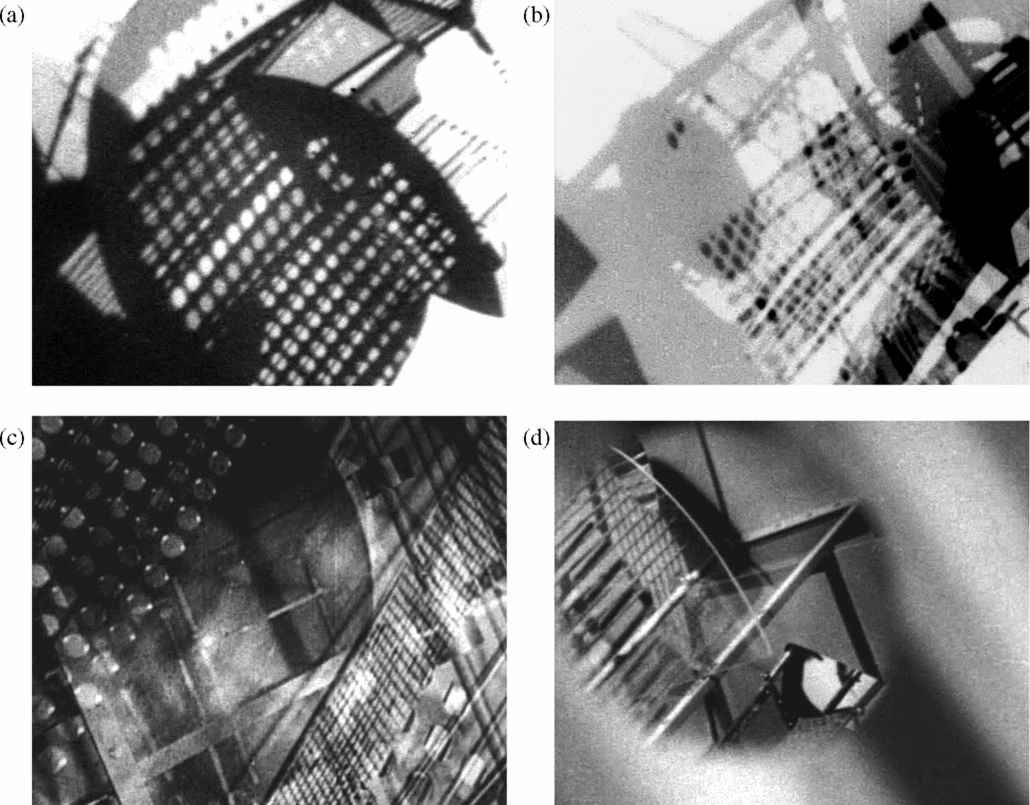
Consider now the spatial implications of a third work that will underscore the diverse types of spatial engagement made available by the moving image. The 6-minute film, “Lightplay: Black/White/Grey,” which was made by the Bauhaus artist and teacher, László Moholy-Nagy in 1930,Footnote 25 offers a different kind of engagement with space that is of a more uncertain status than the first two examples (fig. 2). While the first two examples each depicted a street scene with recognizable depth cues, this “documentation” of Moholy-Nagy's “Light Space Modulator” is of far less certain status spatially. The object represented here was not to be observed itself, as a sculpture, but rather as what he termed a “Light Prop” as its original name suggested (Moholy Reference Moholy1972, 79–84),Footnote 26 It evokes not only the overlap of various spaces achieved by means of a reflection on all possible views of a single object in three dimensions or even on the overlap of past and present spatial experience, but also suggests the plurality of levels of spatial attention, which may focus variously, for instance, on the speck of dust in the air and the surface behind it.
Lightplay Black/White/Grey (Moholy-Nagy, 1930, 6 minutes).

An investigation of the manner in which space was perceived was key to Moholy-Nagy's project. Space needed to be investigated by all of the senses in unison. Indeed the fundamental intermodality of spatial experience was already clear to Moholy-Nagy who wrote,
Each of our senses which can record the position of bodies allows a grasping of space. Thus space is known to man, first of all by means of his sense of vision. This experience of the visible relations of the position of bodies may be checked by movement – alteration of position – and by means of touch; it may be verified by another sense too. From the point of view of the subject, space is naturally to be experienced most directly by movement, on a higher level, by the dance. The dance is at the same time an elemental means for realization of space-creative impulses. It can articulate space, order it. Space expands, sinks and floats – it fluctuates in all directions. (Moholy-Nagy Reference Moholy-Nagy and Hoffman2005, 163)
Both Moholy-Nagy's films and his sculptural works attempt to make just such an experience of space as this tangible; they allow us to perceive the “dance” of the specks of dust as an oscillation between illusory space and abstraction.
Vitality Affects
But how may one analyze such vague aesthetic qualities as these? I would briefly like to introduce the model for such inquiry offered by the developmental psychologist Daniel Stern's notion of “vitality affects.” In his studies of pre-verbal infants, published in 1985 under the title, The Interpersonal World of the Infant, Stern established that babies are capable of transposing information that is perceived in one particular sensory mode into another. This doesn't mean that they translate, for instance “hearing” into “seeing,” but rather that, percepts are encoded into what Stern calls “amodal representations,” which may be recognized in any sensory modality. He writes, “These abstract representations that the infant experiences are not sights and sounds and touches and nameable objects, but rather shapes, intensities, and temporal patterns – the more ‘global’ qualities of experience” (Stern Reference Stern1985, 51).
Such “amodal representations” as these, are given the name “vitality affects.” These are affects which are both experienced in one's own body as well as being recognized in the bodies of others. These elusive qualities are better captured by dynamic, kinetic terms, such as “surging,” “fading away,” “fleeting,” “explosive,” “crescendo,” “decrescendo,” “bursting,” “drawn out,” and so on, than by the more familiar categorical affects that were already set out by Charles Darwin (angry, sad, happy, and so on). Moreover they are well suited to describing the states of other human beings. Stern writes,
Like dance for the adult, the social world experienced by the infant is primarily one of vitality affects before it is a world of formal acts. It is also analogous to the physical world of amodal perception, which is primarily one of abstract qualities of shape, number, intensity level, and so on, not a world of things seen, heard, or touched. (Stern Reference Stern1985, 57)
Thus Stern describes a perceptual capacity that has much more to do with qualitative, nearly atmospheric aspects of perception, than with concrete actions and events in a narrative sense. These are capacities that we have all experienced in the earliest phases of our development.Footnote 27
“Space travel” and Abstraction
Finally, consider one final – and very different – example that challenges some of the assumptions that were described above about spatial engagement and its source, but does so in a very different way from the filmic examples offered. I would again like to return to the way in which a “library” of spatial experience is retained and is always brought to bear on present spatial experience. I would also like to recall the objective that has long been central for game and console design to improve image quality in order to suggest ever-greater three-dimensional realism, which in turn, is meant to increase spatial involvement or immersion. As an alternative consider the example of a two-dimensional game that had surprising and disturbing effects on its players causing an intermingling of the player's “world” and the “object world” represented in the game. Recall that the researchers of “Spatial Presence” noted that the experience of presence is contingent on the capacity of a given medium to induce the viewer, reader, or user (as the case may be) to process the spatial cues offered by the medium and incorporate them into their own “mental representation of the depicted space.”
Tetris
My final example is the old 2-D video game Tetris, which has been known to create something called the “Tetris Effect” in the user – indeed in nearly every user (fig. 3). The object of this simple game, created in 1985, is to rotate the shapes as they appear in the field and descend until they fit into a space available at the bottom of that field. A full row allows that same row to disappear and make more space for the shapes (or tetrominoes), which continue to appear, ever more quickly, at the top. The “Tetris Effect” describes the fact that players, after they cease playing this game, continue to see the shapes falling and continue to be occupied mentally with fitting them into the spaces at the bottom of the field – even into their dreams when they try to sleep at the end of the day. A study from 2000 conducted at Harvard Medical School (Stickgold et al. Reference Stickgold, Malia, Maguire, Roddenberry and O'Connor2000), found that even anterograde amnesiacs, who are unable to transfer experiences to long-term memory and were therefore unable to recall having played the game at all, also dreamt of the shapes falling. It would appear, and this is the outcome of that study, that sleep and especially dreaming function to solidify the experiences of the previous day and thereby aid in learning. The researchers wrote that “‘what was most striking about the data, was the strong similarity in reports from different individuals.’ All the subjects dreamed of pieces falling and sometimes rotating or fitting into empty spaces – and none reported seeing the picture surrounding the pieces, the scoreboard or the keyboard” (quoted in Leutwyler Reference Leutwyler2000).
Tetris.

While this example clearly has more to do with sleeping than with waking life, to my mind it introduces additional doubt into the clear-cut version of the way we process spatial information that I described at the outset of this paper. It should encourage us to look beyond the most obvious explanation for our engagement with moving images and therefore impact the ongoing investigation of the way that representation and abstraction interact for us in our experience of space.
Einfühlung was one rich psychological and aesthetic model developed at the end of the nineteenth century that offered a multi-modal immersive experience, although it had not been explicitly applied to film during its prominence in aesthetics. An examination of Einfühlung at its historical roots, along with other psychological models (such as Kohler's de-emphasis of the role of the apparatus in the creation of impact in the viewer, or Stern's description of the intermodality of affective experience among infants) problematize accepted categories of visual and aesthetic experience and challenge the neat distinction between representation and abstraction that currently reigns in discussions of aesthetic experience, providing additional depth and complexity to recent theorizing on the moving image. Moving back and forth from historical Einfühlung to contemporary empathy and immersion opens up a new angle of insight for understanding the complex spatial experience and affects activated by the moving image.