What can a textbook on hair weaving reveal about how Black women have shaped the contours of British history? And how can attending to ideas about everyday acts of self-fashioning offer insights about practices of belonging in Britain during the 1960s? Despite a plethora of recent new work in Black British history,Footnote 1 much remains to be written about Black women's movement, settlement, and place making in Britain. We need to know more about the infra-ordinary worlds of Black women in Britain and the ways that they imagined, anticipated, and strategized about being and belonging in the day-to-day.Footnote 2 Such stories are ripe with new possibilities for attending to the intricacies of Black people's lived experiences historically.Footnote 3
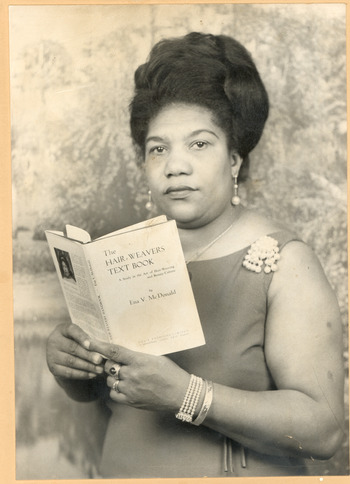
In the thousands of largely anonymous photographs acquired by the Lambeth Archives that constitute the Harry Jacobs collection, Ena V. McDonald is one of a small number of identifiable sitters who commissioned Jacobs to produce a portrait memorializing their presence in contemporary Britain. From the late 1950s, as London became home to more Black and Asian newcomers, Jacobs, a Jewish photographer who maintained a studio in Stockwell, became one of the go-to photographers for Black families seeking to capture treasured moments.Footnote 4 Yet McDonald enlisted his services and studio as part of developing a business invested in marketing a type of beauty culture that imagined the presence of Black women. For McDonald, beauty culture provided a means for Black women to command visibility, acknowledgment, forms of address, and social capital in ways that could influence their position in the labor market and shape claims to particular kinds of status markers in the wider society. Jacobs provided headshots featuring models McDonald selected to showcase the current styles on offer through her salon; he also photographed her holding a copy of her 1967 guide The Hair Weavers Text-Book: A Study in the Art of Hair-Weaving and Beauty Culture (figure 1).Footnote 5
Harry Jacobs, studio portrait of Ena V. McDonald with her book, ca. 1967. Harry Jacobs Collection, IV/233 SP9000, Lambeth Archives, London. This image was reproduced by kind permission of London Borough of Lambeth, Archives Department.

McDonald operated a hairweaving school that trained what she described as “hair artistes,” equipping them to cater to the needs and desires of an expanding Black female clientele in South London in the late 1960s.Footnote 6 Although the early years of postwar Black migration to Britain had largely consisted of men from the Caribbean, by 1958 the numbers of Caribbean women newcomers were on the rise. With that in mind, entrepreneurs like McDonald envisaged a demand for new, gender-specific, culturally competent services that anticipated Black women's intentions to make Britain a place for them, not just as workers but also as people with their own ideas about beauty, style, presence, and the pleasures of everyday life.Footnote 7 In producing The Hair Weavers Text-Book, McDonald aimed to circulate for mass consumption the specialized knowledge, skills, methods, training, and brand on offer at Ena's School of Hair Weaving Technique, a subsidiary of Ena's Fashions Ltd., which she established in Peckham. McDonald explained that her textbook was specially written for “professional hairdressers” wanting to hone their craft but unable to enroll in her full-time training course.Footnote 8
Aside from being a means to bring aspects of McDonald's beauty enterprise to a wider market, The Hair Weavers Text-Book represents an important and unconventional source for understanding the social economies and forms of intellectual praxis tethered to Black women's haircare. The work not only makes a case for understanding Black hair/care as a racialized and gendered cultural domain of knowledge production, but also offers an ideological critique of the politics of beauty.Footnote 9 From the outset, McDonald emphasizes that readers are not simply engaging with the work of a skilled hair stylist; rather, they are encountering a designer “label” and brand that was offering the British public “a new concept of modernisation.”Footnote 10 In this sense, while her book provided readers with a type of practical technical knowledge about hairweaving, the medium itself articulated her desire for the work to establish a degree of professional legitimacy and currency for those who possessed it and sought to emulate her trademark style.
The majority of the text discusses the technical process of hairweaving, including descriptions of basic tools and illustrations of coloring and cutting techniques, along with staged photographs of Black women as styled clients. However, the early chapters set the stage for framing one of McDonald's central claims: “The professional status of the hair weaver must be recognised.”Footnote 11 Beyond learning a skill or vocation that could be monetized, for McDonald the pathway to becoming a hair weaver offered a route to make particular kinds of claims about one's position in a labor market where the intersections of race, gender, and newcomer-citizen status often left Black women with few options. Black women frequently found difficulty translating the professional careers that they had held in the Commonwealth into similar employment prospects in Britain, where the economy was structured to make space for them only in lower-paying, less desirable sectors, the so-called “occupational ghettoes.”Footnote 12 McDonald's ideas about what it meant to become a professional Black woman in Britain were certainly birthed in this context. Her vision of what it meant to be a professional was therefore necessarily steeped in notions of a kind of respectability that could be accrued but was not often assumed to be possessed by Black women.
McDonald counseled that successful hair weavers should consider their “appearance and personality just as important as their technical knowledge.” Hair care professionals should “cherish a good reputation” and “set an example of good conduct and behaviour,” including attending to mundane details of self-presentation such as regulating the pitch of one's voice, which she suggested should radiate “charm and warmth.” She warned stylists to “avoid being emotional” and “learn to suppress,” even as they worked to “develop qualities that demand respect.”Footnote 13 For McDonald, honing one's craft was a technical, performative, and intellectual exercise that required professional Black women to strategize about ways of being in a range of settings. It involved employing a “flexible mind,” or a kind of Duboisian double consciousness that could allow one to maintain a position of self-awareness while exhibiting responsiveness in anticipating and serving the needs and desires of others.Footnote 14
Aside from adapting certain behavioral codes to leverage respectability, McDonald also offered practical advice, encouraging her readers to see themselves as part of “the future of hair weaving” by establishing sound business practices that would lay the groundwork for building a sustainable commercial enterprise.Footnote 15 McDonald emphasized that the hair-care professional should be able to provide services for an expanding multicultural market by learning how to “handle different types and textures of hair—Negro, Asian, Chinese and European.”Footnote 16 She thus anticipated the existence of an increasingly diverse British consumer society where cultural and racialized difference required bespoke accommodations, and where ideas about beauty, self-care, and personal style provided possibilities for projecting dignity, confidence, competence, desire, and a sense of self-worth. “Every woman must be made to feel important,” McDonald insisted—a call to action that in many ways spoke back to a beauty industry that privileged whiteness and made little or no room for the everyday needs, desires, and aspirations of Black women.Footnote 17 Revisiting The Hair Weavers Text-Book, one could also see it as a reminder for historians to continue to ask questions and seek out sources that might tell us more about the Black women whom McDonald imagined as her audience.