Catastrophic disasters have become familiar experiences in our contemporary world, and they require planning by government leaders so that they can provide an efficient and effective response. These disasters range from natural ones such as hurricanes, earthquakes, and epidemics to terrorist attacks involving improvised explosive devices and nuclear, biological, or chemical weapons. Emergencies and disasters begin and end locally, and most are wholly managed and resolved at the local level. Some incidents require a unified response from local agencies, nongovernmental organizations, and the private sector. Some require additional support from neighboring jurisdictions through mutual aid agreements. 1 Most disasters are likely to cross multiple political jurisdictions and geographic boundaries and require a coordinated public health and medical response.
In catastrophic events, the response becomes even more complicated, requiring decision makers across multiple levels of government to allocate available resources quickly, efficiently, effectively, and fairly to optimize and synchronize resource distribution to save lives and to mitigate suffering and morbidity. The decision-making process used by federal leaders during catastrophic events is dynamic, often based on limited situational awareness and gestalt, and can be strengthened by a structured, ethically-based process. The ethical framework offered here may provide a useful supplement to the National Response Framework's strategic and tactical guidance for incident response. 2
During the past 2 decades, an ethical basis for allocation of scarce resources during public health emergencies has been the explicit starting point for practical guidance regarding planning for and responding to public health emergencies.Reference Barnett, Taylor, Hodge and Links 3 - Reference Verweij 12 In general, these approaches seek to develop leadership decision-making processes that are “values based,” meaning that they are based on both substantive ethical principles and fair procedures. 13
Values-based decisions require explicit attention to strongly held beliefs, ideals, principles, and standards to inform leadership decisions in relation to societal goals. It is especially important that government leaders who make decisions regarding publicly held health and medical resources establish values-based decision processes well in advance of a catastrophic disaster. Such ethical preparednessReference McLean 14 is important to the public trust and central to making difficult choices in real-time decision making. 8 , Reference Vawter, Garrett and Gervais 11 Ethical preparedness helps decision makers to anticipate the judgments that will have to be made and model such judgments in a way that is explicit, transparent, and widely shared.Reference Roberts and DeRenzo 15
In a federal system of government, federal leaders are responsible for coordinating the provision of federal resources including allocating resources when needs exceed the available resources. While the National Response Framework describes the distribution of responsibilities between federal and state governments during disasters, little has been written about how decisions should be made by a federal government in disaster situations when resources are not sufficient to fully meet the needs of several states (state refers here to the 50 states, the District of Columbia, US territories, and Native American tribes, all of which may request federal assistance) simultaneously. To address this concern, the Office of the Assistant Secretary for Preparedness and Response (ASPR) at the US Department of Health and Human Services convened a working group in 2011 to consider the question of federal public health and medical resource allocation. The framework presented here grew from that group's work and engagement with stakeholders in ethics, disaster preparedness, and emergency management.
In this report, we present the ethical framework developed by the working group, the processes and outcomes from the stakeholder engagements, and the resulting logic model intended to assist federal decision makers to efficiently, effectively, and fairly allocate limited federal resources to states. The framework builds on the principles that have been identified to guide allocation decisions for individual patients in scarce resource situationsReference Persad, Wertheimer and Emanuel 9 , Reference Caro, Coleman, Knebel and DeRenzo 16 - Reference Winslow 19 and considers how the principle of federalism can be applied to the task of allocating scarce federal public health and medical resources to states. In a catastrophic disaster, situations will arise in which specific resources are insufficient to meet demand or need. We propose this ethical framework and logic model to guide allocation decisions within this dynamic context.
Methods
The working group comprised individuals with ethical, legal, clinical, disaster planning, and emergency management experience and expertise. Working group members as well as subject-matter expert reviewers are listed in the Appendix.
To develop the framework, the group identified underlying assumptions; enumerated substantive and procedural ethical principles to guide decision making; identified concepts consistent with the principle of federalism that make this type of decision making different from that at the individual or community level; specified criteria to apply the concepts to allocation decisions; and applied a scoring system to the criteria. After the original framework was developed it was presented in 3 separate workshops to obtain feedback on its ethical merits and the feasibility of its application. These workshops allowed participants to consider the proposed criteria and provide feedback using a scenario-based approach. Finally, the authors engaged experts with expertise in modeling scarce resource decision making to further refine the framework and approach.
Development of the Original Framework
Assumptions
The working group identified a series of assumptions that underlie the proposed framework. The assumptions include the following:
-
1. The decision process is designed to be used in any stage of a disaster response when there is scarcity of a specific resource needed by affected states. Scarcity is defined relative to a specific resource (eg, mobile medical units, ventilators, vaccine, or therapeutic treatment stocks) and a specific timeframe. It means that in spite of strategic stockpiling and regional cooperation and allocation, the demand or need for the specific resource exceeds the supply that is available or expected to become available within a specified period of time. This assumption encapsulates the critical and most fundamental dilemma that federal leaders face in making allocation decisions. Over time, additional resources may become available; however, allocation of existing resources must be initiated to respond to immediate need.
-
2. A separate allocation decision should be made for each scarce resource.
-
3. Decision makers must be prepared to make allocation decisions in 2 possible sets of circumstances:
-
a When some or all affected states have made formal requests for assistance, as outlined in the National Response Framework, ie, the typical “pull” of federal resources to meet the need 2 ; and
-
b When catastrophic effects on states’ governance prevent it from making a formal request, but when there is an expectation of extreme need based on available information, ie, when the federal government may promote resources toward the need, pending further assessment.
-
-
4. Decision making during catastrophic events, especially in the early hours, will probably be based on incomplete information until situational awareness improves.
-
5. It is likely that some resources will be adequate to meet the needs and should be distributed as needed. Other resources or sets of resources will be scarce and cannot be provided to all who need them. In the latter case, other available and suitable resources can be substituted to provide “functionally equivalent” resources. 20
Substantive and Procedural Values
The working group also proposed a set of fundamental ethical values to consider when making decisions about allocating scarce federal public health and medical resources. The work group based the framework on the literature on medical and public health ethics and theories of distributive justice and applied them to decisions regarding scarce resource allocation. The intent was to reflect the values of society and existing federal guidance.
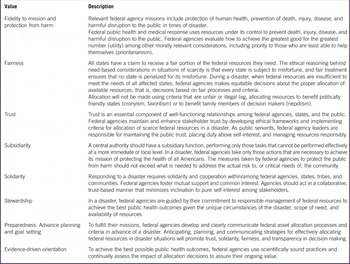
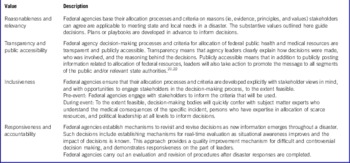
Substantive values are strongly held ethical ideals that inform decisions and actions (ie, decisions and actions about what is right or should be done in the face of uncertainty or conflict). 8 The substantive values the work group identified are shown in Table 1. Because consensus on substantive ethical principles is often difficult to achieve, it is generally recognized that scarce resource allocation decisions must also be based on fair procedures. Such procedures help ensure that even when agreement is not unanimous regarding the allocation decisions themselves, stakeholders will recognize that the decisions resulted from processes that are open, reasonable, inclusive, and fair. Procedural values, therefore, are ethical ideals that promote and can be used to evaluate the fairness of a process for decision making under uncertainty or conflict. Ensuring a procedurally fair process is important precisely because stakeholders may differ about substantive values. The procedural values that the work group identified are shown in Table 2.
Substantive Values to Guide Allocation Decisions in Disaster Situations 5 , 8 , Reference Persad, Wertheimer and Emanuel 9 , Reference Vawter, Garrett and Gervais 11 , 13 - Reference Roberts and DeRenzo 15

Procedural Values to Guide Allocation Decisions in Disaster Situations 5 , 8 , Reference Persad, Wertheimer and Emanuel 9 , Reference Vawter, Garrett and Gervais 11 , 13 - Reference Roberts and DeRenzo 15

Concepts Consistent With the Principle of Federalism
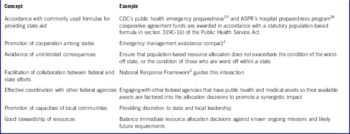
Along with these substantive and procedural values, guidelines for fair allocation of federal resources should take into account political theories about federalism—the division of sovereign authority among levels of government. 21 As described in Table 3, federal leaders should apportion resources to disaster-affected states in a manner that takes into account features of a well-functioning federal system. 22
Concepts Consistent with the Principle of Federalism 1 , 2 , Reference Buchanan 23 , 24

Abbreviations: ASPR, Assistant Secretary for Preparedness and Response; CDC, Centers for Diseases Control and Prevention.
To support states, federal leaders should recognize the role and perspective of state leaders, as they are likely to be best informed about their situations. At the same time, federal leaders are likely to be able to compare the relative needs when several states make requests for assistance. Given this complex reality, both state and federal governments have valuable perspectives to offer regarding the amount of resources that each state needs to respond to a disaster and the amount that the federal government should offer in assistance. Accordingly, the decision about the amount of scarce resources to be given to each state should consider that states with the greatest needs may experience a reduced ability to govern and communicate and, therefore, may submit requests after states with lesser needs.
Recognizing the important partnership between federal and state leaders in addressing disasters most effectively, the National Response Framework specifies that operational planning needs to integrate federal departments and agencies and other national-level partners to provide the right resources at the right time to support state response operations. 2
Allocation Criteria and Scoring System
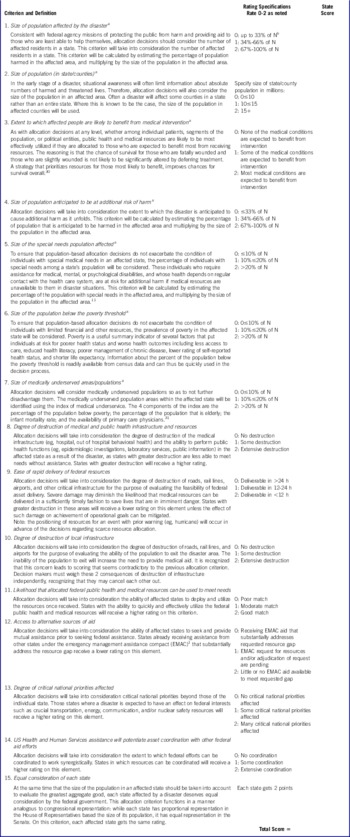
The substantive and procedural values and concepts consistent with the principle of federalism provided the basis for 15 allocation criteria that the work group proposed federal decision makers might use to guide decisions regarding allocation of scarce federal public health and medical resources. The criteria and their definitions are summarized in Table 4. Initially, the work group assigned equal weight to each of the criteria and applied a scoring system to quantify the criteria and to provide a rigorous approach to the allocation decisions. With use of the scoring system, each affected state would be evaluated according to the 15 allocation criteria on a scale of 0 to 2, to produce a total score for each state. Prioritizing among states would be based on the total score each state received when assessed against all 15 criteria. States would not be compared with one another according to any individual criterion. The rating specifications and scoring are also shown in Table 4.
Criteria, Rating Specifications and ScoringReference Danis, Hansen and Knebel 27 - Reference Sharpe, Danis and Knebel 29

aFor all population-based criteria (1 to 7), decision makers should use a consistent approach (either state or county data) in scoring.
bN = number of people in state/county.
Stakeholder Engagement Workshops
We presented the criteria and the scoring system to stakeholders to test the validity of the proposed approach to federal resource allocation decision making. The engagements included the following groups: (1) disaster preparedness and emergency management experts attending the annual Integrated Medical, Public Health, Preparedness and Response Training Summit (ITS)Reference Danis, Hansen and Knebel 27 ; bioethicists attending the annual meeting of the American Society for Bioethics and Humanities (ASBH)Reference Sharpe, Danis and Knebel 29 ; and attendees of the National Institutes of Health (NIH) Bioethics Interest Group.Reference Danis, Sharpe and Knebel 28
Approximately 130 disaster response experts participating in the ITSReference Danis, Hansen and Knebel 27 chose to attend a breakout session in which the allocation framework was discussed. Participants were asked to rate, using audience response technology, each of the allocation criteria on a 5-point Likert scale ranging from “extremely important,” to “not important, can be eliminated.” Six criteria (1,3,8,10-12) had the highest percentage of people who ranked them as extremely important, very important, or important (Table 4). The attendees also rated 2 of the criteria (9 and 15) as unimportant and could be eliminated (Table 4). The remaining criteria received ratings of moderate importance. These findings support the face validity of most of the criteria among disaster response experts. Open-ended comments supported the finding that the respondents thought that some criteria were more important than others, suggesting that the criteria should not be weighted equally.
The engagements with the ASBH and the NIH Bioethics Interest Group used a discussion format, rather than audience-response technology. During the workshops, we provided the background of the problem and the proposed framework and a hypothetical disaster scenario to focus the discussion of the criteria and asked participants to deliberate about the following:
-
• the usability and acceptability of the allocation criteria
-
• whether any other criteria should be added
-
• the utility of the proposed scoring system.
Participants at both of these meetings commented that the framework provided ethically useful guideposts for allocating scarce federal resources and that the criteria reflected the procedural and substantive values relevant to ethical disaster planning and response. However, many respondents also found the criteria to be vague or cumbersome to apply in the context of the hypothetical disaster scenario. They also found the criteria difficult to apply when the data needed to score them were not available. Some agreed with the stakeholders from the ITS and suggested that the criteria should not be weighted equally.
Logic Model
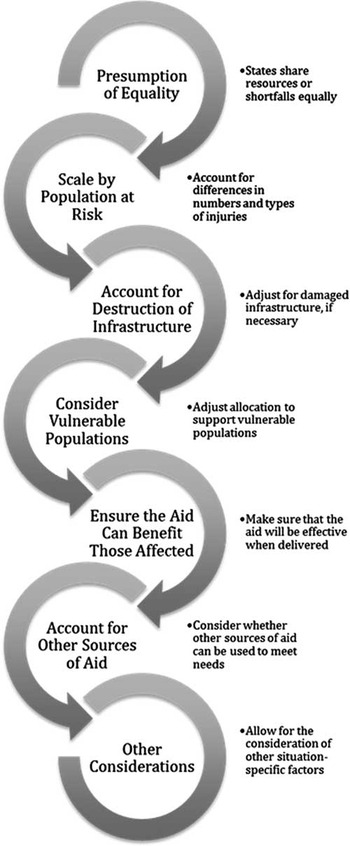
Following these stakeholder engagements, we consulted the analytic decision support group of the Biomedical Advanced Research and Development Authority (BARDA) regarding next steps in the development of the framework, given their expertise in modeling allocation decision making. The BARDA group proposed a logic model to illustrate the decision-making process using the criteria proposed in the original framework (Figure). One difference, however, is that while the original criteria were focused on specific resources, the logic model can be applied to specific resources or to resources more generally. The logic model combines a number of the original criteria and focuses on a qualitative rather than a quantitative approach.
Logic Model Original work developed in collaboration with modeling experts from the Analytic Decision Support Group, Biomedical Advanced Research and Development Authority, US Department of Health and Human Services, Office of the Assistant Secretary for Preparedness and Response (Appendix).

Moreover, the logic model retains the criteria identified in the original framework, which stakeholders agreed were ethically relevant, but organizes the criteria in the form of a decision procedure that may be easier to employ. In this approach, the logic model addresses the concern raised by stakeholders that quantitative scoring of the criteria was cumbersome and that it was difficult to use when situational awareness is limited. It also addresses concerns raised by the BARDA group that a quantitative approach implies a level of precision that is not possible in this type of decision making. The logic model's qualitative approach does not attribute equal weight to the criteria; instead, it allows decision makers to weight relevant criteria differently, as appropriate to the circumstances of the disaster.
The logic model starts with the presumption of equal allocation, which is a modification of criterion 15 from the original framework that specified equal consideration for each state. The presumption is that all affected states are entitled to the same allocation of the scarce federal resources under the same circumstances. This provisional allocation may indicate that each state gets the same amount of the resource or that each state's request is reduced by the same amount. If sufficient differences in need occur, rendering an equal allocation of the scarce resource unfair, then the provisional allocation should be modified based on the considerations in subsequent steps of the logic model. Federal decision makers would continue to the next steps in the logic model for needed refinements to equal allocation.
At the second step of the logic model, decision makers modify the provisional allocation according to the population at risk. This step combines criteria 1 through 4 from the original framework. While the scarce resource need not be allocated solely based on the number of people affected by the disaster, the need for the resource and the potential for the resource to benefit people are both highly correlated with the number of people affected. The types and severity of injuries and the potential for follow-on injuries are both legitimate considerations for allocating the resources. Different types of scarce resources do not need to be equally distributed if it would produce an unfair or inefficient allocation. For example, if a state has a high number of burn injuries while another has a large number of crush injuries, assigning each state an equal number of burn and crush injury teams would not be helpful or ethical. If no meaningful difference in the population at risk is found in the affected states, no adjustment to the provisional allocation is needed at this step.
At the third step of the logic model, decision makers will make modifications to account for destruction of infrastructure (including critical infrastructure and key resources). This step combines criteria 8 and 10 from the original framework and adds critical infrastructure and key resources that have a local impact. For example, if a nuclear power plant is damaged during an earthquake, local impact will occur from radiation exposure; also, national implications will arise because of decreased energy production. If no meaningful difference is found in the degree of destruction of infrastructure between states, then no adjustment to the provisional allocation is needed at this step.
The fourth step of the logic model considers vulnerable populations. In the original framework, criteria 5 through 7 considered special needs populations. With the logic model the language was changed to vulnerable populations to align terminology with existing guidance. 32 If the difference in vulnerable populations is significant between different states, the allocation of the scarce resources may need to be adjusted to make the allocation more equitable. Potential vulnerable populations may include, but are not limited to, the following:
-
• Individuals with pre-existing access needs or functional, medical, mental health, or psychological needs for care, treatment, or pharmaceuticals, 32
-
• Segments of the population below the poverty threshold, and
-
• Medically underserved populations.
If no meaningful difference in vulnerable populations exists among the states, no adjustment is needed to the provisional allocation at this step.
The fifth step in the logic model considers whether the scarce resource is likely to benefit those affected. This step combines criteria 9 and 11 from the original framework. Because the purpose of resource allocation is to help those affected by the disaster, the resources that are provided must be pertinent to the local conditions. If local conditions prevent a scarce resource from being effectively delivered or used due to destruction of required infrastructure, damage to transportation networks that negates the ability of the aid to arrive in a timely manner, or other conditions that render the aid unhelpful, then the provisional allocation must be adjusted so the scarce resource can be sent and used effectively elsewhere. As an example, medical teams that are meant to augment hospitals may not be used effectively if the hospitals are severely damaged. In that circumstance, the teams may be better deployed to a state that can use this scarce resource more effectively. A separate determination would need to be made about whether self-sufficient medical teams are available for deployment to the state that suffered destruction of its hospitals. In making this assessment, federal leaders acknowledge the perceptions and perspectives of state leaders regarding their needs by taking into consideration state requests.
The sixth step of the logic model accounts for the availability of other sources of aid, combining criteria 12 and 14 from the original framework. Federal agencies do not provide aid in a vacuum. When a particular federal resource or resources more generally are scarce, the allocation decision should take into account other aid being made available to affected states. If a state has an internal or other non-federal source for the needed capability, the state's need for the federal resource is decreased. In this case, it would be fairer to decrease the amount of the resource provided to that state and increase the allocation to states that do not have an external source of aid.
The last step of the logic model addresses other considerations (including critical national priorities), which is criterion number 13 in the original framework. These considerations may include White House policies, statutes, regulations, and critical infrastructures and key resources. Examples include presidential direction with regard to international evacuation; legislation regarding spending of disaster relief dollars; US Food and Drug Administration regulations with regard to international donations of food and medications; and damage to critical infrastructures that do not have a local public health and medical impact but could have national implications such as a data center that supports financial services. When analyzing their decisions, federal decision makers should consider factors that have not yet been addressed. If the allocation resulting from the 6 previous steps appears unfair, given such considerations, it should be revised.
Conclusions and Implications
This framework seeks to provide an ethical approach for strategic decision making regarding allocation of scarce public health and medical resources to affected states. This allocation framework begins to resolve a gap that was identified during the 2011 national-level exercise that used a New Madrid seismic zone earthquake scenario. It was noted that there was and still is no, “…system that would verify and protect resources for dissemination [sic], based on a prioritization scale.” Thus, it was recommended that ASPR, “Develop a system to ensure resources are not overly disseminated [sic] to jurisdictions, states, or regions based solely on their ability to communicate easier [sic] than harder hit areas.” 33
Allocation of federal public health and medical resources is different from the crisis standards of care framework developed in 2009 by the Institute of Medicine (IOM) at the request of the ASPR. 20 The IOM work was motivated by the potential for the influenza A (H1N1) pandemic to reach a severity comparable to the catastrophic Spanish influenza pandemic of 1918, and it focused on “…adjusting practice standards” and “…shifting the balance of ethical concerns to emphasize the needs of the community rather than the needs of individuals”. 20 While the IOM framework focuses on the shift in clinical practice from individual patients to the larger community of persons affected by the disaster, the focus of the modified framework provided here is the development of a well-reasoned ethical basis for resource allocation in a multitiered government such as the US federal system.
The 15 allocation criteria that were proposed in the original framework developed by the working group drew on well-established substantive and procedural values in medical ethics and concepts consistent with the principle of federalism. The working group then developed a scoring system based on the criteria. During engagement with disaster preparedness and emergency management experts and bioethicists, it was generally acknowledged that in disaster situations precise information would not be available to decision makers. As a result, using a mathematical formula as a basis for allocations would not be defensible, as it would imply that the process relied on precise calculations rather than on judgment informed by the best available information. By contrast, the logic model incorporates the values-based framework into an iterative decision process that can inform the gestalt of federal decision makers. Although the logic model was developed to apply to decisions regarding allocation of specific scarce resources (where decision makers know that particular resources are insufficient to meet needs), decision makers can also use the framework and logic model to make decisions about fair allocation of resources in general, regardless of whether a particular resource is scarce.