Introduction
Small populations have an increased risk of extinction due to genetic, environmental and demographic stochasticity (Frankham, Ballou and Briscoe, Reference Frankham, Ballou and Briscoe2009; Allendorf, Luikart and Aitkin, Reference Allendorf, Luikart and Aitkin2012). Genetic challenges for small populations include increased homozygosity due to inbreeding, which may lead to inbreeding depression, and genetic drift which reduce genetic variation within populations (Demontis et al., Reference Demontis, Larsen, Baekgaard, Sonderup, Hansen, Nielsen, Loeschcke, Zalewski, Zalewska and Pertoldi2011; Kristensen et al., Reference Kristensen, Hoffmann, Pertoldi and Stronen2015). Because genetic drift is a stochastic process, which is affected by demographic changes, catastrophes, and environmental variation, the outcome can only be simulated (Shaffer, Reference Shaffer and Soulé1987; Mills and Allendorf, Reference Mills and Allendorf1996; Frankham, Ballou and Briscoe, Reference Frankham, Ballou and Briscoe2009; Allendorf, Luikart and Aitkin, Reference Allendorf, Luikart and Aitkin2012). Livestock breeds often have low effective population sizes (N E) and inbreeding depression is commonly observed (Kristensen and Sørensen, Reference Kristensen and Sørensen2005; Leroy et al., Reference Leroy, Mary-Huard, Verrier, Danvy, Charvolin and Danchin-Burge2013). Developments in reproductive technologies, such as artificial insemination, have accelerated the reductions of N E within many domestic breeds, e.g. because these technologies have led to highly skewed sex ratios with many more females than males in the populations (Hiemstra et al., Reference Hiemstra, De Haas, Mäki-Tanila and Gandini2010). The purpose of this study is to use a population viability analysis (PVA) as a tool to predict the possible future of a population of an endangered native breed, the Jutland cattle (Bos taurus) from Denmark. The Jutland cattle breed originated from the Grey and Black Pied cattle, which was widespread in Jutland (Danish peninsula), Denmark, from the Middle ages until the 19th century (Brüniche-Olsen, Gravlund and Lorenzen, Reference Brüniche-Olsen, Gravlund and Lorenzen2012). This breed has since experienced a dramatic decline in population size because other dairy cattle breeds, such as Jersey and Holstein–Friesian, are more productive and therefore preferred by farmers. Only a few farmers have kept the original Jutland cattle. Today the breed consists of a few populations, one named the Kortegaard population, which is investigated in this project. The impact of changes in the breeding scheme on the population will be investigated, and, based on the results, practices expected to increase the long-term survival probabilities of this, and likely other small populations of domestic animals, will be suggested.
Materials and methods
Population viability analysis
A database created by the Danish Veterinary and Food Administration (available at chr.fvst.dk) provided data on the individual cattle from the entire Kortegaard population. The demographic data were collected from the database and the farmers. The data include: the number of individuals, the age of living individuals, dates of birth and death, the age of females when calving, the average age of reproduction, the number of males in the breeding pool, the average number of offspring per male, and the level of allowed kinship between male and female when breeding. These data were used to construct a PVA.
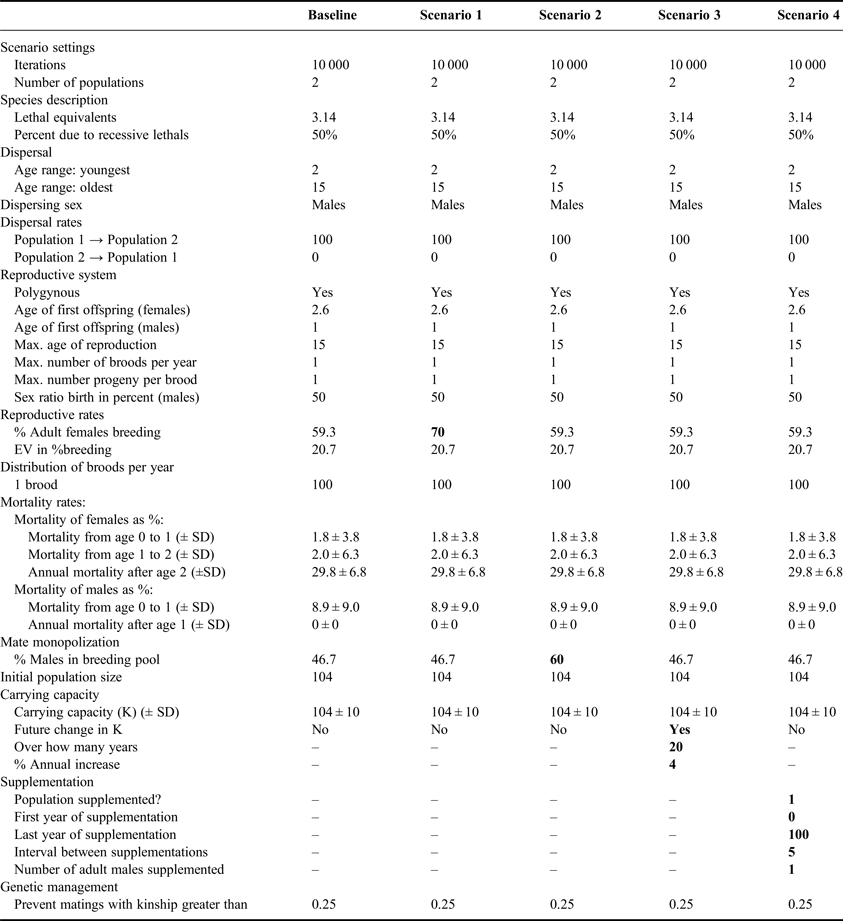
Different software can be used for making a PVA and one is Vortex, a program developed by Chicago Zoological Society, and Vortex version 9.999 was employed in this project (Miller and Lacy, Reference Miller and Lacy2005). Vortex uses a stochastic model, and the demographic variables needed to run the simulation can be found in Vortex's user's manual and in Table 1 (Miller and Lacy, Reference Miller and Lacy2005).
Conditions and basic parameters for the simulations on the Kortegaard herd of Jutland cattle in Vortex.

Conditions and basic parameters for the Kortegaard herd of Jutland cattle for simulations in Vortex 9.999. “Baseline” is the continuation of the current way of breeding, “Scenario 1” includes increased percentage of the females in the breeding pool, “Scenario 2” includes increased percentage of the males in the breeding pool, “Scenario 3” includes increased carrying capacity, and “Scenario 4” includes supplementation of cryopreserved semen to the population.
The bold values are to highlight the values that are different in the scenarios compared to Baseline.
Parameters
The age categories are denoted age 1, age 2, age 3 and so forth, which are equivalent to 0–1 year, 1–2 years and 2–3 years, respectively (Miller and Lacy, Reference Miller and Lacy2005). The inserted values represent the current population. The carrying capacity and initial population size were set to 104, equal to the population size of the Kortegaard population at the time of the study. In the simulations, the population is characterized by a polygynous mating system because males can mate with several females each year. Values for the different parameters can be found in Table 1.
Demographic parameters
A female typically becomes sexually mature when approximately 1 year old (Nowak, Reference Nowak1999). Though, based on data from cattle born in year 2001–2010, a calculated average showed that females of Jutland cattle calve for the first time at the age of 30 months after nine months of gestation. If allowed, females reproduce until around age 12 years; however, there are examples of Jutland cattle reproducing at age 15 (Nowak, Reference Nowak1999). Females active in the breeding pool normally produce one calf per year (twins are rare) after a successful mating. Abortions and twin births were not taken into consideration in the simulations. The sex ratio of born calves is approximately 50:50, but more females than males enter the breeding pool because most males are slaughtered or castrated before they reproduce. From 2001 to 2010 the average percentage of females being active in the breeding pool was estimated to 59.3 percent. This corresponds to approximately 27 females out of a total of 46 sexually mature females in the current breeding scheme. Males enter the breeding pool when 1–2 years old. In theory, males can reproduce their whole life, but on average they only sire six to seven calves in the population. This was taken into account in the simulations by using the function “Dispersal” and letting all males older than 2 years migrate without the ability to return. A composed matrix forced males older than 2 years to migrate from populations 1 to 2 (a fictive population made for this purpose), but the probability of dispersal from populations 2 to 1 was set to 0 percent (Miller and Lacy, Reference Miller and Lacy2005). Occasionally a male is used several years and is therefore older than 2 years before castration or slaughter, but this happens rarely and was thus not included in the simulations. At the time this study was performed the population consisted of 15 reproductively active males including four steers, and these make out the potential breeding pool. The steers were included in the calculations of the percentage of males active in the breeding pool, since they have reached the age of sexual maturity, and Vortex cannot differentiate between steers and bulls. Of the 15 males, seven were selected for breeding in 2013, and therefore it was estimated that only 46.7 percent of the males were active in the breeding pool.
Mortality rates for females were calculated from data gathered from females born from 2001 to 2010, by taking the numbers of deaths amongst the 0–1 and 1–2 years old females plus the annual percentage of deaths among individuals older than 2 years. The same method was used to estimate mortality rates for males, where the numbers of deaths amongst the 0–1-year-old males as well as the annual percentage of deaths among individuals older than 1 year were calculated.
Environmental variation
Vortex utilizes the environmental variation as the annual differences in the prospects of reproduction and survival due to stochastic changes in the environment (Miller and Lacy, Reference Miller and Lacy2005). Since this domestic population is reared in a controlled environment, “Environmental variation” is not a relevant parameter for these scenarios. The likelihood of a domestic cattle breed being struck by diseases or other catastrophes is low because of veterinary treatment and because natural disasters are rare in Denmark. Therefore “Catastrophes” were not taken into consideration.
Inbreeding and genetic management
The loss of genetic diversity is expressed as the rate of inbreeding in both wildlife and domestic populations (Hartl and Clark, Reference Hartl and Clark1989). This category in Vortex is primarily used for populations under management or in captivity, where the breeding can be controlled (Miller and Lacy, Reference Miller and Lacy2005). Lethal equivalents per diploid genome were set to 3.14, as this is the median value observed from a population study of 40 captive vertebrates (Ralls, Ballou and Templeton, Reference Ralls, Ballou and Templeton1988). The number of lethal equivalents determines the severity of inbreeding depression (Miller and Lacy, Reference Miller and Lacy2005).
Under “Genetic management” matings between closely related individuals can be prevented and the coefficient was set to 0.25, because offspring/parent and full sibling mating are avoided. It must be considered that livestock breeding often has a greater degree of inbreeding compared with wildlife populations (Lacy, Reference Lacy1993). Inbreeding may not have the same effect on domestic and wild populations, e.g. because the domestic populations may tolerate greater levels of inbreeding due to controlled and benign environmental conditions (Reed et al., Reference Reed, Fox, Enders and Kristensen2012; Kristensen et al., Reference Kristensen, Hoffmann, Pertoldi and Stronen2015). Therefore, the inbreeding coefficient; F = 0.25 was used for this population, although lower values are normally used when investigating wild populations (Lacy, Reference Lacy1997; Allendorf and Ryman, Reference Allendorf, Ryman, Beissinger and McCullough2002).
Scenarios
Four scenarios were made to simulate the future of the Kortegaard population under different breeding strategies.
Baseline: A continuation of the current breeding practice.
Scenario 1: The percentage of the total number of females active in the breeding pool was increased from 59.3 to 70 percent per year.
Scenario 2: The percentage of the total number of males active in the breeding pool was increased from 46.7 to 60 percent per year.
Scenario 3: The carrying capacity was set to increase with 4 percent per year over a period of 20 years.
Scenario 4: Supplementing one male to the population every 5 years representing use of cryopreserved semen from bulls from previous generations. By using “Optional criteria of supplementation” the supplemented individual will have a certain relation to the population. The allowed kinship between the supplemented males and the population was set to 0.125–0.25.
Furthermore, combinations of the different scenarios were investigated.
Results
The results of the study suggest that the Kortegaard population will go extinct after 122 years if the current breeding practice continues (represented as Baseline). The higher the level of inbreeding the lower the reproductive fitness, but the extinction is due to too few sufficiently unrelated individuals. However, the results also show that the chances of survival can be increased by changing aspects of the breeding practices (Figure 1a). With an increase of females active in the breeding pool from 59.3 to 70 percent of all available females (Scenario 1), the population reaches extinction after 126 years and the population size is more stable compared with Baseline. When increasing the number of males active in the breeding pool from 46.7 to 60 percent (Scenario 2) the population is predicted to go extinct after 136 years. Increasing the carrying capacity annually by 4 percent over the course of 20 years (Scenario 3) results in an increase in the population size for 25 years, after which the population size decreases and reaches extinction after 189 years. The investigated increases in the number of females and males in the breeding pool, as well as the carrying capacity, are selected based on trial simulations in which these percentages showed the best outcome compared with the farmers' effort. The level of inbreeding shows the same tendencies; the lower the pace of increase, the later the population reaches extinction (Figure 1b). The population goes extinct when the level of inbreeding reaches 0.25 because that is the chosen limit for allowed kinship between mating individuals in Vortex. By supplementing one male to the population every 5 years (Scenario 4) the time of extinction is postponed considerably, but the population size is constantly decreasing (Figure 2a). Trial simulations with different intervals of supplementation of different numbers of males to the existing cattle population have been made and show a decrease in the level of inbreeding compared with Baseline with such practices. These simulations show that fewer supplementations with short intervals result in a slower increase in the level of inbreeding than many supplementations with longer intervals, which formed the foundation for the selected supplementation regime. Scenario 4 shows a different development in the level of inbreeding compared with the other scenarios because it never reaches the set limit of 0.25, and the population instead reaches extinction due to the birth rate being lower than the mortality rate (which both are based on the current breeding scheme), i.e. the number of individuals dying each year is greater than the number of individuals being born (Figure 2b).
The number of individuals (a) and the level of inbreeding (b) in the Kortegaard herd of Jutland cattle according to simulations in Vortex 9.999. “Baseline” is the continuation of the current way of breeding, “Scenario 1” includes increased percentage of the females in the breeding pool, “Scenario 2” includes increased percentage of the males in the breeding pool, and “Scenario 3” includes increased carrying capacity.

The number of individuals (a) and the level of inbreeding (b) in the Kortegaard herd of Jutland cattle according to simulations in Vortex 9.999. “Baseline” is the continuation of the current way of breeding, “Scenario 1” includes increased percentage of the females in the breeding pool, “Scenario 2” includes increased percentage of the males in the breeding pool, and “Scenario 4” includes supplementation with cryopreserved semen.

By combining the different scenarios the population becomes more stable and the time of extinction is postponed (Figure 1a). The combination that results in the largest population size and longest survival, without supplementation, is the combination of Scenarios 1, 2 and 3. This combination results in the number of individuals increasing for 25 years, the population size being more stable compared with Baseline, and the population reaches extinction after 221 years (Figure 1a). The best outcome is achieved by combining Scenarios 1, 2 and 4, which results in stabilization of the population size, and after 2 000 years the population has only decreased from 104 to 77 individuals (Figure 2a).
Discussion
The results presented in this study suggest that long-term survival of a small, managed population can be improved even with relatively small changes to the current breeding practices. It seems that an increase in the number of females in the breeding pool (Scenario 1) makes no significant difference when looking at the level of inbreeding in the population. However, a small increase in the number of females in the breeding pool has a positive effect on the growth rate, which has also been observed in other studies on domestic animals (Thirstrup et al., Reference Thirstrup, Bach, Loeschcke and Pertoldi2009).
The growth rate does not change significantly when adding more males to the breeding pool (Scenario 2), but more males do lead to a postponement of the year of extinction, as the limit of allowed kinship is reached later when more males are active in the breeding pool. When comparing the effect on inbreeding by increased number of females in the breeding pool to increased number of males, the effect is greater when changing the latter. Hence, it seems that the number of females in the breeding pool limits the number of individuals, and thus the population size, whereas males limit the genetic diversity.
Raising the carrying capacity each year over a course of 20 years (Scenario 3) results in an increase in population size over this period, and thereafter the population size declines at the same rate as seen in Baseline. Pilot simulations (data not presented) showed that there is a constant relation between the percentage change and the outcome, and, therefore, the farmers can decide to raise their carrying capacity with what fits their needs, accommodations and funds. Increasing the carrying capacity with 4 percent each year over a period of 20 years and also changing the number of either females or males in the breeding pool, results in the same development of population size as seen in the individual scenarios. However, there is an increase in the population size during the first 25 years, which results in a postponed extinction. Compared with Baseline, the combination of increasing the carrying capacity and the number of females in the breeding pool (Scenario 1 + 3) gains fewer years than the combination of increasing the carrying capacity and the number of males in the breeding pool (Scenario 2 + 3). This difference is, as previously mentioned, because the males are the limiting factor when finding suitable matings within the allowed limits of kinship. This is also reflected in the level of inbreeding because the rate at which the level of inbreeding increases is slower in the combination of Scenarios 2 and 3 than the combination of Scenarios 1 and 3. As the growth rate for Scenario 1 + 3 declines less rapidly, it can be argued that even though the population survives for a longer period in Scenario 2 + 3, Scenario 1 + 3 is more beneficial. A combination of Scenario 1, 2, and 3 shows a cumulative effect resulting in both a more stable population size and a greater postponement of the population's extinction.
To increase the chances of long-term survival of the population, we also suggest supplementing the gene pool with cryopreserved semen. It is possible to cryopreserve spermatozoa from cattle and store it in a gene bank until use (Curry, Reference Curry2000). In this manner, farmers can raise the carrying capacity artificially, without actually expanding the in situ population and still supply genetic material from less related earlier generations of animals. The simulations in this study are based on supplementing one male every 5 years, representing cryopreserved semen from related bulls from previous generations, but it may also be considered to utilize cryopreserved oocytes or embryos (Su et al., Reference Su, Yang, He, Li, Ma, Wang, Presicce and Ji2012). According to the simulation (Scenario 4), the population survives for 2 000 years with supplementation of one male every 5 years, although the population size decreases over the years. If this supplementation is combined with Scenarios 1 and 2, then the population size can be almost stabilized. As prior males will be less related, the population's genetic diversity will be increased at each supplementation and thereby keep the inbreeding at a lower level.
For both Scenario 4 and the combination of Scenarios 1, 2 and 4 the level of inbreeding stabilizes around 0.20. The population size still decreases over the years and is not due to an insufficient number of suitable matings, but due to the birth rate being lower than the mortality rate, as previously mentioned. However, this might be avoided if the farmers are made aware of the problem. To lower the mortality rate it is necessary to increase the carrying capacity in order to avoid slaughtering as many individuals each year as is the case with the current breeding scheme. The increase should not be temporary as suggested with Scenario 3 nor artificial as suggested with Scenario 4. A possible approach to obtain a greater carrying capacity in the future is to use the cattle for sustainable nature management and restoration. The investigated breed, Jutland cattle, has been suggested to be suitable for nature management due to its unique ability to graze efficiently on vegetation often avoided by other breeds, and thereby preserving certain natural environments, e.g. heaths and meadows (Ejrnæs and Buttenschøn, Reference Ejrnæs, Buttenschøn and Meltofte2012). This can increase the biodiversity of e.g. plants and insects significantly in the area in question (García et al., Reference García, Fraser, Celaya, Ferreira, García and Osoro2013).
It is important to bear in mind that the presented results are simulations, and thus, do not necessarily depict reality (Beissinger and Westphal, Reference Beissinger and Westphal1998). It would have been ideal to compose a pedigree for the population, but it was not possible due to shortage of registrations. Complete pedigrees would have enabled Vortex to estimate a more accurate degree of inbreeding and thereby generate more precise results. However, even without a pedigree, a PVA can still be used to assess the optimal breeding scheme. The results of this study are too optimistic, because it was assumed that all the individuals are unrelated at the starting point of the simulation. A study by Pertoldi et al. (Reference Pertoldi, Purfield, Berg, Jensen, Bach, Vingborg and Kristensen2014) showed that the population is indeed inbred and has a low effective population size. Furthermore, Vortex is created for simulations on wild populations, and therefore, lacks possibilities for advanced adjustments suitable when working with domesticated populations (Miller and Lacy, Reference Miller and Lacy2005). Because of these uncertainties and limitations, the simulations presented cannot be used for determining the precise time of extinction, but rather for the purpose of assessing effective and realistic ways to manage the Kortegaard population and other endangered breeds or species.
Conclusions
Based on the results it can be concluded that there are several possibilities to increase the chance of long-term survival of the Kortegaard population of Jutland cattle. All tested adjustments lead to postponement of extinction. The number and combination of changes applied to the current breeding practices can be selected from what is possible both economically and practically. Generally, the more parameters adjusted and the greater adjustments, the greater effect on the outcome. The results suggest that the most positive outcome of the simulations will secure the population for at least 2 000 years. Even if supplementation is not economically or practically possible, the population's chance of survival can be increased by almost 100 years by increasing the number of females and males active in the breeding pool from 59.3 to 70 percent and from 46.7 to 60 percent, respectively, and increasing the carrying capacity by 4 percent annually over a period of 20 years. Considering the fact that the Kortegaard population is a small population, this is a major improvement. Similar studies can be made for other small populations, both domestic and captive, to optimize their breeding scheme.
Acknowledgements
CP was financially supported by the Danish Natural Science Research Council (grant numbers: 11-103926, 09-065999 and 95095995), the Carlsberg Foundation (grant number: 2011-01-0059) and the Aalborg Zoo Conservation Foundation (AZCF). TNK was financially supported by the Ministry of Food, Agriculture and Fisheries (grant number: 14-32640-000017). AVS was financially supported by the Danish Natural Science Research Council (postdoctoral grant 1337-00007). A special thanks to two anonymous reviewers for their helpful comments on the manuscript. We thank the farmers Holger Jessen, Jakob Kortegaard, Ole Mols, Louise Lemche, Kirsten Larsen, Simon Wiesner and Randers Regnskov, for their cooperation and supply of data on their cattle.