Significant outcome
-
∙ We demonstrated a deficit in ToM and EF in a group of patients with EOS aged less than 17 years.
Limitation
-
∙ The lack of intelligence quotient assessment and small size of our sample are limitations of our study.
Introduction
Schizophrenia is a mental disorder characterised by a wide spectrum of symptoms, including delusions, hallucinations, disturbance of thought processes and deterioration of social behaviours; its prevalence is about 1% (Reference Regier, Narrow, Rae, Manderscheid, Locke and Goodwin1). Early-onset schizophrenia (EOS) is defined as schizophrenia that arises before 18 years of age (Reference Mcclellan and Werry2). Its prevalence is 50 times lower than that of adult-onset schizophrenia (AOS; Reference Karno and Norquist3). Compared with AOS, EOS is typified by prominent negative symptoms and disorganisation (Reference Bellino, Rocca and Patria4,Reference Sato, Bottlender, Schroter and Moller5), a worse prognosis and a poorer response to treatment (Reference Mcclellan and Werry2–Reference Schurhoff, Bellivier and Jouvent6).
Patients with schizophrenia is characterised by a social cognition deficit in which involving theory-of-mind (ToM) impairment (Reference Green, Horan and Lee7). ToM is defined as the ability of human beings to mentalise about themselves and others. By understanding the intentions of others – their beliefs, thoughts and feelings – humans can predict how they will behave and modify their own behaviour accordingly. Children develop ToM abilities gradually. A crucial stage in their evolution occurs at 4 years of age, when children realise that the thoughts in their mind may not be true. They reach the second stage of ToM at 7 years of age, when they become able to assign to a person beliefs about the thoughts of another (Reference Korkmaz8). A deficit in this ability is evident in patients with disorders, which supports the developmental theory such as schizophrenia, especially EOS. Indeed, ToM deficits are stable and specific to schizophrenia (Reference Sprong, Schohorst and VOS9), with an effect size of between −0.72 and −1.44 depending on the method of evaluation used. Only one study (Reference Pilowsky, Yirmiya, Arbelle and Mozes10) has assessed ToM in adolescents with EOS (n=12) in comparison with autistic participants and typically developing children (TDC): the patients with EOS performed worse than the normally developing children. ToM deficits depend on schizophrenic symptoms in patients with AOS and a correlation exists between mentalising deficits and positive symptoms (Reference Russell, Reynaud, Herba, Morris and Corcoran11,Reference Koelkebeck, Pedersen, Suslow, Kueppers, Arolt and Ohrmann12). However, disorganised and undifferentiated symptoms are found more frequently in patients with EOS than in those with AOS (Reference Nora, Neva and Basant13), which raises the question of whether their severity influences ToM deficits. Some authors report that lower age at onset is associated with greater cognitive deficits (Reference Basso, Nasrallah, Olson and Bornstein14–Reference Rajji, Ismail and Mulsant16). Executive functions (EF) are a set of cognitive processes that regulate, control and manage other cognitive processes and that are involved in planning and controlling goal-directed behaviours, such as working memory, attention, problem solving, verbal reasoning, inhibition, mental flexibility, task switching and initiation and monitoring of actions (Reference Zelazo, Carter, Reznick and Frye17).
Several studies (Reference Carlson, Mandell and Williams18–Reference Hughes and Ensor24) have shown that EF and ToM are significantly correlated in TDC. In a meta-analysis, Perner and Lang (Reference Perner and Lang25) reported that the average correlation between the understanding of false beliefs and EF has a strong effect size (d=1.08). This significant correlation persists after controlling for age, verbal ability and general cognitive abilities (Reference Carlson, Mandell and Williams18,Reference Frye, Zelazo and Palfai21,Reference Perner, Lang and Kloo26). These correlations also persist in different cultures (Reference Chasiotis, Kiessling, Hofer and Campos27). However, the relationship between ToM and EF in patients with schizophrenia remains controversial. A systematic review by Pickup (Reference Pickup28) showed that these two dimensions are independent, whereas a meta-analysis by Bora et al. (Reference Bora, Yucel and Pantelis29) found a correlation between them. Langdon et al. (Reference Langdon, Coltheart, Ward and Catts30) stated that ToM deficits in patients with schizophrenia reflect an executive dysfunction with a failure to inhibit information or an inability to manipulate representations of hypothetical situations to perform appropriate reasoning on the beliefs of others. Koelkebeck et al. (Reference Koelkebeck, Pedersen, Suslow, Kueppers, Arolt and Ohrmann12) demonstrated a significant correlation between ToM and cognitive flexibility deficits, whereas others have not (Reference Bozikas, Giannakou and Kosmidis31,Reference Fine, Lumsden and Blair32).
Aims of this study
The aims of the study were: first, to demonstrate a ToM deficit in patients with EOS using a nonverbal paradigm – The Moving Shapes Paradigm; and second, to determine which factors involved in symptom intensity and EF deficits (specifically, in flexibility and visuospatial inhibition) are able to influence ToM abilities.
Materials and methods
Participants
Our study was conducted in the Child and Adolescent Psychiatry Department at Razi Hospital, Manouba, Tunisia. We enrolled patients aged up to 17 years suffering from EOS (according to the criteria of the Diagnostic and Statistical Manual of Mental Disorders (DSM IV) (33). The exclusion criteria were: neurological diseases; known somatic disorders; genetic syndromes; uncorrected visual or hearing problems; a past diagnosis of pervasive developmental disorders (33); and substance abuse.
In accordance with the Declaration of Helsinki, patients’ parents gave written informed consent for their participation and the patients were verbally informed about their participation in the study. The Kiddie Schedule for Schizophrenia and Affective Disorders Present and Lifetime Version (K-SADS-PL) (Reference Kaufman, Birmaher and Brendt34) was used to confirm the diagnosis of schizophrenia, according to the DSM IV criteria (33). A clinical evaluation was performed using the Positive and Negative Syndrome Scale (PANSS) (Reference Kay, Fiszbein and Opler35).
Patients with EOS were recruited by clinical staff. The patients received a stable regimen of mono- or bitherapy with antipsychotic drugs for over 4 weeks. Hypnotics and benzodiazepines, if used, were interrupted at least 5 days before assessment. Chlorpromazine equivalence was calculated according to the methods of Rijcken et al. (Reference Rijcken, Monster, Brouwers and De Jong-Van Den Berg36) and Atkins et al. (Reference Atkins, Burgess, Bottomley and Riccio37). TDC were recruited in regular high schools, after an initial psychiatric evaluation for past or present psychiatric symptoms using the K-SADS-PL (Reference Kaufman, Birmaher and Brendt34). They were matched to the patients according to age and educational level. The TDC had no personal or family history of psychiatric disorders and no personal history of neurological disorders or substance abuse. The same investigator assessed each participant twice: first at the initial clinical evaluation and again within 10 days for two cognitive assessments. The patients were assessed in the Department of Child Psychiatry at Razi Hospital, whereas the TDC were assessed at their school. The study received approval from the Research Ethics Committee of Razi Hospital.
The Moving Shapes Paradigm
ToM abilities were assessed using the Moving Shapes Paradigm (Reference Abell, Happé and Frith38–Reference Castelli, Frith, Happé and Frith40). This paradigm was designed to assess implicit aspects of mentalising across diverse age groups (Reference Abell, Happé and Frith38–Reference Castelli, Frith, Happé and Frith40) and excludes complex cognitive functions, such as verbal comprehension and facial expression recognition, as possible confounders (Reference Gallagher41,Reference Pouilles, Tiberghien, Georgieff and Franck42). It assesses causal perception and the attribution of intentionality through the interpretation of movement (Reference Pouilles, Tiberghien, Georgieff and Franck42).
The test comprises 12 silent, animated movies featuring simple geometric shapes (triangle, circle and square) on a framed white screen that represent objects or living beings. The sequences illustrate three modalities: the random modality (RDm); the goal-directed modality (GDm); and the ToM modality (ToMm). The answers were recorded and evaluated independently by two raters. For dimensioning, we used the criteria of Castelli et al. (Reference Castelli, Happé, Frith and Frith39), which distinguish three dimensions: the intentionality, appropriateness and length of the answers.
Neurocognitive assessment
EF were assessed with subtests extracted from the computerised battery of tests developed by Davidson et al. (Reference Davidson, Amso, Anderson and Diamond43): the Simon Perceptual (SP), Eyes Looking (EL) and Heart and Flowers (HF) Tasks. These tests were designed to assess inhibition and cognitive flexibility independently or together, depending on the task (for a detailed description of the tasks, see references (Reference Davidson, Amso, Anderson and Diamond43–Reference Zarchi, Diamond and Weinberger45).
Statistical analysis
Data input and statistical analysis were performed using SPSS 18.0. The general descriptive characteristics of the sample were expressed as means and standard deviations.
Both ToM and EF variables were analysed using repeated-measures analysis of variance. Correlations between the clinical symptomatology and different PANSS subscores or RDm, GDm and ToMm sequences were evaluated using Spearman’s rank correlation coefficient. We compared healthy controls and patients using the Mann–Whitney U-test.
Results
Characteristics of the sample (Table 1)
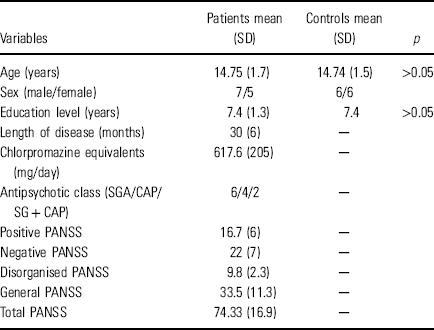
Initially, 16 patients with EOS (including four with very early-onset schizophrenia) were recruited. Of them, four withdrew after the initial clinical visit and 12 completed the study. The mean age of our population was 14.75 years and the average age at the onset of schizophrenia was 12.25 years. The sex ratio was 1.4 and the mean duration of education was 7.4 years. The mean total PANSS score was 74.33. Four patients received strict antipsychotic monotherapy, whereas the other patients received bitherapy. The mean daily dose, in chlorpromazine equivalence, was 523.83 mg/day. Two patients were receiving anticholinergic medication at the time of assessment.
Demographic and clinical characteristics of adolescent patients with schizophrenia and control participants

Performance on theory-of-mind tasks (Table 2)
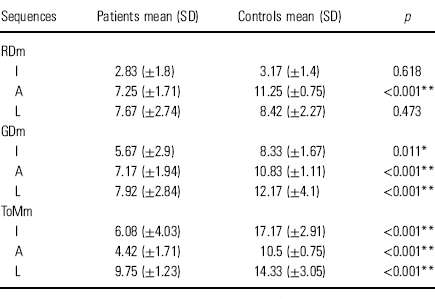
Regarding RDm, the patients showed significantly fewer appropriate responses than the controls (p<10−4). Qualitative analyses of patients’ responses in this modality showed over-mentalising, with excessive attribution of ToM (p<10−4). Regarding GDm and ToMm, the patients obtained significantly lower scores than the TDC in intentionality (p=0.011 and <10−4, respectively), appropriateness (p<10−4 and <10−4, respectively) and length of answers (p=0.007 and 0.006, respectively).
Scores on the animations task test

RDm, random movement modality; GDm, goal-directed modality; ToMm, theory-of-mind modality; I, intentionality; A, appropriateness; L, length of each answer.
*p<0.05.
**p<0.01.
Theory-of-mind tasks, clinical characteristics and psychopathology
No correlations were found among age, educational level and performance in the ToM Animated Tasks. Total PANSS score was negatively correlated with appropriateness score for GDm, (r=−0.648, p=0.02) and ToMm (r=−0.682, p=0.01). No correlation was evident between performance in the ToM Animated Tasks and PANSS positive, negative or disorganisation subscores.
Theory-of-mind tasks and executive functions
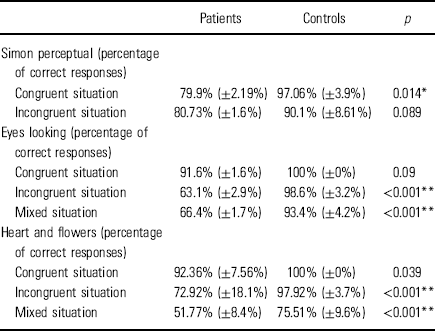
Accuracy rates were significantly lower for tasks demanding moderate levels of inhibition (SP subtest, HF incongruent, EL incongruent) than for tasks demanding high levels of inhibition (mixed EL and HF subtests) (Table 3).
Executive functions test results for accuracy

*p<0.05.
**p<0.01.
No correlations existed between the three scores assessed by the Moving Shapes Paradigm and the rates of accuracy of the three tasks exploring EF.
Discussion
We assessed ToM abilities, clinical characteristics and EF in 12 patients with EOS in comparison with TDC. Adolescents with EOS were significantly more impaired than controls in the three scoring dimensions of the GDm and ToMm. No correlation was evident between performance in the ToM Animated Tasks and PANSS positive, negative or disorganisation subscores. No correlations existed between the three scores evaluated by the Moving Shape Paradigm and the scores of the three tasks exploring EF.
An important limitation of our study is the lack of assessment of intelligence quotient (IQ). Bora et al. (Reference Bora, Yucel and Pantelis29) demonstrated a correlation between ToM performance and IQ, whereas others have not (Reference Chan, Chen and Law46,Reference Frangou47). We chose to match the groups by educational level to compensate for the lack of assessment of IQ. Another limitation of our study is the small size of our sample. This can be explained by the low prevalence of the disorder in young people: EOS is 50 times less prevalent than AOS (Reference Karno and Norquist3).
In this study, we found that, in terms of the GDm and ToMm, patients were impaired in the intentionality, appropriateness and length of their responses. Regarding the RDm, only patients’ appropriateness scores were lower than those of TDC; scores for intentionality and length of response were comparable between the groups. Patients with EOS exhibited significant ToM deficits in the three modalities of the Moving Shapes Paradigm. This is consistent with findings in adult patients with AOS (Reference Pouilles, Tiberghien, Georgieff and Franck42). Russell et al. (Reference Russell, Reynaud, Herba, Morris and Corcoran11) compared patients with schizophrenia aged 18–60 years with controls and observed comparable results. The marking criteria for the ToM Animated Tasks in these two studies were similar to ours. In our study, patients only differed from the TDC in the appropriateness component of the RDm and this finding is also consistent with the literature (Reference Koelkebeck, Pedersen, Suslow, Kueppers, Arolt and Ohrmann12). Pouilles et al. (Reference Pouilles, Tiberghien, Georgieff and Franck42), who studied patients with AOS (mean age: 32.8 years), found differences between patients and controls in measures that included accuracy and causality. Regarding GDm and ToMm in this study, patients’ scores were significantly different from those of TDC. This is in agreement with other studies (Reference Russell, Reynaud, Herba, Morris and Corcoran11,Reference Pouilles, Tiberghien, Georgieff and Franck42). However, studies that assessed patients during their first episode of schizophrenia yield contrary results, demonstrating defects in intentionality and appropriateness only in the ToMm (Reference Koelkebeck, Pedersen, Suslow, Kueppers, Arolt and Ohrmann12,Reference Pedersen, Koelkebeck and Brandt48). The stage of the disease may explain this difference among patients with AOS. We postulate that the younger age at onset of our patients explains their very low competencies. However, we found no correlation between ToM deficits and age, either for patients or for controls. In healthy children, access to intentionality, which represents a higher degree of ToM competency, is reached at 7 years of age (Reference Korkmaz8). Among typically developing participants aged 9–16 years, no effect of age on ToM performance has been reported; changes are only evident in brain activity, with a shift in activity from the ventral to the dorsal part of the medial prefrontal cortex (Reference Moriguchi, Ohnishi, Mori, Matsuda and Komaki49). EOS appears to be associated with greater neurodevelopmental deviance, as reflected in premorbid neurocognitive abnormalities. We suggest that EOS impairs the neurodevelopment of ToM function, leading to deficits in more basic ToM mechanisms in comparison with patients with AOS. The non-verbal material composition of our ToM paradigm excludes biases of interpretation that may result from comprehension difficulties. More specifically, poor performance in this task may reflect difficulties inferring intentionality from stimuli that involve kinematics, and can be interpreted as a deficit in causal perception (Reference Schurhoff, Bellivier and Jouvent6). Further study of self-generated and imitation movements may provide an additional argument to confirm this hypothesis. An important issue is the selection of the task used to explore ToM and the inability to extrapolate one result to other ToM abilities. For instance, in a study by Pilowsky et al. (Reference Pilowsky, Yirmiya, Arbelle and Mozes10), patients with EOS succeeded in the Deception Task but were impaired in the False-Belief Task. It is necessary to extend our understanding of ToM abilities in our group through the investigation of other aspects of ToM.
Irrespective of modality, we observed no association between years of schooling and intentionality and appropriateness scores. This reflects the independence of the ToM deficit from educational level. These results agree with the data of Bora et al. (Reference Bora, Yucel and Pantelis29), who observed no impact of educational level on this dimension. Using the Davidson Battery (Reference Davidson, Amso, Anderson and Diamond43), we demonstrated specific deficits in inhibition and flexibility among patients with EOS but no statistical link with ToM deficits, although mentalising abilities require the analysis of shape movement and may involve inhibition within the sequence and flexibility between sequences. In line with Pickup’s review (Reference Pickup50), we support the modular account of impaired mentalising in patients with EOS.
We found negative correlations between the total PANSS and appropriateness scores for the GDm and ToMm. The relationship between ToM abilities and the clinical symptoms of schizophrenia has been widely studied. Frith (Reference Frith51) argued that the ToM deficit is accentuated in patients with prominent negative symptoms, which induce a functional deficit in mentalisation. In contrast, patients with positive symptoms are able to mentalise but in an inappropriate way, causing ‘over-mentalisation’. Most authors have found correlations between ToM particularities and symptomatology (Reference Russell, Reynaud, Herba, Morris and Corcoran11,Reference Koelkebeck, Pedersen, Suslow, Kueppers, Arolt and Ohrmann12,Reference Abdel-Hamid, Lehmkämper, Sonntag, Juckel, Daum and Brüne52–Reference Shamay-Tsoory, Shur, Barcai-Goodman, Medlovich, Harari and Levkovitz55). Our clinical sample was characterised by high PANSS scores, which is consistent with reports on the persistence of negative symptoms, more chronic course and lack of full remission typical of patients with EOS (Reference Remberk, Namysłowska and Rybakowski56–Reference Remschmidt58). We speculate that ToM deficits are related to the general burden of psychopathology in patients with EOS, or that persistent negative and disorganised symptoms reflect, similarly to ToM deficits, a neurodevelopmental deviance in this disorder.
In summary, in this study, we demonstrated deficits in ToM and EF in a group of patients with EOS. The presence of deficits in the three modalities of the Moving Shapes Paradigm, and the over-interpretation of unintentional movements, may be specific to this form of the disease. Our findings support the status of these two dimensions as markers of schizophrenia.
Authors’ Contributions
All authors contributed significantly. Isabelle Amado, Asma Bouden, Karim Tabbene and Marie Odile Krebs designed the study. Soumaya Bourgou performed the design, acquisition, analysis and interpretation of the data. Racha Triki participated in the rating of the Moving Shapes test. Marie Chantal Bourdel undertook the statistical analysis. Nicolas Franck developed the standards of the French version of the Moving Shapes test. Soumaya Bourgou and Soumeyya Halayem wrote the first draft of the manuscript. Isabelle Amado, Asma Bouden, Soumaya Bourgou and Soumeyya Halayem were involved in drafting the manuscript and revising it critically for important intellectual content. All authors contributed to and are in agreement with the content of the manuscript.
Acknowledgements
The authors would like to thank all the participants in the study especially the patients and their families.
Financial Support
This work has been supported by the DGRST-INSERM program which gave financial help to this study by the promotion of scientific travel and exchange between the French and Tunisian scientific laboratories.
Conflicts of Interest
None.
Ethical Standards
The authors assert that all procedures contributing to this work comply with the ethical standards of the relevant national and institutional committees on human experimentation and with the Helsinki Declaration of 1975, as revised in 2008.