Introduction
There is much contemporary interest in both the symptomatic characteristics and treatment of bipolar depression.Reference Bowden1–Reference Mitchell, Frankland and Hadzi-Pavlovic3 It has become clear that depression is the predominant mood disturbance in bipolar disorders. In a retrospective long-term longitudinal study, Judd etal.Reference Judd, Akiskal and Schttler4, Reference Judd, Akiskal and Schttler5 found that of time spent symptomatic, depressive symptoms accounted for 32% of weeks in bipolar I (BPI) disorder and 50% of weeks in bipolar II (BPII) disorder, with ratios of time spent depressed vs. hypomanic/manic/mixed states of 3:1 for BPI and 37:1 for BPII. Bipolar depression also appears to be particularly debilitating,Reference Bauer, Kirk and Gavin6 even when symptoms are only subsyndromal.Reference Judd, Akiskal and Schettler7 Furthermore, bipolar depression is poorly responsive to extant therapies. For example, Nierenberg etal.Reference Nierenberg, Ostacher and Calabrese8 found response rates of only 5–23% in a STEP-BD equipoise randomized effectiveness trial in resistant bipolar depression, while Leverich etal.Reference Leverich, Altshuler and Frye9 found sustained antidepressant response in only 23% of bipolar depressed patients.
These results highlight the needs both for enhanced diagnostic specificity and improved therapeutic options for this condition. With respect to the former, our research group reported that bipolar depression, compared to major depressive disorder, was associated with greater psychomotor slowing, melancholic and “atypical” symptoms, pathological guilt, and psychotic features in patients with bipolar depression.Reference Mitchell, Frankland and Hadzi-Pavlovic3, Reference Parker, Roy and Wilhelm10, Reference Mitchell, Wilhelm and Parker11
A complementary approach to establishing the clinical characteristics of a condition is to explore for symptom factors, or clusters. Such approaches have been employed in several analyses in major depressive disorder, using either analyses of standardized rating measures such as the Hamilton Depression Rating Scale (HDRS)Reference Hamilton12, Reference Hamilton13 or multivariate studies of other clinical assessments.Reference Parker, Hadzi-Pavlovic and Boyce14, Reference Parker, Hadzi-Pavlovic and Wilhelm15 However, such approaches have been minimally applied in bipolar depression. BenazziReference Benazzi16 reported different factor structures in bipolar II depression and unipolar depression with the Montgomery–Asberg Depression Rating Scale (MADRS).Reference Montgomery and Asberg17 Hantouche and AkiskalReference Hantouche and Akiskal18 conducted a principal components analysis on the 21-item version of the HDRS and 2 other adjunctive measures, similarly demonstrating some differences in component scores between the bipolar II and unipolar depressed samples. Thompson etal.Reference Thompson, Gonzalez and Singh19 reported that a comprehensive scale for bipolar symptomatology, the Bipolar Inventory of Symptoms Scale, yielded 5 domains.
Lamotrigine is approved for maintenance treatment, principally for depression, in bipolar I patients.Reference Bowden, Calabrese and Sachs20, Reference Calabrese, Bowden and Sachs21 While acute response of bipolar depression has generally not differed from placebo, one study found significant superiority for the key secondary outcome measure, the MADRS,Reference Calabrese, Bowden and Sachs22 and a meta-analysis of all 5 acute studies of lamotrigine in bipolar depression confirmed modest evidence of efficacy.Reference Geddes, Calabrese and Goodwin23 No published study of lamotrigine has addressed possible symptomatic dimensions of bipolar depression that may be responsive, or nonresponsive, to this treatment. Our objectives were to conduct a factor analysis of the HDRS and apply the factor scores to an acute treatment study comparing lamotrigine and placebo in patients experiencing bipolar I major depressive episodes to potentially inform future predictors of response. The first double-blind placebo-controlled trials (GW-602; reported in Calabrese etal.Reference Calabrese, Bowden and Sachs22), comprised 195 DSM-IV Bipolar I Disorder patients experiencing a major depressive episode. The second (GW-613; reported in Laurenza etal.Reference Laurenza, Asnis and Beaman24) comprised 437 DSM-IV Major Depressive Disorder (MDD) patients. Both studies had similar designs and assessment tools.
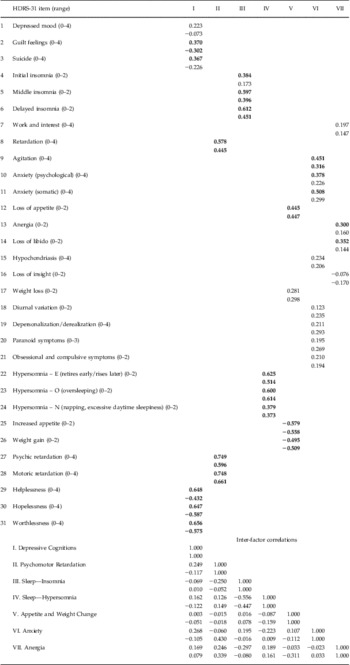
Two specific aims were addressed: (i) to examine for factors in bipolar and unipolar depression using standardized rating scales (HDRS and MADRS), and compare scores on those factors between bipolar and unipolar depressed patients; and (ii) to explore whether such factors are associated with a greater likelihood of response to lamotrigine compared to placebo in bipolar depression. Advantage was taken of the use of the 31-item version of the HDRS in both these lamotrigine trials. The 31-item version of the Hamilton scale was developed by Kupfer etal. (personal communication) to incorporate clinical features commonly observed in bipolar depression (ie, melancholic and reversed vegetative symptoms) in addition to the 24-item HDRS.Reference Jamerson, Krishnan and Roberts25 The 31 items of this scale are detailed in Table 1. Although some item descriptors differ from those used by Hamilton, they incorporate the same symptoms detailed in his original papers.Reference Hamilton12, Reference Hamilton13
Seven-factor solution for the HDRS-31—final allocation of items

While factor structures of the 17-itemReference Hamilton12 and 21-itemReference Hamilton13 versions have been described, the only investigation to date of the 31-item scale (HDRS-31) is that of Jamerson etal.,Reference Jamerson, Krishnan and Roberts25 who reported a principal components analysis of this measure. No formal studies of the psychometric properties of the HDRS-31 have been conducted, therefore interpretation of our findings should be made in light of this limitation.
Methods
Studies and sample
This study accessed 2 large depressed samples that had been recruited for separate double-blind placebo-controlled trials of lamotrigine. The studies had similar designs and assessment tools, the major measures being the MADRS, HDRS-31, and the Clinical Global Impression scale (CGI). In both trials, subjects were randomized to lamotrigine (50 and 200 mg in GW-602, and 200 mg in GW-613) or placebo, and assessments were undertaken at least weekly over 7–8 weeks, with the second study (GW-613; MDD) including an active comparator arm (desipramine).
Lamotrigine did not differ from placebo in the MDD trial on either the MADRS or HDRS-17 or -31; therefore we used only screening and baseline scores from that sample to examine for differences in factor scores between bipolar and unipolar depressed samples. Treatment responses for each factor in the MDD study were not analyzed.
Details of the methods employed in study 602 are reported in Calabrese etal.Reference Calabrese, Bowden and Sachs22 The post hoc analyses described in this article utilized the 9 study visits that the 2 trials had in common (screening, baseline, and the next 7 weekly assessments) and the 2 treatment arms that the trials had in common (placebo and lamotrigine 200 mg).
The data from the screening session were used to provide a measure of severity: separately for each study, and using subjects from the 2 arms (placebo and lamotrigine 200 mg) only, total scores on the HDRS-31, the MADRS, and CGI severity subscale (CGI-S) were standardized, summed, and then restandardized into a severity score to be used in modeling the next 8 assessments. The next 8 assessments were then modeled, using the number of weeks since treatment started (linear trend), weeks squared (quadratic trend), treatment [placebo versus active (lamotrigine 200 mg)], and severity as covariates.
Factor analyses of the Hamilton Depression Rating Scale
Rating scales such as the HDRS can be scored as subscales based on an a priori clinically informed division of the items. However, clinically determined subscales often differ from subscales derived empirically (eg, by using factor analysis). Previous analyses of the HDRS-17 and -21 have suggested various scorings for factors.Reference Bech, Allerup and Gram26, Reference Gibbons, Clark and Kupfer27 Therefore, analyses of the HDRS-31 to supplement Jamerson etal.Reference Jamerson, Krishnan and Roberts25 and to contrast subpopulations (here, bipolar depression and MDD) are likely to be informative.
Exploratory factor analyses
The factor analysis was based on the HDRS item scores from the 2 occasions prior to the commencement of treatment, ie, screen and baseline. We chose to treat the data from each occasion as if they came from 2 different subjects. For example, the 188 bipolar depressed patients resulted in 376 “cases.” Butler etal.Reference Butler, Gock and Hartley28 suggest that this approach has the advantage of allowing reliability to influence the factor structure. Since the assessments were close in time, differences between the 2 ratings are likely to reflect largely the reliability of raters and reporting rather than change, while the dual measurements allow a more accurate factor structure to emerge. The data were analyzed both as continuous data (using the CEFA software of Browne etal.Reference Browne, Cudeck and Tateneni29) and as categorical data (using Mplus software, Muthen and MuthenReference Muthen and Muthen30) in both cases examining the oblique rotations. An attempt to analyze the items as ordinal data using LISRELReference Joreskog and Sorbom31 failed to produce a solution for the bipolar depressed patients and had numerical problems in the MDD patients, thus suggesting that the categorical solutions only provided limited evidence, presumably due to limited range of responses for some items.
Separate solutions were conducted for the bipolar depressed and MDD datasets to gauge how different the structures might be, although this was limited by the sample sizes. The overall aim was to identify factors that were similar across both diagnoses in order to facilitate comparisons between the 2 groups. Because the HDRS-31 was originally developed to incorporate features seen more commonly in bipolar depression, the analysis focused primarily on this measure.
Examination of treatment effects by HDRS-31 subscales
To examine change over time during treatment with lamotrigine and placebo, growth curves were fitted using the linear mixed-effects module “lme” in S-Plus.32 This procedure allows characterization of change by an overall curve across individuals (adjusted for any covariates) and estimation of variation around that curve that is exhibited by individuals. The advantages of this approach over the usual trend analysis within the ANOVA framework include inclusion of individuals with missing data without the need to impute values for the missing data and modeling of between-occasion correlations. All subjects who entered the trial were included, as were all sessions that provided data. Missing data remained missing and were not “carried forward” as is done in an intention-to-treat (ITT) analysis. Scores on each of the factors were constructed by summing across items.
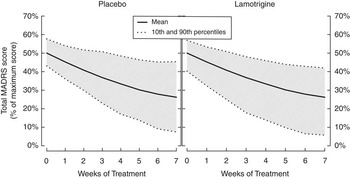
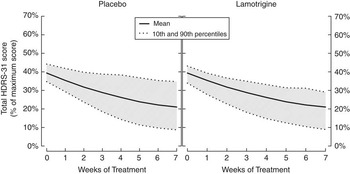
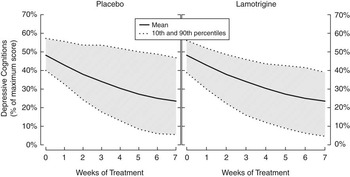
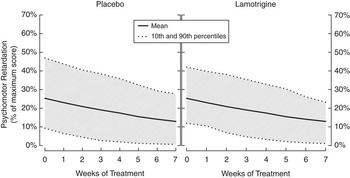
A separate model for each factor was built by first entering terms for linear and quadratic trend (and keeping them in the equation). Trend was entered as both a fixed and random effect (ie, both the overall effect and the individual variation in that effect were estimated). Next, baseline severity and the severity-by-trend interactions were entered. If this produced an improved fit [assessed by a reduction in either the Akaike or Bayesian Information Criteria (AIC and/or BIC)], significant terms were retained; otherwise they were excluded. This was repeated for treatment. Modeling of the between-occasion correlations that would be expected in repeated measures was confined to autoregressive correlations. That is, observations 1 week apart were estimated to have a correlation of φ, those 2 weeks apart φ2, etc. In Figures 1–4, the fitted values from the final equation for each factor or total score were plotted. These fitted values included both the fixed and the estimated random effects. Solid lines plot the mean of the fitted values; broken lines show the 10th and 90th percentiles for the range of values at each time point. The scale for the y-axis represents the values as a percentage of the maximum possible value of the scale.
Treatment measured by total MADRS score

Individual time point t-test analyses were also undertaken to allow for comparability with previous reports of the use of lamotrigine in bipolar depression. The effects of lamotrigine and placebo treatments on the HDRS factors were compared at baseline and weeks 1–7. These were conducted as LOCF analyses.
Results
Rating scale factor analyses
For the HDRS-17, the aim was to attempt to fit the model given in Gibbons etal.,Reference Gibbons, Clark and Kupfer27 which comprised 5 factors defined by 16 of the items. As 2 of the factors were defined by only 2 items, this model was likely to be numerically unstable; it failed to fit for both patient groups in the current study. Removing the third factor (loss of insight and weight loss) yielded a 4-factor model that fit well in the MDD patients [root mean-square error of approximation (RMSEA) = 0.0415, comparative fit index (CFI) = 0.807, adjusted goodness of fit index (AGFI) = 0.956)] but less well in the bipolar depressed subjects (RMSEA = 0.076, CFI = 0.691, AGFI = .876). These findings tend to support the Gibbons etal.Reference Gibbons, Clark and Kupfer27 model for the HDRS-17.
For the HDRS-31, no solution provided entirely satisfactory results. Using the eigenvalues greater than 1 criterion, 11 factors would be retained for bipolar patients and 8 for unipolar patients. A value below 0.05 on the RMSEA statistic has been suggested as a better indicator.33 Only the solutions obtained using CEFA provided this statistic, with RMSEA = 0.048 at 8 factors for bipolar patients, and RMSEA = 0.045 at 6 factors for unipolar patients. Solutions ranging from 5 to 8 rotated factors were compared within and between patient groups to identify any points of consistency. Some of the 8-factor solutions produced factors composed of 2 or 1 items. While this might improve fit, such factors are unlikely to be of clinical utility or be stable in replication, and so were given less weight.
Table 1 shows the preferred 7-factor solution, along with the results of a factor analysis in each group where loadings on designated factors were free to be estimated, but elsewhere were set to zero (unipolar depressed then bipolar depressed figures for each factor are provided). Loadings greater than 0.3 are shown in bold to help identify the factors, but this low cut-off arguably makes the solutions appear clearer than is the case. Although not confirmatory, these analyses give some idea of the fit of the 7-factor solution (RMSEA = 0.0542 and 0.0531).
[As this approach does not account specifically for the non-independence between the pairs of observations, we also examined how the final solution differed from one that incorporated the repeated nature of the observations, by using the exploratory structural equation modeling option in Mplus. Each subject appeared only once, but now with 2 sets of 31 items. We specified 7 factors across the 31 items from time 1 and similarly for time 2, but with no specification of which items loaded on which factors; factor loadings were set to equal, and pairwise item residuals were allowed to correlate. The solution in both unipolar and bipolar patients was highly consistent with the one reported here across the first 6 factors, but less so across the 7th and weakest factor.]
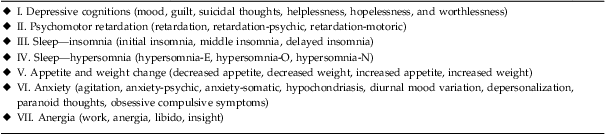
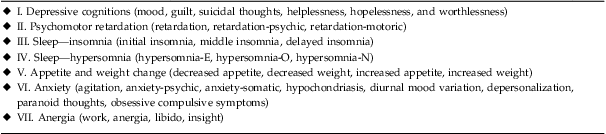
The final 7 factors and their constituent items are listed in Table 2. The solution flows from clinical and/or research decisions that were made as to whether the sleep items should be kept split; what to do with the mood item; and whether to retain the items for work, anergia, libido, diurnal, and insight, which typically, but not always, do not load highly. In the bipolar depressed sample, the first 10 eigenvalues ranged from 3.6 to 1.1 with individual factors accounting for 11.6%, 9.7%, 7.4%, 6.8%, 5.5%, and 3.5% of the variance (equal to a total of 61.6% of the variance). In the MDD sample, they ranged from 3.00 to 0.99, accounting for 9.7%, 8.1%, 7.4%, 6.1%, 4.8%, and 3.2% of the variance (55.6% of the total).
The final seven factors derived from the 31-item version of the Hamilton Depression Rating Scale (HDRS-31)—and their constituent items—in samples with bipolar depression and MDD
A stable factor solution for the MADRS could not be demonstrated.
HDRS-31 factor scores at baseline in bipolar depression and MDD
MDD patients had higher scores on factors I (“depressive cognitions”: 11.7 vs 11.2; t = 2.3, df = 641, p < 0.05), III (“sleep—insomnia”: 4.0 vs 3.4; t = 4.2, df = 641, p < 0.001), and VII (“anergia”: 6.3 vs 6.0; t = 2.63, df = 641, p = 0.009), but these results are confounded by differences in total depression severity between the 2 groups. MDD patients were significantly more severely depressed on each of the depression severity measures (29.9 vs 28.9 on the MADRS, 24.5 vs 23.9 on the HDRS-17, and 37.0 vs 35.5 on the HDRS-31). Most studies comparing bipolar depressed and MDD patients using the same raters have reported no severity differences between these populations,Reference Mitchell, Wilhelm and Parker11 therefore the most likely explanation for this finding is the difference in raters and sites used in the 2 separate studies. It is therefore unlikely that the differences in factor scores indicate true distinctions in severity between the bipolar depressed and MDD samples.
Treatment response in bipolar depression—mixed effects analyses
Treatment responses to lamotrigine and placebo were analyzed using the following as dependent variables: MADRS total score, HDRS-31 total score, and HDRS-31 factors (I to VII).
Treatment response of total score on the Montgomery–Asberg Depression Rating Scale
While linear and quadratic trends are significant under both treatments, Figure 1 shows the significantly steeper linear effect for lamotrigine over placebo (linear by treatment interaction, t = −3.17, p < 0.05).
Treatment response of total score on the 31-item Hamilton Depression Rating Scale
As detailed in Figure 2, there is a significant treatment by linear trend interaction (t = –2.57, p < 0.05) indicating a more stable improvement with lamotrigine than placebo.
Treatment measured by total HDRS-31 score

Examination of treatment effects by HDRS-31 subscales
Scores on Factor I (“depressive cognitions”; Figure 3) were reduced by 1.5 points each week, but with an increasing degree of relapse (quadratic trend), which after 7 weeks was nearly 7 points for the bipolar depressed patients. For each SD above (below) the mean for severity, patients are estimated to be 1.25/1.45 points higher (lower) across all occasions, indicating that even if recovering, the more severely depressed patients do not “catch up.” The linear by treatment interaction shows an additional significant 0.2 units reduction per week due to lamotrigine in the bipolar depressed group, which is equivalent to 1.4 units at the end of treatment (t = −3.00, p < 0.05). The random effects for the influence of time (weeks) have a variance of 0.80 units (SD = 0.89), indicating substantial intra-individual variation. The autoregressive correlation between adjacent occasions is estimated at 0.39 (0.37).
Treatment measured by factor I (Depressive Cognitions)

For factor II (“psychomotor retardation”), only the effects of time and severity were significant (Figure 4). The linear trend suggests a rapid decrease, though some relapse discernible Group variation diluted these differences, as indicated in individual time point analysis of this factor below.
Treatment measured by factor II (Psychomotor Retardation)

There were no significant effects of treatment for factors III–VI. Factor III (“sleep—insomnia”) demonstrated considerable variation in outcome, indicating that while there was some overall improvement, there was also frequent relapse and/or shifts by visit in subjects. Insomnia appeared to be unrelated to overall severity of depression. With factor IV (“sleep—hypersomnia”), there was an improvement in hypersomnia, minimal relapse, and reduced variability between subjects over time. For factor V (“appetite and weight change”), patients showed a sharp decrease, but also large subsequent relapse, in the degree of appetite change. There was no effect of severity. Similarly, for factor VI (“anxiety”), there was no significant effect of treatment. For factor VII (“anergia”), there was no linear treatment effect for lamotrigine over placebo.
Treatment response—individual time point analyses
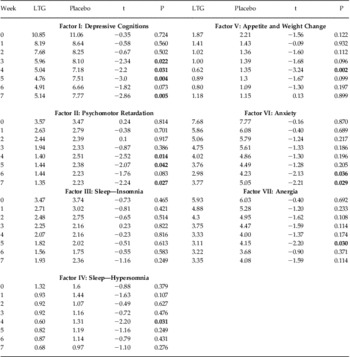
As detailed in Table 3, comparisons of lamotrigine and placebo treatments at separate time points show findings generally consistent with both the mixed-effects analyses described above. These indicate response to lamotrigine 200 mg greater than placebo in the bipolar depressed group with HDRS-31 factor I (depressive cognitions; from week 3) and factor II (psychomotor retardation; from week 4). Effects were inconsistent (ie, significant differences at 1 or 2 time points only) for factors IV, V, VI, and VII.
Differences between lamotrigine (LTG) and placebo treatment at each individual time point for the bipolar depressed group (between-group t-tests)

Discussion
This is the first study to examine the factor structure of the Hamilton Depression Rating Scale (HDRS) in a sample of acutely symptomatic patients with bipolar I depression. It is also the first study to test the utility of such factors in delineating specifically the effect of any therapeutic agent in this condition. Using a 31-item version of the HDRS, this study found that the most satisfactory factor analytic structure was a 7-factor model. Some of the factors, eg, depressive cognitions, are more clinically homogenous in terms of their constituent items; others, eg, anxiety, are more heterogenous.
The 4-factor solution for the 17-item version of the HDRS was consistent with that described by Gibbons etal.Reference Gibbons, Clark and Kupfer27 in a strictly unipolar depressed MDD sample. While it fitted the MDD sample well, it was marginally satisfactory in the bipolar depressed sample. A stable factor solution for the Montgomery–Asberg Depression Scale (MADRS) could not be demonstrated, unlike Benazzi,Reference Benazzi16 who reported a 3-factor solution using a varimax rotation.
This study suggests that 2 HDRS factors in bipolar depressed patients were particularly responsive to lamotrigine. The strongest effect was found for depressive cognitions for which there was a significant linear by treatment interaction using the mixed-effects analysis, as well as with the separate time point analyses. The other factor indicating responsiveness to lamotrigine was psychomotor retardation. Individual time point analyses demonstrated significant benefit on the psychomotor retardation factor compared to placebo from week 4 onward. The mixed-effects analysis found a linear trend indicative of quicker improvement on psychomotor retardation, but was not significant due to substantial subject variability.
In the aggregate, these results suggest that lamotrigine's beneficial effect in bipolar depression is largely limited to 2 core aspects of bipolar depressive symptomatology.Reference Angst, Azorin and Bowden34 No consistent beneficial effects of lamotrigine treatment on insomnia, hypersomnia, appetite weight change, anxiety, or anergia were identified.
This is the first report of specific domain responsiveness of a treatment for bipolar depression. Factor analyses have been employed productively in differentiating profile of response to treatments in acutely manic bipolar patients.Reference Swann, Bowden and Calabrese35
In the only other multivariate study of the HDRS-31, Jamerson etal.Reference Jamerson, Krishnan and Roberts25 undertook a principal components (PC) analysis on data from 910 unipolar major depressed outpatients who had been enrolled in 3 double-blind controlled trials of sustained-release bupropion. Interestingly, that study also found 7 PC domains, which overlap substantially with the 7 factors identified in the present report. The “cognitive symptoms” domain described in that article corresponded closely to the “depressive cognitions” factor, as did the “retardation” domain, which resembled the “psychomotor retardation” factor. Similar to the treatment response findings reported here, Jamerson etal.Reference Jamerson, Krishnan and Roberts25 found that 4 of the 7 PC domains responded more to bupropion than to placebo, including “cognitive symptoms” and “retardation.”
One study of clinical predictors of response to lamotrigine has been published. Using a combined bipolar and unipolar depressed dataset previously described by Frye etal.,Reference Frye, Ketter and Kimbrell36 Obrocea etal.Reference Obrocea, Dunn and Frye37 reported that a positive response to lamotrigine was associated with a bipolar disorder diagnosis, fewer hospitalizations, fewer previous medication trials, and male gender.
This study has both particular strengths, but also substantial limitations. Its major strengths are the large sample size and the availability of data from both unipolar and bipolar depressed patients for comparison purposes. The major limitation is (as detailed above) that no formal studies of the psychometric properties of the HDRS-31 have been conducted. However, the capacity of the HDRS-31 to explicitly address symptomatic aspects common to bipolar depressive states (in particular atypical depressive symptoms such as hypersomnia and hyperphagia, and also psychomotor retardation) warrants its application in the analysis. The importance of this capacity has been recently underlined by a report from China in which the atypical features distinguished between patients with bipolar and unipolar depression.Reference Xiang, Zhang and Wang38 Another problem with any attempt at factor analysis of the HDRS is that some items are scored on a 4-point scale and others on a 2-point scale, which tends to degrade correlations and thus the factorial solution.
Conclusion
Our results indicate that lamotrigine is likely to provide improvement for depressive cognitions and psychomotor disturbance. Equally useful clinically, lamotrigine is unlikely to provide benefits for somatic features of bipolar depression (weight gain, insomnia, hypersomnia) nor for anergia (low energy) or for anxiety, which is commonly present in all syndromal clinical states of bipolar disorder. This profile of areas of benefit, and lack of benefit, from lamotrigine in bipolar depression should be of practical utility to clinicians in deciding when to prescribe lamotrigine as a component of treatment in bipolar depressed patients. Future studies comparing lamotrigine with other agents in bipolar depression would further benefit treatment decisions for bipolar depression.
Disclosures
Philip Mitchell, Dusan Hadzi-Pavlovic, and Gary Evonluk have nothing to disclose. Joseph R. Calabrese has the following disclosures: AstraZeneca, presentation, honoraria; Cortex Congress, presentation, honoraria; Lundbeck, presentation, honoraria; Medwitz Healthcare, presentation, honoraria; Otsuka, presentation and consultation, honoraria and consulting fees; Spirant Comm. Priv. Ltd, presentation, honoraria; Am Biol Bio Sciences, consulting, consulting fees; Convergent Health Solution, consulting, consulting fees; Elan, consult, consulting fees; Health & Wellness, consulting, consulting fees; Hoffman LaRoche, consulting, consulting fees; Lundbeck, consulting, consulting fees; Merck, consulting, consulting fees; Scientia, consulting, consulting fees; Sunovion, consulting, consulting fees; Takeda, consulting, consulting fees. Charles Bowden has the following disclosures: GSK, independent contractor, honoraria; Elan, research support grant; Teva, consultant, consulting fee.
The datasets were provided by GSK, but no financial support (direct or indirect) was received from GSK for the purposes of this study. PBM has not accepted remuneration from pharmaceutical companies and has not served on an industry advisory board in the last 3 years. DH-P reports no financial support. Gary Evoniuk is a full-time employee of GlaxoSmithKline PLC. JRC has received: federal funding from the U.S. Department of Defense, Health Resources Services Administration and National Institute of Mental Health; and research support from Abbott, AstraZeneca, Bristol-Myers Squibb, Cephalon, Cleveland Foundation, Eli Lilly, GlaxoSmithKline, Janssen, NARSAD, Repligen, Stanley Medical Research Institute, Takeda, and Wyeth. JRC has consulted to or served on advisory boards of Abbott, AstraZeneca, Bristol-Myers Squibb, Cephalon, Dainippon Sumitomo, EPI-Q, Inc., Forest, France Foundation, GlaxoSmithKline, Janssen, Johnson and Johnson, Lundbeck, Merck, Neurosearch, OrthoMcNeil, Otsuka, Pfizer, Repligen, Schering-Plough, Servier, Solvay, Supernus, Synosia, Takeda, and Wyeth. JRC has provided CME lectures supported by AstraZeneca, Bristol-Myers Squibb, France Foundation, GlaxoSmithKline, Janssen, Johnson and Johnson, Merck, Sanofi Aventis, Schering-Plough, Pfizer, Solvay, and Wyeth. CLB has received research grants and/or honoraria for consultancies or lectures for Elan Pharmaceuticals, GSK, and NIMH.