Introduction
Enterobius vermicularis (pinworm) is the least pathogenic of all the intestinal helminths. The parasite is cosmopolitan and there is evidence of coexistence with humans that dates back to the Palaeolithic Period. The pinworm has a direct life cycle, involving the oral ingestion of eggs containing infective larvae, with adult helminths inhabiting the large intestinal lumen. The parasite can produce chronic infection through auto-infection, retro-infection and re-infection. Enterobius vermicularis is the last surviving parasitic nematode within economically developed world societies (Gale, Reference Gale2002; Herrström et al., Reference Herrström, Henricson, Råberg, Karlsson and Högstedt2002; Maizels & Weidermann, Reference Maizels, Weidermann and Rook2009; Bøås et al., Reference Bøås, Tapia, Rasmussen and Rønningen2013) and has been suggested to function as an educator of the immune system (Gale, Reference Gale2002) and even as a protective agent (Gale, Reference Gale2002; Maizels & Weidermann, Reference Maizels, Weidermann and Rook2009). There are epidemiological and clinical studies showing an inverse association between enterobiasis and the expression of allergic/atopic, autoimmune and immunological dysfunctions (Huang et al., Reference Huang, Tsai and Yeh2002; Schäfer et al., Reference Schäfer, Meyer, Ring, Wichmann and Heinrich2005; Correale & Farez, Reference Correale and Farez2007; Büning et al., Reference Büning, Homann, von Smolinski, Borcherding, Noack, Stolte, Kohl, Lehnert and Ludwig2008), as in other intestinal helminthiases (Lynch et al., Reference Lynch, Hagel, Palenque, Di Prisco, Escudero, Corao, Sandia, Ferreira, Botto, Perez and Le Souef1998; Cooper, Reference Cooper2002).
The innate immune recognition and the immune stimulation and activation of T-helper (Th) cells result in their differentiation to Th1, Th2, Th17 and T-regulatory (Treg) subpopulations and subsequent functions, as well as in the interaction with B lymphocytes. When activated by the presence of intestinal helminths, the immune system reacts with a type-2 oriented response, which aims to expel them (Michels et al., Reference Michels, Goyal, Nieuwenhuizen and Brombacher2006; Allen & Maizels, Reference Allen and Maizels2011; Bourke et al., Reference Bourke, Maizels and Mutapi2011). A type-2 response in allergy could have pathological consequences and may be associated with atopy. We consider atopy as the tendency for IgE-mediated immune responses to be characterized by the presence of specific IgE and correlated with genetic polymorphisms (Fitzsimmons & Dunne, Reference Fitzsimmons and Dunne2009).
There are limited experimental and clinical data from animals (Michels et al., Reference Michels, Goyal, Nieuwenhuizen and Brombacher2006) and humans (Jarrett & Kerr, Reference Jarrett and Kerr1973; Durmaz et al., Reference Durmaz, Yakinci, Köroğlu, Rafiq and Durmaz1998; Villarreal & Domingo, Reference Villarreal and Domingo1999; Bahceciler et al., Reference Bahceciler, Ozdemir, Kucukosmanoglu, Arikan, Over, Karavelioglu, Akkoc, Yazi, Yesil, Soysal, Bakir and Barlan2007) regarding the immune response to mouse (Syphacia obvelata) and human (E. vermicularis) pinworms.
In this study, school-attending, infected children were examined and their immune response to E. vermicularis was assessed using haematological and serological parameters. Infected children were compared with uninfected controls, in addition to detecting differences between infected atopic and non-atopic children.
Materials and methods
Parasitological procedures
Between May 2007 and March 2009, 1500 children, aged 1–18 years, were examined in two prefectures of central Greece. The children were attending day care, nursery, primary and secondary schools. Examinations were conducted using the Graham test (adhesive-tape test) for the microscopic detection of E. vermicularis eggs in the perianal area, once during morning hours at the children's schools. All tests and microscopic tape examinations were performed by the same person.
The following markers of immune function were assessed in whole blood or serum samples from infected children and uninfected gender- and age-matched controls: the percentage of eosinophils (EO) and the absolute number of eosinophils (EO cells/μl), using an automated haematology analyser (SysmexXS-1000i; Sysmex Corporation, Kobe, Japan); eosinophilic cationic protein (ECP, μg/l), total immunoglobulin E (IgE, kU/l) and specific IgE, using the Thermo Scientific™ ImmunoCAP system (Thermo Fisher Scientific–Phadia Inc., Waltham, Massachusetts, USA). Considering specific IgE, a mixture of the most common allergens was selected (fx5 mixture for food allergens, hx2 and Phadiatop (a mixture of common inhaled environmental allergens) for aero-allergens). Atopy was defined as a positive response ( ≥ 0.35 kU/l) to any of the allergens. The ECP/EO ratio was investigated as a marker of eosinophil activation and degranulation (Park et al., Reference Park, Oh, Park, Kim and Han2006).
The cytokines interleukin (IL)-2, IL-4, IL-5, IL-10, tumour necrosis factor (TNF)-α and interferon (IFN)-γ (in serum samples) were measured in samples from infected children only, using the Human Th1/Th2 Cytokine kit II (BD Cytometric Bead Array; BD Biosciences, San Diego, California, USA). The absence of any measurable level was assigned a value of 0 in our data analysis.
Children were divided into infected and uninfected, non-atopic and atopic, the latter being further divided into atopic negative and atopic positive – pertaining to allergic manifestation – and were confirmed by a diagnosis from a physician during the 12 months before examination. None of the children exhibited symptoms of allergic disease at the time of examination, such as asthma, rhinitis, conjunctivitis or eczema.
Data analysis
Calculations were performed using the statistical package SPSS Statistics 17.0 (SPSS Inc., Chicago, Illinois, USA), with a P value ≤ 0.05 set as the cut-off point. Mean values were compared using the t-test. The Pearson correlation coefficient was used to quantify association between the mean values, whereas for categorical variables the χ2 test was applied.
Results
Levels of infection
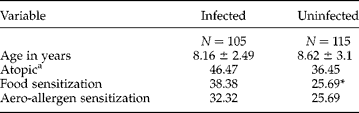
The adhesive-tape test was positive for 116 of 1500 (7.73%) children and necessary instructions were given to the families regarding treatment (mebendazole) and personal hygiene. Data regarding atopic status were available for 99 of 105 (94.29%) infected and 109 of 110 (99.09%) uninfected children. Specifically, 46 of 99 (46.46%) infected and 39 of 109 (35.78%) uninfected children were atopic (P= 0.12). Up to 38 of 99 (38.38%) of these children infected with E. vermicularis exhibited a higher rate of sensitization to food allergens, compared with 28 of 109 (25.69%) uninfected children (table 1, P= 0.05).
The proportion (%) of schoolchildren either infected with Enterobius vermicularis or not, relative to age, atopic status and positive responses to allergen-specific IgE; N= number of children, mean values given as ± SD.
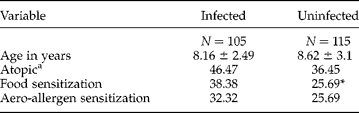
a At least one positive response to any of the allergens tested.
* Level of significance with P ≤ 0.05.
Immune responses
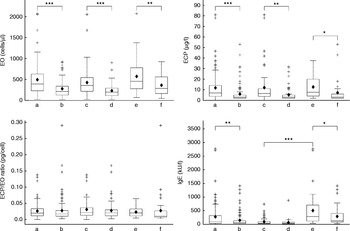
Initially, the infected group was compared to the uninfected group, regardless of atopic status (fig. 1). The number of eosinophils, ECP and total serum IgE were significantly higher in the infected group (fig. 1, P ≤ 0.01). Atopic and non-atopic subgroups within the infected and uninfected groups were assessed separately. In the non-atopic group, significant differences were observed in eosinophils and ECP (fig. 1). Within the atopic group, significant differences were found in eosinophils, ECP and IgE (fig. 1).
Haematological and serological parameters in schoolchildren either infected with Enterobius vermicularis or not: (a) infected, (b) uninfected, (c) infected non-atopic, (d) uninfected non-atopic, (e) infected atopic and (f) uninfected atopic. EO, absolute number of eosinophil (cells/μl); ECP, eosinophil cationic protein (μg/l); ECP/EO, ratio of ECP to EO (pg/cell); IgE, immunoglobulin E (kU/l). Median values are shown in the centre of each box and edges represent the 25th and 75th percentiles, (+) outliers plotted as individuals, (♦) mean values, with *P ≤ 0.05, **P ≤ 0.01 and ***P ≤ 0.001.

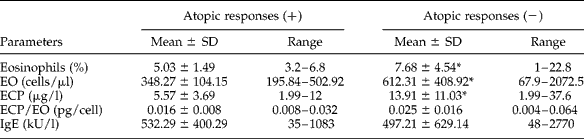
Subsequently, infected children were further investigated comparing non-atopic and atopic groups, the latter further subdivided into atopic positive and atopic negative with respect to clinical manifestations during the previous 12 months before examination. Total serum IgE was found to be significantly higher in the atopic than in the non-atopic group (fig. 1). It is worth noting that the ECP/EO ratio was lower in atopic than non-atopic children, although not significantly (fig. 1). Mean values of eosinophils and ECP were found to be lower in atopic positive than in atopic negative children (table 2).
Immune responses expressed as haematological and serological parameters in 39 negative (−) and 7 positive (+) atopic children infected with Enterobius vermicularis. EO, absolute number of eosinophils; ECP, eosinophil cationic protein; ECP/EO, ratio of ECP to EO; IgE, immunoglobulin E.
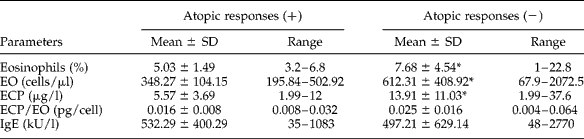
* Level of significance with P ≤ 0.01.
The levels of IL-2, IL-4, IL-5, IL-10, TNF-α and IFN-γ were measured in 102 of 105 (97.14%) infected children. No significant difference in any cytokine measured was observed between atopic and non-atopic children. A positive correlation between IL-4 and IFN-γ levels was observed in the infected group, as well as within the atopic and non-atopic subgroups (data not shown, P< 0.0001 for all three).
Discussion
The results of this study indicate that the immune system of infected children, regardless of their atopic status, is not only aware of the parasite's presence but also responds to it with a type-2 immune response.
As expected, when taking the atopic status into account, total serum IgE was found to be higher in infected than in uninfected atopic children. Additionally, in our study, atopic children infected with E. vermicularis exhibited a higher rate of sensitization to food allergens, compared to uninfected ones. A first possible explanation is that the helminth may have potentiated a specific IgE-mediated response to non-helminthic antigens (Jarrett & Kerr, Reference Jarrett and Kerr1973), in our case food allergens but without any expression of allergy. Another possible explanation for this observation is the cross-linking of allergens or, in other words, an IgE cross-reactivity (Fitzsimmons & Dunne, Reference Fitzsimmons and Dunne2009; Amoah et al., Reference Amoah, Boakye, van Ree and Yazdanbakhsh2014). Similar findings have been reported previously (McSharry et al., Reference McSharry, Xia, Holland and Kennedy1999) in Nigerian children poly-parasitized with intestinal nematodes (mainly Ascaris and Trichuris). Recently, a connection was observed between current E. vermicularis infection and food allergy in Norwegian children (Bøås et al., Reference Bøås, Tapia, Rasmussen and Rønningen2013).
Our findings show that the degree of immune activation was similar in all infected children, as indicated by the increase of eosinophils, the effector cells that principally exert damaging antiparasitic action. It seems that the children's immune system, regardless of atopic status, recognizes the helminth as an adversary (Fitzsimmons & Dunne, Reference Fitzsimmons and Dunne2009). However, the ECP/EO ratio did not significantly differ between infected and uninfected children, which indicates that the infection does not elicit a major difference in defensive response.
The correlations found between the serum levels of IL-4 and IFN-γ, regardless of atopic status, could indicate that the balance between type-1 and type-2 immune responses was not disrupted. This finding is supported by observations in the study by Michels et al. (Reference Michels, Goyal, Nieuwenhuizen and Brombacher2006), where a transient and synchronized variation in IFN-γ and IL-4 cytokines was noted in pinworm infection of experimental mice.
When examining only infected children, taking into account their atopic status, a stronger type-2 response was observed in the atopic subgroup. This is represented by higher serum IgE levels.
The unexpectedly lower levels of eosinophils and ECP in children positive to clinically expressed allergy could signify a larger degree of immune response suppression in this subgroup. This suppression could be construed as the effect of a down-regulatory environment present in the host (Allen & Maizels, Reference Allen and Maizels2011; Bourke et al., Reference Bourke, Maizels and Mutapi2011) that only influences the eosinophils and not the total IgE, showing a dissociation in immune responses (Bourke et al., Reference Bourke, Maizels and Mutapi2011) and suggesting the importance of IgE (Bell, Reference Bell1996; Lynch et al., Reference Lynch, Hagel, Palenque, Di Prisco, Escudero, Corao, Sandia, Ferreira, Botto, Perez and Le Souef1998; McSharry et al., Reference McSharry, Xia, Holland and Kennedy1999; Fitzsimmons & Dunne, Reference Fitzsimmons and Dunne2009).
Based on what is known about the protective response to an intestinal helminthic infection, it would not be unreasonable to speculate that the children's immune system had been activated against parasites and had expelled them, while at the same time a regulatory environment had developed and still remained in the host. At first this environment was favourable for the parasites' survival and consequently proved beneficial to the host.
The possibility of expulsion, amongst the mechanisms of inducing beneficial immune down-regulation, might differentiate the intestinal helminthiases from other parasitoses (Cooper, Reference Cooper2002; Allen & Maizels, Reference Allen and Maizels2011; Bourke et al., Reference Bourke, Maizels and Mutapi2011). A so-called ‘bystander’ immune suppression may occur due to an excess of such a regulatory environment. This hypothesis is supported by a study that correlates a history of E. vermicularis infection with a negative atopic eczema association (Schäfer et al., Reference Schäfer, Meyer, Ring, Wichmann and Heinrich2005). Other studies show a favourable influence of current parasitosis on asthma and rhinitis (Huang et al., Reference Huang, Tsai and Yeh2002) and on other diseases such as colitis (Büning et al., Reference Büning, Homann, von Smolinski, Borcherding, Noack, Stolte, Kohl, Lehnert and Ludwig2008) and multiple sclerosis (Correale & Farez, Reference Correale and Farez2007).
The suggestion about the parasite's dislodgement is also strongly supported by experimental infections with pinworms in humans (Cho et al., Reference Cho, Kang, Kim and Song1985) and mice (Michels et al., Reference Michels, Goyal, Nieuwenhuizen and Brombacher2006).
The atopic children examined in the present study, namely those who exhibited a stronger type-2 response, probably had enhanced worm expulsion (Allen & Maizels, Reference Allen and Maizels2011; Bourke et al., Reference Bourke, Maizels and Mutapi2011), thus leading to a lower residual parasitic burden. The latter could be considered as resistance to infection (Lynch et al., Reference Lynch, Hagel, Palenque, Di Prisco, Escudero, Corao, Sandia, Ferreira, Botto, Perez and Le Souef1998; Flohr et al., Reference Flohr, Quinnell and Britton2009).
To the best of our knowledge, this is one of the first studies of the immune response to E. vermicularis in apparently healthy children in the Western world, also taking into account their atopic background. Although it has been conducted on a limited number of children, it seems to give support to the previously stated suggestions about E. vermicularis.
In conclusion we claim that E. vermicularis is a near-harmless intestinal helminth activating a type-2 immune response that could play a role in educating the immune system. Additionally, we observed a greater activation in atopic children without allergic symptoms, and there seems to be evidence to suggest partial immunosuppression in children who are positive for a history of clinically manifested allergy.
Acknowledgements
The authors thank the children, parents and teachers at the various schools for their co-operation. Additionally, the authors would like to thank Dr Jason Filos for continuous support and data analysis, Professor Stylianos Haralabidis for invaluable assistance and critical suggestions and Professor Leonidas S. Tzouvelekis for stimulating discussions and insightful comments. We also thank Dr Eftichia Petrakou and Dr Manolis Liatsis for measuring and evaluating cytokine levels and allergic parameters (ECP levels, total and specific IgE levels), and Ms Vicky Magiakou for her technical support.
Financial support
The study was funded by the Academy of Athens and Janssen-Cilag/J&J Pharmaceutical companies.
Conflict of interest
None.
Ethical standards
Ethical approval for the study was granted by the Ethics Committee of ‘Aghia Sophia’ Children's Hospital and the regional Education Headmaster. Participation in the study was voluntary. All parents were informed, gave their written consent and completed a questionnaire.