Introduction
According to recent estimates, 2.4 million people are living with HIV in India (UNAIDS, 2010). Prevalence is higher in urban (0.35%) than in rural areas (0.25%) (IIPS & Macro International, 2007), although prevalence in rural areas (constituting 72% of India's population) still represents a large rural population infected and affected by HIV. It is widely believed that many more people in India may be living with undiagnosed HIV infection due to high levels of stigma and discrimination (AVERT, 2010), which inhibit early diagnosis and treatment. Moreover, the widespread prevalence of sexually transmitted infections (STI) in India (Bhattacharya, Reference Bhattacharya2004; Ankivar et al., Reference Anvikar, Rao, Savargaonkar, Bhondeley, Tiwari and Karkare2009), key risk factors for HIV infection, indicates that a considerable amount of undiagnosed HIV may exist, especially in rural areas.
Indian women are especially vulnerable to HIV and its consequences, for several reasons. Firstly, the typical chain of transmission is heterosexual, from female sex workers to male clients, who then pass on the infection to their wives (Kumar et al., 2005; Jha, Reference Jha2008). Despite a popular belief that married women cannot contract HIV (Santhya & Jejeebhoy, Reference Santhya and Jejeebhoy2007), marriage is the main risk factor for Indian women (Newmann et al., Reference Newmann, Sarin, Kumaraswamy, Amalraj, Rogers and Madhivanan2000; Santhya & Jejeebhoy, Reference Santhya and Jejeebhoy2007). Secondly, cultural taboos against the open discussion of sexual issues and against premarital friendships and relationships between young men and women (Bhattacharya, Reference Bhattacharya2004) make it especially difficult for girls to receive accurate and complete information about sexual health, including STI/HIV prevention. Thirdly, social pressures for women to marry and bear children at an early age, and the discouragement of discussion and negotiation of safe sexual practices, even within marriage, compound the susceptibility of women (Bhattacharya, Reference Bhattacharya2004; Solomon et al., Reference Solomon, Chakraborty, D'Souza and Detels2004). For these reasons, Newmann et al. (Reference Newmann, Sarin, Kumaraswamy, Amalraj, Rogers and Madhivanan2000) concluded that Indian prevention and intervention strategies should focus on married, monogamous women whose HIV risk is entirely dependent on their husbands' behaviour.
In India, as elsewhere, fear of stigma acts as a barrier to HIV testing and counselling, resulting in late diagnosis, treatment and access to care and support, and sometimes in onward disease transmission. India's National Family Health Survey-3 (NFHS-3) 2005–2006 (IIPS & Macro International, 2007) reported that only 17% of women and 33% of men had a comprehensive knowledge about HIV prevention and transmission. Nationally, to the four questions relating to HIV-related stigma, the results were as follows: 74.5% said they would care for an HIV-positive relative, 60.2%, that they would buy vegetables from someone infected by HIV, 73.9% would allow an HIV-positive female teacher who was not visibly ill to continue teaching, and 63.9% were in favour of keeping a family member's positive HIV status a secret. However, only 34% of females and 37% of males gave non-stigmatizing answers on all four questions (IIPS & Macro International, 2007).
For people infected with HIV, stigma inhibits disclosure to others (Chandra et al., Reference Chandra, Deepthivarma and Manjula2003; Steward et al., Reference Steward, Herek, Ramakrishna, Bharat, Chandy, Wrubel and Ekstrand2008, Reference Steward, Chandy, Singh, Panicker, Osmand, Heylen and Ekstrand2011) and results in considerable shame, suffering and denial of human rights, dignity and quality of life (Mawar et al., Reference Mawar, Pandit, Sahay and Mahajan2005; Mahendra et al., Reference Mahendra, Gilborn, Bharat, Mudoi, Gupta and George2007; Hossain & Kippax, Reference Hossain and Kippax2010). Indian women living with HIV, including those infected by their husbands, are more often blamed for their illness, and more stigmatized because of it, than men (Pallikadavath et al., Reference Pallikadavath, Garda, Apte, Freedman and Stones2005; Vlassoff et al., Reference Vlassoff, Weiss, Rao, Ali and Prenticein press).
In light of these challenges, India's National AIDS Control Organization (NACO) identified, as one of its eight guiding principles, the ‘creation of an enabling environment wherein those infected and affected by HIV could lead a life of dignity free from stigma and discrimination,’ (NACO, 2006). It has implemented comprehensive educational and awareness programmes, including targeted interventions for populations at higher risk (sex workers, men who have sex with men, injecting drug users). It has also provided information about HIV with the goal of building behavioural skills for preventive practices in the general population (NIHFW & NACO, 2007). However, the evaluation of the impact of these programmes has been limited by the lack of appropriate tools to assess stigma within the community. This paper describes an instrument for assessing community stigma which was found to show considerable promise in the context of rural Maharashtra.
Measuring community stigma
Stigma has been defined as ‘… a negative response to human differences. These may be obvious, visible signs of human behaviour, or they may be more subtle. If these are related to a health condition, we call this response “health-related stigma”,’ (ILEP, 2011, p. 6). Globally, there is a plethora of literature on stigma related to HIV (Aggleton & Parker, Reference Aggleton and Parker2002; Bond et al., Reference Bond, Chase and Aggleton2002; van Brakel, Reference Van Brakel2006), but relatively few studies have focused on stigma within the general community and ways of measuring it (Campbell et al., Reference Campbell, Foulis, Maimane and Sibiya2005; Nyblade & MacQuarrie, Reference Nyblade and MacQuarrie2006; van Brakel, Reference Van Brakel2006). Community stigma refers to perceived community norms about, and behaviour toward, people with HIV (Sivaram et al., Reference Sivaram, Zelaya, Shrikrishnan, Latkin, Go, Solomon and Celentano2009) affecting different dimensions of life, such as personal contact, interactions with family and wider social relations with other community members (Vlassoff et al., Reference Vlassoff, Weiss, Rao, Ali and Prenticein press). Methodologies to assess stigma have focused mainly on experiences of HIV-positive people (Berger et al., Reference Berger, Ferrans and Lashley2001; Mak et al., Reference Mak, Cheung, Law, Woo, Li and Chung2007; Simbayi et al., Reference Simbayi, Kalichman, Strebel, Cloetea, Hendaa and Mqeketoa2007; Sayles et al., Reference Sayles, Hays, Sarkisian, Mahajan, Spritzer and Cunningham2008; Steward et al., Reference Steward, Herek, Ramakrishna, Bharat, Chandy, Wrubel and Ekstrand2008; Kalichman et al., Reference Kalichman, Simbayi, Cloete, Mthembu, Mkhonta and Ginindza2009; Logie & Gadalla, Reference Logie and Gadalla2009; Steward et al., Reference Steward, Chandy, Singh, Panicker, Osmand, Heylen and Ekstrand2011) or on those closely affected, including families and health providers (Emlet, Reference Emlet2006; Mahendra et al., Reference Mahendra, Gilborn, Bharat, Mudoi, Gupta and George2007; Stein & Li, Reference Stein and Li2008; Nyblade et al., Reference Nyblade, Stangl, Weiss and Ashburn2009). A review of tools to measure HIV-related stigma found that most studies among the uninfected concentrated on health workers, care-givers and students (Earnshaw & Chaudoir, Reference Earnshaw and Chaudoir2009), rather than on the broader population.
Studies in various countries have linked community stigma to a number of socio-demographic variables. More stigma has been documented among older respondents (Chen et al., Reference Chen, Choe, Chen and Zhang2005; Genberg et al., Reference Genberg, Kawichai, Chingono, Sendah, Chariyalertsak and Konda2008, Vlassoff et al., Reference Vlassoff, Weiss, Rao, Ali and Prenticein press), and among those with lower levels of education (Letamo, Reference Letamo2003; Chen et al., Reference Chen, Choe, Chen and Zhang2005; Lau & Tsui, Reference Lau and Tsui2005; Sullivan et al., Reference Sullivan, Xu, Feng, Su, Xu and Ding2010; Unnikrishnan et al., Reference Unnikrishnan, Mithra, Rekha and Reshmi2010). Discussion with others (UNAIDS, 2001; Genberg et al., 2009), knowing someone living with HIV (Herek & Capitanio, Reference Herek and Capianio1997; Chen et al., Reference Chen, Choe, Chen and Zhang2005; Genberg et al., Reference Genberg, Kawichai, Chingono, Sendah, Chariyalertsak and Konda2008; Visser et al., Reference Visser, Kershaw, Makin and Forsyth2008; Sullivan et al., Reference Sullivan, Xu, Feng, Su, Xu and Ding2010) and knowledge about HIV transmission have also been linked to lower stigma (Herek et al., Reference Herek, Capianio and Widaman2002; Ogden & Nyblade Reference Ogden and Nyblade2005; Visser et al., Reference Visser, Kershaw, Makin and Forsyth2008), although the latter finding is not consistent across all studies (Simpson et al., Reference Simpson, Johnstone, Boyd, Goldberg, Hart and Prescott1998; Brown et al., Reference Brown, Macintyre and Trujillo2001; Chen et al., Reference Chen, Choe, Chen and Zhang2005; Li et al., Reference Li, Wu, Zhao, Lin, Detels and Wu2007). Also, several researchers have also noted that people are more likely to attribute stigma to others than to themselves (Alicke, Reference Alicke1985; Taylor & Brown, Reference Taylor and Brown1988; Visser et al., Reference Visser, Kershaw, Makin and Forsyth2008).
It should be noted that, while caste and religion are important social categories in India, there is no empirical evidence that they influence HIV-related stigma at the community level. There is limited evidence, in fact, that HIV stigma has created a kind of caste in itself: ‘HIV makes one caste. Even in the highest family HIV means rejection,’ (Petney, Reference Petney2010). As this paper is based on relationships that have been found to be significant elsewhere, caste and religion are not included. However, statistical tests (Chi-squared) of these relationships for the study population found no statistically significant associations between caste or religion and stigma, probably because the predominant caste was Maratha (66.3%) and the predominant religion Hindu (93.2%).
The need for measures to assess interventions aimed at stigma reduction in Indian society has been widely recognized (Mawar et al., Reference Mawar, Pandit, Sahay and Mahajan2005; Pallikadavath et al., Reference Pallikadavath, Garda, Apte, Freedman and Stones2005; Schneider et al., Reference Schneider, Saluja, Oruganti, Dass, Tolentino and Laumann2007; Genberg et al., Reference Genberg, Kawichai, Chingono, Sendah, Chariyalertsak and Konda2008; Pai et al., Reference Pai, Joshi, Moodie, Taksande, Kalantri, Pai, Tulsky and Reingold2009). Stigma is a culturally prescribed concept, expressed in ways specific to communities. Although there are common features of stigma, it can only be understood within the cultural context in which it is experienced. This paper describes an instrument for assessing stigma that can be useful for future research and interventions in rural India, with the ultimate goal of enhancing social support for people living with, and affected by, HIV.
Hypotheses
Based on correlations between stigma and the socio-demographic variables noted above, several hypotheses were developed regarding probable relationships in this study. Age was expected to be inversely correlated with stigma, i.e. that older respondents would express more stigma than younger ones. Increasing education was anticipated to be linked with more discussion of HIV with others and with having seen an HIV-positive person. Knowledge about HIV was expected to be negatively associated with stigma, and it was hypothesized that greater stigma would be attributed to others than to oneself. It was further anticipated that more stigma would be expressed with respect to interactions involving close personal contact with HIV-positive people than to less intimate social interactions.
Methods
The study area
This study was carried out in 2007–2008 in rural Satara District, Maharashtra, which has one of the highest HIV rates in India. A surveillance study of antenatal clients at the District Hospital in 2007 found that 2% of them were HIV-positive (the same prevalence as reported by NACO, 2006). The present research focused on married women and adolescents, two demographic groups considered to be at high risk for HIV infection (Santhya & Jejeebhoy, Reference Santhya and Jejeebhoy2007), in a rural community, where the first author had conducted earlier studies on women's reproductive health. It was initiated at a time when HIV prevention was receiving considerable media attention, especially on television. HIV was generally acknowledged in the community as a problem, and several villagers had died of AIDS. Married women were selected for this research because of their increased vulnerability to HIV and its consequences, compared with men.
An externally funded high school project on HIV prevention had been ongoing in the community for more than a year. Given the exposure of students to this project, the inclusion of adolescents in the study was considered both possible (i.e. socially acceptable) and important (i.e. to compare younger respondents of both sexes with older, married women). The first author's familiarity with the community made it possible to explore the sensitive issue of HIV-related stigma among these groups.
The study population
A census of the village population was conducted, from which lists of all currently married women, aged 15–49, and all unmarried adolescents, aged 15–19, were prepared. All married women who were still menstruating were eligible for the study and 99% of them (n=494) agreed to participate. Samples of 100 adolescent girls and boys were randomly selected from the total population of 159 females and 192 males, both in and out of school, of whom 86 girls and 98 boys were interviewed.
The study took place over 6 months, from October 2007 to March 2008. Three research assistants were recruited from outside the village: two females for the female interviews, and a male assistant for the male interviews.
The stigma module
A series of questions were selected, based on the Explanatory Model Interview Catalogue (EMIC), shown to be useful in detecting community stigma toward different diseases and conditions (Weiss, Reference Weiss1997). The EMIC's value lies in ‘its simplicity and its utility, which has been demonstrated in different cultural settings and with very different health conditions…,’ (van Brakel, Reference Van Brakel2006, p. 310). The questions focused on a vignette, or short story, about an HIV-positive woman (Appendix). The use of a vignette about a fictional person living with an illness has been found to be useful in eliciting responses reflective of what people will do in real-life situations (Peabody & Li, Reference Peabody and Liu2004; Li et al., 2006). Vignettes are particularly appropriate for stigmatizing diseases because they contextualize those affected within the daily life of the community, rather than as abstract entities such as ‘people with HIV’ (Vlassoff et al., Reference Vlassoff, Weiss, Ovuga, Eneanya, Nwel, Babalola and Awedoba2000; ILEP, 2011).
The vignette in this study deliberately focused on a married woman, Pushpa, who had been infected by her husband. This subject of the vignette was intended to portray a typical situation in which the woman was inadvertently ‘innocently’ infected. It was recognized that Pushpa's situation might elicit more stigma and less empathy if she had engaged in culturally unacceptable behaviour such as an extramarital affair or sex work. On the other hand, on the basis of the research cited above, it was also considered that Pushpa could be blamed or victimized because she was a woman.
Respondents were informed that a story about a fictional person would be read to them and that they would be asked several questions about her. The questions about the vignette concerned how people in the community were likely to respond to Pushpa in different dimensions of life, including close personal interactions (purchasing a home-made snack), family interactions (invitation to a wedding) and more distant social interactions (worshipping together). Those who answered ‘yes’ to the questions were considered to express less stigma than those answering ‘no’. Another question focused on discriminatory behaviour, and whether people would do or say something to hurt Pushpa. Space was provided on the questionnaires for qualitative responses and the interviewers encouraged respondents to elaborate on their answers. The stigma-related questions were framed by questions concerning knowledge about HIV, whether respondents had discussed it with anyone and whether they had seen someone living with it.
Pre-testing
The vignette and question module were pre-tested in October 2007 among women and adolescents in two rural communities located 50 km and 70 km from the study community. Local health workers introduced the study to the respondents, and two research assistants conducted the interviews. A total of 28 questionnaires were pre-tested among eighteen married women aged 15–49, and ten unmarried adolescents (seven girls and three boys) aged 15–19. The respondents had no difficulty understanding and answering the questions, and only minor modifications were required after the pre-test.
Statistical methods
Data were double-entered, cleaned and analysed with SPSS. Bivariate analysis was conducted to examine differences in stigma expressed by married women and adolescents, using normal test of proportions. Logistic regression was then used to identify the factors associated with stigma. For the multivariate analysis, married respondents were classified into two groups for each independent variable: age: 15–29 and 30+; education: 0–8 and 9+ years of completed schooling; and ‘Yes/No’ for the following three variables: having discussed HIV with someone, having seen someone HIV-positive, and knowing at least one way of preventing HIV. The dependent variables were also classified into two groups, 1 being the less stigmatizing response and 0 the more stigmatizing. A stigma index was also calculated from the seven stigma-related questions, and further classified into two groups (0–2, ‘low’, coded as 1; and 3–6, ‘high’, coded as 0). This was because roughly half the respondents (59.8%) fell into the 0–2 category. The same classifications were used for adolescent respondents, with the exception of education, which was grouped into 0–10 and 11+ years. Age was omitted for the adolescent group because of its narrow range (15–19). Significance levels of p<0.05 and p<0.10 were used.
It should be emphasized that the purpose of this study was to validate the stigma module by determining whether interactions found by other researchers were also identified by our stigma measures, rather than to examine the interactions among the socio-demographic (independent) variables themselves. Nonetheless, the multiple logistic regression yields adjusted odds ratios for each of the independent variables in the presence of all the other independent variables, which indirectly deals with their interaction, if any.
Ethical clearance for the study was obtained from the Research Ethics Board, University of Ottawa.
Results
The vignette was found to be appropriate and useful for introducing the topic of HIV and for focusing the respondents on a common issue. Respondents empathized with Pushpa, the case presented, and many added their own embellishments to the information provided. For example, one woman remarked, ‘Pushpa didn't know her husband was suffering from AIDS. Otherwise she would not have continued having sexual relations with him.’
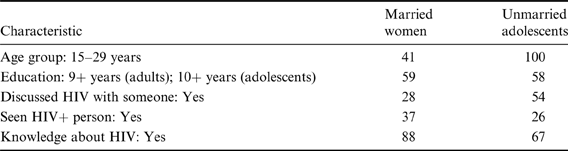
The frequency distributions of the independent socio-demographic variables are presented in Table 1. Among married respondents, 41% were under 30 years of age, and over half had more than eight years of schooling. Only 28% said they had discussed HIV with others, 37% said they had seen someone with HIV and 88% could name at least one HIV prevention method. Most women cited television as their principal source of HIV-related information. Only 6% said they had been close to someone infected with HIV (not shown in table).
Selected characteristics of married women (N=494) and adolescents (N=186), percentage distributions
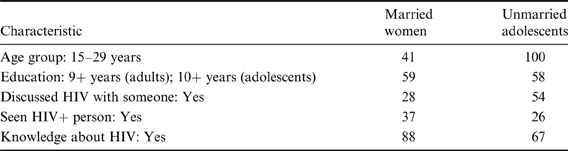
Male and female adolescents were grouped to provide a larger sample for analysis, and because their answers were not significantly different with respect to the majority of the stigma-related questions. Adolescents had higher educational levels than older women: 58% had more than 10 years' schooling, and many were still studying. Over half (54%) had discussed HIV with someone, 26% said they had seen someone with HIV and 67% could name at least one prevention method.
Many respondents, both married women and adolescents, gave examples of how people with HIV had been treated in the community. The case of one HIV-affected couple was cited repeatedly. Rejected by family and friends, the pair had moved to a hut in the fields to die. However, the case of a young village woman who had contracted HIV from her husband (who had died soon after their marriage) was also frequently mentioned. She was doing well on treatment and now had a successful teaching career in another community. When she visited the village she was treated with affection and respect.
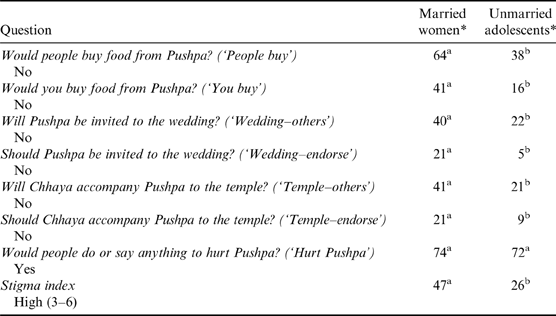
A comparison of the responses of married women and adolescents to the stigma-related questions is presented in Table 2. Married women perceived and expressed a considerable amount of stigma, significantly more than adolescents on most questions. For example, 64% of women said people would not buy food from Pushpa, compared with 38% of adolescents. Forty-seven per cent scored high on the stigma index compared with 26% of adolescents. However, there was no significant difference in responses to the question of whether people would say or do something to hurt Pushpa, all perceiving that they would.
Percentage of married women, aged 15–49 (N=494), and of unmarried adolescents, aged 15–19 (N=186), giving stigmatizing answers
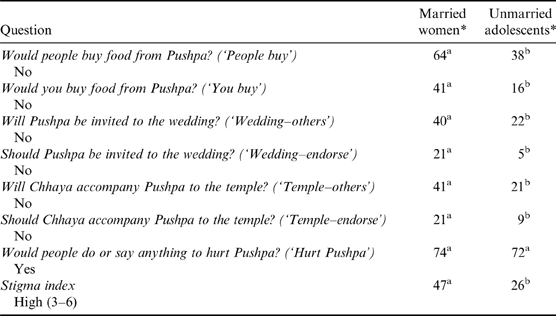
* Percentages with different superscripts (a and b) across rows are significantly different (p<0.01), using normal test for proportions.
Overall, respondents gave less stigmatizing responses themselves than they attributed to others. For instance, 40% of married women said that others would not invite Pushpa to a wedding, whereas the majority felt that she should be invited. Similarly, 21% of adolescents felt that Chhaya would refuse to accompany Pushpa to the temple, whereas only 9% endorsed this behaviour. Interestingly, while both women and adolescents generally failed to endorse community stigma, and many, in their qualitative comments, lamented its existence, they appeared to accept this situation without expressing any feelings of obligation to act upon it.
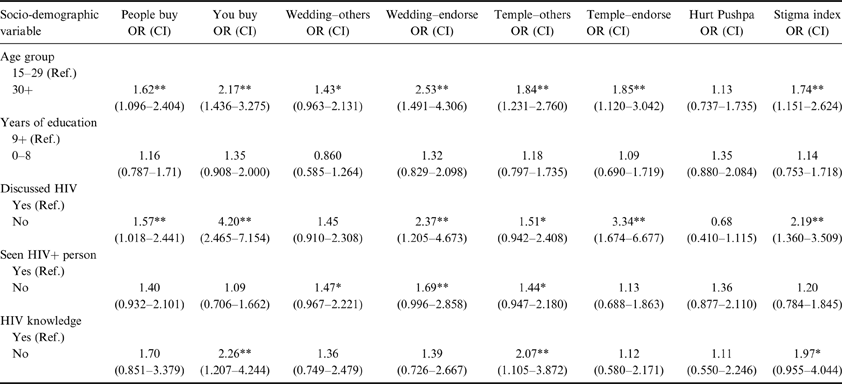
The multivariate logistic results for married women are presented in Table 3. Referring first to the individual stigma-related questions, the odds of giving stigmatizing responses increased with age. Older women expressed more stigma than younger women, the odds ranging from 1.4 to 2.5, but was not significant for one variable, ‘hurt Pushpa’. Lack of discussion of HIV was significantly related to more risk of stigma on all but two questions (‘wedding–others’ and ‘hurt Pushpa’). Those who had not seen someone with HIV were significantly more likely to express stigma on three questions (‘wedding–others’, ‘wedding–endorse’ and ‘temple–others’). Lack of knowledge about HIV was significantly related to greater stigma on two questions (‘you buy’, ‘temple–others’). Education was not significantly associated with any of the stigma questions, although the odds ratios (ORs) were higher than one in most cases. The questions regarding the respondents' own potential behaviour (‘you buy’) and judgements (‘wedding–endorse’ and ‘temple–endorse’) showed the highest ORs. For example, women who had not discussed HIV were 4.2 times less likely to purchase Pushpa's food than those who had.
Adjusted odds ratios (OR) of factors associated with stigmatizing responses among married women, aged 15–49 (N=494)
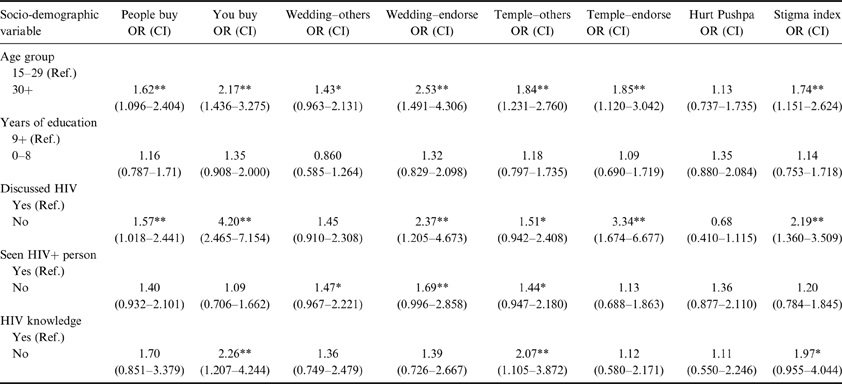
**p<0.05; *p<0.1.
Relationships with the stigma index were significant for three independent variables: age, discussion and knowledge about HIV. For the other two variables – education and having seen someone with HIV – the ORs were not significant but were in the expected direction.
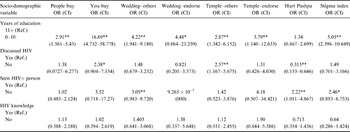
The multivariate logistic analysis results for adolescents are presented in Table 4. It can be seen that adolescents with lower education expressed significantly higher stigma on all but one question (‘hurt Pushpa’). Those who had not discussed HIV with anyone expressed significantly higher stigma on two of the questions (‘you buy’ and ‘temple–others’). However, on the ‘hurt Pushpa’ question, discussion was significantly related to higher stigma. Those who had never seen an HIV-positive person expressed significantly more stigma on two questions (‘wedding–others’ and ‘hurt Pushpa’). While no other relationships achieved statistical significance, most of the ORs were in the expected direction.
Adjusted odds ratios (OR) of factors associated with stigmatizing responses among unmarried adolescents, aged 15–19 (N=186)
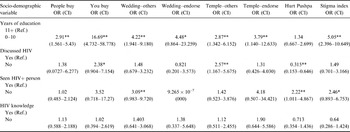
**p<0.05; *p<0.1.
With regard to the stigma index, relationships were significant for both education and having seen someone with HIV, while the relationships with the other two variables (discussion of HIV and knowledge of HIV) were in the expected direction.
Discussion
The above results demonstrate that the goal of reducing stigma, already a national priority in India, is an urgent one, and that programmes aimed to reduce it need to be targeted at the general community as well as specific groups. Intervention programmes need to be accompanied by an understanding of the nature of stigma in the general population and the characteristics of community members who enact, endorse and accept stigma. This study has proposed a module with a few simple questions that can throw light upon and assess these dimensions of stigma.
The majority of this study's hypotheses, based on the findings of other studies, were confirmed. Age, discussion with others and knowledge about HIV were the most important predictors of stigma for married women, whereas education and discussion about HIV were the best predictors among adolescents. The lack of significant correlation between education and stigma among married women may be because information about HIV was not part of the traditional school curricula, whereas adolescents had benefited from the HIV prevention project. This difference is further indicated by the positive relationship between knowledge about HIV and lower stigma among married women, whereas for adolescents, education was a distinguishing variable. People were more likely to attribute stigma to others than to themselves, also in line with the findings of others (Alicke, Reference Alicke1985; Taylor & Brown, Reference Taylor and Brown1988; Visser et al., Reference Visser, Kershaw, Makin and Forsyth2008). Generally, respondents exhibited more sympathy than blame with respect to their own viewpoints, but affirmed emphatically the existence of community stigma. The endorsement of community stigma in some cases, and the general acceptance of its existence without exhibiting any need to confront the situation, indicated a general lack of ownership of the problem by community members.
As expected, more stigma was elicited from the questions regarding more intimate social relationships. For example, the questions about a marriage invitation and accompanying Pushpa to the temple educed less stigmatizing responses than the questions regarding buying food from an HIV-positive person. A greater number of significant relationships were found for married women than for adolescents, probably due to the larger sample size and their greater range of responses to the stigma-related questions.
It can be concluded that this module is a promising tool for future research on community stigma toward HIV in rural India, and for the assessment of HIV-related interventions, for several reasons. Firstly, the culturally appropriate vignette allowed respondents to imagine and relate to the subject as a familiar person, while being free to distance themselves sufficiently to answer sensitive questions. Secondly, the findings are consistent with those of other studies that have found variations in stigma by socio-demographic characteristics, demonstrating the module's strength as a stigma-discriminating tool and its capacity for determining where interventions may be most useful. For example, discussion of HIV was found to be strongly associated with lower stigma, consistent with the observations of Genberg et al. (2009) and UNAIDS (2001). Hence, expanding opportunities for HIV discussion is a key recommendation. Thirdly, the combination of quantitative and qualitative, explanatory responses can help identify different degrees of stigma requiring different levels of intervention (Weiss, Reference Weiss2008). For example, the prevalence and acceptance of hurtful behaviour in the community indicates the need for changes at both legal and normative levels. Fourthly, the module was found to be applicable to different populations of diverse age and sex composition. Finally, it is short, easy to use and capable of yielding results quickly.
A problem shared by all stigma measures is the degree to which they reflect actual stigma. People may under-report their own stigmatizing feelings, perceiving themselves to be less negative than others. In this study, the fictional situation in the vignette may have created a ‘comfortable’ distance between the respondent and the case presented, resulting in answers less judgemental than might be true in real-life situations. Such answers, however, are likely to underestimate, rather than overestimate, stigma, indicating that when stigma is widely acknowledged, as in this study, it is a significant problem to be addressed.
It would be interesting to further test this instrument with a male vignette in the rural Indian setting, in order to compare sex differences in people's responses. While it might be expected that stigma against a male vignette would be less pronounced, variations in the expression of stigma would probably be seen with respect the different situations presented in the questions. It would also be interesting to adapt this module to other settings as well, using culturally specific examples, while retaining the same overall dimensions of stigma used in this study.
Acknowledgments
The authors wish to thank the Swiss Tropical and Public Health Institute, University of Basel, Switzerland, for its financial and technical support for this project, and the Agharkar Research Institute, India, for its institutional and logistical assistance. The help of Ms Sangita Mohite, Ms Chhaya Sawant and Mr Nitiraj Sable, research assistants, is greatly appreciated, as is the constant co-operation and participation of the village people in this study.
Appendix
Vignette and question module on HIV-related stigma
Pushpa is a 35-year-old Maratha woman from this village. She prepares and sells snacks at the market. You like her food and often buy one of her snacks. Her husband worked in Mumbai for eight years and recently returned to the village. He was sick with AIDS and Pushpa was also infected. She is not visibly ill.
1. Is there anything she could have done to prevent getting AIDS?
2. What is Pushpa's biggest problem?
3. If Pushpa asked you for advice about her problem, what would you suggest she do about it?
4. Would people buy food from her?
4.1. What about you? Would you buy food from her?
5. Pushpa has a friend, Manisha. Last year Manisha's daughter got married and Pushpa went to the wedding. Manisha's younger daughter is getting married this year. Will Pushpa be invited this time?
5.1. What is your own opinion? Do you think she should be invited?
6. Before her husband got sick, Pushpa always went to the temple on Thursdays with her friend, Chhaya. Will Chhaya still go with her?
6.1. What is your own opinion? Do you think Chhaya should still go with her?
7. Do you think people might say or do anything to hurt Pushpa because of her illness?
8. Now that you and others in the community know about AIDS, do you ever talk about it?
9. Have you ever seen someone with HIV/AIDS? We are not interested in knowing the person's name, just if you have seen someone with the illness.
9.1. Does anyone close to you have it? (PROBE ON CHARACTERISTICS: SEX, AGE)
9.2. Did they have any problems in the community because of their illness? What kinds?
IS THERE ANYTHING YOU WOULD LIKE TO ADD OR ASK? THANK YOU VERY MUCH FOR YOUR TIME AND CO-OPERATION.