Introduction
It is widely accepted that cognitive status in the elderly predicts mortality and functional status (Holland & Rabbitt, Reference Holland and Rabbitt1991). High cognitive performance has been associated with better mental health, for example lower risk of psychiatric disorders (Zammit et al. Reference Zammit, Allebeck, David, Dalman, Hemmingsson, Lundberg and Lewis2004; Hatch et al. Reference Hatch, Jones, Kuh, Hardy, Wadsworth and Richards2007; Martin et al. Reference Martin, Kubzansky, LeWinn, Lipsitt, Satz and Buka2007), and the emerging field of cognitive epidemiology has begun to explore the role of cognitive ability in physical health and disease outcomes (Gottfredson, Reference Gottfredson2004; Deary & Batty, Reference Deary and Batty2007). Good performance on cognitive tests has been shown to be associated with lower mortality (Whalley & Deary, Reference Whalley and Deary2001; Hart et al. Reference Hart, Taylor, Davey Smith, Whalley, Starr, Hole, Wilson and Deary2003; Singh-Manoux et al. Reference Singh-Manoux, Ferrie, Lynch and Marmot2005; Batty et al. Reference Batty, Deary and Gottfredson2007a; Jokela et al. Reference Jokela, Batty, Deary, Gale and Kivimäki2009a; Sabia et al. Reference Sabia, Guéguen, Marmot, Shipley, Ankri and Singh-Manoux2008), better self-reported health, and lower prevalence of chronic diseases (Hart et al. Reference Hart, Taylor, Smith, Whalley, Starr, Hole, Wilson and Deary2004; Schnittker, Reference Schnittker2005; Bosma et al. Reference Bosma, van Boxtel, Kempen, van Eijk and Jolles2007).
Despite the increasing number of cognitive epidemiologic studies, there has been little, if any, research addressing whether the relationship between cognitive performance and health changes over the adult life course, that is whether this relationship remains stable, diminishes, or grows stronger with age. This issue is particularly important in understanding the role of cognitive factors in successful ageing. Furthermore, it remains unknown whether age-related social transitions, such as retirement, modify associations between cognitive performance and health. Retirement is one of the most important social transitions in late adulthood, as it involves substantial changes in daily life and social environments, and retirement has been associated with health outcomes, and with mental health gains in particular (Kim & Moen, Reference Kim and Moen2001; Drentea, Reference Drentea2002; Mein et al. Reference Mein, Martikainen, Hemingway, Stansfeld and Marmot2003).
In the present study using the Whitehall II occupational cohort (Marmot et al. Reference Marmot, Davey Smith, Stansfeld, Patel, North, Head, White, Brunner and Feeney1991; Marmot & Brunner, Reference Marmot and Brunner2005), we examined whether cognitive performance predicted mental health and physical functioning differently at different times of the adult life course from midlife to early old age. Previous studies have shown that social inequalities in health increase with age (Sacker et al. Reference Sacker, Clarke, Wiggins and Bartley2005; Chandola et al. Reference Chandola, Ferrie, Sacker and Marmot2007). Given that cognitive abilities are known to be associated with socio-economic status (SES; Strenze, Reference Strenze2007), we assessed the role of SES in explaining the link between cognitive performance and health. In addition, we examined whether retirement modified the association between cognitive performance and health. Assuming that being retired is less cognitively demanding than work life, we hypothesized that cognitive performance would be less strongly related to health in retired than in non-retired participants.
Method
Participants
The ongoing longitudinal Whitehall II cohort study has followed a sample (n=10 308) of male and female civil servants in London, UK, since 1985–1988 when the participants were 35–55 years of age (Marmot et al. Reference Marmot, Davey Smith, Stansfeld, Patel, North, Head, White, Brunner and Feeney1991; Marmot & Brunner, Reference Marmot and Brunner2005). We used data from six follow-up phases (phases 3–8, collected in 1991–1993, 1995–1996, 1997–1999, 2001, 2003–2004 and 2006 respectively). The participants were 39–64 years of age at baseline for the present study (phase 3) and 50–76 years of age at the most recent follow-up. Thus, different participants provided data across the whole age range (39–76 years) depending on their age at baseline and year of follow-up. Here we included all participants who provided data at least at one follow-up phase (n=7692; 5414 men, 2278 women). At phases 3, 4, 5, 6, 7 and 8, data were available for 3379, 2994, 5749, 5116, 6180 and 5799 participants respectively. Thus, the total number of observations used in the multilevel model was 29 217. Ethical approval for the Whitehall II study was obtained from the University College London Medical School committee on the ethics of human research.
Cognitive performance
Cognitive performance was measured as the first factor derived from principal component analysis of five standard tests: (1) verbal memory was assessed by a 20-word free recall test of short-term memory; (2) the Alice Heim 4 part I (AH 4-I) 32-item verbal reasoning test (Heim, Reference Heim1970); (3) the AH 4-I 33-item mathematical reasoning test (Heim, Reference Heim1970); (4) phonemic fluency was assessed using ‘S’ words; and (5) semantic fluency using ‘animal’ words (Borkowski et al. Reference Borkowski, Benton and Spreen1967). In the short-term memory test, participants were presented a list of 20 one- or two-syllable words at 2-s intervals and were then asked to recall in writing as many of the words in any order within 2 min. The AH 4-I is a test of inductive reasoning that measures the ability to identify patterns and infer principles and rules. Participants had 10 min to complete this section. In the phonemic and semantic fluency tests, subjects were asked to recall in writing as many words beginning with ‘S’ and as many animal names as they could. One minute was allowed for these tests. Factor analysis of these cognitive tests indicated that the first factor accounted for 59% of the variance in these tests, and this factor score was used as the indicator of cognitive performance in the analyses [mean=0, standard deviation (s.d.)=1]. The factor analysis was performed across phases so that the factor loadings were the same at each phase. Cognitive tests were administered to a subsample of the participants at phase 3 (n=3489) and to all participants at phases 5 (n=5882) and 7 (n=6286).
Mental and physical health
Mental and physical health was assessed using the SF-36 questionnaire (Ware et al. Reference Ware, Snow, Kosinski and Gandek1993; Ware, Reference Ware2000) at all six follow-ups from phase 3 to phase 8. In the present study, we used two of the subscales (mental health and physical functioning), representing the main SF-36 subscales for mental and physical health respectively (Ware, Reference Ware2000). The mental health scale includes five items assessing psychological well-being (e.g. feeling happy, feeling nervous) and the physical functioning scale includes 10 items assessing the ability to carry out daily activities (e.g. difficulties in carrying groceries, difficulties in walking long distances). Both scales were negatively skewed, so they were transformed by cubic transformations (i.e. X T=X 3/10 000). Following common practice for using the SF-36, the scales were then transformed into t scores so that the overall mean score across participants and follow-up phases was 50 (s.d.=10). The scales were scored so that higher values indicated better health.
SES and retirement
SES was assessed on the basis of the participant's civil service employment grade (0=low, 1=middle, 2=high) reported by the participants at each phase. For participants who did not have these data (e.g. participants who had retired or were no longer working in the civil service), SES was assigned to be the employment grade at the most recent follow-up in which data on grade were provided.
At each follow-up phase, the participants reported whether or not they were retired, and this was used as the indicator of retirement status (0=not retired, 1=retired). Although the statutory retirement age is 60 in the civil service, some participants retired earlier (e.g. voluntarily or due to illness) whereas others had not retired by age 60 (e.g. because they continued to work outside the civil service). Thus, even though retirement status was strongly associated with age, they were not completely collinear (correlations between retirement status and age r=0.53 before age 60 and r=0.57 after age 60; see details of modelling the effects of age below), which allowed us to examine the moderating role of retirement status in addition to the ageing effect.
Statistical analysis
We applied multilevel longitudinal modelling (Singer & Willett, Reference Singer and Willett2003; Gelman & Hill, Reference Gelman and Hill2007) to evaluate whether cognitive performance predicted the shape of health trajectories over the adult life course. Data were structured so that measurement times (observations at each phase) were nested within individuals, and the standard error (s.e.) were calculated by taking into account the non-independence of the observations; that is, that the same individuals contributed more than one observation to the dataset. On average, participants provided data at four of the six possible follow-up phases. In the multilevel models, regression coefficients are interpreted in the same way as non-standardized coefficients in ordinary linear regression. All predictors, apart from sex, were entered as time-varying covariates. Models included a random term for intercept but we did not include random terms for age or other covariates (data on the random part of the model not shown).
Based on preliminary analysis of the mental health trajectory, we modelled the effect of age using a piecewise approach (Naumova et al. Reference Naumova, Must and Laird2001), where the age range (from 39 to 76 years) was divided into two parts: before and after the age of 60. This was accomplished by creating one age variable for the age period of 39–59 (Age before 60 years, abbreviated to Ageb, and 0 otherwise) and another age variable for the age period 60–76 (Age after 60 years, abbreviated to Agea, and 0 otherwise). Both of these variables were centred on age 60 (i.e. were equal to age minus 60). Although the average physical functioning trajectory had a different shape than the mental health trajectory, we applied the same piecewise approach in modelling physical functioning because it provided a flexible model to examine whether cognitive performance predicted health trajectories differently before and after the age of 60.
To test whether the association between cognitive performance and health trajectories increased or decreased with age, we assessed interaction effects between cognitive performance and age with each age term included in the model. These interactions were assessed by first testing interaction terms with linear indicators of age and then with quadratic indicators of age. Only significant interaction terms were retained in the models. The interaction effects between SES and health were assessed in the same way. To test whether cognitive performance predicted health differently in retired and in non-retired participants, we assessed interaction effects between cognitive performance and retirement. The results were illustrated by plotting predicted mental health and physical functioning trajectories by age for three selected scores of cognitive performance (1 s.d. below the mean, the mean value, and 1 s.d. above the mean).
All models were adjusted for sex and its statistically significant interaction effects with age, that is allowing the association between sex and the outcomes to change over time. As data on cognitive performance were not available at phases 4, 6 and 8, we assigned cognitive performance scores assessed at phase 3, 5 and 7 to phases 4, 6 and 8 respectively, in order to include all health outcome measures (assessed at each phase) in modelling the mental and physical health trajectories. Given that different participants were followed over different age periods, the study design allowed the role of period or cohort effects to be taken into account in addition to ageing effects. Following previous research from the Whitehall II cohort (Chandola et al. Reference Chandola, Ferrie, Sacker and Marmot2007), we decided to adjust for period effects. The multilevel models were fitted using the xtreg command in Stata 9.2 (StataCorp, USA) statistical program.
Results
Mental health
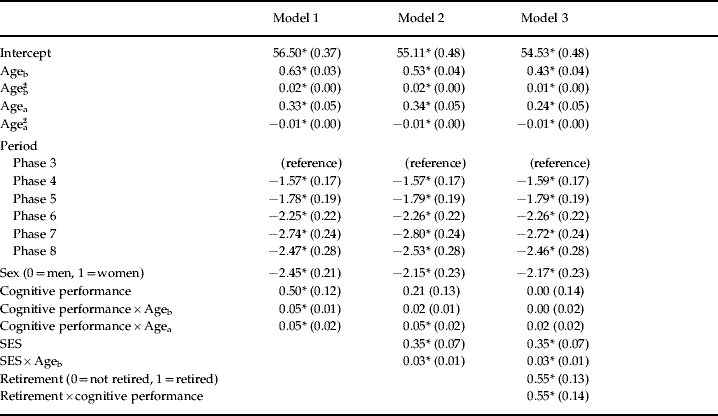
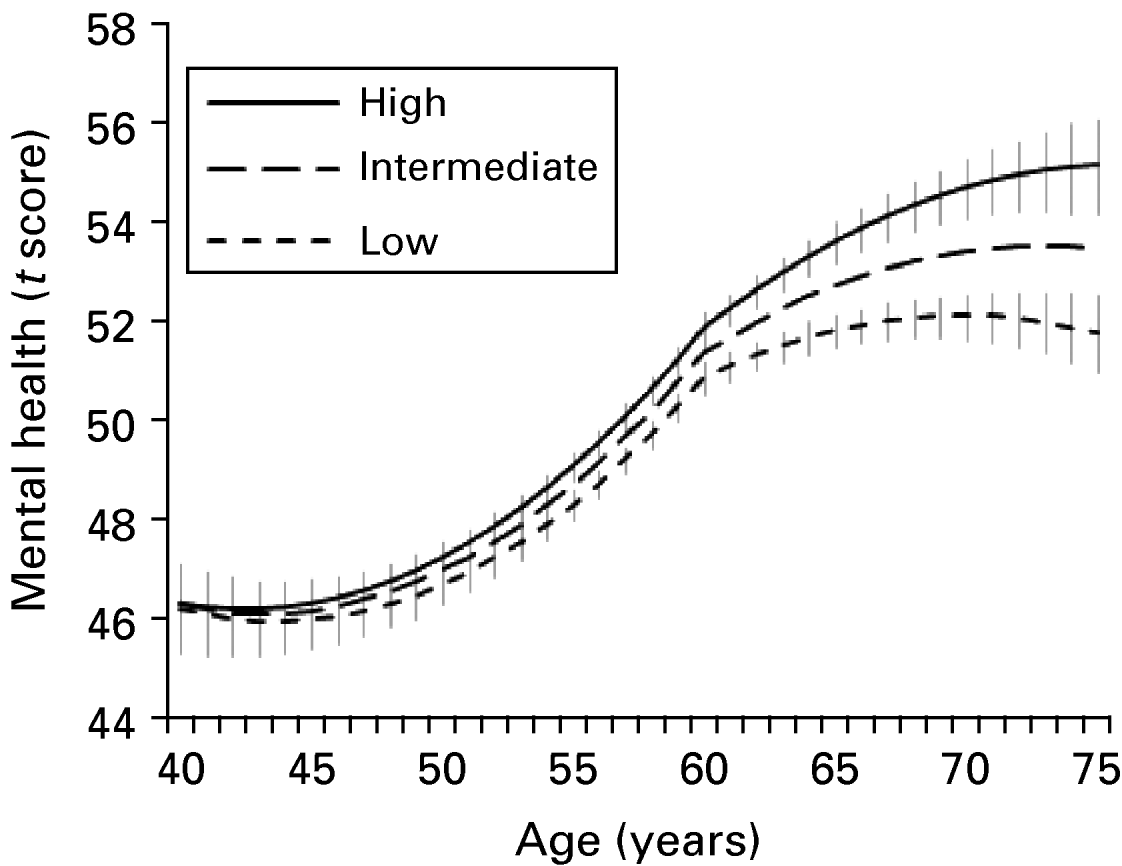
Preliminary analysis of mental health and age indicated that a model including linear and quadratic effects of age fitted the data well, describing an S-shaped trajectory. On average, mental health increased between 39 and 60 years of age, after which the increase began to level off. Women had lower mental health than men (Table 1).
Predicting mental health trajectories from 40 to 75 years of age by cognitive performance, socio-economic status (SES) and retirement status. Beta coefficients (and standard errors) of nested multilevel models (n=7692)

Ageb, Age before 60 years; Agea, age after 60 years.
The main effect of cognitive performance refers to 60-year-olds (model 1), low-SES (model 2) and non-retired (model 3) participants. Mental health is scored as a t score (mean=50, standard deviation=10).
* p<0.05 level (minimum).
Interaction effects between cognitive performance and age before and after 60 years (Table 1, model 1) indicated that the association between cognitive performance and mental health increased with age (Fig. 1). The predicted mental health scores in those with high (+1 s.d.) compared to low (−1 s.d.) cognitive performance levels was better by 0.5, 1.0 and 2.6 units at 50, 60 and 70 years of age respectively.
Predicted mental health trajectories (and 95% confidence intervals) by levels of cognitive performance (low=1 s.d. below the mean; intermediate=mean; high=1 s.d. above the mean). For clarity, the 95% confidence intervals (vertical lines) are not shown for the intermediate group.

The association between cognitive performance and health was accounted for, in part, by SES (Table 1, model 2). In an analysis that included cognitive performance and other covariates in the model, there was a significant interaction effect between SES and age before 60 years but not between SES and age after 60 years (B=0.00, s.e.=0.03, p=0.99; not included in the model), suggesting widening mental health differences associated with SES before age 60. Including SES and its interaction effect with age in the model attenuated the interaction between cognitive performance and age before 60 years (Table 1, model 2), indicating that SES accounted for the mental health differences associated with cognitive performance before but not after age 60.
We found evidence to suggest that retirement modified the association between cognitive performance and mental health (Table 1, model 3). There was an interaction effect between cognitive performance and retirement indicating that cognitive performance was associated with mental health more strongly in retired than in non-retired participants. Inclusion of this interaction term in the model attenuated the interaction effect between cognitive performance and age after 60 years. In other words, the widening mental health differences associated with cognitive performance after the age of 60 were related to retirement becoming more common, as retirement strengthened the association between cognitive performance and mental health.
Physical functioning
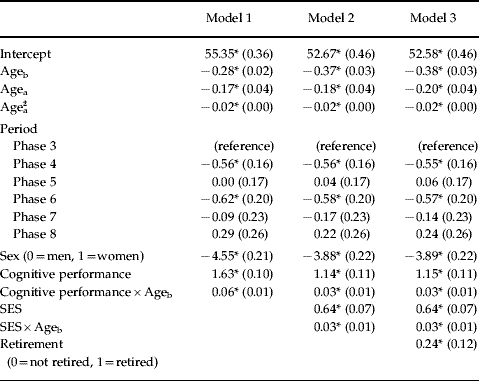
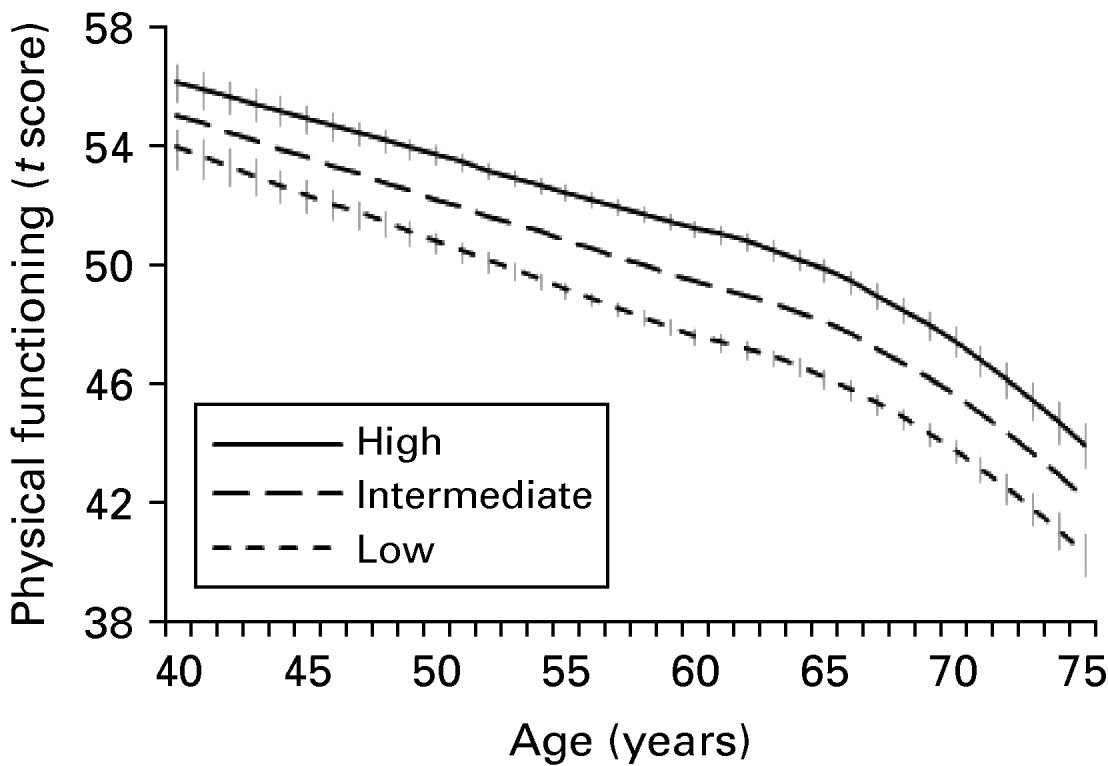
We then repeated the above analysis with physical functioning as the dependent variable. Physical functioning scores declined with age and this decline accelerated after the age of 60, as indicated by the significant quadratic effect of age after 60 years (Table 2, model 1). Women had lower physical functioning than men. The effects of period on physical functioning were not consistent across the phases.
Predicting physical functioning trajectories from 40 to 75 years of age by cognitive performance, socio-economic status (SES) and retirement status. Beta coefficients (and standard errors) of nested multilevel models (n=7692)

Ageb, Age before 60 years; Agea, age after 60 years.
The main effect of cognitive performance refers to 60-year-olds (model 1), low-SES (model 2), and non-retired (model 3) participants. Physical functioning is scored as a t score (mean=50, standard deviation=10).
* p<0.05 level (minimum).
There was a significant interaction effect between cognitive performance and age before 60 years but not with other age indicators (model 1), indicating that physical functioning differences associated with cognitive performance increased with age only before but not after the age of 60 (Fig. 2). The predicted difference between high and low cognitive performance groups was 2.2, 2.8, 3.6 and 3.6 units at ages 40, 50, 60 and 70 respectively.
Predicted physical functioning trajectories (and 95% confidence intervals) by levels of cognitive performance (low=1 s.d. below the mean; intermediate=mean; high=1 s.d. above the mean). The 95% confidence intervals (vertical lines) are shown only for the high and low groups.

Table 2 (model 2) shows that there was an interaction effect between SES and age before but not after 60 (B=0.01, s.e.=0.02, p=0.82; not included in the model), indicating that physical functioning differences associated with SES increased before but not after age 60. Inclusion of this interaction effect halved the magnitude of the interaction between cognitive performance and age before 60, suggesting that the widening differences in physical functioning between participants with high and low cognitive performance were partially explained by differences in SES. There was no interaction effect between cognitive performance and retirement (Table 2, model 3). Thus, retirement did not modify the association between cognitive performance and physical functioning (p value for interaction=0.56; not included in the model).
Attrition analysis
Attrition analysis suggests that our findings are not biased by selective attrition. For each phase, we created a dichotomous variable indicating whether or not the participant had data at the next phase. We then fitted a multilevel logistic model to predict this probability for cognitive performance, mental health and physical functioning, in analysis adjusted for sex, period and linear terms for age. Higher probability of attrition was associated with lower cognitive performance [standardized odds ratio (OR) 0.71, standard s.e.=0.02, p<0.001], poorer mental health (standardized OR 0.89, s.e.=0.02, p<0.001), and poorer physical functioning (standardized OR 0.86, s.e.=0.02, p<0.001). However, these attrition patterns did not contribute to the widening associations between cognitive performance and health because, if anything, the attrition attenuated rather than strengthened the estimated associations. For instance, regressing mental health on cognitive performance at phase 5 (adjusted for sex and age) in all participants who had data at phase 5 yielded the coefficient of B=1.27 (s.e.=0.34, p<0.001; n=5776). When the same linear regression model was fitted in participants who had data at phases 5 and 6 (i.e. excluding drop-outs between phases 5 and 6), the regression coefficient was B=1.01 (s.e.=0.36, p<0.001; n=5033). A similar, small attenuation effect was evident at other follow-up phases (data not shown).
Discussion
Findings from the longitudinal Whitehall II occupational cohort indicate that the importance of cognitive performance in predicting adult mental health and physical functioning may increase with age, resulting in widening health differences associated with cognitive performance. On average, cognitive performance was more strongly related to physical functioning than to mental health. However, the age-related changes in these associations were more pronounced for mental health than for physical functioning: mental health differences associated with cognitive performance widened with age from 39 to 76 years, whereas the physical functioning differences widened only between 39 and 60 years but not after 60 years of age.
The methodological strengths of the study include a large sample size and a longitudinal design with repeated measures of cognitive performance and health outcomes. Attrition analyses suggested that, although cognitive performance and health measures were associated with selective attrition, the selective attrition in question was unlikely to contribute to the widening health differences associated with cognitive performance observed in the data. The main caveat to our findings is that the participants were from an occupational cohort, which may limit the generalizability of the findings.
Performance in cognitive tests has been shown to predict a wide range of mental and physical health outcomes (e.g. Hart et al. Reference Hart, Taylor, Smith, Whalley, Starr, Hole, Wilson and Deary2004; Bosma et al. Reference Bosma, van Boxtel, Kempen, van Eijk and Jolles2007; Der et al. Reference Der, Batty and Deary2009; Gale et al. Reference Gale, Hatch, Batty and Deary2008). Although this association has been observed in samples representing different age periods in adulthood, there are, to our knowledge, no previous longitudinal studies examining this association at different ages in the same sample. The widening health differences observed in our data are therefore novel and imply that cognitive performance may become a more salient correlate of health at older ages.
There are at least four plausible mechanisms that could explain associations between cognitive performance and health (Whalley & Deary, Reference Whalley and Deary2001; Gottfredson & Deary, Reference Gottfredson and Deary2004; Batty et al. Reference Batty, Deary and Gottfredson2007a) and these could be extended to explain the effects of age observed in this study. First, cognitive performance and health may share a common cause, and such a common cause might account for the present findings if its impact were increasingly evident with age. For instance, vascular risk factors (e.g. hypertension, coronary heart disease and dyslipidaemia) become more prevalent with age and they have been associated with both cognitive performance (Singh-Manoux & Marmot, Reference Singh-Manoux and Marmot2005; Singh-Manoux et al. Reference Singh-Manoux, Gimeno, Kivimäki, Brunner and Marmot2008a, Reference Singh-Manoux, Sabia, Lajnef, Ferrie, Nabi, Britton, Marmot and Shipleyb) and health (Rugulies, Reference Rugulies2002; Kumari et al. Reference Kumari, Seeman and Marmot2004).
Second, cognitive performance may be related to health behaviours (Batty et al. Reference Batty, Deary and Macintyre2007b, Reference Batty, Deary, Schoon and Galec). In this case, any association between cognitive performance and health, and physical health in particular, would be expected to strengthen as physical illnesses associated with adverse health behaviours become more prevalent with age. However, as we observed widening differences in physical functioning before but not after the age of 60, this seems an unlikely explanation of our findings. Third, despite the prospective study design, the association between cognitive performance and health may reflect reverse causality; that is, cognitive performance may be affected by mental and physical health (Yaffe et al. Reference Yaffe, Blackwell, Gore, Sands, Reus and Browner1999; Ganguli et al. Reference Ganguli, Du, Dodge, Ratcliff and Chang2006; Chodosh et al. Reference Chodosh, Kado, Seeman and Karlamangla2007; Dotson et al. Reference Dotson, Resnick and Zonderman2008).
Fourth, cognitive performance may predict selection into more ‘healthy’ social environments, for example high SES (Batty et al. Reference Batty, Deary and Gottfredson2007a, Reference Batty, Shipley, Mortensen, Boyle, Barefoot, Grønbaek, Gale and Deary2008; Jokela et al. Reference Jokela, Elovainio, Singh-Manoux and Kivimäki2009b), or be a marker of such environments. Previous research in the present and other cohorts suggests that health inequalities associated with SES may increase with age (Sacker et al. Reference Sacker, Clarke, Wiggins and Bartley2005; Chandola et al. Reference Chandola, Ferrie, Sacker and Marmot2007). In agreement with these observations, we found that, before the age of 60, SES explained the increasing role of cognitive performance either completely (in the case of mental health) or in part (in the case of physical functioning). However, SES did not attenuate the association between cognitive performance and health after age 60, implying that socio-economic circumstances may be relevant in explaining the cognition–health association primarily in working-age populations. Alternatively, the SES measure used in the present study, employment grade, may have failed to capture post-retirement socio-economic conditions completely, so the lack of attenuation might be caused by residual confounding.
Contrary to our hypothesis, cognitive performance predicted mental health more strongly in retired than in non-retired participants. This finding suggests that retirement might involve cognitively challenging social changes, as retiring individuals reorganize their lives and adjust to new daily activities without the structure of work that has characterized most of their adult lives (Kim & Moen, Reference Kim and Moen2001). The modifying role of retirement accounted for the widening differences in mental health after the age of 60; that is, mental health differences associated with cognitive performance became more pronounced as more participants became retired. Retirement did not moderate the association between cognitive performance and physical functioning, indicating that the changing circumstances related to retirement may not be as relevant for physical health in early old age.
The observed associations between cognitive performance and health trajectories need to be interpreted keeping in mind the examined age range of 39–76 years. On average, mental health was at its lowest level between ages 45 and 50 and began to increase after this age period, whereas physical functioning decreased consistently between the ages of 39 and 76 years. Thus, cognitive performance was associated with a steeper age-related increase in mental health and a less steep decline in age-related physical functioning. This suggests that high cognitive performance may be associated with both health gains and health losses related to ageing. However, it is noteworthy that these were only modifications of a general age-related trend because individuals with different levels of cognitive performance all followed the same general mental health and physical functioning trajectories. Further research is needed to assess whether the relationship of cognitive performance with mental and physical health reflect common or separate underlying mechanisms.
In sum, the present findings indicate that the association between cognitive performance and health may be dependent on age and age-related social transitions. Our data suggest that cognitive epidemiology, the study of the role of cognition in health (Deary & Batty, Reference Deary and Batty2007), would benefit from closer attention to the role played by ageing in shaping this association across the life course. This is particularly relevant as the importance of multiple psychological and social factors in explaining the cognition–health association is likely to vary over the life course. Future research should assess the extent to which other social (and biological) factors, in addition to SES and retirement, contribute to these age-related changes.
Acknowledgements
The Whitehall II study has been supported by grants from the British Medical Research Council (MRC); the British Heart Foundation; the British Health and Safety Executive; the British Department of Health; the National Heart, Lung, and Blood Institute (grant HL36310); the National Institute on Aging (grant AG13196); the Agency for Health Care Policy and Research (grant HS06516); and the John D. and Catherine T. MacArthur Foundation Research Networks on Successful Midlife Development and Socioeconomic Status and Health. M.K. was supported by the Academy of Finland (grants 117604, 124322, and 124271). J.E.F. was supported by the MRC (grant G8802774), A.S.M. by a ‘European Young Investigator Award’ from the European Science Foundation, M.J.S. by the British Heart Foundation and M.G.M. by an MRC Research Professorship.
Declaration of Interest
None.