1. Introduction
The relevant literature has two main approaches to accounting for the morphosyntax of the English construction in (1).

These approaches are based on one of two main ideas, either Case assignment across the boundary of the complement clause, termed Exceptional Case Marking (ECM), or movement to the matrix clause for Case assignment, termed Raising-to-Object (R-to-O). A standard assumption for both approaches is that the Acc-marked DP in (1) is an argument of the embedded predicate and bears no thematic relationship with the matrix predicate.
Exceptional Case Marking (Rosenbaum Reference Rosenbaum1967; Chomsky Reference Chomsky, Anderson and Kiparsky1973, Reference Chomsky1981; Bach Reference Bach1974) assumes that the DP Mary in (1) occupies the embedded Spec,TP position and receives its θ-role from the embedded predicate, but that it is governed and assigned structural Acc Case by the matrix V0, which is the Government-Binding (GB) Acc Case assigner (Chomsky Reference Chomsky1981). Assuming the Visibility Condition, this analysis is untenable since the clausal argument of believe (TP) does not receive Case, which, in turn, means that it is not visible at LF for θ-role assignment. The fact that the complement TP is interpreted as a proposition of believe indicates that the structural Acc Case licensed by believe (V0 in GB and v*0 in the Minimalist Program or MP) must be obtained by the TP. This casts doubt on the ECM analysis.
Raising-to-Object (Postal Reference Postal1974; Johnson Reference Johnson1991; Lasnik & Saito Reference Lasnik, Saito, Dobrin, Nichols and Rodriguez1991; Chomsky Reference Chomsky1995; Runner Reference Runner1995, Reference Runner2006; Bruening Reference Bruening2001; Bošković Reference Bošković2002) assumes that Mary in (1) moves from the embedded subject position to an object position in the matrix clause, where it receives structural Acc Case from the Acc Case licensing head of believe (V0/Agro0/v*0). This approach is supported by the observation that Mary is not in the embedded clause (in the surface structure) but rather in the matrix clause since a VP-adverb like sincerely, which is interpreted in relation to the matrix predicate, can follow Mary, as (2)–(3) show.Footnote [2]

As far as structural Case is concerned, this approach is also untenable because it leaves no structural Case for the clausal complement of believe, TP, which means that it will not be visible at LF for θ-role assignment, contrary to fact. I assume no Agr projections (Pollock Reference Pollock1989, Chomsky Reference Chomsky and Freidin1991) since they were eliminated in Chomsky (Reference Chomsky1995). I follow Chomsky (Reference Chomsky2001) in that T0 licenses structural Nom Case on the subject and v*0 licenses structural Acc Case on the object. Thus, I dispense with Agro0 and V0 as structural Acc Case checking categories.
The present paper investigates the SA counterpart in (4), and provides a novel approach, based on a new interpretation of the morphosyntactic properties of this construction as well as on the distinction between structural Case and lexical case laid out in Al-Balushi (Reference Al-Balushi2011).Footnote [3]

As will be clear from the presentation of the morphosyntactic properties of the ‘believe’-construction in SA in Section 3, neither ECM nor R-to-O can be extended to (4). This is because the Acc-marked DP neither receives structural Acc Case from the matrix v*0 nor moves to the matrix clause for Case assignment, nor is it an argument of the embedded predicate.
The proposed conception of Case (Al-Balushi Reference Al-Balushi2011: 122–136) allocates to the terms ‘structural Case’, ‘lexical case’, and ‘default case’ denotations that are slightly different from standard usage. Structural Case is ‘licensed/checked’ on arguments, XPs merged in the A-domain (e.g. Spec, v*P, and complement to V0 position) with a [Case] feature, by functional heads in the A-domain, T0 and v*0, which I assume have intrinsic Case features; that heads have [Case] features was proposed in Chomsky (Reference Chomsky1995: 368) and Carstens (Reference Carstens2001: 147), among others. As will be argued in Section 4, the intrinsic Case feature is Verbal Case (VC), a feature with licensing functions and morphological reflexes. Lexical case, which is Acc in SA, is ‘assigned’ to non-argument nominals (topics, predicates), elements merged in A-bar positions, without a [Case] feature by lexical elements (copular verbs, ‘believe’-type verbs, and particles), which must discharge a lexical case to a nominal (unless blocked by another lexical case assigner). Besides, while arguments are licensed and made visible at LF for θ-role assignment by the feature [Case], non-argument DPs have similar features, like [Topic], with the potential of making them visible at LF for the Visibility Condition purposes. Default case is ‘obtained’ by non-argument nominals (default case mechanism applies) when they reach the morphological component without a morphological case specification as a result of not being in the scope of lexical case assigners (Schütze Reference Schütze2001, Soltan Reference Soltan2007); default case is Nom in SA (Mohammad Reference Mohammad and Eid1990, Reference Mohammad2000; Ouhalla Reference Ouhalla, Lightfoot and Hornstein1994). Non-arguments are never in the scope of structural Case checking categories (T0 and v*0), since those are relevant to structural Case, that is, to arguments. Therefore, the terms ‘Case checking/licensing’ and ‘case assignment’ are not used interchangeably. Section 2 presents the view of SA clause structure that is necessary for the presentation of the properties of the ‘believe’-construction, to be presented in Section 3. Section 4 discusses the conception of Case assumed here, with implications for the distinction between structural Case and lexical case. Section 5 presents the proposed analysis, motivates it, and compares it to some of the earlier proposals. Section 6 attempts to extend the current proposal to English. Section 7 concludes the paper.
2. The proposed view of clause structure
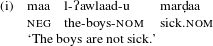
Standard Arabic allows the SVO order, as (5) shows, and the VSO order, as (6) shows. While the verb in the SVO order carries full subject agreement, it carries partial agreement in the VSO order.
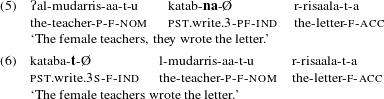
Unlike Mohammad (Reference Mohammad and Eid1990), Benmamoun (Reference Benmamoun1992, Reference Benmamoun2000), and Ouhalla (Reference Ouhalla, Lightfoot and Hornstein1994), who assume that the DP ʔal-mudarris-aa-t-u ‘the female teachers’ is a subject in (5)–(6), I follow Traditional Arab Grammarians (TAGs; e.g. Siibawayhi Reference Siibawayhi1990: 278) and Soltan (Reference Soltan2007: 50–61) who argue, for a number of reasons, that this DP is a subject in (6), merged in Spec,v*P, but a topic in (5), merged in a left-peripheral A-bar position. For example, while (5) conveys a categoricalreading, where an individual is mentioned and commented on, (6) conveys a thetic reading, which is a neutral report of an event (Basilico Reference Basilico1998: 546), suggesting that the two structures do not have the same semantics. Moreover, the pre-verbal DP can be associated with the subject, as (5) shows, as well as the object (theme), as (7) shows.

In addition, since the idiom in (8) loses idiomaticity when the word order is changed, as (9) shows, A-movement, from post-verbal to pre-verbal position, has not occurred (assuming that raising does not affect idiomaticity).
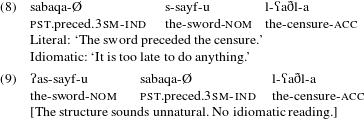
Thus, the two positions are not in the same domain. Also, when a subject in a coordinate structure is spelled out pre-verbally, it must be resumed by a pronoun in the coordinate island, as (10)–(11) show.
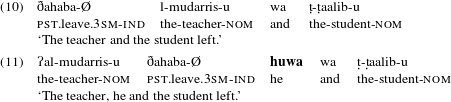
Therefore, the post-verbal DP is an argument (in Spec, v*P) whereas the pre-verbal one is a topic, that is, in the A-bar domain.
Finally, assuming with Soltan (Reference Soltan2007) that indefinite nonspecific NPs cannot occur pre-verbally, but only post-verbally, as (12)–(13) show, then the two positions are in different domains, A-bar and A, respectively.
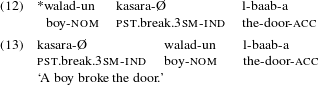
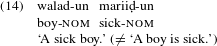
The fact that (14), with walad-un ‘a boy’ in pre-predicate position is a DP, not a clause, indicates that an indefinite nonspecific nominal is not allowed in pre-verbal position, that is, it may not be a subject.
While Soltan (Reference Soltan2007) assumes that the topic is merged in Spec,TP in (5), in Spec,NegP in (15), and in Spec,ModP in (16), I argue that it is merged in Spec,TopP (Topic Phrase, Rizzi Reference Rizzi and Haegeman1997) because many Arabic dialects allow two Neg particles in the clause (requiring two positions), as the Egyptian Arabic example in (17) shows, and also because modality particles are merged in Fin0, the locus of finiteness, which makes a Mod0 head superfluous.
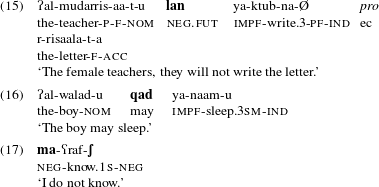
As for the subject in the DP-initial order (SVO), I will assume that it is pro, merged in the subject position, Spec,v*P. However, since pro – which I assume is the full agreement morphology (Al-Balushi Reference Al-Balushi2011) – is an affix, it must move to T0 and be spelled out by the verb to avoid being a stranded affix, which is why the verb realizes full agreement in (5). The view that full agreement morphology constitutes a pronominal argument makes reference to the Basran Grammarians’ incorporation analysis (Fassi Fehri Reference Fassi Fehri1993: 96); it has also been assumed in Platzack (Reference Platzack2003). Thus, pro is licensed by full agreement.
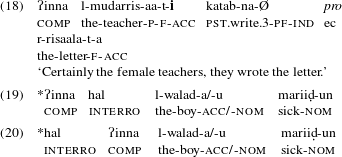
While I (standardly) assume that subjects receive structural Nom Case licensed by T0, I will follow TAGs (Al-Nadiri Reference Al-Nadiri1997: 511) and Soltan (Reference Soltan2007: 54) that topics receive default Nom case at PF, for two reasons. First, the topic appears with lexical Acc case when preceded by ʔinna (a complementizer and an Acc case-assigning particle, Fassi Fehri Reference Fassi Fehri1993: 87). Assuming the Case Freezing Condition (CFC), which states that a DP may not assume more than one Case value (Uriagereka Reference Uriagereka2008), the DP ʔal-mudarris-aa-t-i ‘the female teachers’ in (18) may not have received lexical Acc case from ʔinna after receiving structural Nom Case from T0.Footnote [4] I assume that ʔinna is merged in Force0 since it is in complementary distribution with hal, the yes/no interrogative particle in SA, as (19)–(20) show, ʔinna and hal being clause type markers.
Secondly, assuming that the topic is in Spec,TopP (or even in Spec,TP), and assuming Hallman (Reference Hallman2004), who argues that a head may not check Case on an element in its Spec position because it does not c-command it, the topic may not receive structural Nom from T0 since it is not c-commanded by T0, being even higher than its Spec position. Since structural Case is (standardly) ‘checked’ in narrow syntax and lexical case is (by assumption) ‘assigned’ at the end of narrow syntax, and default case is ‘obtained’ at PF, then lexical case can only ‘bleed’ default case, but not structural Case (more on Case issues in Section 4). Thus, there is no need for such a nominal to realize or receive more than one Case or case value.
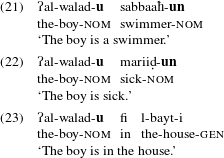
The same five arguments that pre-verbal DPs are topics in SVO structures could be extended to pre-predicate DPs in SA verbless sentences, exemplified in (21)–(23).Footnote [5] This is established in Al-Balushi (Reference Al-Balushi2012), where it is argued that although these sentences are finite clauses, encoding tense (Fassi Fehri Reference Fassi Fehri1993: 87–88; Benmamoun Reference Benmamoun2000: 40) and agreement (Fassi Fehri Reference Fassi Fehri1993: 88; Al-Balushi Reference Al-Balushi2011: 111–112), they do not license structural Case.
Standard Arabic verbless sentences encode tense because the present tense operator in the verbless clause contradicts the past tense operator contributed by the temporal adverb, hence (24) is ungrammatical, in contrast to (25).
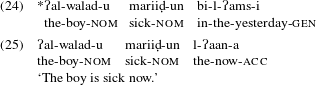
Verbless sentences encode sentential agreement, as the negative clause in (26) shows.

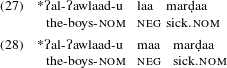
However, (26) is not completely verbless since the Neg laysa is composed of the negative particle laa and the archaic copula-like element ʔays (Ouhalla Reference Ouhalla1993).Footnote [6] Nonetheless, our view is supported by the fact that verbless sentences are ungrammatical with the non- ${\rm\phi}$-inflecting negative particles, as (27)–(28) show, which indicates that these clauses encode agreement that must be realized by the particle in the absence of the verb.Footnote [7]
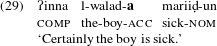
With regard to Case, the topic surfaces with default Nom case at PF since it realizes lexical Acc case in the presence of ʔinna, as (29) shows; thus the DP ʔal-walad-u ‘the boy’ is not in the scope of a Case-checking category in (21)–(23).Footnote [8]
Similarly, the predicate receives default Nom case in (21)–(22) since it realizes lexical Acc in the presence of the copula kaana ‘be’ (which assigns Acc case to the predicate, Benmamoun Reference Benmamoun2000: 43), as (30) shows.

Fassi Fehri (Reference Fassi Fehri1993: 89) states that the copula assigns morphological Acc to the nominal or adjectival predicate. I take ‘morphological’ to mean lexical, that is, to imply that it is non-structural Case. In other words, like default case, lexical case satisfies the Case Filter (morphological component), with no licensing functions.Footnote [9] The topic, which is now a subject in (30), being in Spec,PredP (Predicate Phrase, Adger & Ramchand Reference Adger and Ramchand2003), which is an argument position, receives structural Nom Case licensed by T0.
Since verbless sentences encode [T] and [ ${\rm\phi}$], but do not license structural Case, Al-Balushi (Reference Al-Balushi2012) argues that structural Case is absent due to the absence of the verb, thus establishing the connection between verbal licensing and argument licensing, as will be shown in Section 4.
3. Morphosyntactic properties of the ‘believe’-construction
This section presents the morphosyntactic properties of the ‘believe’-construction in SA in (31).

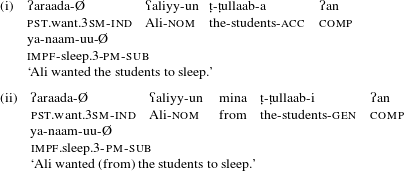
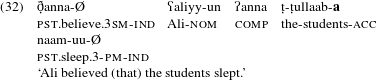
First, I assume with Soltan (Reference Soltan2007: 154–164) that the Acc-marked DP in (31) is in the embedded clause, and that it does not relate thematically or semantically to ð̣anna ‘believe’. For example, there is no semantic difference between the construction in (31) and the one in (32), where the embedded clause is a full CP.
Furthermore, Soltan argues that the fact that the ð̣anna-construction does not have a parallel prolepsis structure with a dative PP, as (33)–(34) show, indicates that the Acc-marked DP does not (start in or) move to the matrix clause.Footnote [10]
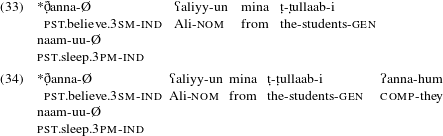
Moreover, if an adverbial follows ṭ-ṭullaab-a ‘the students’ in (31) above, as in (35), it can only modify the embedded clause, which indicates that the DP belongs there. This is also supported by the fact that using conflicting temporal adverbials results in grammaticality when ṭ-ṭullaab-a follows the matrix clause adverb, but ungrammaticality when it precedes both adverbials, as in (36)–(37).

Therefore, I will assume that the Acc-marked DP is merged and remains in the embedded clause. In addition, Soltan argues that the embedded clause in (31) is a TP, since the embedded clause lacks a CP layer (lacking an overt complementizer), and that the Acc-marked DP is base-generated and remains in its highest Spec position (Spec,TP, or Spec,NegP for negative sentences), which Soltan assumes to be an A-bar position. In other words, this DP does not move from the thematic domain to its surface position, for a number of reasons. For example, raising is excluded because idiomaticity is lost when post-verbal DPs are spelled out pre-verbally, as (38)–(39) show.
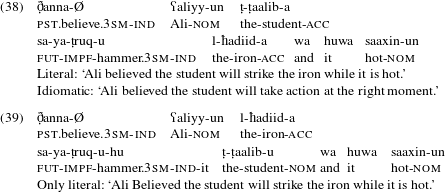
Also, the fact that the Acc-marked DP can be associated with subjects, as (40)–(41) show, and non-subjects, as (42)–(43) show, indicates that it is base-generated in its surface position.
Thus, the Acc-marked DP is not an argument of the embedded verb, but is co-indexed with a pronoun in the thematic domain.
Given these observations, Soltan (Reference Soltan2007: 160–161) concludes that the ‘accusative DP in ð̣anna-type sentences is base-generated in a peripheral position inside the embedded clause and A′-binds a resumptive pronoun in the thematic domain’. Therefore, and given the absence of an overt complementizer, argues Soltan, ‘there is no phase boundary between v* and the highest DP in the embedded clause, and accusative case assignment should proceed via Agree’ (page 161) between v*0 and the Acc-marked DP in embedded Spec,TP.
Although I agree with Soltan that the Acc-marked DP is merged and remains in the embedded clause and that it is Case-marked in its base-generated position, I disagree as to the category of the embedded clause and the exact position of the Acc-marked DP as well as the type of case that it receives. Thus, I will argue that the embedded clause, despite appearances, has a CP layer, and that this DP is actually merged in the embedded Spec,TopP position, which makes it accessible for case assignment (a property of non-arguments), rather than Case checking (a property of arguments), from the matrix predicate; more on this in Section 5.
The position that the embedded clause in (31) is a full CP is based on three arguments. First, given Soltan’s observation that ‘the embedded verb is in its tensed indicative form, not the subjunctive non-tensed form’ (Soltan Reference Soltan2007: 154), I argue that the complement clause in (31) is a tensed/finite CP. This claim is supported by the fact that the embedded verb can realize the past vs. non-past distinction, as (44)–(46) show, thus encoding the feature [Precedence], which ‘is at the heart of what can be called the narrow tense system’ (Cowper Reference Cowper2005: 15).
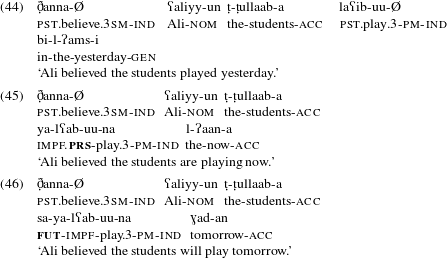
Basically, the embedded verb can have a tense specification different from that of the matrix verb. Also, that the embedded T0 is  ${\rm\phi}$-complete is shown by the morphology of the embedded verbs in (44)–(46).
In addition, Rizzi’s (Reference Rizzi and Haegeman1997) proposal that Fin0 is the locus of the inflectional properties available in the Infl domain indicates that Fin0 is available to anchor the tense and agreement (finiteness) specification on T0, thus indicating the existence of the CP layer, which makes Soltan’s position untenable, especially that it assumes that finiteness may reside in T0 (Soltan Reference Soltan2007: 161 fn. 7).
Secondly, there are Holy Qur’an data where the embedded Fin0 is occupied by a particle which assigns VC (Verbal Case), as (47) shows, thus indicating the presence of the CP layer.Footnote [11]
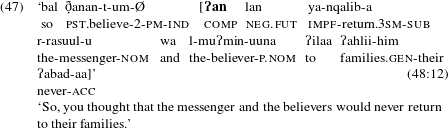
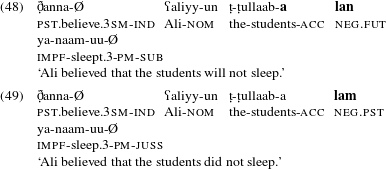
Thirdly, given sentences like (48)–(49), where the Acc-marked DP, which belongs in the embedded clause, appears to the left of negative particles (where Neg0 is higher than T0, as argued in Fassi Fehri Reference Fassi Fehri1993: 87, and Soltan Reference Soltan2007: 185), it is clear that the DP ṭ-ṭullaab-a is not in the embedded Spec,TP position, but rather in the embedded Spec,TopP, whose presence indicates that the embedded clause is a CP.
4. The proposed conception of case
Since earlier approaches to ‘believe’-type constructions are based on the theory of Case at the time, this section will present the theory of Case adopted here, but will start with arguments against the earlier proposals of structural Case.
4.1 Against earlier Case proposals
Following standard views on Case, structural Case has been assumed to be licensed in SA by tense and agreement (Aoun, Benmamoun & Sportiche Reference Aoun, Benmamoun and Sportiche1994: 204; Ouhalla Reference Ouhalla, Lightfoot and Hornstein1994: 48; Benmamoun Reference Benmamoun, Adger, Pintzuk, Plunkett and Tsoulas1999: 110; Reference Benmamoun2000: 40–41; Reference Benmamoun2008: 106–110; Soltan Reference Soltan2007). To motivate the proposed theory of Case, I will show that structural Case is licensed in the absence of agreement and tense. First, I assume Chomsky’s (Reference Chomsky2001) claim that  ${\rm\phi}$-specification must be complete for T0 and v*0 to check Case on the relevant goals. He argues that ‘𝛼 [probe] must have a complete set of
 ${\rm\phi}$-features (it must be
 ${\rm\phi}$-complete) to delete uninterpretable features of the paired matching element β [goal]’ (Chomsky Reference Chomsky2001: 6; italics in the original); that is, a
 ${\rm\phi}$-incomplete T0 or v*0 is a
 ${\rm\phi}$-defective probe, which cannot value [Case] on the goal. Nonetheless, SA verbs are not allowed to fully agree with the subject, always lacking [Number], as (50) shows.

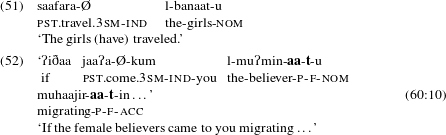
Also, SA T0 can be even more  ${\rm\phi}$-defective since the verb can agree with the subject only in terms of [Person], as (51) as well as the Qur’anic verse in (52) show.
Besides, SA v*0 is also  ${\rm\phi}$-defective since the verb is not allowed to realize object agreement, neither fully (number and gender) nor partially (number or gender), as (53) shows.Footnote [12] I assume that verbal morphology reflects the featural composition of T0 and v*0.

Secondly, Pesetsky & Torrego (Reference Pesetsky and Torrego2001, Reference Pesetsky, Torrego, Guéron and Lecarme2004) argue that Nom Case and Acc Case are licensed on the DP as a result of valuing an uninterpretable [ $u$T] feature on D0 by an interpretable [
 $i$T] counterpart on the relevant Case-checking heads. Thus, tense is crucial for licensing structural Case. However, SA imperatives, which lack tense (as do imperatives crosslinguistically, Huntley Reference Huntley1980, Zanuttini Reference Zanuttini1991, Henry Reference Henry1995, Han Reference Han1998, Rupp Reference Rupp1999, Jakab Reference Jakab, Burelle and Somesfalean2002, Mauck et al. Reference Mauck, Pak, Portner, Zanuttini, Brandstetter and Rus2005, Wratil Reference Wratil2005, Bennis Reference Bennis and van der Wurff2007, Pak et al. Reference Pak, Portner, Zanuttini, Elfner and Walkow2008), license structural Case. Derived from the jussive (Wright Reference Wright1896: 61), SA imperative verbs lack tense morphology, as Table 1 shows. In addition, they do not exhibit the past vs. non-past distinction, and thus lack the feature [Precedence] (Cowper Reference Cowper2005), which indicates that they lack [T].
Structure of the Standard Arabic imperative verbs.

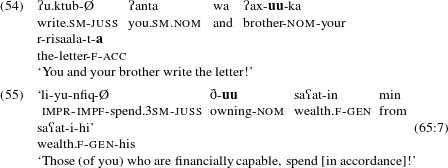
Imperatives just denote ‘future orientation’, which makes reference to mood, not tense (Cowper Reference Cowper2005, Cowper & Hall Reference Cowper and Hall2007). Thus, imperative clauses in SA lack a TP and instantiate a MoodP instead. Nonetheless, both Nom and Acc are licensed in the second person imperative construction in (54), and also in the third person imperative construction in (55).Footnote [13]
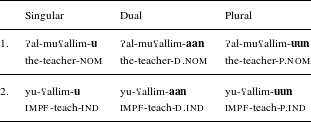
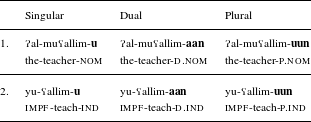
Also, Pesetsky & Torrego (Reference Pesetsky and Torrego2001) argue that Nom Case is a [ $u$T] on D0 because the SA Nom Case suffixes are identical to the ‘mood’ suffixes of the verb form that carries tense, as Table 2 shows. However, I think this similarity should indicate connection between Nom Case and ‘mood’ (or its new interpretation, in the next section), not tense, since the singular Acc Case suffix in SA is identical to the ‘mood’ suffix of a verb form that does not carry tense, the subjunctive.
Similarity between the nominative and indicative suffixes.
Given the defective subject and object agreement, reflecting  ${\rm\phi}$-defective T0 and v*0, as well as the absence of [T] in imperatives, reflecting [T]-less T0 and v*0, I argue that agreement and tense are not responsible for licensing structural Case in SA.
4.2 Verbal system in Standard Arabic
This section reviews the relevant properties of SA verbs with the goal of showing that they encode a Verbal Case feature [VC]. The Arab grammarians of Basrah (Siibawayhi Reference Siibawayhi1990: 407–410) maintained that SA verbs come in three paradigms: the perfective (past tense), the imperative, and the imperfective, which has three forms: indicative, subjunctive, and jussive. These modality-related labels were first contributed by the German philologist Caspari (in Wright’s Reference Wright1896 translation), where it is proposed that the relevant verbal particles are mood assigners and that the suffixes mark mood. Wright’s translation states that SA verbs come in two paradigms: perfective, and imperfective, which has five moods (indicative, subjunctive, jussive, imperative, and energetic/emphatic). Traditional Arabic grammars use terms that indicate the inflectional state of the verb rather than its semantic interpretation: ‘marfuuʕ’, ‘manṣuub’, and ‘majzuum’.Footnote [14] As (56)–(58) show, SA verbs receive a form of case, assigned by certain particles (Siibawayhi Reference Siibawayhi1990).
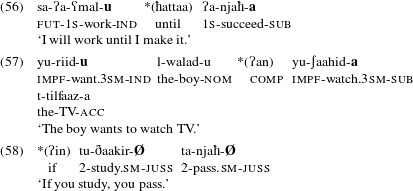
The particles ʔan ‘a Comp particle’ and ℏ attaa ‘until’ assign the subjunctive VC. The particle ʔin ‘if’ assigns the jussive VC; (56)–(57) also show that the indicative VC is not assigned by particles, as maintained by TAGs (e.g. Al-Nadiri Reference Al-Nadiri1997: 439) and Fassi Fehri (Reference Fassi Fehri1993: 164). I will return to this important point in Section 4.3.Footnote [15] The assumption that SA verbs receive case is based on a number of observations. First, like DPs, verbs receive their inflectional states when in the scope of Case/case assigners. Secondly, as Table 2 shows, the indicative form suffixes are similar to the Nom case suffixes. Also, the singular subjunctive suffix is similar to the singular Acc case suffix, as (59) shows; Al-Balushi (Reference Al-Balushi2013) provides a unified account of the similarities and differences between the Nom and indicative suffixes as well as between the Acc and subjunctive suffixes in SA.

Thirdly, the fact that certain particles assign certain VC values and not others, suggests that (like nominal Case forms) only certain verbal forms are licensed in certain contexts. Fourthly, the VC-assigning particles must be followed only by verbs, and never by other elements, as (60)–(61) show.

Fassi Fehri (Reference Fassi Fehri1993: 82–83) questioned Wright’s modality-based proposal, and interpreted these facts such that verbs receive Temporal Case (TCase) (p. 163–164). He proposed that the relevant suffixes mark temporal cases assigned to verbs by particles or by default (indicative) in the same manner nouns receive their cases; as we will soon see, while Fassi Fehri’s TCase is concerned with morphological realization, the proposed concept also has syntactic implications. Also, Benmamoun (Reference Benmamoun2000: 31), who observes that ‘[e]ach mood ending seems to comprise a heterogeneous class of temporal and syntactic contexts’, argues that the SA so-called mood suffixes do not map to the three relevant moods. I follow Fassi Fehri and Benmamoun in dissociating these suffixes and forms from modality.
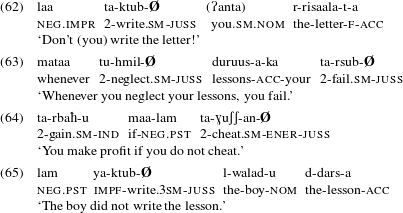
Given the preceding discussion, I would like to argue that all the SA verbs must be subsumed under the three known VC-categories, indicative, subjunctive, and jussive, which are used as cover terms for the various moods and functions that SA verbs convey, comprising indicative, subjunctive, optative, conditional, imperative, jussive, and emphatic. The feasibility of this classification stems from its correlation with the three VC forms (given the relevant particles) resulting from VC assignment marked with morphological inflection.
The jussive VC form conveys the imperative, conditional, and energetic moods and is also used in past negatives, as (62)–(65) respectively show.
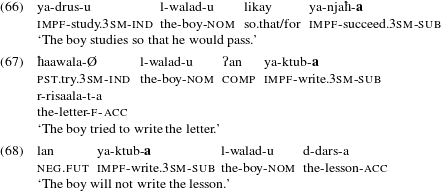
The subjunctive VC is used to convey the optative and subjunctive moods and is also used in future negatives, as (66)–(68) respectively show.
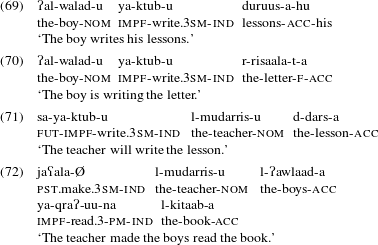
The indicative VC form is used in declarative present (generic and deictic) and future sentences, as well as in the embedded clause of causative verbs, as (69)–(72) respectively show.Footnote [16]
Moreover, I would like to propose that the perfective form is also marked for VC (albeit with no morphological marking) since it conveys indicative mood in the past tense. Wright (Reference Wright1896: 51–52) states that
[t]he Arabic verb has five moods; namely, the Indicative, Subjunctive, Jussive or Conditional, Imperative, and Energetic. Of these moods the first is common to the perfect and imperfect states.
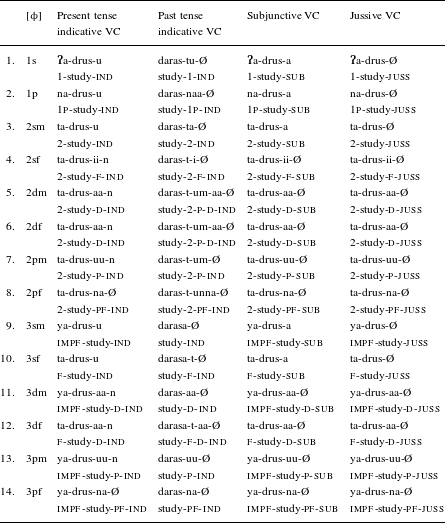
Also, Fassi Fehri (Reference Fassi Fehri1993: 83–84) states that the ‘perfect form of the verb is almost exclusively used for the indicative Mood (presumably by default)’. The perfective is similar to the indicative form of the imperfective in that it receives VC without particles, and also because it does not co-occur with tense- or mood-inflecting particles. Thus, I argue that the perfective verb is also inflected for indicative VC.Footnote [17]Table 3 presents the four verbal forms which are marked for the three VC values which convey a heterogeneous set of functions.Footnote [18]
Standard Arabic verbs in the three Verbal Case (VC) values.
4.3 Verbal Case: The syntactic proposal
The verbal inflection facts discussed in the previous section prompted TAGs to assume case assignment in the verbal as well as the nominal system. Since TAGs (as well as Fassi Fehri Reference Fassi Fehri1993) assumed the indicative VC to obtain by default, it becomes clear that they took these facts to only have morphological implications, such that the relevant particles assign morphological verbal case (m-vc). Though I agree with this view, I believe that this morphological phenomenon, m-vc assignment by particles, indicates abstract verbal licensing. Assuming the standard Case theory with roots in Chomsky & Lasnik (Reference Chomsky and Lasnik1977), Chomsky (Reference Chomsky1980, Reference Chomsky1981, Reference Chomsky1995), and Vergnaud (Reference Vergnaud1982, Reference Vergnaud2008), where morphological nominal case (m-case) was assumed to be indicative of abstract Case (nominal licensing),Footnote [19] I take m-vc to be indicative of abstract verbal licensing; that is, by analogy with m-case, which reflects DP licensing, I claim that m-vc also reflects verbal licensing. To support this claim, let us examine the data in (73)–(76).

Only PRO is grammatical in (73) because there is no Case licenser for the embedded Spec,TP position. Thus, elements that must realize m-case (given the Case Filter, which Chomsky (Reference Chomsky1981: 49) assumes to be part of the PF-component), like lexical DPs, are not allowed in a position where abstract Case is not licensed (assuming no Null Case), since this would result in not satisfying the Case Filter. Null Case was proposed in Chomsky & Lasnik (Reference Chomsky, Lasnik, Jacobs, von Stechow, Sternefeld and Vennemann1993) and argued against in Baltin & Barrett (Reference Baltin and Barrett2002) and Cecchetto & Oniga (Reference Cecchetto and Oniga2004), among others. Chomsky (Reference Chomsky1981: 49) excluded gerunds and lexical NPs from the subject position of infinitival clauses, since they are not allowed ‘in positions in which no Case is assigned’. To show that m-vc indicates VC, let us examine SA verbless sentences once more.
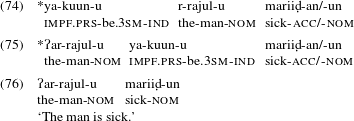
The grammaticality of (76) indicates that (74)–(75) are ungrammatical because the copular verb is not licensed in this position. Like the embedded subject position in (73), where elements which realize m-case (lexical DPs) are not licensed, verbless sentences provide a context where verbs, which realize m-vc, are not licensed.Footnote [20] Thus, like DPs (assumed to require licensing, [Case]), SA verbs seem to require abstract licensing, that is, [VC]. Thus, the different verbal forms (indicative, subjunctive, and jussive) can be argued to reflect abstract verbal licensing [VC] similar to abstract DP licensing (e.g. Nom, Acc). Given the standard view that [Case] is encoded on D0, I will assume that [VC] is encoded on T0 and v*0. Therefore, besides [T], [ ${\rm\phi}$], and [Mood], verbs in SA are marked for [VC]. This indicates that the indicative form obtains by default only morphologically, that is, in the absence of VC-assigning particles, but not syntactically, since it does not appear in verbless sentences where copular verbs are not licensed.
Assuming Rizzi (Reference Rizzi and Haegeman1997) that finiteness resides in the Comp domain (Fin0), and given the observation that (most of) the VC-assigning particles are Comp elements, I will assume that Fin0 has a valued [VC] feature, which values the [VC] features on T0 and v*0, which results in valuing [Case] on the subject and object as Nom and Acc, respectively.Footnote [21] Also, given the observation that [T] and [ ${\rm\phi}$] (as well as [Mood]) do not license structural Case in SA, I will take them to indicate finiteness in the Infl domain (I-finiteness). In this way, [VC] on Fin0 constitutes Comp finiteness (C-finiteness), which is the element that licenses Case in the clause. Structural Case is licensed in the clause iff Fin0 c-selects an XP that has a categorial [V] feature and at least one I-finiteness feature, [T], or [Mood], or [
 ${\rm\phi}$] (Al-Balushi Reference Al-Balushi2011: 140). Thus, Case is licensed in verbal and copular sentences (where there is a VP) but not in verbless sentences (which have a PredP), since the selected TP lacks a categorial [V] feature. Though verbless sentences have a Comp domain (Al-Balushi Reference Al-Balushi2012: 7), their FinP lacks a [VC] feature.Footnote [22] Therefore, SA seems to have two versions of Fin0, with and without a valued [VC] feature; it also has two versions of T0, with and without a [VC] feature.Footnote [23]
Al-Balushi (Reference Al-Balushi2011: 279–287) also argues that pro does not receive Case; it does not require Case for the Case Filter since it is phonetically null. It does not need Case for LF visibility since it is co-indexed with the topic, which is made visible at LF by the feature [Topic]. This co-indexation makes pro visible at LF to transmit the θ-role to the topic; pro appears in SA in SVO sentences, where Nom Case is licensed, and in participial and verbless sentences, where Nom Case is not licensed, since these structures have topics, not subjects (Al-Balushi Reference Al-Balushi2011, Reference Al-Balushi2012). The claim that pro receives no Case is problematic for SVO sentences (as well as for VO sentences, with a null subject and no topic), since a crash is inevitable. However, assuming Hale & Keyser (Reference Hale, Keyser, Martín, Berenguel and Jiménez2000), I follow Al-Balushi (Reference Al-Balushi2011: 279–287) in that Nom on T0 of SVO/VO sentences is licensed via a conflation procedure whereby the movement of pro (full  ${\rm\phi}$-features/agreement morphology, hence lexical head) to T0 amounts to the licensing of Nom Case; thus pro receives no Case.
Unlike structural Case, lexical case is irrelevant for licensing and LF visibility; that is, like default case, it satisfies the Case Filter, which is also satisfied by structural Case. This conception of Case provides a uniform treatment of nominals appearing with morphological case marking in A and A-bar positions in SA. The goal of Section 4 has been to establish the link between verbs, hence [VC] on T0 and v*0, and argument licensing (structural Case), which renders lexical elements relevant to non-arguments (lexical case).
5. A-bar ECM in Standard Arabic
5.1 The analysis
The morphosyntactic presentation of the ‘believe’-construction in Section 3 has revealed that the Acc-marked DP is base-generated and remains in the embedded clause, specifically in the embedded Spec,TopP, and that it is not an argument of the embedded predicate. Besides these findings, I would like to make a number of assumptions. First, unlike Chomsky (Reference Chomsky2001), I assume that Agree is a relation between a probe and a goal that results in valuing virtually any feature; thus it is not restricted to  ${\rm\phi}$-feature valuation. Secondly, I assume with Rezac (Reference Rezac2004: 107) that the search-space is ‘the entire syntactic object in which a probe finds itself’, thus the search-domain of the probe can also expand upward. Also, Baker (Reference Baker, Mercado, Potsdam and Travis2010: 1) states that, in general, ‘a functional head can search upward or downward through the syntactic tree in order to find a DP/NP that it can agree with’. Thus, I will assume that the probe may c-command the goal and the goal may c-command the probe. Thirdly, I do not assume
 ${\rm\phi}$-features to be involved in structural Case checking in SA (contra Soltan Reference Soltan2007), given its defectivity, unless pro must be licensed, which makes reference to the SVO order; thus the full
 ${\rm\phi}$-morphology is there to license pro, that is, to reveal its
 ${\rm\phi}$-content. Therefore, I assume with Bobaljik (Reference Bobaljik, Harbour, Adger and Béjar2008) that
 ${\rm\phi}$-agreement is a morphological, not syntactic, operation. With these assumptions in mind, let us see how Al-Balushi’s (Reference Al-Balushi2011) Case system handles (77), which has the tree structure in (78).
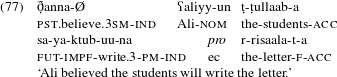
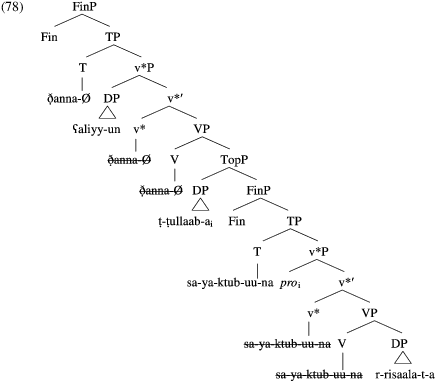
I will start with structural Case checking in the embedded clause. Since the embedded clause is a CP, then Fin0 is present and c-selects a TP with both a categorial [V] feature (given the verb) and a [T] feature (given the independent tense operator in the embedded clause); T0 and v*0 have unvalued [VC] features. Now, v*0 enters an Agree relation with T0 to get its unvalued [VC] feature valued, but no valuation takes place, rather ‘Agree as feature sharing’ is established; that is, the two features become two instances of one feature (Frampton & Gutmann Reference Frampton and Gutmann2000, Pesetsky & Torrego Reference Pesetsky, Torrego, Karimi, Samiian and Wilkins2007). Agree between T0 and Fin0 takes place, resulting in valuing [VC] on T0, and automatically on v*0. The fact that the embedded T0 has a valued [VC] feature means that it can license Nom Case on the embedded subject, which is pro, merged in Spec,v*P and co-referential with the topic in embedded Spec,TopP. Assuming that pro does not receive Case, a crash seems inevitable. Nonetheless, I argue that Nom on T0 is checked via a conflation procedure (Hale & Keyser Reference Hale, Keyser, Martín, Berenguel and Jiménez2000). In other words, it is licensed as a result of the movement of pro (full agreement affix, lexical head) to T0, which results in the verb (in T0) realizing the full  ${\rm\phi}$-content of pro, a characteristic of SVO structures in SA. In contrast, the verb in VSO structures (in T0) does not carry full [
 ${\rm\phi}$] information, since this is realized by the subject in Spec,v*P. The object (probe) enters an Agree relation with v*0 (goal) and gets its [Case] feature valued as Acc. The embedded verb (as well as the matrix one), not being in the scope of a VC-assigning particle, realizes the default indicative m-vc morphology at Spell-Out.
Case checking in the matrix clause proceeds roughly in the same fashion. Since the selected TP has both a categorial [V] feature and a [T] feature, Fin0 will value [VC] on T0 and v*0. T0 will then value [Case] on the lexical DP subject ʕaliyy as Nom. As for the Acc Case feature on v*0, being structural, I argue that it is licensed on the CP complement, for purposes of LF visibility, since the CP, unlike the Acc-marked DP, is an argument of the matrix verb.
This leaves the Acc-marked DP, ṭ-ṭullaab-a ‘the students’, without a structural Case checking category, in violation of both the Case Filter and the Visibility Condition, which undermines the present account, but this is just apparent. To illustrate, since the Acc-marked DP is an A-bar element, then, by assumption, it has no [Case] feature, especially that it is not an argument of either predicate, and so, unlike arguments, is not subject to the Visibility Condition via Case; ṭ-ṭullaab-a is licensed into the derivation through co-indexation with pro. It, nonetheless, has to satisfy the Visibility Condition since it is co-indexed with an argument, pro, which has no means of being visible at LF for θ-role assignment. Therefore, I assume that since ṭ-ṭullaab-a occupies the Spec,TopP position, it has the feature [Topic] (checked by the Top0 head). Like [Case], Al-Balushi (Reference Al-Balushi2011) claims that [Topic] makes topics visible at LF. Thus, pro, which is co-indexed with ṭ-ṭullaab-a, becomes visible at LF, which allows it to receive the relevant θ-role from the embedded verb and transmit it to ṭ-ṭullaab-a. As for the Case Filter, I argue that ṭ-ṭullaab-a, being a non-argument, receives lexical Acc case from the matrix verb ð̣anna, as a lexical element; ð̣anna is a member of a group of verbs, known in the traditional grammar of Arabic (Siibawayhi Reference Siibawayhi1990) as ‘ð̣anna and its sisters’, which assign case to two nominals, a DP and a predicate; examples include xaala ‘imagine’, ℏ asiba ‘believe’, ʕadda ‘consider’, and jaʕala ‘make’.
5.2 More on the analysis
The present account is based on two main assumptions, that the Acc-marked DP is visible by [Topic], and that it receives lexical case. First, the claim that the DP ṭ-ṭullaab-a ‘the students’ in (77) in pre-verbal position is visible by [Topic], not [Case], is supported by an argument which involves the examples in (79) and (80).
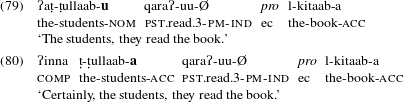
Basically, ʔaṭ-ṭullaab-u in (79) does not receive the agent θ-role because of the Nom case that it realizes, since this is default Nom. This is because if ʔaṭ-ṭullaab-u received the agent θ-role by the Nom case in (79), then it must receive the theme θ-role by Acc in (80), but this is not the case since it is still the agent. Thus, the pre-verbal DP in (79)–(80) becomes visible by [Topic]. This view is more plausible than an alternative where ṭ-ṭullaab-a and l-kitaab-a ‘the book’ in (80) (or ṭ-ṭullaab-a and the complement CP in (77)) receive Acc Case from v*0, since then they will compete for the theme θ-role at LF; this alternative is also implausible since v*0 does not license Acc Case on more than one element.
Thus, the Acc assigned by ʔinna is different from the Acc licensed by v*0, such that only the latter is relevant for LF-visibility. That this approach is on the right track is supported by the fact that ʔinna has no v*0 projection that licenses structural Acc Case, since a verbless sentence with ʔinna, like (81), has a PredP projection.
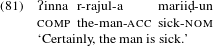
Also, unlike v*0, ʔinna assigns Acc to agents and themes alike, as (82)–(83) respectively show
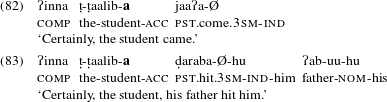
The complementizer ʔinna ‘indeed, truly, verily’ is a member of a group of particles known in the traditional literature as ‘ʔinna and its sisters’, comprising ʔanna ‘a Comp element meaning ‘that”, kaʔanna ‘as though’, laakinna ‘but’, layta ‘wishing’, and laʕalla ‘perhaps, maybe’. They have the same potential of assigning lexical Acc case to the following DP (in ʔinna-DP-Predicate/ʔinna-DP-VO structures), which always has the status of topic; see Ryding (Reference Ryding2005: 425–428) for examples and discussion.
The view that the Acc-marked DP in (77) receives lexical rather than structural case from ð̣anna is supported by the fact that it also receives lexical Acc case from ʔanna, as (84) shows.
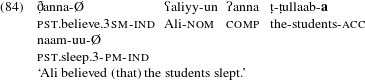
This indicates that the Acc-marked DP always occupies an A-bar position, and hence is not in the scope of a structural Case checking category, thus reserving the structural Acc Case for the CP argument. This view is also supported by the observation that ð̣anna can evidently assign lexical case to non-arguments, as the nominal and adjectival predicates in the complement clauses of (85)–(86) respectively show.Footnote [24]
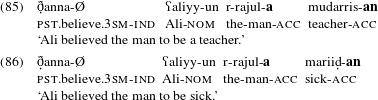
This is a reasonable explanation since it is implausible to assume that v*0 may also license case to the predicate (for lack of thematic/transitivity relationship). The claim that predicates receive lexical rather than structural case is also supported by the standard assumption that they are not subject to the Visibility Condition (Aoun Reference Aoun1979).
Moreover, the alternative view that ṭ-ṭullaab-a in (77) above receives Acc case from a null version of ʔanna (not from ð̣anna, as argued here) is incorrect since, unlike ð̣anna, which assigns lexical case to two elements (the topic and the predicate) as (85)–(86) show, ʔanna, and hence its purported null version, assigns lexical case to one element only, the topic (Siibawayhi Reference Siibawayhi1990), as (87) shows; the predicate in (87) carries default Nom case, the same case it realizes with ʔinna, as (81) shows.

Thus CP arguments always have an unvalued [Case] feature which is valued via Agree with the relevant functional head (v*0) for purposes of LF-visibility. Uriagereka (Reference Uriagereka2006, Reference Uriagereka2008) argues that all arguments, including CPs, carry Case, which he assumes to be Null Case. If Null Case is not available, as the present account assumes, the system must allocate another Case value for CP arguments. Clausal complements have been argued to receive structural Case in Massam (Reference Massam1985), Plann (Reference Plann1986), Bošković (Reference Bošković1995), Tsai (Reference Tsai1995), Picallo (Reference Picallo2002), J.-S. Lee (Reference Lee2005), and Al-Balushi (Reference Al-Balushi2011).
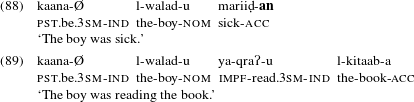
If on the right track, this analysis assumes a distinction between structural Case and lexical case. Both are very common in SA, which calls for a distinction between the two operations based on their contexts and properties. For one thing, structural Acc Case is licensed by v*0, whereas lexical Acc case is assigned (discharged) by different elements, a heterogeneous group; structural Acc Case is also licensed in double object constructions by Appl0, the head of the Applicative Phrase in complement to V0 position (Fournier Reference Fournier2010, Pylkkänen Reference Pylkkänen2002). Also, while the non-checking of structural Case leads to a crash, the non-assignment of lexical case does not when blocked by another lexical case assigner, as in the ‘believe’-structure where the embedded CP is introduced by ʔanna, as in (87), which blocks lexical case assignment by ð̣anna. This is true since the predicate realizes default Nom case, as it does in sentences with ʔinna, as (81) shows. This property of lexical case is also illustrated by sentences like (88)–(89), where the non-assignment of lexical Acc case by kaana ‘be’ in (89) does not result in a crash.
5.3 Comparison with other analyses
Although the Acc-marked DP belongs in the embedded clause and receives case from the matrix clause, the present account is different from classical ECM, for two reasons. First, the Acc-marked DP is not an argument of the embedded predicate. Secondly, it does not receive structural Acc Case, but rather lexical Acc case. Furthermore, it is different from R-to-O since the Acc-marked DP does not move, but is case-marked in its base-generated position. In what follows, I will show how earlier analyses, although they might be suitable for the respective languages, may not be extended to the SA ‘believe’-construction.
Uriagereka (Reference Uriagereka2006: 268) argues that the Acc-marked DP in the English construction is an argument of believe, and that
the complex v-believe somehow also assigns null Case, and clauses can take this Case to satisfy visibility demands. If so, null Case goes with person-less elements: PRO, (some?) clauses, ….
Thus, Uriagereka argues that Null Case is licensed on the TP complement and Acc Case on the DP argument. This analysis is undermined by the standard view that the Acc-marked DP is not thematically related to believe (Aldridge Reference Aldridge, Hornstein and Polinsky2010: 168, among others) as well as by the objection to the conception of Null Case; see Baltin & Barrett (Reference Baltin and Barrett2002) and Cecchetto & Oniga (Reference Cecchetto and Oniga2004) who argue that Null Case must be eliminated from UG.
In an R-to-O analysis proposed for Turkish, Zidani-Eroğlu (Reference Zidani-Eroğlu1997) argues that, though thematically related to the embedded predicate, the Acc-marked DP moves to the matrix clause. Her analysis claims that the Acc-marked DP is Case-marked in the matrix clause ‘though it does not discuss its exact position in that clause or the manner in which accusative Case is assigned’ (page 219). This analysis, too, does not work for the SA construction since the Acc-marked DP is not an argument of the embedded predicate, and also because it does not move.
Alboiu & Hill (Reference Alboiu and Hill2011) analyze R-to-O in Romanian structures with verbs of knowledge as an instance of A-bar movement. The embedded thematic subject may be Nom-marked in the embedded finite clause or Acc-marked in the matrix clause, as (90)–(91) respectively show.
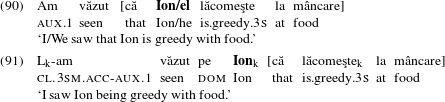
To account for the latter case, Alboiu & Hill provide evidence that the Acc-marked DP is base-generated in the embedded clause, and that it moves out of the embedded finite CP, since matrix clause material may intervene between the Acc-marked DP and the embedded CP.
They argue that (91) results from A-bar movement of the embedded subject to the highest Spec position in the matrix v*P, triggered by an [Evaluative] (discourse) feature, as well as by a [ $u$Top] feature on matrix v*0. As such, the Acc-marked DP, the authors argue, receives two Case values, Nom from embedded T0 and Acc from matrix v*0, but realizes the latter. Alboiu & Hill’s analysis is also not extendable to SA since the Acc-marked DP in SA does not move and also because it receives case only once.
In a recent R-to-O analysis, H. Lee (Reference Lee2007) argues that the English embedded subject (Acc-marked DP) is raised from its base-generated position to the matrix Spec, VP (not Spec, v*P). The proposed movement operation is triggered by the  ${\rm\phi}$-agreement features on V0 (V0-Agree) inherited from v*0. The embedded subject first moves to embedded Spec,TP, but since non-finite T0 cannot value the [Case] feature on the DP, it moves further to the matrix Spec,VP. H. Lee’s analysis, too, is not extendable to SA since it does not provide for the Case-visibility requirements of the clausal argument.
The recognition that Acc Case is needed for both the complement clause and the DP means that any analysis must provide two structural Acc Case values. However, unlike give, a double object verb which has v*0 and Appl0, and so can license Acc Case on both objects, believe does not have two functional heads associated with structural Acc Case. This issue can be resolved by another analysis of the ‘believe’-construction, one that may be based on Hiraiwa’s (Reference Hiraiwa, Matushansky and Gurzoni2001) ‘Multiple Agree’ system. Making the case for ECM in Japanese, Hiraiwa claims that ‘if a probe for multiple goals is derivationally unique, then multiple ECM should be grammatical in the ECM construction in Japanese’ (page 74; italics in the original). In other words, Hiraiwa argues that the matrix v*0 licenses Acc Case on the two Acc-marked nominals in (92), derivationally simultaneously, to avoid intervention effects. Basically, assuming that the probe feature is [+multiple], it continues to probe until it Agrees with all the matching goals in an accessible domain, in a single operation.Footnote [25]

Thus, the matrix v*0 can simultaneously check Acc Case on two elements, which makes this analysis extendable to the English and SA ‘believe’-type constructions, since now v*0 may license Acc Case on the TP/CP (argument) and the Acc-marked DP (non-argument). Nonetheless, Hiraiwa’s innovative analysis may be rejected on the basis of a standard view of Case and argumenthood. To illustrate, adopting an original idea of Hale & Keyser’s (Reference Hale, Keyser, Hale and Keyser1993), Chomsky (Reference Chomsky1995: 315–316) proposes that verbs with internal arguments (transitive, ditransitive, and unergative) have a verbal shell, with v*P and VP projections.Footnote [26] While the internal arguments are merged in the Spec and complement positions of the VP, the external argument is merged in Spec,v*P; intransitive/unaccusative verbs lack the v*P layer. He continues, ‘the v-VP configuration can be taken to express the causative or agentive role of the external argument’ (Chomsky Reference Chomsky1995: 315). Assuming Burzio’s Generalization (Burzio Reference Burzio1986: 178) which states that ‘[a]ll and only the verbs that can assign a θ-role to the subject can assign (accusative) case to an object’, it becomes clear that there is a strong relationship between assigning an external θ-role and licensing structural (objective) Acc Case on the internal argument. This role is both naturally and conveniently given to v*0, since it is the marker of transitivity (creating the external θ-role) that makes the verb ‘accusative’, hence able to assign Acc Case (Hornstein et al. Reference Hornstein, Nunes and Grohmann2005: 102–103), which I take to be structural Case since it is licensed on an argument (internal θ-role bearing XP). If on the right track, this approach indicates that non-arguments may not receive Case from v*0. Thus, this indicates that an extension of the Multiple Agree mechanism to (at least) the SA ‘believe’-construction will not be able to account for the Acc case on the Acc-marked non-argument DP. Therefore, Hiraiwa’s approach is also untenable.
The present account also contrasts with Soltan (Reference Soltan2007), who assumes thatṭ-ṭullaab-a in (77) receives structural Acc Case from the matrix v*0. Soltan’s position is untenable for two reasons. First, it leaves no structural Case to be licensed on the complement clause, in violation of the Visibility Condition. Secondly, it allows Agree to take place between structural Case-checking heads and A-bar elements, which have no [Case] features.
6. A possible extension to English
Extending the analysis proposed for the SA ‘believe’-construction to the English counterpart in (93) must not be discouraged by the fact that the embedded clause in the latter is non-finite.

Assuming that the proposed distinction between structural Case and lexical case holds in English too, the Acc-marked DP in (93) may receive lexical Acc case from believe (as a lexical element), but not Null Case, or structural Acc Case from the matrix v*0, since the latter is reserved for the clausal complement.
Since Mary in (93) is in the matrix clause, where it is not thematically related, and assuming that it is in Spec,VP, as independently argued in H. Lee (Reference Lee2007), which could arguably be an A-bar position in Minimalism, it is really possible that Mary is an A-bar element, an argument of neither predicate.Footnote [27] The standard view that this DP is thematically related to the embedded predicate can be captured if we assume that it is co-indexed with a pro in the embedded thematic domain. Thus, the external argument of the embedded predicate, pro, receives the θ-role from the predicate at LF. Following Al-Balushi (Reference Al-Balushi2011), pro (with no [Case] requirement) becomes visible via co-indexation with Mary since the latter has a feature equivalent to [Topic], which, by assumption, allows it to be visible. This allows the relevant θ-role to be transmitted from pro to Mary. This way, the complement clause receives the structural Acc Case from matrix v*0. After all, it is the clausal complement of believe that must receive the structural Acc Case licensed by the matrix v*0 in the non-ECM/R-to-O construction in (94), where the Acc-marked DP is absent, otherwise a crash is inevitable; this also shows that the non-assignment of lexical case by believe does not result in a crash, since it is blocked by that, which, as argued in Al-Balushi (Reference Al-Balushi2011: 313–314), is a VC licenser, whose presence in the embedded clause indicates finiteness, that is, structural Case. Moreover, the same structural Case value must be licensed on the DP complement in (95). Therefore, a unified approach to argument XPs should maintain that they require structural Case for visibility purposes.

This also calls for investigating the contexts and properties of lexical case in English as well as in other languages, without which, I believe, analyses of ‘believe’-type constructions will either be based on stipulating structural Acc Case-assigning heads (e.g. V0 or Agro0), or ignoring the visibility requirement of the clausal complement of believe, or allowing v*0 to license Acc Case on arguments and non-arguments alike.
The proposal that the Acc-marked DP is an A-bar element, and that it receives lexical Acc case may be extended to constructions like (96), where for, a non-finite Comp (lexical element in Force0) may be argued to assign lexical, not structural, Acc to John, which could be in the embedded Spec,TopP.

Though the current proposal does not provide independent evidence that the Acc-marked DP in the English ‘believe’-construction is an A-bar element, it is at least a possibility worth pursuing.
7. Concluding remarks
This paper has provided an analysis for the ‘believe’-construction in SA according to which the matrix v*0 licenses structural Acc Case on the CP argument, and ð̣anna ‘believe’ assigns lexical Acc case to the Acc-marked DP. This analysis, based on a re-interpretation of the morphosyntactic properties of this construction, avoids the shortcomings of Soltan (Reference Soltan2007), where it is assumed that v*0 licenses Acc Case to the A-bar DP whereas the complement clause argument receives no Case value. It also avoids the disadvantages of some of the earlier analyses. Of those, Uriagereka’s (Reference Uriagereka2006) analysis, where the ‘v*0-believe complex’ provides two Case values, seems to be the closest to the present account, with the non-trivial differences that the Acc-marked DP is not an argument of believe, and that the extra case value provided by this complex is an instance of lexical case, not Null Case.
In addition to the analysis of the ‘believe’-construction, this paper has presented a new conception of structural Case based on a re-interpretation of the properties of the SA verbal system as well as verbless sentences and the relevant tense and agreement facts, incorporating insights from TAGs. It has also revealed some morphosyntactic and semantic differences between structural Case and lexical case in SA, despite the identical phonetic realization.