1 Introduction
A central tenet of many diachronic cognitive linguistic studies is the ‘Uniformitarian Principle’ (Lass Reference Lass1997; Winters Reference Winters, Winters, Tissari and Allan2010: 16): the assumption that the mental grammars of Old English or Middle English readers were subject to the very same constraints that have been identified by modern cognitive linguistics (e.g. Evans & Green Reference Evans and Green2006) and psycholinguistics (Field Reference Field2004). In line with the Uniformitarian Principle, we expect, for example, the same processing effects that affect the language use of present-day speakers to also have had a similar effect in Old and Middle English. Consequently, for the study of language change, processing constraints such as Hawkins’ Performance–Grammar Correspondence Hypothesis (PGCH) should be particularly important. The PGCH assumes that
[g]rammars have conventionalized syntactic structures in proportion to the degree of preference in performance, as evidenced by patterns of selection in corpora and by ease of processing in psycholinguistic experiments. (Hawkins Reference Hawkins2004: 3)
Thus, following the Uniformitarian Principle, the PGCH appears to predict a directionality in language change: if the same content can be expressed by two competing structures and one of these is easier to process than the other (see Hawkins Reference Hawkins1999, Reference Hawkins2004), then the simpler structure will be preferred in performance. Consequently, it will be used more often with a greater range of different lexical items, which increases its type frequency and ultimately leads to it being more cognitively entrenched than its alternative (see Hawkins Reference Hawkins2004: 6).
For Present-day English (PdE), the PGCH has received considerable support from several studies investigating the synchronic competition between two (roughly) synonymous syntactic structures (e.g. genitives versus of-PPs: Szmrecsanyi Reference Szmrecsanyi, Geeraerts, Kristiansen and Peirsman2010; the double object versus prepositional datives: e.g. Bresnan & Ford Reference Bresnan and Ford2010; preposition stranding versus preposition pied-piping: see Hoffmann Reference Hoffmann2011). The present article will look at comparative correlative constructions (see, e.g., Michaelis Reference Michaelis1994; Culicover & Jackendoff Reference Culicover and Jackendoff1999; Den Dikken Reference Den Dikken2005; Sag Reference Sag2010; Cappelle Reference Cappelle2011; Hoffmann Reference Hoffmann2014) and track their evolution throughout the history of the English language:
-
(1) C1C2 construction
[The [more]comparative phrase1 you think about it]C1
[the [more interesting]comparative phrase2 it becomes]C2
-
(2) C2C1 construction
[It becomes [(the) more interesting]comparative phrase2]C2
[the [more]comparative phrase1 you think about it]C1
As (1) shows, canonical comparative correlative (CC) constructions consist of two clauses (C1: the more you think about it / C2: the more interesting it becomes; these structures will therefore be referred to as C1C2 in the following, while CC is a term covering all types of comparative correlative constructions). With regard to their form, both exhibit fixed, phonologically specified material ([ðə . . .]C1 [ðə . . .]C2) as well as schematic, open slots which can be filled freely by the speaker to create novel utterances (e.g. the more she slept, the happier she felt ; the richer the man (is), the bigger the car (is) ). Semantically, C1C2 constructions are characterized by asymmetric (the conditional relationship between protasis C1 and apodosis C2) as well as symmetric (the parallel computation of semantic differentials) properties: the semantic relationship between the two clauses is asymmetric since C2 is interpreted as the apodosis/dependent variable for the protasis/independent variable specified by C1 (e.g. Goldberg Reference Goldberg2003: 220, e.g. the more Ben ate → the fatter he got). Clause-internally, however, both C1 and C2 share the same computation of a semantic differential (Sag Reference Sag2010: 525–6): the meaning of C1 can be paraphrased as ‘the difference between how much you think more at a point t2 than at an earlier point in time t1’; the meaning of C2 can be summarized as ‘the difference between how much more interesting it becomes at a point t2 than at an earlier point in time t1’. The full meaning of (1) can therefore be rendered as (3):Footnote 1
-
(3)
-
(a) C1: ‘There is a positive difference between how much you think
at a point t2 and how much you thought at an earlier point in time t1’
-
(b) C2: ‘There is a positive difference between how interesting it is
at a point t2 and how interesting it was at an earlier point in time t1’
-
(c) overall CC-meaning: C1 → C2
-
In addition to the C1C2 construction, English also has an alternative, synonymousFootnote 2 structure in which C2 precedes C1 (2). This structure has been labeled the CC′ construction (by Culicover & Jackendoff Reference Culicover and Jackendoff1999: 549) and has the comparative phrase at the end of C2 (more interesting) often without the, while C1 retains its the-filler. (In the following, however, I will use the term C2C1 exclusively to refer to these CC′ structures, since it is more iconic and easier to interpret.)
Adopting a functionalist perspective that assumes linguistic forms to preferably mirror their meaning in an iconic fashion (in the sense of iconicity of motivation, see, e.g., Givón Reference Givón and Haiman1985; Haiman Reference Haiman and Asher1994), we can postulate that the C1→C2 order (cause/protasis before effect/apodosis) of the C1C2 construction should be cognitively preferred over the alternative C2C1 construction C2→C1 (effect/apodosis before cause/protasis). In line with Hawkins’ PGCH, it can therefore be expected that the iconic CC construction is preferred over the C2C1 construction during performance since it is comparatively easier to process – a claim that is corroborated by PdE corpus data from the BROWN corpus family in which C1C2 constructions are preferred over C2C1 constructions with a ratio of about 37:1 (Hoffmann Reference Hoffmann2014).
While processing effects play a considerable role in Present-day English, however, I will show that the PGCH played only a secondary role in the genesis and evolution of the English C1C2 and C2C1 constructions. Once we take a closer look at the Old English (OE) and Middle English (ME) data, we find that it was the less iconic C2C1 construction that surfaced first and that the C1C2 construction entered the English language considerably later. Once the two structures were in competition, the PGCH fairly quickly swung the pendulum in favor of the more iconic C1C2 structure. In order to account for the genesis of the two constructions, however, we need to look beyond processing constraints for another explanation.
In this article, I will argue that a cognitively based Structuralist analysis is the key to the explanation of the genesis and evolution of the C1C2 and C2C1 constructions. In the Structuralist view of language change (Meillet Reference Meillet1912: 131–48; Saussure Reference Saussure, Bally, Sechehaye and Harris2006 [1916], Martinet Reference Martinet1952, Reference Martinet1955; for an overview see McMahon Reference McMahon1994: 24–32), ‘[t]he units of language are . . . contrastive and relational, and can only be understood by considering their place within the language system’ (McMahon Reference McMahon1994: 26). Moreover, I claim that a usage-based Construction Grammar approach (Croft Reference Croft2001; Goldberg Reference Goldberg2003, Reference Goldberg2006; Bybee Reference Bybee, Hoffmann and Trousdale2013) provides a modern, cognitively plausible theory that can easily accommodate Structuralist notions and insights.
All Construction Grammar approaches dispense with a clear-cut two-way division of syntax and lexicon. Taking form–meaning pairings (i.e. constructions) as the central building block of grammar, Construction Grammarians claim that mental linguistic knowledge can take various positions on a cline ranging from more lexical form–meaning pairings (phonologically fully specified, substantive items such as apple, or the idiomatic the more, the merrier) to more syntactic, schematic constructions (which comprise schematic slots that can be filled creatively, as in the ditransitive construction [NP1 V NP2 NP3] – ‘NP1 causes NP2 to receive NP3 by V-ing’, which licenses structures such as Noam emailed Ray his handout). In between these two poles, intermediate structures exist (such as the comparative construction [X be Adjcomparative ðən Y] – ‘X is more Adj than Y’) which contain substantive elements ([ðən]) as well as schematic slots (for the subject X, the form of be, the comparative adjective and Y; see Hoffmann & Trousdale Reference Hoffmann and Trousdale2013a). All of these constructions are assumed to form a structured inventory, the so-called ‘construct–i–con’ (Fillmore Reference Fillmore, Axmaker, Jaisser and Singmaster1988; see also Goldberg Reference Goldberg2003: 223), in which similarities on the form and/or meaning level lead to taxonomic links between constructions: more specific, substantive constructions (such as the more, the merrier or the sooner, the better) are stored in taxonomic networks (see Croft & Cruse Reference Croft and Cruse2004: 262–5; Goldberg Reference Goldberg2006: 215), in which they are dominated by more schematic superordinate constructions (such as the X-er, the Y-er; Culicover & Jackendoff Reference Culicover and Jackendoff1999).
As usage-based approaches emphasize (see, e.g., Barlow & Kemmer Reference Barlow and Kemmer2000; Bybee Reference Bybee, Hoffmann and Trousdale2013), speakers do not start out with maximally schematic constructions (sometimes also known as macro-constructions; Gisborne & Patten Reference Gisborne, Patten, Narrog and Heine2011: 100–1). Instead, exposure to specific, substantive constructs leads to increasingly schematic representations depending on type and token frequency: high token frequency, for example, leads to the entrenchment of phonologically filled constructions (Croft & Cruse Reference Croft and Cruse2004: 292–3), while high type frequency, i.e. patterns that are observed with many different items, can lead to the emergence of more abstract schematic representations (provided the types also exhibit a high degree of variance in their semantic distribution; see Barðdal Reference Barðdal2008).
Usage-based Construction Grammars are obviously compatible with Hawkins’ PGCH, in that both approaches assume that input and processing constraints play a crucial role in the evolution of mental grammars. At the same time, I will argue that it is also the structured inventory of constructions itself, the cognitive network which links and connects all the constructions a speaker has acquired, that exerts a considerable influence. Previous diachronic constructional research has already unearthed various constructions that historically derive not just from a single input construction, but multiple source constructions (for an overview, see Van de Velde, De Smet & Ghesquière Reference Van de Velde, De Smet and Ghesquière2013). In addition to this, the claim that the entire constructional network can play a role in linguistic change (Hoffmann & Trousdale Reference Hoffmann and Trousdale2011: 15; Traugott & Trousdale Reference Traugott and Trousdale2013: 50–77) not only receives support from cognitive linguistics (e.g. Evans & Green Reference Evans and Green2006; Hudson Reference Hudson2010), but also from psycholinguistics (Field Reference Field2004; Marslen-Wilson Reference Marslen-Wilson2006; Bencini Reference Bencini, Hoffmann and Trousdale2013) as well as usage-based approaches to language (Kemmer & Barlow Reference Barlow and Kemmer2000; Bybee Reference Bybee, Hoffmann and Trousdale2013; see the discussion above).
Now, in Structuralist approaches to sound change it is claimed that an ‘important aspect of structure is symmetry; gaps in sound systems seem to be disfavoured’ (McMahon Reference McMahon1994: 28). Adopting a usage-based constructionist approach allows us to reinterpret this Structuralist notion of gaps in the system as gaps in the mental constructional network. Unlike the PGCH, this type of Cognitive Structuralist analysis can account for the presence of the less iconic C2C1 structure (and the absence of the more iconic C1C2 structure) in OE as well as for the genesis of C1C2 structures at the end of the OE period. In addition to that, I will also show that the Cognitive Structuralist network account can also straightforwardly accommodate the processing effects predicted by the PGCH once both the C1C2 and the C2C1 construction were in competition.
In the following, I will first give a descriptive overview of the diachronic evolution of the C1C2 and C2C1 construction in English (section 2). In section 3, I will present a constructionist account of the genesis of the two constructions in OE and early ME. After that, section 4 will discuss the role of the PGCH in ME once both constructions were in competition. Section 5 will then summarize the main findings of the present article and argue for a constructionist Cognitive Structuralist approach to language change.
2 Comparative correlative constructions in Old and Middle English
OE had two major types of comparative correlatives (den Dikken Reference Den Dikken2005: 516). The first one, (4) is clearly a predecessor of the PdE construction, though it also deviates significantly from the latter in important respects:
-
(4)


Just like PdE C1C2s, (4) contains two clauses (ðæt hēr ðȳ mārɑ wīsdōm on londe wǣre and ðȳ wē mā geðēoda cūðon) that are introduced by the same lexical item (ðȳ). This lexical item ðȳ (or ðē, with spelling variants þȳ and þē; Kemmler & Rieker Reference Kemmler and Rieker2012: 82) ‘is an old instrumental of [demonstrative] that, meaning “by so much”’ (Jespersen Reference Jespersen1933: 175; see also Mitchell Reference Mitchell1985: 681; Fischer Reference Fischer and Blake1992: 359; Traugott Reference Traugott and Hogg1992: 264). Moreover, just as in PdE, the construction semantically computes a monotonic relationship between the meaning differentials set up by the two clauses (‘there is a positive difference between how much wisdom there is at a point t2 and how much wisdom there was at an earlier point in time t1’ and ‘there is a positive difference between how many languages are known at a point t2 and how many languages were known at an earlier point in time t1’). Note, however, that the construction also exhibits interesting features not found in the PdE comparative correlative construction: first of all, the second þȳ in (4) is separated from the comparative phrase mā geðēoda, which appears clause-internally in post-subject position (Mitchell Reference Mitchell1985: 684). As den Dikken notes (Reference Den Dikken2005: 517), in Old English this separation of þȳ and comparative phrase occurred frequently, in particular in the second clause (a structure that can be also be found in modern Russian and Polish (den Dikken Reference Den Dikken2005: 517). Secondly, the finite verbs in C2 (wǣre) and C1 (cūðon) both occur clause-finally (V-final). For OE C1s this is to be expected, since these were treated as subordinate clauses in OE. C2s, on the other hand, had main clause status, which normally would have led to a verb second (V2) word order. Since the entire comparative correlative is part of the complement of a higher predicate (woldon) in (4), C2 also exhibits V-final in this example.
For the following it is essential to note that (4) is an instance of a C2C1 constructionFootnote 3 with the dependent variable/apodosis (ðæt hēr ðȳ mārɑ wīsdōm on londe wǣre) preceding the independent variable/protasis (ðȳ wē mā geðēoda cūðon). Thus, (4) means ‘the more languages are known, the more wisdom there is in the land’ and not ‘the more wisdom there is in the land, the more languages are known’ (as claimed by Dikken Reference Den Dikken2005: 517). As Mitchell (Reference Mitchell1985: 683–4) points out, in OE only this C2C1 order (with clause-initial þȳ/þē in C2 and C1) can be found. In fact, neither the PdE iconic C1C2 (the more you eat, the fatter you get) nor the PdE C2C1 variant with the comparative element of the second clause in initial position (you get the fatter, the more you eat) surface in the OE data (Mitchell Reference Mitchell1985: 684).
In addition to comparative correlatives such as (4), Old English exhibited a second construction with comparative correlative meaning:
-
(5)

The swa. . .swa. . . construction in (5) is a proportional comparative (Fischer Reference Fischer and Blake1992: 359; see also Jespersen Reference Jespersen1961: 5.382–4; Mitchell Reference Mitchell1985: 656) that has the comparative in situ in both clauses. However, unlike the OE C2C1 construction, it already exhibits the iconic C1C2 order (C1: ‘as he more has’ → C2: ‘so he greedier is’). On top of that, both clauses exhibit verb-final placement (cf. hæfð in C1 and bið in C2).
The complex situation outlined above also continued In Middle English: as Fischer (Reference Fischer and Blake1992: 359–60) points out, variants of proportional swa. . .swa. . . comparatives can still be found in Early Middle English (as se. . .se. . . constructions in (6)):
-
(6) Se me deopre wadeð i þe feondes leiuen, se me kimeð up leatere.
‘the deeper one wades into fiend's swamp, the later one comes up’
(ANcr. (Corp–C) 168.12–13; cit. in Fischer Reference Fischer and Blake1992: 360)
She then goes on to claim that ‘[t]he, however, replaces swa around the beginning of the fourteenth century, somewhat earlier in the south’ (Fischer Reference Fischer and Blake1992: 360; see also Allen Reference Allen1977: 277ff.) and cites (7) as an example:
-
(7)

(7) exhibits the standard PdE clause order C1C2 (‘the more he is troubled with devils’ → ‘the stronger and better he is in good works’) and does indeed seem to be modeled on proportional se. . .se. . . constructions such as (6). Nevertheless, it needs to be pointed out that simply assuming that the replaced se in these contexts does not account for all syntactic properties of Modern C1C2s (or even other ME tokens): in (7) both comparative phrases (more and strengere and betere, respectively) still occur in situ. Yet in PdE both comparative phrases must follow the clause-initial degree word the (cf. *the he is troubled more with devils, *the he is stronger and better in good works).
Moreover, ME also already has examples of the C1C2 construction that are more similar in structure to PdE ones:
-
(8)

(8) is a C1C2 construction with clause-initial [degree word + comparative phrase] structures in both clauses (þe more . . . þe more. . .). Besides, the clause order corresponds to the PdE C1C2 pattern (‘the greater the haste is’ → ‘the graver the sin’). Thus, (8) combines properties of the proportional swa. . .swa. . . comparatives (the C1C2 order) as well as the OE C2C1 construction (the ME form þe of the OE instrumental þȳ/þē). Still, so far previous research has failed to answer the question why ME suddenly exhibited comparative phrases in initial position directly following þe (since neither OE nor ME swa. . .swa. . . / se. . .se. . . comparatives nor the OE C2C1 structure offered this option).
Furthermore, any account that simply assumes the to have replaced se in proportional comparatives also fails to explain the apparent subordinate status of ME C1s. As their surface syntactic structure indicates, the OE and ME proportional comparative examples discussed above seem to accord equal syntactic status to C1 and C2 (with parallel V-final word order in (5) and parallel SV order in (6)). Yet, despite the fact that (8) already exhibits a very symmetrical structure, ME C1C2s still exhibit hypotactic properties:
-
(9) The moore queynte crekes that they make,
-
the more wol I stele whan I take.
‘The more quaint creaks they make,
-
the more I want to steal when I take.’
(Chaucer, The Reeve's Tale; cit. in Jespersen Reference Jespersen1961: 5.381)
As den Dikken (Reference Den Dikken2005: 502) emphasizes, the subordinate marker that Footnote 4 occasionally surfaces in ME C1C2s, but apparently only in C1. This can be taken as a sign that at this point C1 is still treated as a subordinate clause to C2.
Another indication of the hypotactic relationship of C1 and C2 at this stage also comes from inversion data. Jespersen claims that ‘[subject–auxiliary] [i]nversion is pretty frequent in the postponed main statement, especially if it is preceded by more than one the-clause; this often contributes to clearness as to which is the superordinate’ (Reference Jespersen1961: 5.380–1):
-
(10)
-
(a) And ever the hyer he is of estaat,
-
(b) The moore is he yholden desolaat.
‘And ever the higher he is of estate,
The more is he considered abandoned (to shame)’Footnote 5
(Chaucer, The Pardoner's Tale, fourteenth century; cit. in Jespersen Reference Jespersen1961: 5.382)
-
Thus, in (8), (9) and (10b) subject and auxiliary are inverted in C2 (is þe zenne, wol I and is he, respectively), but not in C1 (he is in (10a)). Interestingly, C1C2 constructions still allow for optional subject–auxiliary inversion (SAI) in PdE (cf. The more they work, the more will I pay them vs The more they work, the more I will pay them; Culicover & Jackendoff Reference Culicover and Jackendoff1999: 548; for a quantitative corpus study of this variation, see Hoffmann Reference Hoffmann2014).
While proportional comparatives therefore clearly played a role in the evolution of English C1C2 constructions, it is very unlikely that the latter structures merely arose due to a simple replacement of se by the in ME. In the next section, I will therefore present a new, analogy-based explanation that takes into account the OE and ME constructional networks of comparative clauses and offers a cognitive reinterpretation of classical Structuralist notions.
3 The diachronic evolution of English comparative correlative constructions
As Mitchell (Reference Mitchell1985: 681–4) points out, three relevant comparative clause constructions can be found in the available OE data: type 1 is equivalent to the Modern English structure ‘I am (much/none) the better (for taking those pills)’ (Mitchell Reference Mitchell1985: 681–2):
-
(11)

As can be seen in the final clause of (11; the bolded part), type 1 ‘consists of instr[umental (Inst)] þy/þone/þe + a comparative’ (Mitchell Reference Mitchell1985: 681). Besides, semantically it can be argued to be an apodosis C2 that gives a result (‘be the stronger’) of a contextually retrievable cause – which, however, is not given in a comparative C1 clause (but here instead by the preceding context: C1 ‘he was tested so that he understands his sins’ hence C2 ‘he is going to be stronger on God's work than before’). As the example shows, the meaning of type 1 [þy/þone/þe + comparative] phrases (such as ðy strangra in (11)) is therefore not ‘by that’, but ‘than that’ or ‘than before’ (see Mitchell Reference Mitchell1985: 682). This construction can still be found in PdE (e.g. I am the happier (for having done this)) and thus, from OE to PdE, can be argued to have provided an overt model for the adjacent placement of þy/þone/þe and comparative phrases.
In type 2 variants, ‘a principal clause containing a formula of type 1 is accompanied by a subordinate clause without a comparative adjective or adverb’ (Mitchell Reference Mitchell1985: 682):
-
(12)

The final clause of (12) (þe ure mægen lytlað) is not a comparative, but expresses a concessive meaning (‘(al)though our strength grows less’) instead. Nevertheless, type 2 structures also exhibit important formal and semantic similarities with C2C1 clauses (our hearts must be the stronger, the weaker our bodies get): (12) has three C2s, all of which have an adjacent (in situ) [þe + comparative] phrase (þe heardra, þe cenre and þe mare, respectively).
Finally, OE had the above-mentioned C2C1 structure, which Mitchell (Reference Mitchell1985: 683) labels type 3 ((4), repeated here as (13)):
-
(13)

Like type 2 and type 1, the C2 in type 3 has an adjacent (in situ) [þe + comparative] phrase (ðȳ mārɑ wisdom). It also displays a subordinate comparative C1 clause in which the instrumental clause-initial þy/þone/þe is separated from the in situ comparative (ðȳ sbj mā). In addition to the important role of swa. . .swa. . . proportional comparatives for the further development of English C1C2 (see below), I argue that due to their formal and semantic similarities, OE type 1–3 comparative clauses also influenced the rise of C1C2s.
For the following development of C1C2s, it is relevant that C1 in (13) is clearly marked as a subordinate clause (as indicated by its V-final order). Based on the word order of type 1 (11) and type 2 (12) comparative clauses, on the other hand, it can be assumed that C2 acted as the main clause of (13) (even though it displays V-final order due to the fact that the entire comparative correlative functions as an embedded clause complement of woldon). This hypotactic arrangement can be seen as an iconic encoding of the asymmetric semantic protasis–apodosis relationship of the two clauses (see also Hoffmann Reference Hoffmann2014). Interestingly, unlike the more paratactic swa. . .swa. . . constructions discussed above (see (5)), OE also seems to have had hypotactic proportional comparatives:
-
(14)
-
(15)


Both (14) and (15) have V-final order in their C1 clauses (swincað and hæfde, respectively), while the non-embedded C2 clause of (15) has the verb in non-final position (which could be labeled V3 since the verb wæron follows swa micle and hie; the embedded C2 displays the expected V-final order, bið in (14)). On top of that, the C1 protasis clause in both cases is clearly marked by another feature: an additional, second swa that functions as a subordinator. Consequently, both word order as well as the presence of a complementizer mark C1 is as a (more) subordinate clause (than C2).Footnote 7
Note that (14) is structurally very similar to the C2C1 comparative in (13):
-
• the protasis clause C1 follows the apodosis clause C2 in both cases;
-
• in C2 the characteristic degree-like element ðȳ/swa appears clause-internally, adjacent to the comparative phrase (cf. ðȳ mārɑ wīsdōm in (13) and swa miccle mare in (14));
-
• in C1 the degree-like element ðȳ/swa introduces the clause and it is separated from the comparative phrase, which can be found in a clause-internal position (cf. mā in (13) and mare in (14));
-
• finally, C1 is marked as subordinate to C2 (by the subordinator swa in (14) and V-final word order in (14) and (15)).
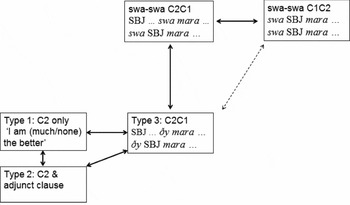
OE thus had a great number of structurally similar constructions, all of which expressed a comparative correlative meaning of some type. As I shall argue, in order to understand the evolution of the PdE C1C2 constructions it is important to take into account how all of these OE constructions interacted synchronically to allow speakers the creation of a new structure. In line with Hoffmann & Trousdale (Reference Hoffmann and Trousdale2011: 15), I therefore assume that constructional change affects not only an individual structure, but actually leads to changes in a network of syntactically and semantically-related constructions. Figure 1 therefore first of all gives a schematic overview of the OE network of all the relevant grammatical constructions.
The OE comparative correlative network (with similarity links)

As was pointed out above, all of the relevant constructions share important formal as well as semantic similarities, concerning:
-
• the presence of a C2 clause (as in type 1–3 ðȳ-clauses or both swa. . .swa. . . constructions);
-
• the ordering of C1 and C2 (as in type 3 and swa. . .swa. . . C2C1 comparatives);
-
• the presence of a subordinate clause together with (main clause) C2 (all constructions except type 1).
Figure 1 expresses these formal and semantic similarities by connecting the constructions in question with double-headed arrows (↔). It should be pointed out that this representation does not differentiate between constructions that are in a subpart relationship (such as type 1, which can be said to be realized as a subpart of type 2 and type 3 constructions) and those that are related by synonymy links (such as the type 3 C2C1 construction and the C1C2 and C2C1 swa. . .swa. . . constructions). While Goldberg (Reference Goldberg1995: 67–100) distinguishes between these different types of relationships, this distinction is not relevant for the discussion at hand: as I will show, in line with assumptions from output-based usage-based approaches (Croft & Cruse Reference Croft and Cruse2004: 300–2), the grammaticalization of the. . .the. . . C1C2s involved the analogical extension of surface forms and their meaning (as part of which the ontological difference between subpart and synonymy links played only a secondary role).
Moreover, adopting the Uniformitarian Principle, I assume that the mental grammars of Old English or Middle English readers were subject to the very same cognitive constraints as modern speakers of English. Thus, I assume that figure 1 can be taken as a representation of the mental network of comparative clause constructions of OE speakers. As mentioned above, the postulation of a constructional network is integral to Construction Grammar approaches (see Croft & Cruse Reference Croft and Cruse2004: 262–5; Goldberg Reference Goldberg2006: 215), in which taxonomic networks play an important role in accounting for the organization of mental grammatical knowledge. The basis for the postulation of such networks comes from extensive cognitive linguistic and cognitive psychological research that has provided ample evidence that mental linguistic knowledge from lexical items and syntactic constructions to social categories is stored and organized in such networks (Croft & Cruse Reference Croft and Cruse2004: 262–5; Hudson Reference Hudson2010: 34–69): links in these networks are created based on formal as well as semantic similarity between elements. Psycholinguistic evidence for these links comes from priming studies (see Hudson Reference Hudson2010: 74–6, 141, 201; see also Berg Reference Berg2014 for an overview of further experimental evidence): elements can be primed based on phonological (e.g. cat, catalogue, category; Mattys Reference Mattys and Brown2006 in Hudson Reference Hudson2010: 201) as well as semantic similarity (doctor > nurse; Collins & Loftus Reference Collins and Loftus1975; Hasson & Small Reference Hasson, Small, Stemmer and Whitaker2008: 84). Moreover, not only words, but also morphemes (Marslen-Wilson Reference Marslen-Wilson2006) and constructions can be primed (Bencini Reference Bencini, Hoffmann and Trousdale2013). In cognitive connectionist / interaction activation models (see, e.g., Rumelhart, McClelland & the PDP research group Reference Rumelhart and McClelland1986; Bates & MacWhinney Reference Bates, MacWhinney, Bates and MacWhinney1989) these results receive a straightforward interpretation: mental knowledge of all types is represented in networks, with links between elements emerging through formal as well as semantic similarity (and greater similarity leading to greater association and faster priming effects).
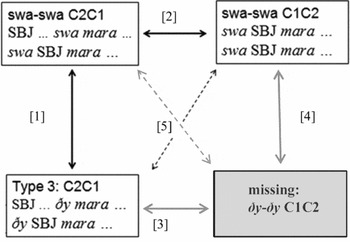
Figure 1 then can be seen as a visual representation of the OE comparative correlative constructional network, with the similarity links between constructions being the stronger the more formal and semantic properties are shared. Focusing on those OE structures that comprise both C1 and C2 clauses, figure 2 shows how these formal and semantic links contributed to the analogical creation of the new C1C2 comparative correlative construction.
OE C1 and C2 comparative correlative network (with similarity links)

The black arrows in figure 2 show the existing similarity links between the OE constructions, while the grey arrows represent the analogical links that form the basis for the creation of the new ðy–ðy C1C2 construction. While earlier approaches to grammaticalization tended to downplay the role of analogy (see, e.g., Haspelmath Reference Haspelmath1998; Lehmann Reference Lehmann2004; as discussed in Traugott & Trousdale Reference Traugott and Trousdale2013: 37), recently it has been identified as one of the main processes of (syntactic) change (cf. e.g. Traugott & Trousdale Reference Traugott and Trousdale2013: 37; Bergs Reference Bergs and Dancygier2017). As Traugott & Trousdale (Reference Traugott and Trousdale2013: 37–40) point out, however, there is an important difference between analogical thinking (which is based on existing constructional networks) and what they call ‘analogization’, the actual mechanism that leads to (syntactic) change. Analogical thinking is only a ‘change-enabling’ parsing process that is the result of the mental network storage of linguistic information and may or may not result in change. Analogization, on the other hand, is the mechanism that following analogical thinking actually results in the creation/neoanalysis of new structures (Traugott & Trousdale Reference Traugott and Trousdale2013: 38).
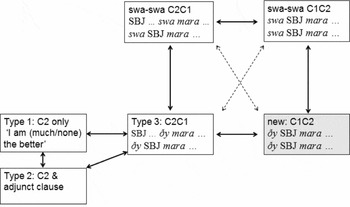
Figure 2 illustrates these distinct steps: the dark arrows show the network links between the three (observed) OE constructions. Due to the strong formal and semantic similarities between the swa–swa C2C1 and the type 3 ðy–ðy C2C1 construction (link [1] in figure 2) and the strong link between the synonymous swa–swa C2C1 and the swa–swa C1C2 construction (link [2] in figure 2), analogical thinking gives rise to the analogical links [3] and [4] (see the grey arrows in figure 2).Footnote 8 These analogical links then (unconsciously) highlight a paradigmatic gap in the network: the absence of a ðy–ðy C1C2 construction (highlighted by the grey box in figure 2). Due to the strength and multitude of the analogical links, in a next step analogization then leads to the analogical formation of this construction (figure 3).
The late OE/ early ME comparative correlative network (with similarity links)

Figure 3 gives the full comparative correlative network after analogization has taken place (at the end of the OE/start of the ME period). As can be seen, the constructional network is now a highly symmetrical one, with both swa–swa as well as ðy–ðy C1C2 and C2C1 constructions.
In the following, I will show how the ME data support this analogization account: first of all, the earliest ME C1C2 constructions did in fact exhibit the same structural word order as swa–swa comparative correlatives: (a) C1 precedes C2, (b) both swa and ðe introduce the two comparative clauses and (c) the comparative phrase appears after the subject (mare and grædigra as well as more and strengere and betere) (see the OE swa–swa comparative correlative (16) and the new ME ðe–ðe C1C2 (17), respectively):
-
(16)
-
(17)


At the same time, already by the fourteenth century we also find ðe–ðe C1C2 clauses that differ greatly from the OE swa–swa model in (16). Unlike swa–swa proportional comparatives, (18) has an adjacent placement of þe + comparative phrase. The most likely overt analogical model for this adjacent placement seems to have been the three OE types of C2 clauses (see (11–13); Mitchell Reference Mitchell1985), all of which exhibited this word order.
-
(18)

On top of that, (18) has a complementizer þet (indicated by grey font), which marks C1 as the subordinate clause, as well as subject–auxiliary inversion ( is V þe zenne SBJ ; indicated by italics) in C2, which identifies the latter as a main clause. Both of these features have multiple analogical sources. The subordinate status of C1 models the complementizer proportional comparative structures with swa micle swa (see (14)–(15)), but also the status of the C1 clause in type 3 OE C2C1 clauses (see (13)). The main clause status of C2, on the other hand, is modeled on all three types of C2 clauses in OE (see (11)–(13); Mitchell Reference Mitchell1985).
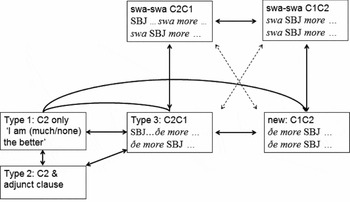
Focusing on the adjacent placement of þe + comparative phrase, figure 4 illustrates how the three types of OE C2 clauses functioned as analogical models in the analogization of the new C1C2 construction:
The early ME comparative correlative network (with similarity links)

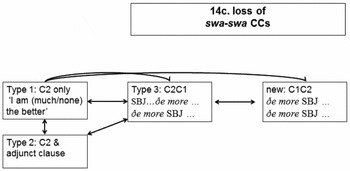
During the fourteenth century, once C1C2 þe–þe as well as C2C1 þe–þe constructions existed, the proportional swa–swa comparative disappeared (Allen Reference Allen1977: 277ff.). As figure 5 shows, one reason for this might have been that the constructional network then no longer needed the latter type of construction since the new þe–þe paradigm covered all of the meanings once expressed by proportional comparatives. As an anonymous reviewer pointed out, this makes it seem as if there are conflicting tendencies at work: on the one hand, language seems to disfavor variation for a single function (which explains why the swa–swa alternatives fall out of use). On the other hand, my analysis implies that new, additional variants can nevertheless be introduced into the system provided there is sufficient analogy-based motivation (which is why the C1C2 þe–þe correlative constructions emerged in late OE). What is important here is, I think, the observation that competition need not always lead to the extinction of a variant. If two constructions are syntactically distinct and semantically synonymous, then they will almost always be distinguished by some pragmatic difference in use (Goldberg Reference Goldberg1995: 67). For Present-day English, for example, I have argued that C1C2 and C2C1 constructions are semantically synonymous, but that the C2C1 construction is preferred if the comparative phrase of C2 is focused (e.g. [It becomes [ even more interesting] FOCUS ]C2, [the more you think about it]C1; Hoffmann Reference Hoffmann2014). Thus, pragmatic differentiation can lead to the conservation of a syntactic variant, even if it should be dispreferred by processing principles alone. By the same reasoning, it would thus have been possible for English to keep both sets of C1C2 and C2C1 structures with þe–þe (PdE the–the) and swa–swa (PdE so–so) – provided the latter had fulfilled some kind of unique pragmatic function. Since C1C2 and C2C1 comparative correlatives with the–the took over the whole range of semantic functions and also divided the different pragmatic uses between them, however, there was no functional need for the swa–swa proportional correlatives any more (figure 5).
The late ME comparative correlative network (with similarity links)

The constructional account of the grammaticalization of C1C2 the–the comparative correlative constructions emphasizes the role of the entire constructional network in the genesis of this new form–meaning pairing (as advocated by Hoffmann & Trousdale Reference Hoffmann and Trousdale2011: 15; Traugott & Trousdale Reference Traugott and Trousdale2013: 50–77; see also Pijpops & Van de Velde Reference Pijpops and Velde2014 for what they call constructional ‘contamination’). This approach differs distinctly from previous analyses such as Allen's (Reference Allen1977: 277ff.), which claim that the merely replaced swa in proportional comparatives. Such an analysis that limits the context of grammaticalization to a single construction (a view of grammaticalization expressed by, e.g., Lehmann Reference Lehmann, Gerritsen and Stein1992: 406), has already been criticized as being too simplistic (see Trousdale Reference Trousdale2008a, Reference Trousdale, Davidse, Breban, Brems and Mortelmans2012). Yet, while previous diachronic Construction Grammar studies focused on the importance of gradual change and the elaboration of the taxonomy of a single construction type (via changes on the micro-, meso- as well as macro-constructional level;Footnote 9 see Gisborne & Patten Reference Gisborne, Patten, Narrog and Heine2011: 100–2), the present study has shown that it is also the full constructional network that constrains as well as (via analogization) enables the creation of a new structural variant.
The claim that the entire constructional network can play a role in linguistic change (Hoffmann & Trousdale Reference Hoffmann and Trousdale2011: 15; Traugott & Trousdale Reference Traugott and Trousdale2013: 50–77) receives independent support from cognitive linguistics, psycholinguistics as well as usage-based approaches to language. Furthermore, it also provides a cognitive explanation for the Structuralist view of language change (Meillet (Reference Meillet1912: 131–48); Saussure (Reference Saussure, Bally, Sechehaye and Harris2006 [1916]); Martinet (Reference Martinet1952, Reference Martinet1955); for an overview see McMahon Reference McMahon1994: 24–32). With respect to sound changes, Structuralist approaches, for example, claimed that an ‘important aspect of structure is symmetry; gaps in sound systems seem to be disfavoured’ (McMahon Reference McMahon1994: 28). Similarly, I argued above that the missing C1C2 the–the comparative correlative construction constituted a gap in the OE constructional network (see figure 2) that was identified via analogy and, consequently, filled via analogization. Thus, Construction Grammar provides a cognitive model for the Structuralist notion of language as a system (the constructional network) and gaps in the system as potential loci of change.
4 Middle to Modern English: competition and processing constraints
Once the C1C2 the–the comparative correlative construction with its iconic protasis–apodosis order was added to the constructional network, it became a ‘point-attractor’ (in the sense of Lass Reference Lass1997: 295–7) that functioned like a ‘sink’ and consequently attracted more and more micro-constructions. This attraction was so great that it not only ousted the swa–swa proportional comparatives during ME. On top of that, as we will see below, the iconic C1C2 comparative correlative construction is also much more productive than the non-iconic C2C1 construction in Present-day English. Thus, as soon as there was a choice between competing constructions with a similar meaning, cognitive processing principles governed the choice between these variants (in line with the predictions of the Uniformitarian Principle).
This claim is supported by a pilot study that investigated the actualization course of the C1C2 the–the comparative correlative construction over the Middle English period (Hoffmann Reference Hoffmann2014). Drawing on a large corpus of Middle English texts, the Corpus of Middle English Prose and Verse (CMEPV),Footnote 10 Hoffmann (Reference Hoffmann2014) extracted all ‘the more’ tokens and manually extracted all relevant C1C2 and C2C1 instances. This query was thus limited to one type of CC construction only (those with a comparative more) and ME CCs, obviously, also exhibited other comparative phrases and/or non-adjacent placement of the comparative phrase in clause-internal position. Yet, since more-comparatives are the most frequent prototype of the construction (Hoffmann Reference Hoffmann2014), it was decided to choose this pattern for a pilot study. This search resulted in 1,269 hits, all of which were manually checked to discard false positives and doubled results. As this analysis showed, all in all 165 relevant comparative correlative tokens could be retrieved. Of these 165 ‘the more’ comparative correlative tokens in the CMEPV only 5 were C2C1 tokens. The earliest attestation of a C2C1 pattern in the corpus comes from the Wycliffe Bible (19):
-
(19) And biholde [we togidere in the stiring of charite and of good werkis; not forsakinge
oure gadering togidere, as it is of custom to sum men, but coum|fortinge,
and bi so myche the more,]C2
[bi hou myche ȝe seen the dai neiȝynge]C1.
‘And let us consider one another to provoke unto love and to good works:
Not forsaking the assembling of ourselves together, as the manner of some is; but exhorting one another: and so much the more, as ye see the day approaching.
(Wycliffe Bible, Hebrew X: 24–25 / d. 1384; source of paraphrase: King James VersionFootnote 11 )
Unlike the OE examples (13), (19) contains measurement PPs in both C1 (bi hou myche) and C2 (bi so myche) and a degree word + comparative phrase sequence in C2 only (the more). At first sight, this example might therefore be seen as evidence for a complex (universal) measurement PP + degree phrase structure (as postulated by den Dikken Reference Den Dikken2005: 502). Note, however, that, for theoretical reasons, den Dikken only claims the existence of overtly filled complex measurement PP + degree phrase structures for Early Modern English (den Dikken Reference Den Dikken2005: 514, 521). So how can we explain the bi so myche the more . . . bi hou myche sequence in the ME example (19)?
The answer to this question lies in the textual genesis of the manuscript from which (19) is taken: the Wycliffe Bible is not an original Middle English text, but only the translation of the Latin Vulgate version of the Bible. Moreover, the earlier version of this translation is characterized by its meticulous rendering, which often resulted in structures that seem to reflect the original Latin syntax rather than that of idiomatic Middle English (see, e.g., Görlach Reference Görlach1994: 13).
As the original Vulgate passage from the Epistle to the Hebrews (20) shows, this is also true for (19):
-
(20) et consideremus invicem in provocationem caritatis et bonorum operum non deserentes
collectionem nostram sicut est consuetudinis quibusdam sed consolantes
et tanto magis
quanto videritis adpropinquantem diem
(Jerome's, Latin Vulgate Hebrew X: 24–5/d.405)
www.hsaugsburg.de/∼harsch/Chronologia/Lspost04/Hieronymus/hie_vn19html
(last accessed 10 April 2014)
Thus, the ablative forms tanto ‘that-much:abl’ and quanto ‘how-much:abl’ (Michaelis Reference Michaelis1994: 45) of (20) are simply translated as prepositional phrases in (19). Since tanto (as well as quanto) functions as the clause-initial degree word in Latin CCs, a direct word-for-word translation of the relevant C2 part tanto DEG magis CMPR would have been bi so myche more. The additional English comparative correlative degree word the in (19) (bi so myche the more) can thus be seen as interference of the native ME C2 degree word (which derived from the OE instrumental demonstrative; see above).
The remaining 4 C2C1 tokens date from the fifteenth century and all come from a single author, with two instances even appearing in the same sentence (21):
-
(21) it seemeth that [alle other lasse evydence than is experience,
schulde bi so moche the more diminisse,
and the more lasse the merite of feith,]C2a
[bi hou myche thilke evidence the more neiȝeth
to the grettist evydence, which is experience;]C1a
[and bi so myche al evydence schulde the more
and the better suffre the merite of feith to be,]C2b
[bi hou myche the ferther it is fro the hiȝest and grettist evydence,
which is experience.]C1b
(Reginald Pecock, bishop of Chichester, Book of faith, ch. III: folio 25b; d.1456)
Reginald Pecock was an influential Middle English theologian and bishop,Footnote 12 whose education and grammatical training (see Babington Reference Babington1860: xi) must have included a wide reading of Latin texts, including the Vulgate as well as the Wycliffe Bible. Even though his texts are not translations, it is therefore not surprising that Pecock's writings should exhibit Latinate structures such as the bi so moche (‘tanto’) and bi hou myche (‘quanto’) prepositional phrases. What is interesting about the above tokens, however, is the variable placement of the ME the deg +comparative phrase: in (21), for example, it occurs in both clause-initial (C2a bi so moche the more and C1b bi hou myche the ferther ) as well as in situ position (C2b bi so myche . . . the more and the better as well as C1a bi hou myche . . . the more ). While the clause-initial placement (at least for C1 in C2C1s) clearly corresponds to the rise of the new the–the C1C2 constructions, the in situ examples are probably due to influence of se–se proportional correlatives (see (6)), which still displayed this word order.
The data in (19) and (21) raise interesting points about the influence of loan constructions (here from Latin) on the native ME constructional network – mostly, that we do not see a simple one-to-one structural transference of the Latin pattern (bi so moche ‘tanto’ and bi hou myche ‘quanto’). Instead, the Latinate complex measurement PP + degree phrase structures is combined with the native comparative correlative degree word the, which indicates a case of blending the Latinate with the native construction. Besides, these examples appear to show that native speakers were no longer consciously aware that the native comparative correlative degree word the had the same semantic function as the Latin complex measurement PP + degree phrase structure.
More important for the present study, however, is the relative frequency of the C1C2 and C2C1 constructions. Remember that, due to the original source structures (11) and (12), OE only had the non-iconic C2C1 construction. However, as the ME data revealed, as soon as the iconic C1C2 construction was introduced to the language (via analogization), the two constructions were in competition. Now, in the ME CMEPV data, the iconic C1C2 construction is already considerably more frequent than the non-iconic C2C1 alternative (with a ratio of 160:5 = 32:1, which is already very close to the PdE ratio of 37:1; Hoffmann Reference Hoffmann2014). What this shows is that historical developments can lead to a constructional network that only contains a non-iconic construction without the presence of its more iconic alternative. Once both options are available and competing, however, the PGCH quickly sways the pendulum in favor of the construction that is easier to process.
5 Conclusion
All of the above results are compatible with the Uniformitarian Principle. As the present study highlighted, however, there are situations in which the ‘optimal’ variant that would be preferred on grounds of general cognitive principles is not a part of the language. How can such a situation arise if cognitive processing principles are supposed to shape grammars? The analysis of the evolution of English comparative correlatives revealed that, in addition to processing effects, the entire constructional network plays a major role: on top of the non-iconic C2C1 construction (type 3: (13)), OE also had a C2–only main clause construction (type 1: (11)) as well as a C2–main clause followed by a (non-comparative correlative) subordinate clause (type 2: (12)). Following Mitchell (Reference Mitchell1985: 684), it seems plausible to assume that the type 2 and type 3 constructions actually derive from type 1. Moreover, type 2 constructions were maybe created first via analogization and that type 3 C2C1 constructions were then analogically modeled based on Type 1 (which only had a C2 clause) as well as type 2 (in which the subordinate clause followed the main clause C2). This would explain why comparative correlative meanings in OE ended up being expressed by non-iconic type 3 C2C1 constructions: the clause order of type 3 constructions was simply analogically modeled on another, already existing construction in the constructional network that displayed a main clause > subordinate clause order. If this analysis (already suggested by Christophersen (Reference Christophersen1939: 116)) is correct then the evolution of comparative correlatives would show that for the genesis of new constructions the mental network structure (that is, the number and types of semantically and formally related constructions) can be more important than processing factors (here iconicity). Once a more iconic construction is added to the network via, for example, analogization (as the iconic C1C2 construction was added to the early ME constructicon), competition and processing constraints will immediately come into play. It is from this point onwards that, in line with the PGCH, the easier construction will be activated more quickly and more often, which in turn leads to it being more deeply entrenched.
Summing up, the history of English CCs thus provides further support for the view that syntactic constructions are stored in a cognitive network whose structure can lead to the grammaticalization of a new construction via analogization (Trousdale & Traugott Reference Traugott and Trousdale2013). Moreover, I argued that the Construction Grammar notion of constructional networks can be seen as a cognitive reinterpretation of Structuralist approaches to language change. Thus, Construction Grammar approaches provide a modern, cognitively plausible theory that can accommodate Structuralist ideas and, at the same time, also provides new insights into the cognitive foundations of linguistic variation and change.