The last two decades have seen a substantial number of facultative referendums for the ratification of international treaties. The most prominent examples are the referendums for the ratification of institutional reforms in the European Union (EU). In 2005 and 2006, for example, France, Poland, the United Kingdom and several other countries either held (or planned to hold) referendums on the EU's Constitutional Treaty (also known as the Treaty Establishing a Constitution for Europe [TECE]). Interestingly, other EU member countries—among them Austria, Belgium and Sweden—decided not to submit the treaty to a popular vote. Even more variation exists when looking at party positions: in Spain, all political parties represented in the national parliament called for a referendum, while in Latvia all political parties backed ratification in parliament. In 15 member states, political parties were split on this issue. Across Europe, about half of the parties that favored a referendum also supported the treaty, whereas the other half opposed it. What explains this variation across party positions with respect to the desirability of an international treaty per se as well as of a non-required referendum as an instrument of its ratification?
We develop an original game-theoretic model to answer this question. A key prediction derived from the model is that, all else equal, parties are most prone to support a referendum on an international treaty at the beginning and toward the end of the electoral cycle. At the same time, the few parties that endorse a referendum in the middle of the electoral cycle are highly likely to come out in favor of the international treaty. These findings come about for two reasons. First, voters’ incentives to treat referendums as second-order elections and use them to signal their (dis)satisfaction with the government's performance to date are highest in the middle of the electoral cycle. This is what we call the “voter signaling” effect. Secondly, changes in their political capital as a result of ratification decisions carry greater weight for parties the closer they find themselves to the next election. We call this the “reputational” effect of referendums.
The effect of timing, however, is conditional on public opinion towards the treaty in a country. We expect the probability of a party calling for a referendum to fall over the course of the electoral cycle in countries with a favorable public opinion toward the treaty and to grow in countries with a skeptical public opinion. Public support for a treaty, of course, increases the likelihood that a party will support the treaty in a referendum campaign.
We test our argument against a dataset that includes the positions of 175 parties on whether to support a referendum on the EU's Constitutional Treaty (signed in October 2004) and on whether to back the treaty in a referendum campaign. Since the signing of this treaty fell randomly within the electoral cycle of EU member states, we can test our argument in a quasi-experimental manner. Using multinomial logistic regression analysis, we find solid support for our theory.
In developing this argument, we build on a series of recent studies that address the question of why political parties sometimes call for optional referendums on salient issues (Schneider and Weitsman Reference Schneider and Weitsman1996; Hug Reference Hug2004; Closa Reference Closa2007; Hug and Schulz Reference Hug and Schulz2007; Tridimas Reference Tridimas2007; Finke and König Reference Finke and König2009; Dür and Mateo Reference Dür and Mateo2011). These studies stress factors such as the role of institutional rules (Hug Reference Hug2004; Finke and König Reference Finke and König2009), voters’ preferences (Tridimas Reference Tridimas2007; Dür and Mateo Reference Dür and Mateo2011), parties’ expected gains from the policy (Finke and König Reference Finke and König2009), the closeness of elections (Dür and Mateo Reference Dür and Mateo2011) and imitation across countries (Closa Reference Closa2007). Our main contribution to this literature is a focus on party strategies rather than country-level outcomes. Moreover, we highlight the importance of domestic political factors within various institutional settings. A further novelty in our approach is that we simultaneously derive parties’ two-pronged equilibrium strategies on whether to endorse a referendum and what position to take in a referendum campaign, thus obviating the need for arbitrary assumptions on party stances, which are often used in the literature.
We also contribute to the growing literature on second-order elections. For some time, scholars have debated the extent to which voters use electoral contests of secondary importance to send signals to their government.Footnote 1 Schmitt (Reference Schmitt2005) empirically establishes a curvilinear effect of the time elapsed between any European Parliament election and a national parliamentary election on the degree of vote share congruence at both the party and country levels, and presents this as evidence of strategic voting. Our results suggest that parties take such a curvilinear effect for granted in their decision-making process. In the same vein, Ray (Reference Ray2003a) uncovers a positive relationship between incumbent support and pro-EU attitudes that appear primarily when referendums are held on the reform of European institutions or during European Parliament election years. Both our theoretical and empirical results essentially replicate a similar inverted-U relationship in the case of referendums for international treaty ratification.
A Partisan Model of International Treaty Ratification
Basic Set-up
This article focuses on the ratification subgame, seeking to explain variation in party stances with respect to the use of popular referendums as ratification mechanisms. Our interest lies primarily in cases of international treaty ratification in which the government may strategically exercise the option of submitting the international agreement to a popular vote. In these cases, opposition parties can also position themselves strategically with respect to the use of referendums for purely rhetorical reasons, even without having referendum-initiation powers. Incumbent and opposition parties then play a reputational game of electoral competition, in which the political stakes are a function of timing within the electoral cycle. This novel theoretical approach highlights the domestic strategic contours of treaty ratification by allowing for the probabilistic occurrence of failed referendums (as in the case of the French and Dutch rejections of the EU's Constitutional Treaty).
Consider what happens once the negotiation stage of a far-ranging and politically salient international treaty (such as accession to or deepening of a highly institutionalized international organization) has been successfully completed. Let  $$${{x}_c}\, \in \,X\, \subset \,{\Bbb R}$$$
(X closed and compact) denote the outcome of international treaty negotiations along the single dimension of political (dis)integration and policy (de)centralization. Without loss of generality, assume that the treaty negotiation outcome xc lies to the right of the status quo
 $$$\left( {{{x}_c}\, \gt \,{{x}_{SQ}}} \right)$$$
in terms of further deepening the existing cooperation arrangements. In that case, the incumbent party needs to decide whether to ratify the negotiated agreement via parliament (with ratification assumed to be certain) or by referendum (the outcome of which is uncertain). We go on to model the role of political timing and related strategic considerations with respect to these choices using a probabilistic game of electoral competition. This approach allows us to subsume the role of voters as strategic players into an endogenously derived probability function for the outcome of a referendum vote.
We effectively restrict the zone of acceptable agreements at the intergovernmental negotiation table to those that are weakly preferred to the status quo by both the incumbent ( $$${\rm{\rDelta }}u\left( {{{x}_c},{{x}_{SQ}};{{x}^I} } \right)\, \gt \,{\rm{0}}$$$
, where
 $$${{x}^I} $$$
denotes the incumbent's ideal policy) and the average voter (
 $$${\rm{\rDelta }}W\left( {{{x}_c},{{x}_{SQ}}} \right)\,\geq \,{\rm{0}}$$$
, where W(·) denotes aggregate welfare) (see Assumption 1 in the Appendix).Footnote 2 Therefore, neither the office-seeking (those interested in aggregate welfare maximization) nor the policy-seeking (those weighting particularistic interests more heavily) factions of the incumbent will have reason to object to the treaty. In the case of supermajority parliamentary ratification rules,Footnote 3 our assumption of certain ratification implies that the treaty is acceptable to a pro-integration supermajority of parliamentarians (who have publicly stated positions on integration policy and preference profiles known to the incumbent). Although we recognize that the negotiated agreement is endogenously determined within a two-level game framework (Putnam Reference Putnam1988), we choose to assume away the strategic importance of domestic institutional rules of ratification (parliamentary and referendum initiation rules) for the country's bargaining leverage by focusing on a partial equilibrium analysis of the ratification subgame.
Opposition policy preferences along the integration dimension are presumably not constrained by such conditions. Opposition rhetoric is assumed to be both purposive and reflective of the underlying preferences of the party base. For the purposes of the benchmark model laid out below, we consider the case of an opposition party with relatively moderate views on integration policy; that is, its ideal integration policy is such that  $$${{x}^O} \, \in \left[ {{{x}_{SQ}},{{x}_c}} \right]$$$
. The Appendix also discusses the cases of extreme (pro- or anti-) opposition views on integration and their implications for our theoretical results.Footnote 4
Even though the dimensionality of such far-ranging treaties is effectively higher, this is not cause for major theoretical concern as this parsimonious framework constitutes a partial equilibrium analysis of the ratification stage, which has a binary “accept-or-reject” outcome with respect to a given policy package xc. Moreover, as the article's emphasis is on the domestic political determinants of international treaty ratification, the potential strategic interdependence of ratification decisions across countries falls beyond the scope of our partial equilibrium approach. Even though we choose to examine the domestic context of ratification in isolation, a new integration agreement may still only take effect once it has been successfully ratified by all countries involved. While the utility losses of failed ratification in any one country are certain—since the entire agreement will collapse—the domestic policy gains of successful ratification are diluted by the risk of international agreement failure. This could explain why most pronouncements about the timing of referendums are intentionally vague. Even so, in the empirical section we argue that the significance of these sequencing and spatial interdependence spillover effects is empirically tenuous, since the ratification decisions were taken without prior knowledge of the scheduled timing of referendums in other countries, and such positions were considered binding in the future.
A Referendum as a Probabilistic Voting Game
Citizens care both about the policy content of the negotiated treaty and the valence of parties.Footnote 5 Valence here refers to the electorate's changing perceptions of a party's competence and overall record of performance. It is independent of ideology or policy area; instead, it is influenced by the process and outcome of ratification. Hence, parties effectively compete along two dimensions. This set-up is akin to valence models that have been increasingly applied to the study of electoral competition.Footnote 6 We assume that party positions and actions in the ratification process are observed by both domestic (voters) and international (treaty cosignatories) audiences. Moreover, we model valence gains and losses as zero sum for both the incumbent and the opposition, insofar as they accrue to the incumbent's current level of relative political capital. Relative political capital (δ) in this sense (that is, as a state variable of accumulated valence) connotes the overall level of trustworthiness and popularity enjoyed by the incumbent vis-à-vis the opposition and vice versa.
Democratic political elites are also motivated by office and policy. The relative importance of these two objectives depends on the salience of the valence component to voters (γ). This salience factor depends on the time until the next election and the political climate at the time of ratification, namely the level of polarization (both rhetorical and legislative). The relative salience variable is also conditioned by the institutional and structural features of the party system that make it either more adversarial (e.g., United Kingdom) or consensual (e.g., Switzerland).
We follow the majority of scholars in this field in classifying referendums for the ratification of international treaties as second-order elections that evolve into popularity contests. Substantive debates over international policy are often shrouded by domestic electoral motivations and strategic posturing, subject to the various audience costs and benefits associated with different ratification outcomes. The incumbent's perceived ability to govern is always on the line at every popular vote.Footnote 7 Partisan supporters will always welcome an opportunity to reward the incumbent at the ballot, while its opponents will snatch the chance to voice their disapproval by all democratic means possible. Probabilistic voting allows us to derive the joint effects of relative government popularity (δ) and relative policy salience (γ) based on the probability that the referendum will pass. It also captures the common uncertainty and converging beliefs among political elites about the outcome of a mass vote. This way, referendum voting equilibria are implicitly “black-boxed” into a probability function, enabling us to focus on the strategic properties of the ratification subgame.
We provide the full mathematical derivation of the probabilistic model expounded above in the online appendix (see Proposition 1). We also show that, in the case of independently and uniformly distributed random variables, the probability of successful ratification by referendum takes the following form (where μ > 0 captures the aggregate level of uncertainty over the incumbent's relative popularity):
 $$P\,\left( {\gamma, \delta, {\rm{\rDelta }}W} \right)\, = \,\frac{{\rm{1}}}{{\rm{2}}}\, + \,\mu \left( {\frac{{{\rm{\rDelta }}W}}{\gamma }\, + \,\delta } \right).$$
In other words, popular governments and desirable international treaty agreements tend to be more successful in a popular referendum, while the prominence of domestic electoral factors and political issues tend to precipitate negative referendum outcomes. The intuition for the first two partial effects is quite straightforward. The partial effect with respect to the relative salience parameter (γ) should be viewed in light of Assumption 1 in the Appendix (that is,  $$${\rm{\rDelta }}W\left( {{{x}_c},{{x}_{SQ}}} \right)\,\geq \,{\rm{0}}$$$
). Given that the treaty would be unequivocally endorsed by a popular majority based on its intrinsic policy merits, it would be in increasing jeopardy of not being ratified by referendum as the vote becomes further overshadowed by domestic electoral issues. For the rest of the analysis, we employ the simple specification of the probability function provided in Equation 1. In the online appendix we derive more general conditions that are necessary in order for our comparative statics predictions to hold; namely, that the average welfare differential of treaty implementation for swing voters needs to be non-negative (Assumption 2).
An Incumbent-Opposition Game of Treaty Ratification
We now consider the strategic interaction between the incumbent (I) and the opposition (O) with respect to the process of treaty ratification. Our game-theoretic approach clearly captures the strategic interplay between the incumbent's constitutional prerogatives and the opposition's rhetorical actions. We start with a normal-form specification of the game, in which the incumbent needs to decide whether to “call” (C) a binding non-required referendum for treaty ratificationFootnote 8 or “not to call” (NC). If the government calls a referendum, it essentially opts for an uncertain lottery outcome, whereby the treaty will be ratified by a popular majority according to the probability parametrically specified in the above probabilistic voting subgame. A negative referendum outcome would imply that the whole ratification process will stall, and that the agreement has to be renegotiated at the intergovernmental level. Hence, the status quo level of integration and cooperation (xSQ) constitutes the reversion point. If the incumbent does not call a referendum, the treaty is ratified by a parliamentary majority commanded by the government. While levels of party cohesion and parliamentary voting thresholds vary across political systems, our assumption of certain parliamentary ratification is plausible within the context of parliamentary European democracies with high levels of party cohesion.
While the incumbent naturally always comes out in favor of the treaty agreement it negotiated multilaterally, the opposition's strategic posture is more nuanced, as it needs to decide where it stands both with respect to the treaty itself and the mechanism of ratification. Depending on its own policy preferences  $$$\left( {{{x}^O} } \right)$$$
, among other things, it may choose to “endorse” a referendum and “come out against” the treaty (EN), to “endorse” and “come out in favor” (EY) or “not to endorse” a referendum in the first place (NE). Failure to endorse a referendum need not be qualified by a specific stance with respect to the treaty itself, as it implies tacit consent to the ratification of the treaty and its continued acceptance in the future as part of the country's international commitments. In light of our assumption about party cohesion and simple majority rulesFootnote 9—and the assertion that voters only care about policy outcomes insofar as they are excluded from the ratification process—the position and rhetorical intensity of the main opposition party in parliament has no effect on the payoffs of the game or on the hypothetical outcome of the referendum vote. Since parliamentary debate is presumed to be insulated from external audiences, parties are assumed to vote purely on policy grounds (i.e., they vote “yes” if and only if
 $$${\rm{\rDelta }}u\left( {{{x}_c},{{x}_{SQ}};{{x}^i} } \right)\,\geq \,0$$$
).
Let us next lay out the payoff structure along the valence dimension. We essentially posit that the timing and outcome of a referendum will have a similar effect on the relative political capital of the major political parties as a mid-election poll. In the event of successful ratification by referendum, the incumbent (I) is rewarded with a relative valence gain  $$$b\, \in \,\left( {{\rm{0}},{\rm{1}}} \right)$$$
for reflecting the majority will through a mechanism of direct democracy. The same applies to the opposition (O) if it supports the treaty. On the other hand, c (normalized to unity) denotes the relative loss in popularity for going against the popular will of the ex post majority. This loss will be borne by either of the mainstream parties as long as they position themselves ex ante on the opposite side of the referendum outcome.Footnote 10 Finally,
 $$$d\, \in \,\left( {{\rm{0}},{\rm{1}}} \right)$$$
captures the valence net reward (punishment) of giving (not giving) voters a direct say in the treaty ratification process. This parameter may vary with respect to a country's constitutional tradition in direct democracy (measured, for example, by the total number of past referendums on national and international issues). Note that while parameters b and c are contingent on the outcome of the popular vote, parameter d is not. Moreover, the asymmetry between reputational gains and losses
 $$$\left( {b\, \lt \,c\, = \,1} \right)$$$
is justified for two reasons: (1) if a failure to ratify will cause negative integration externalities on the other treaty cosignatories, the opprobrium of international audiences (directed primarily against the incumbent government)Footnote 11 may affect the party's decision-making calculus in order to avoid negative reputation costs and (2) standard loss-aversion arguments apply (losing hurts more than winning helps).
The probabilistic nature of referendums gives rise to risky alternatives (lotteries) that depend on the outcome of the vote. The lottery associated with the policy component of the utility function is  $$${\rm{\rPi }}\, = \,\left( {{{x}_c},P;{{x}_{SQ}},1\,{\rm{ - }}\,P} \right)$$$
; the treaty is implemented (subject to successful ratification in all countries) at point xc with the probability P of a “yes” vote (as specified in Equation 1), and the status quo level of integration prevails with the probability 1–P of a “no” vote. Lotteries over the orthogonal valence payoffs will depend on the opposition's pure strategy response to the incumbent's choice to initiate a referendum (C): (1) if the opposition chooses to endorse a referendum publicly calling for a “no” vote (EN), then the incumbent is faced with the lottery over valence payoffs
 $$${\cal L}_{{EN}}^{I} \, = \,\left( {1\, + \,b,P;\,{\rm{ - }}\,\left( {{\rm{1}}\, + \,b} \right),1\,{\rm{ - }}\,P} \right)$$$
, with an expected value of
 $$$EV\left( {{\cal L}_{{EN}}^{I} } \right)\, = \,\left( {{\rm{2}}P\,{\rm{ - }}\,{\rm{1}}} \right)\left( {{\rm{1}}\, + \,b} \right)$$$
; (2) if the opposition chooses to endorse a referendum publicly calling for a “yes” vote (EY), then the incumbent is faced with the lottery over valence payoffs
 $$${\cal L}_{{EY}}^{I} \, = \,\left( {0,P;0,1\,{\rm{ - }}\,P} \right)$$$
, where
 $$$EV\left( {{\cal L}_{{EY}}^{I} } \right)\, = \,{\rm{0}}$$$
and (3) if the opposition chooses not to endorse a referendum publicly (NE), then the incumbent is faced with the lottery over valence payoffs
 $$${\cal L}_{{NE}}^{I} \, = \,\left( {b,P;{\rm{ - }}1,1\,{\rm{ - }}\,P} \right)$$$
, with an expected value of
 $$$EV\left( {{\cal L}_{{NE}}^{I} } \right)\, = \,P({\rm{1}}\, + \,b)\,{\rm{ - }}\,{\rm{1}}$$$
. Since competition along the orthogonal dimension of political capital accumulation is modeled as zero sum, the corresponding valence lotteries faced by the opposition are the same but with the payoff signs reversed:
 $$${\cal L}_{{{{\alpha }^O} }}^{O} \, = \,{\rm{ - }}{\cal L}_{{{{\alpha }^O} }}^{I}, \,\forall {{\alpha }^O} \, \in \,\left\{ {EN,EY,NE} \right\}$$$
. Note that in the case of (C, EY), the electoral fortunes of the two mainstream parties are tied together, as their relative gains and losses cancel each other out.
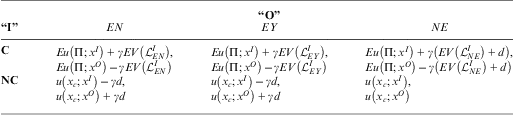
The normal form of the ratification game shown in Table 1 encapsulates all the above features of the model while remaining agnostic about the sequence of moves by the major political actors. This is generally the case in games of political rhetoric. Since subgame perfection is a refinement of Nash equlibria, the simultaneous-form version of the game prevents us from eliminating any plausible equilibria as a result of restrictive (and possibly erroneous) assumptions about the order of play. Quasi-linear utility with respect to integration policy and valence implies that parties will be risk-neutral with respect to changes in their relative political capital (hence the expected value calculation of the valence gambles); on the other hand, risk attitudes toward changes in policy remain ambiguous. Note that for very high values of salience γ, the game essentially becomes one of pure conflict as the policy component becomes less relevant.
Ratification Game with Simple Majority Referendum-Initiation Provisions
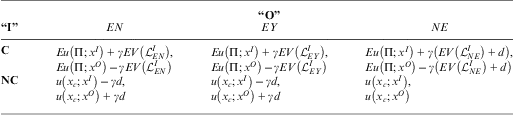
Note: the incumbent (“I”) has the option of calling (C) or not calling for a referendum (NC), while the opposition (“O”) has the option of endorsing the referendum while saying ‘no’ to the treaty (EN), endorsing the referendum while saying ‘yes’ to the treaty (EY) or not endorsing the referendum at all (NE). Π denotes policy-related lotteries,  $$$\cal L $$$
denotes valence-related lotteries and γ captures the relative salience of these two orthogonal dimensions of electoral competition. Finally,
 $$${{x}^I} $$$
and
 $$${{x}^O} $$$
correspond to the ideal policies of the incumbent and the opposition, respectively.
An examination of the Nash equilibria of the game (see Correspondence 4 in the Appendix) clarifies what we mean by the strategic interplay between incumbent constitutional prerogatives and opposition rhetoric. Essentially, the policy component of the utility function is determined by the incumbent's choice of ratification instrument, while the political stakes of the referendum are set by the opposition's strategic posture. If O opts for the polarizing strategy of endorsing a referendum in opposition to the treaty (EN), then it does so with the intention of raising the stakes (or else widening the spread of lottery outcomes). On the other hand, the strategy of supporting treaty ratification by referendum (EY) neutralizes the stakes, since  $$$EV\left( {{\cal L}_{{EY}}^{I} } \right)\, = \,{\rm{0}}$$$
. The lottery
 $$${\cal L}_{{NE}}^{I} $$$
resulting from no endorsement (NE) lies in the middle in terms of its spread of potential payoffs. If, on the other hand, the incumbent opts for (certain) parliamentary ratification, then it is always best for the opposition to endorse a referendum and thus reap the democratic legitimacy valence payoff d. To summarize, in the benchmark specification of our partisan treaty ratification model, the opposition will be in control of the political stakes of the zero-sum valence dimension of electoral competition.
However in this version of the game, in which the opposition is assumed to have moderate policy preferences and no referendum-initiation prerogatives per se, its policy stance along the integration dimension (x O) has no strategic relevance. In other words, the opposition's strategic posturing in the process of international treaty ratification does not vary due to its intrinsic policy preferences. Even if O were negatively predisposed toward the new integration agreement  $$$\left( {{\rm{\rDelta }}u\left( {{{x}_c},{{x}_{SQ}};{{x}^O} } \right)\, \lt \,{\rm{0}}} \right)$$$
, it may well choose to support its ratification by referendum (EY) as long as the average voter is sufficiently pro-integration and the overall political climate is conducive to popular ratification. This apparent paradox is a direct implication of the constitutional allocation of referendum-initiation prerogatives, which in the benchmark model rest wholly with the majority party.Footnote 12
Comparative Statics and Electoral Timing
Our key contribution to the study of international treaty ratification is that we account for the fact that the timing of ratification falls randomly within the domestic electoral cycle of each signatory country. We treat the timing of the ratification process as the end of the negotiation process. This allows for a quasi-experimental empirical design that explains a substantial part of the cross-country variation in party-level ratification strategies by controlling for domestic explanatory variables in isolation from the international context.Footnote 13 We focus mostly on relative political capital and relative political salience and treat them both as state variables (δ(t) and γ(t), respectively) that fluctuate during the term subject to stochastic shocks around that trend. We surmise that the incumbent's relative political capital is subject to a negative decaying trend over the length of its term. On the other hand, the expected time trend of the relative salience of valence is less straightforward and essentially non-monotonic when viewed from the joint perspective of voters and politicians. This exogenous variation with respect to the electoral cycle proves to be very useful for the empirical identification of our research question.
We proceed to analyze the model's comparative static predictions with respect to electoral timing by way of trend and off-trend changes in the underlying time-varying parameters δ(t) and γ(t). Secondarily, we also discuss the exogenous partial effects of other time-invariant domestic-level parameters, namely  $$${\rm{\rDelta }}W\left( {{{x}_c},{{x}_{SQ}}} \right)$$$
and
 $$${\rm{\rDelta }}u\left( {{{x}_c},{{x}_{SQ}};{{x}^j} } \right)$$$
. We apply the properties of monotone comparative statics (Ashworth and Bueno de Mesquita Reference Ashworth and Bueno de Mesquita2006) and extract a number of interesting theoretical predictions from our model. More specifically, we seek to predict the direct partial effect of each time-varying parameter on the relative likelihood between two given actions for a player by deriving their effects on that player's utility differential compared to all other actions by the opponent. If changes in the model's underlying parameters cause the utility differentials between any two actions to move in the same direction regardless of the opponent's response, then one can unambiguously predict a monotonic partial effect on the relative probability that a player will choose one action over another. This analysis is in accordance with the multinomial logistic regression model used in the empirical section of the article. The formal derivation of the comparative statics properties of the model is presented in the online appendix.
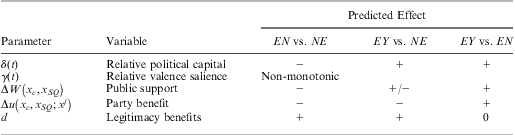
In regards to our first parameter of interest, government popularity δ(t), we know from above (Equation 1) that it is positively related to the probability of a “yes” vote (“voter signaling” effect). Taking partial derivatives of the utility differentials (see Equation 5 in the Appendix) for both the incumbent and the opposition leads us to predict that an exogenous off-trend increase in the incumbent's stock of relative political capital is associated with: (1) a positive net effect on the relative odds of endorsing a referendum and supporting the treaty vs. not endorsing a referendum for opposition parties (or calling vs. not calling a referendum for incumbents), (2) a negative net effect on the relative odds of endorsing a referendum and opposing the treaty vs. not endorsing a referendum and (3) a positive net effect on the relative odds of endorsing a referendum and supporting the treaty vs. endorsing a referendum and opposing the treaty. All in all, mainstream opposition parties will not want to position themselves against popular incumbents, so they will either choose to wage their battle in the parliamentary arena or—unless locked in an anti-integration stance—openly endorse both the treaty and its ratification by popular vote.Footnote 14
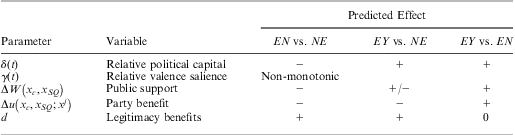
Hypothesis 1: An exogenous increase in the incumbent's relative political capital has (1) a positive net effect on the relative odds of EY vs. NE, (2) a negative net effect on the relative odds of EN vs. NE and (3) a positive net effect on the relative odds of EY vs. EN.
The comparative statics behavior of the model with respect to the relative salience parameter γ(t) is more complicated simply due to the fact that γ enters the utility differentials both as a multiplicative factor and through the referendum-success probability function P(·). An increase in γ has a twofold effect on parties’ strategic calculus: (1) it leads to a decrease in the probability of successful ratification by referendum (“voter signaling” effect) and (2) it raises the relative weight of the domestic political stakes of the ratification gamble (“reputational” effect). The “voter signaling” effect captures the degree to which voters seek to signal their (dis)satisfaction with the government's performance to date ex ante (before the outcome of the vote is known), thereby inducing favorable changes in government policy. From the point of view of parties, the “reputational” effect reflects the expected present discounted value (in terms of future electability) of changes in their stock of relative political capital ex post. In other words, the closer the next elections are, the stronger is the effect of off-trend fluctuations in parties’ valence on their upcoming electoral performance. The combination of these two opposing effects on the behavior of the conditional utility differentials implies a strong non-monotonic relationship between γ and the relative odds of any two actions.
When considering the joint effects of government popularity (decreasing trend) and relative salience (non-monotonic trend) along the electoral cycle trend,Footnote 15 we expect that the “voter signaling” and “reputational” effects intensify (or weaken respectively) at different rates throughout the electoral cycle, thus giving rise to strong non-monotonicities. More specifically, the “voter signaling” effect will tend to be stronger toward the earlier part of the electoral cycle (as long as sufficient time remains for corrective action on the part of a government with high expected levels of popularity), while the “reputational” effect will tend to predominate toward the end of the cycle, as politicians are bound to place more weight on the electoral impact of fluctuations in their stock of political capital the closer they get to an electoral campaign.
Hypothesis 2: The political timing of ratification has a convex non-monotonic trend effect on the relative odds of EN vs. NE and EY vs. NE. More specifically, the net likelihood that any party does “not endorse” a referendum increases in the earlier part of the government's term, peaks in the middle and starts decreasing in the latter part of the cycle.
Another parameter of interest is the aggregate welfare differential of treaty ratification vis-à-vis the status quo  $$$\left( {{\rm{\rDelta }}W\left( {{{x}_c},{{x}_{SQ}}} \right)} \right)$$$
. All else equal, we consider exogenous changes in the aggregate policy desirability of the new integration agreement, holding its policy content fixed at its negotiated level. We find that this variable affects utility differentials in two ways. First, higher welfare gains from treaty ratification imply a higher probability of a “yes” vote (Equation 1); hence, incumbent parties will be more likely to call for a referendum and opposition parties will be more likely to endorse one. Secondly, the more controversial and politicized the proposed treaty, the higher the public demand for a referendum. Bypassing popular consultation through parliamentary means on highly controversial international issues is quite costly for politicians across the board. When the electorate does (not) expect to be directly consulted on grave issues of foreign policy orientation, then we expect d to be relatively high (low). Therefore we assume that the magnitude of the democratic legitimacy variable d is a decreasing function of the average popularity of the treaty
 $$$\left( {d^{\prime}\left( {{\rm{\rDelta }}W} \right)\, \lt \,{\rm{0}}} \right)$$$
.
Taking partial derivatives of the utility differentials (Equation 5 in the Appendix) for both the incumbent and the opposition leads us to the theoretical prediction that the net effect of ΔW on the relative odds of endorsing a referendum and supporting the treaty vs. not endorsing a referendum for opposition parties (or calling vs. not calling a referendum for incumbents respectively) is ambiguous. Yet the net effect on the relative odds of endorsing a referendum and opposing the treaty vs. not endorsing a referendum is negative for opposition parties (trivially so for incumbents). Finally, the net effect of public support for the treaty on the relative odds of endorsing a referendum and supporting the treaty vs. endorsing a referendum and opposing the treaty is positive for opposition parties (again trivially so for incumbents).
Hypothesis 3: Parties are more likely to endorse a referendum the more skeptical public opinion is of the treaty that has to be ratified.
The magnitude of the effects of δ(t) and ΔW is secondarily contingent on the time-varying relative salience parameter γ(t). Hence, electoral timing can have second-order effects on parties’ ratification choices, which we account for empirically using a model with interaction timing effects.
In terms of parties’ exogenous ideological preferences along the integration dimension, the ratification game in Table 1 would lead us to expect that ceteris paribus, the more valuable the proposed treaty is along the policy dimension relative to the status quo (higher  $$${\rm{\rDelta }}u\left( {{{x}_c},{{x}_{SQ}};{{x}^j} } \right)$$$
), the more hesitant parties are to risk failure of ratification by submitting it to a popular vote. This, in turn, implies lower relative odds of endorsing a referendum and supporting the treaty vs. not endorsing a referendum, lower relative odds of endorsing a referendum and opposing the treaty vs. not endorsing a referendum, and higher relative odds of endorsing a referendum and supporting the treaty vs. endorsing a referendum and opposing the treaty. Note that in cases where referendum-initiation prerogatives only lie with the party holding the majority of seats in parliament opposition, policy preferences are expected to have no effect on equilibrium outcomes; this is not the case under alternative (minority or supermajority) constitutional provisions.Footnote 16
Finally, in countries where instruments of direct democracy are more highly valued per se (that is, in countries with higher values of d), we should expect both incumbent and opposition parties to be more eager to endorse ratification by referendum, regardless of their position on the issue in hand.
Table 2 presents a list of the proposed parameters of our model along with their predicted effects on the relative odds between any two pairs of actions with respect to the choice of ratification instrument and endorsement of the proposed treaty.
List of Model Parameters, Variables and Predicted Effects
Empirical Analysis
We test our argument with respect to political parties’ decisions about whether to endorse a referendum and whether to support the EU's Constitutional Treaty. This treaty offers a unique opportunity to test our argument in a large-N study, as political parties in all but one EU member country had to decide whether or not to support a referendum.Footnote 17 While a substantial number of referendums on other international treaties has been held,Footnote 18 the case of the Constitutional Treaty includes cases in which a call for a referendum can be observed as well as all cases in which such a call could be observed. Although this also applies to the Treaty of Lisbon (signed in 2007), collusion among European governments to avoid referendums had a strong exogenous impact on party positioning in that case. Our dataset thus includes information on 175 parties that were represented in the national parliaments of 24 EU member countries in 2003 and/or 2004.
The Data
Our dependent variable (Party Position) is a nominal variable that combines the positions of a party with respect to the Constitutional Treaty and the desirability of a referendum. It is coded 1 for parties that did not endorse a referendum (NE), 2 for parties that endorsed a referendum and opposed the treaty (EN) and 3 for parties that endorsed a referendum and supported the treaty (EY). The data for this variable come from Dür and Mateo (Reference Dür and Mateo2011), who use a variety of sources, including party websites and direct contacts with party members, to gather the necessary evidence. According to this dataset, of the 175 parties included in the analysis, 75 (42.9 percent) opposed a referendum, 46 (26.3 percent) supported a referendum but opposed the treaty, and 54 (30.9 percent) supported both a referendum and the treaty.Footnote 19
Hypothesis 1 emphasizes the incumbent's stock of relative political capital (δ) (Political Capital). We use two proxies for this variable. First, we rely on Eurobarometer data (2004b) on whether respondents “tend to trust [the national government] or not to trust it” from a survey carried out in February and March 2004. We assume that responses to the question on trust in government are highly influenced by respondents’ evaluation of the current government.Footnote 20 Secondly, as a cross-check we also use data from the June 2004 European Election Study (European Election Study 2009). This survey included the question: “Do you approve or disapprove the government's record to date?” Our variable is the share of valid responses that indicates approval of the government; it is highly positively correlated with the Eurobarometer data (r = 0.71).
Hypothesis 2 stresses a referendum's timing within the electoral cycle (Timing). We measure this variable in days remaining in the electoral term as of 1 January 2004.Footnote 21 While in some countries governments can decide (or are forced) to call elections early, in general the length of the electoral term as specified in the constitution is a good proxy for the actual length of term. The 1 January 2004 cutoff date is based on the reasoning that it was around that time that most parties made a decision on whether to support a referendum (the parties moving first took a decision in mid-2003, those moving last in mid-2004).Footnote 22 Since none of the countries in the sample held an election in the fall of 2003 and only three did so in the first half of 2004, our results for this variable are not sensitive to the precise cutoff date chosen. We take account of our theoretical expectation of a non-monotonic influence of γ on parties’ decision making by also including the square of Timing in our empirical model.
Hypothesis 3 draws attention to the role of public opinion (Public Support). Data for this variable come from a Eurobarometer poll from January 2004 (Eurobarometer 2004a) that asked respondents to state whether they agreed or disagreed with the statement that “the European Union must adopt a Constitution.”Footnote 23 While this question did not directly ask respondents about their evaluation of the Constitutional Treaty (which at that time was not yet finalized), the responses give an indication of the project's support among voters when parties decided whether to call a referendum.Footnote 24 The model assumption that  $$${\rm{\rDelta }}W\left( {{{x}_c},{{x}_{SQ}}} \right)\,\geq \,{\rm{0}}$$$
is corroborated by the fact that the minimum value of public support for the treaty was reported to be 51 percent in the United Kingdom. Below, we also test whether the effect of Public Support is conditional on Timing.
Using public opinion to explain party positions begs the question of the direction of causality: does public opinion influence party positions, or do party positions influence public opinion? In the absence of an instrumental variable that predicts public opinion but has no independent effect on party positions, we cannot fully resolve this issue. Nevertheless, the fact that the Constitutional Treaty was not a particularly salient topic for the general public in January 2004, when the data were collected, eases the endogeneity concern. In fact, in November 2003 only 29 percent of respondents to a survey knew that the Convention on the Future of Europe had prepared a draft Constitutional Treaty (Eurobarometer 2003a, 12).
We also include several control variables in the empirical analysis below. First, we control for a party's general stance on European integration (Party Benefit) relying on hand-coded party programs for the 2004 European Parliament elections (Braun et al. Reference Braun, Salzwedel, Stumpf and Wüst2007; Veen Reference Veen2011). Secondly, we operationalize the democratic legitimacy benefits of a referendum (d) using a Eurobarometer poll from Spring 2003 (Eurobarometer 2003b) that asked respondents whether they considered it essential, useful but not essential, or useless “that all citizens of the European Union could give their opinion, by referendum, on the draft Constitution” (Legitimacy). Thirdly, the variable Minority takes the value 1 for parties in the Czech Republic, Denmark and Slovenia—that is, countries in which a parliamentary minority could force the government to hold a referendum on the Constitutional Treaty either by refusing to accept parliamentary ratification (in countries with a qualified majority requirement for parliamentary ratification) or by using constitutional provisions that allow a minority of parliament to call a referendum. Fourthly, New Member is a dummy variable for countries that acceded to the EU in May 2004. Fifthly, we operationalize the competitiveness of the political system (Competitiveness) using the number of effective parties (that is, the number of parties weighted by their fraction of votes) in the last elections held before the start of the intergovernmental conference (Gallagher and Mitchell Reference Gallagher and Mitchell2008). Finally, we include a dummy variable for left-wing and liberal parties, which tend to be more supportive of direct democracy—and, therefore, of referendums—than right-wing parties (Ideology). The Appendix offers more information on the control variables and summary statistics for all variables included in the models.
Testing the Argument
As our dependent variable is nominal with three categories (not endorse (NE); endorse, treaty no (EN); and endorse, treaty yes (EY)), we use multinomial logit regression to estimate our models.Footnote 25 The coefficients estimated using multinomial logit models capture the increase or decrease in the log odds of being in a specific outcome category (in our case, for example, the probability of EN relative to NE), given a one-unit change in the predictor (Long and Freese Reference Long and Freese2006). The coefficient for the EY vs. EN comparison is the difference between the estimated coefficients for the EY vs. NE and EN vs. NE comparisons, and therefore is not listed separately in the tables below.
The multinomial logit model relies on the independence of irrelevant alternatives assumption. For three reasons, we argue that this assumption does not pose a problem for our analysis. First, formal tests (Hausman and Small-Hsiao) fail to reject the assumption for our models. Secondly, the recent literature shows that the multinomial logit model produces consistent results even if the assumption is severely violated (Dow and Endersby Reference Dow and Endersby2004). Thirdly, the results from a multinomial probit model that relaxes the independence of irrelevant alternatives assumption are substantially the same as those reported below (see Models A1-A3 in the Appendix).
Strategic interdependence, as modeled above, makes us expect little intracountry variation in referendum endorsement. The data confirm this expectation: of 113 opposition parties in our dataset, only 13 adopt a position on whether to endorse a referendum that differs from the one taken by government parties. By contrast, we expect significant intracountry variation in stances on the treaty. To take this into account, we include a cluster term in our models and further show in our robustness checks that the key results do not change when estimating a multilevel model with random intercepts. In most of the models we do not distinguish between incumbent and opposition parties as incumbency status has no independent effect in our strategic game; in fact, when we drop all government parties in a robustness check, this does not change the results.
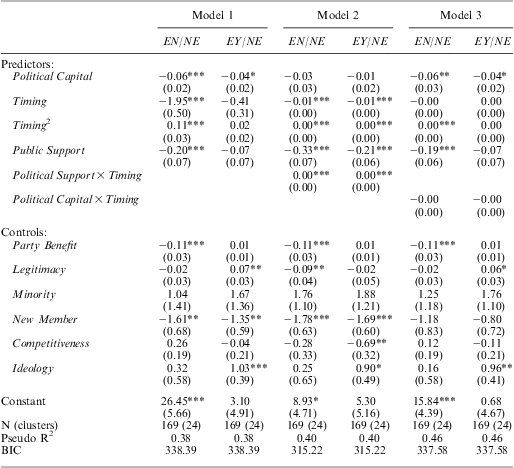
The results are summarized in Table 3. Model 1 provides support for most of the expectations derived from our formal argument.Footnote 26 As expected in Hypothesis 1, the more political capital a party has, the less likely it is to support a referendum but oppose the treaty. The negative and weakly statistically significant coefficient of Political Capital for the EY vs. NE comparison, however, runs counter to our argument. Interestingly, the more political capital a government has, the less likely all parties are to endorse the treaty. Closeness to the next election reduces the probability that a party will endorse a popular vote but oppose the treaty in a referendum campaign. Moreover, Timing 2 is positive and highly statistically significant in the EN vs. NE comparison. This finding supports Hypothesis 2 and our broader argument that parties are concerned about second-order election effects, which should be highest in the middle of the electoral cycle. Finally, as expected in Hypothesis 3, the higher public support is, the less likely a party is to call for a referendum.
Explaining Party Positions on the Ratification of the Constitutional Treaty

Note: estimated coefficients from a multinomial logistic regression. Standard errors clustered by country in parentheses; ***p < 0.01, **p < 0.05, *p < 0.1.
Several of the control variables have the expected effects. The larger Party Benefit is, the less likely the party is to support a referendum and reject the treaty. Our findings for the Legitimacy variable also make sense: the greater the demand for a referendum, the more likely it is that parties come out in favor of both a referendum and the treaty. Parties in new member countries are less likely to endorse a referendum and support the treaty. Finally, left and liberal parties are more likely than other parties to endorse a referendum and support the treaty. The coefficients for Minority and Competitiveness are not statistically significant in any of the three comparisons.
A possible objection to our findings is that parties’ decisions about whether to endorse a referendum are interdependent across countries (Closa Reference Closa2007). Alas, our data do not allow us to tackle this objection head on, as we do not know exactly when each party decided whether to endorse a referendum (see also Footnote 22). Beyond the case of the French Union pour un Mouvement Populaire, however, we have little reason to suspect a spatial diffusion effect influencing parties’ decision making.
Substantive Effects
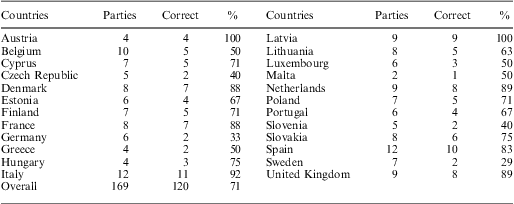
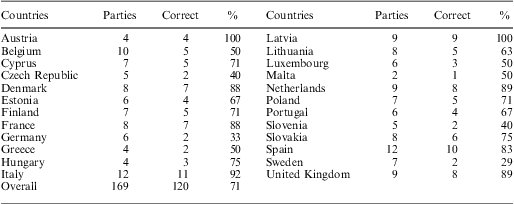
The overall explanatory power of the model is very good. Model 1 correctly predicts 71 percent of observations, which compares favorably with a chance result (based on the modal category in the overall dataset) of 42.9 percent. The high percentage of correctly predicted cases is particularly noteworthy, as predicting one of three categories is more difficult than predicting one of two in a binomial logit model. We correctly predict the positions of all parties in two countries (Austria and Latvia); in only four countries (Czech Republic, Germany, Slovenia and Sweden) is the percentage of correct predictions less than 50 percent (see Table 4).Footnote 27
Number of Parties per Country and Number and Percentage Correctly Predicted
Figures 1a and 1b offer a graphic illustration of the substantive effects of two of our variables. The first of the two graphs shows the effect of timing on the probability of the three outcomes. The most important finding from this graph is that the probability that a party will not endorse a referendum (the bold line) follows an inverted-U shape, and the probability falls sharply in the last two years before an election. While the likelihood that a party will choose to endorse a referendum and support the treaty remains relatively stable throughout the first few years of the electoral cycle, it declines in the last year. By contrast, the probability of a party campaigning against the treaty increases sharply right before an election. The 95 percent confidence intervals (not shown) demonstrate that these changes across the electoral cycle are statistically significant. The confidence interval for the “not endorse” curve at its peak (900 days before the next election) ranges from 0.43 to 0.91. By contrast, the confidence interval for the same curve right before an election ranges from 0 to 0.01.
Predicted effects of Timing and Public Support
The second of the two figures illustrates the effect of public opinion on party positioning. Most obviously, the probability that a party will not endorse a referendum strongly increases, together with public support for the treaty, from 0.03 [0,0.13] to 0.76 [0.51,1.00]. This means that parties were more likely to endorse a referendum on the Constitutional Treaty in countries with a skeptical public opinion. By contrast, the probability that a party will endorse a referendum but oppose the treaty falls from 0.88 [0.74,1.00] to 0.02 [0,0.06] as public opinion becomes increasingly more favorable toward the treaty. Parties endorsed a referendum and came out in favor of the treaty in countries with a medium degree of public support for the treaty.
Interaction Effects
Our model suggests that the effects of both Public Support and Political Capital should depend on the timing of the referendum within the election cycle. We test these expectations by including interaction terms between these two variables and Timing in our empirical model. The results of the model that includes the interaction effect with Public Support are very supportive (Model 2 in Table 3). Figure 2 displays the substantive effect of this interaction effect,Footnote 28 showing that the probability of not endorsing a referendum increases over time if public support for the treaty is high (in this case the maximum). By contrast, with low public support for the treaty (the minimum value in the dataset), the probability of not endorsing a referendum falls very sharply around the middle of the electoral cycle. The interaction effect between Political Capital and Timing, by contrast, is not statistically significant at the conventional level. It just misses that mark, however, and the term is weakly statistically significant when using a multinomial probit model (see Model A3 in the Appendix).
Predicted effect of Timing on the probability of no referendum endorsement in model with interaction term
Robustness Checks
We carried out a series of tests to check the robustness of our results (all of these results are shown in the Appendix). First, we dropped all 62 government parties from the model (Model A4 in the Appendix) because, according to our theoretical model, government parties only have two options available to them: to endorse or reject a referendum.Footnote 29 Their stance on the treaty itself is predetermined by the fact that they actively participated in its negotiation. Including them in the multinomial model with three options may therefore bias our results for the EY vs. EN comparison. In fact, the results of this model come even closer to our expectation than those reported in Model 1, with the coefficient for Political capital now no longer statistically significant in the EY vs. EN comparison.
Secondly, we check whether the results are robust to dropping 57 parties with extreme positions on European integration. We operationalize “extreme position” as having a value beyond one standard deviation around the mean of Party Benefit (Veen Reference Veen2011). The reason for dropping these parties is the same as for government parties: realistically, they do not have any flexibility to alter their position on the treaty itself, as their stance is predetermined by their ideological orientation. Again the results are very stable, with the exception of the coefficient for Public Support, which is no longer statistically significant (Model A5 in the Appendix).
Thirdly, we estimate a model with random intercepts to account for the multilevel structure of our data more directly, namely parties nested within countries.Footnote 30 Most of the results from this model are similar to those from the model without random effects (Model A6 in the Appendix). The exception is Timing, which is no longer statistically significant. However the timing of the decision about whether to call a referendum in the electoral cycle still matters in this model, as the highly statistically significant coefficient for Timing 2 shows.
Fourthly, we use different measures for some of our variables. On the one hand, we use data from Hooghe et al. (Reference Hooghe, Bakker, Brigevich, de Vries, Edwards, Marks, Rovny, Steenbergen and Vachudova2010) to operationalize Party Benefit. Doing so does not change the results reported above (Model A7 in the Appendix). On the other hand, using an alternative measure for Political Capital (approval of the government's record to date) does not change most of the results, but the coefficient for that variable is only weakly statistically significant in the EN vs. NE comparison (Model A8 in the Appendix).
Fifthly, we add a measure of internal conflicts within parties, as it has been argued that internally divided parties may be more likely to call for a referendum (Bjørklund Reference Bjørklund1982). While ideally we would have data on internal divisions on the Constitutional Treaty itself, the best data that we could find is the variable internal dissent on European integration from the 2002 Chapel Hill Expert Survey (Hooghe et al. Reference Hooghe, Bakker, Brigevich, de Vries, Edwards, Marks, Rovny, Steenbergen and Vachudova2010). Alas, we are missing values for this variable for 35 parties. Nevertheless, the results are very robust to the inclusion of this variable (Model A9 in the Appendix). Finally, we drop Germany from our analysis, as its constitution makes the initiation of a referendum on an EU treaty particularly difficult.Footnote 31 Again, doing so does not affect our results (Model A10 in the Appendix).
Conclusion
We have presented a game-theoretic model of the process of ratifying an international treaty in order to explain parties’ simultaneous decisions about whether to call for a referendum and what position to take on the treaty itself. Our findings show that this decision depends on the timing of the decision within the electoral cycle, the incumbent's political capital and the level of public support for the treaty. The higher the government's relative political capital, the less likely parties are to endorse a referendum and reject the treaty. The probability that parties will call for a referendum is lowest in the middle of the electoral cycle. Finally, public support for the treaty reduces the probability that parties will opt for a referendum. These findings are robust to variations in data sources and estimation techniques. What makes our approach particularly powerful is that for given referendum-initiation rules, our findings on party-level strategies are a sufficient statistic for predicting country-level outcomes.
The results have implications for a variety of debates. First, our findings run counter to fears that parties may use popular votes mainly as plebiscites. On the contrary, uncertainty and concerns about second-order voting contribute to a situation in which parties are most likely to call for a referendum on an international treaty when public opinion is rather skeptical. This finding offers an explanation for the sizable number of failed referendums on European integration.
The results also speak to the literature on second-order elections. For some time, scholars have debated the extent to which voters use referendums to send signals to their government.Footnote 32 Our findings add to this debate by indicating that parties base their decision on whether to call for a referendum on the assumption that voters engage in second-order voting. The fear of being punished in a referendum makes government parties wary of calling for a referendum even if voters are satisfied with the treaty in question.
Finally, for the specific case of European integration, the article's findings suggest that making the decision about whether to call for a referendum on treaty revisions (or issues such as the accession of Turkey) at the national level is problematic. With respect to the ratification of EU treaties, the fact that domestic political factors influence the incidence and outcome of a referendum makes it more difficult to defend the application of direct democracy at the national level on normative grounds. It will always be difficult to insulate the international policy debate and decision-making process from domestic-level factors and contingencies, which may end up distorting popular preferences with respect to integration policy, obfuscating the interpretation of the referendum outcome or derailing the overall ratification process. A European-level referendum on major decisions facing the EU may be the best instrument to deal with this problem (Rose Reference Rose2011).