Syncope is defined as a transient loss of consciousness because of transient global cerebral hypoperfusion characterised by rapid onset, short duration, and spontaneous complete recovery. 1 Pathophysiologically, as a result of transient global cerebral hypoperfusion, syncope is caused by an inadequate supply of oxygenated blood in the reticular activating system in the brain stem followed by rapid spontaneous recovery.Reference Brignole, Alboni and Benditt 2 , Reference Calkins and Zipes 3 Syncopes can be aetiologically grouped as neurally mediated, orthostatic, cardiogenic – cardiac arrythmias or congenital – and cerebrovascular syncopes.Reference Brignole, Alboni and Benditt 2 Cardiogenic and cerebrovascular syncopes can be readily diagnosed by detailed patient history and physical examination. On the contrary, orthostatic and neurally mediated syncopes, gathered under unexplained syncope, are differentially diagnosed by using head-up tilt test.Reference Cooke, Carew, Costelloe, Sheehy, Quinn and Lyons 4 , Reference Seifer and Kenny 5 The most prevalent neurally mediated syncope in childhood is the reflex syncope – vasovagal syncope.Reference Benditt, Ferguson and Grubb 6
The head-up tilt test was first used in 1986 in patients with unexplained syncope.Reference Kenny, Ingram, Bayliss and Sutton 7 The test has been used in children since the 1990s with the purpose of determining the diagnosis and effect of therapy in patients suspected to have reflex syncope.Reference McLeod 8 With the description of orthostatic hypotension and orthostatic intolerance syndrome in children, the area of use of the test has been widened.
Although the aetiology of OI and postural orthostatic tachycardia syndrome are not fully known, orthostatic intolerance has been described as near syncope on upright posture relieved on lying down and postural orthostatic tachycardia syndrome as orthostatic intolerance symptoms accompanied by extreme increase in heart rate. The main symptoms of orthostatic intolerance include dizziness, blurred vision, headache, palpitation, tremor in hands, vomiting, shortness of breath, chest pain, and syncope.Reference Stewart 9 Initially, the diagnostic criteria for orthostatic intolerance and postural orthostatic tachycardia syndrome in adults were also used for children – sustained heart rate increase of 30 beats per minute and/or heart rate more than 120 beats per minute within 10 minutes when the patient is inclined to a 70° head-up angle on tilt table.Reference Low, Sandroni, Joyner and Shen 10 However, in 2010, in a study on healthy young volunteers, it was determined that most of the volunteers showed haemodynamic values matching orthostatic intolerance syndromes criteria on an inclined tilt table.Reference Skinner, Driscoll and Porter 11 In 2011, the most recent consensus report on autonomic orthostathic syndromes endorsed by the European and American societies of the autonomic nervous system stated that adult diagnostic criteria may not be applicable for individuals with low resting heart rates.Reference Freeman, Wieling and Axelrod 12 For individuals aged 12–19 years, the increment required for the diagnosis had to be at least 40 beats/minute. In 2012, Singer et al,Reference Singer, Sletten, Opfer-Gehrking, Brands, Fischer and Low 13 redescribed the criteria for the diagnosis of orthostatic intolerance syndromes in children.
In light of these scientific findings, the purpose of this study was to retrospectively review the recorded data of patients with unexplained syncope who underwent head-up tilt testing at our centre in the preceding year, and to report the different haemodynamic patterns observed by the physicians. To the best of our knowledge, there is no study in the literature on head-up tilt testing on children with unexplained syncope, reporting the recently described haemodynamic patterns. Our data on tilt testing on children with unexplained syncope could be useful in the interpretation and designation of different haemodynamic patterns observed in children.
Materials and methods
In this study, records of 520 children who underwent tilt testing in the syncope laboratory of the paediatric cardiology clinic between April, 2012 and July, 2013 were retrospectively analysed. The study population consisted of 400 patients: 264 (66%) were girls and 136 (34%) were boys, aged 12.6±2.6 years (median 13; range 5–18). The study protocol was approved by the institutional ethics committee. Age, echocardiography, surface ECG, 24-hour Holter recording, cardiac stress tests, blood counts, laboratory tests, and head-up tilt test data such as arterial blood pressure, heart rate, ECG, symptoms, signs, and special remarks noted by the tester, were collected. The studied subjects were interviewed for additional details, either directly or through phone calls.
The subjects were interviewed specifically for the presence of factors capable of complicating the head-up tilt test results on the day of testing, such as disorders causing autonomic nervous system symptoms – anaemia, arrhythmia, hypertension, or endocrine disorders – or medications. They were also questioned for the number of syncopes in the last 3 months before the tilt test, frequency of orthostatic intolerance complaints, and previous diagnoses of cardiac or neurological disorders. Patients diagnosed with a chronic disease capable of affecting the tilt test results or not compatible with unexplained syncope were excluded from the study. Of the 520 cases who underwent head-up tilt testing in our syncope laboratory in the preceding year, 400 cases with unexplained syncope were identified and enrolled in the study.
Protocol of head-up tilt testing: The patients scheduled to undergo head-up tilt testing in our Syncope Laboratory were instructed to discontinue all medications, with a probable effect on the autonomic nervous system at least 5 days before the test. The test was conducted in a slightly dim, quiet, and temperature-controlled room, after 4 hours of fasting. The electrocardiograms and blood pressures of the test patients were automatically recorded by a digital monitoring device (Dash 2000 Physiological Monitor; General Electric, New York, United States of America). The total duration of the tilt test was 45 minutes, consisting of 25 minutes of resting in the supine position, followed by 20 minutes in the upright position on a 70° inclined tilt table.
According to the observations made during the tilt tests on 400 children enrolled in the study, it was possible to discern nine different haemodynamic patterns in response to tilt testing:
Normal haemodynamic pattern (n=277): No change or slight decrease (<20 mmHg) in systolic arterial blood pressure, not accompanied by a cardiac rate increment exceeding 40 beats/minute during tilt testing, after the tilt table was inclined.Reference Singer, Sletten, Opfer-Gehrking, Brands, Fischer and Low 13 , Reference Park 14
Orthostatic intolerance syndrome haemodynamic pattern (n=78): In general, this group had complaints of orthostatic intolerance symptoms in daily activities. This group of patients was identified as per the criteria redescribed by Wolfgang et alReference Singer, Sletten, Opfer-Gehrking, Brands, Fischer and Low 13 and further divided into three subgroups according to the presence or absence of accompanying heart rate increases, in addition to complaints of orthostatic intolerance, during tilt testing.
Paediatric orthostatic intolerance pattern (n=28): A heart rate increment of more than 40 beats/minute accompanied by complaints of orthostatic intolerance, such as dizziness and blurred vision, within the first 5 minutes of upright tilting of the tilt table.
Paediatric postural orthostatic tachycardia syndrome pattern (n=24): Criteria of paediatric orthostatic intolerance accompanied by a heart rate increment of ⩾130 beats/minute in patients aged ⩽13 years, and ⩾120 beats/minute in patients aged ⩾14 years, within the first 5 minutes of head-up tilt.
Asymptomatic postural orthostatic tachycardia syndrome pattern (n=26): Patients showing the increased heart rates seen in paediatric postural orthostatic tachycardia syndrome pattern but not the complaints of orthostatic intolerance during the tilt test.
Vasovagal syncope haemodynamic pattern (n=38): The modified VASIS classification was used to identify these patients. They were divided into four subgroups according to the arterial blood pressure and heart rates recorded during the tilt test.Reference Brignole, Menozzi and Rosso 15
Type 1 – Mixed (n=17): During syncope, bradycardia accompanies hypotension, but the heart rate does not fall below 40 beats/minute, and, if it falls, it lasts <10 seconds. Asystole may be present, but lasts only ⩽3 seconds. Arterial blood pressure falls before the heart rate does.
Type 2A – Cardioinhibitory without asystole (n=10): During syncope, the heart rate falls below 40 beats/minute for more than 10 seconds, if asystole happens, it does not last for more than 3 seconds. Arterial blood pressure falls before the heart rate does.
Type 2B – Cardioinhibitory with asystole (n=2): During syncope, the heart rate falls below 40 beats/minute for more than 10 seconds, if asystole happens, it lasts for more than 3 seconds. Arterial blood pressure falls at the same time with or before the heart rate.
Type 3 – Vasodepressor type (n=9): The heart rate does not fall more than 10% of its initial rate, even at the most evident moment of syncope; however, the blood pressure falls significantly.
Orthostatic hypotension pattern (n=7): Within the first 3 minutes of head-up tilt, the patients in this group suffered a decrease of ⩾20 mmHg in systolic blood pressure, and ⩾10 mmHg in diastolic blood pressure.Reference Freeman, Wieling and Axelrod 12 , 16
Positivity of tilt test: The tilt test was considered positive when any one of the eight haemodynamic patterns, except for the pattern of normal haemodynamics, was observed.
Statistical analysis
The statistical analysis was performed by using SPSS 18.0 package program (PASW Statistics for Windows, Version 18.0, Chicago, Illinois, United States of America). The numerical data were presented as mean±standard deviation or median (minimum–maximum) and rates as percentage. In the evaluation of numerical data with normal distribution between the groups, one-way analysis of variance test was used, and as a post-hoc method Bonferroni and Tukey test was conducted. For the comparison of numerical data without normal distribution, Kruskal–Wallis test was used, and as a post-hoc method Mann–Whitney U-test was used. For the comparison of rates in the groups, χ2 test was conducted. A p-value of <0.05 was accepted as significant.
Results
The patients were divided into four main groups according to the different haemodynamic patterns they showed during the head-up tilt testing.
-
1. Normal haemodynamic group: n=277, aged 12.5±2.8 years
-
2. The orthostatic intolerance syndrome group: n=78, aged 13.2±2.6 years
-
3. Vasovagal syncope group: n=38, aged 12.9±1.8 years
-
4. Orthostatic hypotension group: n=7, aged 13.0±1.7 years
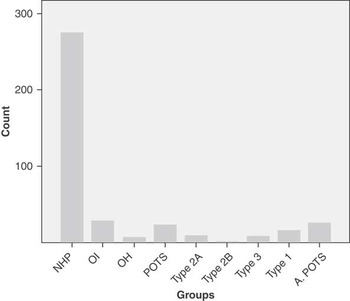
When the subgroups of the main groups were considered, there were a total of nine different haemodynamic patterns (Fig 1):
-
1. Normal haemodynamic pattern: n=277 (69.2%)
-
2. Paediatric orthostatic intolerance group: n=28 (7.0%)
-
3. Paediatric postural orthostatic tachycardia syndrome: n=24 (6.0%)
-
4. Paediatric asymptomatic postural orthostatic tachycardia syndrome: n=26 (6.5%)
-
5. Orthostatic hypotension group: n=7 (1.7%)
-
6. Vasovagal syncope, mixed type: n=17 (4.2%)
-
7. Vasovagal syncope, non-asystolic cardioinhibitory type: n=10 (2.5%)
-
8. Vasovagal syncope, asystolic cardioinhibitory type: n=2 (0.5%)
-
9. Vasovagal syncope, vasodepressor type: n=9 (2.2%)
Bar graph showing the distribution of all groups.

The tilt test was positive in 123 (30.7%) patients. The second most frequent pattern, after the normal haemodynamic pattern, was the orthostatic intolerance syndrome with 78 (63.4%) patients, followed by the vasovagal syncope group with 38 (30.8%) patients. Within the orthostatic intolerance syndrome group, the most frequently encountered subgroup was the paediatric orthostatic intolerance group, and the least was the paediatric postural orthostatic tachycardia syndrome group. In the vasovagal syncope group, the most frequently observed haemodynamic pattern was the mixed type, and the least was the asystolic cardioinhibitory type.
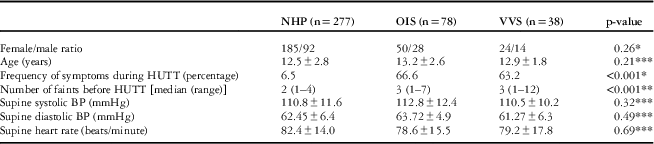
There were no statistically significant differences between the groups of orthostatic intolerance syndromes, vasovagal syncope, and normal haemodynamics in terms of age, gender, baseline systolic, and diastolic blood pressures, and frequency of syncope before therapy (p>0.05) (Table 1). However, the baseline median supine heart rate values differed significantly between the groups, caused by lower baseline supine heart rates in the paediatric orthostatic intolerance subgroup of the orthostatic intolerance syndrome main group (p<0.01). Comparison of the supine resting–phase haemodynamic values between the subgroups within the orthostatic intolerance syndrome main group is shown in Table 2, and the haemodynamic values of the patients in the vasovagal syncope and orthostatic hypotension groups at the initiation of postural orthostatic tachycardia syndrome are shown in Table 3.
Comparison of baseline haemodynamic values in the normal haemodynamic, vasovagal syncope, and orthostatic intolerance syndrome main groups.

BP=blood pressure; HUTT=head-up tilt test; NHP=normal haemodynamic pattern; OIS=orthostatic intolerance syndromes; VVS=vasovagal syncope
Data are presented as number, percentage, mean±SD, and median (minimum–maximum).
* χ2 test
** Mann–Whitney U-test
*** One-way analysis of variance
Comparison of baseline haemodynamic values in the subgroups of the orthostatic intolerance syndrome main group.

A.POTS=asymptomatic postural orthostatic tachycardia syndrome; BP=blood pressure; OI=orthostatic intolerance; OIS=orthostatic intolerance syndromes; POTS=postural orthostatic tachycardia syndrome
Data are presented as number, mean±SD, and median (minimum–maximum) values
* χ2 test
** Mann–Whitney U-test
*** One-way analysis of variance
Baseline haemodynamic values of patients in the vasovagal syncope and the orthostatic hypotension groups.

BP=blood pressure; HUTT=head-up tilt test; OH=orthostatic hypotension
Data are presented as number, mean±SD, and median (minimum–maximum)
The most frequent symptoms in groups during the 20-minute active phase of the tilt test were: paleness, nausea, and dizziness in the normal haemodynamic group; fainting, paleness, and sweating in the vasovagal syncope group; dizziness, blurred vision, and palpitation in the orthostatic intolerance syndrome group; and fainting and dizziness in the orthostatic hypotension group. Overall, 11.5% (46/400) of the cases experienced syncope during the active 20-minute phase of the tilt test, with 2% (8/400) being in the orthostatic intolerance syndrome group and 9.5% (38/400) in the vasovagal syncope group. Subjects in the orthostatic hypotension and normal haemodynamic groups did not experience syncope during the tilt test.
The median numbers of syncopal episodes of the groups before tilt testing were also compared. There was no significant difference between the vasovagal syncope and orthostatic intolerance syndrome main groups (p=0.750). However, there was a significant difference between the normal haemodynamic group and both the orthostatic intolerance syndrome and vasovagal syncope groups (p<0.01), because of the significantly low median in the normal haemodynamic group.
Discussion
In recent years, children as well as adults have been increasingly referred to health-care facilities with symptoms of orthostatic intolerance, causing difficulty in carrying out daily activities. Thus, there is growing awareness on paediatric orthostatic intolerance and postural orthostatic tachycardia syndrome cases with renewed suggestions on diagnostic criteria and modes of therapy.Reference Brignole, Alboni and Benditt 2
Initially, the diagnostic criteria for orthostatic intolerance and postural orthostatic tachycardia syndrome in adults were also used for children.Reference Low, Sandroni, Joyner and Shen 10 In 2012, Singer et alReference Singer, Sletten, Opfer-Gehrking, Brands, Fischer and Low 13 redescribed the postural orthostatic tachycardia syndrome criteria in children. The paediatric orthostatic intolerance was described as a heart rate increment of more than 40 beats/minute accompanied by complaints of orthostatic intolerance, such as dizziness and blurred vision, within the first 5 minutes of head-up tilting to a 70° angle. The paediatric postural orthostatic tachycardia syndrome was described as, in addition to paediatric orthostatic intolerance criteria, a heart rate increment of ⩾130 beats/minute in children aged ⩽13 years, and ⩾120 beats/minute in children aged ⩾14 years, within the first 5 minutes of tilting the table to a 70° angle.
Although active standing is a better provocative manoeuvre than passive standing (tilt testing) for the diagnosis of orthostatic hypotension, head-up tilt testing has become standard practice in the diagnostic work-up of these patients. The head-up tilt test had been initially used solely for the diagnosis of reflex syncope in children; however, its usage has, in time, been extended to the diagnosis of recently described entitites of orthostatic intolerance syndromes and orthostatic intolerance. The head-up tilt test is safely applied to all orienting children of age 6 and older with unexplained syncope.Reference McLeod 8 The test as applied to children has no standard protocol as to the duration of the test as well as to the angle of inclination of the table. To create further susceptibility to the test, provocation with medications such as isoproterenol and isosorbide is recommended.Reference Levine 17 , Reference Nair, Padder and Kantharia 18 Lin et alReference Lin, Wang, Ochs, Tang, Du and Jin 19 suggested that a tilt angle of 60° and test time of 45 minutes should be suitable for children with vasovagal syncope. In our study, the total duration of the test was set at 45 minutes, 25 minutes in the lying position and 20 minutes in the upright position at an angle of 70°, and no pharmacological provocation was used. In our study, the duration of the lying position at the beginning of tilt testing was held longer than those in the literature because longer resting times are recommended for patients with orthostatic hypotension and orthostatic intolerance syndromes.Reference Singer, Sletten, Opfer-Gehrking, Brands, Fischer and Low 13
The reflex (neurally mediated) syncope is a transient loss of consciousness initiated by a triggering event that disables the cardiovascular reflexes that normally play a role in the control of the circulatory system, resulting in vasodilatation and/or bradycardia and thereby in a fall in arterial blood pressure and global cerebral perfusion.Reference Kouakam, Vaksmann, Lacroix, Godart, Kacet and Rey 20 If the triggering factors are emotional and/or orthostatic stress, the syncope is then termed “common faint” or “vasovagal syncope”.Reference Van Dijk and Sheldon 21 Early signs of activation of the autonomic nervous system precede reflex syncopes, which include paleness, sweats, and nausea. In our study, the most frequent prodromal signs in the vasovagal syncope group were paleness, sweats, and dizziness.
The vasovagal syncopes are classified according to the sympathetic and parasympathetic pathways they use. The term “vasodepressor” is used to describe hypotension caused by a drop in vasoconstrictory tone during tilt testing, “cardioinhibitory” as the presence of bradycardia and asystole, and “mixed” as the presence of the two former conditions. 1 The head-up tilt test is the gold standard in the differentiation of the subtypes of vasovagal syncope.Reference McLeod 8 Kouakam et alReference Kouakam, Vaksmann, Lacroix, Godart, Kacet and Rey 20 used tilt testing to determine the subtypes of vasovagal syncope in 45 patients; of them, 21 patients had mixed, 17 patients had vasodepressive, and seven patients had cardioinhibitory type of vasovagal syncope. In our study, in accordance with the literature, the mixed subtype of vasovagal syncope was the most frequent (n=17/38; 44.7%).
Ulas et al reported that the length of time after the tilt table was inclined was directly proportional to the frequency of syncope.Reference Ulas, McNeeley, Zhang, Chelimsky and Chelimsky 22 They observed syncope in 18% of the patients at 10 minutes, 65% at 20 minutes, and 96% at 30 minutes following the inclination of the tilt table, and recommended longer duration for the test. In our study, according to the tilt protocol we used, the total duration of the test was 45 minutes, 25 minutes in the lying position and 20 minutes in the upright position at an angle of 70°. Following the inclination of the tilt table, we observed syncope in 11.5% of patients (46/400) at 20 minutes; of the total number of patients, 86.2% (38/400) were in the vasovagal syncope group. The prevalence of syncope in our study seems to be lower; however, our study group was composed of patients with unexplained syncope, whereas Ulas et al have studied patients already diagnosed with vasovagal syncope.
In paediatric basal head-up tilt testing without medications, the range of positivity is reported between 8 and 66%.Reference Lerman-Sagie, Rechavia, Strasberg, Sagie, Blieden and Mimouni 23 – Reference Fouad, Sitthisook and Vanerio 25 In our study, the positivity of tilt testing was 30.75%. We attributed the lower rate of positivity of tilt testing in our study to the relatively shorter duration of the active phase of testing and lack of medical provocation.
In our study, our patients were divided into paediatric orthostatic intolerance and paediatric postural orthostatic tachycardia syndrome groups according to the respective haemodynamic patterns mentioned above. There was a group of patients that met the heart rate increment criteria for postural orthostatic tachycardia syndrome described by Singer et al,Reference Singer, Sletten, Opfer-Gehrking, Brands, Fischer and Low 13 but did not exhibit any signs or symptoms of orthostatic intolerance during head-up tilt testing. Yet, these patients had been admitted with orthostatic intolerance symptoms during daily activities. Thus, these patients were gathered in a new group and designated as “asymptomatic postural orthostatic tachycardia syndrome group”. Huh et alReference Huh, Yeom, Kim, Woo, Park and Park 26 studied 22 patients who showed orthostatic intolerance symptoms during daily activities and met the heart rate criteria for postural orthostatic tachycardia syndrome in the tilt test. Only seven (31.8%) of these patients did not present symptoms of orthostatic intolerance during tilt testing and they had significantly higher diastolic pressures at the start of the test. In our study, the haemodynamic findings did not differ significantly between the postural orthostatic tachycardia syndrome and the asymptomatic postural orthostatic tachycardia syndrome groups.
As there is no study in the literature on the frequency of orthostatic intolerance syndromes during head-up tilt testing on patients with unexplained syncope, we could not compare our data with the literature. In our study, the most frequently observed haemodynamic pattern was that of orthostatic intolerance syndromes, by 63.4%. In general, the frequency of symptoms – trembling, vomiting, headache, palpitation, shortness of breath, blurred vision, dizziness, and chest pain – in paediatric postural orthostatic tachycardia syndrome patients during daily activities is equal to the frequency in adult patients; however, fainting is more frequent in paediatric postural orthostatic tachycardia syndrome patients.Reference Zhang, Du, Wang, Du, Wang and Tang 27 , Reference Medow and Stewart 28 In our study, we could not compare the frequency of syncope in paediatric patients with that in adult patients. However, when the groups were assessed for the frequency of syncope during the 3 months before the head-up tilt test, we observed that groups of orthostatic intolerance syndromes and vasovagal syncope experienced the same frequency of syncope.
In conclusion, we conducted head-up tilt testing on 400 children with syncope of undetermined origin and discerned nine different haemodynamic patterns. The most frequently observed haemodynamic pattern was that of orthostatic intolerance syndromes. To the best of our knowledge, there is no study in the literature on head-up tilt testing on children with unexplained syncope reporting the recently described haemodynamic patterns. Our results can aid in the interpretation and designation of different haemodynamic patterns observed with head-up tilt testing on children with unexplained syncope.
Study limitations
The main limitation of this study is the limited number of patients in the orthostatic hypotension and vasovagal syncope subgroups. The patients were divided into four main groups, and the groups were statistically compared with each other for their haemodynamic values at the start of the tilt test. However, the main group of orthostatic hypotension could not be compared with other groups because of the limited number of subjects.
Acknowledgement
The authors wish to thank Filiz Tekin for her valuable contributions to the study.
Financial Support
This research has not received any specific grant from any funding agency, commercial, or non-profit sectors.
Conflicts of Interest
None.