Rude as many of these objects are, and incongruous as the various designs represented on the same article may appear, they exhibit a wonderful amount of skill, which is fully evidenced by the success of the wide-spread deception which has been practised. That an illiterate mud-raker should possess such a power of design and manipulation as these objects illustrate, leads one to wish that such remarkable talent had had a worthier sphere for its development.
Charles Reed to the Society of Antiquaries of London, 21 March 1861.Footnote 1
From 1857 the English archaeological community was disrupted by controversy over a large number of supposedly medieval objects that appeared for sale in London. In 1861 Charles Reed (1819–81) exposed these as forgeries at a meeting of the Society of Antiquaries of London. The head of a London printing company (and future Liberal MP for Hackney), Reed was philanthropically inclined with a keen interest in education, causing him to regret that the forgers did not use their abilities more constructively. He did not name the forgers, but many knew them as William Smith (Billy) and Charles Eaton (Charley), with the result that their forgeries are now called ‘Billys and Charleys’. This paper will investigate how the Billy and Charley forgeries were made, the controversy they created, their exposure and why such bizarre objects, unlike any archaeological finds known before or since, could be accepted as genuine by eminent antiquaries.
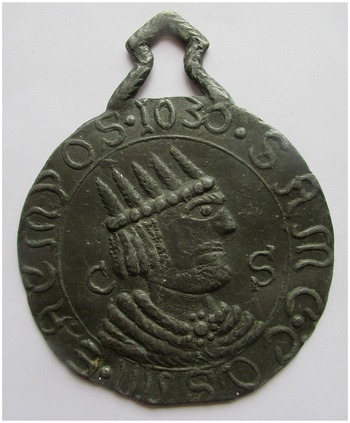
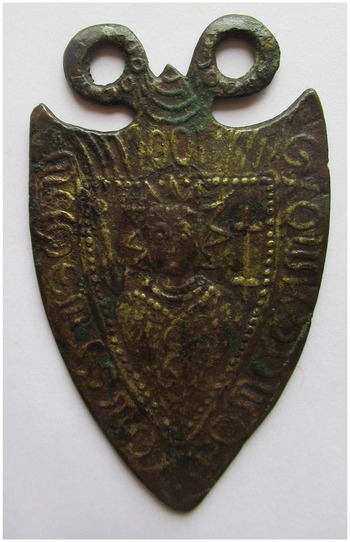
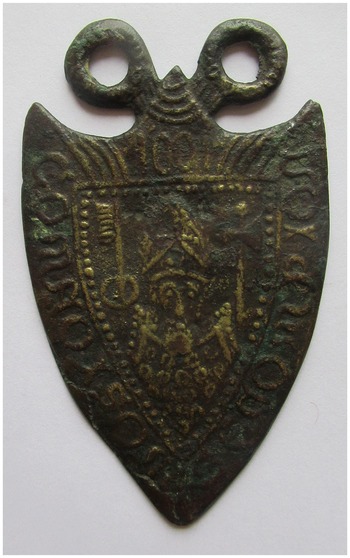
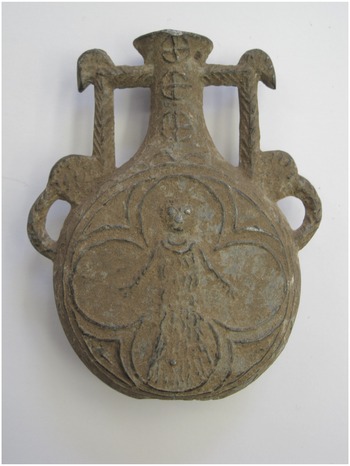
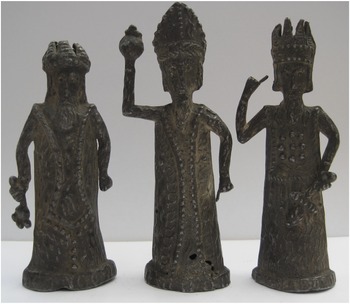
William Smith and Charles Eaton, the eponymous forgers, are shadowy figures. Charley was aged thirty-five at his demise on 4 January 1870, suggesting that he was born in (or about) 1834.Footnote 2 It is possible that Billy was older.Footnote 3 They cannot be traced in census returns or similar records, but they were said to have made forgeries in Rosemary Lane (since re-named Royal Mint Street) in the Tower Hamlets area of London.Footnote 4 They were originally mudlarks who searched the Thames for things to sell, and they had some skill in finding historical and archaeological items. In about 1845, possibly in his early teens, Billy began supplying items to William Edwards, a London antique dealer.Footnote 5 Charley joined him some years later. In June 1857, Billy and Charley, in their early or mid-twenties, began counterfeiting antiquities with the sole aim of making money (there is no indication that they sought fame as pioneering archaeologists).Footnote 6 They conducted a simple operation requiring little capital outlay, casting objects from lead with moulds made of chalk, on which they engraved patterns with nails and knives, manufacturing items that could be sold quickly for immediate profit.Footnote 7 Their most common products were medallions of between five and ten centimetres in diameter with loop hangers, displaying medieval-looking figures (either full length or portrait busts) on both sides, often knights in body-hugging chain mail and tightly fitting helmets, or religious figures in long robes (figs 1–6, 11, 12). Primitive casting techniques often gave these poorly defined edges and uneven surfaces. Since Billy and Charley were illiterate, inscriptions surrounding the figures were meaningless jumbles of letters and numbers. Dates in Arabic numerals ascribed manufacture to the eleventh century (or the following two centuries), even though Arabic numerals were not used in Europe before the fifteenth century (figs 1, 3, 5, 11).Footnote 8 Other creations included ampullas (fig 7), small shrines (fig 8) and statuettes (fig 9). A medallion cost 2d (1p) to make and sold for half a crown (2s 6d, or 12½p); larger items sold for up to 10s (50p).Footnote 9 A new basin was being dug at Shadwell Dock in Tower Hamlets, and they claimed they found the objects there.
Obverse of a medallion by Billy Smith and Charley Eaton, bearing the date 1030. The letters C and S beside the bust were obviously copied from a Roman coin. Size: 95mm in diameter, 115mm high. Photograph: author.

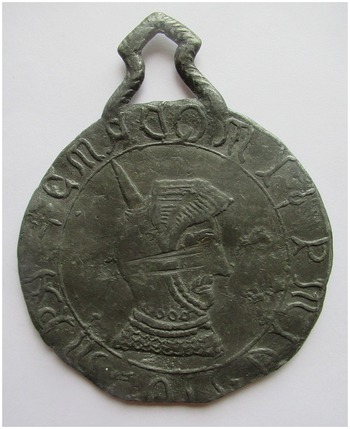
Reverse of the medallion shown in fig 1. Billy Smith and Charley Eaton may have deliberately damaged it to make it appear old. Photograph: author.

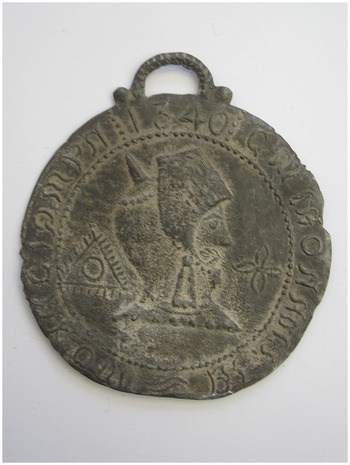
Obverse of a medallion by Billy Smith and Charley Eaton. The date, 1340, is rather late for their productions. Photograph: Reproduced with kind permission of the Cuming Museum, London.

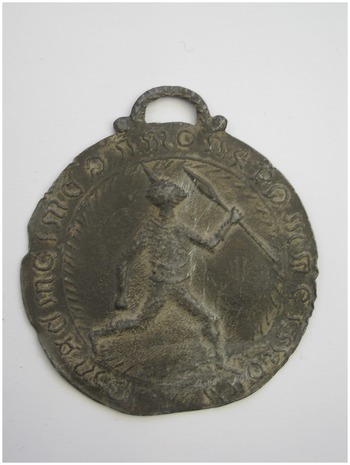
Reverse of the medallion shown in fig 3. Photograph: Reproduced with kind permission of the Cuming Museum, London.

A shield shaped forgery by Billy Smith and Charley Eaton. Dated 1001. Allegedly found in the Thames at Putney. Size: 96mm high. Photograph: author.

Reverse of the forgery shown in fig 5. Photograph: author.

Lead ampulla by Billy Smith and Charley Eaton. Photograph: Reproduced with kind permission of the Cuming Museum, London.

Reliquary by Billy Smith and Charley Eaton. Photograph: Reproduced with kind permission of the Cuming Museum, London.

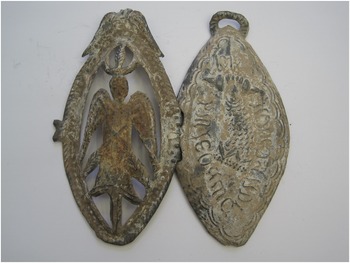
Solid lead figurines by Billy Smith and Charley Eaton. Size: 150–70mm high. Photograph: Reproduced with kind permission of the Cuming Museum, London.

Billy and Charley made their forgeries at an opportune moment in the Victorian era, when any objects thought to be medieval would be sought after, no matter how strange or unconvincing. Their creations could have appealed to enthusiasts for the Gothick genre, a fictional vision representing the Middle Ages as exotic, fantastic and bizarre: Billy and Charley’s forgeries would not have looked out of place in Horace Walpole’s fantasy mansion at Strawberry Hill or the fantastical Monk’s Parlour in Sir John Soane’s Museum. By the 1850s the Gothic Revival had spread across Britain: the appearance of innumerable Neo-Gothic churches and public buildings helped to create an unprecedented interest in the Middle Ages.Footnote 10 Economic expansion created a large middle class, with the disposable income and leisure time to study and collect archaeological artefacts, leading to the formation of historical and archaeological societies. Developments in printing allowed books on archaeology to circulate widely. Construction of railways and sewage systems, together with urban expansion, disturbed archaeological sites, causing concerned people to salvage and collect the historic artefacts these developments unearthed. Landowners financed archaeological excavations on their estates. This inevitably caused unscrupulous or unprincipled workers to take advantage of collectors by forging archaeological specimens. Many frauds were relatively simple, such as making casts of coins and similar small antiques, or creating flint tools. Often, these were soon exposed: experienced observers might distinguish items that had been buried for centuries from newly made objects, while suspicion might be aroused by a large quantity of material appearing from one location or a supposed discovery’s unusual appearance.Footnote 11 But factors came into play on Billy and Charley’s behalf, so that, while their creations attracted suspicion, these also received interest and support.
Edwards became a keen customer for Billy and Charley’s supposed discoveries. George Eastwood, another antique dealer, then became very enthusiastic about them, buying many from Edwards before buying directly from Billy and Charley, making these his main stock-in-trade. The 1851 census listed Eastwood as born in Norwich in 1820, a ‘dealer in ancient coins, medals and precious stones’ at 2 City Terrace in present-day London EC1.Footnote 12 Edwards and Eastwood believed they were variants of ‘pilgrims’ signs’, which had become objects of antiquarian interest twelve years previously.Footnote 13 Edwards called them ‘the most interesting relics I have met with for years’,Footnote 14 while Eastwood described them as ‘a remarkably curious and unique collection of leaden signs or badges’Footnote 15 and ‘truly curious and remarkable’.Footnote 16 Both dealers had a large clientele and sent specimens on approval to customers, including Thomas Bateman (1821–61), the Derbyshire landowner and antiquary (Edwards offered twenty medallions for £10).Footnote 17 Wholly unconvinced, in February 1858 Bateman communicated his suspicions to Henry Syer Cuming (1817–1902) of Walworth in South London, the secretary of the British Archaeological Association:
On the subject of Thames antiquities, I may be allowed to mention some pilgrims’ signs in lead of the most outré character that have been represented as having been found within the last four months. They are of unusually large size, and on close observation of them are four distinct types, as a female saint with two or three children, a mitred ecclesiastic [fig 6], a crowned bust [fig 1] and a man in armour [figs 2–4]. The last appears to be the prevailing figure. He is clad in scaly armour intended for ring mail from the neck to the soles of his feet, but has a helmet of the 16th century on his head, surmounted by a formidable spike, and carries an immoderately barbed spear in his hand! Notwithstanding the manifest absurdity of the subjects they are well and carefully put up in imitation of the genuine objects, the lead having been treated with acid before receiving a coat of Thames mud, the latter apparently laid on with a brush.Footnote 18
Cuming replied that he first heard about the objects in October 1857 when an acquaintance spent £60 on them, and he immediately realised they were forgeries. He had not been directly approached to buy them, being a known sceptic in such cases.Footnote 19
The objects attracted attention elsewhere, and in March 1858 the Gentleman’s Magazine reported ‘an enormous quantity of plaques in lead are being found in the bed of the Thames at low water’. While compared with pilgrims’ signs, they were of inferior quality, resembling tin and pewter children’s toys. The Gentleman’s Magazine warned that, while they had sold for ‘absurdly high prices’, they should be regarded as ‘almost worthless’.Footnote 20 Later that month Cuming informed Bateman he was close to exposing the fraud:
On Thursday last [25 March 1858] I examined 800 of the forged leaden objects and thus saved our member [of the British Archaeological Association], Mr Foreman, from being let in for £400, which he was upon the point of paying for them. I have found out that the moulds were made of chalk. I think the graving tool was a nail. The game is now almost up, and it is high time it should be.Footnote 21
Cuming noted that keepers at the British Museum believed the objects were fakes.Footnote 22 On 28 April 1858 Cuming lectured about the objects to the British Archaeological Association. He said 12,000 had been made, which was an exaggeration, the actual total was probably between 1,000 and 2,000, but this suggests that they circulated rapidly and attracted considerable interest. Vendors described them as pilgrims’ signs, which clearly was incorrect. Declaring ‘they appear to have been made in moulds of chalk, the graving tools being nails and penknives’, he pointed out the anachronisms in their design, condemned them as a ‘gross attempt at deception’ and regretted that there was no legal method of punishing the forgers. The lecture was not published in the Journal of the British Archaeological Association, but reports appeared in The Athenaeum on 8 May 1858, the Literary Gazette on 15 May 1858 and the Gentleman’s Magazine in June 1858.Footnote 23 Less than 200 words long, and not featured prominently in either publication, this still caused sales of the objects to slump. Edwards may not have been badly affected, having sold much of his stock to Eastwood, but Eastwood, having ventured his fortune, trade and reputation on the objects, found his business greatly diminished.Footnote 24
At this point, Charles Roach Smith (1807–90) became interested in the objects. The most eminent antiquary of the day, he had been the first person to identify pilgrim signs, a name he devised.Footnote 25 Believing the objects archaeologically significant, Roach Smith offered Eastwood full support, and, by doing so, prevented them from being wholly dismissed as forgeries. On 9 June 1858 Eastwood expressed appreciation for this, writing: ‘it is a great consolation to know I am not quite at the mercy of such ignorant persons who have spread and published such untrue statements’. Eastwood added, ‘the two men who have found them are well known to you’, indicating that Roach Smith was acquainted with Billy and Charley.Footnote 26 In July 1858 Roach Smith wrote in support of Eastwood in the Gentleman’s Magazine. He was unsure if the objects were pilgrims’ signs, but thought they might have been children’s toys.Footnote 27 Thomas Hugo (1820–76), the vicar of St Botolph’s Bishopsgate in London and chairman of the London and Middlesex Archaeological Society (a prolific contributor to the society’s Transactions), also considered the objects genuine antiquities, exhibiting them as such to archaeological societies in June and July 1858.Footnote 28 It may seem strange that Roach Smith and Hugo could have believed these to be archaeologically important, but they were among the first antiquaries to make systematic, analytical studies of small finds. The Victorian interest in archaeology was partly due to the unearthing of many artefacts that were previously unknown or disregarded, so the sudden discovery of these items at Shadwell need not have seemed implausible, especially since the reconstruction of London Bridge between 1824 and 1832 uncovered an incredible quantity of archaeological finds in the Thames, enriching Roach Smith’s Museum of London Antiquities and other collections.Footnote 29
The debate moved beyond academic speculation when Eastwood sued The Athenaeum’s publishers for libel. The case, heard at Guildford Assizes on 4 August 1858 before Sir James Shaw Willes (1814–72), is unique in English legal history in resulting from a meeting of an archaeological society.Footnote 30 Edwin James (1812–82), the prosecuting counsel, said that when The Athenaeum published Cuming’s lecture on 8 May 1858 it effectively accused Eastwood of selling forgeries, even if he was not named, and Eastwood did not seek vindictive damages but wished to clear his name. Witnesses would prove the objects’ authenticity. Eastwood, the first person to testify, said that, having dealt in antiques and curiosities for at least twenty years, he was among the kingdom’s best experts in this field. In June 1857 he bought some of the objects under discussion from Edwards and visited Shadwell to meet Billy and Charley. Over the next year he bought 1,100, believing them to be pilgrims’ signs, paying £296 to Edwards and £50 to Billy and Charley for them; he re-sold 300. A box of specimens created bewilderment and amusement in the courtroom. Edwards was next to testify, saying he had been an antique dealer for twenty years. Much of his stock came from ‘his boys, named Bill and Charley’ who found items in the Thames or obtained them from riverside workers. He had dealt with Billy for thirteen or fourteen years, but not quite so long with Charley. In June 1857 Billy and Charley began bringing him the objects, eight or ten at a time, eventually supplying 1,100, for which he paid £200. It was announced that Charley’s wife would not let him attend court;Footnote 31 however, Billy Smith did appear. Referred to as ‘a rough-looking young man who described himself as a shore raker’, he said he and Charley looked for things to sell to curiosity dealers. Since June 1857 they had found 2,000 objects at Shadwell, searching at night or buying them from labourers, making £400 by selling them.
Expert witnesses were called. Roach Smith affirmed his belief in the objects’ archaeological significance, but he considered further study was necessary before he could make definite statements. Hugo thought they were of fifteenth- or sixteenth-century manufacture, but his reasons were purely intuitive. The antiquaries William Chaffers (1811–92) and Henry Osborn Cureton (1785–1858), antique dealers who shared Roach Smith’s collecting interests, and Frederick William Fairholt (1814–66), an engraver who illustrated some of Roach Smith’s publications, added support.Footnote 32 Here the prosecution rested its case. Montague Chambers (1799–1885), the defence lawyer, claimed there was no case to answer. In trying to prove the objects were not forgeries the prosecution supplied no evidence that The Athenaeum libelled George Eastwood. Justice Willes agreed and directed the jury to return a not guilty verdict, although the defence was asked to affirm its faith in George Eastwood’s integrity.
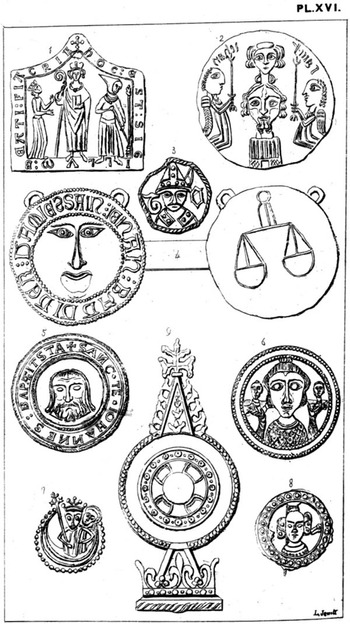
Cuming and Bateman had been called as defence witnesses, but the adjournment of the case meant that they did not give evidence. Nevertheless, Cuming thought they triumphed over the respected antiquaries who testified for the prosecution. ‘We gained a glorious victory … how are the mighty fallen!’, he wrote to Bateman. Cuming claimed to have obtained one forger’s confession to taking designs from the Journal of the British Archaeological Association and Roach Smith’s Collectanea Antiqua. Footnote 33 Billy and Charley medallions can be compared with engravings of pilgrim signs in Collectanea Antiqua (fig 10).Footnote 34 These show pendants displaying blank, expressionless human faces and rough, cartoon-like figures, surrounded by inscriptions that are difficult to read, not wholly dissimilar to Billy and Charley’s productions. This might raise suspicions that Billy and Charley collaborated with more knowledgeable figures, but Cuming gave no clues to their identities.Footnote 35 However, it is equally possible that collectors and dealers showed archaeological publications to Billy and Charley as guides of what to look for, and they used these as models for their forgeries. The Journal of the British Archaeological Association was strangely silent about the debate on the objects, only mentioning it indirectly with a notice that Charles Wentworth Dilke (1789–1864), The Athenaeum’s proprietor, had been elected an honorary life member of the Association.Footnote 36
Engraving of pilgrims’ signs from Charles Roach Smith’s Collectanea Antiqua, vol 2, pl 16 (Roach Smith Reference Roach Smith1861). Henry Syer Cuming claimed to have obtained a confession from one of the forgers that they had used illustrations from this publication as models for their forgeries. There are some similarities between the objects as represented here and the medallion forgeries.

A week after the trial, The Tablet, a Roman Catholic periodical, ridiculed the objects:
There are now to be had in London certain figures or images, grotesque in shape, of the proper medieval ugliness, to which learned antiquarians in their despair give the name of ‘pilgrim signs’. The explanation is reserved, and we must be content with the name, and paying our money for an ounce or two of lead. It was said that these figures are of modern manufacture, and that they had nothing to do with pilgrims, which we are ready enough to believe. But a great number of them has been dug up in London, something more than a thousand in one place. The pilgrims must have thrown their signs away in a body, at the same time, in the same place, perhaps after a sermon by Latimer, or some other enemy of pilgrimages, who converted their wearers at once to a lighter religion, so far as the weight of the lead was concerned. …. Were these signs all dug up out of the earth, or were they merely smeared over with Thames dirt to give the proper air of venerable antiquity? That question is not yet decided.Footnote 37
Roach Smith was unhappy that Eastwood went to court. ‘We proved the genuineness of the finds, and we could do no more’, he wrote to Hugo, but even before the trial he believed the intricacies of the law meant that litigation would not deliver a satisfactory result.Footnote 38 He believed that the appropriate course of action would be for an archaeological society to hold an open, public discussion about the objects. (He dismissed Cuming’s lecture, as this was delivered to a few people at a closed meeting without debate.Footnote 39 ) In October 1858 Roach Smith argued in the Gentleman’s Magazine that the objects’ absurdity proved their authenticity. A forger would copy well-known items, not make things with no resemblance to any product of any period, nor did he believe that forgers could create such a large and varied assortment of objects. They may have been debased late variants of pilgrims’ signs, manufactured in the sixteenth century, which could explain the anachronisms in their design.Footnote 40 On 29 September 1858 the surprising discovery in Shadwell Basin of a Roman lead coffin containing human skeletal remains might have been regarded as supporting evidence for the objects’ authenticity.Footnote 41
The church craftsman, John Green Waller (1813–1905), a close friend of Roach Smith, prepared a study of the objects. In January 1859 Roach Smith informed Hugo:
I have received Waller’s report on the leaden signacula. He considers the idea of anyone supposing them forgeries and proceeds to discuss them in the most satisfactory manner. This is most important and may serve to readjust this intricate and badly managed affair; to serve, I should rather say, the cause of truth and fair dealing and protect the honest man against the monstrous presumptions of various people, who, to get credit, injure right and left … This decided verdict scatters Mr Cuming’s foolscap tirade to the winds.Footnote 42
That month Joseph Mayer (1803–86), the wealthy Liverpool collector, asked Thomas Wright (1810–77), the antiquary and literary scholar, if he should buy some of the objects. Wright replied:
I have been examining the leaden things, and do you know I am satisfied they are genuine … Waller, who is a first-rate scholar of medieval antiquities, is going to write a paper, if not a book upon them.Footnote 43
Billy and Charley’s creations were unusual among Victorian forgeries in being given credibility by prominent antiquaries, who were sufficiently convinced of their authenticity to testify to this in a court of law and argue in their favour in writing. Wright had worked with Roach Smith to set up the British Archaeological Association; it is striking that many prominent supporters of the objects were friends or colleagues of Roach Smith, suggesting that personal loyalties played a part within the controversy.Footnote 44 Waller’s research was never published, and most of his papers have been lost or destroyed, so his investigations into the objects must remain a mystery. Although Mayer bought some he was not wholly convinced, expressing doubts when showing them to the Historic Society of Lancashire and Cheshire in 1863.Footnote 45
Eastwood benefited from the Guildford trial in a way he may not have anticipated. The Times published a detailed account of the proceedings, which was reprinted in many national and local newspapers across Britain during August 1858.Footnote 46 The resulting publicity caused sales to increase, and in February 1859 Eastwood announced the relocation of his shop to London’s Haymarket with blanket advertising:
A very considerable addition has been made during the winter to the singular leaden signacula found at Shadwell, which were the subject of a trial at Guildford. They are now on view at 27 Haymarket, where they have been inspected by some of the most experienced antiquaries, who, while they concur in asserting the perfect genuineness of these remarkable objects, do not fully agree in explaining the purpose for which they were made. Upon one point nearly all concur, and that is they are of about the time of Queen Mary, and were probably used in religious processions. Some of the badges resemble the earlier pilgrims’ signs. The most recent discovery is the figure of a bishop in solid lead, nearly two feet high. He is robed and mitred, and in his right hand holds a short cross [fig 9]. It is remarkable that among so many hundreds of these figures there are scarcely any duplicates.Footnote 47
After this the debate receded from public attention. Possibly those involved believed they had said everything they could, although the concentration of finds at Shadwell led to a suggestion that a ship carrying a cargo of the objects sunk there.Footnote 48 William Edwards died on 14 August 1859. His will records him as a dealer in coins and antiquities at 81 Aldersgate Street in present-day London EC1.Footnote 49 In February 1860 Bateman wrote to Thomas Nadauld Brushfield (1828–1910), a fellow antiquary (and pioneer psychiatrist):
I do not hear very much from C R Smith … I should much like to see his ‘collective wisdom’ a title suggestively inapplicable to anything like a vindication of the unlucky leads, leading one at once to an antithesis, ‘the collector’s folly’ in being imposed on by such trash.Footnote 50
In 1861 Roach Smith tried to revive the debate in his Collectanea Antiqua. He now believed the objects were imported into England to replace religious items destroyed by the Reformation. Observing that the systematic study of archaeological artefacts was a new, imperfect discipline, he maintained that the objects should be discussed in a public meeting. He had confidence in Eastwood, who, he felt, had been treated unfairly.Footnote 51
As Collectanea Antiqua went to press, Charles Reed exposed the fraud. On 9 December 1858 he had exhibited some of the objects to the Society of Antiquaries of London, when they attracted unfavourable comments and prompted Augustus Wollaston Franks (1826–97) to warn of ruses and tricks perpetrated by forgers.Footnote 52 (Franks had bought some of the objects from Edwards with the probable intention of exposing them as forgeries.Footnote 53 ) Making enquiries at Shadwell Dock, Reed found that nobody had unearthed the objects or seen Billy and Charley searching for them. When a ‘sewer hunter’ (a scavenger who searched London sewers for items of value), who was an associate of Billy and Charley, tried to sell Reed some of the objects, he persuaded the sewer hunter to divulge how they were made, then offered a bribe to steal Billy and Charley’s moulds. On 21 March 1861 Reed exhibited the moulds to the Society of Antiquaries, when many present commended his detective work.Footnote 54 The Gentleman’s Magazine reported:
No ready way presented itself of approaching those conclusions in favour of the genuineness of these leaden objects, at which some amateurs and even some antiquaries had shewn more zeal than judgement in servingFootnote 55
The reaction of those involved in the debate is not known. Roach Smith did not mention the episode in his Retrospections.Footnote 56 Eastwood continued in business; maybe he had made his fortune or diversified his trade into other areas. (He probably was the author of an anonymous letter in the Gentleman’s Magazine of May 1862, accusing sceptics of forging copies of the objects to discredit him.Footnote 57 ) Eastwood died at his family’s home at 25 St Peter’s Square, Hammersmith, on 16 October 1866, aged forty-six. Rollin and Feuardent, Parisian antique dealers, took over his shop, which operated into the early twentieth century.Footnote 58
Reed’s exposure of the objects did not immediately become common knowledge. On 7 August 1861 ‘an antiquary’ wrote a short letter to The Times warning about the sale of fraudulent antiquities in London.Footnote 59 This prompted ‘another antiquary’ to mention Reed’s detective work, saying the moulds he obtained were displayed in Somerset House.Footnote 60 Later that month London’s City Press newspaper featured a long piece about ‘the leaden pilgrim signs’, repeating points from Roach Smith’s Collectanea Antiqua.Footnote 61 This elicited a letter from Reed saying he had exposed them as fakes.Footnote 62 Hugo wrote dismissing Reed’s findings as unworthy of serious consideration.Footnote 63 Reed riposted to this condescension by saying Hugo was the only figure in the archaeological community who refused to accept his findings.Footnote 64 To silence those who still believed the objects to be genuine, Reed and some colleagues sketched an implausible item and told the sewer hunter they would pay for something similar, which was duly supplied. Thomas Gunston, a friend of Cuming, played a similar trick, asking for a statue with fabricatus written on the base.Footnote 65
In October 1862 James Smith and William Aiken appeared at Bow Street Magistrates Court, charged with obtaining money on false pretences. The case presented against them leaves no doubt that they were Billy Smith and Charley Eaton (the only uncertainty is who was who).Footnote 66 For some weeks they frequented the Lyceum Tavern in the Strand, dressed as labourers, selling ‘certain metal images, badges, &c’, saying these were found at Hungerford Market, then being demolished to make way for Charing Cross Railway Station. Mr Holland, a broker, and Mr Bannister, the landlord of the Lyceum, bought some, including ‘two small images of badges similar to those worn by pilgrims’ for 3/- (15p) and ‘two images in shrines’ for 11/6d (57½p), eventually spending £4. Holland then discovered that ‘Smith’ and ‘Aiken’ did not work at Hungerford Market, and ‘the pretended antiquities were forgeries, a manufactory of which, it was said, exists at Whitechapel’. ‘Aiken’ retorted that the plaintiffs were not angry because the objects were forgeries, but because they had been unable to re-sell them for profit. ‘Smith’ argued that he only showed the objects to people, making no claims about their age or value. The magistrate remarked that the objects were made with skill and looked interesting, so the plaintiffs had not wholly wasted money. Unable to make selling the objects a criminal offence, he dismissed the case. This episode perhaps explains how Billy and Charley avoided imprisonment; it also raises the question of how many other aliases they used in their careers.
In 1864 Captain Arthur Tupper of the Royal Artillery bought some of the objects. After discovering their true nature, he wrote to Cuming on 26 January, fuming ‘the only way to stop the sale of these wretched forgeries is publicity at meetings and in the newspapers’.Footnote 67 Cuming had made no public pronouncements on the objects since 1858, but Tupper’s indignation may have roused Cuming into action to report Billy and Charley’s activities for the Journal of the British Archaeological Association.Footnote 68 In 1865 Samuel Sharp (1814–82), a geologist and antiquary, published a study of forgery to show collectors how to recognise faked antiquities, which included detailed illustrations of Billy and Charley’s productions.Footnote 69 Continued publicity must have eroded Billy and Charley’s market in London, so it may not have been coincidental that they sought new outlets elsewhere.
In July 1867 Billy and Charley appeared in the Windsor area with male and female accomplices.Footnote 70 Posing as labourers who had found objects on a building site, they sold items for between 2/6d (12½p) and 6/- (30p). They evidently frequented pubs, as innkeepers were prominent victims; they also duped a pawnbroker and a shopkeeper’s son. A purchaser showed a medallion to Francis Rawlins, a clergyman, who realised it was a forgery and alerted the police, fearing that students at Eton College might be swindled. A constable apprehended Billy and Charley selling forgeries in a chemist’s shop and took them to Slough Police Station; here, while Charley answered to Charles Eaton, Billy gave his name as George Henry Smith. They possessed a pocketbook recording a train journey from London, visiting Staines, Feltham and Ashford before Windsor. (Perhaps one of their accomplices was literate.) At Windsor magistrates’ court they were charged with obtaining money by deception. Charley said they came to Windsor seeking work and bought items from a man with a horse and a cartload of ‘old iron’. On enquiring as to what these might be, they were surprised to find that people wished to buy them. The Windsor and Eton Express reported:
They are dressed as labouring men, but their close-shaven beards and other appearances denote that the character has been assumed and leads to the suspicion that they are artificers in brass who have taken to a dishonest speculation.
Billy (or George Henry) remonstrated:
I want to know what I am committed for. I am a hard-working labouring man, and not many weeks since I sold my horse and cart and coal shed.
Accomplices in the witness gallery spoke in their defence:
The mother of one of the prisoners, and also his wife, who had an infant in her arms, vehemently protested that he had always been an industrious working man.
Declarations of innocence did not impress the court, since it was said that over twenty similar cases could be proved against the prisoners, who were remanded in custody to appear before the county assizes; at which point their accomplices fled. On 23 July 1867 Billy (or George Henry) and Charley appeared at Aylesbury Crown Court, where the grand jury decided that it was not wholly clear if they knowingly sold forgeries, and they were released.Footnote 71 Reports of Billy and Charley’s arrest in Windsor appeared in many newspapers, bringing further awareness of their forgeries.
Billy and Charley may have changed their strategy, to make brief visits to new locations, pass a few items, then move on quickly. In January 1868 the Hampshire Advertiser described an exhibition of antiquities and natural history specimens in Portsea, reserving particular enthusiasm for Roman finds discovered during drainage excavations.Footnote 72 It transpired that ‘imposters who adopt the guise of labourers’ had sold identical objects in Guildford, Portsmouth and Southampton, which Edmund Kell, a Unitarian minister at Southampton, recognised as forgeries.Footnote 73 Kell wrote a circular letter to local and national newspapers across Britain, warning that these were ‘manufactured wholesale in Birmingham’.Footnote 74 On 25 March 1868 Kell showed the objects at a meeting of the British Archaeological Association, when Cuming identified them as Billy and Charley’s work (after which Kell apologised to the Birmingham Journal for slighting that city as their place of manufacture).Footnote 75 In Bedford, in March, men ‘in the costume of a navvy’ approached people with objects they said had been found in drains, which were clearly Billy and Charley’s forgeries. An itinerant selling identical items appeared in Cambridge in April and Bury St Edmunds in August 1868.Footnote 76
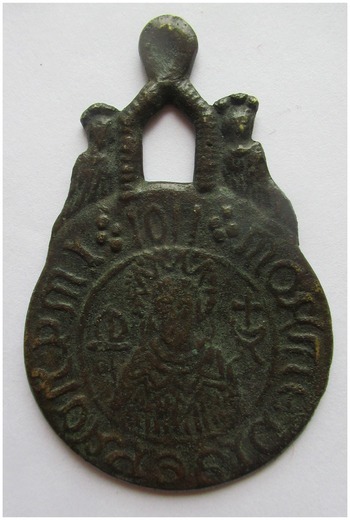
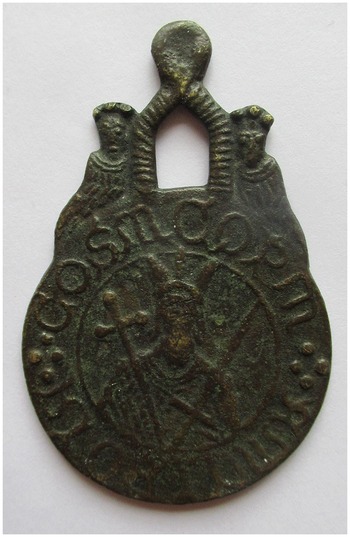
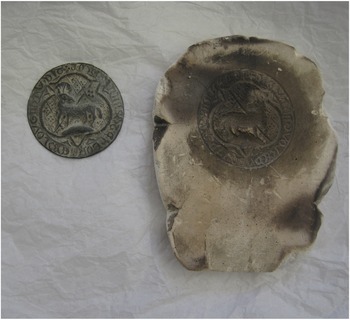
By 1869 Billy and Charley’s productions were so well known that they found it impossible to sell them. Cuming was therefore able to buy seven identical medallions they had made for a penny each to display as a warning of their activities (figs 11 and 12). Other examples of this are known: 50mm in diameter, the craftsmanship is delicate, showing that Billy and Charley’s technique improved with experience.Footnote 77 Charley Eaton died on 4 January 1870, aged 35. The death certificate gave his profession as ‘riverside labourer’, the cause of death as consumption and the place of death as 2 Matilda Place, in a yard extending east from an alley called North-East Passage, between Cable Street and Wellclose Square (wholly obliterated by modern tower blocks) in present-day London E1, a quarter of a mile east of Rosemary Lane. Mary Eaton, present at his death, signed the certificate with a cross. Cuming reflected, ‘bad as this fellow was, he was an honourable man in comparison with his partner’. Billy continued as a solo operative, using the name William Monk. Later, in 1870, he made a badge displaying the Lamb of God with the chalk die, the only surviving mould of a forgery, which he sold cheaply to Cuming, admitting to copying the design from a butter print (fig 13).Footnote 78 In 1871 Billy failed to sell a lead copy of a thirteenth-century jug;Footnote 79 in June 1872 Cuming acquired two lead tokens he had made,Footnote 80 and Billy then disappears from history.
Medallion by Billy Smith and Charley Eaton, dated 1011. In 1869 Henry Syer Cuming bought seven showing this design for a penny each. He suspected this might have been modelled on a Byzantine coin (Cuming Reference Cuming1869). Billy and Charley made several medallions with this design, which appear quite frequently in museums and collections. Size: 50mm in diameter, 75mm high. Photograph: author.

Obverse of the medallion bought by Cuming in 1869. Photograph: author.

Forgery made by Billy Smith (using the alias William Monk) in 1870. Size: 50mm in diameter. The chalk die is the only mould of a Billy and Charley forgery known to survive. Photograph: Reproduced with kind permission of the Cuming Museum, London.

It is possible to estimate how many forgeries Billy and Charley made. At the Guildford trial Edwards said they bought him 1,100 objects, eight or ten at a time. Eastwood, too, acquired 1,100. Billy stated that he and Charley ‘found’ 2,000 objects. This suggests a daily output of four or five objects, which could total between 1,400 and 1,800 in a year. If manufacture continued at the same rate after the trial until March 1861, when Reed exposed their operation, they could have made a further 4,000 or 5,000, at a conservative estimate. Over the following ten years production may have declined as their market shrank, but they could have manufactured between 6,000 and 10,000 quite distinctive objects in their careers. At the Guildford trial Billy said he and Charley made £400 from selling these: if prices were between 2/6d (12½d) and 10s (50p), this is feasible. At that time a skilled London labourer’s weekly wage was between £1 and £1 10s (£1.50), while a rural farm worker earned between 10s (50p) and 15s (75p) a week; Billy and Charley may not have become wealthy from selling forgeries, but they could have made rather more money than many London labourers and workers.Footnote 81 If Edwards offered Bateman twenty medallions for £10, he, too, was making a substantial profit.Footnote 82 Cuming referred to collectors who paid £60, and even £400.Footnote 83 Even if he exaggerated, this still suggests that Edwards and Eastwood ran a lucrative trade. Billy Smith and Charley Eaton were exceptional among Victorian archaeological forgers, not just in making unique and recognisable fakes, but also in obtaining support from antique dealers and endorsement from respected antiquaries, to become possibly the most prolific operatives of their kind. The forgeries were first called Billys and Charleys in 1908, by Thomas Sheppard (1876–1945), the curator of Hull Municipal Museum.Footnote 84
In 1902 Cuming left his collections to the Borough of Southwark to form the Cuming Museum. Housed in the Newington Library and Walworth Town Hall on Walworth Road, the museum featured a display of Billy and Charley forgeries with details of Cuming’s role in exposing them. Sadly, the building housing the museum was damaged by fire in 2013. The collections have since been kept in store until they find a new home; meanwhile, selected items can be seen on the Heritage Southwark website.Footnote 85 The Museum of London holds the largest and most comprehensive single collection of Billys and Charleys; the British Museum, the Ashmolean Museum in Oxford and the Fitzwilliam Museum in Cambridge possess selections, although these institutions’ display policies mean they are seldom publicly exhibited. In 2010 Billy and Charley entered the broader canon of English literature when they featured in Leo’s Heroes, a children’s novel about a boy who discovers the secret of time travel and visits Victorian London.Footnote 86
In retrospect, it seems strange that people accepted Billys and Charleys as genuine when they display so many glaring errors; but when strong emotions are roused, people are liable to take an uncompromising stance to defend something. Roach Smith’s support of the objects was his only significant mistake in a long and distinguished career. Eastwood’s stance is understandable, as he profited financially from selling them. Those who bought the objects were susceptible to the allure of being collectors, owning rare, curious, attractive or informative objects and ready to overlook the anomalies in their designs. People try to fit things into patterns. Some of those who first saw Billys and Charleys hoped, over-optimistically, that these could find a place in a coherent pattern of human development and advancement, and continued to hope for this until the objects were irrefutably proven to be forgeries. Among the most peculiar productions of the Victorian enthusiasm for archaeology, Billy and Charley forgeries are now kept in museums. The wheel has turned full circle.
ACKNOWLEDGEMENTS AND DEDICATION
Thanks are due to Dr Michael Rhodes, FSA, for directing my attention to George Eastwood’s letter to Charles Roach Smith, and for insights into Charles Roach Smith’s role in the debate over Billys and Charleys; to Philip Mernick for helping me to locate Matilda Place; to previous members of the staff of the Cuming Museum for making their resources available to me; and to The Antiquaries Journal anonymous reviewers for advice and encouragement.
This paper is dedicated to the memory of my mother, Joan Mary Halliday (1920–93), who first told me about Billy and Charley and stimulated my interest in their forgeries.
ABBREVIATIONS AND BIBLIOGRAPHY
Abbreviations
- BL
-
British Library, London
- SAL
-
Library of the Society of Antiquaries of London
- SLHLA
-
Southwark Local History Library and Archive
- SMT
-
Sheffield Museum Trust
- TBC
-
Thomas Bateman Correspondence
- TNA
-
The National Archives, Kew