

1. Introduction
This paper presents a longitudinal study of the perceptions of Cubans residing in Miami-Dade County, Florida, where 65% of the population is Latino, and over half of Cuban origin, toward the correctness of varieties of Spanish, including the Cuban one. The study was modeled on an earlier one carried out in 1998 with the same population. The aim of this second study was to examine whether perceptions had changed or remained stable in relation to social and demographic changes in the community. In what follows, the goals of perceptual dialectology are summarized, the findings of the earlier study are outlined, and the Cuban community in Miami-Dade County is described.
1.1. Perceptual Dialectology
The area of study known as perceptual dialectology grew from Preston’s research on nonlinguists’ attitudes toward regional varieties of U.S. English (Preston, Reference Preston1986, Reference Preston1988, Reference Preston1989, Reference Preston1996, Reference Preston1999; Long & Preston, Reference Long and Preston2002). Since its inception, studies have been carried out in a wide range of communities with diverse sociolinguistic situations and language ideologies, including English in the United States (i.e. Benson, Reference Benson2003; Bucholtz, Bermudez, Fung, Vargas & Edwards, Reference Bucholtz, Bermudez, Fung, Vargas and Edwards2010; Fridland & Bartlett, Reference Fridland and Bartlett2006; Hartley, Reference Hartley2005; Preston, Reference Preston1986, Reference Preston1988, Reference Preston1996) and England (Pearce, Reference Pearce2009), French in Canada (Evans, Reference Evans2002) and France (Kuiper, Reference Kuiper1999, Reference Kuiper2005), Spanish in Madrid (Moreno Fernández & Moreno Fernández, Reference Moreno Fernández and Fernández2002), at the US-Mexico border (Martínez, Reference Martínez2003) and in Miami (Alfaraz, Reference Alfaraz2002), German after the reunification (Dailey-O’Cain, Reference Dailey-O’Cain1999), as well as Hungarian (Kontra, Reference Kontra2002), Turkish (Demirci, Reference Demirci2002; Demirci & Kleiner, Reference Demirci and Kleiner1998, Reference Demirci and Kleiner1999), Japanese (Long, Reference Long1999), and Korean (Long & Yim, Reference Long and Yim2002), to mention some varieties and regions.
At the heart of research in this area is an interest in understanding the beliefs and attitudes of the folk, or everyday people, toward language varieties and their speakers (Niedzielski & Preston, Reference Niedzielski and Preston2000). Preston (1999: xxv) noted that among the reasons for investigating what the folk believe about regional and social dialects is that it can reveal “folk dialect areas where there are none scientifically and vice versa.” Moreover, Preston pointed out that “instances of language change and so-called language attitudes...might be profoundly influenced by folk beliefs about language, particularly beliefs about the status of language varieties and the speakers of them” (p. xxiv). Labov (Reference Labov2001: 191) noted that “covert attitudes and beliefs” contribute to the transmission of changes “if speakers feel that their adoption of the linguistic form will lead others to attribute to them the positive traits of the given group and allow them to share in the privileges of that group.” Studies on perceptions of dialects can help estimate the likelihood of convergence or divergence (Giles, Reference Giles1973), and thus, the direction of linguistic changes in dialect contact situations (Auer, Hinskens & Kerswill, Reference Auer, Hinskens and Kerswill2005; Trudgill, Reference Trudgill1986).
Perceptual dialectology studies have generated a body of work that has contributed to our understanding of dialect perceptions, but longitudinal studies represent a gap in the research. With the exception of Preston (Reference Preston2011) and the research reported on in this paper, studies have not addressed perceptions over time, particularly in relation to social changes. Preston (Reference Preston2011) compared findings from twenty-some years of work on perceptual dialectology in Michigan. At the outset, he asked:
Will Michigander’s language attitudes look the same twenty years later? Surely more than two decades of greater media exposure to regional varieties, particularly their use by obviously well educated speakers, and perhaps some growing sense that severely downgrading the speech of others might not be the nicest thing one could do will have ameliorated these harsh views.
His findings led him to conclude that the group’s perceptions had not changed: “[P]rejudice against the South and perceptions of Michigan as the site where the most correct English is spoken have not changed in twenty years” (p. 7). Moreover, rather than having mitigated their evaluations of other regions, Michiganders gave harsher ratings to some regions than they had in earlier studies.
The description of findings from the first study of Miami Cubans, discussed in the next section, will show that Cubans share with Preston’s Michiganders a very high regard for the correctness-status of their own variety. The evidence Preston found for stability in the perceptions of Michiganders provides a backdrop for the study of perceptions among Miami Cubans. It motivates the question of whether the perceptions of Cubans have remained stable because of their strong investment in the correctness-status of their variety, similar to the Michiganders in Preston’s study, or whether Cuban perceptions have changed, despite the high regard for their own variety, in response to local social and demographic changes.
1.2. The First Study of Miami-Cuban Perceptions
The original study, discussed in Alfaraz (Reference Alfaraz2002), examined the perceptions of Cuban-origin individuals residing in Miami, Florida. It focused on regional varieties of Latin American Spanish, presented as countries, following a common classification model that disregards that isoglosses do not coincide with national boundaries (Lipski, Reference Lipski1994; Penny, Reference Penny2004), but which, based on evidence from a pilot study that included drawing dialect regions on maps, reflects how Spanish speakers think about regional dialects. Along with the varieties of Latin American, Peninsular Spanish was included as a variety because it is widely accepted as the standard–Spain is the seat of the institution governing Spanish, La Real Academia Española, which oversees and approves standard grammar and lexicon published in their official dictionary and grammar books.
Fieldwork was conducted in Miami in 1998, on the heels of a major wave of immigration from Cuba. The study included a stratified sample of 148 individuals who had immigrated at different time periods, or who had been born in the United States and actively used Spanish. The study and all instructions were in Spanish. Using a questionnaire, we asked participants to rate on a seven-point scale the correctness, pleasantness, and degree of difference of the varieties of Latin American and Spain. Although given the opportunity to add regions other than the countries listed, only a few participants added Andalusia, reflecting a general north-south division in Peninsular Spanish. Rather than eliciting perceptions of the Cuban variety by listing the name of the country, Cuba was listed as two varieties: One representing the variety of the diaspora (Cuba 1), and the other the variety of the island (Cuba 2). This separation of Cuban Spanish into two varieties was based on observing widely held beliefs about intragroup differences based on the dimensions of space—here (Miami-United States) versus there (Cuba)—and time—then (pre-revolution) versus now (post-revolution). When taking the survey, participants did not comment on the division and rated them without hesitation. Indeed, it was surprising to see automatic responses given to their own variety. The ratings of other varieties were straightforward, both of those with a stronger demographic presence in Miami and those not commonly encountered, as, for instance, Bolivian or Paraguayan Spanish.
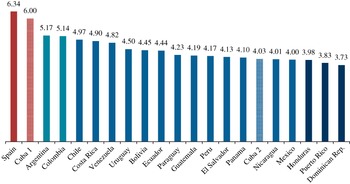
The findings for regional dialects in Figure 1 confirms that the distinction made for the two varieties of Cuban Spanish captured a perceptual dialect boundary that was revealed in their ratings. The diaspora variety (Cuba 1) received the highest rating (6.0), second only to Spain (6.34), whereas the island variety (Cuba 2) received among the lowest ratings (4.03). The significance of the separation between the varieties was shown with a cluster analysis in which Cuba 1 and Spain were in one cluster, Cuba 2 in a second, and all the other regional varieties in a third. Although a linguistic boundary between the diaspora and island varieties had not been demonstrated with empirical data, there was a perceptual-dialect boundary whose function was to strengthen intragroup boundaries. Not only did the established immigrants give Cuba 1 higher ratings than Cuba 2, the newest arrivals also gave the island variety lower ratings than the diaspora one. Regardless of time of arrival to Miami (or birth there), all groups noted differences between Cubans here and Cubans there. For newcomers, the perceptual boundary was spatial (here versus there), whereas for established groups, the boundary was both spatial and temporal (then versus now).
Results for all varieties from original study.

While these results for Cuban Spanish most obviously stemmed from political ideology, they also revealed ideologies of economics and race. For the Cuban varieties, wealth and race correlated with correctness: The island was perceived as poor, black, and nonstandard, whereas the diaspora was wealthy, white, and standard. These beliefs about wealth and race surfaced in the evaluation of other regional varieties as well. A correlation was found between positive ratings and degree of white population and, similarly, between positive ratings and greater wealth or economic development, operationalized as gross domestic product per capita. Thus, higher ratings were given to regions with larger proportions of white population and higher gross domestic product per capita, for instance, Spain (6.34) and Argentina (5.16), which ranked third after Cuba 1. On the other hand, correctness ratings were lower for varieties from poorer regions that had larger proportions of non-white or mixed-race speakers, particularly (and paradoxically), the Spanish of their two Caribbean island neighbors, Puerto Rico (3.83) and the Dominican Republic (3.73). In sum, this first study confirmed that Cubans in Miami believed in the high degree of correctness-status of the diaspora (their) variety. Moreover, the study showed a link between correctness-status, race, and economic development. Whether it continues to influence perceptions will be examined in this restudy of the community.
1.3. Cuban Presence in the Community
The Cuban enclave in Miami-Dade County predates the Cuban Revolution, but it was this event in 1959 that triggered large waves of immigration from the island to the United States and settlement of heavy concentrations of Cubans in Miami. According to the 2010 Census, over two-thirds of Cubans lived in the state of Florida and nearly half the Cubans in the United States lived in Miami. In the Miami enclave, Cubans made up more than half (53%) of the Hispanic or Latino population. In the decade from 2000 to 2010, the Cuban population increased by 26%, and immigration from Cuba, as well as from other Latin American countries fueled growth of the Hispanic population.
There were four major waves of immigration from Cuba from 1959 to 1996, with continuous immigration of smaller numbers in the interludes. The largest number of Cubans arrived in the 1960s and early 1970s: The first wave (1959–1962) brought 248,000 Cubans, the second (1965–1973) brought 297,318 more, and in the three-year interlude (1962–1965) between these waves, 56,000 more arrived. During the Mariel Boatlift in 1980, 124,776 Cubans arrived by boat, and during the last major wave, the so-called Rafter Crisis (1994–1996), 80,000 Cuban rafters and visa holders settled in the United States.
Growth of the Cuban population in Miami continued at a rapid pace in the ten-year period between 1995 and 2005. During this time, over 200,000 Cubans were estimated to have immigrated to the U.S., among them rafters (balseros), people smuggled in on speedboats (boteros), and winners of the U.S. government visa lottery (el bombo) (Henken, Reference Henken2005). According to the 2010 Census, the number of Cubans in the U.S. increased from 1.2 million in 2000 to 1.8 million in 2010. While agencies resettled Cuban arrivals to various parts of the United States, an overwhelming number settled in Miami-Dade County or migrated there from the places they had been sent during the resettlement process.
The Cuban population in Miami-Dade numbered 856,007 at the time of the 2010 Census. The attraction of the area for newcomers, as García (1996: xi) described it during the mid-1990s, continues to explain its appeal to Cubans, whether new arrivals or established immigrants:
The new immigrants who will settle in Miami will find the city familiar and yet alien. Miami is certainly not a Cuban city, but it is home to the second-largest Cuban population in the world, and new immigrants will find it enough like home to want to settle there—or return there, if things do not go well for them in other parts of the United States. Miami will serve as a prism through which to interpret the U.S., and hopefully a buffer to shield them from the harsher aspects of the adaptation process. They will be among compatriotas who know what it’s like to leave one’s homeland in search of better options.
Although Miami-Dade has historically been an enclave for Cuban immigrants, it attracted immigrants from Latin American countries as economic instability and political turmoil increased migration from the region. The 2010 U.S. Census reported that, between 2000–2010, the number of South Americans grew by 77% and the number of Central Americans by 65%. Like Cubans, immigrants from other Spanish-speaking countries often prefer to settle in Miami rather than venture beyond the bilingual city to other regions, where they will, most certainly, need to learn English in order to work and carry out public interactions.
The immigration of Spanish-speaking groups has contributed to a dialect contact situation in which Cubans are increasingly in contact with diverse varieties of Latin American Spanish. Moreover, it can be said that heavy recent immigration from Cuba has created a situation in which Cuban Spanish is in contact with itself, in the sense that the variety of earlier immigrants is in contact with the variety of newcomers.
1.4. Goals
The goal of this research was to examine dialect perceptions in real time. To this end, the first study was replicated with a twelve-year time depth to investigate perceptions in relation to changes in the community, including significant growth in the number of immigrants from Latin American countries and an influx of newcomers from Cuba that contributed to the growth of the Cuban population in Miami-Dade County by 44% between 2000 and 2010. In the remainder of this paper, the status of perceptions toward regional varieties of Spanish and toward varieties of Cuban Spanish are described and later compared to the findings of the earlier study.
2. Design and Analysis
Classic perceptual dialectology studies have used a variety of techniques to elicit evaluations, including hand-drawn maps, which have been a rich source of data about folk beliefs (Hartley & Preston, Reference Hartley and Preston1999; Preston, Reference Preston1986, Reference Preston1996), and questionnaires about the degree of difference, and the correctness and pleasantness of varieties, terms which correspond to the notions of status and solidarity (Lambert, Reference Lambert1967); in fact, in Preston (Reference Preston2011), we find correctness expanded to correctness-status and pleasantness to pleasantness-solidarity.
As noted above, the original study of perceptions among Cubans in Miami used a questionnaire, and the same questionnaire was used in the restudy. The questionnaire listed the Spanish-speaking countries of Latin America and Spain alphabetically, with the order reversed on half the questionnaires, and, as in the first study, Cuba was listed as Cuba 1 and Cuba 2. A seven-point scale was used to rate correctness and pleasantness, presented separately, but with correctness being presented first. As in the initial study, participants completed the task without questioning the options. Once again, the separation of Cuba 1 and Cuba 2 was not questioned. Participants clearly enjoyed filling out the questionnaire and most talked aloud as they gave ratings, explaining their choices and justifying them with imitations and anecdotes, providing a rich source of qualitative data similar to that obtained when the think aloud method (van Someren, Barnard & Sandberg, Reference Van, Martin, Barnard Yvonne and Sandberg1994) is used. In both this and the first study, the confidence with which participants gave ratings was striking. Although the actual numbers given may have varied somewhat, the talk surrounding the ratings was similar and demonstrated the cohesiveness of the group’s perceptions.
The questionnaire was written and delivered in Spanish. Participants were recruited if they actively spoke Spanish in their daily lives, had acquired Spanish as a first language, or had acquired it simultaneously with English. Verbal invitations to participate, questions, and explanations were in Spanish, or in Spanish and English, depending on whether the participant was monolingual or bilingual. The study was conducted by a Cuban-American bilingual whose variety during data collection can be described as a standard variety of US Cuban Spanish, with a fair degree of leveling of marked phonetic features, and accommodation to participants’ varieties, particularly popular US Spanish (Otheguy, Reference Otheguy2009, Reference Otheguy and Stern2010) when situations became more casual. Participants were recruited in public spaces, including retail stores, as well as through acquaintances, friends, and colleagues. As in the first study, participants were often hesitant to give social information, even after being assured of their anonymity.
The sample contained 84 Cuban-origin individuals. As in the previous study, an attempt was made to survey Cubans of varying ages and socioeconomic statuses who had arrived from Cuba at different periods of time, as well as Cuban-Americans born in the US of Cuban parents, but these were only included in the study if they reported actively participating in the Spanish-speaking community. The social factors studied included gender, age, socioeconomic status (SES), social network, and year of arrival from Cuba. Gender was considered a binomial category made up of male and female. Age groups were established according to ten-year spans, with five groups created: 20–29, 30–39, 40–49, 50–59, and 60+. Socioeconomic status reflected a combination of schooling and type of employment; four groups were created representing the upper middle class, lower-middle class, upper-working class, and lower-working class. Network groupings were based on participants’ reports about the number of Cuban friends and coworkers they interacted with, resulting in four groups: All Cuban, mostly Cuban, half Cuban, or contains few or no Cubans.
We also asked the year in which participants arrived in the US. Four groups were created according to age of arrival from Cuba. These groupings generally followed the major waves of immigration described earlier. The first group contained immigrants who arrived between 1959 and 1978, during the first and second major waves, which occurred between 1959–1962 and 1965–1973, and in the slow but continuous immigration that occurred between and after the major waves. The second group consisted of Cubans who immigrated during the years between 1979–1992; this group had people from the third major wave, through the Mariel Boatlift in 1980, as well as others who filtered in during the remainder of the 1980s, often from third countries. The third group represented immigrants who arrived during the fourth major wave, the Rafter Crisis, and covered the period 1994–1999. In this restudy, a fourth group was added that included immigrants who arrived between 2000 and 2010, after the four major waves.
Statistical analysis of the quantitative data from the questionnaires was carried out using SPSS, with a variety of statistical tests run on the data, including t-tests, correlations, multidimensional scaling, and k-means cluster analysis. In the following section, the results for Cuban Spanish and the other regional varieties studied are presented separately. The results for other varieties are presented first, followed by those for Cuban Spanish. After these results, a comparison of the findings for correctness from this study and the earlier study is discussed.
3. Results
3.1. Regional Varieties
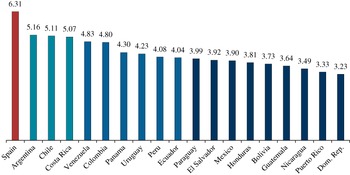
The means of the correctness-status ratings for regional varieties are shown in Figure 2. It was not surprising that Peninsular Spanish received the highest rating (6.31), which confirmed that it was regarded as the most prestigious variety, representing a model of correct usage. None of the Latin American varieties reached the six-point range in their rankings; in fact, the next highest scores were in the low five-point range: Argentina (5.16), Chile (5.11), and Costa Rica (5.07). These were followed with varieties in the four-point range: Venezuela (4.83), Colombia (4.80), Panama (4.30), Uruguay (4.23), Peru (4.08), and Ecuador (4.04). The rest of the regional dialects received ratings in the three-point range, including Paraguay (3.99), El Salvador (3.92), Mexico (3.90), Honduras (3.81), Bolivia (3.73), Guatemala (3.64), Nicaragua (3.49), Puerto Rico (3.33), and the Dominican Republic (3.23).
Ratings of regional varieties without Cuban Spanish.

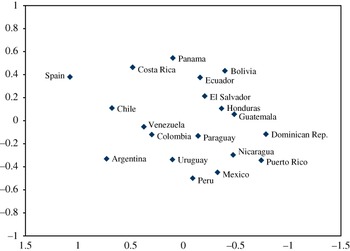
These perceptions of correctness followed a general regional trend that is evident in the multidimensional scaling in Figure 3. The prestige-correctness of Peninsular Spanish is reflected in the placement of Spain in the upper left quadrant, set off from other regions. The Caribbean varieties of Puerto Rico and the Dominican Republic, rated the two least correct, are furthest to the right on the x-axis. In comments about these regions, participants indicated that the degree of incorrectness stemmed from their association with large mulatto and African-origin populations. The Central American varieties of Costa Rica, Panama, El Salvador, Honduras, and Guatemala are in the upper section, but Nicaragua, another Central American variety, is in the lower right section. It is, however, different from the other Central American varieties in that it has had a strong presence in the community. The US’s largest group of Nicaraguans resides in the city of Sweetwater in the Miami-metropolitan area, where signage in Spanish reflects the group’s presence, and a public park and public middle school are named after a famous Nicaraguan poet, Rubén Darío. Sweetwater, or Pequeña Managua (Little Managua), is surrounded by other suburban metro cities with heavy concentrations of Cubans. Plotted along with the Central American regional varieties are the South American varieties of Bolivia and Ecuador; their being grouped with Central American varieties reflects a perception of incorrectness that, as with the insular Caribbean varieties, participants attributed to large concentrations of mestizo and indigenous populations. In contrast, the varieties of the Southern Cone, Argentina, Uruguay, and Paraguay, are in the lower section, and Chile is toward the bottom of the upper one. As noted above, Argentina and Chile received the two highest correctness ratings among Latin American regions. The plotting of Cuban Spanish, discussed below, will provide further insight on this spatial arrangement of these varieties.
MDS Regional varieties.

To understand the influence of social factors on perceptions, age, gender, socioeconomic status, social network, and year of arrival were analyzed using t-tests. All but gender were found to be significant. The results for age (p<.001) showed that the oldest participants, 60 years and older, gave the highest ratings (4.54), and there was a trend for ratings to become lower as age decreased: 50–59 years 4.38, 40–49 years 4.20, 30–39 years 4.08, and 20–29 years 3.55. Despite an expectation that the oldest groups would give lower ratings, demonstrating less tolerance to varieties other than their own, it was the youngest group that gave the harshest ratings. Linguistic evaluations can be subject to age-effects, according to Garrett, Coupland, and Williams (Reference Garrett, Coupland and Williams2003:85-86), who noted that age may influence the judgments of younger adults, whose attitudes are still developing; furthermore, younger people may be inclined to oppose the views of the dominant group. The lower ratings of younger people may be related to age, but they can also indicate a change in the community toward harsher evaluations of non-Cuban dialects.
The results for socioeconomic status (p<.001) indicated that participants from the highest social status group (upper middle) gave the highest ratings (4.57), whereas those from the lowest social status group (lower working) gave the lowest (3.92). The groups in the middle had scores in between these two ranges: Lower middle (4.28) and upper working (4.35). Competition for employment and resources may explain why participants in the lowest socioeconomic group gave the lowest ratings. In the struggle to secure employment as unskilled laborers, these Cubans may find themselves competing with immigrants from other parts of Latin America, which may cause them to regard less favorably Latin America varieties in general. Along with this economic component, the linguistic insecurity of this group may contribute to it downgrading other varieties in relation to its own.
Along with age and socioeconomic status, the composition of the social network significantly influenced ratings of regional varieties (p<.01). Although the differences here were small, the results showed that Cubans with more closed networks had more favorable views of the correctness of other varieties than Cubans with more open networks. The most favorable ratings were given by people who reported networks that were entirely made up of Cubans (4.52), and the second highest were from participants with mostly Cubans in their network (4.33). Varieties were judged more harshly if the network was half Cuban (4.00), or if it had few or no Cubans (4.09). Thus, rather than mitigating negative views of other dialects, these findings suggest that regular interactions with speakers of other varieties contributed to negative evaluations. The implications for language change are clear: Open networks are not likely to result in linguistic accommodation that diverges from the Cuban norm. The findings for Cuban Spanish, discussed below, will add another layer to this prediction of divergence from other regional varieties in this community.
Year of arrival or birth in the U.S. also showed significant differences in ratings (p<.001). The group born in the U.S. gave the lowest ratings (3.92); the two groups of immigrants that arrived after 1994 had similar ratings—2000–2010 (3.99) and 1994–1999 (4.00)—and earlier immigrants gave higher ratings—arrivals from 1959–1978 (4.45) and 1979–1992 (4.59). Viewed in terms of competition among groups in the community, the more favorable ratings of established immigrants reflects their greater social and economic stability, whereas the newer arrivals are more likely to be in direct competition for jobs and resources with newcomers from other regions, but this does not necessarily explain the low ratings of US-born Cubans, who are represented across socioeconomic groups. The evaluations of this group are discussed further in relation to the results for the two Cuban varieties.
3.2. Cuban Spanish
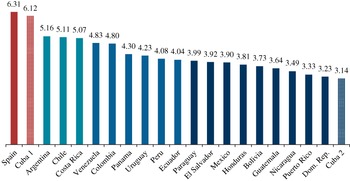
Including the results for Cuban Spanish in the ranking of regions, shown in Figure 4, reveals that Cuba 1 had the second highest score (6.12) after Peninsular Spanish (6.31), which made it the highest ranked for correctness of the Latin American varieties. The other Cuban variety, Cuba 2, on the other hand, received lower evaluations (3.14) than any of the other varieties. These results confirmed the community’s high regard for the correctness-status of the variety represented in Miami and its low regard for the variety of the island.
Ratings of regions with Cuban varieties.

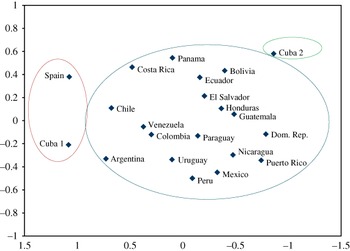
Multidimensional scaling revealed interesting patterns in the spatial representation of the two Cuban varieties in relation to other regional varieties. In Figure 5 we see that Cuba 1 is on the far left below Spain on the x-axis, whereas Cuba 2 in the far upper right, directly above the Dominican Republic and Puerto Rico, and closest to Bolivia. This plot also indicates with circles the clusters derived from a K-means cluster analysis with three clusters specified. The first cluster is made up of Spain and Cuba 1, positioned to the far left, set off from other regions. The second cluster includes all the non-Cuban varieties. The single member of the third cluster is Cuba 2. These results suggest that perceptions center on the opposition between the two varieties of Cuban Spanish. The prestige of Cuba 1, measured against Peninsular Spanish as the prescriptive norm, contrasts with the low status of Cuba 2, whose distinctness sets it off from other Latin American varieties. Thus, the often cited belief that Cuban Spanish on the island has become increasingly impoverished over time underlies a perceptual boundary that marks the political and ideological separation of Cubans in Miami from Cubans on the island.
MDS with clusters.

In contrast to the influence of social factors on the ratings of non-Cuban regional varieties, t-tests showed that only age (p<.001) and year of arrival (p<.05) were significant for Cuba 1, and none were significant for Cuba 2. The evaluation of Cuba 1 across age groups showed that the youngest group (20–29) gave it the lowest rating (5.0) and the oldest group gave it the highest (6.49). Other age groups were between these two extremes: 30–39 (6.09), 40–49 (5.67), 50–59 (6.00). The same age distribution was found for the rating of the non-Cuban regional varieties: The oldest group gave the highest, and the youngest, the lowest scores. As suggested above, this pattern may be age-graded, related to changes in individuals over time, as noted in Garrett et al. (Reference Garrett, Coupland and Williams2003), or it may reflect a change in perceptions in the community. If this is, in fact, age-grading, then younger participants are likely to change their attitudes as they age. On the other hand, if these ratings for Cuba 1 reflect community change, then they are indicative of less favorable attitudes encroaching on perceptions of the highly esteemed variety of the Cuban diaspora community in Miami.
For younger Cubans who arrived as children or were born in Miami, Cuba 1 is a variety of U.S. Spanish that interacts with English, and their less favorable evaluations of it may be based on a negative attitude toward contact features and salient bilingual practices, such as borrowing and codeswitching. Similarly, younger speakers who immigrated from Cuba agree that Cuban Spanish in Miami is prestigious, but for many of these speakers, particularly the ones who are not bilingual, new features derived from contact with English that they have encountered are highly salient and mark differences between their native variety (Cuba 2) and the variety in Miami (Cuba 1). These differences figure prominently in conversations about language and language learning in the U.S. In some of the interviews, newcomers reported, in a humorous tone, that they needed to learn to speak Spanglish in Miami, and that they were forgetting to speak Spanish but had not yet learned English.
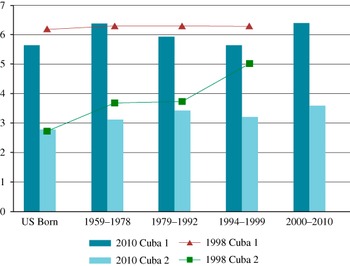
The results for year of arrival revealed that Cuba 1 received the highest ratings from the newest arrivals from 2000–2010 (6.38) and the oldest from 1959–1978 (6.37). Following these were arrivals from 1979–1992 (5.93), 1994–1999 (5.64), and the US-born group (5.63). While it was not surprising that the longest-established residents gave Cuba 1, their own variety, more favorable ratings, it was unexpected that the newcomers, who cannot claim it as their native variety, gave it similarly high ratings. In the ratings for Cuba 2, although not significantly different, Cubans born in the U.S. gave the lowest ratings (2.75), followed by arrivals from 1959–1978 (3.08). The ratings were somewhat higher for the other year of arrival groups: 1979–1992 (3.40), 1994–1999 (3.18), 2000–2010 (3.56). In contrast to Cuba 1, and to other regional varieties, there is consensus across groups about the status of Cuba 2.
4. Real-Time Comparisons
4.1. Regional Varieties
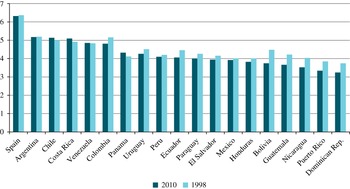
A comparison of the ratings of correctness for regional varieties from the 2010 and 1998 studies revealed a generally stable pattern. The results in Figure 6 show that ratings were somewhat lower in the second study than in the first—fourteen of the nineteen varieties had lower scores—and that the regions with the lowest scores were the ones that received harsher ratings in the second study, including Bolivia, Guatemala, Nicaragua, Puerto Rico, and Dominican Republic. Increases in correctness ratings at the second time period were minimal and limited to regions whose correctness had been rated more highly in the first study. Overall, however, differences in ratings over time were not significant.
Comparison of ratings of regional varieties at two time periods (without Cuban Spanish).

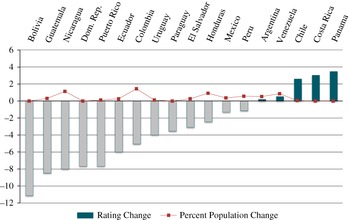
Interesting differences between varieties were found when ratings were converted into regularized scores. This was done based on a percent calculated from the highest rating, given to Spain, and a rate change score derived from the difference between the percentage points for the two time periods. The regularized scores in Figure 7 are of changes in the ratings between 1998 and 2010. This figure also shows demographic changes in Miami during the period studied as a percent reflecting differences in the total population of individuals who claimed regional origin in the country (from the U.S. Census Bureau figures for 2000–2010).
Rating change and population change.

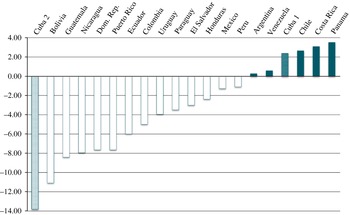
The regularized rating change confirms that rating changes were negative for all varieties except those of Panama, Costa Rica, Chile, Venezuela, and Argentina. Negative rating changes were largest for countries whose correctness-prestige was lowest in the first study: Bolivia (−11.08), Guatemala (−8.40), Nicaragua (−7.94), Puerto Rico (−7.64), and the Dominican Republic (−7.64). Negative changes were also found for Ecuador (−6.01), Colombia (−5.0), Uruguay (−3.94), Paraguay (−3.49), El Salvador (−3.02), Honduras (−2.4), and slightly less negative scores were given to Mexico (−1.28) and Peru (−1.11).
By far the greatest rate change was found for Bolivia, whose correctness score dropped 11.08 percent. This has clear political underpinnings: The ascent of Evo Morales, who had strong ties to Cuban leader Fidel Castro and the deceased Venezuelan leader, Hugo Chávez, was an event that ran directly counter to the ideological position of the group. Why then was Venezuelan Spanish given a slightly more positive rating in the restudy, or at least not given a harsher one, when it also experienced political changes toward the left with Hugo Chavez, elected to office in 1999, at the helm? The answer is that Cubans are sympathetic to the plight of the tens of thousands of Venezuelans who arrived in Miami after Chavez became president. According to the U.S. Census, the number of Venezuelans in Miami grew 117%, from 21,593 to 46,851, between 2000 and 2010. Venezuelan politics are followed as closely in local, Cuban-dominated, Spanish-language media outlets as the political events in Cuba have been since the settlement of the diaspora community.
Although we can point to the growth of the Venezuelan community in Miami in the years between the first and second study as a factor that mitigated the political one, demographic factors alone did not significantly account for ratings of regional varieties. When changes in ratings were examined in relation to changes in the population of groups in Miami, no significant link was found between them (R 2=.05, F(1, 16)=.83, p=.38). Demographic presence accounted for only 5 percent of the change in perceptions observed between 2000 and 2010. Thus, in the dialect contact situation, there were factors beyond the interplay of ingroup and outgroup dynamics, evident in demarcation of group boundaries and competition for resources, that influenced attitudes. Political ideology was clearly an important factor, and it interacted with ideologies of race and wealth to shape perceptions towards regional varieties.
The earlier study reported that economic development influenced perceptions. A positive correlation was found between evaluations and gross domestic product per capita (r(19)=.67, p<.01). To examine whether changes in economic development continued to correlate with ratings of the regions, a correlations test was run on the 2010 ratings and recent GDP per capita, which had increased over the last decade in all regions except Argentina. Once again, a strong positive correlation (r(19)=.61, p<.01) was found between perceptions of regional varieties and wealth of the region.
Racial composition of regions was another factor correlating with perceptions in the previous study (r(19)=.58, p<.01). To determine whether race continued to be a relevant factor, a correlations test was carried out on the 2010 mean scores and racial composition, calculated as the proportion of white versus non-white population. Again, the results showed a positive correlation (r(19)=.61, p<.01) between perceptions of varieties and degree of racial diversity in the region. As in the earlier study, countries that were predominately indio or mestizo had lower ratings, and countries where large segments of the population were of African origin received the lowest ratings. Thus, the low ratings given to some Central American varieties, such as El Salvador, Honduras, Guatemala, and Nicaragua, some South American varieties, namely Paraguay, Ecuador, and Bolivia, and the Caribbean varieties of Puerto Rican and Dominican Spanish, can be explained as a downgrading based on race. As will be discussed below, race and poverty are factors that, along with politics, also played a role in shaping beliefs about the correctness-status of both Cuba 1 and Cuba 2.
4.2. Cuban Spanish
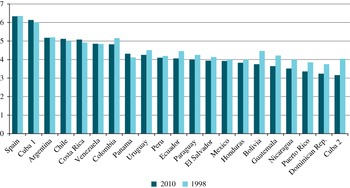
Comparing the perceptions of the Cuban varieties in the two studies, in Figure 8, shows that Cuba 1 held its place as the second most correct variety. Indeed, the rating of Cuba 1 remained generally stable, increasing slightly from 6.00 in 1998 to 6.12 in 2010. Cuba 2, on the other hand, was ranked higher among the varieties in the earlier study, where it ranked 6th ahead of Nicaragua, Mexico, Honduras, Puerto Rico, and Dominican Republic, but in the restudy, it ranked last. Ratings of Cuba 2 dropped from 4.03 in 1998 to 3.14 in 2010, when it received the lowest correctness ratings of all varieties.
Comparison of ratings at two times including Cuban varieties.

The ranking of the change in ratings over time for all the regional varieties in Figure 9 shows differences in the stability of perceptions of the Cuban varieties. First, it is clear that Cuba 1, compared to itself over time and compared to most other varieties, had remained generally stable, with only a small increase of 2.35%. Thus, the belief in the prestige and status of Cuba 1 had held strong, its resistance to change firmly grounded in its ideological function. In contrast, Cuba 2 had the largest change of all varieties, decreasing 13.8 percentage points. Only Bolivia, which experienced a political move to the left, had a double-digit decrease in the ratings. It is clear that Cuba 2 was heavily downgraded because it is on the opposite side of the ideological divide separating Miami-Cubans from their homeland.
Rating change over time with Cuban varieties.

Moreover, in Miami these perceptions also function to mark boundaries between established Cubans and newcomers. Downgrading the variety of newcomers, Cuba 2, is an overt rejection of that group. García (1996:xi), whose book on Cuban immigrants in Miami was published during the Rafter Crisis when immigration from camps in Guantanamo was in progress, forecast tensions that exist today between established immigrants and new arrivals as a result of their racial, sociocultural, and political differences:
This is not to say that there will not be conflict. Emigrés of the first wave (1959–62), disproportionately white and middle class, will find it difficult to relate to the new immigrants, whom they consider rough, poor, and uneducated. The fact that many of the new immigrants are black or of mixed racial heritage, and were once the faithful revolutionary proletariat, widens the cultural chasm. Already, the term balsero has become a pejorative among the older emigrés, a way of differentiating themselves from the new arrivals, just as the term marielito (for the Cubans of the third wave) acquired currency in the early 1980s for many of the same reasons. The arrival of more than twenty thousand new immigrants each year, most of whom will probably stay in south Florida, will also exacerbate ethnic tension in Miami.
Thus, language serves to mark boundaries between established Cubans and newcomers. Led by the older immigrants from the early first wave, for whom Cuba 1 is the native variety, established Cubans point to the variety spoken by new arrivals (Cuba 2), with its abundance of unfamiliar lexical items, and perhaps with phonetic and grammatical changes that advanced over the course of forty-some years, and note it a corrupt form of the language they knew. Certainly, this is not a surprising discovery, given that older generations tend to believe their language is deteriorating in younger generations. What makes this an interesting finding that contributes to our understanding of group relations is the separation of the groups in time and space and their reencounter in one location, the unfamiliar new group having encroached on the physical and linguistic space of the older group, which deploys its power and prestige to maintain its position and uses its beliefs about the correctness-status of its language to fortify the boundaries separating the two.
What is remarkable in the evaluation of the Cuban varieties is that newcomers are complicit in upgrading the diaspora variety and downgrading the island one. In the earlier paper, I noted that this “appears to reflect their desire to disassociate from the island in order to avoid the negative sentiments” of established Cubans; meanwhile, they “signal their loyalty to the Miami group by accepting its attitudes toward Cuban Spanish on the island.” Whether as an outcome of hegemony, or perhaps driven by their own linguistic insecurity, newcomers embrace the correctness-status of Cuba 1. Newcomers’ attitudes toward Cuba 1 signal their acceptance of the community’s predominant ideology and alignment with the values of established immigrants, not necessarily political, but in terms of the aspirations of immigrants in general, including economic stability, home ownership, access to education for oneself and one’s children, and other indicators of successful adaptation.
In a comparison of the means by year of arrival at the two time periods, shown in Figure 10, we see that the stability of Cuba 1 contrasts with changes in perceptions of Cuba 2. Ratings for Cuba 2 of Cubans who arrived during and after the Rafter Crisis (1994–1999) were considerably higher in 1998 (5.1) than in the restudy (3.18). They appear to have accommodated to the perceptions of earlier immigrants. When the first study was conducted, this group had only recently arrived. It was a large group with strong connections, forged in planning and leaving Cuba or in the camps at Guantanamo. They also had strong ties to Cuba—many were the first in their families to emigrate, leaving parents, spouses, siblings, and children behind. Over time, however, they brought their families and settled into life in Miami in the same way earlier immigrant groups had done years earlier. A decade or so later, the members of this group had less in common with new arrivals from the island than with the established groups, who also had homes, families, and generally shared the same values and lifestyles. Interview data confirmed that members of this group believed they were more like Cubans who arrived in earlier waves than like the newcomers. As for the newest arrivals, the findings of this study showed that they have appropriated the diaspora variety and expressed negative perceptions of the variety on the island.
Year of arrival groups’ ratings of Cuban varieties over time

4.3. Language Change
To return to the significance of perceptions for language change, it was noted in the introduction that the beliefs of nonlinguists contribute to formation of language attitudes that can influence linguistic change (Preston, Reference Preston1999). Based on the findings described here for regional varieties and for Cuban Spanish, predictions can be made about the direction of changes in the Miami-Cuban speech community. The implications for movement toward leveling in the dialect contact situation are clear: It is unlikely that Cubans will accommodate linguistically to the fast-growing groups of speakers of other regional varieties in the community. In fact, one possible outcome is that the Cuban group will move in the opposite direction, diverging from the others with features, frequencies, and constraints that differentiate Cuban Spanish from other varieties. Nonetheless, multidimensional scaling and cluster analysis, in both this and the earlier study, showed that Cubans are not very concerned with other regional varieties, but rather, that they focus their attention on Cuban Spanish, on the varieties of the diaspora and the island. Given the harsh downgrading of the island variety, it is doubtful that the group will accommodate through convergence to the variety of newcomers. It is very likely, however, that the new arrivals will accommodate to the variety of the diaspora community, similar to what was found for the perceptions of arrivals from 1994–1999. Testing this prediction will depend on uncovering the linguistic features, beyond lexical ones, that serve to mark differences in the varieties of Cuban Spanish of established groups and newcomers. Taken together, the results outlined above showed a robust and stable belief in the prestige of the diaspora variety that may inhibit accommodation and leveling, despite ongoing social and demographic changes in the community.
5. Conclusion
Longitudinal research on perceptions in the Cuban community in Miami showed patterns of stability and change. Its findings suggest that perceptions may remain stable in communities in which they are firmly rooted in ideology, whether sociopolitical, as shown for Miami Cubans, or linguistic, as Preston has demonstrated for Michiganders. The restudy of perceptions in the Cuban community in Miami raises questions for future research. The most obvious, perhaps, is whether the distinctions Cubans make between varieties of Cuban Spanish is a perceptual dialect boundary that reflects an ideological one separating the diaspora from the island, or whether it is an actual dialect boundary separating established immigrants from the original speech community. Thus, the relationship between perceptions and production needs to be investigated to determine whether the perceptual dialect differences observed here correspond to a linguistic reality. Research on production data needs to be carried out to understand linguistic changes in the diaspora speech community and compare them to those of the sending community. Future research needs to explore further the findings highlighted here about the influence of political, racial, and economic ideologies on the perception of dialects. Moreover, longitudinal research is needed to explore the linguistic and social factors that motivate stability or change in perceptions over time in different communities. Studies in real time, coupled with production studies, will contribute to our understanding of the influence of folk perceptions on linguistic changes.