Introduction
Phenology is the study of the cyclical changes that occur during a plant’s life cycle. Trees exhibit phenological phases of leaf initiation, maturity and loss that are more or less temporally separated depending on the seasonality and environmental conditions (Kushwaha et al. Reference Kushwaha, Tripathi, Tripathi and Singh2011). Leaves are responsible for photosynthesis, carbon gain and the subsequent growth and survival of trees. Determining the factors responsible for the phenological patterns of leaf production and loss in contrasting environments is important to improve our understanding of plant growth patterns, biomass production and the impacts of climatic factors (Kikuzawa and Lechokowicz Reference Kikuzawa and Lechowicz2011). This has further implications for ecosystem primary productivity and forests’ carbon balance, as leaf phenology influences the timing and magnitude of seasonal CO2 cycles. Additionally, it is important to understand the environmental adaptations of trees and their community-level interactions, such as production of food for herbivores (Reich Reference Reich1995, van Schaik et al. Reference van Schaik, Terborgh and Wright1993).
Studies on plant phenology are gaining importance due to the influence of climatic change on this key physiological process (Fitter and Fitter Reference Fitter and Fitter2002, Körner and Basler Reference Körner and Basler2010, Ramaswami et al. Reference Ramaswami, Datta, Reddy and Quader2019, Zhao et al. Reference Zhao, Zhang, Song, Xu and Xiao2013). Changes in precipitation and temperature regimes (amount, seasonality and predictability) under future climate scenarios are likely to affect plant phenology (e.g. Kaewthongrach et al. Reference Kaewthongrach, Vitasse, Lamjiak and Chidthaisong2019), thereby altering the length of the plant growing period and resource use patterns with the potential to influence competitive interactions between species. In temperate regions, leaf production and loss are regulated by temperature and photoperiod, but in seasonal tropical climates, water availability and photoperiod appear to be the most important regulating factors (Adole et al. Reference Adole, Dash, Rodriguez-Galiano and Atkinson2019, Borchert and Rivera Reference Borchert and Rivera2001, Singh and Kushwaha Reference Singh and Kushwaha2005, Reference Singh and Kushwaha2016, van Schaik et al. Reference van Schaik, Terborgh and Wright1993). The availability of water as a key resource is influenced by both the absolute amount of precipitation and the capacity of the soil to store water, in addition to the ability of species to access this water (Borchert Reference Borchert1994, Elliott et al. Reference Elliott, Baker and Borchert2006, Kushwaha and Singh Reference Kushwaha and Singh2005b). Furthermore, the variability in the timing of phenophases in tropical trees indicates contrasting physiological responses to climatic cues within and between both species and locations (Reich Reference Reich1995).
In India, phenological studies have been concentrated in southern India and the Western Ghats, with a secondary centre of activity in northern and north-eastern India (Ramaswami et al. Reference Ramaswami, Datta, Reddy and Quader2019). One of the most intensively studied sites is the seasonally dry forest of Hathinala in northern India with studies finding that leaves were generally produced in the pre-monsoon period with leaf fall in the cool winter period. Also, the majority of trees were deciduous and variation in precipitation has been reported as one of the most significant abiotic factors influencing leaf development (Kushwaha and Singh Reference Kushwaha and Singh2005a, b). In north-eastern India, by contrast, the climate is tropical or sub-tropical with a greater annual precipitation than dry northern Indian forests although the monsoonic pattern of precipitation seasonality still prevails (i.e. high precipitation during a hot summer period), and there is a mix of evergreen and deciduous species. The earliest studies in this region were that of Boojh and Ramakrishnan (Reference Boojh and Ramakrishnan1981) and Shukla and Ramakrishnan (Reference Shukla and Ramakrishnan1982) who found a similar pattern of phenological seasonality to the Indian dry forests of pre-monsoon leaf flushing and winter leaf fall. More recent studies have confirmed the similarity of these patterns at the community level (Devi et al. Reference Devi, Singha and Das2019, Lalruatfela and Tripathi Reference Lalruatfela and Tripathi2019) but also showed the subtleties of differences between species and between years (Borogayary et al. Reference Borogayary, Das and Nath2018, Devi et al. Reference Devi, Singha and Tripathi2020, Nath et al. Reference Nath, Nath and Das2016) and how they may be related to environmental factors. Whilst precipitation is suggested as a key factor influencing phenological patterns (Aravind et al. Reference Aravind, Ganeshaiah and Shaanker2013, Bullock and Solis-Magallanes Reference Bullock and Solis-Magallanes1990, Williams et al. Reference Williams, Bunyavejchewin and Baker2008), the role of photoperiod has not been well explored in an Indian context despite other authors noting its importance in a range of tropical forests (Adole et al. Reference Adole, Dash, Rodriguez-Galiano and Atkinson2019, Borchert et al. Reference Borchert, Calle, Strahler, Baertschi, Magill, Broadhead, Kamau, Njoroge and Muthuri2015, Rivera et al. Reference Rivera, Elliott, Caldas, Nicolossi, Coradin and Borchert2002, Williams et al. Reference Williams, Bunyavejchewin and Baker2008).
North-eastern Indian moist forests also have a greater proportion of evergreen species with a clearly different leafing phenology (Lalruatfela and Tripathi Reference Lalruatfela and Tripathi2019, Shukla and Ramakrishnan Reference Shukla and Ramakrishnan1982). This is because the period of water stress is not as intense as in dry forests (lower temperatures due to the higher elevation and a generally moister climate) and deciduousness is a key strategy to avoid excessive water loss during dry seasons (Givnish Reference Givnish2002). These contrasting tree functional types differ with respect to the duration of deciduousness and timing of leaf production (Borchert et al. Reference Borchert, Rivera and Hagnauer2002, Singh and Kushwaha Reference Singh and Kushwaha2016). Plant functional traits may also influence the distribution and phenological strategies of trees (Chaturvedi et al. Reference Chaturvedi, Tripathi, Raghubanshi and Singh2021). Two key functional traits are leaf mass per area (LMA) and wood density (WD) both of which influence growth rates (and photosynthesis in the case of LMA) with greater LMA species and greater WD species both having slower growth rates (Reich Reference Reich2014). Along with this, both of these traits convey an increased water use efficiency and are linked to a longer leaf life span (Ishida et al. Reference Ishida, Nakano, Yazaki, Matsuki, Koike, Lauenstein, Shimizu and Yamashita2008, Lalruatfela and Tripathi Reference Lalruatfela and Tripathi2019, Poorter et al. Reference Poorter, Niinemets, Poorter, Wright and Villar2009, Reich et al. Reference Reich, Walters and Ellsworth1997). Furthermore, species that are more ‘conservative’ (Reich Reference Reich2014) and can withstand greater drought pressures would be expected to flush leaves earlier and to delay senescence. All of these taken together suggest that LMA, WD, resource use efficiency (light and water) and leaf life span may be related to the extent of deciduousness in tropical trees. In support of this suggestion, evergreen and/or leaf-exchanging species have been reported to exhibit greater LMA, WD and leaf thickness than deciduous tree species (Kushwaha et al. Reference Kushwaha, Tripathi, Singh and Singh2010, Prior et al. Reference Prior, Eamus and Bowman2003, Silva et al. Reference Silva, Espírito-Santo and Morais2015).
This study therefore aims to document patterns of phenological diversity in a moist sub-tropical hill forest of north-eastern India in relation to a broader range of environmental factors than previously studied. We hypothesise that the variation in leaf phenology in tropical trees is correlated with environmental factors as well as species’ functional traits (i.e. LMA, WD) and further hypothesise that there is a difference found between the major functional group of trees, i.e. evergreen and deciduous.
Materials and methods
Study site description
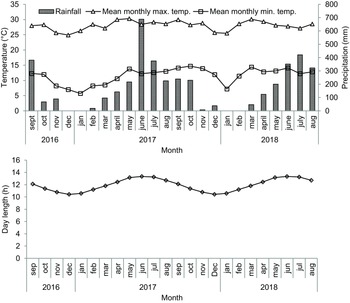
The present study was conducted in Reiek community reserve forests of Mamit district in the state of Mizoram in north-eastern India with an elevation around 1200–1400 m a.m.s.l. (23°41' N, 93°36' E; area c. 10 km2). The entire study area is hilly with a complex physiography characterised by steep slopes, deep valleys, irregular ridges and rugged topography. The vegetation of the study area is characterised as sub-tropical wet hill forest according to Champion and Seth (Reference Champion and Seth1968) with a canopy height of approximately 12–15 m. The climate is typically monsoonic with distinct seasons viz. a dry and cool winter (December–February), hot dry summer (March–June), monsoon accounting for about two-thirds of the annual precipitation (July–September) and a post-monsoon period that is also dry and cool (October–November). The mean annual precipitation was c. 2350 mm (2530 mm in 2016 and 2104 mm in 2017 during this study; Fig. 1).
Maximum (max.) and minimum (min.) temperatures, precipitation and day length (hours; h) (2016–2018) at the Reiek sub-tropical moist hill forest study site in Mizoram, north-eastern India (source: ENVIS Centre, Mizoram; www.mizenvis.nic.in).

Recording of phenological events
Phenological observations were recorded for 28 canopy tree species distributed among 18 families (Supplementary material). Devi et al. (Reference Devi, Singha and Tripathi2018) recorded the relative abundance of these, and other species, at the study site. Five mature individuals (diameter at breast height (dbh; 1.3 m) ≥ 10 cm) of each of the selected species were marked and observations were made on leaf flush and leaf fall at fortnightly intervals for 2 years (September 2016–August 2018). The phenological activity for each species was evaluated as the sum of individuals with different phenological stages (at least 30% of the crown exhibiting the relevant stage) every month. The phenophase was considered as the status of the majority (at least three out of five) of individuals. The duration of a phenological event in a species was calculated by obtaining the number of days required for the completion of an event from the date of the fortnightly visit when the event was first observed (Kushwaha and Singh Reference Kushwaha and Singh2005a).
Estimation of WD and LMA
For estimating LMA, 125 mature leaves from the crowns of five individuals (25 leaves per individual) of each species were plucked. Four discs of 1 cm2 per leaf were cut, oven-dried (80°C for 24 hours) and the mass of leaf lamina per unit area reported as LMA. In the case of compound leaves, the dry mass and area of the leaflets (excluding the rachis) were determined and converted to dry mass per unit area. Out of the five marked individuals of each species, three individuals were randomly selected for determination of stem WD, and three main trunk cores per individual (total nine cores per species) taken at breast height (1.3 m). Cores to the centre of the stem were collected with an increment borer (0.5 cm diameter and 20 cm length), sealed in aluminium foil and plastic bags and taken to the laboratory. Bark was removed from each core, and it was then placed in water in a graduated cylinder to determine the volume. The cores were oven dried (80 °C for 48 hours) and weighed to obtain the dry mass. WD is expressed as the dry mass per unit volume. Leaf strategy index (LSI), reflecting the rate of resource use and resource conservation for each species, was calculated as the ratio of mean leaf fall duration to mean leaf flush duration (Kushwaha and Singh Reference Kushwaha and Singh2005a, Singh and Kushwaha Reference Singh and Kushwaha2005).
Statistical analyses
Multiple regressions (backwards step-wise elimination) were performed to investigate relationships between phenophases and environmental variables (i.e. photoperiod, precipitation, minimum temperature and maximum temperature), and also with a 1-month lag time. Synchrony index was calculated as the ratio between each individual tree’s mean period of a phenological phase and the overall conspecific mean period (Devineau Reference Devineau1999) with perfect synchrony indicated by a value of 1 and asynchrony increasing as the number declines. Relationships between synchrony indices and among duration of deciduousness, LMA, WD and LSI across different species were analysed using Spearman’s rank correlations. Changes in phenophase timing between years and comparisons of synchrony indices and functional traits between functional groups were assessed using mixed effects models with functional group (and year when assessing differences between years) as fixed factors and species as a random factor. Statistical analyses were done using Minitab v. 17.
Results
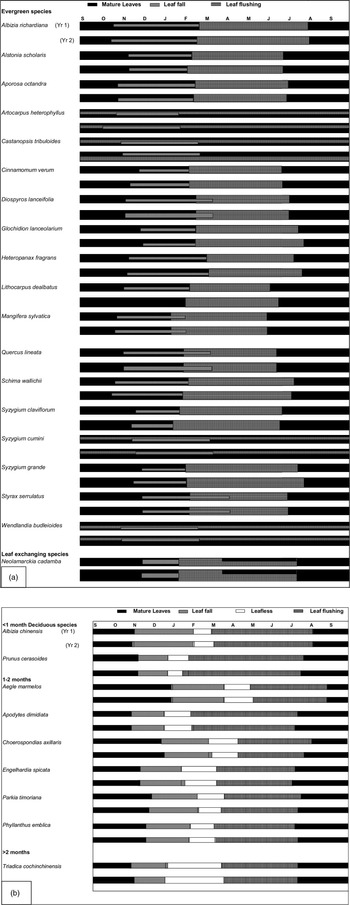
The selected tree species were characterised into three broad functional types based on their leafing strategies: evergreen, leaf-exchanging (<25% of the canopy retaining its leaves whilst new leaf buds are initiating) and deciduous (with different lengths of deciduousness). Among these three leafing strategies, 18 species were evergreen, one species was leaf-exchanging and nine species showed varying lengths of deciduousness (Fig. 2; Supplementary material).
Diversity in seasonal patterns of vegetative phenological stages for (a) evergreen and leaf-exchanging species and (b) deciduous species in a sub-tropical moist hill forest of Mizoram, north-eastern India. For each species, the upper and lower bars represent the first (Year 1) and second (Year 2) years of the study, respectively.

Variations in timing of leaf flush
Among evergreen species, the majority initiated leaf flushing in February, which continued until August (Fig. 2a). However, in four evergreen tree species, leaf flushing was continuous throughout the year (Fig. 2a). The one leaf-exchanging species (Neolamarckia cadamba) showed a similar trend of leaf flushing (i.e. from February to July) as the evergreen species (Fig. 2a). Wider variation was observed among the deciduous tree species in terms of duration of their leaf flushing (Fig. 2b). In the majority of the deciduous tree species (six species), leaf flushing started in February with leaf development completed by the end of August in both years (Fig. 2b); leaf flushing in the remaining three deciduous species occurred later during the months of March to May but was mostly also completed by August. Inter-annual variation in leaf flushing varied between evergreen and deciduous species. In the second year of the study, many of the evergreen species showed significantly earlier leaf flush by about 1 week, but, in contrast, deciduous species showed significantly later flushing (by around 2 weeks) (year × functional group interaction: F = 84.2, p < 0.001). The mean synchrony index for leaf flushing was 0.81 (±s.d. 0.05), which did not differ between evergreen and deciduous species.
Variations in timing of leaf fall
The peak leaf fall was observed in December to January with minimal leaf fall observed during the monsoon season (June to August). Whilst leaf fall (abscission) in the evergreen trees occurred more evenly throughout the year (Fig. 2a), thus retaining a stable quantity of functional leaves, leaf fall in deciduous tree species was mostly concentrated during the cool dry winter period (November to February) and occasionally later in the year until April (Fig. 2b). Leaf fall was earlier by about 2 weeks for evergreen, but not deciduous, species in the second year of the study compared to the first (year × functional group interaction: F = 52.3, p < 0.001). The synchrony index for leaf flushing among species was positively correlated with that for leaf fall (r = 0.43, p < 0.05), and overall was 0.81 (±0.05), which also did not differ between evergreen and deciduous species.
Leafing patterns
On the basis of the leaf flush and leaf fall period, seven leafing patterns were apparent. In the evergreen species, three distinct leafing patterns were observed: (a) occurrences of leaf flush and leaf fall in a distinctive period (ten species), (b) overlapping of leaf flush and leaf fall (four species) and (c) occurrence of leaf flush and leaf fall throughout the year (four species). One species was observed with the (d) leaf-exchanging pattern where the leaf flush occurred and new leaf buds initiated before the tree became entirely leafless. Deciduous tree species differed considerably in terms of the leafless period and, depending upon the extent of leafless duration, three leafing patterns were recognised: (e) up to 1 month leafless (two species), (f) 1–2 months leafless (six species) and (g) more than 2 months leafless (one species).
Environmental correlates of phenological patterns
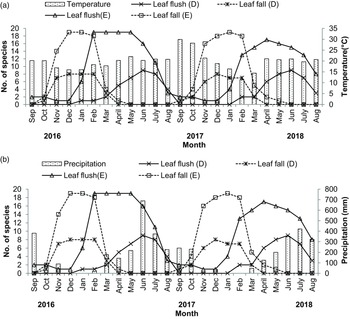
The number of species exhibiting leaf flushing was most strongly positively correlated with photoperiod followed by minimum temperature, and also positively correlated with the amount of precipitation in evergreen (+ leaf-exchanging) species (Table 1) with a weaker relationship between maximum temperature (Table 1). The number of species exhibiting leaf fall and their relationship with environmental variables were negatively correlated, with precipitation and minimum temperatures having the strongest negative relationships with leaf fall in both evergreen and deciduous species (Fig. 3; Table 1). Similar patterns were seen when correlations were lagged by 1 month, but the maximum temperature was generally a stronger predictor than minimum temperature (Table 1).
Relationships between vegetative phenological patterns of tree species in relation to precipitation, maximum and minimum temperatures in a sub-tropical moist hill forest of Mizoram

The r 2 represents the variation explained by a backwards step-wise elimination multiple regression, and the asterisks indicate the significant predictors in the model with significance shown as
* =p < 0.05,
** =p < 0.01,
*** =p < 0.001.
Variance inflations factors for all predictors in the models were less than 3.0.
Relationships between the numbers of evergreen (+ leaf-exchanging) and deciduous tree species exhibiting leaf flush and leaf fall and (a) temperature and (b) precipitation in a sub-tropical moist hill forest of Mizoram, north-eastern India.

Correlations between tree functional traits and leaf phenology
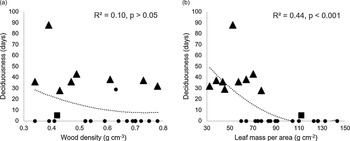
LMA was significantly denser for evergreen (+ leaf-exchanging) (96.7 ± s.e. 5.7 g m−2) than deciduous (53.6 ± 5.0 g m−2) species (F = 22.6, p < 0.001), whereas WD did not differ (evergreen: 0.60 ± 0.03 g cm−3, deciduous: 0.54 ± 0.05 g cm−3, F = 1.19, p > 0.05). Surprisingly, LMA and WD were not correlated (r = 0.09, p > 0.05). Both WD (Fig. 4a) and LMA (Fig. 4b) were negatively correlated with the length of deciduousness (i.e. the leafless period) although only the latter was strongly statistically significant. The mean leafing strategy index (LSI) was 0.44 (±0.03) for evergreen tree species, 0.47 for the leaf-exchanging species and 0.63 (±0.04) for deciduous species, and the LSI and the length of deciduousness (i.e. the leafless period) were positively correlated (r = 0.73, p < 0.001). The LSI showed a negative correlation with LMA (r = −0.58. p < 0.001) but no relationship with WD. Species with greater LMA flushed their leaves earlier (average date across the 2 years) (r = −0.62, p < 0.001) as well as shedded them earlier (r = −0.37, p = 0.05); there were no relationships between WD and leafing activity.
Relationships between duration of deciduousness and (a) wood density and (b) leaf mass per areas in a sub-tropical moist hill forest of Mizoram, north-eastern India. Triangles = deciduous species, square = leaf-exchanging species, circles = evergreen species.

Discussion
In common with other studies in the region (Das and Das Reference Das and Das2013, Devi and Garkoti Reference Devi and Garkoti2013, Kikim and Yadava Reference Kikim and Yadava2001, Lalruatfela and Tripathi Reference Lalruatfela and Tripathi2019, Shukla and Ramakrishnan Reference Shukla and Ramakrishnan1982), we show here a peak of leaf fall in the cool dry winter season, with subsequent leaf flushing in the pre-monsoon period leading into the monsoon, with increasing temperatures and with early rains appearing to trigger leaf flushing. Leaf flushing starts with the onset of favourable climatic conditions increasing photosynthetic rates prior to the heavy monsoon cloud cover and, in locations with seasonal precipitation, dry season leaf flushing allows trees to be ‘ready’ for the peak growing period during the monsoon (Singh and Kushwaha Reference Singh and Kushwaha2005, Singh and Singh Reference Singh and Singh1992). It appears that just a light (>5 mm) dry season rain can initiate phenological events (Wright et al. Reference Wright, Calderón and Muller-Landau2019), as noted for Prunus cerasoides in our study, but there will be inter-specific differences for varied requirements of temperature, photoperiod and light intensity between tree species. Early leaf flushing could also represent an adaptation to avoid larger insect populations later in the wet season if delicate young leaves are initiated when insect populations are low (Murali and Sukumar Reference Murali and Sukumar1993, Silva et al. Reference Silva, Leal, Espírito-Santo and Morais2017) although more studies are needed on spatial and temporal insect dynamics in north-eastern India to explore this hypothesis in a regional context.
Tropical deciduous forests are composed of mosaics of tree functional types that differ considerably with respect to the duration of deciduousness and time of bud break of leaf flushing (Borchert et al. Reference Borchert, Rivera and Hagnauer2002, Chaturvedi et al. Reference Chaturvedi, Tripathi, Raghubanshi and Singh2021, Kaewthongrach et al. Reference Kaewthongrach, Vitasse, Lamjiak and Chidthaisong2019, Ongole et al. Reference Ongole, Teegalapalli, Byrapoghu, Ratnam and Sankaran2021, Singh and Kushwaha Reference Singh and Kushwaha2005, Valdez-Hernández et al. Reference Valdez-Hernández, Andrade, Jackson and Rebolledo-Vieyra2010, Williams et al. Reference Williams, Bunyavejchewin and Baker2008). The major proposed triggers for leaf flushing and leaf fall are changes in precipitation with its impact on soil moisture, and/or changing photoperiod (Borchert et al. Reference Borchert, Calle, Strahler, Baertschi, Magill, Broadhead, Kamau, Njoroge and Muthuri2015, Bullock and Solis-Magallanes Reference Bullock and Solis-Magallanes1990, Lopezaraiza-Mikel et al. Reference Lopezaraiza-Mikel, Quesada, Álvarez-Añorve, Ávila-Cabadilla, Martén-Rodríguez, Calvo-Alvarado, do Espírito-Santo, Fernandes, Sánchez-Azofeifa, de Jesús Aguilar-Aguilar, Balvino-Olvera, Brandão, Contreras-Sánchez, Correa-Santos, Cristobal-Perez, Hilje, Jacobi, Fonseca-Pezzini, Rosas, Rosas-Guerrero, Sánchez-Montoya, Sáyago, Vázquez-Ramírez, Sánchez-Azofeifa, Powers, Fernandes and Quesada2013, Reich and Borchert Reference Reich and Borchert1982, Rivera et al. Reference Rivera, Elliott, Caldas, Nicolossi, Coradin and Borchert2002, Williams et al. Reference Williams, Bunyavejchewin and Baker2008), which also interact with increasing leaf age in the case of leaf fall (Borchert et al. Reference Borchert, Rivera and Hagnauer2002). It was difficult to determine which of the factors investigated (temperature, precipitation or photoperiod) was the most important cue for phenological patterns as they were inter-related at our study location, but stronger correlations were generally seen between the number of species undergoing phenological activity and temperature (either minimum or maximum) than with precipitation whilst photoperiod often showed the strongest effect, suggesting that it plays a key role influencing tropical phenological patterns as noted by others (Borchert et al. Reference Borchert, Renner, Calle, Navarrete, Tye, Gautier, Spichiger and von Hildebrand2005, Reference Borchert, Calle, Strahler, Baertschi, Magill, Broadhead, Kamau, Njoroge and Muthuri2015, Rivera et al. Reference Rivera, Elliott, Caldas, Nicolossi, Coradin and Borchert2002). Interestingly, the study of Aravind et al. (Reference Aravind, Ganeshaiah and Shaanker2013) showed the importance of monsoon precipitation in influencing fruiting phenological patterns in southern Indian forests through isolating the impact of photoperiod. The synchrony index for both leaf flushing and leaf fall was remarkably similar to previous studies in northern India (Bajpai et al. Reference Bajpai, Pandey and Chaudhary2017, Kushwaha and Singh Reference Kushwaha and Singh2005a) suggesting that the phenological cues as well as phenological plasticity are similar between these seasonally dry forests. However, a longer study time frame would be required to answer the question of the key phenological triggers more explicitly rather than the 2 years of this study (e.g. Brearley et al. Reference Brearley, Proctor, Suriantata, Dalrymple and Voysey2007).
Das and Das (Reference Das and Das2013) showed that species can shift their phenology by up to 2 months between years. However, the differences between the 2 years of our study were not particularly great with alterations to phenophases by just a few days, although deciduous and evergreen species sometimes differed in the direction of change which may be the outcome of delayed and reduced precipitation during the second year of study. It is also important to consider physiological processes that may influence phenological processes. For example, Skarpe (Reference Skarpe1996) and Smith-Martin et al. (Reference Smith-Martin, Xu, Medvigy, Schnitzer and Powers2020) reported evergreen species to have deeper roots than deciduous species and there are numerous broad physiological contrasts between evergreen and deciduous trees (Chaturvedi et al. Reference Chaturvedi, Tripathi, Raghubanshi and Singh2021, Devi and Garkoti Reference Devi and Garkoti2013, Eamus Reference Eamus1999, Fu et al. Reference Fu, Jiang, Wang, Brodribb, Zhang, Zhu and Cao2012) with evergreen trees generally having traits of more slow-growing ‘conservative’ species. These traits can be linked to the length of deciduousness itself rather than just considered as a phenological dichotomy. Deciduousness helps in avoiding drought stress (Givnish Reference Givnish2002) and the contrasting patterns of leaf phenology, including more rapid leaf recruitment and shoot elongation (Devi and Garkoti Reference Devi and Garkoti2013), allows contrasting strategies to co-exist. Deciduous leaves often have more rapid photosynthetic rates (linked to a reduced LMA: Niinemets Reference Niinemets1999) and nutrient concentrations but are generally thinner, less expensive to construct and are more heavily damaged by herbivores (Reich Reference Reich1995). This is supported by our work and other studies where deciduous species had reduced LMA compared to evergreen (+ leaf-exchanging species) (Kushwaha et al. Reference Kushwaha, Tripathi, Singh and Singh2010, Prior et al. Reference Prior, Eamus and Bowman2003). We found a negative correlation between LMA and the length of deciduousness in our study trees suggesting that the longer a tree loses its leaves for, the more rapid its photosynthesis needs to be to compensate for the lack of carbon gain whilst they are leafless in order to compete successfully with evergreen species. However, we did not find any relationship between the length of deciduousness and WD, in contrast with the negative correlation reported by Kushwaha and Singh (Reference Kushwaha and Singh2005a) in northern Indian dry forests, suggesting that water storage in stems, or the lack of, may not be a key factor controlling phenology in this moister north-eastern Indian forest. Species with greater LMA also flushed and shed leaves earlier – earlier shedding is likely to avoid droughts and agrees with the work of Ongole et al. (Reference Ongole, Teegalapalli, Byrapoghu, Ratnam and Sankaran2021) in southern India. However, earlier flushing is in contrast to the above study (Ongole et al. Reference Ongole, Teegalapalli, Byrapoghu, Ratnam and Sankaran2021) but could be due to any/all of: shallower rooting allowing preferential access to early rains, faster leaf production if they are less ‘expensive’ to construct and less stressful drought conditions in north-eastern India. Further studies on stem and leaf water relationships would be valuable to provide additional insights into linkages between tree ecophysiology and phenological processes (e.g. da Silva Braga et al. Reference da Silva Braga, Vitória, Souza, Barros and Freitas2016, Fu et al. Reference Fu, Jiang, Wang, Brodribb, Zhang, Zhu and Cao2012). The range of LSI values observed in this study (0.38–0.80) was quite similar to that reported from the dry tropical forest of northern India (0.44–1.00; Kushwaha et al. Reference Kushwaha, Tripathi, Singh and Singh2010). Whilst Kushwaha et al. (Reference Kushwaha, Tripathi, Singh and Singh2010) reported positively significant correlations between LSI, LMA and WD in the dry tropical forest, we only found positive relationships between LSI and LMA further suggesting that this leaf functional trait is more important than WD in influencing phenological patterns here. However, Ongole et al. (Reference Ongole, Teegalapalli, Byrapoghu, Ratnam and Sankaran2021) found that SLA (the reciprocal of LMA) and WD were not the best predictors of phenological patterns, but that leaf carbon content and dry matter content predicted these patterns more successfully, thus indicating that a broader range of traits than just those considered here should be measured in future studies.
Conclusion
We show how deciduous and evergreen species vary in their phenological patterns, that these are correlated with leaf functional traits, and how they respond to climatic differences between years. Photoperiod and minimum temperature were the factors most strongly correlated with phenological activity although it was difficult to separate these at our study location due to similar seasonal patterns between them. LMA also influenced patterns of leaf flushing, longevity and loss, whilst relationships with WD, another important plant functional trait, were much less clear. Our study also shows that rather than being only divided into deciduous and evergreen, leafing strategies as related phenological patterns can be considered along a continuum (mediated by leaf traits). We agree with the suggestion of Kushwaha and Singh (Reference Kushwaha and Singh2008) for an Indian phenological network, perhaps with widespread and contrasting species e.g. Artocarpus, Quercus, Parkia, Schima, etc. The long-term monitoring of trees in such a network would allow for an improved examination of climatic factors influencing phenology and, along with more in-depth analysis of plant traits, allow better understanding of the influence of climate change on phenology and its implications for ecosystem dynamics in the future.
Supplementary material
The supplementary material for this article can be found at https://doi.org/10.1017/S0266467423000184
Availability of data and material
Available on request from the corresponding author.
Acknowledgements
This work was supported by the Department of Science and Technology, New Delhi (Grant No. DST/CCP/MRDP/193/2019(G). The first author is grateful to the University Grants Commission, New Delhi for financial support in the form of a D. S. Kothari Post-Doctoral Fellowship. The Department of Forestry, Mizoram University, Aizawl is thankfully acknowledged for providing the infrastructure to perform the laboratory work. We thank the officials of the Department of Forest and Climate Change, Government of Mizoram for necessary permissions and support during the field work.
Authors’ contribution
NLD and SKT designed the experiment. NLD carried out field measurements. NLD, FQB and SKT processed the data and wrote the paper. SKT received the grant. NLD received Kothari Fellowship. All author(s) read and approved the final paper.
Competing interests
No conflict of interest.