Introduction
Dizziness is a common, non-specific complaint. A recent survey revealed that, every year in England and Wales, eight out of every 1000 patients are likely to consult their general practitioner due to this symptom.Reference Jayarajan and Rajenderkumar1 Between 13 and 16 per cent of dizzy patients are referred for a specialist opinion; up to 36 per cent of these referrals are to the ENT clinic.Reference Jayarajan and Rajenderkumar1, Reference Bird, Beynon, Prevost and Baguley2
The key specialist investigation for evaluating vestibular function is the vestibular assessment, which may include a battery of clinical, electrophysiological and questionnaire-based tests. This makes formal vestibular assessment both expensive and time-consuming. However, numerous authors agree that a diagnosis can be made in the majority of cases from a focussed history and examination, with selective adjunctive use of magnetic resonance image (MRI) scanning or audiometry.Reference Rutka3–Reference Luxon7 There is also acknowledgement of the limitations of certain aspects of the standard vestibular test battery;Reference Ruckenstein and Shepard4–Reference Bakr and Saleh6 however, no author has been able to quantify the unrealistic expectations of these investigations.
The role of an ENT specialist in the assessment of the dizzy patient should be to diagnose and treat pathologies appropriately and, also, to determine when a vestibular assessment would have a useful role in the management of these patients.
A retrospective audit was undertaken focussing on whether: (1) the diagnosis and management of benign paroxysmal positional vertigo (BPPV) had been attempted prior to referral for vestibular assessment; (2) the assessment was helpful in the decision-making process (as to whether vestibular rehabilitation was indicated); and (3) the assessment had a significant impact on the eventual patient management.
Materials and methods
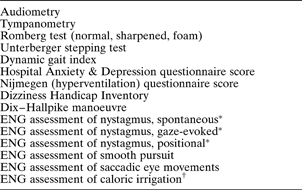
We retrospectively reviewed the notes of 100 consecutive patients referred for a vestibular assessment by the ENT department of the Norfolk and Norwich University Hospital. A member of the audiology administrative staff independently identified patients from the audiology appointments system. The clinical notes for each patient were reviewed and data entered into a spreadsheet for analysis (Microsoft® Excel X for Mac®). The following data were recorded: patient demographics, out-patient clinic evaluation (specifically, whether a Dix–Hallpike manoeuvre was performed), referral for vestibular rehabilitation and eventual patient management. At the Norfolk and Norwich University Hospital, a full vestibular assessment involved a number of items (see Table I). In the current study, the term ‘electrophysiological assessment’ specifically relates to the assessment of eye movements by electronystagmography, as applicable to the last six items in Table I.
Composition of vestibular assessment at Norfolk & Norwich University Hospital
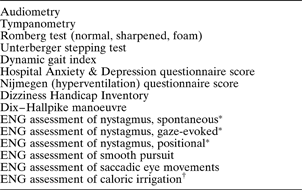
* Abnormal if ≥6° per second. †Abnormal if ≥20 per cent asymmetry. ENG = electronystagmography
Results
A vestibular assessment was performed on 100 consecutive patients referred by the ENT department between March 2006 and November 2006. All 100 sets of medical notes were obtained, without exception. Patient ages ranged from 15 to 85 years (median = 56). There were 30 male patients and 70 female patients.
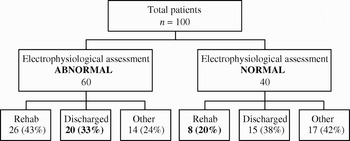
Overall, 40 patients had normal electrophysiological test results (Figure 1). The remaining 60 patients had a vestibular assessment that was judged to be abnormal. Thirty-seven patients had a Dix–Hallpike manoeuvre performed before referral. One patient (who had a negative Dix–Hallpike manoeuvre before referral) was diagnosed with resolved BPPV, and another patient (who had a positive Dix–Hallpike manoeuvre before referral) had an Epley manoeuvre performed as part of their assessment. Of the remaining 63 patients, who had not had a Dix–Hallpike manoeuvre performed before referral, nine had a positive Dix–Hallpike manoeuvre during vestibular assessment, and BPPV remained their sole final diagnosis subsequent to a successfully performed Epley manoeuvre.
Management of patients with abnormal electronystagmography or caloric test results. Rehab = vestibular rehabilitation

In total, 34 patients were referred for vestibular rehabilitation. Of these patients, 76 per cent had an abnormal electrophysiological assessment and 24 per cent had a normal assessment.
In total, 35 patients were discharged immediately after their vestibular assessment, without a formal ENT follow-up appointment, being simply written to with their results. Fifteen of the 40 patients with normal results (38 per cent) and 20 of the 60 patients with abnormal results (33 per cent) were dealt with in this way.
The eventual management of the 100 patients was: 11 had BPPV diagnosed and treated as necessary; 34 were referred for vestibular rehabilitation; 35 were discharged with no further follow up; and 20 were followed up in the ENT clinic.
Discussion
Writing about the clinical assessment of the dizzy patient is extremely challenging as expert opinions vary significantly. Many clinicians use a vestibular assessment for the evaluation of nearly all patients, whereas others are more sparing and rarely require a vestibular assessment to aid management. The aim of this study was to assess the practical implications of vestibular assessment for patients passing through a modern ENT department.
A formal assessment of the vestibular system can supply useful information which can be helpful in the management of the dizzy patient. However, the idea of reliably diagnosing a peripheral vestibulopathy purely from the outcome of electrophysiological tests is a common misconception. The diagnostic accuracy of caloric tests, for example, cannot be compared to that of a pure tone audiogram.Reference Ruckenstein and Shepard4 Caloric responses provide information on the function of the horizontal semicircular canal; normal test results do not necessarily rule out vestibular dysfunction in the other constituents of the peripheral vestibular apparatus.Reference Gordon, Shupak, Spitzer, Doweck and Melamed5 Even if the responses are thought to be useful, it is worth bearing in mind that the results will vary in individual patients over time; this is particularly important when dealing with patients with active Ménière's disease, and those who are recovering or undergoing central compensation after an acute peripheral vestibular insult. It is interesting to note that the American Academy of Otolaryngology-Head and Neck Surgery guidelines for the diagnosis of Ménière's disease do not consider electrophysiological testing as essential.8 The whole concept of ‘normal’ and ‘abnormal’ results is perhaps misleading, and the use by some of strict cut-off values is especially unhelpful. In our department, an abnormal caloric test is considered when a canal paresis and/or directional preponderance of 20 per cent or more is demonstrated. This value may differ between departments, and may lead to a situation whereby a patient is defined as having normal vestibular function in one department and abnormal vestibular function in another.
Many previous studies have found that the most common peripheral vestibulopathy is BPPV.Reference Bath, Walsh, Ranalli, Tyndel, Bance and Mai9, Reference Wells and Yande10 This condition is diagnosed by performing the Dix–Hallpike manoeuvre, and it should be treated with a particle-repositioning manoeuvre; a vestibular assessment is not required. Despite this, 11 of our cohort undergoing a vestibular assessment were diagnosed solely with BPPV. Sixty-three of our patients did not have a Dix–Hallpike manoeuvre performed as part of their initial examination, nine of whom had BPPV. By taking a thorough history and performing a Dix–Hallpike manoeuvre prior to referral for vestibular assessment, a reduction of 9 per cent of requests could have been achieved. The one patient who was referred having been diagnosed with BPPV would have been more sensibly referred for an Epley manoeuvre performed by a competent audiologist or an ENT doctor, rather than for a full vestibular assessment.
The role of electrophysiological testing in determining the need for further rehabilitation is poorly defined, particularly as some patients may recover quickly from a major vestibular insult, whilst others may suffer prolonged imbalance with little evidence of peripheral vestibular dysfunction.Reference Ruckenstein and Shepard4 In our cohort, 76 per cent of patients referred for vestibular rehabilitation had abnormal results. However, 24 per cent of patients referred for vestibular rehabilitation had normal results, indicating that, in a quarter of such cases, the outcome of objective electrophysiological tests would appear not to have assisted a decision regarding the need for vestibular rehabilitation. If the decision to undertake a course of vestibular rehabilitation is made primarily on the patient's symptoms, then it would be more useful to utilise patient questionnaires to a much greater extent, at an earlier stage in this process. This would potentially be more cost-effective, and would enable quicker access for those patients who do require vestibular rehabilitation.
Considering the eventual outcome of our patients, it is interesting that 35 patients were discharged with no further follow-up appointment. It is unclear how a vestibular assessment would have helped in the management of these patients, especially when over 30 per cent of both the ‘normal’ and ‘abnormal’ groups were treated in this manner. For patients with unilateral cochlear symptoms, such as a sensorineural hearing loss, management is well defined in that exclusion of intracranial pathology is required, ideally by MRI scanning. This test is performed to exclude retrocochlear disease, so that in the case of a normal result the patient can be simply written to. In contrast, the results of a vestibular assessment need to be analysed in the context of the patient's symptoms and, assuming that the patient remains symptomatic, follow up may be required to reassess the patient in the light of these results.
It is worth noting that vestibular assessment is not without its problems. An assessment of patient discomfort during various audiological procedures revealed caloric testing to be particularly unpleasant from the patient's point of view.Reference Beynon, Clarke and Baguley11 Furthermore, vestibular assessment can have a deleterious outcome when performed on patients with psychogenic dizziness, as the experience only bolsters their psychopathology. Caloric irrigation can cause other adverse effects it can act as a tinnitus initiator, and so caloric irrigation can complicate migraine.Reference Seemungal, Rudge, Davies, Gresty and Bronstein12
To date, there has been a paucity of formal studies considering the practical implications of vestibular assessment upon the outcome of an independently defined cohort of patients. Browning states that, of those dizzy patients requiring further investigation, the majority are diagnosed by radiological methods and that:
‘…outside a neuro-otological clinic, calorics and electronystagmography have a minimum role. Even in a neuro-otological clinic, they are more often a toy than an aid to diagnosis.’Reference Browning13
• The key specialist investigation for evaluating vestibular function is the vestibular assessment, which may include a battery of clinical, electrophysiological and questionnaire-based tests
• A formal vestibular assessment is expensive and time-consuming
• All patients should undergo a Dix–Hallpike manoeuvre performed prior to referral for a vestibular assessment; this could reduce the number of referrals by approximately 10 per cent
• There is a strong case for dedicated dizziness clinics run by practitioners with a specialist interest in balance disorders, in order to ensure appropriate requests for vestibular assessment
Norre considered patients with specific diagnoses of BPPV, Ménière's disease and ‘sudden unilateral loss syndrome’, and concluded that the role of certain aspects of vestibular assessment was to provide further information regarding functionality, rather than to confirm a diagnosis based on typical signs and symptoms.Reference Norre14 However, this conclusion was dependent on data from posturography more than data from the vestibular assessment elements performed routinely in our unit. Bakr and Saleh considered the role of electronystagmography and concluded that it does not significantly aid diagnosis, although it may confirm a peripheral lesion in certain circumstances.Reference Bakr and Saleh6
The vestibular assessment remains a useful investigation which can aid the management of dizzy patients in certain circumstances. However, prior to referral, it is worth considering the implications of a ‘normal’ and ‘abnormal’ result for patient management. This, along with performing a Dix–Hallpike manoeuvre, could significantly reduce the number of requests for a vestibular assessment.
The results of this study are worthy of reflection, particularly when we consider the current issues surrounding the provision of balance services in the UK and the role of the ENT surgeon. Documents put forward by ENT-UK concur with our findings, and state that ‘special tests are expensive and may be uncomfortable and are not routinely necessary to make the diagnosis but can prove essential in more complex cases.’15 From March 2008, UK health services were required to ensure that all patients are assessed, investigated and treated within an 18-week target. This has caused anxiety in many domains, particularly for those involved with the provision of ENT services.Reference Davis16 Therefore, careful consideration of current practice is required if proposed targets are to be fulfilled.
Conclusions
All patients should have a Dix–Hallpike manoeuvre performed prior to referral for vestibular assessment. The majority of our patients undergoing vestibular rehabilitation had abnormal test results, although a significant number did not. Prior to referral, it is worth considering the implication of a ‘normal’ and ‘abnormal’ result for the management of the patient. Careful consideration should be given to the development of dedicated dizziness clinics run by practitioners with a specialist interest in balance disorders, in order to ensure appropriate requests for vestibular assessment.