INTRODUCTION
By the end of the 21st Century, the earth's climate is predicted to warm by an average of 2–4°C (IPCC Reference Pachauri and Reisinger2007), due to both anthropogenic and natural factors (Eitzinger et al. Reference Eitzinger, Orlandini, Stefanski and Naylor2010). Emission of green house gases (GHG) such as carbon dioxide (CO2), methane (CH4) and nitrous oxide (N2O) from agricultural systems is one of the major sources contributing to this global increase of temperature (Maraseni et al. Reference Maraseni, Mushtaq and Maroulis2009; Smith & Olesen Reference Smith and Olesen2010). Studies have shown that the annual mean maximum and minimum temperatures have increased by 0·35 and 1·13°C, respectively, for the period 1979–2003 at the International Rice Research Institute, Manila, Philippines (Peng et al. Reference Peng, Huang, Sheehy, Laza, Visperas, Zhong, Centeno, Khush and Cassman2004). This increase in temperature has exposed most of the world's crops to heat stress during some stages of their life cycle. The difficulty in precise prediction of the projected agricultural impacts of climate change further adds to the uncertainty (Watanabe & Kume Reference Watanabe and Kume2009). Rice (Oryza sativa and Oryza glaberrima) is one of the important cereals grown across the world. Although it has been used as a model plant for many years, the growth responses of rice to high temperature are still poorly understood (Nagai & Makino Reference Nagai and Makino2009).
Most rice is currently grown in regions where current temperatures are already close to optimum for rice production. Therefore, any further increases in mean temperatures or of short episodes of high temperatures during sensitive stages, may be supra-optimal and reduce grain yield. Yields of rice have been estimated to be reduced by 41% by the end of the 21st Century (Ceccarelli et al. Reference Ceccarelli, Grando, Maatougui, Michael, Slash, Haghparast, Rahmanian, Taheri, Al-Yassin, Benbelkacem, Labdi, Mimoun and Nachit2010). There is sufficient evidence that increasing night-time temperature has been the main cause of increases in global mean temperatures since the middle of the 20th Century, and is thus the main factor contributing to the yield decrease (Kukla & Karl Reference Kukla and Karl1993; Ziska & Manalo Reference Ziska and Manalo1996; Peng et al. Reference Peng, Huang, Sheehy, Laza, Visperas, Zhong, Centeno, Khush and Cassman2004; Sheehy et al. Reference Sheehy, Elmido, Centeno and Pablico2005).
Conversely, in some areas temperature increase would improve the crop establishment of rice, for example in Mediterranean areas, where cool weather usually causes poor crop establishment (Nakagawa et al. Reference Nakagawa, Horie, Matsui, Mew, Brar, Peng, Dawe and Hardy2003). But the negative effects associated with temperature increment heavily outweigh the positive. And thus, while some countries in the temperate zone may reap some benefit from climate change, many countries in the tropical and subtropical zones appear more vulnerable to the potential impacts of global warming (Rosenzweig & Parry Reference Rosenzweig and Parry1994).
The objective of the present review is to summarize recent important research findings on the responses of rice to high temperature, with special emphasis on genotypic variation and morphological characteristics of rice in relation to high temperature, and also to gain an insight into the mechanisms of high-temperature stress tolerance. Some of the strategies that will help in mitigating heat stress are also discussed.
HIGH TEMPERATURE IN RELATION TO GROWTH AND DEVELOPMENT OF THE RICE PLANT
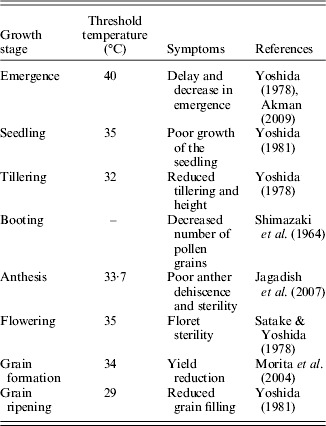
Temperature, along with photoperiod, is the main driving force for crop development (Kropff et al. Reference Kropff, Mathews, Van Laar, Ten Berge, Mathews, Kropff, Bachelet and van Laar1995). The optimum temperature for the normal development of rice ranges from 27 to 32°C (Yin et al. Reference Yin, Kroff and Goudriann1996). High temperature affects almost all the growth stages of rice, i.e. from emergence to ripening and harvesting (Table 1). The developmental stage at which the plant is exposed to heat stress determines the severity of the possible damage to the crop (Wahid et al. Reference Wahid, Gelani, Ashraf and Foolad2007).
Symptoms of heat stress in rice plants

However, flowering (anthesis and fertilization) and to a lesser extent the preceding stage booting (microsporogenesis) are considered to be the stages of development most susceptible to temperature in rice (Satake & Yoshida Reference Satake and Yoshida1978; Farrell et al. Reference Farrell, Fox, Williams and Fukai2006). Exposure to 41°C for 4 h at flowering caused irreversible damage and plants became completely sterile (IRRI 1976), whereas this high temperature (41°C) had no effect on spikelet fertility at 1 day before or after flowering (Yoshida et al. Reference Yoshida, Satake and Mackill1981). In the same study, it was also found that pollination of heat-stressed stigmas with unstressed pollen as well as self-pollination at 1 h before heat stress application did not affect spikelet fertility. These analyses delineated the heat-sensitive stage of spikelets to 1 h before and after flowering. A temperature increase of 1°C shortened the number of days from sowing to heading by c. 4–5 days for some genotypes (Nakagawa et al. Reference Nakagawa, Takahashi, Hasegawa, Watanabe and Horie2001). There is genotypic variation in spikelet sterility at high temperature in both the sub-species of O. sativa, indica and japonica (Matsui et al. Reference Matsui, Omasa and Horie2001; Prasad et al. Reference Prasad, Boote, Allen, Sheehy and Thomas2006), which can be defined by different temperature thresholds (Nakagawa et al. Reference Nakagawa, Horie, Matsui, Mew, Brar, Peng, Dawe and Hardy2003). However, in general, indica is more tolerant to higher temperatures than japonica (Satake & Yoshida Reference Satake and Yoshida1978).
HIGH TEMPERATURE AND SPIKELET STERILITY
Temperatures higher than the optimum induced floret sterility and thus decreased rice yield (Nakagawa et al. Reference Nakagawa, Horie, Matsui, Mew, Brar, Peng, Dawe and Hardy2003). Spikelet sterility was greatly increased at temperatures higher than 35°C (Matsui et al. Reference Matsui, Namuco, Ziska and Horie1997a). In greenhouse experiments with both indica and japonica genotypes, Jagadish et al. (Reference Jagadish, Craufurd and Wheeler2007) found that less than 1 h of exposure to temperatures above 33·7°C was sufficient to induce sterility. Enhanced CO2 levels may further aggravate this problem, possibly because of reduced transpirational cooling (Matsui et al. Reference Matsui, Namuco, Ziska and Horie1997a).
Mechanism of heat-induced floret sterility
Ecophysiological analysis has revealed the mechanism responsible for heat-induced floret sterility (Matsui et al. Reference Matsui, Kobayasi, Yoshimota and Hasegawa2007). A key mechanism of high-temperature-induced floret sterility in rice is the decreased ability of the pollen grains to swell, resulting in poor thecae dehiscence (Matsui et al. Reference Matsui, Omasa and Horie2000). This swelling of pollen grains in the locules is the driving force for anther dehiscence (Matsui et al. Reference Matsui, Omasa and Horie1999a). Endo et al. (Reference Endo, Tsuchiya, Hamada, Kawamura, Yano, Ohshima, Higashitani, Watanabe and Kawagishi-Kobayashi2009) found that although high-temperature-treated pollen showed a normal round shape, some of the tapetum functions such as pollen adhesion to the stigma and its subsequent germination were negatively affected. Endo et al. (Reference Endo, Tsuchiya, Hamada, Kawamura, Yano, Ohshima, Higashitani, Watanabe and Kawagishi-Kobayashi2009) also identified some temperature-responsive genes in the anther by clustering of microarray data. Some other possible reasons discussed by researchers for decreasing spikelet fertility at high temperature are altered hormonal balance in the floret (Michael & Beringer Reference Michael, Beringer, Michael and Beringer1980), disturbance in the availability and transport of photosynthates to the kernel (Afuakwa et al. Reference Afuakwa, Crookston and Jones1984), lack of ability of the floral buds to mobilize carbohydrates under heat stress (Dinar & Rudich Reference Dinar and Rudich1985) and changes in the activities of starch and sugar biosynthesis enzymes (Keeling et al. Reference Keeling, Banisadr, Barone, Wasserman and Singletary1994; Singletary et al. Reference Singletary, Banisadr and Keeling1994).
Significant genotypic variations in high-temperature-induced floret sterility exist. Matsui et al. (Reference Matsui, Omasa and Horie2001) found a 3°C variation of temperatures causing sterility of 0·5 between the most tolerant and most susceptible cultivars among nine japonica cultivars. Similarly, Sheehy et al. (Reference Sheehy, Elmido, Centeno and Pablico2005) reported altered responses of rice genotypes in terms of spikelet fertility to different levels of temperature increases. Greater increments in temperature resulted in higher proportions of sterility. Exogenous application of growth regulators has been shown recently to have some positive effects on the spikelet fertility and pollination (Mohammed & Tarpley Reference Mohammed and Tarpley2009a). In fact, their exogenous application increased the level of endogenous antioxidants and thus prevented the oxidative damage to the membranes in rice (Mohammed & Tarpley Reference Mohammed and Tarpley2009b).
Pollination in relation to spikelet fertility at high temperature
Pollination contributing factors (pollen production, viability and reception) play a dominant role in productivity of the crop. Generally, male reproductive development in rice is known to be more sensitive to heat stress (Wassmann et al. Reference Wassmann, Jagadish, Heuer, Ismail, Redona, Serraj, Singh, Howell, Pathak and Sumfleth2009a). Prasad et al. (Reference Prasad, Boote, Allen, Sheehy and Thomas2006) reported that high-temperature stress during rice flowering led to decreased pollen production and pollen shed. The probable reasons were the inhibition of swelling of pollen grains, indehiscence of anthers and poor release of pollen grains (Matsui et al. Reference Matsui, Omasa and Horie2000, Reference Matsui, Kobayasi, Kagata and Horie2005), and thus fewer numbers of pollen grains were available to be intercepted by the stigma. Mackill et al. (Reference Mackill, Coffman and Rutger1982) stated that the proportional fertility was positively correlated with the number of pollen grains shed on the stigma under both high and ambient temperatures. Physiologically, the decreased production of pollens at elevated temperatures may be attributable to impaired cell division of the microspore mother cells (Takeoka et al. Reference Takeoka, Al Mamun, Wada, Kaufman, Takeoka, Al Mamun, Wada and Kaufman1992). Similarly, high temperatures at anthesis or soon after can cause poor pollen germination and retarded pollen tube growth, along with poor anther dehiscence. Different reasons have been discussed for variation of these traits among tolerant and susceptible cultivars. For example, Matsui et al. (Reference Matsui, Omasa and Horie2001) stated that the occurrence of well-developed cavities in anthers, and thick locule walls which enable easy rupture of the septa in response to swelling of pollen, resulted in better anther dehiscence and pollen shed in tolerant cultivars.
Exposure of pollen grains to high temperature resulted in a loss of pollen viability within 10 min (Song et al. Reference Song, Lu and Chen2001) and it was essential that more than 10 pollen grains germinated on the stigmata to ensure successful fertilization of a rice floret (Satake & Yoshida Reference Satake and Yoshida1978). Given that c. 0·50 of the pollen grains on a stigma germinate, there must be over 20 pollen grains on a stigma to ensure fertilization (Matsui & Kagata Reference Matsui and Kagata2003a). Along with this, exposure to high temperature for a few hours can reduce pollen viability greatly and therefore causes yield loss (Wassmann & Dobermann Reference Wassmann and Dobermann2007). The stigma is less sensitive to heat than the anther and pollination of the stigma with unstressed pollen generally restores the spikelet fertility (Yoshida et al. Reference Yoshida, Satake and Mackill1981). The decrease in spikelet fertility can be termed a phenotypic character of rice plant under high temperature, while the decrease in pollen germination and activity can be considered as the physiological factors responsible for this decrease (Tang et al. Reference Tang, Zheng, Jin, Zhang, Huang and Chen2008). Thus, all these traits, which somehow ensure normal pollination, are also vital for the thermo-tolerance capabilities of various genotypes.
Role of humidity in spikelet sterility at high temperature
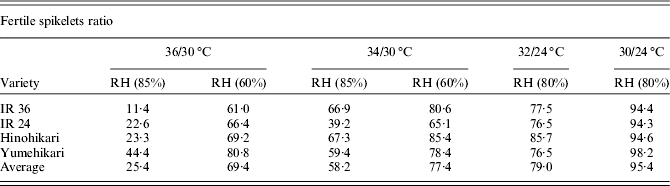
Humidity also plays an important role in rice yield, as higher relative humidity (RH) at the flowering stage under increased temperature affects spikelet fertility negatively (Yan et al. Reference Yan, Ding, Wang, Liu, Li, Muhammad and Wang2010). Field observations in some high-yielding rice areas with a drier climate and high temperatures (e.g. New South Wales and Southern Iran) suggested no significant increase in spikelet sterility even at temperatures >40°C (Wassmann & Dobermann Reference Wassmann and Dobermann2007). Prior to this, a decrease in the fertility of spikelets at high air temperatures with increased humidity was reported by Matsui et al. (Reference Matsui, Omasa and Horie1997b) who suggested that humidity modified the impact of high temperature on spikelet fertility. An RH of 85–90% at the heading stage induced almost complete grain sterility in rice at a day/night temperature of 35/30°C (Abeysiriwardena et al. Reference Abeysiriwardena, De, Ohba and Maruyama2002). Heavy water loss from florets might impede one of the major processes of pollination, such as swelling of the pollen grains (Matsui et al. Reference Matsui, Omasa and Horie1999b). Weerakoon et al. (Reference Weerakoon, Maruyama and Ohba2008) reported that spikelet fertility was not always inhibited by high humidity, because at low temperature (>30°C) the fertility was c. 0·9. They also observed that with increased RH, pollen shedding on stigma was reduced at high temperature, while no such reduction with increased RH was noted at lower air temperatures (Table 2). These observations suggest that the shedding of pollen on the stigma and the subsequent spikelet sterility are affected by RH along with temperature. Nishiyama & Satake (Reference Nishiyama and Satake1981) also showed that the dehiscence of the anther, which plays an important role in the fertility of the spikelet, was promoted by dry air. The temperature inside the spikelet decreases with a reduction in RH, possibly due to the enhancement of transpiration at low RH (Weerakoon et al. Reference Weerakoon, Maruyama and Ohba2008). This reduction in temperature inside the spikelet increases the viability of pollen grains. Viable pollen grains absorb moisture and swell at moderate to high RH levels and create the required pressure for the rupture of the septum, which helps in the deposition of pollen on stigma and thus produces a fertilized spikelet (Weerakoon et al. Reference Weerakoon, Maruyama and Ohba2008).
Fertile spikelet ratio of different varieties of indica and japonica rice exposed to different daytime air temperatures and RH levels

Adapted from Weerakoon et al. (Reference Weerakoon, Maruyama and Ohba2008).
PHYSIOLOGICAL AND BIOCHEMICAL MECHANISMS OF HEAT TOLERANCE
Heat tolerance is generally defined as the ability of the plant to grow and produce economic yield under high temperature (Wahid et al. Reference Wahid, Gelani, Ashraf and Foolad2007). As plants cannot move, the only option they have to defend themselves from various stresses is to make metabolic and structural adjustments (Yamanouchi et al. Reference Yamanouchi, Yano, Lin, Ashikari and Yamada2002). Rice tolerance classically comprises elements of escape or avoidance, i.e. the timing of panicle emergence and spikelet/floret opening relative to the occurrence of the stress, and the absolute tolerance of key processes, such as anther dehiscence, to the stress. The ability of a variety to decrease its spikelet temperature with reduced RH can be considered as an avoidance mechanism, while the variability among the varieties in spikelet sterility at a given spikelet temperature could be considered as true tolerance (Weerakoon et al. Reference Weerakoon, Maruyama and Ohba2008). True heat tolerance at sensitive stages might be conferred by protecting structural proteins, enzymes and membranes from heat damage. The role of heat shock proteins (HSPs) and other stabilizing factors is crucial in these processes (Maestri et al. Reference Maestri, Klueva, Perrota, Gulli, Nguyen and Marmiroli2002). Relatively little is known about stress avoidance and true tolerance mechanisms in rice. For phenotyping and modelling, it is required that these two mechanisms, as well as the effects of temperature on the fertility of spikelets, are clearly understood and investigated further.
Acquired or induced thermo-tolerance is the ability induced by a sub-lethal heat stress to overcome subsequent exposure to lethal high temperatures (Burke et al. Reference Burke, O'Mahony and Oliver2000). This type of tolerance is a cell autonomous phenomenon that results from an exposure to a short period of sub-lethal temperature or other moderate stress treatment (Larkindale & Vierling Reference Larkindale and Vierling2008). It depends mainly on the induction of specific pathways during the acclimation period and subsequent acquisition of thermo-tolerance (Klueva et al. Reference Klueva, Maestri, Marmiroli, Nguyen and Basra2001).
Basal or inherent thermo-tolerance is the measure of the inherent capacity of an organism to tolerate high temperature (Lee et al. Reference Lee, Hubel and Schoffl1995). Quantitative trait loci (QTL) studies have shown that heat tolerance of rice during flowering is under polygenic control (Zhang et al. Reference Zhang, Chen, Xiao, Xiao, Chen and Zhang2009), which makes it more difficult to study.
Role of HSPs in inducing thermo-tolerance
High temperatures generally induce the expression of HSPs and suppress, at least in part, the synthesis of normal cellular proteins. Such a response allows organisms to become tolerant to lethal high temperatures (Chang et al. Reference Chang, Jinn, Huang, Chen, Chang and Wang2007). HSPs are not only induced in response to short-term stress but their production is also vital for heat acclimation (Timperio et al. Reference Timperio, Egidi and Zolla2008). The rapid accumulation of HSPs in the sensitive organs can play an important role in the protection of the metabolic apparatus of the cell, thereby acting as a key factor for plants’ adaptation to, and survival under, heat stress (Wahid et al. Reference Wahid, Gelani, Ashraf and Foolad2007). The HSPs produced in eukaryotes can be grouped into six different families/classes: HSP100, HSP90, HSP70, HSP60, sHSPs (small HSPs) and the Ubiquitin HSP8.5 group (Efeoglu Reference Efeoglu2009). Apart from heat shock, HSPs are also produced in response to various abiotic stresses including water stress, chilling stress, salinity stress and anoxic conditions (Pareek et al. Reference Pareek, Singla and Grover1995). These HSPs can help in coping with heat stress by improving photosynthesis, partitioning of assimilate, nutrient and water use efficiency and membrane thermal stability (Wahid et al. Reference Wahid, Gelani, Ashraf and Foolad2007). A positive relationship has been documented in many plant species between HSPs and heat tolerance of the whole plant (Huang & Xu Reference Huang and Xu2008). Also, a relationship between HSPs and reactive oxygen species (ROS) has been proposed which corroborates the hypothesis that during the course of evolution plants were able to suppress ROS and now plants are using these ROS as signalling molecules to induce HSPs (Timperio et al. Reference Timperio, Egidi and Zolla2008). Better acclimation was reported when the high-temperature stress occurs gradually instead of through a sudden change in temperature (Larkindale & Vierling Reference Larkindale and Vierling2008).
Considering the crucial role of HSP in imparting thermo-tolerance, Katiyar-Agarwal et al. (Reference Katiyar-Agarwal, Agarwal and Grover2003) developed transgenic rice by the introduction of HSP101 from Arabidopsis thaliana cDNA into the indica rice variety Pusa Basmati 1. Overall, this transgenic rice showed normal growth and development, and it also performed significantly better in the recovery after heat stress when compared with the untransformed rice. Similarly, the over-expression of rice OsHSF7 gene in A. thaliana has very recently been reported to increase the thermo-tolerance by increasing the proportion of plants surviving 42°C for 16 h, from 0·22 to 0·52 (Liu et al. Reference Liu, Qin, Zhang, Peng, Xiong, Chen and Yao2009). On the other hand, expression of a member of rice heat stress transcription factors (OsHsfA2e) has been reported to enhance tolerance to environmental stresses such as high temperature and salt stress in Arabidopsis (Yokotani et al. Reference Yokotani, Ichikawa, Kondou, Matsui, Hirochika, Iwabuchi and Oda2008).
Factors other than HSPs contributing to thermo-tolerance
A complex network of changes is involved in plant acclimation to heat stress. Research findings have shown that pathways other than HSPs induction also play a vital role in thermo-tolerance of plants (Larkindale & Vierling Reference Larkindale and Vierling2008). Disruption of some plant growth hormones such as ethylene, salicylic acid, abscisic acid, calcium and hydrogen peroxide through mutation affected the thermo-tolerance capability of the plants, although the levels of accumulated HSPs did not vary from their wild types in these mutated plants (Larkindale et al. Reference Larkindale, Hall, Knight and Vierling2005). When applied exogenously, these chemicals can enhance thermo-tolerance without an accompanying accumulation of HSPs (Larkindale & Knight Reference Larkindale and Knight2002), mainly through increased antioxidant capacity and membrane thermal stability which can reduce the extent of damage caused by ROS (Mohammed & Tarpley Reference Mohammed and Tarpley2009b). Another prominent alteration produced at the molecular level to counteract the high-temperature stress in plant cells is the modification of antioxidant enzymes, and alteration of membrane composition and structure (Stone Reference Stone and Basra2001). The ability of some cultivars to undergo evaporative cooling can also impart tolerance to high-temperature stress, especially when availability of irrigation water is ensured under sufficient vapour pressure deficit between the canopy and atmosphere.
TRAITS RELATED TO TOLERANCE OF HIGH TEMPERATURE STRESS
Below is a brief description of some morphological characteristics that can alter the response of crops towards heat stress.
Plant architecture
Plant architecture can play an important role in high-temperature stress tolerance. Thus, developing plant varieties with appropriate architecture will help to cope with the increase in temperature. For example, if the plant morphology is such that the panicle is surrounded by many leaves, the plant will be able to withstand high-temperature stress due to increased transpirational cooling and by preventing evaporation from the anther due to its shading by the leaves. The reduced evaporation from the anther will ensure swelling of the pollen grains, an important trait for anther dehiscence. The newly developed semi-dwarf improved varieties may prove quite useful in this regard due to their improved canopy architecture (Wassmann et al. Reference Wassmann, Jagadish, Heuer, Ismail, Redona, Serraj, Singh, Howell, Pathak and Sumfleth2009a). The reduced height may also enhance resistance to lodging, thus giving more resilience to the crop against indirect stresses such as floods, which will become more frequent due to global warming.
Time of flowering and anthesis
The occurrence of flowering early in the morning was discussed many years ago as a useful phenomenon imparting heat tolerance to rice genotypes (IRRI 1977). In addition, early flowering is considered a relatively simple trait that can be used easily in breeding (Yoshida Reference Yoshida1981). Nishiyama & Blanco (Reference Nishiyama and Blanco1981) conducted a series of experiments on the probability of controlling flower opening time during the day and on the mechanism of flower opening in rice plants. They found that a dark treatment lasting 1 h prior to the natural flower opening advanced the flower opening time by up to 2 h in some cases. This advancement was, however, accompanied by some anther indehiscence. The day–night change of (29/21 °C) temperature was more effective in advancing the opening time than the constant temperature (25/25°C) in their experiments. Longer or shorter durations of dark treatments were also effective, but to a lesser extent.
Flowering and anthesis in most O. sativa genotypes of rice occur over a 5-day period, with most spikelets reaching anthesis between 10:00 h and 12:00 h (Nishiyama & Blanco Reference Nishiyama and Blanco1980; Prasad et al. Reference Prasad, Boote, Allen, Sheehy and Thomas2006). A rice floret emerges from the sheath of the flag leaf just before anthesis and opens for about 1 h in the morning (Matsui & Kagata Reference Matsui and Kagata2003b). Avoidance mechanisms also include: (i) cooling of the spikelet at flowering, (ii) asynchronous tiller and panicle development, (iii) asynchronous flowering time of spikelets within each panicle and (iv) anthesis and pollination taking place within the same spikelet (self-pollination). The latter was considered as one of the major difference between heat-tolerant (N22) and susceptible varieties (Yoshida Reference Yoshida1981). Yield depression resulting from exposure to high temperatures during critical developmental stages is mitigated to some extent within a crop because it is composed of individuals whose tillers are not of the same age. This means that the panicles produced pass through their vulnerable stages at different times and some might therefore escape heat damage. However, breeders and growers do not want crops to be unreasonably asynchronous as this extends the ripening period and increases the risk of crop loss due to other factors.
The anthesis time during the day is important because spikelet sterility is induced by high temperature during or soon after anthesis (1–3 h after anthesis in rice, Satake & Yoshida Reference Satake and Yoshida1978), but not after fertilization is completed. Sheehy et al. (Reference Sheehy, Elmido and Mitchell2001) showed that a large variation exists in time-of-day of flowering among rice cultivars. Identification of genes responsible for controlling the time of day when flowering commences would be crucial for this stress avoidance mechanism (Sheehy et al. Reference Sheehy, Elmido, Centeno and Pablico2005).
Although indica and japonica genotypes of O. sativa have similar patterns of flowering, it is worth noting that O. glaberrima genotypes flower much earlier in the day, with more than 0·90 of spikelets reaching anthesis by 09:00 h (Nishiyama & Blanco Reference Nishiyama and Blanco1980; Prasad et al. Reference Prasad, Boote, Allen, Sheehy and Thomas2006). This is a potentially useful trait that should be incorporated into O. sativa now that interspecific crosses can be made (Jones et al. Reference Jones, Dingkuhn, Aluko and Semon1997). While phenotyping for heat tolerance, it is essential that high temperature (or other stress) is timed to coincide with the peak period and that escape is taken into account (Jagadish et al. Reference Jagadish, Craufurd and Wheeler2007). Developing some techniques to ensure that the process of anthesis completely occurs within the same spikelet will help the plant to avoid heat stress successfully. In this regard, the application of methyl jasmonate (MeJA) has been proved to significantly induce opening of rice floret within about 30 min, with the most rapid induction occurring just 6 min after treatment (Zeng et al. Reference Zeng, Zhou, Zhang, Murofushi, Kitahara and Kamuro1999). The results indicated that MeJA-induced opening of rice florets significantly. In addition, exogenous application of MeJA in A. thaliana has been reported to confer basal thermo-tolerance and protect it against heat shock (Clarke et al. Reference Clarke, Cristescu, Miersch, Harren, Wasternack and Mur2009).
Length of anther
It has been suggested that cultivars with large anthers are tolerant of high temperature at the flowering stage (Matsui & Omasa Reference Matsui and Omasa2002). As the direct cause of temperature stress is the reduction in the number of pollen grains that germinate on the stigmata (Satake & Yoshida Reference Satake and Yoshida1978), it can be assumed that cultivars with large anthers are tolerant to temperature stress because they have a large number of pollen grains per anther, which compensates for the reduction in the number of pollen grains that germinate under high temperature (Matsui & Omasa Reference Matsui and Omasa2002).
Size of basal pore
Basal pores are located just above the stigmata and at the bottom of the theca, and open at the time of flower opening when the anthers stand erect. Therefore, pollen grains in the anthers with large basal pores would readily drop out of the basal pores on to the stigmata. In contrast, most of the pollen grains in anthers with small basal pores would remain in the anthers at the time of floret opening (Matsui & Kagata Reference Matsui and Kagata2003a). Thus, this trait, along with the length of the anther, increases the chances of pollination (a process generally perturbed under high-temperature stress as discussed earlier), mainly by facilitating pollen release from the anther. As these characters can be easily identified compared with some other morphological traits, they can be used easily in breeding and as screening tool for selection of rice germplasms for high-temperature resistance.
Length of basal dehiscence of anther
Anther dehiscence is the final step of anther development and results in the release of pollen grains to enable pollination, fertilization and seed set (Goldberg et al. Reference Goldberg, Beals and Sanders1993). In O. sativa, filaments begin to elongate at the beginning of anthesis and pollen grains swell rapidly. The increased pressure from the swollen pollen grain causes the locule to bulge, resulting in rupture of the septum, which has been weakened by hydrolytic enzyme action (Keijzer et al. Reference Keijzer, Leferink-Ten Klooster and Reinders1996; Matsui et al. Reference Matsui, Omasa and Horie1999a). For successful anther dehiscence and pollination, a series of developmental events leading to the breakage of the stomium and release of pollen grains must synchronize with other developmental processes that occur within both the anther and the floret (Zhu et al. Reference Zhu, Ramm, Shivakkumar, Dennis and Upadhyaya2004).
Matsui & Omasa (Reference Matsui and Omasa2002) showed that some high-temperature-tolerant cultivars with spikelet fertility of >0·80 under a day temperature of 37·5°C, have well-developed lacuna for the anther dehiscence between the septum and stomium of theca. The well-developed lacuna may weaken the septum and promote theca dehiscence, thus increasing the tolerance of pollination to high temperatures (Matsui & Omasa Reference Matsui and Omasa2002). The well-developed lacuna, however, is not an appropriate marker for exploration of genetic resources and breeding of high-temperature tolerant cultivars because the lacuna is not visible from the outside of the anther and it is time consuming to observe it. For efficient selection in a breeding programme, visible markers of high-temperature tolerance are required. Matsui & Kagata (Reference Matsui and Kagata2003a), using japonica rice cultivars in Japan, reported that long basal dehiscence of theca for pollen dispersal increased the stability and certainty of pollen transport to the stigmata under normal conditions. Genetic improvement for large basal dehiscence may increase the certainty of pollen shedding, by compensating for the decrease of theca dehiscence and delay of the pollen release, thereby increasing tolerance to high temperatures. It is easy to measure the dehiscence size. Under severe high temperature, the swelling of the pollen grains is inhibited, which leads to indehiscence of the theca (Matsui et al. Reference Matsui, Omasa and Horie2000), while moderately high temperatures usually result in failure of pollen release (Matsui et al. Reference Matsui, Kobayasi, Kagata and Horie2005).
In another experiment, Matsui (Reference Matsui2005) found that the long basal dehiscence of the theca helps the pollen grains to fall from the theca onto the stigmata and increases the stability of the pollination under hot and humid conditions as well as in normal conditions. He concluded that under normal conditions the tolerance of a variety to high temperature can be estimated by measuring the length of basal dehiscence. And as genotypes with large basal dehiscence under normal temperatures will also have greater basal dehiscence under high temperature, thus it can be easily estimated for high temperature from that under normal conditions (Matsui et al. Reference Matsui, Kobayasi, Kagata and Horie2005). It shows that this character is expressed stably both under normal and high temperatures. The length of basal dehiscence of thecae has been reported to be under strong genetic control (Matsui et al. Reference Matsui, Kobayasi, Kagata and Horie2005). Later, the experiments of Matsui et al. (Reference Matsui, Kobayasi, Yoshimota and Hasegawa2007) also suggested that the external environment also has some effect on the basal dehiscence as it was longer at the edge of the rice canopy than inside the community and tended to be longer on the second day than on the first day. If such variation in the size of the basal dehiscence among cultivars from different origins correlates with the viability of pollination in a wide range of genotypes, the size of the basal dehiscence could be a useful morphological marker of pollen viability.
INTERACTIVE EFFECT OF TEMPERATURE WITH OTHER CLIMATIC FACTORS ON RICE
The atmospheric CO2 level is projected to increase in the future, which will have significant effects on various plants. As a C3 plant, rice will certainly benefit from this increase in CO2, mainly through reduced photorespiration. A positive role of CO2 enrichment has also been shown for biomass accumulation, tillering, panicles per plant and grain yield of rice (Baker et al. Reference Baker, Allen and Boote1990, Reference Baker, Allen and Boote1992; Ziska & Teramura Reference Ziska and Teramura1992). Higher CO2 levels will influence stomatal behaviour beneficially by reducing water loss through transpiration, thus increasing water use efficiency (Wassmann et al. Reference Wassmann, Jagadish, Sumfleth, Pathak, Howell, Ismail, Serraj, Redona, Singh and Heuer2009b). So the projected rise in CO2 concentration will be advantageous in some ways for rice growth and development. However, the overall effect is negative when increases in both CO2 and temperature are taken into account simultaneously (Moya et al. Reference Moya, Ziska, Namuco and Olszyk1998; Wassmann et al. Reference Wassmann, Jagadish, Heuer, Ismail, Redona, Serraj, Singh, Howell, Pathak and Sumfleth2009a). The rising CO2 level may exacerbate future scenarios for rice production in the long run, as it will further increase the global temperature. Furthermore, research on the interactive effect of these two climatic components has revealed that the canopy temperature increases with an increase in CO2 level due to closure of stomata, which in turn, may also reduce the critical air temperature for spikelet sterility (Matsui et al. Reference Matsui, Namuco, Ziska and Horie1997a).
The global rise in temperature will also increase the severity of other environmental stresses such as floods and drought. It may alter the whole hydrological cycle and will bring more unpredictability and intensity in terms of precipitation. Probably, the wet places will become wetter and the dry will get drier. The variation in rainfall will lead to more frequent floods and droughts, which are the most important constraints for deep water and aerobic cropping systems, respectively. Both these extreme conditions (drought and flood), if exceed certain critical period, will have substantial consequences on rice and may lead to complete failure of the rice crop when occur at sensitive stages either in the form of water shortage or excessive submergence. And thus, the changing climate may enforce a shift in the cropping pattern in most parts of the world most probably making rice the most suitable choice for areas with increased water availability but becoming less appropriate for farmers in areas with decreased wetness. So there is a need to adopt a multi-faceted approach while studying the impact of high-temperature stress, also focusing on other environmental stresses, which may be equally detrimental for rice productivity. In addition to these abiotic stresses, rice plants will become more and more susceptible to biotic stresses such as insect pest infestation with the changes in temperature and other climatic factors.
MITIGATING STRATEGIES FOR THE FORTHCOMING WARMER CLIMATE
The availability of high-density genetic and physical maps, expressed sequence tags (ESTs), genomic sequences and mutant stocks such as T-DNA insertional mutants (Jeon et al. Reference Jeon, Lee, Jung, Jun, Jeong, Lee, Kim, Jang, Yang, Nam, An, Han, Sung, Choi, Yu, Choi, Cho, Cha, Kim and An2000) have established rice as an excellent model plant for the study of heat tolerance among cereals. And the high level of synteny and homology within the Poaceae family will facilitate transfer of identified QTLs and candidate genes from rice to other cereals (Maestri et al. Reference Maestri, Klueva, Perrota, Gulli, Nguyen and Marmiroli2002). Some of the strategies that may help to cope with the threats of changing climate are outlined below.
Breeding perspective
Progress in rice breeding has rapidly accelerated due to the availability of the full rice genome sequence (IRGSP 2005) and intensive QTLs mapping efforts for a wide range of traits (Ismail et al. Reference Ismail, Heuer, Thomson and Wissuwa2007). Some of the breeding options which, if adapted, will help to mitigate the problem of rising temperature can be briefly summarized as follows.
The fertility of spikelets at high temperature can be used as a screening tool for high-temperature tolerance during the reproductive phase. Selection for heat tolerance should be done for those breeding materials which can tolerate temperatures higher than 38°C (Satake & Yoshida Reference Satake and Yoshida1978). Some cultivars that are not so sensitive to relatively higher temperatures, e.g. N22, have already been identified, so in the case of breeding for high-temperature stress only these materials should be used as genetic donors. For efficient selection in a breeding programme, visible markers of high-temperature tolerance are required. In this regard, the length of the anther and the size of its basal pore are some of the morphological traits that can be easily identified and can be used in breeding and as screening tool for selection of rice germplasms for high-temperature resistance. Genetic modification of the male reproductive organ should be targeted in future breeding programmes as it is more sensitive to high temperature.
Exploiting the existing genotypic variation in flowering time (especially the wild-type) serves as a useful mitigation option for rising temperature as it is a relatively simple trait that needs to be focused in breeding programmes. Introgression of the early morning flowering gene from Oryza officinalis into O. sativa has recently been shown to have positive effect on reducing the spikelet fertility (Ishimaru et al. Reference Ishimaru, Hirabayashi, Ida, Takai, San-Oh, Yoshinaga, Ando, Ogawa and Kondo2010).
QTL mapping, along with associated genetic studies focusing on the relationship between the phenotype of a trait and its genetic markers, should provide an opportunity to relate specific alleles to trait variation and thus to identify candidate genes (Cardon & Bell Reference Cardon and Bell2001). Breeding of cultivars with asynchronous tillers and panicles will increase the likelihood that critical processes of growth and development may occur at a cooler time in some tillers, but this phenomenon also has some other complications. The production of high-temperature tolerant transgenic rice cultivars would provide a stability advantage and will improve its overall performance under temperature stress.
More research on the inheritance of tolerance related traits and genotype-by-environment interaction (G×E) is needed. The targeted G×E-based findings will not only help to understand the relationship of production environment and genotypic characteristics of rice, but (as an immediate solution for the problem) will also help to select better genotypes suitable for particular environments (Krishnan & Rao Reference Krishnan and Surya Rao2005). Variation in response of cultivars to CO2 enrichment has already been reported (Ziska et al. Reference Ziska, Manalo and Ordonez1996), so additional research is needed to identify or develop cultivars that can maintain higher yield at high temperatures along with high CO2.
Future research activities should be aimed at identification and breeding of heat tolerant germplasms exploiting the variation in both genotypic and morphological characters. Several approaches should be actively exploited to improve heat tolerance in current cultivars, including discovery and exploitation of new genes and alleles, improved breeding efficiency, marker-assisted selection and genetic modification.
Management Options
Wide variability in response to temperature exists in the current rice genetic resource. Replacement of the sensitive cultivars by tolerant cultivars in the fields will increase the global rice production. From the management point of view, it is essential to adjust the duration of varieties such that they avoid peak stress periods. And for this purpose, the development of varieties with suitable growth durations and tolerance of altered sowing times can play a vital role. Site-specific adjustments in cropping systems may be needed because the effect of these changes in climatic factors varies with the region. The inherent diversity in rice agronomic systems, such as aerobic and flooded rice, may be quite effective for this targeted adaptation. Similarly, a shift in the cropping pattern from flooded to aerobic rice is expected in the near future. Keeping the field wet but not flooded and with added organic matter reduces the global warming potential from rice fields without a decrease in yield (Yu et al. Reference Yu, Chen and Patrick2004). Management practices such as saturated soil culture (SSC), alternate wetting and drying (AWD) and aerobic rice cultivation in the case of drought stress, while growing improved varieties containing the sub1 gene in flooded soils, offer some adaptive options for the indirect stresses related to temperature increase. AWD of the irrigated rice fields may also help indirectly, as it reduces methane emission (a significant contributor to global warming). Similarly, the no-tillage system is also an effective management strategy to reduce GHGs from rice fields (Ahmad et al. Reference Ahmad, Li, Dai, Zhan, Wang, Pan and Cao2009). The use of some growth regulators like MeJA (for advancing the flowering time to early morning), salicylic acid and glycine betaine (for increasing the percent pollen germination and spikelet fertility) will be also useful in mitigating the yield reduction threats. MeJA has recently been shown to cause an increase in spikelet sterility (although it enhanced flowering time), possibly due to indehiscence and poor pollination (Kobayasi & Atsuta Reference Kobayasi and Atsuta2010). However, the use of these regulators needs more experimental verification since literature on this topic is scarce. Growing rice varieties with higher yield potential reduces GHG emissions by actively channelling carbon from the atmosphere to the grains. The utmost care should be taken such that any improvement in tolerance to high-temperature stress of rice plant will not have a negative effect on qualitative traits.
This work was supported by National Basic Research Program of China (No. 2009CB118605) and the Major Projects of International Cooperation National Natural Science Foundation of China (Project No. 30821140349) along with National Natural Science Foundation of China (Project No. 30971707). The authors are greatly thankful to the Higher Education Commission of Pakistan for providing PhD scholarship to Farooq Shah.