[It] is not until a building has assumed this character, till it has been entrusted with the fame, and hallowed by the deeds of men, till its walls have been witnesses of suffering, and its pillars rise out of the shadows of death, that its existence, more lasting as it is than that of the natural objects of the world around it, can be gifted with even so much as these possess, of language and of life. —John Ruskin
Introduction
The preservation of heritage is inherently political. Archaeologists, cultural resource managers, conservators, and governments make particular decisions about the objects and places they preserve, the methods by which they interpret these relics of the past, and the histories they privilege in the process. Certain histories and physical remains are necessarily excluded, privileging one period, class, or category of heritage over the others in a given place. This act of marginalization is multiscalar and self-perpetuating in nature, attracting tourists and scholars alike from far and wide to partake in the consumption and reaffirmation of the showcased history, while ignoring or even denigrating the contiguous histories that are underinterpreted. As a singular, idealized association between history and place is established and reinforced, communities that value alternate meanings of a place are often disenfranchised and disempowered. This article presents a consideration of the politics of heritage as they relate to the sustainable coexistence of designated heritage sites and living historic communities. Considering the extreme example of the western hamlets of Gurna and their recent demise, the article questions whether the practice of preservation can be depoliticized to valorize a privileged heritage without denigrating an underprivileged one.
Although a decades-old corpus of sociological and anthropological literature considers power relationships in multiple contexts, it is only recently that scholars have focused this theoretical lens on the heritage disciplines, underscoring the intrinsic politics of heritage. In so doing, a number of imperial, colonial, and elitist rhetorics have come to light, questioning the legitimacy and appropriateness of preserving one heritage over another, or one spatial association over another. Indeed, there is a recent recognition of the profound conflict between the privileged and the marginalized over differing social values, lived traditions, and everyday practices that are collocated.
The village of Gurna, on Luxor’s West Bank in Egypt, serves as a case study to represent the pinnacle of conflict between a local historic community established within and around a vast expanse of pharaonic remains. Efforts to uncover, study, and display the wonders of pharaonic Egypt intimately involved the local Gurnawis from the early days of European-led archaeological efforts. However, in more recent years, the privileged story of the pharaonic heritage and its related modern industries of archaeology, research, and tourism dramatically overwhelmed the Gurnawi presence and long intertwined existence in the area to allow forced relocation of the community and demolition of its own historic and striking vernacular. Only a few years later, the loss of Gurna symbolizes the failure of government officials and heritage professionals to preserve living communities amid the pharaonic tombs and structures that are the focus of economically important tourism and ongoing archaeological study.
In order to establish the historicity of the Gurnawi settlements and their close relationship to the European discovery of the pharaonic remains in the area during the 18th and 19th centuries, the article relies on content analysis of text, maps, and drawings from the period referring to the people of Gurna. Modern changes to the cultural landscape, particularly the demolition of the Gurnawi homes, are evident through before-and-after comparisons of satellite images, which further reveal the politically significant buildings that survived demolition. Recent literature on concepts of living heritage and approaches to preserve the multilayered value of cultural and historic sites provides a framework for considering Gurna and developing best practice models.
Heritage as Concept
The practice of heritage preservation has long been considered one of benevolence, safeguarding vestiges from the past for the benefit of the future. This concept, as understood by historic preservation professionals, derives principally from European architectural and art historians in the 19th century looking on the great ruins of the past with romanticism and developing theories about the sociocultural values of historic structures.Footnote 1 Social thinkers and architectural theorists of the time highlighted the significance with which monuments were imbued and argued over their legacy and preservation approaches.Footnote 2 From these theoretical writings and efforts to restore examples of the built heritage emerged a focus on preserving not only physical vestiges, but also understanding the technology and values imbued therein. James Marston Fitch notes that the “comprehensive protection of such monuments and artifacts, and the scholarly examination of the theories and techniques that produced them, is of central importance to our cultural future.”Footnote 3 Focus, therefore, has typically been placed on the protection and examination of the physical in the first case, with more recent consideration of intangible values to ensure a holistic approach to preservation and interpretation of historic sites.Footnote 4
Efforts to understand intangible values have highlighted the assignation of value as an intrinsic component of the “consumption” of historic sites, including not only use and admiration, but also protection and preservation. The 19th-century art historian Alois Reigl claimed “the term ‘monument’… can only be meant subjectively, not objectively. We modern viewers, rather than the works themselves by virtue of their original purpose, assign meaning and significance to a monument.”Footnote 5 Meaning is not intrinsic to a work of art or a monument, but is actively redefined by those who experience it, with each stakeholder group and, arguably, each individual adding a new layer of significance and meaning. Nearly a hundred years after Reigl was writing, David Lowenthal claimed that ongoing assignation of value is inherent to the use and care of things historic. “Heritage is ever revitalized; our legacy is not simply original but includes our forebears’ alterations and additions. We treasure that heritage in our own protective and transformative fashion, handing it down in the faith that our heirs will also become creative as well as retentive stewards.”Footnote 6 For Lowenthal, the admiration and protection of heritage are themselves acts of value assignment and, as such, create new associations with a place that are supplemental and cumulatively expand its significance. As the focus of cultural consumption, in one form or other, heritage becomes the object of “commodification” and takes on new meaning with each act of use, repair, study, or reuse.Footnote 7 Preservation aims to protect the most significant and documented of these layers of meaning, while respecting all physical and intangible accretions. However, it is a politically charged activity.
The selection of one assignation of meaning as the focus of preservation has political implications with socioeconomic and cultural manifestations. Laurajane Smith refers to this privileged rhetoric as the “authorized heritage discourse,” which she contrasts with the existence of a “range of popular discourses and practices” that may counter the former.Footnote 8 Smith further highlights that the authorized heritage discourse is “self-referential,” in that it establishes who has the capacity to inform it and, ultimately, who does not. In this way, a dominant interpretation of a heritage site can simply overwhelm other interpretations and discourses integral to its layered significance but not “authorized” as valid or valuable. The result is a disempowerment and disenfranchisement of the other “subaltern,” to use Smith’s language, viewpoints or associations. Casting aside of these layers of significance can lead to the ultimate loss of socioculturally and historically important information, including physical sites themselves.
It is necessary at this point to discuss the role of place in defining and empowering built heritage as a sociopolitical entity. Unlike an objet d’art that can be moved from locality to locality and is then recontextualized within each new environment, immovable heritage (e.g., constructed buildings, land art, grottoes, and natural sites) is inextricably intertwined with its physical, social, cultural, and economic context. As a backdrop to the creation, use, re-creation, modification, and decay of these sites, place is both witness and participant over time. It is much more than a geographical location pinpointed on a map and serves as the setting that creates, defines, and redefines over time the use and value of a cultural heritage site. The importance of place, as theorized by geographer Carl Sauer, is its identity as the “combination of natural and man-made elements.”Footnote 9 This sense of identity is further elaborated by the concept of “place memory,” defined by Dolores Hayden as the embodiment of “the human ability to connect with both the built and natural environments.”Footnote 10 Place as a concept integrates both its physical components and the emotional associations with the setting. Arguably, the latter attachment may endure even though the former physical elements have changed or been removed. In other words, place embodies the varied assignments of values over time without temporal distinction and simultaneously recognizes endogenous and exogenous impacts on the creation, modification, and re-creation of these values. The preservation process, in its purest form, aims to identify, document, and safeguard all these superimposed layers of meaning and interpret their spatial associations.
Selecting a Past to Protect
Nonetheless, the act of preservation often, if not always, requires some form of selection and identification of a privileged heritage discourse. Physical manifestations of the approved discourse are protected, while other physical accretions and evidence of later associations may be willfully destroyed. Preservation establishes a sanctioned perspective presented and interpreted for posterity that then serves to exclude and marginalize other layers of meaning. Such exclusion, in turn, can limit access to and use of a place, and disenfranchise entire communities with divergent associations to the heritage place, to the degree of affecting their lifestyle, livelihood, and even identity.
Much of the literature on the politics of preservation has focused on the very tangible processes of archaeology and related cultural tourism. On one hand, scholars identify archaeology as a tool for governments to promote specific agendas and control sociocultural conflict.Footnote 11 On the other, archaeologists and other heritage professionals take on the mantle of creating culture and defining heritage, often intricately interwoven with the process of establishing national identity and, more recently, legitimizing and coalescing subgroup identity.Footnote 12 Casting the preservation process as an application of moral relativism, whether promoted by government or by scholar, Meskell states in no uncertain terms that the “creation of heritage is a culturally generative act that is intrinsically political. Heritage consultants and archaeologists could be said to invent culture, and, in the process, constitute heritage.”Footnote 13 Thus, the act of preservation, including herein the processes of discovery, study, and documentation, serves to establish a sanctioned, or authorized, discourse about a place. Those involved in this act, often an educated and/or governing elite, are then responsible for identifying and privileging one or more selected interpretations and uses of a heritage place.
The tourism industry represents another important stakeholder in the preservation process, itself creating accretions and new layers of meaning while often underscoring the authorized heritage discourse. As a mass act of cultural consumption,Footnote 14 tourism has enormous impact on the perceived significance and associations of a place. Hall identifies tourism as an inherently political power struggle that results in the domination of tourists over the indigenous population, and examples abound of the negative impact of tourism on the lives of residents.Footnote 15 This domination further accords tourists a simplified or “flattened” history that supersedes all others for the sake of presentation. The interpreted heritage site tends to tell the story of the local elite, often overlooking the underclasses intimately involved in the processes of creation, rediscovery, or present-day activity.Footnote 16 McKercher and du Cros note that tourism requires transformation of the cultural resource “to make it appealing and relevant to the tourist” and “simple and singular in its theme.”Footnote 17 In this way, tourism often results in a singular interpretation of a site: one story with a simplistic message presented for the sake of outsiders. Tourists appear to occupy a Gramscian cultural hegemony that privileges their simplified understanding of the places they visit and reinforces a singular accepted discourse.Footnote 18 Although many cultural site managers strive to highlight multiple layers of historical significance and sociocultural values related to a place, loss of certain discourses through the selection process is inevitable. Nonetheless, heritage professionals should strive to preserve and interpret as many of the discourses as possible.
Gurna: A Village Built on History
The village of Gurna that would become a north–south linear sprawl of sizable mudbrick houses on Luxor’s West Bank was established at least as early as the 18th century on top of a vast field of pharaonic remains from Egypt’s New Kingdom (roughly 1550–1069 bce). Although the Gurnawis—those who live at the foot of the Theban Mount (Al-Gurn)—were themselves associated with the era of discovery and archaeology of the region, they and their communities have been marginalized by a history of contempt and a modern series of relocation efforts. The goal of these efforts, as expressed by the Egyptian authorities, was to remove the community from atop the ancient tombs that first brought it there. Events that began in 2006 resulted ultimately in the wholesale demolition of the community’s historic buildings, forced relocation of residents, and refusal to interpret the community’s historical associations to the World Heritage Site within which it resided.
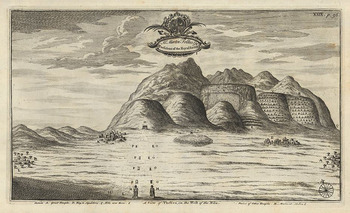
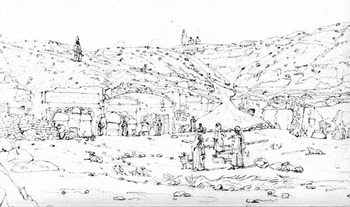
The region in question, long known as Thebes and highlighted by Herodotus for the wonder of its pharaonic vestiges, regained interest among itinerant Europeans in the 18th century. An early drawing of the West Bank in 1743 (see Figure 1) depicts some of the larger pharaonic remains and two outlying villages within the Nile flood plains and near the edge of the desert, one of which is labeled Gurna.Footnote 19 Vivant Denon, a participant in the Napoleonic expeditions of Egypt and first director of the Louvre Museum, made multiple references to Gurna, which he called “Kurnu,” and his interaction with the Gurnawis in his 1802 publication on Egypt.Footnote 20 He notes that hamlets of Gurna were already established amid the pharaonic tombs beyond the edge of the Nile flood plain and that some of the residents took shelter in them.Footnote 21 Despite the difficult and oft belligerent encounters between the Gurnawis and the French expedition, the former, which Denon interchangeably termed “incorrigible,” “criminals,” and “dogs,” eventually agreed to guide him through some of the larger tombs of the pharaohs.Footnote 22 A later panoramic drawing of the Theban hillside by Robert Hay of LinplumFootnote 23 in the 1820s depicts the locals living and working amid the tombs (see Figure 2), presumably attracted more and more to the desert from the floodplains by the advent of Europeans involved in archaeological exploration and in need of paid labor.
Anonymous, A View of Thebes, on the West of the Nile, the village of Gurna is indicated by the letter “A,” plate in Richard Pococke, Description of the East and Some Other Countries, Vol. 1 (1743).

Robert Hay of Linplum, Detail from Panorama, 1820s (Hay Collection, British Library).

As interest in Egypt grew from the early 19th century and beyond, more Europeans specializing in the discovery of pharaonic remains and eager for a “cultural” vacation came on the scene. Isabella Frances Romer published a work about her explorations of Egypt and Palestine and mentioned the village of Gurna and its people in the 1840s.Footnote 24 Alexander Henry Rhind commented on Romer’s fanciful sketches of western Thebes dotted with villas as a potential vacation spot for British subjects.Footnote 25 A number of manor-like structures built as residences for Egyptologists and travelers spending time in the area became a part of the Theban landscape. It appears to be around this same period that the Gurnawis constructed similar manor-like homes in the area, presumably following the lead of their European neighbors, though adapting the construction to their own needs and expectations.
Gurnawi Vernacular
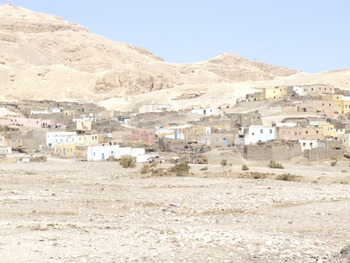
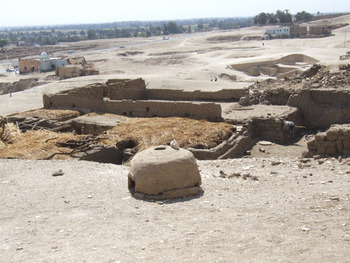
The three modern hamlets of Gurna that lay within the historic precinct were composed of multiple large, mudbrick family residences, sometimes of two or more stories, and often brightly colored to contrast with the Theban desert landscape (see Figure 3). Irregular fenestration was common, with most windows on the east side of the structures, facing the flood plains and Nile beyond. Building interiors comprised organically organized spaces with undulating walls and earthen molded furnishings often built into the mudbrick walls or integrated into the clay floors. Of note were the towering pigeon roosts, integrated earthen ovens, and granaries and other storage areas protruding from the walls. As Hassan Fathy, famed architect and researcher of the Gurnawi vernacular, noted in his description of the residences, “the villagers allow themselves to mold the most individual and beautiful plastic forms … the plan of a room or the line of a wall would not be a dull, square, measured thing but a sensitively molded shape, like a pot.”Footnote 26 Often, a seamless integration of interior and exterior spaces composed the homes, integrating the unique plastic forms highlighted by Fathy (see Figure 4). The layout and program of these residences are representative of the Gurnawi response to their environment, using the only material readily available to them: mud from the Nile flood plains. Mud plasters usually covered both the interior and exterior of the walls, with shades of yellow, aquamarine, or pink often adorning the exterior. Some of these structures incorporated in their plan an underlying tomb, used as additional living space.
Sheikh ‘Abd el Gurna hamlet, view from southwest, February 2009 (author’s photo).

Gurnawi house, Sheikh ‘Abd el Gurna hamlet, view from northeast and above, with built-in earthen oven flue in foreground and mosque visible in distance, February 2009 (author’s photo).

The location of the structures, grouped into three principal settlements that overlay an area dotted with thousands of New Kingdom pharaonic tombs, is testament to the strong physical relationship of Gurna and the Gurnawis to the discovery, reuse, and visitation of the tombs. Historic reference to and ongoing residence within some of the tombs, their documented involvement in the European archaeological endeavor, and Gurnawi interaction with modern tourists highlight the integral role of the pharaonic landscape and its consumption within Gurnawi culture and livelihood. Locals had not only lived with and among these ancient sites for at least two centuries, but they had also come to rely on their discovery, excavation, and visitation for their survival, often dedicating part of their homes to the manufacture and sale of tourist trinkets and, according to some officials, original artifacts.
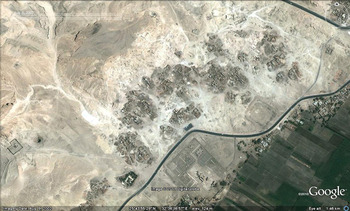
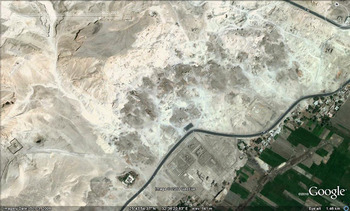
The scenic architecture and lively participation of the Gurnawis in the life of the extensive archaeological site on the West Bank, which became a UNESCO World Heritage Site in 1979, has concerned Egyptian authorities since the 1940s and incited them to call for their relocation. The practical challenge proffered by the authorities is the policing of the thousands of tombs in the area that are overlaid and partially inhabited by the Gurnawis. Many Gurnawi houses have incorporated one or more pharaonic tombs as subterranean chambers used for storage, living quarters, barns, and countless other spaces for everyday use. Soon after Egyptian independence from Britain, the antiquities authorities began investigating ways to protect the tombs by relocating the Gurnawis who lived among them. As early as the 1940s, the authorities attempted to create a “New Gurna” far to the east and outside of the historic area, planning to relocate many of the inhabitants from the center of tourist activity, on which they relied for their livelihood. The unfinished village, designed by Hassan Fathy after extensive study of Gurnawi lifestyle and relationship to their built environment, failed as an endeavor, in part because Gurnawis vehemently resisted the move from their ancestral homes to a modern vernacular village dissimilar to their own aesthetic and lifestyle.Footnote 27 In the 70 years since, efforts to attract and forcibly relocate the villagers to new, climatically and culturally inappropriate concrete buildings have continued with mixed results. Most recently, the authorities addressed the question by demolishing nearly all the structures of Gurna’s western hamlets and forcibly relocating the inhabitants. Although families resisted bulldozing of their earthen manors by continued occupancy, the majority of vernacular structures were destroyed between 2006 and 2009 (see Figures 5 and 6), affecting some 3500 families through forced relocation and dissolution of a once vibrant agglomeration of hamlets.Footnote 28
Satellite image of Sheikh ‘Abd el Gurna hamlet, August 2002 (Google Earth).

Satellite image of Sheikh ‘Abd el Gurna hamlet, October 2009 (Google Earth).

Preserving Them Out of House and Home
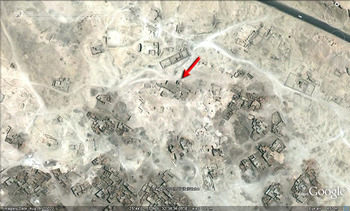
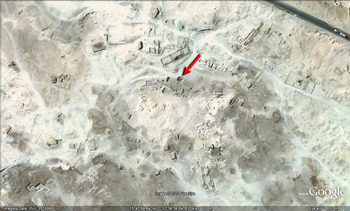
The loss of the Gurnawi homes represents the destruction of an historic vernacular architecture in favor of preserving the authorized, more highly valued heritage in the same place. Despite the expressed concern for the impact of the community on the prized subterranean heritage, the authorities simultaneously demolished a unique opportunity to interpret the story of Gurna and its residents: the first and only museum of Gurnawi history and culture housed within two restored historic structures. The Gurna Discovery Center, as it was called, had been established in April 2001 as a free museum of Gurna history and culture open to locals and tourists alike and authorized by the Supreme Council of Antiquities. Included in the exhibitions were copies of Robert Hay’s panoramas, historic photos of Gurnawis and their residences, and reports and images of modern-day events relevant to the area. Although the protection of this center would have preserved some aspects of the Gurnawi story and a physical example of the built heritage, it was destroyed in 2010 during the last wave of demolitions, apparently approved by then-director of the Supreme Council of Antiquities, Zahi Hawass, as part of a plan to protect the nearby tomb of Nakht, an astronomer under the 18th Dynasty Pharaoh Thutmose IV (approximately 14th century bce).Footnote 29 The website of the Discovery Center acknowledges its own demise with a banner stating “the information below is now history—yet another part of the vanished history of Gurna.”Footnote 30 A sole building was preserved from within the destroyed Gurnawi hamlet of Sheikh ‘Abd el Gurna. Metropolitan House, the 1912 field house built by the Metropolitan Museum of Art currently used by the Polish team working at the temple of Hatshepsut (see Figures 7 and 8), is linked to the elite history of Egyptology and ongoing archaeological discovery. Its continued presence amid the piles of rubble that once represented vibrantly colored, sizable Gurnawi residences underscores the official preference for an archaeological past that is part of the authorized heritage discourse (see Figure 9). While targeting the local vernacular in the area for demolition, this building was protected as part of the site’s archaeological heritage.
Satellite image of Sheikh ‘Abd el Gurna hamlet, August 2002; arrow indicates Metropolitan House (Google Earth).

Satellite image of Sheikh ‘Abd el Gurna hamlet, October 2009; arrow indicates Metropolitan House (Google Earth).

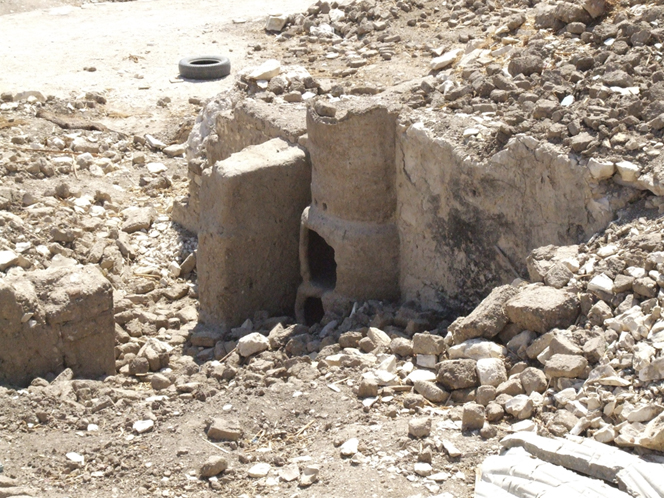
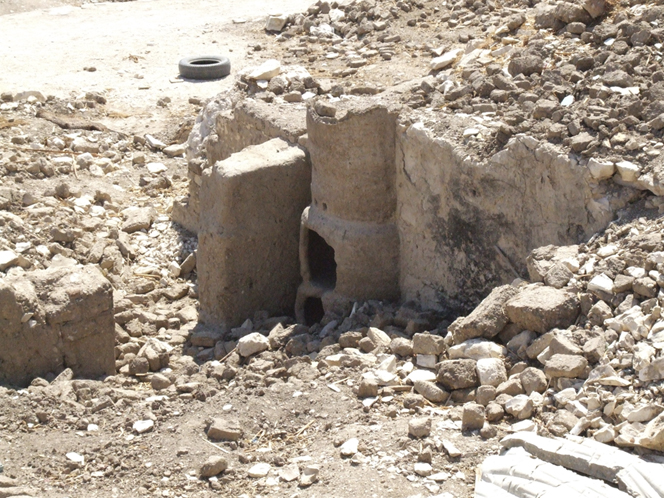
Detail of built-in earthen oven amid the rubble of destroyed residence, February 2009 (author’s photo).
At the end of 2009, in the midst of one of the final campaigns of Gurna demolitions, the Egyptian cultural authorities, announced that Howard Carter’s field house would be turned into a museum.Footnote 31 This announcement not only underscored the undeniable significance of the ancient Egyptian heritage, but also formalized protection and interpretation of the history of its modern discovery. Previously, Hawass had often referred to inadvertent discoveries by villagers throughout Egypt as events precipitated by their pack animals or livestock rather than by the villagers themselves, reinforcing a common view that villagers had no active involvement in the archaeological endeavor.Footnote 32 Due in part to this official view, the Gurnawi contribution to the discoveries of Luxor’s West Bank remains underrepresented and undervalued, and the relocation and demolition of the community undermine the association of Gurna with the pharaonic remains. The lack of physical vestiges of the Gurnawi community atop the pharaonic tombs removes the need for interpretation and allows for a privileged retelling or “cleansing” of the archaeological history that supports only the authorized discourse of the West Bank as a pharaonic city of the dead, omitting subsequent living communities.
A few scholars have considered the relationship between the politics of heritage and the previous efforts to relocate the Gurnawis. Mitchell highlights factors of identity construction and nation-making in Egypt as integral to the process of defining a pharaonic history that is separate from a more recent Islamic identity.Footnote 33 He further notes the changing polemic of the government from a focus on the protection of the pharaonic site in the 1940s to a concern for tourist experience and safety in the 1990s, in both cases denouncing the role of Gurnawis as participants in the archaeological discovery of the sites and in the tourism industry that now overruns them. Meskell in turn considers the relationship between violence and tourism, questioning the motivations behind the 1997 massacre of tourists that took place in the area, though not involving the Gurnawis, who were among the first to come to the aid of victims and overpower the terrorists. “It could be argued that the construct of ‘global world heritage’ is, in part, a remnant of colonialism.”Footnote 34 She likens tourism and violence, respectively, to a form of imperialism and a backlash against foreign hegemony. Meskell further represents tourism in Egypt as a force for marginalization of modern local communities in light of the focus on pharaonic identity: tourists are not encouraged to discover the later periods of Egyptian history, and little or none of the revenue reaches the locals, remaining largely in the hands of foreign tourism companies and, once in Egypt, with national entities based in Cairo.Footnote 35 The heritage industry that caters largely to foreign tourists makes no effort to introduce a more informed history of the places they visit, causing both tourist and guide to overlook many rich and integral vestiges of local and regional history in favor of the authorized discourse. However, it is important to note that Gurnawis had, prior to the demolitions, integrated themselves somewhat effectively into the heritage industry on the West Bank, serving as unofficial guides, selling trinkets and wares, working with foreign missions, and even showcasing their own community and heritage to interested tourists.
The World Bank and USAID conducted studies in Luxor and throughout Egypt related to the protection of the pharaonic remains that privileged tourism while disenfranchising local communities. They lauded economic development efforts to increase high-end tourism by effectively separating tourists from local communities and preventing their interaction.Footnote 36 This reinforced an archaeological perspective on Egypt’s history by extricating subsequent and even contemporary layers of habitation from the interpretation of these places. Quite surprisingly, USAID conducted studies of plans for Gurnawi relocation, including proposed designs of housing and research on their cultural values and lifestyle, all without questioning whether the relocation was indeed necessary or if there were viable options for mitigating concerns about the community’s interaction with the pharaonic Necropolis.Footnote 37 The understanding that Gurnawis were “criminals” and “tomb robbers”Footnote 38 seems to rest on the judgments of 18th- and 19th-century European explorers without consideration for the modern socioeconomic context. Additionally, the significance of the thousands of adjacent pharaonic tombs, many of which are in deplorable condition and have been thoroughly documented, was never reconsidered in light of the living community sharing the land. Indeed, the value of the pharaonic landscape is uncontested, but authorities have refused to accept the significance of the community as an intrinsic component of this landscape. It is worth noting that many members of the Egyptology community were adamant that the Gurnawis or, at least, the physical evidence of their community should remain and become part of an overarching conservation and interpretation plan for the West Bank.Footnote 39 However, the concerns of the largely foreign archaeological community for the preservation of Gurna hamlets were met with simple government reiterations of the need to protect the pharaonic heritage.
Conclusion
Gurna is one of many examples of living communities disenfranchised by preservation efforts, but it provides a challenging and test-worthy case for considering alternatives to this approach of site protection inspired by eminent domain. Concerns for the pharaonic tombs that dot the landscape of the West Bank are justified; inappropriate use and introduction of waste water and animals have exacerbated their deterioration. In such cases, heritage professionals and government officials have the responsibility and, often, the mandate to take necessary action. Nonetheless, there appears to have been no attempt to educate the Gurnawis to work with site managers and mitigate these threats. The authorities instead focused on their forced relocation, conducting numerous trials and employing a diverse group of consultants to facilitate that process over a 70-year period that culminated in forced relocation and demolition. Although small numbers of residents did relocate in response to some earlier campaigns, the efforts were large failures overall and were even known to result in violence, as Mitchell notes occurred in 1998 when police opened fire on protesting villagers.Footnote 40 These failures, particularly with episodes of protest and violence, are clear evidence of the attachment of the villagers to their homes and land. As mentioned previously, this was not only an ancestral association or attachment to place, but for many this attachment was borne by economic necessity to earn from the tourism that engulfed them.
Reconciling a living community and its needs with the preservation of the heritage beneath was the principal question that unfortunately received no answer from the acts of demolition. There are multiple preservation options that better serve the interests of the Gurnawis, while still protecting the historic tombs and other pharaonic heritage in the vicinity. These approaches can be divided into two main categories: (1) community development models that aim to keep the Gurnawis living in their homes above the tombs and (2) preservation approaches that facilitate relocation of the residents while protecting and interpreting a corpus of their vernacular in situ. Each category has a broad spectrum of possibilities related to the size of the remaining community, the number of buildings preserved, amount of access locals and others have, and so forth. However, all these options must incorporate appropriate and adequate protection of the pharaonic tombs and relevant education about their significance.
In the first category of possible approaches, the government and site managers might have worked with the local community as partners and stakeholders in the preservation process, learning what activities threaten the pharaonic tombs and developing mitigation strategies, such as drainage for wastewater, systems of refuse removal, regulations about animals, and restrictions on tomb access and theft. In this way, the site managers could develop a working relationship with the villagers and involve them in strategies for protecting the heritage site on which they live, simultaneously increasing security and establishing a warning system for major problems of preservation. Concomitant with these efforts, they could underscore the importance of the living Gurnawi heritage, its physical manifestations, and the current lifestyle. The existence of the Gurna Discovery Center provided a unique opportunity to showcase the long history of the community and their significant association with the historic archaeological endeavor of the region. This approach requires long-term planning and intensive training, and carries with it heightened risk for continued damage to the tombs, but encourages a deepened respect for the heritage site by locals, allowing their continued habitation and establishing additional layers of desperately needed security and monitoring for the pharaonic sites. Involvement of the Gurnawis in the protection of the site could have been integrated into a preservation master plan for the West Bank, integrating their role in the process, while also interpreting the significance of the Gurnawi presence and their vernacular architecture to visitors.
The second category comprises options more readily implemented by preservation professionals and government officials, given that post-relocation protection and preservation are far more easily ensured by site managers. An initial education campaign would still be required to raise awareness about the significance and fragility of the pharaonic heritage among the Gurnawis, while encouraging their willingness to be relocated in cooperation with the government. However, a history of 70 years of largely unsuccessful relocation efforts underscores the improbability of unhindered, peaceful implementation. Nonetheless, over the years, some families did abandon their homes in favor of relocation. These abandoned buildings could have been preserved as part of the historic landscape of the West Bank, with one or more even open to tourism, as part of the interpretation of Gurnawi heritage presented by the Gurna Discovery Center. In the extreme scenario that occurred, with demolition of nearly all structures, the opportunity still remained to preserve a few select structures, including the Gurna Discovery Center, to serve as a signpost of the community and built heritage that was for centuries integral to the cultural landscape of the West Bank.
Although the above suggestions clearly have no opportunity for implementation in Gurna now, it is hoped that these approaches may be developed and tested in other cases where living communities of historic importance are threatened by calls for preservation of adjacent heritage sites. Preservation approaches that would have integrated the Gurnawi settlement would have been preferable to any other alternative, although they may have been difficult to implement without risking additional damage to the pharaonic tombs. In some cases, forced relocation may be necessary, but simply bulldozing homes as soon as inhabitants left for the day represents a barbaric and inhumane method of forcing compliance, since residents have no home to which to return. Other methods of relocation must be researched and considered. Even in the most dire of cases, where demolition may be determined necessary for most structures, the Gurna Discovery Center should have been preserved as the sole vestige of Gurna’s past association to the pharaonic landscape. Ultimately, the loss of the Gurnawi houses represents a decision to privilege one authorized discourse over another. The active destruction of living cultural heritage embodied by historic settlements and the lives impacted together form undeniable testimony. Although the calls for relocation of the community and destruction of the homes arose from a perceived need to protect the pharaonic heritage, the drastic actions have resulted in an irreparable denigration of the cultural landscape and history that included the Gurna settlements.