Highlights
-
Medication management, education and exercise activities seem to be the pillars of management for patients with migraine.
-
To improve clinical management, there is a need to characterize the migraine problem and its underlying causes, and to describe the corrective measures, projected results and mechanisms underpinning these outcomes.
Introduction
Migraine is a neurological disease that causes a significant personal and societal burden and is estimated to affect 14% of the global population. Reference Stovner, Nichols and Steiner1 Considered the second most common nonfatal burden, the number of migraine sufferers is constantly increasing. Reference Safiri, Pourfathi and Eagan2,Reference Vos, Abajobir and Abate3 Chronic migraine (CM) is 4.4 times more costly than episodic migraine (EP). Reference Buse, Greisman, Baigi and Lipton4 CM is defined by the International Classification of Headache Disorders (ICHD-3) as headaches on ≥ 15 days/month for > 3 months with at least 8 monthly migraine attacks (with or without aura) as defined by the ICHD-3. Reference Olesen, Bendtsen and Dodick5 CM is associated with higher headache-related disability, lower quality of life and higher healthcare consumption. Reference Amoozegar, Khan, Oviedo-Ovando, Sauriol and Rochdi6,Reference Cho, Song and Chu7 Each year, 3% of people with EP transition to CM, a process sometimes referred to as chronification or progression. Reference Natoli, Manack and Dean8 In Canada, a recent study found that the direct and indirect cost of migraine is $25K per person affected for chronic and frequent EP and $15K for low-frequency EP. Reference Amoozegar, Khan, Oviedo-Ovando, Sauriol and Rochdi6
The mechanisms behind the transition from EM to CM are still poorly understood. Reference Andreou and Edvinsson9–Reference May and Schulte11 However, results from one longitudinal study highlighted that this transition can be reversible and that over a 2-year period, 26% of CM patients will experience a “remission,” defined as a return to an episodic status. Reference Manack, Buse, Serrano, Turkel and Lipton12 It is now recognized that migraine frequency is a continuum and that patients may fluctuate over time between EM and CM. Reference Serrano, Lipton and Scher13 The goal of migraine management is ultimately to decrease the impact on the patient, which is influenced by attack frequency and severity, patient response to acute treatments, the decrease in interictal burden and associated comorbidities such as depression, anxiety and insomnia. Reference Buse, Rains and Pavlovic14,Reference Vincent, Viktrup, Nicholson, Ossipov and Vargas15 Migraine management involves a wide range of clinical rehabilitation practices, from providing medical information and basic therapeutic education to more comprehensive programs incorporating self-management. This variability hampers the clinical applicability of these protocols. Before proposing any recommendations for migraine interventions, we aimed to identify how interventions are generally structured. The objectives of this study were therefore to (1) describe multidisciplinary rehabilitation intervention activities offered to people with migraine, (2) identify the professionals involved and (3) identify the assessment tools used in studies to document progress and outcomes.
Methods
Our study protocol followed the Joanna Briggs Institute guidelines for scoping reviews Reference Peters, Godfrey, McInerney, Munn, Tricco, Khalil, Aromataris and Munn16 and the frameworks of Arksey and O’Malley Reference Arksey and O’Malley17 and Levac et al. Reference Levac, Colquhoun and O’brien18 We reported our findings according to the Preferred Reporting Items for Systematic Reviews and Meta-Analyses: Extension for Scoping Reviews guidelines. Reference Tricco, Lillie and Zarin19
Stage 1: Identifying the initial research questions
The research team developed research questions to guide the scoping review and achieve the study’s aim. The main questions were: what activities are offered to people with migraine headaches in a multidisciplinary intervention, which types of professionals offer the activities, what delivery mode is used for these activities and what is their duration? The secondary question was: what assessment tools are used to document progress and outcomes?
Stage 2: Identifying relevant studies
The literature search was carried out from June 2022 to April 2024 and targeted publications from January 2002 to April 2024. The following databases were consulted: MEDLINE with Full Text, Academic Search Complete, AMED – The Allied and Complementary Medicine Database, APA PsycInfo and CINAHL Plus with Full Text. The search was performed using the EBSCOhost Research Databases interface in Advanced Search mode. Boolean operators (AND, OR) and proximity operators (N2) were used. Keywords were searched in titles (TI), abstracts (AB) and subjects (SU). The terms used for the literature search were selected using the free vocabularies (keywords) and controlled vocabularies of the various search engines (such as MESH terms). Truncation was applied to keywords when necessary to ensure that the entire body of literature was searched. A time period was set for the literature search (2002–2024), but no limits on language, type of design or participant age were included in the search strategy. A search was also carried out in the reference lists of each of the selected studies to ensure that all relevant literature was identified. The complete search strategy is described in Figure 1. This strategy was developed in collaboration with a librarian specialized in the health field and was tested before starting the literature search. The keywords chosen were related to the following concepts: (1) migraine or headache, (2) intervention and 3) multidisciplinary care. Based on the overlap in the literature between migraine and headache, the latter was included in the search. The identified studies were exported to Zotero software, version 6.0.9, and duplicates were eliminated.
Search strategy.

Stage 3: Study selection
The eligibility criteria were developed through an iterative process involving all members of the research team.
In our scoping review, we included articles (1) published in French or English between 2002 and 2024, (2) involving an adult population aged 18–65 with migraines or headaches, (3) focusing primarily on interdisciplinary models of care and (4) including a description of multidisciplinary or interdisciplinary interventions (healthcare professionals from two or more disciplines of involved). All types of study designs were included, with the exception of case reports. We excluded studies focusing only on EP or secondary migraine.
Selection process
Two reviewers independently screened each title and abstract using the eligibility criteria. Then they read the relevant full-text studies and systematically applied the eligibility criteria. Disagreements were discussed until a consensus was reached between the two reviewers. When no consensus was reached, disagreements were resolved by a senior researcher.
Stage 4: Data extraction and charting
To answer the research questions, a data extraction table was created based on the template for intervention description and replication (TIDieR). Reference Hoffmann, Glasziou and Boutron20 The following information was extracted: author, year of publication, country, design, goals, conceptual framework or theory, population, description of the intervention activities, professional providing the intervention, mode of delivery (individual or group), duration of the intervention, duration of the program, professional referring the patient, measurement tools and outcomes. Data extraction was carried out by reviewer 1, and the information gathered was verified by reviewer 2.
Stage 5: Collating, summarizing and reporting
We described the characteristics of the included articles (years, countries, population, activities, professionals) using simple descriptive statistics (frequency) and produced an information synthesis.
Results
Study selection
As shown in Figure 2, we obtained 3,248 titles and abstracts after removing duplicates. Of these, 3,169 title and abstract records were excluded because they did not report multidisciplinary interventions or involve an adult population with migraines. We then read 79 full-text articles. After reading them, another 61 articles were also excluded because they did not contain enough information to answer our research questions. Among these, there were seven literature reviews dealing with multidisciplinary migraine treatment. These reviews either specified the professionals involved or described the activities in very general terms. Since primary studies included in the literature reviews had already been selected and reviewed, it was decided not to include literature reviews in our results. Also, these reviews did not extract or thoroughly document the information on the programs’ activities and delivery. In the end, we included 18 articles.
PRISMA flowchart.

Characteristics of articles
As shown in Table 1, the 18 articles reviewed covered 14 interventions. Two interventions were each covered by two different articles (21–22 in one instance; 23–24 in the other). Articles 25–27 also covered the same intervention. Four interventions were carried out in Germany and reported in seven different articles. Reference Gaul, Brömstrup, Fritsche, Diener and Katsarava21,Reference Gaul, van Doorn and Webering22,Reference Wallasch and Hermann25–Reference Gunreben-Stempfle, Grießinger, Lang, Muehlhans, Sittl and Ulrich29 Three interventions were carried out in Canada and reported in four different articles. Reference Barton, Schultz, Jarrell and Becker23,Reference Magnusson, Riess and Becker24,Reference Lemstra, Stewart and Olszynski30,Reference Sauro and Becker31 Three interventions were carried out in the USA, Reference Blumenfeld and Tischio32–Reference Zheng, Tepper, Covington, Mathews and Scheman34 two in Denmark, Reference Jensen, Zeeberg, Dehlendorff and Olesen35,Reference Zeeberg, Olesen and Jensen36 one in Sweden Reference Helmerson, Sundholm, Hedborg, Waldenlind, Kierkegaard and Remahl37 and one in Romania. Reference Mihaiu, Debucean, Mihancea, Maghiar and Marcu38 The most common design was a prospective cohort; it was reported in 12 articles. Reference Gaul, Brömstrup, Fritsche, Diener and Katsarava21–Reference Gunreben-Stempfle, Grießinger, Lang, Muehlhans, Sittl and Ulrich29,Reference Blumenfeld and Tischio32,Reference Krause, Stillman, Tepper and Zajac33,Reference Jensen, Zeeberg, Dehlendorff and Olesen35 Three articles reported an experimental design. Reference Lemstra, Stewart and Olszynski30,Reference Helmerson, Sundholm, Hedborg, Waldenlind, Kierkegaard and Remahl37,Reference Mihaiu, Debucean, Mihancea, Maghiar and Marcu38 A retrospective cohort design was reported in two other articles. Reference Zheng, Tepper, Covington, Mathews and Scheman34,Reference Zeeberg, Olesen and Jensen36 The type of design was not reported in one article. Reference Sauro and Becker31
Characteristics of the included studies

1 Note: (1) ICHD-I = International Classification of Headache Disorders, 1st edition; (2) ICHD-II = International Classification of Headache Disorders, 2nd edition; (3) ICHD-IIR = International Classification of Headache Disorders-II Revised; (4) ICHD-3 = International Classification of Headache Disorders, 3rd edition; (5) NR = not reported. 2Intervention in study #23 (Barton 2014). 3Silberstein SD, Lipton RB, Sliwinski M. Classification of daily and near-daily headaches: field trial of revised IHS criteria. Neurology 1996;47:871-875.
* These 2 studies (21;22) cover the same intervention.
† These 2 studies (23; 24) cover the same intervention.
‡ These 3 studies (25; 26; 27) cover the same intervention.
What activities are offered to people with migraine headaches in a multidisciplinary intervention?
Medication management
Most interventions – 13 of the 14 – addressed medication (93%), either by adapting the treatment or by advising patients on the risks of misuse, or both. Reference Gaul, Brömstrup, Fritsche, Diener and Katsarava21–Reference Helmerson, Sundholm, Hedborg, Waldenlind, Kierkegaard and Remahl37 Five of the 13 interventions (38%) included a withdrawal program in their protocol. Reference Wallasch and Hermann25–Reference Wallasch, Angeli and Kropp27,Reference Blumenfeld and Tischio32,Reference Zheng, Tepper, Covington, Mathews and Scheman34–Reference Zeeberg, Olesen and Jensen36 Overall, medication management sessions were provided through face-to-face interventions with the healthcare professional, notably for the withdrawal program and during group or face-to-face sessions that involved advising patients on medications. When a withdrawal program was carried out, it was by either a specialized nurse Reference Jensen, Zeeberg, Dehlendorff and Olesen35,Reference Zeeberg, Olesen and Jensen36 or an anesthetist. Reference Blumenfeld and Tischio32 The healthcare professional involved in medication management was not identified in two interventions.
Exercise
According to Caspersen, Reference Caspersen, Powell and Christenson39 exercise is a subset of physical activity that is planned, structured and repetitive and whose final or intermediate objective is the improvement or maintenance of physical fitness. Exercises were present in 13 of the 14 interventions studied (93%) and included several types: aerobics, muscle strengthening, flexibility and stabilization, as well as other forms of exercise (e.g., yoga, tai chi, qigong, BATT). Reference Gaul, Brömstrup, Fritsche, Diener and Katsarava21–Reference Sauro and Becker31,Reference Krause, Stillman, Tepper and Zajac33–Reference Mihaiu, Debucean, Mihancea, Maghiar and Marcu38 Aerobic exercises were proposed in 6 of the 13 interventions (46%), Reference Gaul, Brömstrup, Fritsche, Diener and Katsarava21–Reference Wallasch, Angeli and Kropp27,Reference Gunreben-Stempfle, Grießinger, Lang, Muehlhans, Sittl and Ulrich29,Reference Lemstra, Stewart and Olszynski30,Reference Krause, Stillman, Tepper and Zajac33 muscle-strengthening exercises in 5 (38%), Reference Barton, Schultz, Jarrell and Becker23,Reference Magnusson, Riess and Becker24,Reference Donath, Luttenberger, Geiß, Albert and Fraunberger28–Reference Lemstra, Stewart and Olszynski30,Reference Krause, Stillman, Tepper and Zajac33 flexibility exercises in 6 (46%), Reference Barton, Schultz, Jarrell and Becker23,Reference Magnusson, Riess and Becker24,Reference Donath, Luttenberger, Geiß, Albert and Fraunberger28–Reference Lemstra, Stewart and Olszynski30,Reference Krause, Stillman, Tepper and Zajac33,Reference Mihaiu, Debucean, Mihancea, Maghiar and Marcu38 stabilization exercises in 1 (8%) Reference Barton, Schultz, Jarrell and Becker23,Reference Magnusson, Riess and Becker24 and other types of exercises in 6 (46%). Reference Donath, Luttenberger, Geiß, Albert and Fraunberger28,Reference Zheng, Tepper, Covington, Mathews and Scheman34–Reference Mihaiu, Debucean, Mihancea, Maghiar and Marcu38 More than one type of exercise was proposed in 6 of the 13 interventions (46%). Reference Barton, Schultz, Jarrell and Becker23,Reference Magnusson, Riess and Becker24,Reference Donath, Luttenberger, Geiß, Albert and Fraunberger28–Reference Lemstra, Stewart and Olszynski30,Reference Krause, Stillman, Tepper and Zajac33,Reference Mihaiu, Debucean, Mihancea, Maghiar and Marcu38 The dosage of the exercises varied greatly, ranging from an intensive treatment consisting of five exercise sessions per week for 2 weeks Reference Donath, Luttenberger, Geiß, Albert and Fraunberger28 to a background treatment offered twice a week for 2 hours. Reference Gunreben-Stempfle, Grießinger, Lang, Muehlhans, Sittl and Ulrich29 Rehabilitation programs lasted from 2 weeks Reference Donath, Luttenberger, Geiß, Albert and Fraunberger28 to 18 months. Reference Zeeberg, Olesen and Jensen36 Group exercises were provided in 4 of the 13 interventions (31%), Reference Gunreben-Stempfle, Grießinger, Lang, Muehlhans, Sittl and Ulrich29,Reference Lemstra, Stewart and Olszynski30,Reference Zheng, Tepper, Covington, Mathews and Scheman34,Reference Helmerson, Sundholm, Hedborg, Waldenlind, Kierkegaard and Remahl37 individually in 5 (38%) Reference Wallasch and Hermann25–Reference Wallasch, Angeli and Kropp27,Reference Sauro and Becker31,Reference Jensen, Zeeberg, Dehlendorff and Olesen35,Reference Zeeberg, Olesen and Jensen36,Reference Mihaiu, Debucean, Mihancea, Maghiar and Marcu38 and in both modes in 2 (15%) Reference Gaul, Brömstrup, Fritsche, Diener and Katsarava21,Reference Gaul, van Doorn and Webering22,Reference Krause, Stillman, Tepper and Zajac33 ; the method was not specified in two interventions (15%). Reference Barton, Schultz, Jarrell and Becker23,Reference Magnusson, Riess and Becker24,Reference Donath, Luttenberger, Geiß, Albert and Fraunberger28 In the 13 interventions in which it was studied, exercise therapy was provided either by a physiotherapist, Reference Gaul, Brömstrup, Fritsche, Diener and Katsarava21,Reference Gaul, van Doorn and Webering22,Reference Wallasch and Kropp26,Reference Donath, Luttenberger, Geiß, Albert and Fraunberger28,Reference Krause, Stillman, Tepper and Zajac33,Reference Jensen, Zeeberg, Dehlendorff and Olesen35,Reference Zeeberg, Olesen and Jensen36,Reference Mihaiu, Debucean, Mihancea, Maghiar and Marcu38 an exercise therapist Reference Gunreben-Stempfle, Grießinger, Lang, Muehlhans, Sittl and Ulrich29,Reference Lemstra, Stewart and Olszynski30 or a kinesiologist. Reference Magnusson, Riess and Becker24 Healthcare professionals were not identified in two interventions. Reference Zheng, Tepper, Covington, Mathews and Scheman34,Reference Helmerson, Sundholm, Hedborg, Waldenlind, Kierkegaard and Remahl37
Education/self-management
Education
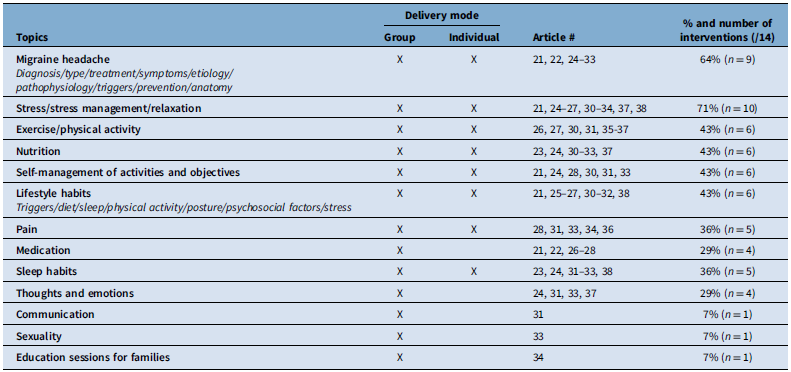
Education is defined as a step-by-step process integrated into the care approach. Reference Deccache and Lavendhomme40 It aims at increasing patients’ understanding of their disease and treatments so that they can take charge of their health. Education also promotes a return to normal activities according to some. Reference Deccache and Lavendhomme40,Reference Fournier41 All the interventions reviewed addressed education (100%). Education sessions covered 13 different topics. The 2 most frequently addressed topics were (1) the migraine headache itself (etiology, treatments, symptoms, etc.) in 9 of the 14 interventions (79%) and stress (stress management, relaxation) in 10 of the 14 interventions (71%). Eleven other topics were also addressed, but only one concerned the family directly. Reference Zheng, Tepper, Covington, Mathews and Scheman34 See Table 2 for more details. Eight topics were addressed in both group and individual sessions, and four were addressed exclusively in group sessions.
Topics addressed in educational activities

The duration of the education sessions ranged from 1 hour to 2.5 hours per session but was not specified for half of the interventions. Reference Barton, Schultz, Jarrell and Becker23,Reference Magnusson, Riess and Becker24,Reference Donath, Luttenberger, Geiß, Albert and Fraunberger28,Reference Lemstra, Stewart and Olszynski30,Reference Krause, Stillman, Tepper and Zajac33–Reference Zeeberg, Olesen and Jensen36 Group delivery mode was used in 13 of the 14 interventions (93%). Individual education sessions were also used in 10 of the 14 interventions (71%). Reference Gaul, Brömstrup, Fritsche, Diener and Katsarava21–Reference Donath, Luttenberger, Geiß, Albert and Fraunberger28,Reference Lemstra, Stewart and Olszynski30–Reference Blumenfeld and Tischio32,Reference Jensen, Zeeberg, Dehlendorff and Olesen35,Reference Zeeberg, Olesen and Jensen36,Reference Mihaiu, Debucean, Mihancea, Maghiar and Marcu38
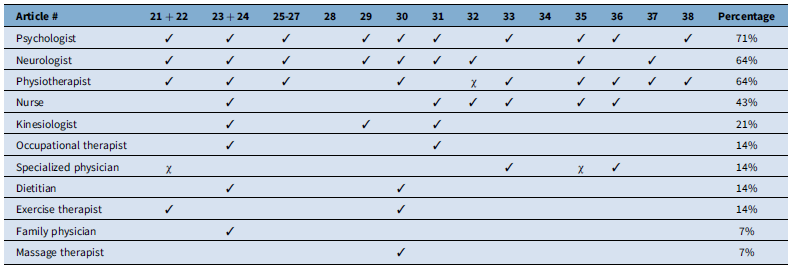
The four types of healthcare providers most frequently involved in education activities were psychologists Reference Gaul, Brömstrup, Fritsche, Diener and Katsarava21–Reference Wallasch, Angeli and Kropp27,Reference Gunreben-Stempfle, Grießinger, Lang, Muehlhans, Sittl and Ulrich29,Reference Lemstra, Stewart and Olszynski30,Reference Krause, Stillman, Tepper and Zajac33,Reference Mihaiu, Debucean, Mihancea, Maghiar and Marcu38 (57%), neurologists Reference Gaul, Brömstrup, Fritsche, Diener and Katsarava21–Reference Wallasch, Angeli and Kropp27,Reference Gunreben-Stempfle, Grießinger, Lang, Muehlhans, Sittl and Ulrich29,Reference Lemstra, Stewart and Olszynski30,Reference Blumenfeld and Tischio32,Reference Helmerson, Sundholm, Hedborg, Waldenlind, Kierkegaard and Remahl37 (50%), physical therapists Reference Gaul, Brömstrup, Fritsche, Diener and Katsarava21–Reference Wallasch, Angeli and Kropp27,Reference Lemstra, Stewart and Olszynski30,Reference Jensen, Zeeberg, Dehlendorff and Olesen35,Reference Zeeberg, Olesen and Jensen36 (43%) and nurses Reference Barton, Schultz, Jarrell and Becker23,Reference Magnusson, Riess and Becker24,Reference Blumenfeld and Tischio32,Reference Krause, Stillman, Tepper and Zajac33,Reference Jensen, Zeeberg, Dehlendorff and Olesen35,Reference Zeeberg, Olesen and Jensen36 (36%). Other healthcare providers who were marginally involved included occupational therapists, nutritionists, kinesiologists, sports therapists and doctors.
Self-management
According to Lorig, Reference Lorig42 self-management is the learning and practice of skills needed to lead an active and emotionally satisfying life in the face of chronic illness. Only 4 of the 14 interventions (29%) clearly mentioned a self-management goal. Reference Barton, Schultz, Jarrell and Becker23–Reference Wallasch, Angeli and Kropp27,Reference Lemstra, Stewart and Olszynski30,Reference Sauro and Becker31 Of these, two interventions (50%) detailed the content of their self-management workshop. Reference Magnusson, Riess and Becker24,Reference Sauro and Becker31 One self-management workshop Reference Sauro and Becker31 focused on the following: learning to self-monitor the stress response and the basics of relaxation and breathing, pacing activities and balancing lifestyles, cognitive restructuring, communication styles and creating coping plans. This workshop consisted of five 2-hour sessions held once a week for 5 consecutive weeks. The other self-management workshop Reference Magnusson, Riess and Becker24 addressed the topics of self-monitoring, relaxation, distraction, pacing, cognitive restructuring and communication.
Workshops were delivered in group mode in three interventions (75%) Reference Barton, Schultz, Jarrell and Becker23–Reference Wallasch, Angeli and Kropp27,Reference Sauro and Becker31 ; no delivery mode (group or individual) was specified for the fourth intervention (25%). Reference Lemstra, Stewart and Olszynski30 The self-management workshop was offered either by a psychologist, an occupational therapist or a nurse in one intervention (25%), Reference Lipton, Buse and Nahas10,Reference Arksey and O’Malley17 and by a “non-physician professional” in another intervention (25%). Reference Sauro and Becker31 The healthcare provider was not specified in two interventions (50%). Reference Wallasch and Hermann25–Reference Wallasch, Angeli and Kropp27,Reference Lemstra, Stewart and Olszynski30
Stress management techniques
According to Murphy, Reference Murphy43 stress management interventions were defined as techniques designed to help employees modify their appraisal of stressful situations or deal more effectively with the symptoms of stress. Stress management techniques were specifically mentioned in 5 of the 14 interventions (36%). Reference Gaul, Brömstrup, Fritsche, Diener and Katsarava21,Reference Gunreben-Stempfle, Grießinger, Lang, Muehlhans, Sittl and Ulrich29,Reference Jensen, Zeeberg, Dehlendorff and Olesen35,Reference Zeeberg, Olesen and Jensen36,Reference Mihaiu, Debucean, Mihancea, Maghiar and Marcu38 Cognitive and behavioral techniques were used in three of these five interventions (60%), Reference Gunreben-Stempfle, Grießinger, Lang, Muehlhans, Sittl and Ulrich29,Reference Jensen, Zeeberg, Dehlendorff and Olesen35,Reference Zeeberg, Olesen and Jensen36 while “stress management strategies” were reported in the other two (40%). Reference Gaul, Brömstrup, Fritsche, Diener and Katsarava21,Reference Mihaiu, Debucean, Mihancea, Maghiar and Marcu38 Only one intervention (20%) Reference Gunreben-Stempfle, Grießinger, Lang, Muehlhans, Sittl and Ulrich29 specified a session duration, which was 2 hours per week. Four interventions used group sessions, Reference Gaul, Brömstrup, Fritsche, Diener and Katsarava21,Reference Gunreben-Stempfle, Grießinger, Lang, Muehlhans, Sittl and Ulrich29,Reference Jensen, Zeeberg, Dehlendorff and Olesen35,Reference Zeeberg, Olesen and Jensen36 and one was offered individually. Reference Mihaiu, Debucean, Mihancea, Maghiar and Marcu38 The healthcare providers involved were a psychologist in three interventions (60%), Reference Jensen, Zeeberg, Dehlendorff and Olesen35,Reference Zeeberg, Olesen and Jensen36,Reference Mihaiu, Debucean, Mihancea, Maghiar and Marcu38 a psychologist and neurologist in the fourth intervention (20%) Reference Gunreben-Stempfle, Grießinger, Lang, Muehlhans, Sittl and Ulrich29 and not specified in the fifth intervention (20%). Reference Gaul, Brömstrup, Fritsche, Diener and Katsarava21
Relaxation techniques
According to Lehrer and al., Reference Lehrer, Woolfolk and Sime44 relaxation techniques encompass a variety of approaches designed to promote mental and physical relaxation, thus alleviating stress and fostering well-being. Overall, 11 of the 14 interventions (79%) used relaxation techniques. Reference Gaul, Brömstrup, Fritsche, Diener and Katsarava21–Reference Magnusson, Riess and Becker24,Reference Wallasch and Kropp26–Reference Gunreben-Stempfle, Grießinger, Lang, Muehlhans, Sittl and Ulrich29,Reference Sauro and Becker31,Reference Krause, Stillman, Tepper and Zajac33,Reference Jensen, Zeeberg, Dehlendorff and Olesen35,Reference Helmerson, Sundholm, Hedborg, Waldenlind, Kierkegaard and Remahl37,Reference Mihaiu, Debucean, Mihancea, Maghiar and Marcu38 These included progressive muscle relaxation Reference Alhawatmeh, Albataineh and Abuhammad45,Reference Jacobson46 in seven interventions (64%) Reference Gaul, van Doorn and Webering22–Reference Magnusson, Riess and Becker24,Reference Wallasch and Kropp26–Reference Gunreben-Stempfle, Grießinger, Lang, Muehlhans, Sittl and Ulrich29,Reference Sauro and Becker31,Reference Helmerson, Sundholm, Hedborg, Waldenlind, Kierkegaard and Remahl37 ; applied relaxation Reference Hayes-Skelton, Roemer, Orsillo and Borkovec47 Reference Gaul, van Doorn and Webering22,Reference Donath, Luttenberger, Geiß, Albert and Fraunberger28,Reference Krause, Stillman, Tepper and Zajac33 and biofeedback relaxation Reference Sauro and Becker31,Reference Jensen, Zeeberg, Dehlendorff and Olesen35,Reference Zeeberg, Olesen and Jensen36 in three (27%); visualization and autogenics training Reference Linden, Lehrer, Woolfolk and Sime48 in two (18%) Reference Barton, Schultz, Jarrell and Becker23,Reference Magnusson, Riess and Becker24,Reference Sauro and Becker31 ; deep breathing, body scan, pain transformation, meditation and relaxation in one (9%) Reference Barton, Schultz, Jarrell and Becker23,Reference Magnusson, Riess and Becker24 ; “strategies of muscle relaxation” in another intervention (9%) Reference Gaul, Brömstrup, Fritsche, Diener and Katsarava21 ; and lastly, “relaxation training” and “additional relaxation techniques” (with no further clarification) in two interventions (18%). Reference Krause, Stillman, Tepper and Zajac33,Reference Mihaiu, Debucean, Mihancea, Maghiar and Marcu38 Session duration varied from 45 minutes to 2 hours each and was not specified in six interventions (54%) Reference Gaul, Brömstrup, Fritsche, Diener and Katsarava21,Reference Barton, Schultz, Jarrell and Becker23,Reference Magnusson, Riess and Becker24,Reference Donath, Luttenberger, Geiß, Albert and Fraunberger28,Reference Krause, Stillman, Tepper and Zajac33,Reference Jensen, Zeeberg, Dehlendorff and Olesen35,Reference Zeeberg, Olesen and Jensen36 . Reference Gaul, Brömstrup, Fritsche, Diener and Katsarava21,Reference Barton, Schultz, Jarrell and Becker23,Reference Magnusson, Riess and Becker24,Reference Donath, Luttenberger, Geiß, Albert and Fraunberger28,Reference Krause, Stillman, Tepper and Zajac33,Reference Jensen, Zeeberg, Dehlendorff and Olesen35,Reference Zeeberg, Olesen and Jensen36 Home exercises had to be performed every day. For 10 of the 11 interventions (91%), relaxation techniques were offered in group sessions. Reference Gaul, Brömstrup, Fritsche, Diener and Katsarava21–Reference Gunreben-Stempfle, Grießinger, Lang, Muehlhans, Sittl and Ulrich29,Reference Sauro and Becker31,Reference Krause, Stillman, Tepper and Zajac33,Reference Jensen, Zeeberg, Dehlendorff and Olesen35–Reference Helmerson, Sundholm, Hedborg, Waldenlind, Kierkegaard and Remahl37 Three interventions (27%) Reference Wallasch and Kropp26,Reference Gunreben-Stempfle, Grießinger, Lang, Muehlhans, Sittl and Ulrich29,Reference Mihaiu, Debucean, Mihancea, Maghiar and Marcu38 also offered relaxation exercises at home. In four interventions, relaxation sessions were offered by a psychologist (36%). Reference Gaul, van Doorn and Webering22,Reference Jensen, Zeeberg, Dehlendorff and Olesen35,Reference Zeeberg, Olesen and Jensen36,Reference Mihaiu, Debucean, Mihancea, Maghiar and Marcu38 The relaxation sessions were offered by either a nurse, Reference Krause, Stillman, Tepper and Zajac33 a non-physician professional, Reference Sauro and Becker31 a physiotherapist Reference Helmerson, Sundholm, Hedborg, Waldenlind, Kierkegaard and Remahl37 or a neurologist and a psychologist combined. Reference Gunreben-Stempfle, Grießinger, Lang, Muehlhans, Sittl and Ulrich29 The healthcare provider involved was not specified in four interventions (36%). Reference Gaul, Brömstrup, Fritsche, Diener and Katsarava21,Reference Barton, Schultz, Jarrell and Becker23,Reference Magnusson, Riess and Becker24,Reference Wallasch and Kropp26–Reference Donath, Luttenberger, Geiß, Albert and Fraunberger28
Biofeedback
Biofeedback has been defined by Huang et al. Reference Huang, Wolf and He49 as the use of instrumentation to make covert physiological processes more overt; it also includes electronic options for shaping appropriate responses. The equipment used and the physiological parameter targeted were not reported in any of the articles. Of the 14 interventions reviewed, six (43%) Reference Gunreben-Stempfle, Grießinger, Lang, Muehlhans, Sittl and Ulrich29,Reference Sauro and Becker31–Reference Krause, Stillman, Tepper and Zajac33,Reference Jensen, Zeeberg, Dehlendorff and Olesen35,Reference Zeeberg, Olesen and Jensen36 reported using biofeedback. In 50% of these interventions, Reference Sauro and Becker31,Reference Jensen, Zeeberg, Dehlendorff and Olesen35,Reference Zeeberg, Olesen and Jensen36 biofeedback was presented as a relaxation technique, and in one intervention (17%), Reference Sauro and Becker31 it was combined with other relaxation techniques. Only one intervention (17%) Reference Blumenfeld and Tischio32 specified session duration, which was 30 minutes. Although biofeedback is often an individualized activity in general practice, it was mainly offered in group settings (67%), Reference Sauro and Becker31,Reference Blumenfeld and Tischio32,Reference Jensen, Zeeberg, Dehlendorff and Olesen35,Reference Zeeberg, Olesen and Jensen36 and marginally offered individually in two (33%) interventions. Reference Gunreben-Stempfle, Grießinger, Lang, Muehlhans, Sittl and Ulrich29,Reference Krause, Stillman, Tepper and Zajac33 Psychologists were cited as the main professionals conducting the activity (50%). Reference Krause, Stillman, Tepper and Zajac33,Reference Jensen, Zeeberg, Dehlendorff and Olesen35,Reference Zeeberg, Olesen and Jensen36
Psychological intervention
According to Hodges and al., Reference Hodges, Walker and Kleiboer50 the aim of psychological intervention is to promote significant changes in the client’s cognitive, emotional or behavioral functioning, interpersonal system, personality or state of health. However, in the interventions reviewed, “psychological intervention” was poorly defined, if at all, and its content varied greatly. This type of activity was identified in 9 of the 14 interventions (64%). Reference Gaul, van Doorn and Webering22–Reference Magnusson, Riess and Becker24,Reference Donath, Luttenberger, Geiß, Albert and Fraunberger28,Reference Gunreben-Stempfle, Grießinger, Lang, Muehlhans, Sittl and Ulrich29,Reference Sauro and Becker31,Reference Krause, Stillman, Tepper and Zajac33–Reference Jensen, Zeeberg, Dehlendorff and Olesen35,Reference Mihaiu, Debucean, Mihancea, Maghiar and Marcu38 All such activities were offered in individual sessions, with more than half adding some group sessions. Reference Gaul, van Doorn and Webering22,Reference Barton, Schultz, Jarrell and Becker23,Reference Zheng, Tepper, Covington, Mathews and Scheman34–Reference Zeeberg, Olesen and Jensen36 Only two interventions Reference Gaul, van Doorn and Webering22,Reference Mihaiu, Debucean, Mihancea, Maghiar and Marcu38 specified a duration for this activity: a single 1-hour session. Only one of the nine interventions (11%] Reference Barton, Schultz, Jarrell and Becker23,Reference Magnusson, Riess and Becker24 offered a family-only workshop. The content of the psychological intervention reported in the studies overlapped with that of several other activities. The psychological approaches used were mainly cognitive behavioral therapy (CBT) Reference Wallasch, Angeli and Kropp27–Reference Gunreben-Stempfle, Grießinger, Lang, Muehlhans, Sittl and Ulrich29,Reference Zheng, Tepper, Covington, Mathews and Scheman34,Reference Zeeberg, Olesen and Jensen36 and behavioral therapy, Reference Gaul, van Doorn and Webering22,Reference Zheng, Tepper, Covington, Mathews and Scheman34 with marginal use of counseling Reference Barton, Schultz, Jarrell and Becker23,Reference Mihaiu, Debucean, Mihancea, Maghiar and Marcu38 and psychodynamic therapy. Reference Zheng, Tepper, Covington, Mathews and Scheman34 Psychological interventions were provided by a psychologist in six of the nine interventions (67%). Reference Gaul, van Doorn and Webering22–Reference Magnusson, Riess and Becker24,Reference Gunreben-Stempfle, Grießinger, Lang, Muehlhans, Sittl and Ulrich29,Reference Krause, Stillman, Tepper and Zajac33,Reference Jensen, Zeeberg, Dehlendorff and Olesen35,Reference Mihaiu, Debucean, Mihancea, Maghiar and Marcu38 The healthcare provider was not specified for three of the nine (33%). Reference Donath, Luttenberger, Geiß, Albert and Fraunberger28,Reference Sauro and Becker31,Reference Zheng, Tepper, Covington, Mathews and Scheman34
Which types of professionals were involved in the intervention activities?
Table 3 shows the professionals specifically involved in the studied interventions. In some studies, other external professionals, such as anesthetists, psychiatrists, dentists, medical specialists or physiotherapists, were involved if the headaches were related to a specific pathology (e.g., an oral problem), but they are not listed here.
Professionals involved in the intervention activities

✓ Professionals involved. χ Professionals involved only in specific cases. (Blank space) Therapist not reported.
What assessment tools are used to document progress and outcomes (secondary question)?
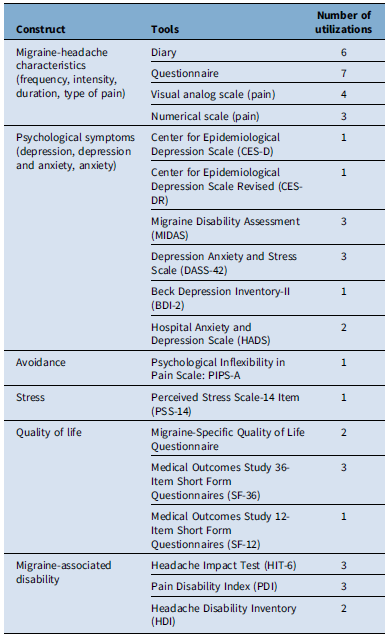
As shown in Table 4, the included articles mentioned various tools that could also be used by clinicians to assess progress and intervention outcomes. All the studies used an outcome related to migraine-headache characteristics (frequency, intensity, etc.). These outcomes were assessed by using either a questionnaire, a diary, a visual analog scale or a numerical scale. Psychological outcomes (depression, depression and anxiety) were assessed in 10 of the 14 interventions (71%) using the Center for Epidemiological Depression Scale (revised or not), the Migraine Disability Assessment, the Depression Anxiety and Stress Scale-42, the Beck Depression Inventory-II or the Hospital Anxiety and Depression Scale. Reference Gaul, Brömstrup, Fritsche, Diener and Katsarava21,Reference Wallasch and Kropp26,Reference Gunreben-Stempfle, Grießinger, Lang, Muehlhans, Sittl and Ulrich29–Reference Zheng, Tepper, Covington, Mathews and Scheman34,Reference Helmerson, Sundholm, Hedborg, Waldenlind, Kierkegaard and Remahl37,Reference Mihaiu, Debucean, Mihancea, Maghiar and Marcu38 Avoidance and stress were assessed in a single study using the Psychological Inflexibility in Pain Scale and the Perceived Stress Scale 14 Item, respectively. Reference Helmerson, Sundholm, Hedborg, Waldenlind, Kierkegaard and Remahl37 Quality of life was assessed in 3 of the 14 interventions (21%) using the SF-36, SF-12 or Migraine-Specific Quality of Life Questionnaire. Reference Gunreben-Stempfle, Grießinger, Lang, Muehlhans, Sittl and Ulrich29,Reference Blumenfeld and Tischio32,Reference Helmerson, Sundholm, Hedborg, Waldenlind, Kierkegaard and Remahl37
Lastly, the impact of migraine/headache was assessed in 6 of the 14 interventions (43%) using the Headache Impact Test, the Pain Disability Index or the Headache Disability Inventory. Reference Magnusson, Riess and Becker24,Reference Lemstra, Stewart and Olszynski30,Reference Sauro and Becker31,Reference Krause, Stillman, Tepper and Zajac33,Reference Zheng, Tepper, Covington, Mathews and Scheman34,Reference Helmerson, Sundholm, Hedborg, Waldenlind, Kierkegaard and Remahl37
Discussion
This study aimed to systematically map the activities of multidisciplinary rehabilitation interventions for people with migraines and the tools used to document progress and outcomes. Our results show that interventions for migraine are very diverse. Medication management, education and exercise seem to be the pillars of management for patients with migraine. The results lead us to a few observations.
Structure of reported interventions
Our study found that intervention activities for migraine fall under seven main themes (medication management, exercise, education, self-management, stress management technique, relaxation technique, biofeedback and psychological intervention). Exercise therapy, which can be composed of aerobic exercise, resistance exercise, flexibility or other modalities such as tai chi, is recommended for the treatment of EP. Reference La Touche, Fierro-Marrero and Sánchez-Ruíz51 Exercise, notably aerobic, shows efficacy in reducing the frequency, intensity and duration of migraine attacks. Reference La Touche, Fierro-Marrero and Sánchez-Ruíz51,Reference La Touche, Fernández Pérez and Proy Acosta52 Similarly, education and self-management for identifying the triggers of migraine attacks and lifestyle modifications form the crux of migraine management and are recommended in recent guidelines for decreasing pain frequency, pain intensity and migraine duration. Reference La Touche, Fierro-Marrero and Sánchez-Ruíz51,Reference Robblee and Starling53 Other interventions related to stress management techniques or psychological interventions, such as CBT, show positive results in terms of reducing the number of migraine attacks. Reference Bae, Sung and Kwon54 Biofeedback, frequently associated with other types of treatment, helps to modulate stress Reference Sturgeon, Ehde, Darnall, Barad, Clauw and Jensen55 and reduce headache duration and intensity. Reference Nestoriuc and Martin56 Finally, relaxation techniques can help decrease the frequency of EP attacks. Reference La Touche, Fierro-Marrero and Sánchez-Ruíz51
Several articles conclude that these techniques for treating headaches are effective in diminishing many of the characteristics of migraine (frequency, duration, intensity). A few studies evaluate combinations of interventions, and they find that these treatments are only effective for EP, whereas dedicated studies on CM are lacking. Reference Blumenfeld, Lipton, Silberstein, Tepper, Charleston and Landy57 In addition, many experimental groups are composed of people with multiple types of headaches, whether primary or secondary. The diagnosis of CM is not simple. Older studies describe a combination of tension-type headache and migraine, which would probably be diagnosed now as CM since the update of the ICHD-3 classification. European countries were historically more prone to separate tension-type headache from migraine. Medication overuse headache was also used as a separate diagnosis from CM until the ICHD-3 classification, where it can be diagnosed in combination with CM. Hence, we surmise that many of the studies retained in our analysis included more patients with CM than they described, due to the evolution of diagnostic criteria.
Need to rethink interventions
We observed the absence of a formal program theory underpinning the proposed interventions. Program theory is “an explicit conceptual framework of how an intervention contributes to a set of specific outcomes through a series of intermediate results.” Reference Olsson, Kapetanovic, Hollertz, Starke and Skoog58 It outlines the problems and their underlying causes and describes the corrective interventions, expected results and mechanisms underlying these results. Lastly, it describes how the impact of the intervention is evaluated. Reference Davidoff, Dixon-Woods, Leviton and Michie59 In our scoping review, the included studies tended to emphasize the need for interventions to decrease the burden of migraine. However, the corrective activities were not described in great detail, which hinders the reproducibility and implementation of these strategies.
Solutions are now available for the standardized reporting of interventions to facilitate their use (e.g., Hoffman et al. Reference Hoffmann, Glasziou and Boutron20 ). In the articles analyzed, the methods by which the interventions acted on the problem are not clearly defined by the authors. As we have already seen, most of the interventions were shown to be effective for migraine. However, while the cohorts included people with several types of headaches, no information was provided on the underlying mechanisms that would enable an understanding of how the intervention worked on each type of headache. An explanation of these mechanisms would have provided a better understanding of the phenomena at work.
In addition, although patients’ self-management of their symptoms and migraine triggers seems to be at the heart of most interventions, no definitions are proposed. Jonkman et al. Reference Jonkman, Schuurmans, Jaarsma, Shortridge-Baggett, Hoes and Trappenburg60 defined self-management as interventions aimed at equipping patients with skills to actively participate and take responsibility for managing their chronic condition in order to function optimally. They regard this as achievable through knowledge acquisition and a combination of at least two of the following: stimulation of independent sign/symptom monitoring, medication management, enhancing problem-solving and decision-making skills for medical treatment management and changing clients’ physical activity, dietary and/or smoking behavior. Although definitions are lacking in most articles, it is necessary to structure self-management programs. Reference Dineen-Griffin, Garcia-Cardenas, Williams and Benrimoj61 Also, interventions do not appear to be individualized according to people’s needs, but rather to have a standard content.
Based on our review of the tools used, outcomes are generally measured by changes in migraine characteristics (e.g., frequency and intensity), associated disabilities or related psychological symptoms. Few studies analyze whether the interventions actually have an impact on what they are intended to change. In addition to the absence of a program theory, the results measured are not always related to the activity deployed. For example, the use of education strategies assumes that the acquisition of knowledge leads to a change in behavior. However, studies tend not to measure whether patients increase their knowledge levels because of this intervention. This means that any variation or lack of variation in behavior cannot be directly linked to education. The absence of an initial theory and suitable assessment system could lead to misleading conclusions. Moreover, although all the articles in our scoping review described the themes addressed and the duration of the intervention activities, none of them addressed the learning theory on which the education component was based. Yet the learning theory forms the basis for choosing certain teaching methods and measuring their effects on appropriate learning objectives. The absence of an explicitly described learning theory makes it impossible to define how this is achieved and leaves little scope for replication.
Therefore, interventions for CM require a better theoretical framework, including reporting on the gaps observed, the objectives sought by researchers, the resources implemented to achieve these objectives, the theoretical justification of the objectives and a rigorous methodology for evaluating the effectiveness of interventions. In addition, education and self-management need to be defined, and the underlying program theory must be described. This process would make it possible to improve the effectiveness, replication and implementation of interventions. Reference Blumenfeld, Lipton, Silberstein, Tepper, Charleston and Landy57,Reference Wallner, Mayer and Adlbrecht62
Conclusion
Migraine management is generally multidisciplinary, involving a variety of interventions ranging from exercise and psychological treatments to medication management, lifestyle changes and stress management techniques. Depending on their nature, these interventions are offered in either individual or group delivery mode. The lack of program theory and randomized studies of multimodal interventions has resulted in a diverse range of interventions that are not always evidence-based. Although consensus exists on the treatment of people with acute migraine, Reference Ailani, Burch and Robbins63 the long-term objectives of using a combination of interventions for CM still have to be worked out. Reference Blumenfeld, Lipton, Silberstein, Tepper, Charleston and Landy57 Also, given that migraine is recognized as a complex condition Reference Blumenfeld, Lipton, Silberstein, Tepper, Charleston and Landy57 and that the proposed interventions still appear to be largely unindividualized, the question remains as to whether the current content meets patients’ needs.
Construct and measurement tools in the included articles

As some studies used more than one instrument to measure the same construct, the total number of instruments used may exceed the total number of studies.
Author contributions
MJD and MFC contributed to the study concept and design. KD and MAP conducted the literature search. MJD, MFC, TG, KD, MPR and PG conducted the analysis. MJD, MFC, TG, EL, SL and MAP prepared the initial manuscript. All authors were involved in critically reviewing the manuscript for important intellectual content. All authors approved the final manuscript.
Funding statement
This study was financially supported by Nestlé and the J. Armand Bombardier – Pratt & Whitney Canada Research Chair in Work Rehabilitation.
Competing interests
The authors have no competing interests to declare.
Role of funders
The funders had no role in the design and conduct of the study; data collection; management, analysis and interpretation of the data; preparation, review or approval of the manuscript; and decision to submit the manuscript for publication.
Availability of data and materials
The datasets used and/or analyzed during the current study are available from the corresponding author upon reasonable request.