Introduction
In 2018, lung cancer (LC) was the most frequent and most deadly neoplasm in the world (Ferlay et al., Reference Ferlay, Colombet and Soerjomataram2018). LC patients are often diagnosed in advanced stages and have shown a tendency to have more frequent and severe emotional symptoms than other cancer populations (Walker et al., Reference Walker, Hansen and Martin2014; Diaz-Frutos et al., Reference Diaz-Frutos, Baca-Garcia and García-Foncillas2016), including hopelessness, anxiety, and depression (Salminen et al., Reference Salminen, Silvoniemi and Syrjänen2013; Diaz-Frutos et al., Reference Diaz-Frutos, Baca-Garcia and García-Foncillas2016). It is estimated that between 25% and 39% of these patients have emotional distress (Carlsen et al., Reference Carlsen, Jensen and Jacobsen2005; Ugalde et al., Reference Ugalde, Aranda and Krishnasamy2012; Mosher et al., Reference Mosher, Winger and Hanna2014). In Mexico, around a third of LC patients have reported anxiety and depression (Arrieta et al., Reference Arrieta, Angulo and Núñez-Valencia2013; Gonzalez-Ling et al., Reference Gonzalez-Ling, De La Torre-Vallejo and Luvian-Morales2017).
Quality of life (QoL) is a crucial factor in this population, and it is well known that lower levels of QoL are associated with the presence of emotional distress and stigma (Cataldo et al., Reference Cataldo, Jahan and Pongquan2012; Gonzalez and Jacobsen, Reference Gonzalez and Jacobsen2012; Aukst Margetic et al., Reference Aukst Margetic, Kukulj and Santic2013). Among patients’ most frequent unmet needs are dealing with their family's fears and concerns, being physically dependent, frustration for not being able to do the same things as before, fear of upcoming physical decline, and worries about their family's ability to take care of them. These themes resonate deeply with elements of the model of dignity in the terminally ill (Chochinov et al., Reference Chochinov, Hack and McClement2002) and focus on attributes of personhood that are integral to their sense of self.
The unfavorable prognosis of LC, including the deterioration in QoL, emotional distress, unmet needs, and stigma point to the need to consider their dignity. Dignity Therapy (DT) is a brief evidence-based psychotherapeutic intervention aimed to promote a patient's dignity and emotional well-being in the face of life-threatening diseases (Chochinov, Reference Chochinov2012). In this intervention, patients record a facilitated hour length audio-taped interview based on a list of questions about their life experiences, accomplishments, their hopes and dreams for their loved ones, lessons learned, or any type of message they would like to express (Chochinov, Reference Chochinov2012). The interview is transcribed and edited with the objective to create a Generativity Document that the patient can share with whomever they choose (Chochinov, Reference Chochinov2012).
Both patients with advanced diseases and recipients of the document have shown excellent satisfaction with the intervention, and patients have reported benefit in dignity-related distress, suffering, spiritual well-being, hope, will to live, meaning, and purpose in life (Chochinov et al., Reference Chochinov, Hack and Hassard2005, Reference Chochinov, Kristjanson and Breitbart2011; Fitchett et al., Reference Fitchett, Emanuel and Handzo2015). Systematic reviews have pointed out that the benefit based on patient feedback is clear. However, improvement on standardized psychometric measures has been hard to demonstrate, mostly because several trials have included patients with low baseline distress levels (Fitchett et al., Reference Fitchett, Emanuel and Handzo2015; Donato et al., Reference Donato, Matuoka and Yamashita2016; Martínez et al., Reference Martínez, Arantzamendi and Belar2017; Xiao et al., Reference Xiao, Chow and Liu2019). By contrast, trials with higher baseline distress (Julião et al., Reference Julião, Oliveira and Nunes2014) have found statistically significant improvements in anxiety and depression.
There is evidence that DT has been applied in diverse cultural contexts (Fitchett et al., Reference Fitchett, Emanuel and Handzo2015) with satisfactory results, but the only evidence we found of its use in a Spanish speaking population was in Spain (Javaloyes Bernácer et al., Reference Javaloyes Bernácer, Botella Mira and Meléndez López2014), where satisfactory results were obtained. Therefore, the aim of this preliminary study is to analyze the effect of DT on standardized measures of anxiety, depression, hopelessness, emotional distress, dignity-related distress, and QoL in a group of Mexican patients with stage IV LC undergoing active medical treatment with baseline emotional distress.
Methods
Eligible participants for this pretest–posttest study were (a) diagnosed with stage IV LC, (b) undergoing active cancer treatment, and (c) had baseline >3 score on the Distress Thermometer. Exclusion criteria were as follows: (a) cognitive or consciousness deficit that could interfere on telling their life story and (b) psychiatric diagnosis. Elimination criteria were (a) patients’ death, (b) patient's withdrawal, or (c) physical or cognitive impairment during the study that interfered with the completion of the intervention.
Sample size was estimated a priori for two-paired samples using G*Power v.3.1 for an effect size of 0.70 (Javaloyes Bernácer et al., Reference Javaloyes Bernácer, Botella Mira and Meléndez López2014) and a statistical power of 0.95. To the 24 required participants, an extra 20% (5) were added due to potential losses, for a total of 29 patients.
Measures
Clinical characteristics were obtained from the electronic health record, INCanet. The Hospital Anxiety and Depression Scale (HADS) was used to determine the presence of anxiety or depression symptoms, and the Distress Thermometer to track emotional distress. The Patient Dignity Inventory (PDI) was used to assess patients’ perception of dignity and the European Organization for Research and Treatment of Cancer quality of life questionnaire (QLQ-30) to assess QoL. All instruments have been validated in Mexican populations (all Cronbach's alpha >0.85) (Zigmond and Snaith, Reference Zigmond and Snaith1983; Aaronson et al., Reference Aaronson, Ahmedzai and Bergman1993; NCCN, 2003; Almanza et al., Reference Almanza, Rosario and Pérez2008; Oñate-Ocaña et al., Reference Oñate-Ocaña, Alcántara-Pilar and Vilar-Compte2009; Galindo Vázquez et al., Reference Galindo Vázquez, Benjet and Juárez García2015; Chochinov et al., Reference Chochinov, Hassard and McClement2008; Rodríguez-Mayoral et al., Reference Rodríguez-Mayoral, Galindo-Vázquez and Allende-Pérez2021). Single-item questionnaires (Wilson et al., Reference Wilson, Scott and Graham2000) on an ordinal scale (0–6) for dignity and hopelessness were applied to briefly assess these constructs. After the intervention, a Patient Feedback Questionnaire was also completed by patients similarly to other DT trials (Chochinov et al., Reference Chochinov, Hack and Hassard2005, Reference Chochinov, Kristjanson and Breitbart2011; Hall et al., Reference Hall, Goddard and Opio2011).
Ethics
The protocol was approved by Mexico's National Cancer Institute Research and Ethics Committees with approval number INCAN/CI/1135/17, INCAN/CEI/973/17, and CEI/1232/17. This study conforms to the standards of the Declaration of Helsinki. The data that support the findings of this study are available on request from the corresponding author. The data are not publicly available due to ethical consideration.
Procedure
All interviews and document edition were performed by the psycho-oncologist (AGL), who has received formal training in DT. To ensure the fidelity of the intervention an intervention manual was used (Chochinov, Reference Chochinov2012), and interviews were audio taped. Eligible patients were screened at the Thoracic Oncology waiting room at the Instituto Nacional de Cancerología, Mexico, from April 2018 to June 2019. Those who agreed to participate signed the corresponding informed consent.
The appointments were scheduled according to patients’ availability. The first session included filling out questionnaires, answering questions about DT, the introduction of the question protocol and determining the recipients of the document.
The second session consisted in an hour length audio-taped interview based on the nine-question framework from the DT protocol, in which patients may speak about their life and address documents to their loved ones. Patients could ask for more recording time if necessary. As a cautionary measure, we asked patients to designate if they would want someone to receive the audio or transcription of the interview if, for some reason, they were unable to conclude the intervention.
Transcription was performed by the interviewer or a member of the Psycho-oncology research crew. Editing was completed as soon as possible. The final session was also scheduled at the patient's convenience where the Generativity Document was reviewed and could be modified by the patient. A print copy was delivered to the patient and follow-up questionnaires were completed immediately post-intervention.
To promote internal validity, patients were asked to postpone the use of other psychological interventions (i.e., cognitive behavioral therapy, or any other psychotherapies) during their participation in the study to avoid interaction between treatments. Instead, they could discuss any additional needs with the therapist who could decide whether it was necessary to end their participation in the study to attend to their symptoms.
Statistical methods
Continuous variables are reported as arithmetic means, medians, standard deviations, and ranges. Categorical variables are expressed as proportions. Differences between evaluations were analyzed using the Wilcoxon test and Student's paired t-test. Statistical significance was determined as a value of p < 0.05 with a 95% confidence interval (CI). Effect size was calculated using Cohen's d. Statistical analysis was performed with the IBM SPSS v.25 © statistical package.
Results
Of 50 eligible patients, 29 agreed to participate in the study. These patients had a median score of 5 (4–9) on the Distress Thermometer. Causes for refusal and experimental losses are described in Figure 1. As can be seen, unfortunately, two patients died after the second session due to unexpected physical worsening. They had authorized a family member to receive their Generativity Document. Their relatives were summoned, the document was read, and emotional support was provided. These patients were excluded from the analysis of results.
Patient flow diagram.

Twenty-four patients completed the intervention, causes for withdrawal are stated in Figure 1, and participants’ characteristics can be found in Table 1. Since a high percentage were from other states within Mexico (46%), due to their preference, DT appointments were held when they had a medical consultation or treatment.
Patient socio-demographic and clinical characteristics

N = 24, Age: Me. 60 years (39–87), SD = 12.52.
The median days between the first and second sessions were six days (mean: 13, SD 17.50, range: 1–73). Most patients chose to conduct the DT interview without their caregiver (23/24). The audio file of the interviews had a median duration of 43 min (mean: 40, SD: 11, range: 16–60). The median days between the second and third sessions were 20 days (mean: 19, SD: 13.22, range: 1–63). Overall, it took a median of 27 days to complete the intervention (mean: 32, SD: 21.92, range: 7–88 days). Patients were asked when they intended to share their Generativity Document, and most (19/24) wanted to share it immediately.
Dignity therapy effect
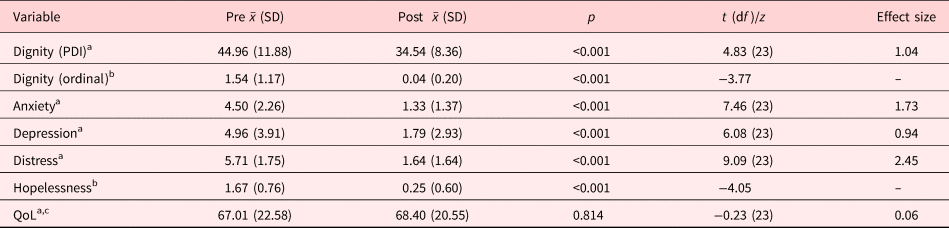
The results of the primary outcomes are shown in Table 2. In general, after completing DT, a statistically significant improvement in dignity-related distress scores was observed in the PDI (t (23) = 4.83, p < 0.001, d = 1.04) and in the dignity item (z = −3.77, p < 0.001). Anxiety (t (23) = 7.46, p < 0.001, d = 1.73), depression (t (23) = 6.08, p < 0.001, d = 0.94), emotional distress (t (23) = 9.09, p < 0.001, d = 2.45), and hopelessness (z = −4.05, p < 0.001) also showed a significant improvement after the intervention. QoL levels remained stable (t (23) = −0.23, p > 0.05). A subanalysis with patients with lower baseline QoL was performed to see if there was a difference in the outcomes but no statistically significant differences were found (all p > 0.05).
Effect of DT on dignity, anxiety, depression, distress, hopelessness, and QoL

Effect size was estimated by Cohen's d.
a Student's paired t-test.
b Wilcoxon test.
c Higher scores reflect better QoL.
Since time to completion was so variable, patient outcomes were analyzed accordingly. Patients who took 27 days or more to complete the intervention did not show any difference on psychometric variables in comparison to those who took 26 days or less (all p > 0.05).
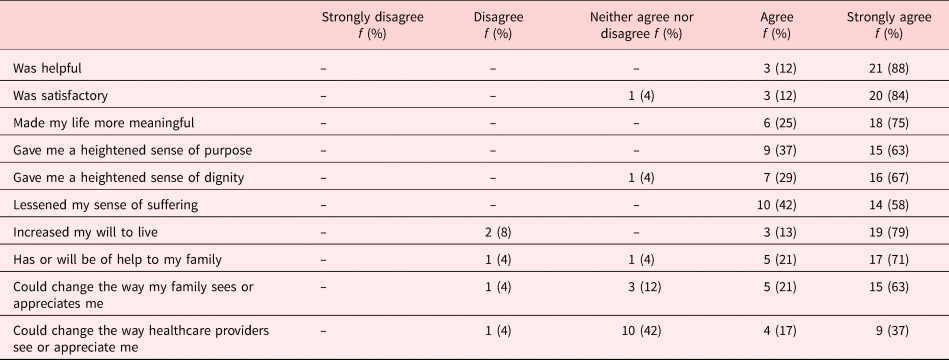
In the patient feedback questionnaire after receiving DT, most patients manifested a positive evaluation of their results (Table 3). All the patients who completed the intervention agreed or strongly agreed that DT helped them, increased their meaning and purpose in life and decreased their suffering. Most reported that their sense of dignity (96%) and their will to live (92%) increased. Seventy-two percent indicated that the Generativity Document helped or would help their family; and 84% believe that it could improve the way they are perceived by their loved ones.
Patient feedback questionnaire

Discussion
DT was well received among Mexican LC patients in this preliminary study. Dropout numbers were low; with a high rate of treatment completion that indicates patients were interested and compliant to treatment. This is also implied in the prominent levels of satisfaction (96%) on the Patient Feedback Questionnaire where participants said that DT helped them, and improved their meaning and purpose in life, suffering, sense of dignity, will to live, and could affect the way others perceive them. This supports earlier findings (Chochinov et al., Reference Chochinov, Hack and Hassard2005; Vergo et al., Reference Vergo, Nimeiri and Mulcahy2012; Johns, Reference Johns2013) where it has shown to be useful when being compared with patients receiving standard palliative care (Chochinov et al., Reference Chochinov, Kristjanson and Breitbart2011; Hall et al., Reference Hall, Goddard and Opio2011), or narrative life review interventions (Dose et al., Reference Dose, Hubbard and Sloan2016; Vuksanovic et al., Reference Vuksanovic, Green and Dyck2017).
We found no previous studies applying DT in the Latin-American population, and the degree of acceptance and our results, support the notion that DT is a brief, effective, and viable intervention for these patients. Our findings also support its effectiveness in real-world circumstances, since it was well received in a distinct cultural setting and its beneficial effect was observed in the context of public health care, where resources such as time and space are quite limited. Patients from quite different social backgrounds showed interest and appreciated the value that creating a legacy or gift for their loved ones could bring. They also found the experience helpful not only for themselves but also potentially for their families (92%). The fact that 72% of patients believe that the intervention will also have a beneficial effect for their loved ones, agrees with the study by McClement et al. (Reference McClement, Chochinov and Hack2007) suggesting that this bears further study on caregivers.
As in two earlier reports (Vergo et al., Reference Vergo, Nimeiri and Mulcahy2012; Dose et al., Reference Dose, Hubbard and Sloan2016), all patients were receiving active cancer treatment. This study suggests that implementing DT in the context of active treatment in advanced cancer patients is feasible and acceptable. Larger future studies should be conducted to confirm these promising findings.
This study focused on Mexican patients with stage IV LC in active cancer treatment. These patients have incurable cancer but may improve their QoL and aspire to considerable overall survival with noncurative cancer treatment (Lung Cancer Key Findings, 2020). Even in this context, only two patients presented difficulties regarding their ability to speak (i.e., low volume, agitation) but did not need to stop recording and reported being surprised that the hour had passed so quickly. This suggests that therapists should not exclude patients with physical symptoms and approach them in a flexible manner. When reading their Generativity Document, hopefully families and loved ones will remember the patients’ tone and voice as it was before they were sick (Chochinov, Reference Chochinov2012).
Time management is a key component of DT, where availability and interest convey a message that is dignity affirming (Chochinov, Reference Chochinov2012). This is why the time to complete the intervention was so variable (7–88 days), since we had to adapt to patient availability. Our patients had a tendency to create longer documents (Md. 11.5 pages, range 4–18) than what was previously reported (Montross et al., Reference Montross, Winters and Irwin2011) (Md. 8 pages, range 4–14), but the median number of sessions was lower in this study (3 vs. 4).
Benefit in primary outcome measures
In most of the previous studies on DT, patients had low baseline levels of distress, making it difficult to measure an improvement on standardized psychometric scales. Given the high frequency of emotional symptoms among LC patients, baseline distress was established as an inclusion criterion to avoid floor or ceiling effects, as had happened in other trials (Chochinov et al., Reference Chochinov, Kristjanson and Breitbart2011; Hall et al., Reference Hall, Goddard and Opio2011; Johns, Reference Johns2013; Houmann et al., Reference Houmann, Chochinov and Kristjanson2014).
The trial by Julião et al. (Reference Julião, Oliveira and Nunes2014), which included patients with high baseline anxiety and depression, and the trial by Javaloyes Bernácer et al. (Reference Javaloyes Bernácer, Botella Mira and Meléndez López2014), with patients with high anxiety, both reported statistically significant benefit on those measures post-DT. We too demonstrate statistically significant improvements on measures of anxiety, depression, dignity-related distress, hopelessness, and emotional distress, with large effect sizes. This supports the idea that DT has a positive effect in these variables and that it is likely that the reason other studies have struggled to prove this benefit is due to low base rates of distress.
So, while patients without distress have manifested benefit from DT on self-report surveys and existential parameters (Chochinov et al., Reference Chochinov, Kristjanson and Breitbart2011; Hall et al., Reference Hall, Goddard and Opio2011; Johns, Reference Johns2013; Houmann et al., Reference Houmann, Chochinov and Kristjanson2014), this study demonstrated that patients with depression, anxiety, dignity-related distress, and hopelessness can also obtain significant benefit and emotional relief. This is important for therapists determining who might benefit from DT; suggesting that DT may be therapeutic in both patients with psychiatric comorbidities, as well as those experiencing existential struggles that are typical of patients approaching end of life. Clearly, more research is needed to determine strategies for the broader implementation of this efficacious palliative care intervention.
LC patients have a high symptomatic burden. It is possible that this, in combination with the brevity of the intervention (Median days to completion: 27, range 7–88), resulted in no significant changes in QoL. Perhaps patients with stage IV disease are unlikely to demonstrate improvements on QoL measures, which are more heavily skewed toward physical dimensions of advanced disease. While the effect of DT on QoL in the earlier stages of disease is unknown, it is also questionable if patients in earlier stages would obtain the same benefit in variables related to sense of dignity and more existential concerns.
Study limitations
Among the limitations of this study is its design. Due to the level of literature advancement with RCTs that support the efficacy of DT, we opted for a pre–post study to evaluate the effectiveness of this intervention in real-world circumstances. The design was also chosen due to feasibility in the center where the research was conducted.
During the performance of this study, the possibility of having a historical comparison group with standard treatment was considered. Patient data from cases with similar characteristics treated in the same center were gathered. However, analyses were not feasible because statistically significant differences were found in the baseline characteristics and levels of emotional symptomatology among groups. This was a preliminary study with a small sample size; therefore, we suggest larger studies with a comparison group to be carried out in the future to confirm these results. As there is no comparison group or control group, the internal and external validity of the results is limited.
Clinical implications
DT is a useful intervention that may be applied with Latin-American stage IV LC patients undergoing cancer treatment that are experiencing emotional distress. Its use was highly satisfactory for patients and proved benefit in all outcome variables, except QoL, which remained stable. Specifically, in the context of Mexico's healthcare system, even in healthcare centers with integrated mental health services, an intervention like DT stands out since it is a brief and effective strategy that requires a small amount of resources to successfully address existential and emotional problems.
DT was highly acceptable to patients, implying that there may be a role for it to play among cohorts who are not at the end of life, when physical and emotional symptoms might make it more complex to apply. While DT may be used in this context, further research is needed to confirm its application in those settings.
In conclusion, this preliminary paper adds to a growing literature, suggesting that DT has an important role to play among distressed patients, as well as those experiencing emotional and existential issues associated with advanced cancer. Patients in active cancer treatment, which might have significant physical or emotional symptoms, may be considered to receive this intervention. Further research with a larger sample size and a control group is warranted.
Acknowledgments
Many thanks to Dr. Oscar Arrieta, who contributed to the success of this study, and to Shugely Ramos, who helped with the transcription of Generativity Documents. We would also like to acknowledge the generous help from Wreally Studios who gave us access to their manual transcription tool.
Funding
Ana Gonzalez-Ling receives funding from a scholarship from Mexico's National Council of Science and Technology (CONACYT) (Scholarship number 450429, Scholarship holder 609113).
Conflict of interest
The authors have no relevant financial or nonfinancial competing interests to report.