Introduction
All fifty states and DC allow some form of concealed carry, with most states requiring individuals to obtain a permit before they can carry.1 Concealed carry, whether with or without a license, grants broad privileges to carriers to travel with their firearm in public. Moreover, on privately owned land, many states permit invitees, guests, employees, and customers to carry concealed or unconcealed firearms onto the real property of other people unless expressly prohibited by the owner. Many states even allow uninvited strangers to enter other people's rural land with firearms to hunt unless the landowner has “posted” the property with signs prohibiting trespassing. These legal rules create right-to-carry defaults that might conflict with landowner preferences and burden the ability of private property owners to control what happens on their premises.
An early draft of a forthcoming book (Ayres & Vars, forthcoming 2020) conjectured that a “majority of homeowners do not expect or desire dinner guests or repair people to bring concealed weapons onto their property.” One of the book's anonymous reviewers responded, “Maybe in New Haven, but not necessarily in Tuscaloosa or Ft. Worth.” This study grew out of a desire to empirically test this majoritarian conjecture. To obtain information on preferences about what people think the default should be, as well as what the law is, concerning the right to carry firearms onto private land, we administered a survey to a representative sample of 2000 people across the US. In line with our findings, we argue that that there are compelling reasons to flip the right-to-carry default in favor of a “prohibited-unless-permitted” default that requires explicit permission before carrying a firearm onto private property.
Theoretical Framework
Defaults are legal rules that govern parties in the absence of some explicit contrary agreement or altering action. Altering rules are the associated laws governing the necessary and sufficient conditions for displacing a default. Majoritarian defaults are set by lawmakers to reflect what a majority of parties prefer. Setting defaults to majority preference will often be efficient because majoritarian defaults can economize on transaction costs by eliminating the need to contract around the default.
However, there are a number of reasons why minoritarian defaults might produce more efficient or more equitable outcomes. For example, if transaction costs are greater for parties in the minority, setting the default to reflect the minority's preference may allow the “low cost” majority to contract around the default more efficiently than the “high cost” minority would have.Reference Korobkin2 Alternatively, lawmakers might intentionally set defaults that are dispreferred in order to induce the parties, by their express contracting, to reveal private information. These information-forcing benefits of such “penalty” defaults have been shown to justify a variety of minoritarian defaults.Reference Ayres and Gertner3 Finally, and most relevant to what follows, minoritarian defaults might be justified by externality or paternalism concerns. When a particular contractual outcome gives rise to either of these concerns, lawmakers might choose a minoritarian default that mitigates these concerns, relying on the inertial tendency of parties to stick with the default.Reference Ayres4 An externality-reducing default can be especially effective if combined with impeding altering rules that make the default stickier.
In the context of guns, a “no guns” default might be justified as a majoritarian rule to the extent that our survey evidence finds broad support for flipping the “permitted-unless-prohibited” presumption. Or, a “no guns” default might be justified as externality-reducing, even if only a minority support this presumption. Given the inertial tendency to stick with the status quo, lawmakers should expect that a “prohibited-unlesspermitted” default would radically expand the private spaces where guns could not be carried. Reducing the number of places available for gun carriers to travel freely with their firearms might have knock-on effects, reducing preferences to carry and possess firearms more generally, as it becomes increasingly inconvenient to do so.Reference Ayres and Vars5
Legislative Landscape
Federal law prohibits concealed carry of a firearm in federal property, airports and airplanes, the Capitol building, and school areas.6 Some states have expanded upon these limitations to include places of worship, hospitals and other healthcare facilities, sports arenas, alcohol outlets, and a few other places.7
Four jurisdictions have flipped defaults for private dwellings. In Louisiana, no one “may carry [a] concealed handgun into the private residence of another without first receiving the consent of that person”8 and a similar statute exists in South Carolina.9 D.C. states that “[the] carrying of a concealed pistol on private residential property shall be presumed to be prohibited unless otherwise authorized by the property owner.”10 Arkansas requires individuals to inform a private property owner if they are carrying a firearm.11 In 2003, Alaska amended its concealed carry statute to include that, “a person commits the crime of misconduct … if the person … knowingly possesses a deadly weapon … within the residence of another person unless the person has first obtained the express permission of an adult residing there to bring a concealed deadly weapon within the residence.”12
Twenty-five states have flipped the default for hunting, requiring that hunters obtain permission before entering private property. Texas, for example, requires that hunters in counties with 3.3 million or more residents receive written permission and carry it with them so long as they are on the landowner's property.13 States that have not flipped the default often establish as an altering rule that landowners “post” their land to indicate that no trespassing is allowed. States like North Carolina14 and Missouri15 make posting land easier by allowing property owners to paint purple marks along their property line. Vermont, in contrast, requires private landowners to post “Permission Only” signs around their property line, with “the owner's name and a method by which to contact the property owner or a person authorized to provide permission” clearly printed on the posted notice.16
A few states have established “no carry” defaults for alcohol outlets17 (and churches),18 but no state has adopted generalized “no carry” defaults for retail establishments. States that recognize the rights of private property owners to control the carry of firearms onto their premises often make it burdensome to do so by imposing strict and specific altering rules, requiring, for example, posting multiple signs with minimum font sizes.19 Other states encourage retail establishments to allow carry by immunizing them from tort liability if they allow, but not if they prevent, carry.20
All states, by remaining silent, effectively adopt a carry default that allows employees to bring guns onto their employers' property unless explicitly prohibited by the employer. Twenty-five states have passed “bring your gun to work” mandatory rules that prohibit employers from banning the possession of guns in employees' cars parked in the employer's parking lot.21 Kentucky allows employees to request an injunction against any employer who “fires, disciplines, demotes, or otherwise punishes an employee who is lawfully exercising” their right to leave a firearm in their car at work.22
Finally, all states, by default, allow tenants to possess firearms in their rental units, unless the lease explicitly prohibits it. A few states go further and prohibit landlords from restricting tenant firearm possession in leases, foreclosing landlords' abilities to contract around this default.23 Some states do not allow public housing to limit gun ownership,24 but DC for example, has designated public housing as a gun-free zone.25
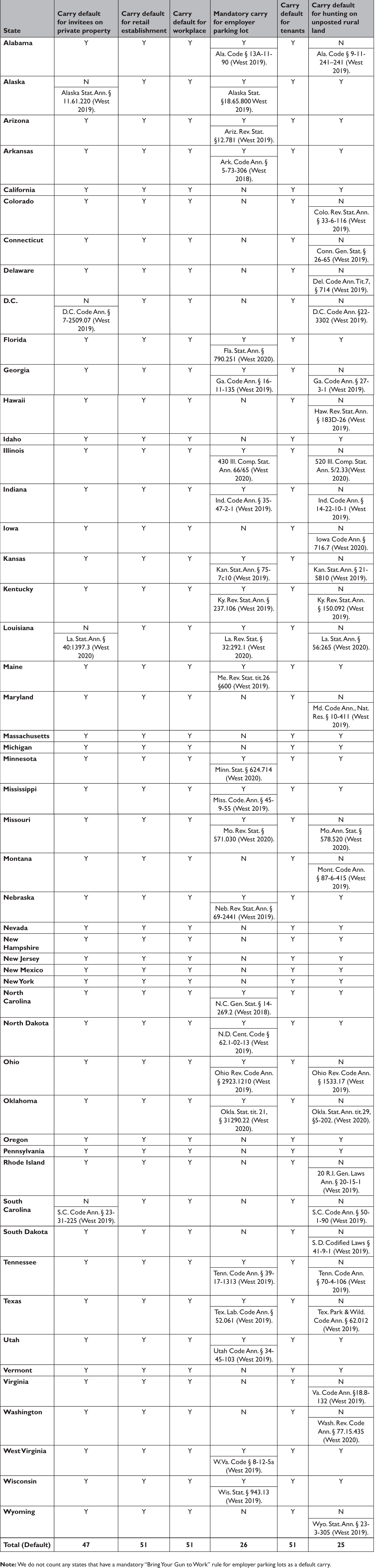
Our Online Appendix Table A1 summarizes the law in each of the fifty states and DC As it stands, fortyseven jurisdictions allow carry into private residences, twenty-six allow employees to carry a firearm onto an employer's parking lot, and twenty-five allow hunters to hunt on unposted rural lands, by default. All states have a carry default for places of employment and retail establishments (with some exceptions discussed above for bars and churches) and default or mandatory carry rights for rental units.
Methods
We distributed a survey to 2000 individuals using YouGov, a custom research company that created a representative sample of individuals across demographic groups spanning the entirety of the United States based on the 2016 American Community Survey. Our respondents were selected through sample matching, wherein the final population was matched to a randomized target frame using a Euclidean distances metric.Reference Ayres and Vars26 The observations were collected from April 7–13, 2020 and are weighted based on demographic characteristics to further ensure that the sample is representative. We framed the survey as a series of seven vignettes, each presenting a different default rule.27 We tested 5 different contexts of landowners: rural landowners, homeowners, retailers, employers, and landlords. In each context, we asked a question about what the respondent thinks the law should be, and a question about what the law is.
Our survey randomly assigned subjects to one of sixteen treatment groups in a 2x2x2x2 factorial design.28 There were two global treatments. The first primed subjects as either landowners or gun owners. For example, subjects randomly assigned to the landowner frame were given the following vignette:
You are throwing a party at your home and you find out after the party ends that one of your friends had been carrying a firearm while at the party.
Should your family and friends be allowed to carry a gun onto your property without your explicit consent?
□ Yes
□ No
Does your state currently have laws that prevent acquaintances from carrying firearms into other people's homes without their explicit consent?
□ Yes
□ No
□ I don't know
Subjects assigned to the gun-owner frame were asked the same questions, but the respondent was situated in the vignettes as the gun owner:
Your friends are throwing a party at their home. You are legally licensed to carry a gun and you do so while at the party.
We hypothesized that priming subjects to take the part of the gun-owner (landowner) might decrease (increase) respondent support for “no carry” defaults.
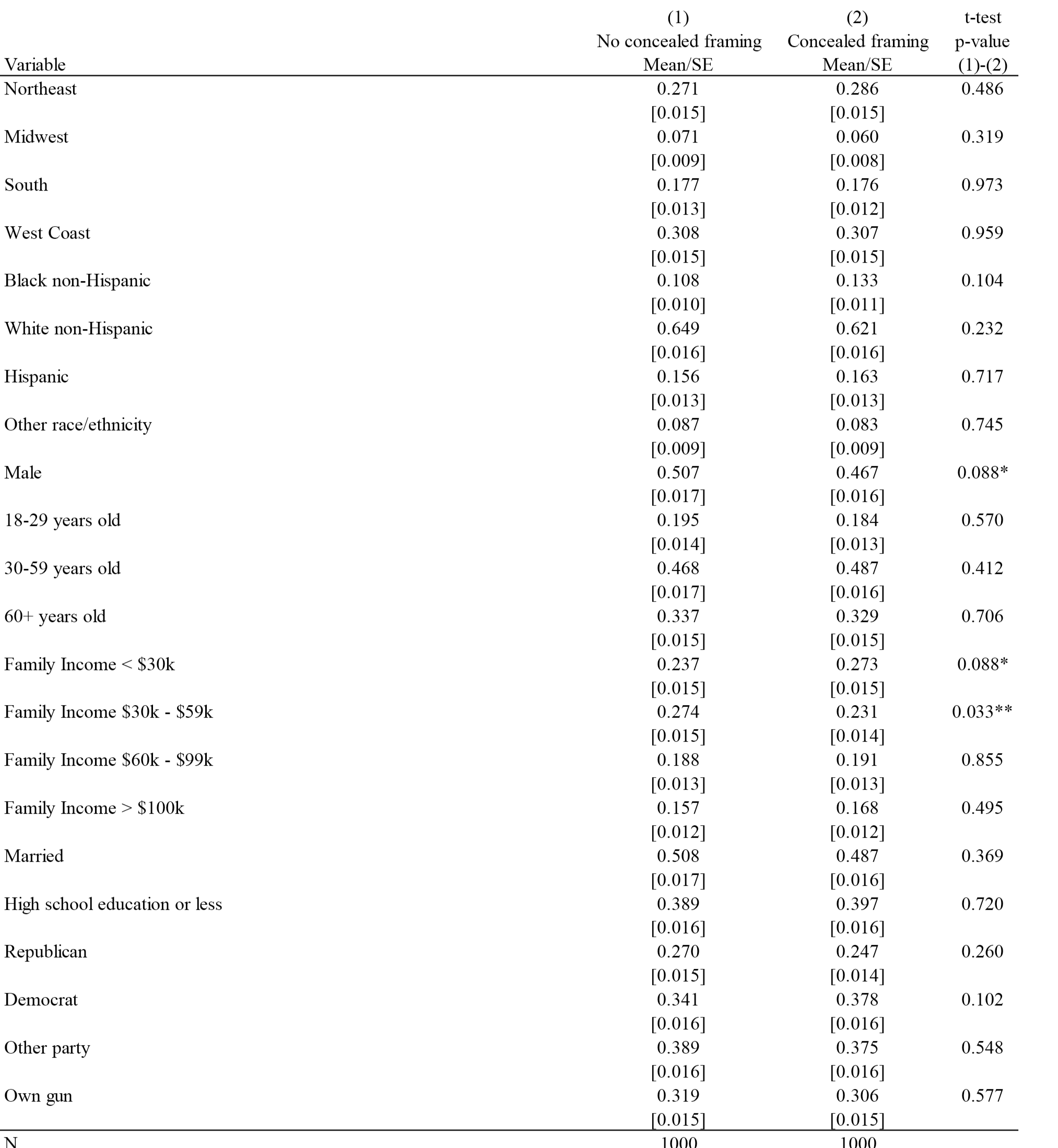
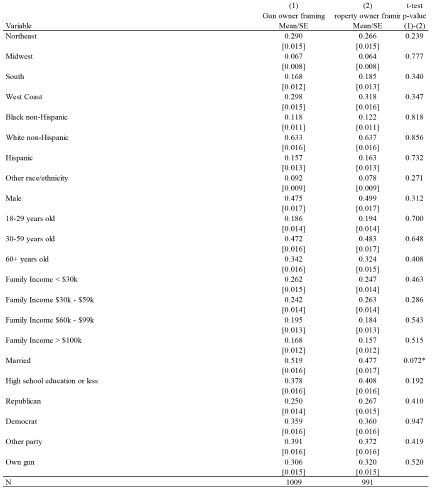
The second global treatment randomly assigned half the subjects to vignettes that included the word “concealed” in all the vignettes presented to the respondent. We hypothesized that priming subjects with vignettes emphasizing the shrouded nature of concealed carry would increase respondent support for “no carry” defaults. Balance tables presented in Online Appendix Tables A2 and A3 show that assignment to each of these two sets of framings was successfully randomized.
We also had two vignette-specific treatments. First, the vignette related to tort immunization for retail establishments was randomized among an “allow” or “prevent” condition, addressing whether tort immunity should exist for establishments that allow guns on their property or those that prevent gun carry. Second, in the vignette related to a “no hunting” default, subjects were randomly assigned to groups with two different altering rule descriptions: a no hunting “without the explicit consent of the owner” condition or a no hunting “unless you post ‘No Trespassing’ signs” condition.
Results
What the Law Should Be
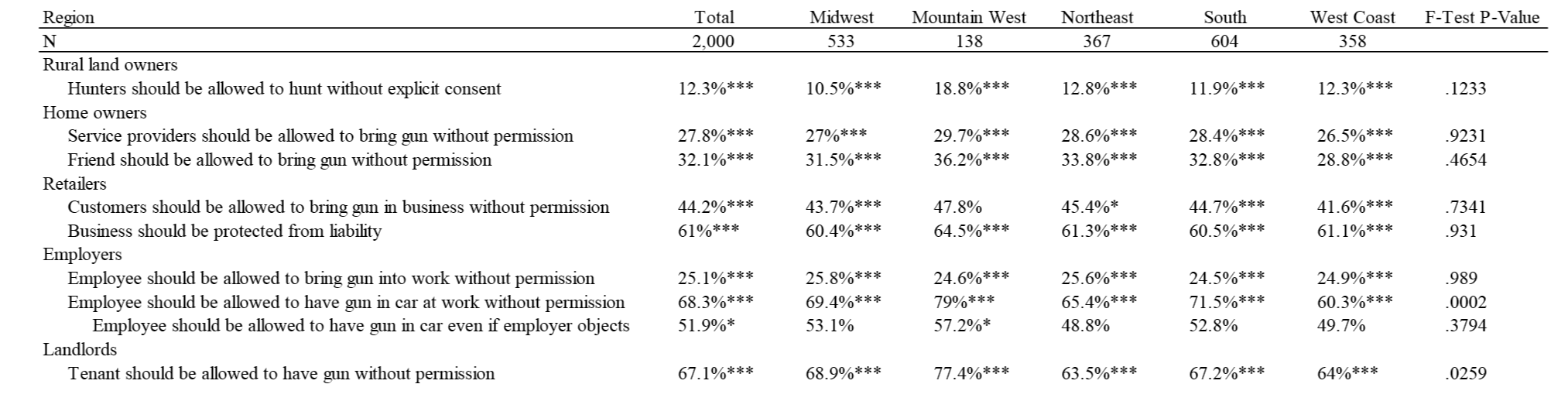
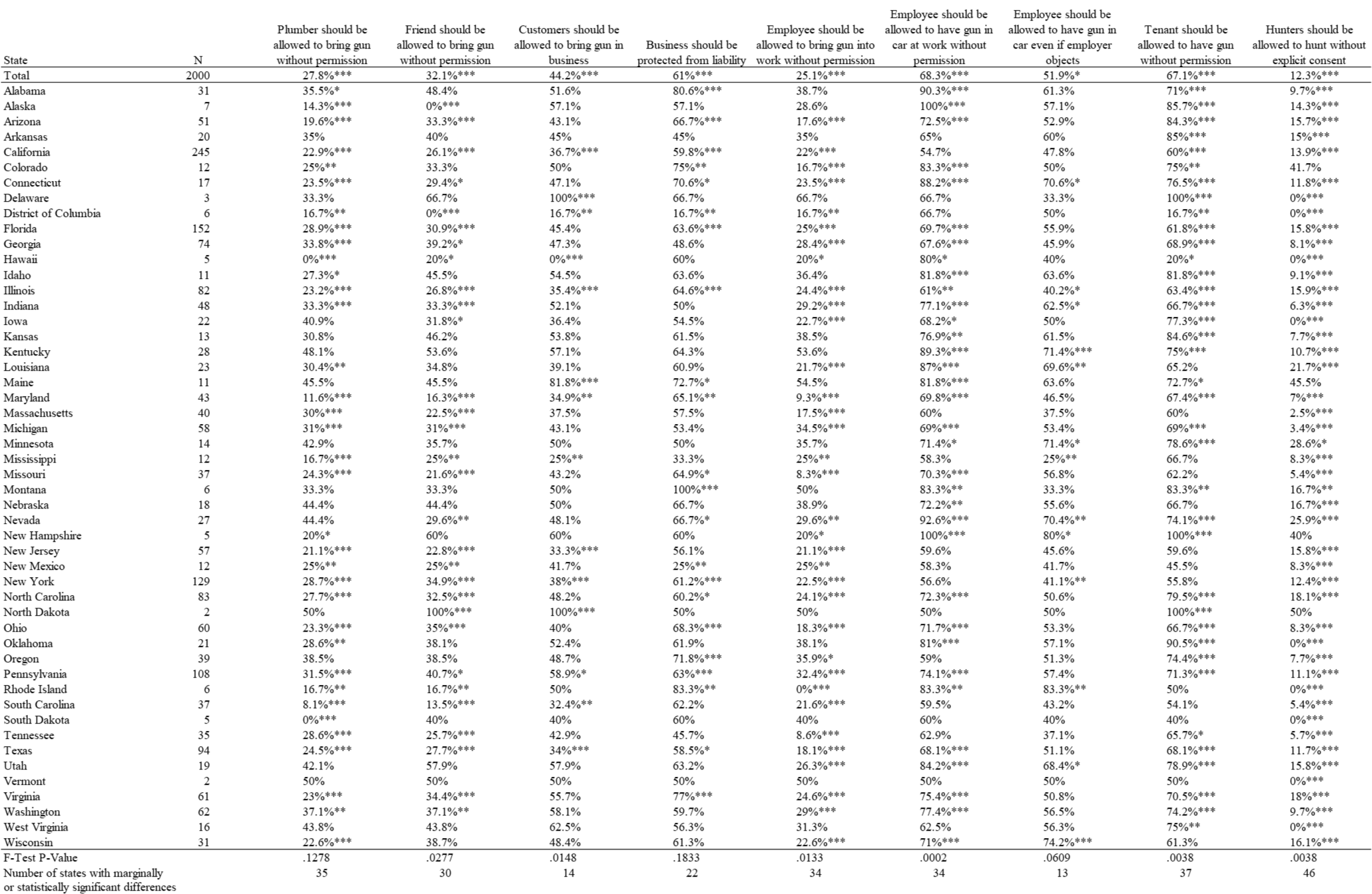
Table 1 reports our central results concerning respondent preferences across a variety of landowning contexts.29
Proportion of Respondents Favoring “Carry” Default by Owner Context and Region

Notes: F-Test p-value is for test that regional are jointly equal. Asterisks test whether proportion equals 50%:
* p < 10%,
** p < 5%,
*** p < 1%.
We find only a small percentage of respondents (12.3%) report a preference for hunters to be allowed to hunt without the landowner's explicit permission.30 Similarly, less than a third of respondents support a “carry” default for service providers (27.8%) or friends and family (32.1%) with regard to home residences. These sample proportions are all statistically different from 50% (p. < .01). Only about one-quarter of respondents (25.1%) expressed support for a default right of employees to bring guns into their places of employment (p. < .01). A larger, but still minority proportion of respondents (44.2%), believe customers, by default, should be allowed to carry into retail establishments, and this percentage is again statistically different from 50%.
Table 1 indicates that respondent preferences were sensitive to particular carrying contexts. Two-thirds of respondents (67.1%) supported the default right of tenants to possess weapons on property they had rented, and this proportion was statistically greater than 50% (p. < .01). An even larger proportion (68.3%) support the default right of employees to keep guns in their cars on their employer's parking lot (p. < .01). However only a bare majority (51.9%) supported the mandatory rule of many “bring your gun to work” statutes that grant a parking lot carry right, even if the employer objects, and this sample proportion was not statistically different than 50%. Finally, Table 1 shows that 61% of respondents support retailer businesses being immunized from tort liability, regardless of whether they allow or prevent gun carry in their stores.31
An important takeaway from Table 1 is the surprising consistency of respondent preferences across jurisdictions. The F-test results indicate there are no statistically significant differences in support for default carry rights for most of the contexts examined. For example, every region consistently disapproves of the hunting default — ranging from a high of 18.8% support in the Mountain West to a low of 10.5% in the Midwest. The only statistically significant regional differences concern respondent beliefs around employees leaving guns in their cars and tenants being allowed to possess firearms without the landlord's explicit consent. While we generally see that the Mountain West prefers the current default and the West Coast tends to favor default carry the least, the more important result is the surprising consistency of respondents' support, or lack of support, in each context tested. Red states and blue states may differ substantially in their gun control regulations, but the citizens of these jurisdictions hold substantially similar beliefs about whether there should be a default right to carry firearms on other people's property.
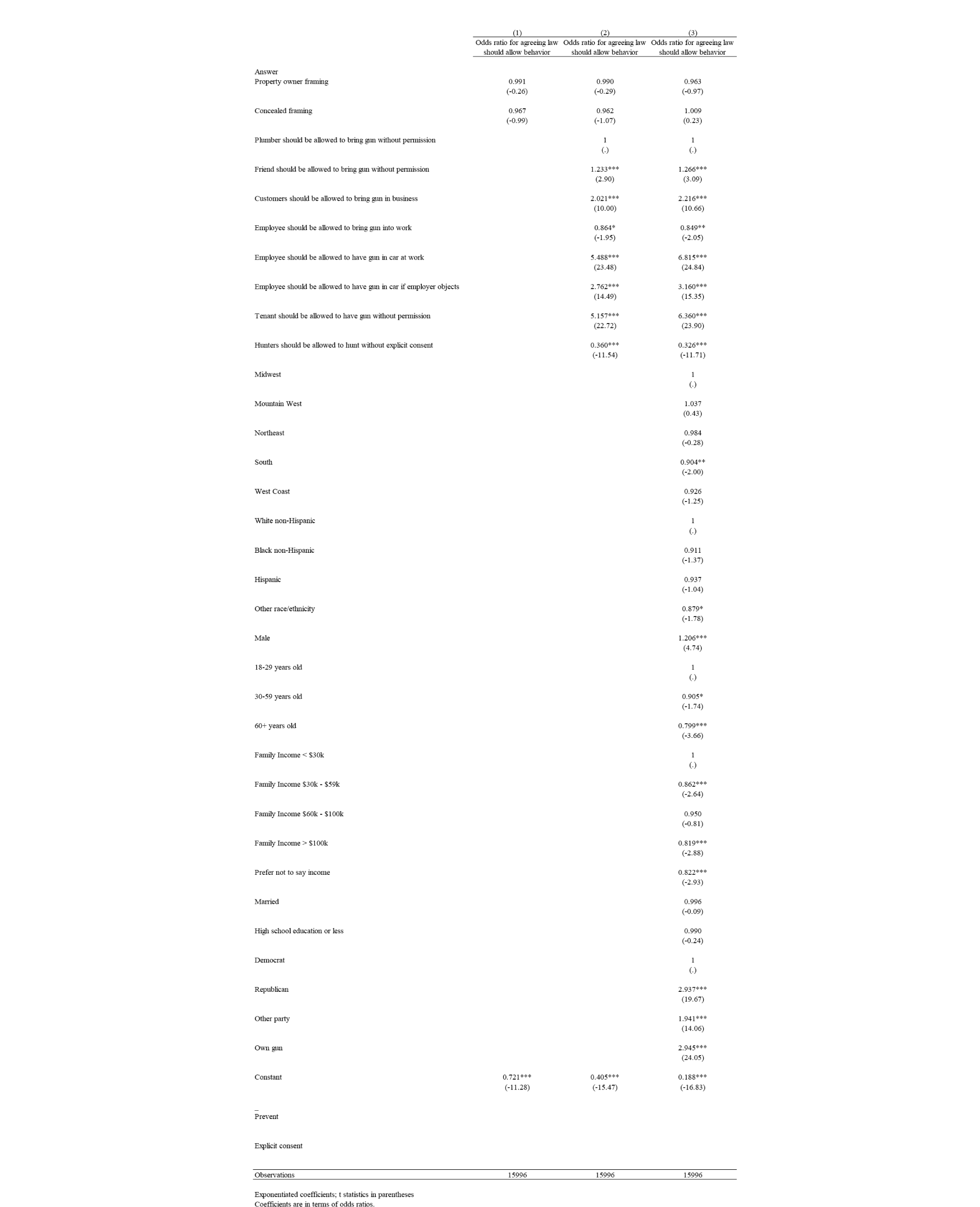
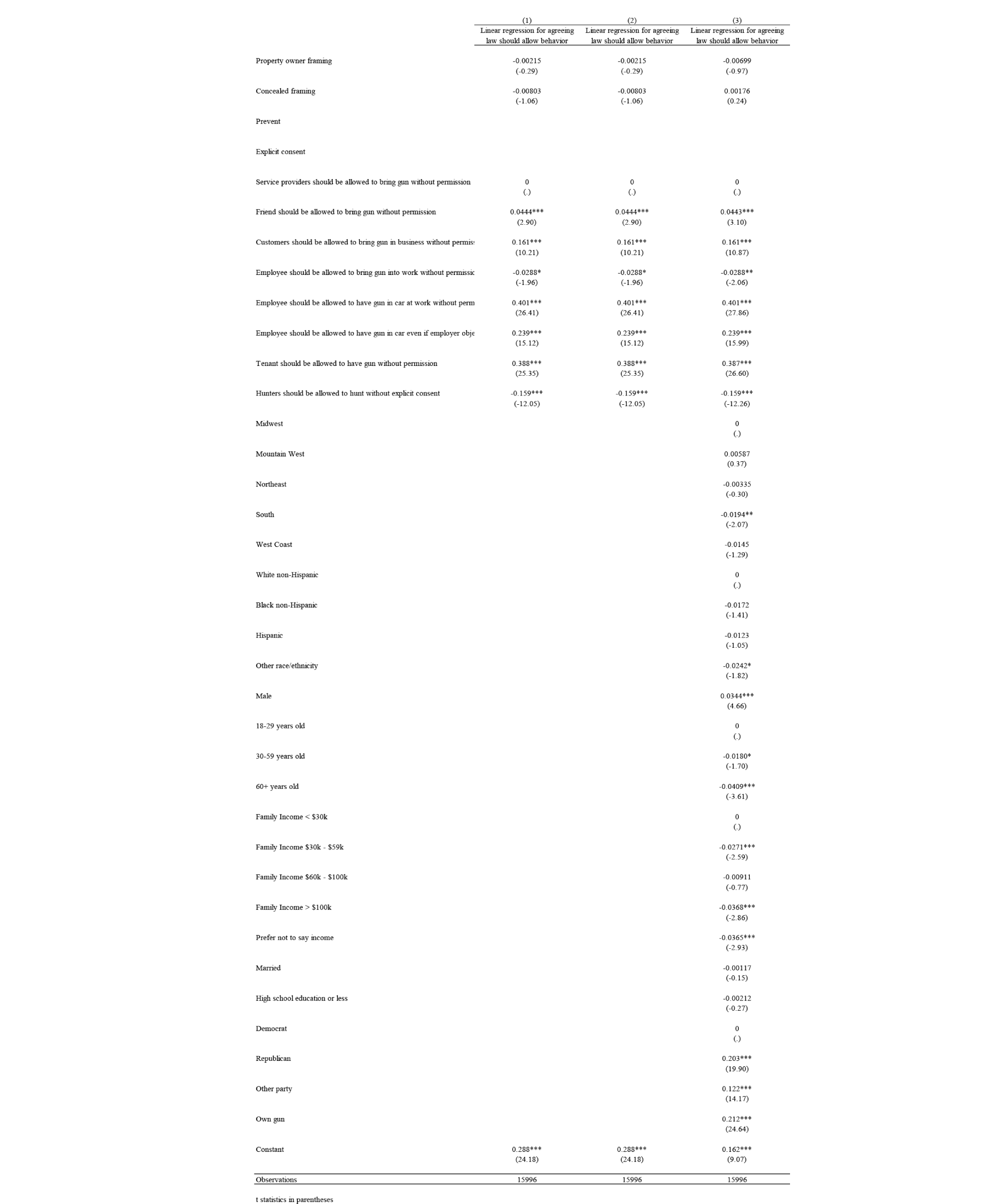
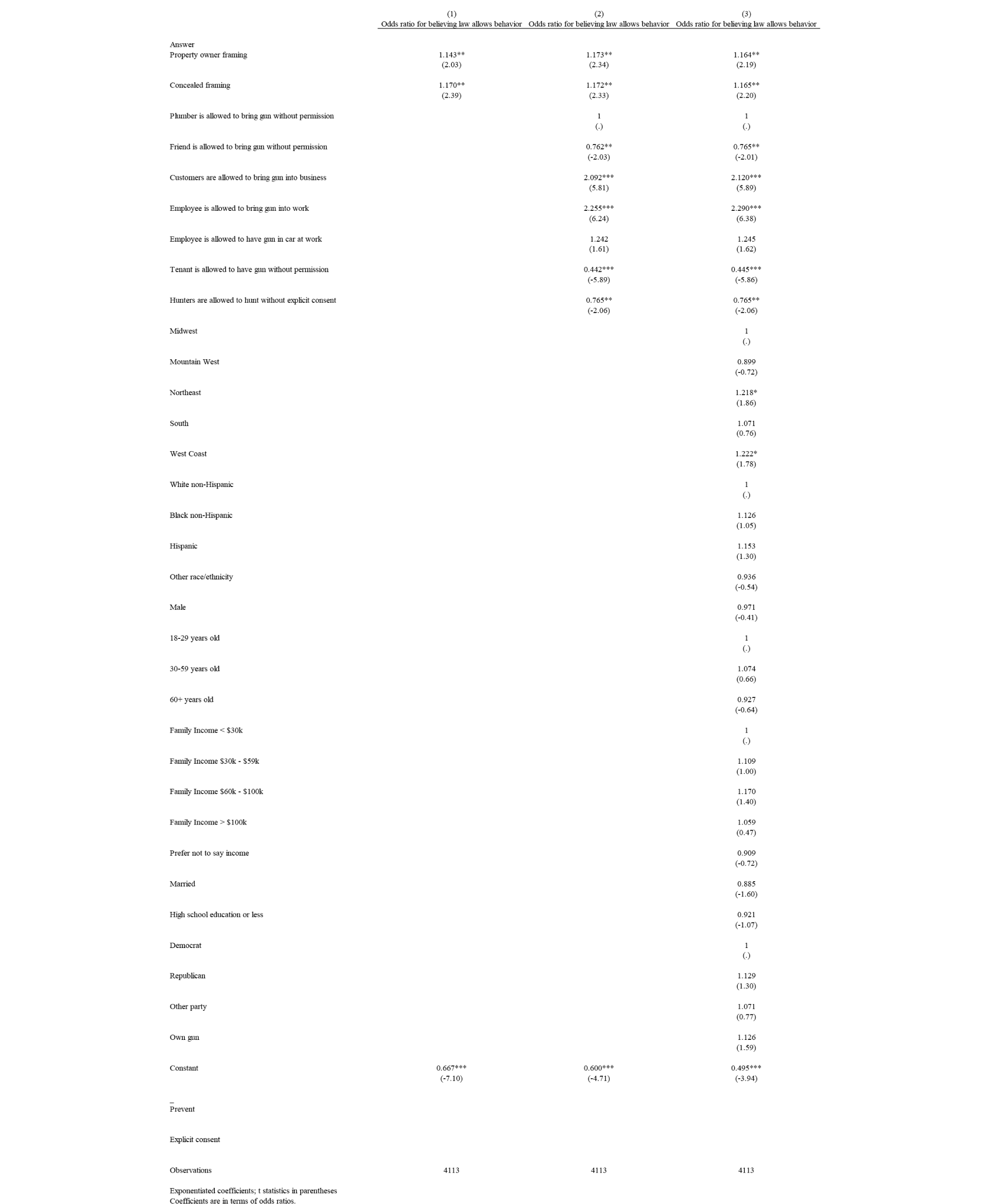
To explore how underlying demographic variables influence the support of individual respondents, we regressed answers to support questions in regressions that included question fixed effects and separately controlled for respondent race, gender, income, age education, political affiliations, and regional residence, as well as whether the respondent owns a gun. The underlying logistic and linear regressions can be found in Online Appendix Tables A8 and A9, respectively. Figure 1 summarizes the demographic influences from the logistic regression.
Logistic Regression Coefficients of “What the Law Should Be” by Demographics

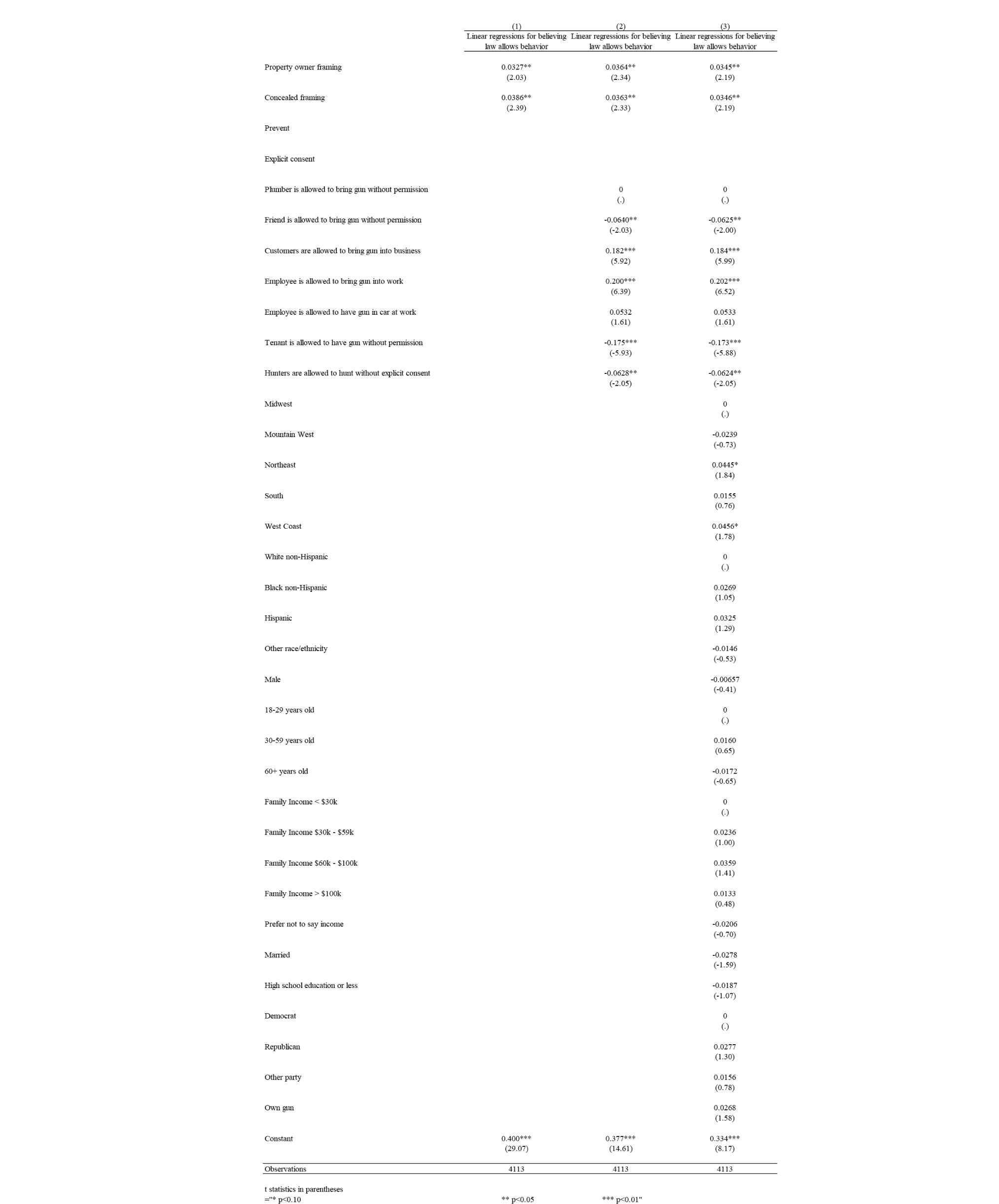
We find that gun owners, Republicans, individuals who identify as neither a Republican nor a Democrat and men are more likely to believe that the law ought, by default, to allow carry onto other people's property. We find similar results for OLS specifications with the same controls (Online Appendix Table A9).
What the Law Is
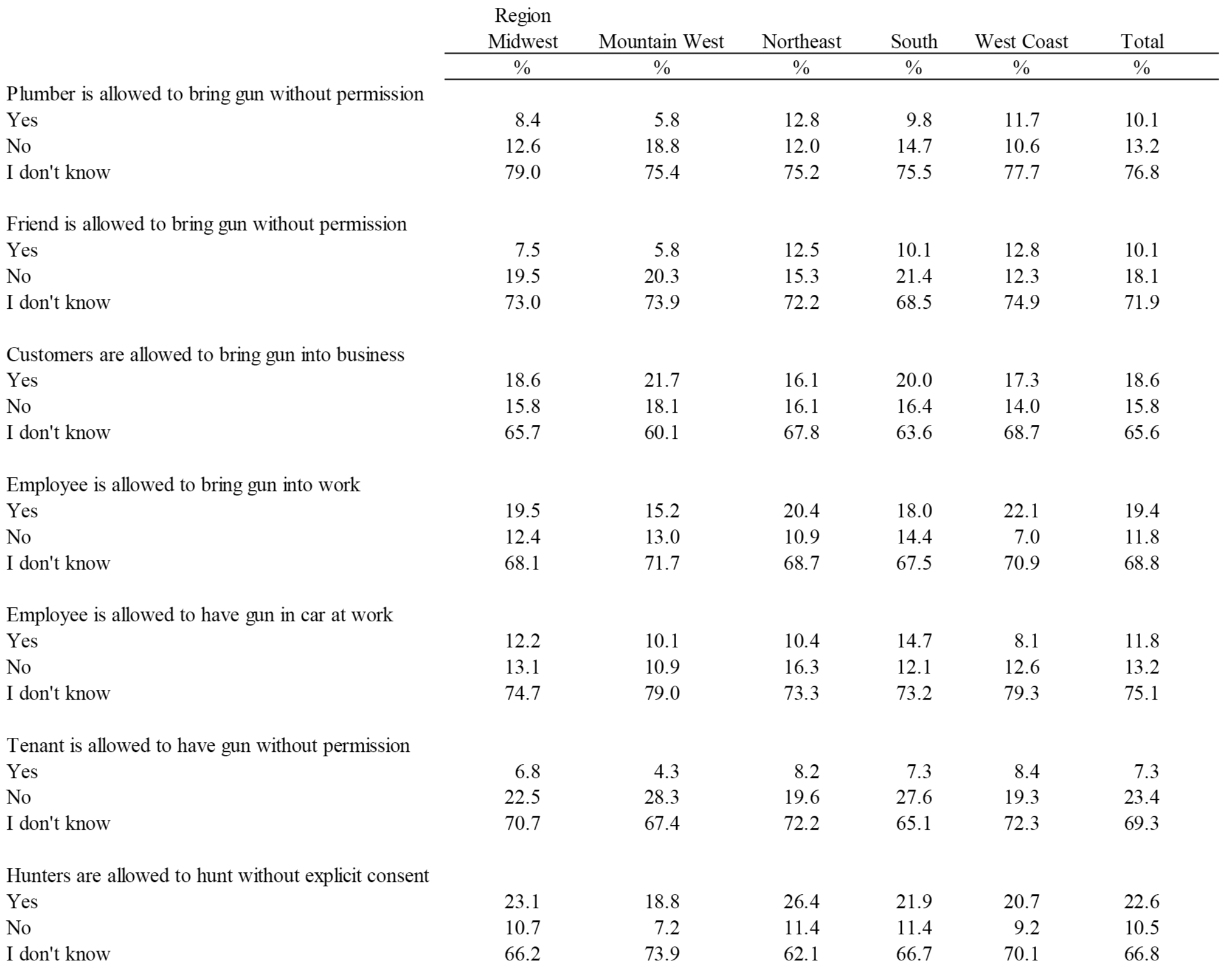
Online Appendix Tables A10 and A11 show the results of specifications, regressing responses to our questions concerning the positive legal status of gun rights on the same demographic variables. These regressions do not find any consistent relationship between demographics and beliefs about what the law is. The more important survey result is that, as shown in Table 2, more than two-thirds of respondents reported not knowing whether their state, by default, allows firearms to be carried onto other people's property in a variety of landowning contexts. The table divides respondents into those who come from jurisdictions that have a carry default and those from jurisdictions that, by default, do not allow carrying in these contexts. The “No Carry Default” columns have some blanks because as discussed above, there are no jurisdictions that currently have a no-carry default for retail customers, employees or tenants.
Prevalence of Respondents Being Uninformed and Misinformed about the Law

The table also reports the proportion of respondents who hold mistaken beliefs about what the law is. For example, 22.7% of respondents residing in hunting default jurisdictions mistakenly believe that the law, by default, prevents third-party hunting, while 10.6% of respondents residing in no-hunting default jurisdictions mistakenly believe that hunting, by default, is allowed. The table indicates that the likelihood of being misinformed is more prevalent when the underlying default allows carrying firearms onto another person's property.
Ignorance of the law can undermine the ability of individuals to exercise their rights as landowners and, more generally, as contractors. A homeowner who wrongly believes that repair people are, by default, not allowed to carry concealed weapons onto her property is less likely to explicitly condition entry on not carrying. In jurisdictions with a no-carry default with respect to private residences, such as South Carolina, misinformation about the law can lead a gun-owner to mistakenly bring a firearm onto another person's property.
Treatment Effects
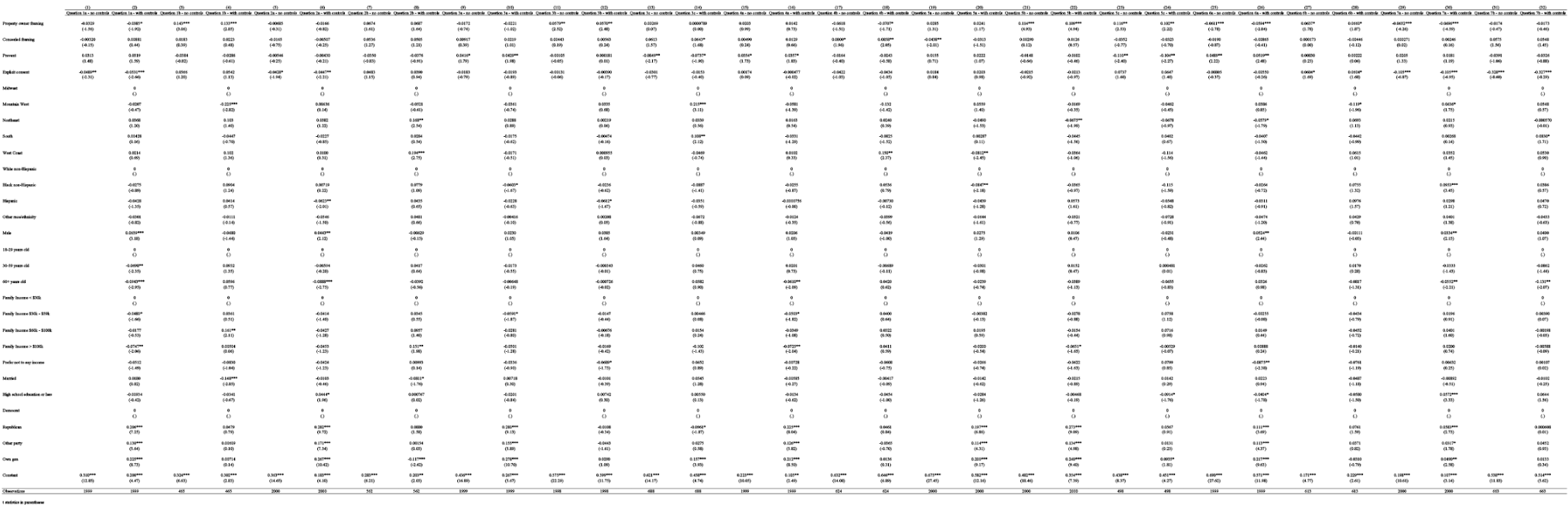
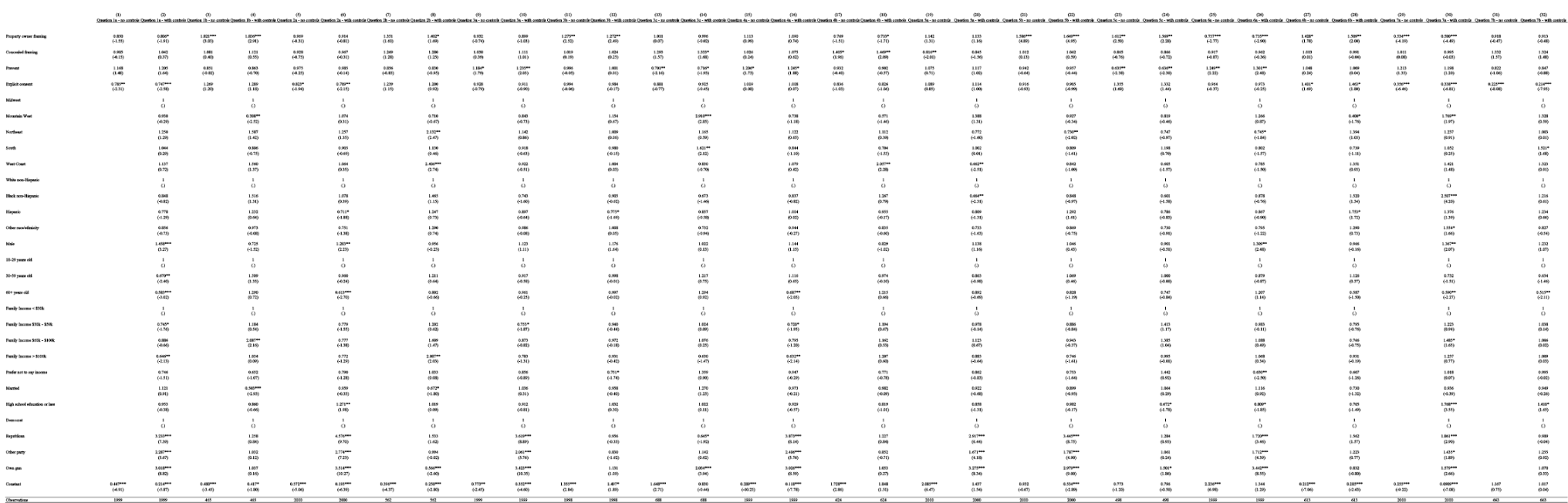
Table 3 summarizes the average effects of our global treatments. Regression results testing for treatment effects for individual questions using linear and logistic regressions can be found in A7 and A12, respectively, and a summary of responses by state is available in Online Appendix Tables A4 (what law should be) and A6 (what law is).
Average Effects for Property/Gun and Conceal Carry Frames

Notes: Percentages are averages of support for ”carry” default across different owner contexts as described in the Appendix. P-values test whether frame proportions are equal.
In designing the survey, we expected that participants who were framed in the vignettes as gunowners would be more likely to support a default right to carry than participants framed as landowners. As reported in Table 3, however, we find that the framing of the question did not significantly impact the proportion of people who believe the law should, by default, allow carrying on other people's property (p. > .7).32 Similarly, we expected that the concealed carry framing would induce greater normative concern with carry defaults, given the hidden nature of the weapon. However, our results again find no significant difference between vignettes with or without concealed carry framing on beliefs of what the law should be (p. > .3).
Table 3 does, however, find that participants who were framed in the vignettes as gun owners were significantly less likely to report that their jurisdiction, by default, allows carrying of firearms onto other people's property (than participants framed as landowners). This result is surprising. The gun-owning condition caused different beliefs in what the law is — moreover it tended to make the treated group more mistaken, as it reduced the number of participants who believe their jurisdiction has a carry default, when most jurisdictions, for most contexts, by default, allow third-party firearm possession. One possible interpretation of this result is that when framed as gun-owners, survey respondents became more cynical about government providing appropriate legal rules. Online Appendix Table 13 shows, with linear regressions, that participants who were framed as a gun owner were significantly (p. < .01) more likely to believe that the law was consistent with what they believed the law should be, though the effect size was relatively small (1.9% estimated effect). Similarly, Table 3 shows that those participants exposed to the concealed carry framing were significantly more likely (than those who were not so exposed) to believe that the legal default permitted carry than those without that framing (p. < .05). This result is again consistent with a cynicism interpretation: as vignettes are framed to make gun carrying more dangerous, respondents are more likely to believe that the law provides the wrong default.
Discussion
Our results strongly support a majoritarian justification for flipping to a “no carry” default onto rural lands for hunting, and into private residences and places of employment. We use majoritarian in a democratic, rather than in an outcome-based, sense. Our results reflect the preferences people have for what the law should be, not necessarily what they would choose for themselves. So, while people may prefer their own guests to carry, we find that people prefer a “no carry” default.
Flipping the default to coincide with what the majority of people want is democracy. Given that a substantial majority of people support a “no carry” default in these contexts, regardless of framing, there is a strong case for flipping the legal default to match their expectations. It also likely reduces transactional inefficiencies — like burdensome posting requirements or social invitations explicitly conditioned on invitees not carrying. States with posting requirements should flip the default to match the states that have already prohibited hunting without explicit landowner permission. Like South Carolina, Louisiana, DC, and Alaska, states should require individuals to seek explicit permission before entering a private dwelling.
Public preferences regarding defaults for retail establishments are not as overwhelming, but we still find statistically significant majorities rejecting the current “carry” default. In addition to this majoritarian evidence, there is also a substantial externalityreducing rationale for flipping the default. Following the 2019 WalMart shooting in El Paso, Texas, many retailers began to restrict the carry of firearms into their stores.Reference Gangitano and Wong33 Costco prohibited anyone, except law enforcement officers, from carrying a firearm into its stores, justifying the policy as a means to “protect [its] members and employees” and WalMart requested that customers not openly carry firearms.34
Unfortunately, simply requesting that patrons refrain from carrying is not always effective, as some gun owners continue to carry into these establishments.Reference Corkery35 Retailers may fear customer backlash if they erect signs restricting or permitting gun carry in their stores and may be inclined to abide by a state's default rule regardless of their preferences. Thus, establishments may not be well situated to contract around the right-to-carry default effectively and efficiently, even if they wish to.
Given the public safety concerns and difficulties for retailers to enforce no firearm policies on their own, states should flip the default, preventing individuals from carrying into an establishment without explicit permission to do so. Retailers who are comfortable permitting firearms in their stores can contract around this default and lawmakers need not impose overly onerous altering rules.
Our results strongly support a majoritarian justification for flipping to a “no carry” default onto rural lands for hunting, and into private residences and places of employment. We use majoritarian in a democratic, rather than in an outcome-based, sense. Our results reflect the preferences people have for what the law should be, not necessarily what they would choose for themselves. So, while people may prefer their own guests to carry, we find that people prefer a “no carry” default.
States that currently restrict the ability of employers to prevent employees from storing guns in their car while parked on the employer's parking lot unreasonably curtail the property rights of employers. While our results do not provide a majoritarian rationale for flipping the default, states ought to at least transform these “bring your gun to work” mandatory rules into mere defaults, maintaining the ability for employer landowners to post signs or contractually limit firearm carry onto their parking lots.
Similarly, statutes limiting a landlord's ability to contract around the tenant possession default also inappropriately limit the landlord's property rights and freedom of contract. Though our results do not provide a majoritarian justification, flipping the default may still be beneficial. Landlords may wish to know which of their tenants are armed, especially given instances where landlords have been shot by tenants in rent and eviction disputes.Reference Miller36 While Heller prevents the government from limiting the ability to possess a firearm in the home, a private property owner is well within her right to do so. By flipping the default, we incentivize the gun owner to reveal that information to the landlord, allowing the landlord to be on notice of which tenants are carrying in their rental units.
Once flipped, states would need to educate gun owners that they are not permitted to carry freely onto private property. Federally licensed dealers could distribute materials at time of sale and states requiring permits or training for public carry could include this information as part of their instruction. While we do not make any strong prescriptions for penalties, states may consider imposing civil penalties on individuals who violate our proposed default by carrying firearms onto private property without the owner's permission. This may include imposing a civil fine for a first offense and requiring individuals to forfeit their gun and/or registering them in the NICS database — prohibiting future firearms purchases — upon further transgressions.
Conclusion
The right to bear arms can only be exercised upon particular pieces of land. The Supreme Court's Heller decision firmly annunciates an individual right to possess firearms in one's own home.37 The extent of the right to carry on streets, parks, and in other public places remains an open question.38 But a substantial portion of the U.S. landmass is privately owned.
Landowners have a powerful self-defense interest to control whether invitees, licensees or tenants carry firearms onto their land. But right-to-carry defaults can undermine this central attribute of ownership. When Alaska's legislature was considering altering its right-to-carry default for private property, the Executive Director of the Alaska Network on Domestic Violence & Sexual Assault testified that “[when] a person carries concealed, that takes away my right to make a choice about whether or not I want to be in the presence of that weapon.”39 The presumptive right to carry concealed weapons onto other people's property takes away their opportunity to make informed choices about how best to remain secure.
We find that a substantial and statistically significant majority of Americans reject the default right to carry weapons onto other people's residences, unoccupied rural land, retail establishments and businesses. Moreover, we find consistent majoritarian preference not just in the blue coastal regions, but in the all regions of the country. Since many defaults are never altered, “no carry” defaults are public-regarding by radically expanding the areas that are de jure gun free. Restricting the places where guns can be possessed can not only reduce the likelihood of impulsive misuse of firearms — a likely explanation for Missouri's “no carry” default in bars — and the settings (especially automobiles) from which guns can be stolen,40 such restrictions might also, on the margin, reduce overall demand for gun ownership. While some people purchase guns solely to defend their homes, others may purchase in part for use in other contexts. As these contexts for use decrease, so too might the demand for guns.
Acknowledgment
Zachary Shelley provided excellent research assistance.
APPENDIX
Default Carry Rules Across the US

Note: We do not count any states that have a mandatory “Bring Your Gun to Work” rule for employer parking lots as a default carry.
Concealed Framing Balance

***, **, and * indicate significance at the 1,5, and 10 percent critical level.
Property Owner Framing Balance

***, **, and * indicate significance at the 1,5, and 10 percent critical level.
State-Level Summary of Opinions on What the Law Should Be

Region-level Summary of Beliefs About What the Law Is

State-level Summary Beliefs About What the Law Is

Linear Regressions for Treatment Effects on All Questions

Logistic Regressions for Demographic and Treatment Effects on Opinions About What the Law Should Be

Exponentiated coefficients; t statistics in parentheses
Coefficients are in terms of odds ratios.
Linear Regressions for Demographic and Treatment Effects on Opinions About What the Law Should Be

t statistics in parentheses
Logistic Regressions for Demographic and Treatment Effects on Beliefs About What the Law Is

Exponentiated coefficients; t statistics in parentheses
Coefficients are in terms of odds ratios.
Linear Regressions for Demographic and Treatment Effects on Opinions About What the Law Should Be

t statistics in parentheses
=”* p<0.10
** p<0.05
*** p<0.01”
Logistic Regressions for Treatment Effects on All Questions

Logistic Regressions for Treatment Effects on Belief That Law Matches Preferences

t statistics in parentheses
A14: YouGov's Sample Matching
In selecting the sample population, YouGov employs the process of sample matching. Sample matching is a way to select a representative population out of a non-randomly selected population. This process is two-fold. First, a target sample is randomly selected from the target population. Then, each member of the target sample is matched on various factors with a member of the opt-in pool of respondents that YouGov has compiled. This population is the matched population. In matching members, YouGov uses a proximity matching method in which a Euclidean distance is calculated for each variable being matched between members of the two populations. These distances are weighted, with weights being assigned based on which attributes are important to a given survey, and then aggregated. Participants are selected based on their closeness to the target frame with reference to these calculated distances. YouGov's current sampling frame is based the 2016 American Community Survey and contains U.S. citizens across various demographic groups, states, and other variables.
A15: Hypothesis & Treatment Groups
There were two global treatment groups in our survey. The first primed respondents as gun owners or the landowner. We hypothesized that those primed as gun owners would be more likely to believe the law should protect gun rights, and therefore would favor a carry default. Similarly, we believed respondents primed as landowners would prefer a “no carry” default. The second global prime was including or omitting the word “concealed” in each of the questions. Here we hypothesized that emphasizing the hidden nature of the weapon might make individuals more likely to prefer a “no carry” default.
We had two question specific treatment groups. First, the vignette related to tort immunization for retail establishments was randomized among an “allow” or “prevent” condition, addressing whether tort immunity should exist for establishments that allow guns on their property or those that prevent gun carry. Given that currently some states immunize retailers that allow firearms, we wanted to see if those laws were in line with individual preference or if people believed that retailers should immunized if they prevent firearms. In the second question specific treatment, respondents were randomized between a no hunting “without the explicit permission of the landowner” condition or a no hunting “if land is posted condition.” We wanted to capture any differences in preference for altering rules to hunt on land given that some jurisdictions require landowner permission to hunt and others require the landowner to post if they want to restrict hunting.
A16: Full Version of Survey
PRIMING FOR LANDOWNER RIGHTS
You have hired a plumber to come and fix a pipe in your home. As the plumber is working, you notice they are carrying a gun that you were not informed of.
Should your plumber or other service provider be allowed to bring a [concealed] gun into your home without your explicit consent?
□ Yes
□ No
Does your state currently have laws that prevent service providers from [concealed] carrying firearms into other people's homes without their explicit consent?
□ Yes
□ No
□ I don't know
You are throwing a party at your home and you find out after the party ends that one of your friends had been carrying a firearm while at the party.
Should your family and friends be allowed to carry a [concealed] gun onto your property without your explicit consent?
□ Yes
□ No
Does your state currently have laws that prevent acquaintances from carrying [concealed] firearms into other people's homes without their explicit consent?
□ Yes
□ No
□ I don't know
You run a local business and you learn that customers have been carrying firearms into your store.
Should customers be allowed to carry a [concealed] gun into your retail establishment without your explicit consent?
□ Yes
□ No
Should you be protected from paying damages in a lawsuit against you if you [prevent/allow] customers [from carrying/to carry] [concealed] guns into your business?
□ Yes
□ No
Does your state currently have laws that [prevent/allow] customers [from carrying/to carry] [concealed] firearms into retail establishments without the establishment's explicit consent?
□ Yes
□ No
□ I don't know
You run a local business and you learn through some of your employees that another employee is carrying a firearm into the workplace.
Should your employee be allowed to carry their [concealed] gun into your business without your explicit consent?
□ Yes
□ No
Does your state currently have laws that prevent employees from carrying [concealed] firearms into places of employment without the employer's explicit consent?
□ Yes
□ No
□ I don't know
You run a local business and you learn through some of your employees that another employee keeps a firearm in their vehicle in your parking lot.
Should your employee be allowed to keep their gun in their vehicle in the parking lot of your business without your explicit consent?
□ Yes
□ No
Should your employee be allowed to keep their gun in their vehicle even if you explicitly object?
□ Yes
□ No
Does your state currently have laws requiring that employees be able to carry firearms in their cars onto the employer's parking lots [even if the employer explicitly objects]?
□ Yes
□ No
□ I don't know
As a landlord you are renting rooms to various tenants. You later discover that one of your tenants has a firearm in their apartment.
Should your tenant be allowed to possess a gun without your explicit consent?
□ Yes
□ No
Does your state currently have laws that prevent tenants from possessing firearms on rented property without their landlord's explicit consent?
□ Yes
□ No
□ I don't know
You own a large, wooded, plot of land in a rural part of the state and on a recent visit you noticed empty bullet shells around your property. You learn that people have been hunting on your property.
Should people be allowed to enter your property to hunt [without your explicit consent/unless you post “No Trespassing” signs]?
□ Yes
□ No
Does your state currently have laws that [prevent strangers from carrying firearms onto rural property without the landowner's explicit consent/allow strangers to carry firearms onto rural property unless “No Trespassing” signs are posted]?
□ Yes
□ No
□ I don't know
PRIMING FOR GUN RIGHTS
You are a plumber who is legally licensed to carry a concealed weapon. You tend to carry your firearm during house visits.
Should you be allowed to carry a [concealed] gun into your customer's home without the owner's explicit consent?
□ Yes
□ No
Does your state currently have laws that prevent service providers from carrying [concealed] firearms into other people's homes without their explicit consent?
□ Yes
□ No
□ I don't know
Your friends are throwing a party at their home. You are legally licensed to carry a gun and you do so while at the party.
Should you be allowed to carry a [concealed] gun onto your family and friends' property without their explicit consent?
□ Yes
□ No
Does your state currently have laws that prevent acquaintances from carrying [concealed] firearms into other people's homes without their explicit consent?
□ Yes
□ No
□ I don't know
You are legally licensed to carry a gun. You enter a local business while carrying your firearm.
Should you be allowed to carry a [concealed] gun into a retail establishment without the explicit consent of the store owner?
□ Yes
□ No
Should the business owner be protected from paying damages in a lawsuit against them if they [prevent/allow] customers [from carrying/to carry] [concealed] guns into the business?
□ Yes
□ No
Does your state currently have laws that [prevent/allow] customers [from carrying/to carry] [concealed] firearms into retail establishments without the establishment's explicit consent?
□ Yes
□ No
□ I don't know
You are legally licensed to carry a gun. Sometimes you carry your gun into your workplace without informing your employer.
Should you be allowed to carry your [concealed] gun into your workplace without the explicit consent of your employer?
□ Yes
□ No
Does your state currently have laws that prevent employees from carrying [concealed] firearms into places of employment without the employer's explicit consent?
□ Yes
□ No
□ I don't know
You are legally licensed to carry a gun and you keep a firearm in your vehicle which you leave parked in the parking lot during work.
Should you be allowed to keep your gun in your vehicle in the parking lot without your employer's explicit consent?
□ Yes
□ No
Should you be allowed to keep your gun in your vehicle even if your employer explicitly objects?
□ Yes
□ No
Does your state currently have laws requiring that employees be able to carry firearms in their cars onto the employer's parking lots [even if the employer explicitly objects]?
□ Yes
□ No
□ I don't know
You are renting an apartment and you legally possess a gun that you keep in your apartment.
Should you be allowed to possess a gun without the explicit consent of your landlord?
□ Yes
□ No
Does your state currently have laws that prevent tenants from possessing firearms on rented property without their landlord's explicit consent?
□ Yes
□ No
□ I don't know
Your neighbor owns a large, wooded plot of land in a rural part of the state. You are planning a hunting trip with your friends.
Should you be allowed to enter the property to hunt [without the explicit consent of the property owner/unless “No Trespassing” signs are posted]?
□ Yes
□ No
Does your state currently have laws that [prevent strangers from carrying firearms onto rural property without the landowner's explicit consent/allow strangers to carry firearms onto rural property unless “No Trespassing” signs are posted?
□ Yes
□ No
□ I don't know
Demographic Questions
Do you own a firearm?
□ Yes
□ No


A17: A Note about Defaults
In majoritarian default setting, the default is set to the preference that most people have. Our questions as framed asked people for their preferences on default rules, not necessarily their preference for carry for guests. So, our survey results indicate the democratic preference that most people have, but that might not actually be the majoritarian preference. In designing our survey, we assumed that these two would coincide. However, it is possible that people prefer that their guests be allowed to carry, but generally believe the law should default to no carry. Our results show that a majority of people prefer a no carry default for private residences, rural land for hunting, places of employment and retail establishments. If it is the case that this default preference does not align with individual preference, then our results provide a stronger rationale for adopting minority defaults. In some case minority defaults may be more efficient, they might be public-regarding or paternalistic, or they might be a way to signal social values. If it is the case that sometimes, individual preference does not align with democratic preference, then that may be another basis for preferencing the minoritarian default over the majoritarian one.