


Introduction
Externalizing behavioural problems comprise oppositional, aggressive, and hyperkinetic behaviour and often persist over the course of early and later childhood and from adolescence into adulthood (Bongers, Koot, van der Ende and Verhulst, Reference Bongers, Koot, Van Der Ende and Verhulst2004). School failure, peer problems, emotional dysregulation, alcohol and drug abuse, and adolescent delinquency are frequent results of early onset disruptive behavioural problems (Moffitt, Reference Moffitt1993). Thus, social and financial costs to society as well as adverse individual developmental trajectories call for effective prevention programmes that identify high-risk populations and provide effective help for caregivers and children (Loeber and Farrington, Reference Loeber and Farrington2000). Available prevention programmes aim at improving problem behaviour in children with prodromal signs or symptoms of a child-psychiatric diagnosis, e.g. conduct disorder (indicated prevention), whereas selective prevention programmes address groups that are at risk of developing externalizing disorders due to social or individual risk factors. Universal prevention programmes provide support for the general public or a whole population group.
Developmental models of disruptive problem behaviour have identified ineffective parenting skills, coercive and punitive discipline methods, and a lack of monitoring as key factors contributing to child behavioural problems during preschool and elementary school years (Greenberg, Domitrovich and Bumbarger Reference Greenberg, Domitrovich and Bumbarger2001; Patterson, DeGarmo and Forgatch, Reference Patterson, DeGarmo and Forgatch2004). Later, peer relationships, avoidance of deviant peer associations, and the enhancement of social-cognitive and academic skills become increasingly relevant for the persistence of externalizing problem behaviour (Dodge and Pettit, Reference Dodge and Pettit2003). Thus, depending on child age and symptom constellation, prevention programmes preliminarily target parents, teachers, or children, or try to combine all three approaches.
The aim of the present paper is to report the short-term effects of our indicated Prevention programme for preschool children with Externalizing Problem behaviour (PEP; Plück, Wieczorrek, Wolff Metternich and Döpfner, Reference Plück, Wieczorrek, Wolff Metternich and Döpfner2006). PEP is based on an intervention programme developed by our group to treat grade-school children with oppositional and hyperkinetic disorders. The parent-, teacher- and child-focused modules of this intervention programme were effective in long-term symptom reduction (Döpfner, Breuer, Schürmann, Wolf Metternich and Lehmkuhl, Reference Döpfner, Breuer, Schürmann, Wolf Metternich and Lehmkuhl2004; Döpfner, Schürmann and Frölich, Reference Döpfner, Schürmann and Frölich2002). PEP involves parents and kindergarten teachers of children aged between 3 and 6 years and is administered in a group format with 10 sessions each for separate groups of parents and teachers. More information on the intervention is provided in the Methods section.
Similar parent or teacher management trainings are included in various well evaluated internationally accepted prevention programmes. One example is the Incredible Years Programme that targets children aged 3 to 8 years and aims at increasing parents’ competences as well as providing child- and teacher-focused components (Webster-Stratton, Reference Webster-Stratton1998). The programme has repeatedly been proven to be effective in reducing child problem behaviour (Brotman et al., Reference Brotman, Gouley, Chesir-Teran, Dennis, Klein and Shrout2005; Drugli and Larsson, Reference Drugli and Larsson2006; Webster-Stratton, Reid and Hammond, Reference Webster-Stratton, Reid and Hammond2004). The Fast Track Program approaches parents and children who are at high risk for developing disruptive behaviour problems and provides additional school-based interventions. The programme reduced the risk of antisocial behaviour up to 10 years after initial intervention (Conduct Problems Prevention Research Group, 2002, 2004, 2007). One example of a preschool parent-focused prevention programme is the “Triple P” Positive Parenting Programme by Sanders (Reference Sanders1999). Using this programme, individual therapeutic interventions and parental group training were effective in reducing child externalizing problems and in improving parenting practices in an indicated preschool sample (Sanders, Markie-Dadds, Tully and Bor, Reference Sanders, Markie-Dadds, Tully and Bor2000). Positive treatment effects were found across different cultures, compared to other treatments, and in various treatment intensities (Bodenmann, Cina, Ledermann and Sanders, Reference Bodenmann, Cina, Ledermann and Sanders2008; Hahlweg, Heinrichs, Kuschel and Feldmann, Reference Hahlweg, Heinrichs, Kuschel and Feldmann2008; Nowak and Heinrichs, Reference Nowak and Heinrichs2008; Sanders, Bor and Morawska, Reference Sanders, Bor and Morawska2007). Triple P is also available in German (Dirscherl, Hahlweg, Sanders and von Wulfen, Reference Dirscherl, Hahlweg, Sanders and von Wulfen2007). Positive treatment effects have been reported for universal prevention (Heinrichs et al., Reference Heinrichs, Hahlweg, Naumann, Kuschel, Bertram and Ständer2009) and for a high-risk sample (Heinrichs, Bertram, Kuschel and Hahlweg, Reference Heinrichs, Bertram, Kuschel and Hahlweg2005).
Various meta-analyses conclude that parent management training can be regarded as a robust intervention (Dretzke et al., Reference Dretzke, Frew, Davenport, Barlow, Stewart-Brown, Sandercock, Bayliss, Raftery, Hyde and Taylor2005; Eyberg, Nelson and Boggs, Reference Eyberg, Nelson and Boggs2008; Greenberg et al., Reference Greenberg, Domitrovich and Bumbarger2001; LeMarquand, Tremblay and Vitaro, Reference LeMarquand, Tremblay, Vitaro, Hill and Maughan2001; Serketich and Dumas, Reference Serketich and Dumas1996). Immediately following treatment, effect sizes are in the moderate range with advantages of behaviourally oriented over nonbehavioural parent training programs for samples with significant behaviour problems (Lundahl, Risser and Lovejoy, Reference Lundahl, Risser and Lovejoy2006). While some authors doubt that additive components like school- or child-based interventions enlarge treatment effects of parent trainings (Lundahl et al., Reference Lundahl, Risser and Lovejoy2006; Serketich and Dumas, Reference Serketich and Dumas1996), others report larger effect sizes for multicomponent prevention programmes (Nelson, Westhues and MacLeod, Reference Nelson, Westhues and MacLeod2003).
To our knowledge, no indicated prevention programme for preschool children with disruptive problem behaviour that provides intervention for parents as well as for teachers is under evaluation in German speaking countries. Our programme combined various advantages of the well evaluated programmes described above: first, a parent and teacher screening procedure prior to the training ensured that children who were at risk of developing more serious behaviour problems participated in the programme. Second, the same PEP staff member worked separately with both the parent and teacher groups for a single set of children, thus enabling parents and teachers to use similar strategies for specific problem behaviours. A third advantage of our programme was that the group setting and additional individual telephone supervision combined a high degree of individualized work by well trained child psychologists with the social support among group members. The didactic methods of PEP were tailored to the needs of a family cohort with a below average education, and practical barriers were minimized by meeting with the parents and kindergarten teachers in the rooms of the kindergarten, which were near families’ homes and familiar to bothparents and teachers.
Primary outcome measures for documenting the short-term effects of PEP were child outcome, parenting practices, and the quality of parent-child interaction during a standardized play situation. By including mothers’ reports as well as teachers’ and observers’ ratings of child and parent behaviour, we provide data on various perspectives of PEP effects. Because parental psychopathology, marital conflicts, parental cognitive distortions (e.g. perceived self-efficacy), and the quality of the emotional bonding between parent and child seem to play a mediating role in the persistence of disruptive child behaviour (Miller Brotman et al., Reference Miller Brotman, Klein, Kamboukos, Brown, Coard and Sosinsky2003; Rubin and Burgess, Reference Rubin, Burgess and Bornstein2002), we also assessed parents’ reports on a variety of these parental quality of life measures.
We hypothesized that after the PEP intervention, mothers, teachers, and observers would report a decrease in child behavioural problems. Further, we expected parenting skills and parent-child interactions to improve. We also expected to see a “dose” related effect of PEP in the secondary analysis where we compared families who attended five or more training sessions with the nontreated control group.
Method
Informed parental consent was obtained for all participants and the study was approved by the Medical Ethical Committee of the University Hospital of Cologne.
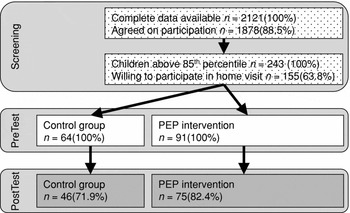
Sixty-two kindergartens in the urban area of Cologne, Germany, were chosen to take part in the study and were selected to represent an equal distribution of higher, middle and lower social economical neighbourhoods. As the first step of the sample selection procedure, kindergarten teachers were asked to use a 13-item screening instrument derived from the Child Behaviour Checklist 4–18 (Arbeitsgruppe Deutsche Child Behavior Checklist, 1998; Plück et al., Reference Plück, Hautmann, Brix, Freund-Braier, Hahlweg and Döpfner2008) to describe those children aged between 3 and 6 years who were expected to attend the kindergarten for the following year. Overall, 2845 children were rated by their teachers. Parents were then contacted and asked to complete the same screening instrument. Of these, 724 parents did not return the screening instrument and 243 families filled out the screening instrument but did not agree to the dissemination of their addresses. Thus, 1878 complete data sets were available for calculation of a teacher-parent sum score on seven items of the screening instrument. These seven items were Child Behaviour Checklist 4–18 items: 1 (Argues a lot); 5 (Can't concentrate); 6 (Can't sit still or is hyperactive); 8 (Destroys things belonging to others); 10 (Impulsive or acts without thinking); 12 (Physically attacks others); and 13 (Temper tantrums).
In order to generate an indicated sample, those children who scored above the 85th percentile of all complete datasets were selected for further investigation. Of the 243 invited to take part in the further study, 88 parents refused. Thus, the study sample comprised 155 children attending 54 kindergartens, with 1 to 6 children per kindergarten. Each of the kindergartens was randomly assigned to either the intervention group or the control group so that any one teacher was not simultaneously teaching children in both groups. The control group did not get any support. Because we expected a number of parents in the intervention group not to participate in the training sessions despite agreeing to do so, we decided to randomize approximately 60% of the total sample to the intervention group. Thus, 91 children (58.7%) were assigned to the intervention group, while the control group comprised 64 families. A flow chart summarizing the recruitment of the study sample is given in Figure 1.
Flow chart on how the studied sample was recruited, including the screened sample and the randomized subsample

As the data were organized hierarchically, the value of group membership and kindergarten in predicting the mothers’ ratings of child outcome was analysed using a regression analysis. Kindergarten did not contribute to the quality of the regression equation (F change(53,98) = 0.653, p = .955) allowing further analysis on the child level. Moreover, 91 intervention children were distributed over 32 kindergartens, with a median of 2 children per kindergarten, making kindergarten effects on treatment outcome unlikely. Ten trainers taught 2–15 parents and 4–16 teachers. No main effect of trainer was detected on any of the primary outcome measures (F(10,80) = 0.636–1.293, p = .787–.249).
Families and teachers in the intervention group attended on average 6.1 (SD 3.8) and 8.6 (SD 1.8) training sessions, respectively.
Evaluation procedure
Prior to group randomization, families were visited at their homes by two research assistants for approximately 3 hours. The post intervention data were collected during a second home visit scheduled approximately 8 weeks after treatment termination. Home visits included structured interviews, academic tests, and parent behaviour rating scales for mothers and fathers. Further, the parent who generally spent more time with the child was video-taped during a standardized play situation with the child. Research assistants rated child behaviour during the academic testing and the play situation. Parents were paid 25 euros per home visit and 10 euros per set of returned rating scales. Research assistants were blind to treatment group membership.
Intervention procedure
The PEP intervention comprised 10 sessions each lasting 90–120 minutes, with 5–6 participants per group. Parents and teachers were in different training groups. Training sessions were held weekly in rooms of the kindergarten by the same experienced child psychologist who was trained and supervised by the senior author. Training material and procedures were standardized and provided as a manual (Plück et al., Reference Plück, Wieczorrek, Wolff Metternich and Döpfner2006). The first three units focus on defining individual problem situations and imparting unspecific basic strategies to benefit caregiver-child-interactions. First, three difficult key situations with the child are defined, parents’ perspective is changed from attention to problems only to attention to both positive and negative aspects of the child's behaviour, and parents are taught to pay special attention to the child's competences and compliance. Second, parents are introduced to the vicious circle of interaction as a plausible model for the development of unwanted child behaviour. Third, parents reflect personal resources for reducing stress and gaining new power by caring for oneself. The next three units teach parents and teachers the classical key strategies of behaviour modification using their individually defined situations for defining rules, communicating commands effectively, and using positive reinforcement of appropriate child behaviour and negative consequences of inappropriate child behaviour. Sessions 7 to 10 consolidate these strategies by working on common difficult parenting situations, e.g. enduring conflicts among siblings or peers. Each topic is discussed for each child individually on the basis of the specific problem constellation. Individual homework assignments and telephone supervision is provided. Caregivers are trained in self-monitoring and monitoring of the child's behaviour to enable further changes.
Dependent measures
Socioeconomic and family characteristic data were gathered by a family background interview. Mothers’, teachers’, and observers’ view on child symptoms, mothers’ reports on their parenting skills, and parents’ quality of life was assessed using questionnaires, while parental warmth was judged by observer ratings during a structured play interaction.
Child symptoms. The Child Behaviour Checklist (CBCL 1½–5; Achenbach and Rescorla, Reference Achenbach and Rescorla2000; Arbeitsgruppe Deutsche Child Behaviour Checklist, 2002a) is a well-established, internationally accepted questionnaire designed to assess parents’ reports on a variety of child-specific behavioural problems. The Caregiver-Teacher Report Form (TRF 1½–5; Achenbach and Rescorla, Reference Achenbach and Rescorla2000; Arbeitsgruppe Deutsche Child Behaviour Checklist, 2002b) comprises similar items rated by kindergarten teachers. For this report, the scale scores of externalizing and internalizing behaviour were used. Previous studies have shown that CBCL and TRF are robust and highly reliable rating scales (Döpfner, Berner, Schmeck, Lehmkuhl and Poustka, Reference Döpfner, Berner, Schmeck, Lehmkuhl, Poustka and Sergeant1995).
The Problem Checklist Attention-Deficit/Hyperactivity Disorder (PCL ADHD) and the Problem Checklist Oppositional Defiant Disorder (PCL ODD) represent the diagnostic criteria (DSM-IV and ICD-10) for ADHD and ODD respectively (Döpfner and Lehmkuhl, Reference Döpfner and Lehmkuhl2000), and are identical for parents, teachers and observers. Due to the age range of our subjects, we only used a subscale of the Problem Checklist Conduct Disorder (PCL CD) for assessing oppositional defiant symptoms (PCL ODD, 11 items). In our sample, internal consistencies were Cronbach's α = .91 for mothers’ reports on the PCL ADHD and .88 for mothers’ PCL ODD. Internal consistencies of teachers’ reports of PCL ADHD and PCL ODD were Cronbach's α = .90 and .92, respectively.
The German version of the Home-Situation-Questionnaire (HSQ, Barkley, Reference Barkley1990; Breuer and Döpfner, Reference Breuer and Döpfner1997) assesses 15 difficult parenting situations. Teachers described difficult situations during kindergarten hours. In our sample, internal consistencies were Cronbach's α = .80 for mothers’ reports and .82 for teachers reports.
The Questionnaire on Judging Parental Strains (QJPS), which comprises 55 items, was completed by parents and teachers (Majoros, Reference Majoros2001). Internal consistency scores were Cronbach's α = .97 for parents and .93 for teachers.
Research assistants rated children's behaviour during the home visit on the PCL ADHD and on the 11-item scale “observed behaviour during the test” (OBDT, Döpfner and Lehmkuhl, Reference Döpfner and Lehmkuhl2000), which rates inattentiveness, hyperactivity, impulsivity, and noncompliance during an academic test. The situation was standardized.
Parenting. The German adaptation of the Parent Practices Scale (PPS; Strayhorn and Weidmann, Reference Strayhorn and Weidmann1988) comprises 13 items measuring positive, reinforcing and supportive parenting behaviour on a 4-point rating scale. Internal consistency in our sample was .84.
The German adaptation of the Parenting Scale (PS) originally developed by Arnold, O'Leary, Wolff, and Acker (Reference Arnold, O'Leary, Wolff and Acker1993) and adapted by Miller (Reference Miller2001) comprises 29 items, which assess dysfunctional parenting strategies. Internal consistency for the overall score was Cronbach's α = .76 in our sample.
The German adaptation of the Problem Setting and Behaviour Checklist (PSBC) developed by Sanders et al. (Reference Sanders, Markie-Dadds, Tully and Bor2000) measures the perceived ability to solve difficult parenting situations. Internal consistency for the overall score in our sample was Cronbach's α = .90.
The Self-Efficacy Scale (SEFS) is the German adaptation of the Parenting Sense of Competence Scale developed by Johnston and Mash (Reference Johnston and Mash1989) and the Self Efficacy for Parenting Task Index by Coleman and Karraker (Reference Coleman and Karraker1997). The SEFS comprises 15 items measuring parents’ perception of self-efficacy on a 4-point scale. Internal consistency for the overall score was Cronbach's α = .80.
Parents’ quality of life. The Depression Anxiety Stress Scale (DASS; Lovibond and Lovibond, Reference Lovibond and Lovibond1995) comprises 42 items assessing symptoms of depression, anxiety, and stress in adults on a 4-point scale. Internal consistency for the overall score was Cronbach's α = .96 in our sample.
The Social Support Scale (SSC; Fydrich, Geyer, Hessel, Sommer and Brähler, Reference Fydrich, Geyer, Hessel, Sommer and Brähler1999) comprises 14 items and measures anticipated social support. Internal consistency for the overall score was Cronbach's α = .94 in our sample.
The Life Satisfaction Scale (LSS) measures general satisfaction with various aspects of life (Henrich and Herschbach, Reference Henrich, Herschbach, Schwarz, Bernhard, Flechtner, Küchler and Hürny1996). Internal consistency in our sample was Cronbach's α = .84.
The German version of the Parent Problem Checklist (PPC; Dadds and Powell, Reference Dadds and Powell1991) comprises 16 items dealing with conflicts between partners over child rearing. Internal consistency was Cronbach's α = .88 in our sample.
Parent-child interaction during free play and task periods. A 20-minute parent-child interaction was divided into 5 minute blocks: free play, building a lego brick figure, independent play of the child while the parent was further interviewed by the psychologist, and clearing up. After completion of the home visit, the two research assistants scored the interaction using the German adaptation of the Coder Impressions Inventory (CII; McMahon and Langua, Reference McMahon and Langua1996), which comprises parent-related scales of parental warmth (12 items), appropriate discipline (13 items), harsh discipline (4 items), and physical discipline (2 items). In our sample, the parental warmth scale was the only scale with satisfying internal consistency scores (Cronbach's α = .82) and was thus used to measure parent-child interactions. Consistencies of the other three scales might have been low due to the nature of the standardized interaction situation. Children rarely showed problem behaviour, thus, parents infrequently disciplined their children during the standardized interaction.
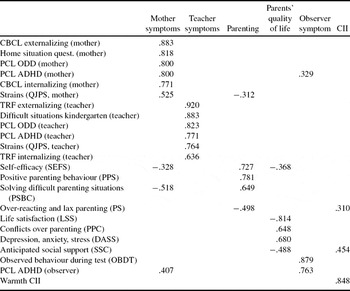
All dependent variables were subjected with equal weight to a factor analysis to generate composite scores. Consecutive analyses were conducted with composite rather than with individual instruments to minimize multiple testing in the primary outcome analysis. Table 1 shows that six factors with eigenvalues > 1 were extracted, explaining 68.4% of the variance. Scales of the respective questionnaires were recoded if necessary and z-transformed by total sample means and standard deviations. Primary outcome measures were a composite score of child symptoms described by mothers, teachers and observers, a parenting composite score, parents’ reports on their quality of life and observed parental warmth (see Table 1). Z-scores of the CBCL, C-TRF, PCL, HSQ and QJPS represent the child symptoms composite score (mothers/teachers). The parenting composite score comprised the PPS, PS, PSBC, and SEFS. The parents’ quality of life composite score comprised the mean scores of the DASS, SSC, LSS and PPC. The observers’ composite score of child symptoms was based on the PCL ADHD and OBDT.
Factor analysis (principal component analysis) of pretest scale scores with varimax-rotation (loads a > .30)

Note: ADHD = attention-deficit/hyperactivity disorder; CBCL = Child Behaviour Checklist; CII = Coder Impressions Inventory; DASS = Depression anxiety Stress Scale; LSS = Life Satisfaction Scale; OBDT = observed behaviour during the test; ODD = oppositional defiant disorder; PCL = Problem Checklist; PPC = Parent Problem Checklist; PPS = Parent Practices Scale; PS = Parenting Scale; PSBC = Problem Setting and Behaviour checklist; QJPS = Questionnaire on Judging Parental Strains; SEFS = Self-Efficacy Scale; SSC = Social Support Scale; TRF = Caregiver-Teacher Report Form
Statistical analysis
Two analyses were conducted: (1) an intention to treat analysis that included all subjects offered PEP training as the intervention group; (2) a dosage analysis where the intervention group comprised only those families who attended at least five parent training sessions.
Incomplete data were handled as follows: missing pretest scale scores were replaced by group means (Tabachnick and Fidell, Reference Tabachnick and Fidell1996). For two children, mother ratings were missing, and for five children teacher ratings were not available. For the intention to treat analysis, there were differences in attrition rates between the intervention group (n = 16; 18%) and the control group (n = 18; 28%). Thus, while 18% of intervention group families declined participation in the posttest, 28% of control group children could not be tested twice. To account for this, individual pretest scores were used to predict posttest scores using a separate regression analysis for both groups. The pretest composite scores for families that dropped out of the study between the pre- and post-tests did not differ from those that remained in the study. However, mothers who dropped out after the pretest assessment had a lower level of education than those who remained in the study (Z = −3.45, p < .001).
Comparisons between the intervention and control group were made using t tests and Mann–Whitney U tests for demographic data, pretest scores on overall child symptom severity and the primary outcome measures.
To account for the interdependence of primary outcome measures, multivariate analyses of covariance were conducted with pretest scores of the primary outcome measures as covariates.
For the dosage analysis we divided intervention group families into “infrequent” and “frequent” attenders. PEP topic-related considerations as well as the bimodal distribution of the variable “attended training sessions” suggested that 4 and fewer versus 5 to 10 sessions represented a good cut-off. The “frequent attenders” comprised 64 families (average 8.38 sessions; SD = 1.58), while 27 families attended on average 0.67 sessions (SD = 1.07) and represented the group of the “infrequent attenders”. Again, multivariate analyses of covariance were conducted with pretest scores of the primary outcome measures as covariates to compare the “frequent attenders” with the original control group. Effect sizes were calculated by using Cohen's d (Cohen, Reference Cohen1988).
Results
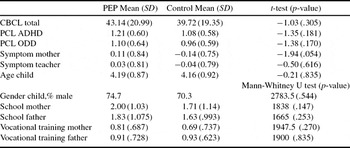
Table 2 summarises the demographic characteristics and pretest mean scores of the PEP intervention and nontreated control groups. There were no significant differences between these groups for children's age and gender, or symptom severity on the CBCL total, PCL ADHD, or PCL ODD. Mothers and fathers of both groups reported similar levels of school education and vocational training. There was a between-group difference in the pretest mothers’ composite score of child symptoms; children in the intervention group were rated as more severely impaired than children in the control group.
Demographic characteristics and pretest symptom scores of the PEP intervention and the nontreated control groups

Note: PEP = prevention programme for externalizing problem behaviour; CBCL = Child Behaviour Checklist; PCL = Problem checklist; ADHD = attention-deficit/hyperactivity disorder; ODD = oppositional defiant disorder
In the comparison of “frequent” and “infrequent attenders”, the “infrequent attenders” reported more positive parenting strategies (PPS: t87 = 2.37, p < .02). Mothers of the “infrequent attenders” group were less well-educated than mothers in the “frequent attenders” group (Z = −2.14, p < .03). All other child or family characteristics were similar between frequent and infrequent attending families.
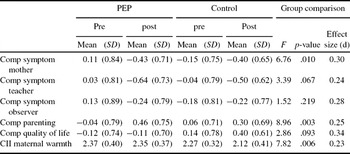
The intention to treat analysis revealed a main effect of treatment (F(5,144) = 4.16, p < .001). With respect to the six outcome measures at the post treatment testing, groups differed significantly in mothers’ symptom ratings (F(1) = 6.76, p < .01), in mothers’ perception of parenting skills (F(1) = 8.96, p < .003), and in observers’ ratings of parental warmth during the parent-child interaction (F(1) = 7.82, p < .006). No posttest group differences were found on mothers’ reports on their quality of life or on teachers’ or observers’ child symptom ratings (F(1) = 2.86, p = .093; F(1) = 3.36, p = .067; F(1) = 1.52, p = .219, see Table 3). Effect sizes ranged from to 0.23 and 0.34, thus corresponding to Cohen's small to moderate effects (see Table 3).
Intention to treat analysis: repeated-measures ANCOVAs of primary outcome measures (composite scores and CII)

Note: PEP = prevention programme for externalizing problem behaviour; CII = Coder Impressions Inventory; Comp = Composite score
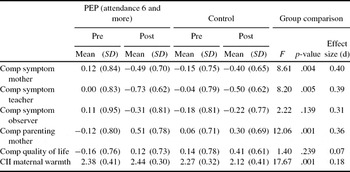
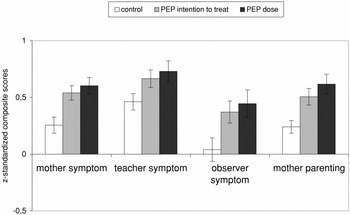
The results of the dosage analysis are given in Table 4 and Figure 2. A significant effect of group was found across all dependent measures at post testing (F(5,113) = 4.96, p < .001). Child symptoms described by mothers and teachers declined significantly in the PEP “frequent attenders” group compared to the nontreated control group (F(1) = 8.61, p < .004; F(1) = 8.20, p < .005). PEP mothers reported use of better parenting strategies than control group mothers (F(1) = 12.06, p < .001), which corresponded to higher scores in parental warmth in the PEP group compared to the control group at posttreatment (F(1) = 17.67, p < .001). Observers’ ratings on child symptoms did not differ between groups (F(1) = 2.22, p = .139), and mothers’ reports on quality of life were similar between groups (F(1) = 1.40, p = .239). Effect sizes were marginally larger in the dosage analyses than in the original intention to treat analysis.
Dosage analysis: repeated-measures ANCOVAs of composite scores

Note: PEP = prevention programme for externalizing problem behaviour; CII = Coder Impressions Inventory; Comp = Composite score
Differences in pre- to post- intervention scores in primary outcome composite scores of the intention to treat and dosage analysis. Scores are z-standardized.

Discussion
The aim of the study was to investigate the treatment effects of a prevention programme for preschool children with disruptive problem behaviour. We developed a screening instrument that preceded the training to include children with clinically significant impairments and children who showed prodromal signs of conduct, hyperkinetic, or oppositional defiant disorder as rated by parents as well as kindergarten teachers. To document the efficacy of this approach, we analysed treatment effects in the group of families that had agreed to attend the PEP training, 20% of which, however, did not attend a single session. Primary outcome measures were child symptoms as reported by mothers, kindergarten teachers, and observers, reported parenting strategies, observed parental warmth during a period of child-parent interaction, and mothers’ reports on their quality of life. In the intention to treat analysis, significant treatment effects were found for child symptoms reported by mothers, for the parenting composite score, and for parental warmth during the parent-child interaction observation. Improvements in parenting strategies and reductions in child symptoms have been reported by various authors after parent management trainings for children with clinically significant problems (Chronis, Jones, and Raggi, Reference Chronis, Jones and Raggi2006; Connor et al., Reference Connor, Carlson, Chang, Daniolos, Ferziger, Findling, Hutchinson, Malone, Halperin, Plattner, Post, Reynolds, Rogers, Saxena and Steiner2006; Daly, Creed, Xanthopoulos and Brown, Reference Daly, Creed, Xanthopoulos and Brown2007; Farmer, Compton, Bums and Robertson, Reference Farmer, Compton, Bums and Robertson2002) or in a preventive setting (Bor, Sanders and Markie-Dadds, Reference Bor, Sanders and Markie-Dadds2002; Brotman et al., Reference Brotman, Gouley, Chesir-Teran, Dennis, Klein and Shrout2005; Conduct Problems Prevention Research Group, 1999; Drugli and Larsson, Reference Drugli and Larsson2006; Nixon, Sweeney, Erickson and Touyz, Reference Nixon, Sweeney, Erickson and Touyz2004; Webster-Stratton et al., Reference Webster-Stratton, Reid and Hammond2004). Of our 91 PEP parents, 27 attended on average less than one PEP session despite their stated willingness to participate. In the standardized situation of parent-child interaction during the second home visit, mothers of the intervention group were rated to show more warmth in the interaction with their child. Thus, making use of few PEP training sessions or even only having the opportunity to use assistance might have changed the mothers’ perception of parenting strategies and of the child's problems. This in turn might have influenced interactions with the child in the observed respect. In line with this it has been suggested that problems decrease while people wait for a treatment to begin (Hautmann, Hanisch, Mayer, Plück and Döpfner, Reference Hautmann, Hanisch, Mayer, Plück and Döpfner2008).
In the intention to treat analysis, teachers’ ratings did not show group differences at the post intervention testing. Consistent with this, Webster-Stratton (Reference Webster-Stratton1998) did not find intervention-related improvements in kindergarten teachers’ reports of child externalizing problems despite positive effects on parental measures. One might speculate that parents justify their effort of participating in the training by reporting less problematic child behaviour despite the absence of objective changes. The increase in parental warmth in the PEP group, however, together with positive intervention effects on teacher reports in the dosage analysis, does not support this argument. If effort justification worked, the group of teachers should have rated the children of “infrequent attenders” less problematic, because teachers attended 8 to 9 PEP sessions irrespective of parents’ PEP attendance. Thus, spillover effects seem to account for greater treatment effects on teachers’ ratings of those children whose parents were regarded as “frequent attenders”. Frequent attendance at the PEP sessions by parents not only decreased problems at home, but also had an effect on children's behaviour during kindergarten hours.
The effect sizes in our intention to treat analysis were smaller than those previously reported for indicated prevention programmes presumably due to the large group of “infrequent attenders” as suggested by the larger effect sizes in the dosage analysis, which corresponded better to the previously reported effect sizes (Eyberg et al., Reference Eyberg, Nelson and Boggs2008). We can only speculate why 20% of those families that originally agreed to participate did not attend the training sessions at all. A recent meta-analysis pointed out that practical barriers such as transportation or high levels of family-related adversities (e.g. low education or socioeconomic status) seem to decrease treatment effects (Lundahl et al., Reference Lundahl, Risser and Lovejoy2006). The families studied here comprised a group of parents suffering from multiple adversities including below average education. Despite our attempt to minimize practical barriers by meeting with the parents close to theirs homes, we did not succeed in reaching the entire sample.
Other groups have reported short-term changes in child behaviour such as child social cognition or problem solving abilities described by independent observers (Conduct Problems Prevention Research Group, 2002, 2004, 2007). We found a positive treatment effect on parent-child interaction but no improvements in observers’ ratings of child symptoms during the testing, suggesting that observers were only able to detect changes in the mother's rather than the child's behaviour. Closer inspection of group differences, however, suggests that there is no change in parental warmth from pre to post testing in the PEP group, while there is a decrease in parental warmth in the control group. This corresponds to models on parent-child interactions that suggest an interdependence of problem behaviour and quality of emotional bonding between child and parent (Côté, Vaillancourt, LeBlanc, Nagin and Tremblay, Reference Côté, Vaillancourt, LeBlanc, Nagin and Tremblay2006; Jester et al., Reference Jester, Nigg, Adams, Fitzgerald, Puttler, Wong and Zucker2005; Shaw, Dishion, Supplee, Gardner and Arnds, Reference Shaw, Dishion, Supplee, Gardner and Arnds2006). PEP might thus not only be helpful in decreasing problem behaviour by the use of better parenting strategies, but also may have helped mothers to view their child from a different perspective.
Our dosage analysis showed increased effect sizes on all measures. As expected, PEP had greater effects for those families that were motivated to cooperate and willing to invest time and effort. Moreover, spillover effects were found in these children, as teachers rated those children whose parents attended more PEP sessions to benefit more. It has to be kept in mind, however, that the group of “frequent attenders” is less representative of the screened sample as these families may have been more motivated and better organized than those who attended less than half of the PEP sessions.
One limitation of the reported data is that it is difficult to distinguish between cognitive parental processes and treatment-related changes in observable behaviour because, aside from observers’ ratings of parent-child interactions, we mostly examined parent-reported measures. A more extensive interaction observation in naturalistic everyday situations might allow a differentiation between these processes. On the other hand, observational data inevitably include a subjective element (Sonuga-Barke, Reference Sonuga-Barke2004). Although our data had good internal consistency scores and revealed treatment effects, the blindness of the research assistants to the family's group membership could not be fully guaranteed as a few families gave away their group membership during the home visit.
One limitation of the recruitment and intervention process was that we were not able to maintain high compliance in the control group families. Families were only contacted for the testings, resulting in high attrition of control group families after completion of the post testing.
Despite the stated limitations of our study and the fact that various well-evaluated programmes exist for English-speaking families, our programme adds to the existing body of literature for several reasons. First, aside from the evaluation of a cross-cultural generalization of treatment effects, we paid special attention to the needs of our poorly educated family cohort when developing the PEP material. Slides, handouts, and homework assignments were well-structured and repeatedly used the same procedures. Second, PEP addresses kindergarten teachers as well as parents, promoting exchange between both caregivers and enabling the implementation of similar rules and consequences in both environments. Existing prevention programmes that include teacher and parent modules are generally more time-consuming than our programme. Comprising 10 group sessions and yielding satisfying results, especially in the subsample that attends most of these sessions, PEP may be a cost-effective training for both teachers and parents.
In conclusion, our data suggest that PEP teaches parents how to use more effective parenting skills and, thus, reduce child disruptive problem behaviour. Moreover, it enabled teachers to better interact with the problem child. PEP seems to be a useful tool in the prevention of externalizing disorders. We need to examine the stability of the reported treatment effects with follow-up data, including e.g. school entry and grade-school teachers’ reports. Effects can only be considered clinically relevant if they continue to be stable.
Acknowledgements
This work was supported by the Deutsche Forschungsgemeinschaft (DFG, project DO 620/2-1. Efficacy of indicated prevention in preschool children with externalizing problem behaviour).



Comments
No Comments have been published for this article.