INTRODUCTION
Engraulis anchoita Hubbs & Marini, 1935 is the most abundant fish resource in the south-west Atlantic Ocean (Ciechomski & Sánchez, Reference de Ciechomski and Sánchez1988). The species plays a key role in the pelagic ecosystem of the Argentine waters and constitutes the main component of the diet for several important commercial fish species, as well as mammals and seabirds. South of 34°S at least two populations of E. anchoita occur separately at approximately 41°S: the northern and the southern or Patagonian stock (Hansen et al., Reference Hansen, Cousseau and Gru1984). During spring the northern stock is found in coastal sectors off the Buenos Aires Province, mostly in waters shallower than 50 m, where massive spawning occurs (Sánchez & Ciechomski, Reference Sánchez and de Ciechomski1995; Pájaro, Reference Pájaro1998). In contrast, the Patagonian stock spawns in association with a series of frontal systems of different intensities along the Patagonian coast (Sánchez et al., Reference Sánchez, Pájaro and Macchi1996).
Annual commercial catches of the northern population of Argentine anchovy have increased from 12000–28000 t during 1990–2003 to 41000 t in 2004 (Hansen & Garciarena, Reference Hansen and Garciarena2005a). Nevertheless, annual total allowable catches were set at a level of 127000 t for the northern anchovy stock and 59000 t for the Patagonian stock (Hansen & Garciarena, Reference Hansen and Garciarena2005a, Reference Hansen and Garciarena2005b). This indicates that, at present, the species might be underexploited.
The Daily Egg Production Method (DEPM) was developed by the Southeast Fisheries Center, in California, for the northern anchovy, Engraulis mordax, a species having indeterminate fecundity (Hunter et al., Reference Hunter, Lo and Leong1985). This method has in the past been successfully applied to a variety of anchovy, sardine and mackerel species around the world (Arkhipov et al., Reference Arkhipov, Andrianov and Lisovenko1991; García et al., Reference García, Pérez, Lo, Lago de Lanzos and Sola1992; Alheit, Reference Alheit1993; Priede & Watson, Reference Priede and Watson1993; Shelton et al., Reference Shelton, Armstrong and Roel1993; Hunter & Lo, Reference Hunter and Lo1997; Lo et al., Reference Lo, Hunter and Charter2001; Somarakis et al., Reference Somarakis, Palomera, Garcia, Quintanilla, Koutsikopoulos, Uriarte and Motos2004). The DEPM estimates the spawning biomass as the ratio of the daily egg production and the daily specific fecundity. The last parameter includes information on batch fecundity, spawning fraction, average female weight and sex ratio. This method only requires one egg survey placed in the peak of the spawning season to determine daily egg production. In the last ten years new methodologies have been developed in order to improve the estimation and reduce the variance of the DEPM parameters such as the daily egg production, the total spawning area and the daily specific fecundity (Lo et al., Reference Lo, Hunter and Charter2001; Castro et al., Reference Castro, Fréon, van der Lingen and Uriarte2005; Lo et al., Reference Lo, Macewicz and Griffith2005; Stratoudakis et al., Reference Stratoudakis, Bernal, Ganias and Uriarte2006).
Research surveys performed to estimate abundance of adults, eggs and fecundity of Engraulis anchoita were conduced from 1966 to 1990. Since 1993, the DEPM was applied simultaneously with the acoustic method to estimate the biomass of the Argentine anchovy (Sánchez et al., Reference Sánchez, Pájaro and Macchi1996). Acoustic and DEPM estimations are in many ways complementary because information collected from the trawl stations provides data necessary for both methods. The acoustic method determines fish biomass based on the estimates of fish density by echointegration, the length and weight composition of the population and the target strength–length relationship. These two methods provide largely independent estimates of stock size and Hampton et al. (Reference Hamptom, Armstrong, Jolly and Shelton1987) have combined the DEPM and acoustic method in order to get more accurate and precise biomass estimates than either of the estimates could provide separately.
The aim of this paper was to estimate the spawning stock biomass of the two Argentine anchovy populations using the DEPM from 1996 to 2004.
MATERIALS AND METHODS
Survey description
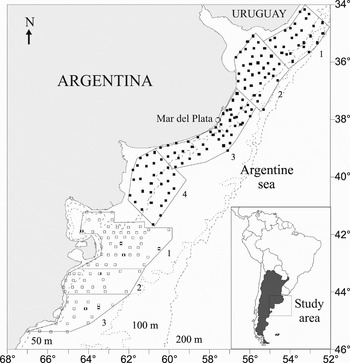
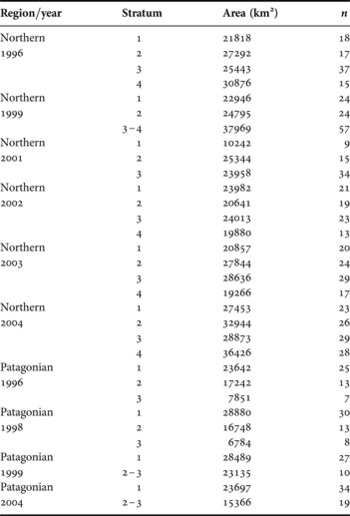
From 1996 to 2004 a series of combined acoustic and DEPM surveys have been carried out in order to assess the spawning populations of anchovy in the continental shelf off Argentina. Plankton samples were collected during research cruises conducted by the National Institute for Fisheries Research and Development (INIDEP) on board the RV ‘Oca Balda’ and RV ‘Dr Holmberg’. The average duration of the cruises was approximately three weeks in October for the northern stock and two weeks in December for the Patagonian population, covering in each case the period of peak spawning. The study area included coastal and shelf sectors off the Buenos Aires province between 34°S and 41°S up to a depth of approximately 140 m (Figure 1). The survey design for all years was more or less similar except for the lengthening of some shelf transects. The area of the surveys was split into four strata for the northern stock area and three strata for the Patagonian area, according to previous records of relative abundance of both egg and adult fish of the species. Each stratum was not considered independent from the other. The positive spawning area (where P 0 values were estimated) was considered as the area shoreward to the boundary of observed spawning including all positive stations and the few embedded negative stations (Table 1).
Survey area and design for the study of the northern and Patagonian stock of Argentine anchovy during spring and summer. Full circles, CalVET/PairoVET stations distributed in the north area; empty circles, CalVET/PairoVET stations distributed in the Patagonian area; numbered areas, strata used to estimate anchovy biomass.

Spawning area of each stratum where P 0 was estimated for the northern and Patagonian regions. n, number of positive PairoVET stations for anchovy eggs for each stratum within each region.

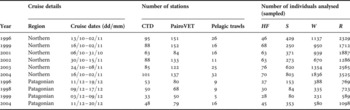
Oceanographic (CTD) and ichthyoplankton stations were regularly distributed along the acoustic transects. Distance between stations and between transect lines was 10–20 nautical miles and 15–25 nautical miles respectively. The temperature at 10 m depth was recorded at every station. At any time of day or night during the acoustic tracking, fishing hauls were performed when great quantities of anchovy were indicated. Table 2 presents details of the sampling effort and number of specimens analysed to estimate each parameter of the DEPM.
Summary of survey data. HF, hydrated females, S, spawning frequency, W, total weight, R, sex ratio.

Collection of anchovy eggs and adult specimens
Anchovy eggs were collected using vertical hauls of a CalVET/PairoVET net with a 0.225 m diameter and 220µm mesh size (Smith et al., Reference Smith, Flerx, Hewitt and Lasker1985). Vertical tows (Figure 1) were started from a point below the maximum depth of the eggs (typically 70 m) and ending at the surface. Filtered water was estimated by means of a mechanical flowmeter. Immediately after the end of each tow, the plankton sample was preserved in 5% formaldehyde in seawater. In the laboratory, anchovy eggs from each plankton sample were identified and counted under a binocular-dissecting microscope.
Adult anchovies were collected with a midwater trawl net having a 10-mm mesh size (Table 2). Thirty adult females were selected randomly from each sample and fixed in 10% formaldehyde in seawater. A ventral cut was made in each fish in order to facilitate the penetration of the formaldehyde into the body cavity. In the laboratory, each fish was weighed individually before having the gonad removed.
Parameter estimation of daily egg production
Anchovy eggs were staged according to a 9-stage scale and aged according to the sea temperature at 10 m depth (Ciechomski & Sánchez, Reference de Ciechomski and Sánchez1984). The abundance of each stage in the samples was standardized to the number under m2 of sea surface. Spawning was assumed to occur synchronously at 22:00 hours (Pájaro, unpublished data). As stated by Armstrong et al. (Reference Armstrong, Shelton, Hampton, Jolly and Melo1988), staged eggs were be allocated to one of up to three previous nights' spawning, according to the estimated egg ages for the various developmental stages. The age of eggs at each station were subsequently recalculated for each ‘spawning nights’ egg group using the elapsed time between 22:00 hours and sampling time.
Data from the total eggs collected each year were used to estimate hourly mortality rates by means of non-linear least-squares regression of abundance on age. It was generally assumed that spawning occurred at a fixed time of the day and that egg numbers declined at a constant exponential rate (Alheit, Reference Alheit1985).
The mortality of anchovy eggs was assumed to follow an exponential decay model of the form:

where P t is the number of eggs at age t, P 0 is the number of eggs at age 0, Z is the hourly instantaneous mortality rate and t is the age of eggs in hours.
The mean density of eggs at each age-class was estimated for each separate survey strata by averaging the station values for that age-class within each stratum. Stations 18.5 km apart were given twice the weighting of stations spaced 9.26 km apart to allow for the greater area represented by the 18.5 km stations. These mean densities were then multiplied by the stratum areas and summed to give overall abundance of eggs of age t to t+1 h. Only the abundances of eggs aged between 5 and 50 hours were included in the regression to avoid bias caused by hatching or incomplete recruitment of the eggs to the plankton. The methodology applied in this study followed that of Armstrong et al. (Reference Armstrong, Shelton, Hampton, Jolly and Melo1988). They estimated the egg density in each egg class weighted by stratum area with the aim of estimating total egg abundance at each age. This procedure was adopted in the current study to reduce any bias potentially caused by egg mortality varying between survey strata with different fish densities or environmental conditions. This was done despite that such variations were unlikely to be detectable at the present sampling rate.
The values of abundance of eggs at age at each station were divided by the estimated survival rate exp(−Zt) to provide up to three estimates of daily egg production (depending on the number of batches expected at the ambient temperature and time of sampling). These values were averaged to give a station value ( ). Parameters for strata and stations were suffixed i and j respectively. Stratum mean values
 were calculated as means of the station values.
The survey mean value  was obtained by averaging over strata with weights equal to Ai, the positive areas of the strata:
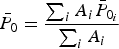
The component of variance in  arising from sampling error in the estimation of egg abundance was given by:
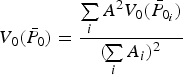
The overall variance of  , was obtained by including the error associated with the estimation of egg mortality:

where V(Z) is the variance of the hourly egg mortality estimate, and t is the mean age of eggs over the survey area.
Adult parameter estimates
The parameters involved in the estimates of the average specific fecundity were obtained from a single sample collected at each trawl station. Additional samples were collected when hydrated females were observed. Adult parameters were estimated using a weighted sample mean and a weighted variance (Draper & Smith, Reference Draper and Smith1981; Picquelle & Hewitt, Reference Picquelle and Hewitt1984) for each survey.
As the weight of hydrated females was temporarily increased due to water incorporation of the oocytes a few hours prior to spawning, adjusted weights were determined for each female sampled. The corrected weight (W ij) of the fish i at the station j was estimated from a linear regression of total body weight and the ovary-free weight (W ij*):

Batch fecundity (F) was estimated using the hydrated oocyte method (Hunter et al., Reference Hunter, Lo and Leong1985). Linear regressions were fitted to describe the relationship between batch fecundity (F ij) and gonad-free weight, (W ij*):

For each of these parameters relating to adult fish, mean and variance were calculated according to the equations developed by Piquelle & Stauffer (1985), which allow weighing of each station according to subsample size. The variance of batch fecundity was estimated as described in Draper & Smith (Reference Draper and Smith1981). As the values of fecundity corresponding to the individuals collected in each station were not observed directly but rather estimated with their own associated variance, these estimates of variance were adjusted to account for this additional source of variation.
The sex ratio (R) was calculated as the fraction in weight of mature females in the total adult population. According to Picquelle & Stauffer (Reference Picquelle, Stauffer and Lasker1985) the value of the sex ratio corresponding to each trawl station (R i) may be calculated as:

where Wf i and Wm i are the estimated weights of mature males and females in each trawl station.
The spawning fraction (S) represents the proportion of mature females that had spawned each day. Since no validated system existed for classifying Argentine anchovy postovulatory follicles by age, they were assigned according the description made for Engraulis mordax by Hunter & Goldberg (Reference Hunter and Goldberg1980). The proportion S was estimated by the incidence of females with day-1 and day-2 POFs separately. The spawning fraction was determined based on the average of the percentages of day-1 and day-2 spawning females (Fitzhugh et al., Reference Fitzhugh, Thompson and Snider1993; Macchi, Reference Macchi1998).
Daily specific fecundity (DSF) was determined as the number of eggs per population weight (g) per day:

Egg production estimation model
The spawning biomass was estimated with the Parker's (Reference Parker1980) equation, modified by Stauffer & Picquelle (Reference Stauffer and Picquelle1980) for the northern anchovy, Engraulis mordax:

where SB is the spawning biomass in metric tons for the area A (km2), and P 0, W, S, R and F were explained before.
The variance of the biomass estimate through this method was calculated according to the delta method (Seber, Reference Seber1973), as a function of variance and covariance of the estimates parameters:
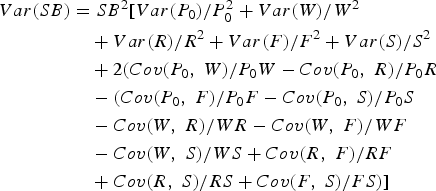
The sample covariances were only estimated for the adult parameter, since P 0 was derived from the plankton stations and the adult parameters were derived from the trawl stations. Thus the sample covariance between P 0 and the adult parameters was assumed to be 0.
RESULTS
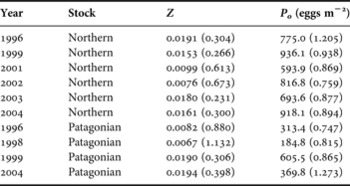
Annual estimates of the hourly egg mortality rate Z ranged between 0.0076 h−1 and 0.0191 h−1 for the northern population and between 0.0067 h−1 and 0.0194 h−1 for the Patagonian stock (Table 3). Estimates of the total daily egg production (P 0) showed higher incidence of spawning for the northern anchovy population, which produced mean values of P 0 between 594 eggs m−2 and 936 eggs m−2, whereas the annual means of the Patagonian stock ranged from 185 eggs m−2 to 605 eggs m−2. The parameter thus varied by nearly a factor of five, from the highest in the northern population in 1999 to the lowest value for the Patagonian stock in 1998. Coefficients of variation were high in both populations (Table 3). Inter-regional differences were observed when annual means of P 0 values for the northern and Patagonian stock were compared (t-test P < 0.003).
Hourly instantaneous rate of mortality (Z) and daily egg production (P 0). Coefficients of variation are given in parentheses.

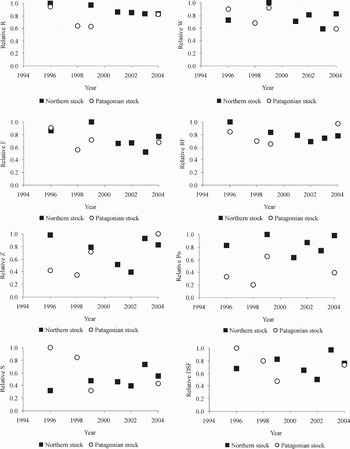
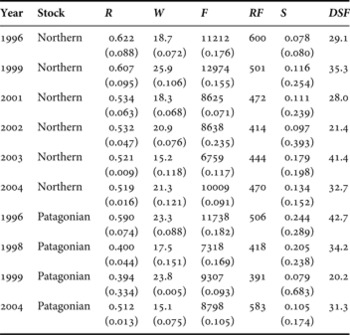
The mean values estimated for the Argentine anchovy DEPM parameters were characterized by inter-annual differences greater than inter-regional differences with the exception of the daily egg production (Figure 2). For the northern population, the estimates of mean weight of mature females ranged from 15 to 26 g, the relative batch fecundity from 414 to 600 eggs g−1, the spawning frequency from 0.078 to 0.179, and the females ratio from 0.519 to 0.622 of the spawning stock. The estimates corresponding to the Patagonian stock were similar being 15 to 24 g, 418 to 583 eggs g−1, 0.079 to 0.244, and 0.394 to 0.590, respectively (Table 4).
Relative estimates of the DEPM parameters based on the Argentine anchovy surveys carried out during the period 1996–2004. Each annual value is represented as a fraction of the greatest estimate corresponding to any of the two stocks during the whole period. R, sex ratio; W, total weight; F, fecundity; RF, relative fecundity; Z, hourly instantaneous rate of mortality; P 0, daily egg production; S, spawning fraction; DSP, daily specific fecundity.

Adult parameter estimates of Argentine anchovy DEPM applications. R is the sex ratio by weight, W the average weight of mature females (g), F the batch fecundity, RF the relative fecundity (RF = F/W, eggs g−1), S the spawning fraction and DSF the daily specific fecundity. Coefficients of variation are given in parentheses.

Estimates of the daily specific fecundity for both populations ranged from 20.2 to 42.7 eggs g−1day−1, having the lowest values being found in 2002 for the northern stock and in 1999 for the Patagonian population (21.4 and 20.2, respectively). Of the parameters included in the biomass equation, the spawning fraction showed the highest coefficients of variation, whereas the sex ratio showed the smallest. Throughout the period analysed and between the two populations, the relative batch fecundity estimates were similar with a mean of 480 eggs g−1 (Table 4).
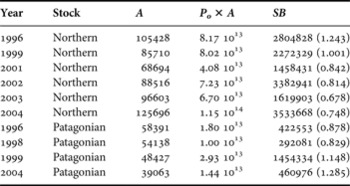
The spawning area of the northern anchovy population was almost twice that of the Patagonian stock. The annual estimates of spawning biomass for each group ranged from 1.6–3.5 and 0.3–1.5 million metric tons, respectively, and they consistently showed large coefficients of variation (Table 5).
Total spawning area, A (km2), total daily egg production for the spawning area (P 0 × A) and spawning biomass estimates (SB) for northern and Patagonian Argentine anchovy populations. Coefficients of variation are given in parentheses.

DISCUSSION
Pelagic fish are characterized by large stock size variability. The Argentine anchovy populations have shown large annual fluctuations from the 1960s and, even though the surveyed areas were not always the same, estimates of instantaneous abundance by either acoustic or egg-censoring based methods ranged from 0.3 to 10 million tons (Ciechomski & Sánchez, Reference de Ciechomski and Sánchez1988, Sánchez et al., Reference Sánchez, Pájaro and Macchi1996, Hansen & Garciarena, Reference Hansen and Garciarena2005b). Within narrower boundaries, important inter-annual fluctuations were observed in the present study during the period 1996–2004. The 2002 and 2004 estimates of the northern population spawning biomass were considerably higher than in other years. The high 2004 estimate was caused by a high daily egg production (Table 2) combined with a large spawning area (Tables 4 & 5), whereas the high estimate in 2002 was due to a high P 0 combined with a low reproductive output, i.e. daily specific fecundity (Tables 2 & 3). Similarly, the highest 1999 estimate of the Patagonian spawning stock was caused by a high P 0 and concurrent low daily specific fecundity (DSF) of that year (Tables 2 & 3). Changes in adult reproductive output to a lower DSF in 2002 for the northern stock (21.4 eggs g−1/day) and in 1999 for the Patagonian stock (20.2 eggs g−1/day) were the result of low relative batch fecundity and spawning frequency.
A characteristic of the application of DEPM in the south-west Atlantic was the low precision of the daily egg production (P 0) and spawning fraction (S) parameters, which together accounted for the largest amount of variation in the spawning biomass estimation. Our results indicated that the CV for daily egg production was higher than those of the other DEPM parameters. The high variance associated with the estimate of P 0 was a result of the scattered pattern of data used to fit the egg mortality relationship (equation 1), as well as of the great variability in egg abundance recorded in the samples. The uncertainty of P 0 and hourly instantaneous rate of egg mortality (Z) contributed to a major portion of the uncertainty of spawning biomass estimates (Picquelle & Stauffer, Reference Picquelle, Stauffer and Lasker1985). Armstrong et al. (Reference Armstrong, Shelton, Hampton, Jolly and Melo1988) estimated that these two parameters accounted for more than 80% of the sum of the squared CV of the egg production survey parameters.
Although the survey design of the DEPM was planned to cover a large area, it is evident that the number of CalVET/PairoVET stations and trawl stations were insufficient to allow the egg production survey parameters to be estimated with desirable precision. Improved estimates of those parameters will result primarily from increased sampling effort in the high-density areas (Cunha et al., Reference Cunha, Figueiredo, Farinha and Santos1992).
Variance of the daily egg production could be reduced by increasing the number of egg samples (Alheit, Reference Alheit1993), but the resulting expense of ship time often makes this improvement impossible in practice. Armstrong et al. (Reference Armstrong, Shelton, Hampton, Jolly and Melo1988) determined that to reduce the CV of the cape anchovy spawning biomass from 35% to 20% would require at least a further doubling of the overall survey effort by increasing the density of sample transects.
The high coefficient of variation for Z in this study was largely due to patchiness of early-stage eggs (Smith, Reference Smith1973), which in turn is primarily caused by the pattern of aggregation of adult females (Lo et al., Reference Lo, Green Ruiz, Jacob Cervantes, Moser and Lynn1996). Estimates of daily egg production and embryonic mortality are key elements in estimating spawning biomass (Lo, Reference Lo1997). Uriarte & Motos (Reference Uriarte and Motos1998) pointed out that another way to reduce the variance of the estimates of egg counts by 22% was to count the two nets of the PairoVET sampler. The use of the two nets of the same haul increased the filtered volume and the precision of the estimates.
The use of the exponential decay model to estimate P 0 requires satisfying a critical assumption: the egg mortality rate must not vary with the development stage, a hypothesis that is often violated due to predation on early stages (Hunter & Lo, Reference Hunter and Lo1997). However, abundance of 1-day-old eggs was not overrepresented in the Argentine anchovy stomachs when compared with older eggs (Pájaro et al., Reference Pájaro, Sánchez and Aubone1998). The bias associated with P 0 could be reduced by improving some methodological steps and by adopting some statistical alternatives for estimating daily egg production: generalized linear models, simulation studies or geostatistical data treatment (Curtis, Reference Curtis2004). Recently, a generalized additive model (GAM) to the DEPM for the Bay of Biscay anchovy (Engraulis encrasicolus) was applied (Ibaibarriaga et al., 2004). An advantage of the GAM methodology is that it provides predicted egg production surfaces that allow tracking historical changes of the spawning in space and analysing its relationship with environmental covariates (Ibaibarriaga et al., 2004).
Other potentially more efficient sampling schemes, such as adaptive sampling might yield more efficient and unbiased estimates of egg production for the youngest eggs (Lo et al., Reference Lo, Green Ruiz, Jacob Cervantes, Moser and Lynn1996). Presently the CalVET/PairoVET samplers are used together with a continuous underway fish egg sampler (CUFES) as an efficient auxiliary information provider (Lo et al., Reference Lo, Hunter and Charter2001). The CUFES is a useful tool with the DEPM when it is used to estimate the total spawning area reducing the potential bias of not enclosing the entire population (Lo et al., Reference Lo, Hunter and Charter2001). Yolk-sac larvae have been also used in addition to eggs in an estimate of Pacific sardine biomass (Lo et al., Reference Lo, Green Ruiz, Jacob Cervantes, Moser and Lynn1996). The addition of yolk-sac larvae substantially improves the precision of the estimate of daily egg production (Somarakis et al., Reference Somarakis, Koutsikopoulos, Machias and Tsimenides2002) and increases the number of pairs in the mortality curve when data are scarce. In our study, the use of yolk-sac larvae to increase the number of age categories for constructing the mortality curves was not necessary as the duration of the embryonic stage was more than 3 days.
The spawning frequency (S) of the Patagonian anchovy population showed higher CV than those of the northern stock (Table 4). A major difference in the S estimation of the Patagonian stock could be the consequence of a smaller number of trawl stations sampled. Precise estimates of spawning rates typically require approximately 35 or more independent trawl samples of adult fish, which should be distributed over the whole spawning area (Alheit, Reference Alheit1993; Hunter & Lo, Reference Hunter and Lo1997). However, with the exception of 2003, variability of the spawning fraction of the northern stock was relatively low. In order to explain the relative consistency of spawning fraction estimates, Hunter & Lo (Reference Hunter and Lo1997) introduced the ‘biorhythm hypothesis’, which suggests that the frequency of spawning is relatively constant for females of a population that is actively spawning as long as the habitat conditions remain relatively constant. Furthermore, the same authors suggested that an even larger potential bias may exist in using a mean spawning rate for S as it is affected not only by the age structure of the population and the abundance of food but also by the variation in timing of peak reproduction.
The CV of the spawning fraction of the Patagonian stock were higher than the CV of the northern stock due to the low number of trawl stations sampled in the Patagonian stock area. In 1996, 2003 and 2004 northern stock, the number of trawl stations was higher than 25 and the CV of S was less than 20%. Nevertheless, similar CV values to those observed for the northern population have been cited for Engraulis capensis (Armstrong et al., Reference Armstrong, Shelton, Hampton, Jolly and Melo1988; Shelton et al., Reference Shelton, Armstrong and Roel1993), Sardinops sagax (Lo et al., Reference Lo, Green Ruiz, Jacob Cervantes, Moser and Lynn1996) and Sardina pilchardus (Cunha et al., Reference Cunha, Figueiredo, Farinha and Santos1992). In this study the fractions of day-1 and day-2 females were used to estimate the spawning frequency. According to Ganias et al. (Reference Ganias, Somarakis, Machias and Theodorou2003), the precision of the estimate can be improved if more than one daily class of spawners can be identified in the samples, and subsequently combined to produce a composite estimate of the spawning fraction.
The estimates of northern Argentine anchovy stock biomass derived from the DEPM and the independent estimates obtained from the acoustic method (Hansen & Garciarena, Reference Hansen and Garciarena2005a) are shown in Figure 3. With the exception of 1996 and 2002, reasonably close agreement between the two methods could be observed when the estimated biomass of the northern stock was analysed. In 1996 acoustic biomass was much larger than the value obtained from the DEPM. However, a cohort analysis showed a value lower than 4 million tons (Hansen & Garciarena, Reference Hansen and Garciarena2005b), which was closer to the 2.8 million tons calculated with the DEPM. In 2002 the biomass derived from DEPM was larger than the acoustic biomass, but no acceptable explanation for this difference could be found. A comparison between the Patagonian stock biomass derived from the DEPM and the acoustic method was not performed due to the low number of analysed years. At first glance, the agreement between acoustic method estimates and DEPM estimates has been much closer for the northern anchovy population than for the Patagonian stock. A reason for this discrepancy could be the insufficient sampling effort, i.e. the low number of CalVET/PairoVET and trawl stations allocated within the Patagonian stock region.
Biomass (million metric tons) estimates of the northern stock of Engraulis anchoita from the Daily Egg Production Method (DEPM) and acoustic method (AM) for the period 1996 to 2004.

Armstrong et al. (1998) and Shelton et al. (Reference Shelton, Armstrong and Roel1993) have indicated that DEPM can be operated successfully in tandem with hydro-acoustic biomass estimates, whereby the two methods provide largely independent estimates of stock size. The combination of the two estimates would produce a more accurate and reliable estimate than either of the two alone (Shelton et al., Reference Shelton, Armstrong and Roel1993).
It must however be recognized that the DEPM is a labour-intensive technique, requiring several months after the completion of the survey to produce results. But in spite of its relatively low precision, the method offers valuable information to adjust the acoustic estimates (Alheit, Reference Alheit1993). Moreover, another important aspect of the continued application of the DEPM and acoustic method is that they provide a time series of both estimates of anchovy population size and biological parameters for basic research.
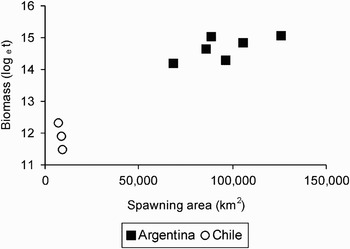
In the south-east Pacific the spawning area of the central-south stock of Engraulis ringens is placed. This stock lives along the Chilean coast, at similar latitudes with the northern population of E. anchoita. During midwinter–early spring E. ringens spawns in the central-south area off Chile, from 35°S to 41°30'S, covering an area of 7000–9000 km2 (Cubillos et al., Reference Cubillos, Castro and Oyarzún2005). In the same way with the northern Argentine anchovy stock, the E. ringens spawning is coastal and related to depth lower than 50 m (Cubillos et al., Reference Cubillos, Castro and Oyarzún2005). However, contrasting with the Chilean anchovy, the spawning area was greater in the case of E. anchoita. This is probably a consequence of the largest continental shelf width in the E. anchoita spawning area off Argentina, with more than 170 km, in contrast with the narrow continental shelf in the E. ringens spawning area off Chile with less than 45 km in width (Camus, Reference Camus2001). The comparison of both species showed that the spawning stock biomass of E. anchoita was much higher than the spawning biomass of E. ringens (Figure 4) principally due to the largest spawning area of the Argentine anchovy.
Comparison between spawning biomass (expressed in loge) and spawning area of Engraulis ringens off Chile and E. anchoita off Argentina from 34–41°S.

A future goal will be to apply a different methodology to obtain the daily egg production in order to diminish the uncertainty associated with the Z and P 0 parameters. Another chance will be to combine data for the northern and Patagonian regions to reduce the variance and thus the coefficient of variation of estimates of parameters such as P 0, Z and S, because some of the parameter estimates do not seem to be different between north and south. The decision of combining both sets of data will need to be supported by statistical analysis every year.
Finally, the DEPM has been demonstrated to be an important, although labour-intensive, method for obtaining biomass estimates for Engraulis anchoita in addition to the estimates obtained from acoustic surveys. Perhaps, the most important conclusion derived from the studies by Hunter & Lo (Reference Hunter and Lo1997) is that after 25 years of use, the Daily Egg Production Method remains a surprisingly robust method of estimating fish biomass.
ACKNOWLEDGEMENTS
We thank Daniel Brown for collecting plankton samples and separating anchovy eggs of PairoVET samples. We greatly appreciate Nancy Lo and two anonymous referees for their suggestions to improve the manuscript. This is INIDEP contribution No. 1529.