


Introduction
Silybum marianum (L.) Gartn. (Asteraceae), common name milk thistle, has been utilized for medicinal purposes since ancient times (Morazzoni and Bombardelli, Reference Morazzoni and Bombardelli1995). It is native to southern Europe, Asia Minor and northern Africa and it is usually cultivated as a medicinal plant principally in Europe and Asia (Morazzoni and Bombardelli, Reference Morazzoni and Bombardelli1995; Andrzejewska et al., Reference Andrzejewska, Martinelli and Sadowska2015). The species is diploid (2n = 34; Tutin et al., Reference Tutin, Heywood, Burges, Moore, Valentine, Walters and Webb1976) and it was described to be mainly autogamous with an average outcrossing rate of 2% under field conditions (Hetz et al., Reference Hetz, Liersch and Schieder1995). More recently, in wild S. marianum populations, a higher outcrossing rate has been hypothesized (Martinelli et al., Reference Martinelli, Fulvio, Pietrella, Focacci, Lauria and Paris2021). Silybum marianum need no vernalization and can be classified as an annual species even though it can be biennial under certain conditions (Young et al., Reference Young, Evans and Hawkes1978; Groves and Kaye, Reference Groves and Kaye1989). Seed dormancy was recently studied in this species indicating that substantial after-ripening occurred after 2 months of dry storage (Monemizadeh et al., Reference Monemizadeh, Ghaderi-Far, Sadeghipour, Siahmarguee, Soltani, Torabi and Bakin2021). As for cold tolerance, the plant is hardy to zone 8b (USDA classification; Martinelli, Reference Martinelli2019), and as a crop it can be grown utilizing an overwintering growth cycle in these settings. In contrast, in cooler climates, the species is grown as a summer annual crop (Andrzejewska et al., Reference Andrzejewska, Martinelli and Sadowska2015).
Milk thistle is still marked by traits that are typical of undomesticated species. Although having been possibly cultivated in Italy since Neolithic time (Rottoli, Reference Rottoli2000), the species has not been completely domesticated and it still retains traits such as fruit dispersal at maturity, asynchronous flowering, spiny leaves, lodging problems and variable yield quality and stability. In particular, the reduction of natural fruit shattering at maturity and the improvement of fruit quality traits currently represent the main targets of further S. marianum breeding programmes (Alemardan et al., Reference Alemardan, Karkanis and Salehi2013). Nevertheless, milk thistle possesses a significant economic importance as a medicinal species. At present, it is among the top selling herbal products in the USA, Italy and other countries (ISMEA report, 2013; Smith et al., Reference Smith, May, Eckl and Morton Reynolds2020) and drugs used for liver pathologies based on purified milk thistle extracts have been available for almost 50 years (Albrecht et al., Reference Albrecht, Frerick, Kuhn and Strenge-Hesse1992).
The medicinal properties of milk thistle are diverse and are mostly determined by its ability to accumulate bioactive flavonolignan complexes referred as silymarin (Wagner et al., Reference Wagner, Diesel and Seitz1974; Abenavoli et al., Reference Abenavoli, Capasso, Milic and Capasso2010). Silymarin consists of a mixture of flavonolignans and is predominantly accumulated in the fruit integument (Cappelletti and Caniato, Reference Cappelletti and Caniato1984; Giuliani et al., Reference Giuliani, Tani, Maleci Bini, Fico, Colombo and Martinelli2018). The six main silymarin constituents are: silybin A and B, isosilybin A and B, silychristin and silydianin. Wide flavonolignans variability has often been reported within different commercial silymarin formulations (Chambers et al., Reference Chambers, Holečková, Petrásková, Biedermann, Valentová, Buchta and Křen2017). Interestingly, each flavonolignan has appeared to have different biological activities (Polyak et al., Reference Polyak, Morishima, Lohmann, Pal, Lee, Liu, Graf and Oberlies2010) and this is therefore pivotal to further select genotypes with the most appropriate chemotype. A wide range of variable chemotypes has been described in S. marianum wild populations (Abouzid et al., Reference AbouZid, Chen and Pauli2016; Poppe and Petersen, Reference Poppe and Petersen2016; Drouet et al., Reference Drouet, Abbasi, Falguières, Ahmad, Sumaira, Ferroud, Doussot, Vanier, Lainé and Hano2018; Arampatzis et al., Reference Arampatzis, Karkanis and Tsiropoulos2019) and, recently, the two phenotypically stable S. marianum chemotypes A and B have been identified (Martinelli et al., Reference Martinelli, Potenza, Moschella, Zaccheria, Benedettelli and Andrzejewska2016, Reference Martinelli, Fulvio, Pietrella, Focacci, Lauria and Paris2021).
Other than silymarin, S. marianum fruits also contain further valuable products such as oil (27–32% of fruit DW) and protein (ca 19%; Andrzejewska et al., Reference Andrzejewska, Martinelli and Sadowska2015; Martinelli et al., Reference Martinelli, Potenza, Moschella, Zaccheria, Benedettelli and Andrzejewska2016). As for fruit fatty acid composition, the main fatty acid is linoleic acid (28–64%) followed by oleic acid (20–50%) (Chambers et al., Reference Chambers, Holečková, Petrásková, Biedermann, Valentová, Buchta and Křen2017). By-products generated from silymarin extraction have shown to possess different non-medical applications in human and animal nutrition and biofuel production (Andrzejewska et al., Reference Andrzejewska, Martinelli and Sadowska2015). Milk thistle lignocellulosic biomass was tested for biogas production with positive results (Kalamaras and Kotsopoulos, Reference Kalamaras and Kotsopoulos2014). Equally important, S. marianum was recently proposed for biomass production in contaminated sites allowing concomitant bioenergy production and phytoremediation (Domínguez et al., Reference Domínguez, Montiel-Rozas, Madejon, Diaz and Madejon2017a, Reference Domínguez, Madejon, Madejon and Bianco2017b).
Recently a mutagenesis programme has been implemented to increase genetic variability of key domestication traits in this species (Martinelli, Reference Martinelli2019). The progeny of the mutagenized population has been screened during following generations for major phenotypic traits, fruit scattering resistance and fruit fatty acid composition. The most interesting and genetically stable mutagenized lines derived from the above-mentioned mutagenesis experiment and two promising wild S. marianum genotypes are now stored at the Genebank of the Leibniz Institute of Plant Genetics and Crop Plant Research (IPK, Gatersleben). In this manuscript, a detailed description of these nine S. marianum accessions is provided and their possible further utilization is discussed.
Material and methods
Mutagenesis treatment and mutagenized population development
Accession RCAT 057475 obtained from the Institute for Agrobotany (Tapioszele, Hungary; donor code HUN003) was used as starting material (‘wild type’) for the mutagenesis programme (accession SIL11). The mutagenesis treatment was performed with ethyl methanesulfonate (EMS) according to Martinelli (Reference Martinelli2019). Silybum marianum fruits were treated with 35.6 mM freshly prepared EMS. The mutagenic treatment was applied in the dark for 16.5 h at 22°C under constant agitation. At the end of the incubation period, the fruits were washed under tap water for 1 h. Prior to field sowing, the fruits were allowed to dry at room temperature on filter paper for 5 days. A total of 5000 EMS-treated fruits (M1 fruits) were sown under open field condition in March 2013 at Budrio (Bologna, Italy) experimental farm. The fruits were sown 3 m inter-row distance and placed ca 17 cm from each other along the row. Flowering took place during May and June and M2 fruits were harvested between July and August 2013 collecting only the central flower head from each plant as soon as reaching BBCH stage 88 (Martinelli et al., Reference Martinelli, Andrzejewska, Salis and Sulas2015), this is to minimize fruit loss. A total of 2239 plants were able to produce M2 fruits. The obtained population was multiplied with single seed descent approach up to the production of M4 fruits in summer 2015. During the process, the entire M2 and M3 populations were screened for the identification of milk thistle mutant lines. Different putative mutant lines were identified during the screening of the M2 and M3 populations, respectively. Each putative mutant line was further multiplied during subsequent years selecting the best plants among the derived progenies from each putative mutant line. During the evaluation of the line progenies, to avoid any possible accidental crossing between lines, one flower head per plant had been isolated with non-woven fabric just before flowering (Martinelli, Reference Martinelli2018), only the fruits obtained from the isolated flower head were utilized for further multiplications. Before IPK acquisition, all the accessions underwent natural self-fertilization for a minimum of seven generations and are, at present, phenotypically stable.
All the mutant lines presented in the manuscript (namely SIL12, SIL13, SIL14, SIL15, SIL16, SIL17 and SIL18) derive from the above-mentioned mutagenic treatment of the accession SIL11. The accession SIL19 is a wild accession not involved in the mutagenesis programme (Table 1).
General description of the presented accessions (results refer to Bologna 2017 harvest)

na, not analysed; SD, standard deviation.
a Thousand fruit weight at 7% humidity (n = 3).
b % of fruit dry weight (n = 2)
c According to Martinelli et al. (Reference Martinelli, Potenza, Moschella, Zaccheria, Benedettelli and Andrzejewska2016) and Giuliani et al. (Reference Giuliani, Tani, Maleci Bini, Fico, Colombo and Martinelli2018).
Fruit fatty acid and total oil content analysis
The analysis of fruit fatty acid composition was performed according to Martinelli et al. (Reference Martinelli, Potenza, Moschella, Zaccheria, Benedettelli and Andrzejewska2016). Fruits of milk thistle were ground with a ZM1 mill (Retsch, Germany) equipped with a 0.75 mm mesh. The obtained flour was extracted under constant agitation for 30 min at room temperature with hexane (20 solvent to flour ratio, v/w). After centrifugation, the supernatant was utilized for analysis. The fatty acid profile was analysed in gas chromatography with an HRGC 5300 (Carlo Erba, Italy) equipped with an FID detector and an autosampler AS2000 (ThermoFisher, USA) after trans-methylesterification of the hexane extract. Trans-methylesterification was performed with 2N KOH in methanol under vigorous agitation (diluted hexane extract to KOH ratio 10, v/v). The GC column was an RTX 2300 (30 m, 0.25 mm ID, 0.2 μm df; Restek, USA). GC settings are as follows: carrier gas helium, column flow 2 ml/min, split ratio 1:30, temperature programme: 170°C for 12 min, up to 240°C (20°C/min) and hold 240°C for 3 min, injection volume 1 μl. The single fatty acids were identified by comparison of chromatograms with the relevant analytical standards provided by Sigma-Aldrich.
Total oil quantification was performed after Soxhlet oil extraction. Three grams of grounded fruits were extracted for 8–10 h with hexane. After complete hexane evaporation, the obtained oil was measured gravimetrically.
Results and discussion
All the accessions described in the manuscript will be available through the ‘Genebank Information System of the IPK Gatersleben’ (https://gbis.ipk-gatersleben.de) and can be utilized for both breeding and research purposes. Each accession here is described both presenting novel results and taking into consideration the information included in previous literature, this is to have a comprehensive description of the presented plant material.
Accession SIL11 (names: G20, wild type; doi: 10.25642/IPK/GBIS/8301337)
The accession, originating from Germany, was initially obtained from the Institute for Agrobotany (Tapioszele, Hungary; donor code HUN003; donor accession number RCAT 057475). It was evaluated for fruit traits within a collection of 26 different S. marianum genotypes (genotype G20 in Martinelli et al., Reference Martinelli, Potenza, Moschella, Zaccheria, Benedettelli and Andrzejewska2016). If compared with other accessions, fruits from this genotype are characterized by comparatively high thousand fruits weight, average total oil content, low oleic acid content (Martinelli et al., Reference Martinelli, Potenza, Moschella, Zaccheria, Benedettelli and Andrzejewska2016). The total fruit oil content of this accession is ca 28% (Table 1) and the gas chromatographic analysis of fruit fatty acid profile indicates an oleic and stearic acid content of ca 8 and 33%, respectively (Table 2). It shows comparatively low silymarin total content and high silydianin content (S. marianum chemotype B according to Martinelli et al., Reference Martinelli, Potenza, Moschella, Zaccheria, Benedettelli and Andrzejewska2016). The accession was utilized as breeding material to observe the silymarin phenotype of F1 hybrids between S. marianum chemotypes A (SIL19) and B (SIL11) obtaining the intermediate silymarin profile, chemotype C (Martinelli et al., Reference Martinelli, Fulvio, Pietrella, Focacci, Lauria and Paris2021). Moreover, this accession was utilized for the description of phenolic compounds localization in fruits characterized by chemotype B (Giuliani et al., Reference Giuliani, Tani, Maleci Bini, Fico, Colombo and Martinelli2018). The natural fruit shattering process and vegetative biomass composition of this accession were described in Martinelli (Reference Martinelli2019; therein described as ‘wild type’). Vegetative biomass was characterized both by hemicellulose fraction composed by xylans and by a high cellulose to hemicellulose ratio. Moreover, the main morphologic and biomass traits of this accession have shown a comparatively high harvest index and low nitrogen biomass content (Martinelli, Reference Martinelli2020). This accession was also both used as a main reference for the description of the phenological BBCH scale for S. marianum and as genetic material for the selection of reference genes for real-time polymerase chain reaction normalization in this species (Martinelli et al., Reference Martinelli, Andrzejewska, Salis and Sulas2015; Fulvio et al., Reference Fulvio, Martinelli and Paris2021).
Gas chromatographic analysis of fruit oil fatty acid profile (% total fatty acids ± SD) of wild type and mutant lines grown in Budrio (Bologna, Italy) under overwintering cycle

n = 9; SD, standard deviation; wt, wild type.
Accession SIL12 (name: G62; doi: 10.25642/IPK/GBIS/8301427)
The fruit of this mutant line is characterized by silymarin chemotype B, an oil content of ca 28% fruit DW (Table 1) and significantly altered fatty acid profile if compared to wild type (SIL11). The accession shows significantly higher oleic acid content and, as a consequence, reduced linoleic acid content (Table 2). Interestingly, despite fruit oleic acid content usually varies at changing environmental temperatures during fruit ripening, oleic acid content of SIL12 is usually stable being around 68% of total fatty acids. As for the possible improvement of fruit fatty acid composition, accessions SIL12 may be useful. Specifically, the oleic acid content measured in this accession is the highest so far reported in this species (Chambers et al., Reference Chambers, Holečková, Petrásková, Biedermann, Valentová, Buchta and Křen2017) suggesting that significant results might be achieved.
If compared to SIL11, no differences were observed for fruit shattering process at maturity or any other morphological (vigour, plant height, number of flowers head, thousand fruit weight) or phenological traits.
Accession SIL13 (name: D35; doi: 10.25642/IPK/GBIS/8301435)
Correspondingly, the fruit of this mutant line is characterized by a modified fatty acid profile when compared to wild type (SIL11). The accession shows almost a twofold steric acid content and reduced oleic acid content (Table 2). The stearic acid content measured in this accession is the highest so far reported in milk thistle (Chambers et al., Reference Chambers, Holečková, Petrásková, Biedermann, Valentová, Buchta and Křen2017) suggesting that significant results might be achieved using this accession in breeding programmes aiming to increase fruit stearic acid content. Moreover, the fruit is characterized by high thousand fruit weight, silymarin chemotype B and an oil content similar to SIL11 (Table 1).
Under overwintering growth cycle in Mediterranean conditions, no major differences from SIL11 were observed as for fruit shattering process at maturity, or any other morphological (vigour, plant height, number of flowers head, thousand fruit weight) or phenological traits. When grown under cooler conditions at IPK, this accession showed occasional modification to side branches morphology.
Accession SIL14 (names: MUT-CO, Contorta; doi: 10.25642/IPK/GBIS/8301450)
The main characteristic of this mutant is that it is completely shatter-resistant. At maturity, flower heads do not open up and the fruits are completely retained (Martinelli, Reference Martinelli2019; therein referred as ‘MUT-CO’). The main constraint to S. marianum wider utilization is the fruit shattering natural process that takes place at maturity (Alemardan et al., Reference Alemardan, Karkanis and Salehi2013). This results in significant fruit losses (30–40% of the production; Hevia et al., Reference Hevia, Wilckens, Berti and Fischer2007) and in further S. marianum infestation of the subsequent crop. To date, no shatter-resistant S. marianum genotypes have been described and, to reduce fruit losses, S. marianum is usually harvested before physiological maturation with subsequent problems related to fruit drying and possible mycotoxins formation (Fenclova et al., Reference Fenclova, Novakova, Viktorova, Jonatova, Dzuman, Ruml, Kren, Hajslova, Vitek and Stranska-Zachariasova2019). In the future accessions, SIL14 may be useful breeding material to solve the fruit shattering problem.
This accession was originally named ‘Contorta’, that in Italian means ‘twisted’, because after flowering the stems start twisting (online Supplementary Fig. S1). The vegetative biomass of this accession is extremely fragile and it breaks easily if bent between fingers. The compositional analysis of the biomass revealed a remarkable reduction of xylans content that might be responsible for both the failure of flower head opening and its biomass fragility (Martinelli, Reference Martinelli2019). Despite the observed biomass, fragility can create a serious problem to canopy stability under adverse climatic conditions, it was possible to combine harvest this accession obtaining a fruit productivity and quality (silymarin and oil) comparable with SIL11 (Martinelli, Reference Martinelli2019). Interestingly, accessions SIL14 might be also useful to develop S. marianum genotypes characterized by modified plant biomass composition.
Moreover, the accession is characterized by silymarin chemotype B and comparatively high total oil content (Table 1). Previous studies evaluated oil content and fatty acid profile of fruits from different S. marianum accessions, and the improvement of fruit fatty acid profile was included between the important breeding objectives for this species (Fathi-Achachlouei and Azadmard-Damirchi, Reference Fathi-Achachlouei and Azadmard-Damirchi2009; Alemardan et al., Reference Alemardan, Karkanis and Salehi2013; Martinelli et al., Reference Martinelli, Potenza, Moschella, Zaccheria, Benedettelli and Andrzejewska2016; Meddeb et al., Reference Meddeb, Reizig, Abderrabba, Lizard and Mejri2017). In accession SIL14, the total fruit oil content of ca 31% (Table 1) is comparatively very high (Fathi-Achachlouei and Azadmard-Damirchi, Reference Fathi-Achachlouei and Azadmard-Damirchi2009; Alemardan et al., Reference Alemardan, Karkanis and Salehi2013; Martinelli et al., Reference Martinelli, Potenza, Moschella, Zaccheria, Benedettelli and Andrzejewska2016; Meddeb et al., Reference Meddeb, Reizig, Abderrabba, Lizard and Mejri2017) highlighting that, other than fruit shattering, this accession shows interesting characteristics also for oil production purposes.
Accession SIL15 (names: MUT27/13, Mutant C; doi: 10.25642/IPK/GBIS/8301456)
This mutant line possesses peculiar traits at both vegetative biomass and fruit level. As for vegetative biomass, the stems of this line are extremely flexible (but not fragile) and at maturity the plant shows a prostrated habit (online Supplementary Fig. S2). For seed reproduction purposes, this accession is usually supported with bamboo poles to prevent lodging (online Supplementary Fig. S3). The line is partially shatter-resistant because the pappus ring does not open completely at maturity resulting in reduced fruit dispersal (Martinelli, Reference Martinelli2019; therein identified as ‘MUT-27/13’). In the future, this accession also may be useful breeding material to solve the fruit shattering problem.
Stem flexibility is associated to a considerable reduction of soluble lignin biomass content if compared to SIL11 or other mutagenized lines (Martinelli, Reference Martinelli2019). To be noted is also the fact that this accession has light brown-coloured fruits, which evidently differ from the dark brown-black fruits of SIL11. This reduction of fruit colour pigmentation is due to low condensed tannin content in the pericarp subepidermal layer (Giuliani et al., Reference Giuliani, Tani, Maleci Bini, Fico, Colombo and Martinelli2018; therein referred as ‘Mutant C’ line). The reduction of both fruit condensed tannin content and biomass lignin content (Giuliani et al., Reference Giuliani, Tani, Maleci Bini, Fico, Colombo and Martinelli2018; Martinelli, Reference Martinelli2019) indicates that in this genotype a mutation along the phenylpropanoids biosynthetic pathway is present. Despite this, silymarin composition and content do not show major differences with SIL11 (Giuliani et al., Reference Giuliani, Tani, Maleci Bini, Fico, Colombo and Martinelli2018).
Accession SIL16 (name: MUT113/4; doi: 10.25642/IPK/GBIS/8301460)
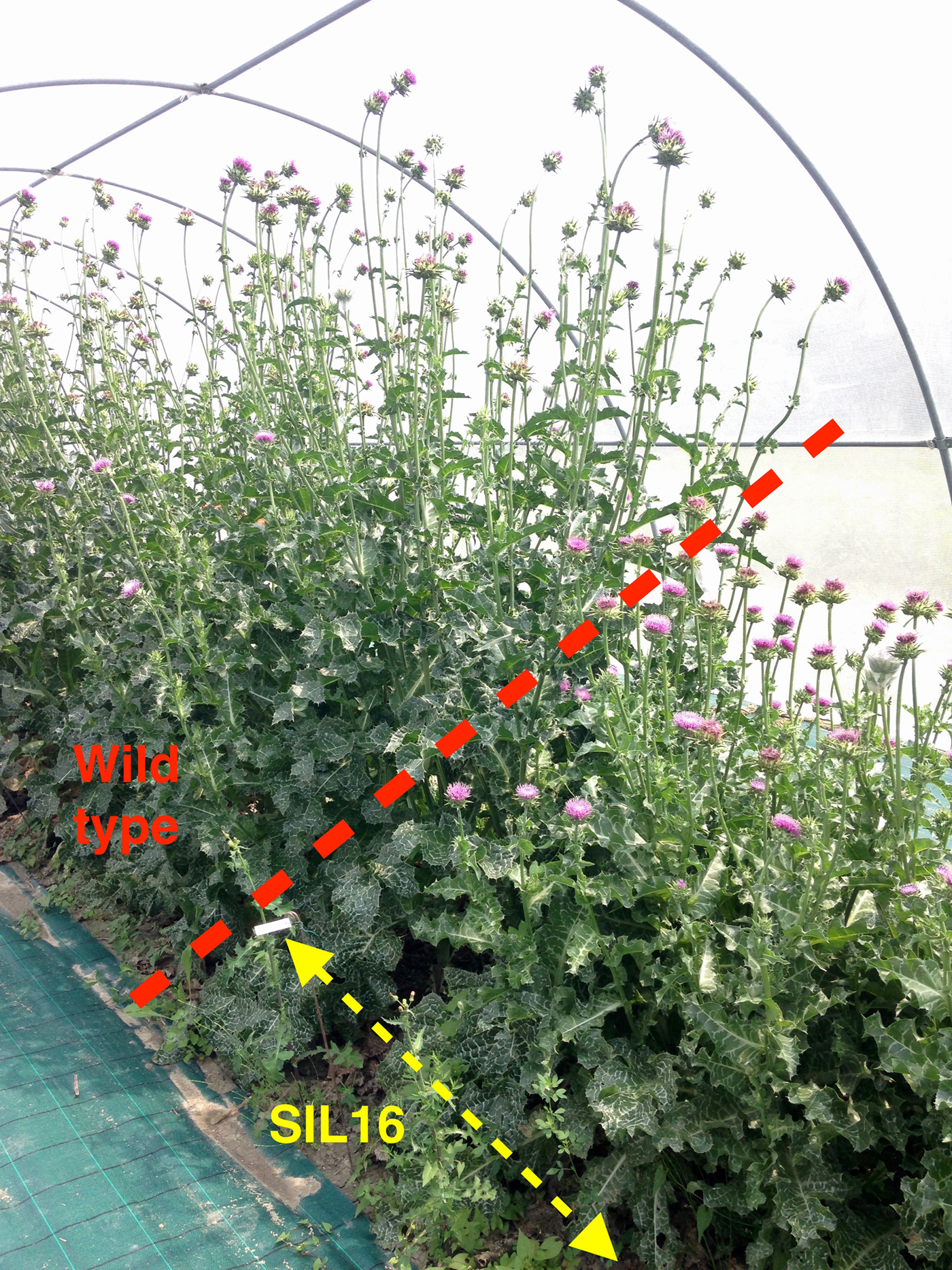
The accession shows a dwarf phenotype for both plant size and fruit dimension. This mutant is primarily characterized by small plants that do not exceed 120 cm under favourable Mediterranean overwintering growing conditions. Also fruit size is reduced with a thousand fruit weight of 13.27 g ± 0.5 (SD; Table 1). If compared to SIL11, the accession shows both half plant height and half fruit weight (Fig. 1). Interestingly, the average height of ca 120 cm is maintained also under annual growth cycle (i.e. spring sowing), when S. marianum overall plant height is usually reduced (Fig. 2).
Comparison between wild type (SIL11) and the dwarf accession SIL16 at flowering stage. Overwintering growth cycle (Bologna, Italy).
SIL16 grown under annual growth cycle (i.e. spring sowing) at IPK (Gatersleben, Germany).

Noticeably, besides a reduced size, this accession also shows almost absent fruit shattering at maturity due to the fact that most of the fruits are firmly attached to the receptacle (Martinelli, Reference Martinelli2019; therein referred as ‘MUT-113/4’). Moreover, the accession also displays two main morphological peculiarities: dichotomous, rather than pseudomonopodial branching (Martinelli, Reference Martinelli2019), and flower heads that, at intermediate flowering (BBCH stage 67; Martinelli et al., Reference Martinelli, Andrzejewska, Salis and Sulas2015), exhibit a typical central depression due to reduced floret length (Fig. 3).
(a) Flower head of wild-type genotype (SIL11) at BBCH stage 67; (b) flower head of accession SIL16 at BBCH stage 67 showing a typical central depression due to reduced florets length. When all the florets are open (BBCH stage 69), the difference between the two lines is no more evident.

Overall, despite reduced plant size, plant vigour is good and flowering always abundant (Figs 1 and 2).
Accession SIL17 (name: MUT100; doi: 10.25642/IPK/GBIS/8301624)
Contrary to accession SIL16, the mutant line SIL17 is characterized by both taller plants and higher thousand fruit weight if compared to wild type. Plants are taller than wild type: they easily reach 3 m at maturity. The thousand fruit weight is typically of 41.2 g ± 0.2 (SD; Table 1). Small plantlets of this accession (BBCH stage 12) are often characterized by supernumerary/deformed first true leaves (online Supplementary Fig. S4). As for other morphological features, the plants appear normal and extremely vigorous.
Accession SIL18 (name: MUT1; doi: 10.25642/IPK/GBIS/8301626)
This mutant line displays plants with almost completely white leaves (hypervariegated leaves; Fig. 4). Typically, plants of accession SIL18 are characterized by reduced plant vigour if compared to the wild type (SIL11). In the future, this accession can be used to better study the ecophysiological and adaptive role of variegated leaves in this species: a theme that until now had only been limitedly studied (Lev-Yadun, Reference Lev-Yadun2017; Shelef et al., Reference Shelef, Summerfield, Lev-Yadun, Villamarin-Cortez, Sadeh, Herrmann and Rachmilevitch2019).
On the left a wild type plant at rosette stage, on the right a hypervariegated plant of accession SIL18.

Accession SIL19 (name: G23; doi: 10.25642/IPK/GBIS/8301630)
This accession derives from a wild population originally sampled in locality Pelago (Florence province, Italy) at 280 m a.s.l. It was evaluated for fruit traits within a collection of 26 different S. marianum genotypes (genotype G23 in Martinelli et al., Reference Martinelli, Potenza, Moschella, Zaccheria, Benedettelli and Andrzejewska2016, Reference Martinelli, Fulvio, Pietrella, Focacci, Lauria and Paris2021). If compared with other accessions, fruits from this accession are mainly characterized by both comparatively low fruit weight and size, and average total oil content. If compared to other wild accessions, oil from this genotype displays high oleic acid content mirrored by a low linoleic acid content (Martinelli et al., Reference Martinelli, Potenza, Moschella, Zaccheria, Benedettelli and Andrzejewska2016). As for silymarin, it shows comparatively high total silymarin content and high silycristin and silybin contents (S. marianum chemotype A according to Martinelli et al., Reference Martinelli, Potenza, Moschella, Zaccheria, Benedettelli and Andrzejewska2016; Table 1). As previously mentioned, the accession was utilized as breeding material to observe the silymarin phenotype of F1 hybrids between S. marianum chemotypes A and B (Martinelli et al., Reference Martinelli, Fulvio, Pietrella, Focacci, Lauria and Paris2021). The vegetative biomass of this accession has a comparatively high insoluble lignin content and the plant morphology is characterized by a generally low number of side branches (Martinelli, Reference Martinelli2020).
Despite the presented accessions are mostly characterized by good vigour and unique characteristics, further breeding is necessary for their exploitation. Recently, a technical protocol for the setup S. marianum crosses has been proposed (Martinelli, Reference Martinelli2018) and additional breeding programmes will possibly permit further genetic improvement of this species. Specifically, to increase canopy stability of the accessions SIL14 and SIL15, further crosses with the line SIL16 or with the other previously identified dwarf line can be hypothesized (Bahl et al., Reference Bahl, Bansal, Goel and Kumar2017). Moreover, to minimize fruit shattering and allow sufficient biomass resistance and canopy stability, SIL16 appears as an interesting candidate accession despite the significantly reduced fruit size. Interestingly, the accessions SIL16 and SIL17 show the lower and the higher thousand fruit weight so far described, respectively (Martin et al., Reference Martin, Lauren, Smith, Jensen, Deo and Douglas2006; Martinelli et al., Reference Martinelli, Potenza, Moschella, Zaccheria, Benedettelli and Andrzejewska2016; Arampatzis et al., Reference Arampatzis, Karkanis and Tsiropoulos2019). Further crosses of SIL16 with accession SIL17 might increase the fruit and plant size concomitantly avoiding fruit shattering at maturity. To further increase the oleic acid content of the mutant line SIL12, crosses with the wild accession SIL19, naturally showing a high oleic acid fruit content (Martinelli et al., Reference Martinelli, Potenza, Moschella, Zaccheria, Benedettelli and Andrzejewska2016), can be hypnotized.
Silymarin is the most valuable product obtained from S. marianum (Smith et al., Reference Smith, May, Eckl and Morton Reynolds2020) and the existence of different chemotypes has been previously reported (Abouzid et al., Reference AbouZid, Chen and Pauli2016; Poppe and Petersen, Reference Poppe and Petersen2016; Martinelli et al., Reference Martinelli, Potenza, Moschella, Zaccheria, Benedettelli and Andrzejewska2016; Drouet et al., Reference Drouet, Abbasi, Falguières, Ahmad, Sumaira, Ferroud, Doussot, Vanier, Lainé and Hano2018; Arampatzis et al., Reference Arampatzis, Karkanis and Tsiropoulos2019). The two phenotypically stable S. marianum chemotypes A and B (accessions SIL19 and SIL11) may be useful to obtain cultivars with the desired silymarin composition and to circumvent the problems related to the significant variability of silymarin formulations (Chambers et al., Reference Chambers, Holečková, Petrásková, Biedermann, Valentová, Buchta and Křen2017; Fenclova et al., Reference Fenclova, Novakova, Viktorova, Jonatova, Dzuman, Ruml, Kren, Hajslova, Vitek and Stranska-Zachariasova2019). Moreover, given that the silymarin biosynthetic process is yet to be completely understood (Poppe and Petersen, Reference Poppe and Petersen2016; Abouzid et al., Reference AbouZid, Ahmed, Moawad, Owis, Chen, Nachtergael, McAlpine, Friesen and Pauli2017; Martinelli et al., Reference Martinelli, Whittaker, Benedettelli, Carboni and Andrzejewska2017; Drouet et al., Reference Drouet, Tungmunnithum, Lainé and Hano2020), these two significantly different and stable chemotypes might be used in comparative studies to further elucidate this biochemical process.
Conclusions
The presented accessions may prove to be a useful genetic material for the improvement of qualitative fruit traits (silymarin quality, fatty acid composition) and for the further development of shatter-resistant S. marianum genotypes towards the complete domestication of this promising species. Moreover, the comparison of accessions showing contrasting characteristics will represent important tools to further investigate silymarin biosynthetic pathway, to examine the functions of vegetative biomass components and to better understand the ecophysiology of this species.
Supplementary material
The supplementary material for this article can be found at https://doi.org/10.1017/S1479262121000484
Acknowledgements
Thanks are due to A. Di Candilo, V. Milito, M. Iannucci, F. Brunetti and F. Govoni for the field-work at Budrio (Bologna, IT) experimental farm. Many thanks to C. Carletti for proofreading the manuscript.



