Prematurity is a significant public health concern, with more than 1 in 10 infants born prior to term (≤36 weeks gestation) each year in the United States (March of Dimes, 2007). Despite advances in neonatal care and corresponding declines in preterm infant mortality, morbidities for this group have not decreased in a similar manner (Institute of Medicine of the Academies, Assuring Healthy Outcomes, Reference Behrman and Butler2006). Neurodevelopmental problems are common in preterm infants, even in the absence of significant neurological findings during the neonatal intensive care unit (NICU) stay (e.g., Caravale, Tozzi, Albino, & Vicari, Reference Caravale, Tozzi, Albino and Vicari2005). Despite these threats to development, not all preterm infants develop significant problems. Individual variation in preterm infant outcomes is actually the norm rather than the exception. The study of such variation can contribute to our understanding of resilience in preterm infants, is a crucial step in early identification for intervention, and may aide in the design of innovative interventions tailored to individual children's specific vulnerabilities and competencies. To this end, the present study examined early child and family predictors of resilience across behavioral, social, and academic domains in 6-year-old children born preterm who did not have significant neurological findings during the NICU hospitalization.
Risk and Resilience Processes in Children Born Preterm
Resilience can be defined as the process of positive adaptation despite the experience of risk or adversity (Masten, Reference Masten2001). Researchers testing resilience models have consistently found that core adaptive systems at multiple levels, including cognitive skills and the parenting system, predict children's adaptive outcomes in the face of stress or adversity (Masten & Obradović, Reference Masten and Obradović2006). Although research on resilience processes has grown dramatically in the past three decades, only a handful of studies have focused on identifying resilience processes in preterm infants. In an analysis of control group data from the Infant Health and Development Program study, Bradley et al. (Reference Bradley, Whiteside, Mundfrom, Casey, Kelleher and Pope1994) examined broad competence in preterm low birthweight (PT LBW) infants at age 3. They found that 12% of PT LBW children living in poverty were resilient, whereas 40% of those from more affluent families were resilient. Treyvaud et al. (Reference Treyvaud, Indur, Lee, Northam, Doyle and Anderson2012) found that more optimal home environments predicted resilience, as indicated by more optimal cognitive and socioemotional development in toddlers born very preterm. However, no studies have focused on broad resilience in preterm children during their transition to school. Thus, it is unclear if preterm children are more likely to show strengths in some domains (e.g., social competence) while showing significant weaknesses in others (e.g., academic achievement) or if there is a group of preterm children who exhibit broad competence across multiple developmental domains during the transition to school.
Prematurity is considered a biological risk condition in infancy because of corresponding neurological immaturities and early exposure to an extrauterine environment for which the infant is not yet full prepared (Kopp, Reference Kopp1990). Prematurity is associated with other child risk factors that may jeopardize subsequent developmental processes, such as low birthweight, poor health, and cognitive delays, and it is also known to interact with family risk factors, such as socioeconomic stressors and maternal stress or depressive symptoms (e.g., Bhutta, Cleves, Casey, Cradock, & Anand, Reference Bhutta, Cleaves, Casey, Cradock and Anand2002; Lindstrom, Lindblad, & Hjern, Reference Lindström, Lindblad and Hjern2011). Although some risks associated with prematurity diminish over time, some problems continue, or become more apparent, at school age, adolescence, and even adulthood (Bhutta et al., Reference Bhutta, Cleaves, Casey, Cradock and Anand2002; Saigal & Doyle, Reference Saigal and Doyle2008). Yet despite the risks associated with prematurity, many children born preterm do not develop cognitive delays, or academic or social problems.
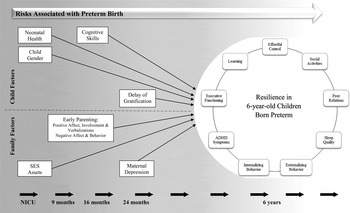
When conceptualizing positive adaptation in the context of risk, indicators of resilience should reflect what constitutes success for children in the culture and age group under study, and it may also include indicators of good adjustment or adaptation in domains that prior research has established as likely to be compromised in the population of interest. Previous research has established that children born preterm show higher rates of cognitive delays, academic and behavior difficulties, attention-deficit/hyperactivity disorder (ADHD), and impaired self-regulation compared to children born at term (Bhutta et al., Reference Bhutta, Cleaves, Casey, Cradock and Anand2002; Feldman, Reference Feldman2009, Taylor, Klein, & Hack, Reference Taylor, Klein and Hack2000). For example, previous research has found that 23% of very low birthweight preterm children exhibited attention-deficit disorders, 51% of children born preterm had poor school performance at age 5, and children born preterm tested an average of 10.5 IQ points lower than their full-term peers (Bhutta et al., Reference Bhutta, Cleaves, Casey, Cradock and Anand2002; Quigley et al., Reference Quigley, Poulsen, Boyle, Wolke, Field and Alfirevic2012). Moreover, correlates of ADHD can include sleep difficulties and challenges with executive functioning as well (e.g., Barkley, Reference Barkley1997; O'Brien et al., Reference O'Brien, Holbrook, Mervis, Klaus, Bruner and Raffield2003). In addition to the absence of problems, it is also important to document strengths such as positive social and academic development when one examines resilience processes (Masten, Reference Masten2001). Thus, demonstrating competent functioning in multiple domains despite the risk of preterm birth would reflect resilience in children born preterm. Figure 1 depicts our person-focused resilience model for school-age children born preterm.
Person-focused resilience model for school-age children born preterm.

As a developmental note, it is important to consider children's age in such resilience models. As children reach school age, variables that are viewed as positive outcomes for infants and very young children may be conceptualized as different components of the developmental process (see Figure 2). For example, the ability to delay gratification may be considered evidence of resilience during the toddler or preschool period; however, early delay of gratification may be viewed as a promotive or protective factor for school-age children because of its positive association with subsequent developmental competencies (e.g., academic achievement, executive function, and prosocial behaviors; Masten & Coatsworth, Reference Masten and Coatsworth1998; Poehlmann & Eddy, Reference Poehlmann, Eddy, Eddy and Poehlmann2010).
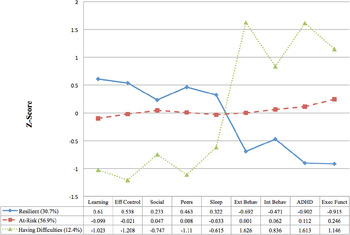
(Color online) Latent profile analysis. Learning, effortful control, social, peers, and sleep are coded with higher numbers indicating more resilience. Externalizing behavior, internalizing behavior, attention-deficit/hyperactivity disorder, and executive functioning are coded with lower scores indicating more resilience.

ADHD Symptoms and Ability to Delay in Preterm Children
In addition to cognitive and academic problems, preterm children show elevated rates of behavior problems and ADHD compared to children born full-term (Bhutta et al., Reference Bhutta, Cleaves, Casey, Cradock and Anand2002). ADHD symptoms include impaired attention skills, impulsivity, and hyperactivity beginning in the first 6 years of life. It is one of the most commonly diagnosed behavioral disabilities in children born preterm, with prevalence rates of 23% compared with 3%–7% in full-term children (American Psychiatric Association, 2000; Botting, Powls, Cooke, & Marlow, Reference Botting, Powls, Cooke and Marlow1997). Although historically the focus of prematurity research has been on very preterm infants, 75% of preterm infants are born in the late preterm period (34–36 weeks gestation; Davidoff et al., Reference Davidoff, Dias, Damus, Russell, Bettegowda and Dolan2006). Despite more optimal neonatal health and cognitive outcomes compared to very preterm infants, late preterm infants are at increased risk for behavior and attention problems as well as school-related problems (e.g., Morse, Zheng, Tang, & Roth, Reference Morse, Zheng, Tang and Roth2009; Shah, Robbins, Coelho, & Poehlmann, Reference Shah, Robbins, Coelho and Poehlmann2013), although in a recent population-based birth cohort study, late preterm children did not show higher rates of ADHD than other children (Harris et al., Reference Harris, Voigt, Barbaresi, Voge, Killian and Weaver2013).
In children with ADHD, problems with impulse control, executive functioning, and delay of gratification are key challenges (Barkley, Reference Barkley1997). Delay of gratification, defined as postponement of immediate wishes to obtain future outcomes (Mischel, Shoda, & Peake, Reference Mischel, Shoda and Peake1988), is a self-regulatory behavior that predicts children's subsequent social and cognitive competence, such as planning ahead, coping with stress (Mischel, Shoda, & Rodriguez, Reference Mischel, Shoda and Rodriguez1989), fewer interpersonal difficulties, and even less drug use (Ayduk et al., Reference Ayduk, Mendoza-Denton, Mischel, Downey, Peake and Rodriguez2000). Previous research has documented self-regulatory deficits in preterm children (Clark, Woodward, Horwood, & Moor, Reference Clark, Woodward, Horwood and Moor2008; Feldman, Reference Feldman2009), including the ability to delay, although few studies have linked these early deficits to children's school-age outcomes in preterm children. In one exception, Feldman (Reference Feldman2009) linked preterm children's difficulty delaying gratification at age 24 months with their externalizing behavior problems at 5 years. However, no studies have examined early ability to delay in relation to resilience across multiple domains in preterm children, although many deficits in preterm infants are hypothesized to reflect impaired self-regulation (Davis & Burns, Reference Davis and Burns2001). We suggest that early adaptive self-regulatory behaviors in preterm children, such as the ability to delay during the toddler period, may be correlated with a range of positive outcomes at school age. Thus, one goal of this study is to examine toddler delay of gratification as a predictor of resilience at age 6 in children born preterm.
Parenting Interactions and Maternal Mental Health in Children Born Preterm
Experiencing positive parenting and parent–child interactions helps foster resilience in children experiencing a range of risk factors (Masten & Coatsworth, Reference Masten and Coatsworth1998). Children born preterm are at increased risk for less optimal dyadic interactions, and their mothers are at risk for experiencing elevated depressive symptoms and stress.
Early in life, preterm infants are less alert and responsive, less able to provide clear signals, and more easily stressed than healthy full-term infants (e.g., Buka, Lipsitt, & Tsuang, Reference Buka, Lipsitt, Tsuang, Friedman and Sigman1992; Greene, Fox, & Lewis, Reference Greene, Fox and Lewis1983), although the quality of their social interactions tends to improve over the first 2 years of life (Poehlmann, Schwichtenberg, Bolt, et al., Reference Poehlmann, Schwichtenberg, Shlafer, Hahn, Bianchi and Warner2011). The mothers of preterm infants show less sensitivity and more intrusiveness during interactions compared to mothers of term infants (e.g., Crnic, Ragozin, Greenberg, Robinsin, & Basham, Reference Crnic, Ragozin, Greenberg, Robinson and Basham1983). Moreover, in preterm infants, quality of parent–child interactions has been linked to the development of children's cognitive, language, and social skills (Landry, Chapieski, Richardson, Palmer, & Hall, Reference Landry, Chapieski, Richardson, Palmer and Hall1990; Landry, Smith, Miller-Loncar, & Swank, Reference Landry, Smith, Miller-Loncar and Swank1997; Smith, Landry, & Swank, Reference Smith, Landry and Swank2006). However, studies have not examined links between early parent–child interaction and broad competence across multiple developmental domains at school age in children born preterm.
Giving birth to an infant prior to term is a nonnormative family transition that is associated with elevated parental stress and feelings of distress (Davis, Edwards, Mohay, & Wollin, Reference Davis, Edwards, Mohay and Wollin2003). Numerous studies have found that mothers of high-risk infants report more symptoms of distress and depression compared to mothers of low-risk full-term infants (e.g., O'Brien, Asay, & McCluskey-Fawcett, Reference O'Brien, Asay and McCluskey-Fawcett1999). However, these symptoms tend to decrease over time on average, although there is individual variability (Poehlmann, Schwichtenberg, Bolt, & Dilworth-Bart, Reference Poehlmann, Schwichtenberg, Bolt and Dilworth-Bart2009). In the present study, we examined maternal depressive symptoms at 24 months and early (9- and 16-month) parent–child interaction quality as predictors of subsequent resilience in children born preterm.
Socioeconomic Assets and Child Characteristics
Socioeconomic risks and assets predict cognitive development and emerging self-regulation in preterm children (Poehlmann et al., Reference Poehlmann, Schwichtenberg, Shah, Shlafer, Hahn and Maleck2010), and child gender is related to more optimal effortful control (Else-Quest, Hyde, Goldsmith, & Van Hulle, Reference Else-Quest, Hyde, Goldsmith and Van Hulle2006). In preterm children, poorer neonatal health has been associated with parent–child interaction quality and children's development, although the direction of effects differs depending on the outcome or family process assessed (e.g., Feldman, Reference Feldman2006; Poehlmann, Schwichtenberg, Bolt, et al., Reference Poehlmann, Schwichtenberg, Bolt, Hane, Burnson and Winters2011). Resilience research has also found that children's cognitive skills are related to resilience processes (Masten, Reference Masten, Glantz and Johnson1999). Given these findings, we included socioeconomic assets, child gender, cognitive skills, and neonatal health in our models.
Research Questions and Hypotheses
1. Can one identify a group of preterm children who exhibit positive adaptation across multiple developmental domains at age 6 (learning, executive functioning, effortful control, ADHD symptoms, internalizing and externalizing behavior problems, sleep quality, social activities, and peer relations) despite risks associated with prematurity? Based on prior research (e.g., Bradley et al., Reference Bradley, Whiteside, Mundfrom, Casey, Kelleher and Pope1994), we hypothesized that approximately one-third of children born preterm would show broad competence at age 6, whereas others would show problems in some areas while exhibiting positive adaptation in others.
2. Do early child factors (neonatal health, early cognitive skills, and ability to delay as a toddler) and family factors (observed early parenting quality, family socioeconomic assets, and maternal depressive symptoms) predict which preterm children are categorized as resilient at age 6? We hypothesized that fewer neonatal health complications, better early cognitive skills, longer toddler delay times, more positive early parenting, higher socioeconomic assets, and fewer maternal depressive symptoms would predict resilience in preterm children at age 6 (Figure 1).
Methods
Participants
A total of 181 infants born low birthweight or preterm and their mothers were recruited from three NICUs in southeastern Wisconsin. A research nurse at each hospital invited families to participate in the study if they met the following criteria: (a) infants were born at or less than 36 weeks gestation or weighed less than 2500 g at birth, (b) infants had no known congenital malformations or prenatal drug exposures (including significant neurological complications like periventricular leukomalacia or Grade IV intraventricular hemorrhage, (c) mothers were at least 17 years of age, (d) mothers could read English; and (e) mothers self-identified as the child's primary caregiver. Inclusion and exclusion criteria were identified based on a review of research to identify infants who were at risk for compromised development because of prematurity rather than infants who had more certainty in their outcomes or who also experienced additional known risks (e.g., maternal substance abuse or children in foster care). Because maternal report measures were the focus of the 6-year data collection, and most measures were not available in other languages, it was important that mothers be able to read English. Moreover, our institutional review board indicated that we should include emancipated minors in our study, and thus mothers had to be at least 17 years of age.
If a child was part of a multiple birth, one child was randomly selected to participate in the study. Because the hospital would not allow us to be the “first contact” for families and gave us only information about families who signed consent forms, 181 (97%) are considered in data collection. Infants and families were assessed at seven timepoints: just prior to the infant's NICU discharge; at 4, 9, 16, 24, and 36 months; and at 6 years. All visits between 4 and 36 months of age were completed using the child's corrected age. Corrected age is calculated based on the infant's due date and is commonly used in early assessments of preterm infants (DiPietro & Allen, Reference DiPietro and Allen1991). Data from 7 of the original 181 families were removed because we later discovered from our review of infant medical records that a Grade IV intraventricular hemorrhage had occurred prior to the infants' NICU discharge (n = 3), or the child was born after 36 weeks gestation, despite having low birthweight (n = 4).
The current study included data from the NICU discharge, 9-month, 16-month, 24-month, and 6-year assessments. One hundred seventy-three preterm infants and their mothers participated at hospital discharge, 147 at 24 months, and 106 participated at 6 years. Sixty-one percent of the original families participated at the 6-year assessment. Families lost to attrition did not differ from families who remained in the study on infant health variables, child gender, paternal age, family income, number of children in the family, and maternal race. However, families were more likely to be lost to attrition when the mother was younger and single and had completed fewer years of education, and when the father had completed fewer years of education. In addition, infants lost to attrition were less likely to be Caucasian.
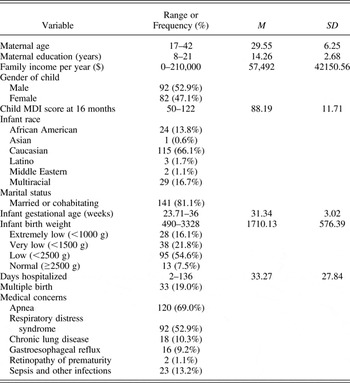
Sample characteristics are detailed in Table 1. Participant family characteristics paralleled the population of Wisconsin during the data collection period. For example, 77% of the mothers who gave birth in 2005 in Wisconsin were White, 9% were Black, and 9% were Latina (Martin et al., Reference Martin, Hamilton, Sutton, Ventura, Mathews and Kirmeyer2010), although the rate of preterm birth is higher for Black (17%) than it is for White (11%) infants (Hamilton, Martin, & Ventura, Reference Hamilton, Martin and Ventura2012). Between birth and age 3, 32.6% of children from the sample received some type of early intervention service (e.g., physical therapy, occupational therapy, speech/language therapy, counseling, and/or special education services).
Sample demographic and neonatal characteristics at NICU discharge (N = 174)

Procedure
A research nurse at each NICU informed eligible families about the study. Interested families signed an institutional review board approved consent form and were contacted by study personnel to schedule a visit prior to NICU discharge. During the NICU discharge, a researcher collected demographic data from the mother and infant health information from the infant's medical chart. At the child's 9-month visit, research assistants completed a home visit and recorded mother–child play interactions. For the 16-month visit, families visited a laboratory playroom, mother–child play interactions were videotaped, and the children participated in a cognitive assessment. At 24 months (corrected age), families visited the laboratory and researchers assessed children's effortful control skills. Families were paid $60 for the 16-month visit, $80 for the 24-month visit, and children were given an age-appropriate book or toy at each assessment. At 6 years, mothers were asked to complete a 20- to 25-min phone interview and return self-report questionnaires in a stamped envelope. Mothers were sent a $15 gift card for participation.
Measures
Measures in latent profile analysis at age 6
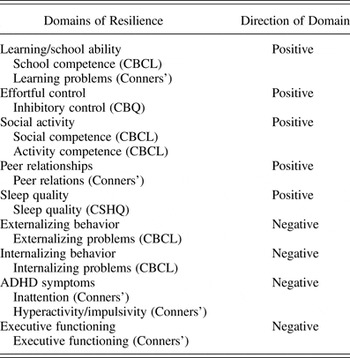
The following measures were used in creating the latent profile analysis (LPA). Some of these subscales were combined into composites to form domains of resilience (Table 2), which is the preferable technique to address LPA weighting issues (Pastor, Barron, Miller, & Davis, Reference Pastor, Barron, Miller and Davis2007).
Domains of resilience in latent profile analysis

Note: Positive directions of effect indicate that higher scores are associated with more competence, and negative directions of effect indicate that higher scores are associated with more problems. CBCL, Child Behavior Checklist; CBQ, Children's Behavior Questionnaire; CSHQ, Childrens Sleep Habits Questionnaire.
Child Behavior Checklist (CBCL)
Mothers completed the CBCL (Achenbach & Rescorla, Reference Achenbach and Rescorla2001). The CBCL is a widely used standardized behavior rating that is completed by an adult with whom the child lives. The scale is appropriate for children ages 6–18. On the CBCL, mothers rated each of 113 problem behaviors on a 3-point scale (0 = not true, 1 = somewhat or sometimes true, and 2 = very true or often true), regarding the child's behaviors during the past 2 months. Responses were then summed to obtain scores for internalizing and externalizing problem scales. High scores on the internalizing and externalizing subscales indicate more problematic behaviors. The CBCL has high internal consistency (Cronbach αs range from 0.78 to 0.97) and has been used with preterm children (e.g., Gray, Indurkhya, & McCormick, Reference Gray, Indurkhya and McCormick2004; Yu, Buka, McCormick, Fitzmaurice, & Indurkhya, Reference Yu, Buka, McCormick, Fitzmaurice and Indurkhya2006).
In addition to rating their children on a number of problem behaviors, mothers also completed a series of competency scales addressing their children's abilities, strengths, and skills. These scales (school, activity, and social) have moderately high internal consistency, with αs ranging from 0.63 to 0.79. The school competence subscale reflects the maternal ratings of academic performance across different subject areas, presence of special education services, and whether the child repeated a grade in school or had any other academic problems. Higher scores represent greater school competency. The activity competence subscale reflects the level of involvement in hobbies, activities, organizations, clubs, teams, jobs, and chores, as well as how well the child performs in those activities. The social competence subscale reflects the number of close friends the child has, the degree he or she sees them outside of school, and an evaluation of how well the child gets along with others in comparison to other children his or her age. In these three scales, higher scores indicate better competence.
Conners' Rating Scale
Mothers completed the Conners' Rating Scale, Third Edition (Conners, Reference Conners2008), a parent-reported assessment of ADHD and its common comorbid problems and features. The 110-item questionnaire asked parents to rate statements of children's behaviors on a 4-point scale (0 = not true at all, 1 = just a little true [occasionally], 2 = pretty much true [often, quite a bit], or 3 = very much true [very often, very frequently]). Scores on multiple content scales were used in this study, which have past internal consistency ratings ranging from α = 0.85 to 0.94 (Conners, Reference Conners2008). To assist with interpretation, several scales were reverse-coded to align higher scores with positive qualities.
Mothers completed the 14-item hyperactivity/impulsivity subscale and the 10-item inattention subscales in order to assess ADHD symptomatology. Higher scores indicated greater symptomatology. Mothers also completed the 9-item executive functioning subscale, which assessed difficulty with initiation, perseverance, organization, planning, and decision making. Higher scores indicated greater deficits in executive functioning.
The nine-item learning problems subscale was used in this study to assess academic struggles, learning, and memory for concepts. Therefore, this scale was reverse-coded, with higher scores indicating better learning skills. The peer relations subscale contains six items assessing making and maintaining friendships, social skills, and social acceptance. This scale was also reverse coded, with higher scores indicating better peer relations.
Child Behavior Questionnaire (CBQ)
Mothers completed the CBQ (Rothbart, Ahadi, Hershey, & Fisher, Reference Rothbart, Ahadi, Hershey and Fisher2001), a questionnaire designed to measure temperament in children ages 3–7. The CBQ assesses 15 different dimensions, including anger, fear, reactivity, attentional focus, frustration, sadness, approach, inhibitory control, and activity level, over the past 6 months. Mothers rated children on 94 items on a scale of 1 to 7, ranging from extremely untrue to extremely true. For this study, the 13-item inhibitory control subscale was used as a measure of effortful control, and higher scores represent better ability to plan and inhibit inappropriate responses. Internal consistency on the CBQ ranges from α = 0.67 to 0.92 with a mean of 0.75 (Rothbart et al., Reference Rothbart, Ahadi, Hershey and Fisher2001). Internal consistency of effortful control is this study was α = 0.74.
Children's Sleep Habits Questionnaire (CSHQ)
Children's sleep quality was assessed using the CSHQ (Owens, Spirito, & McGuinn, Reference Owens, Spirito and McGuinn2000). This parent-report measure has 45 items, which are often broken into the eight subscales of bedtime resistance, sleep onset delay, sleep duration, sleep anxiety, night awakenings, parasomnias, sleep-disordered breathing, and daytime sleepiness, as well as a total sleep disturbance scale (33 items). Mothers coded items indicating frequency of behavior on a 3-point scale (1 = rarely [zero to one time per week], 2 = sometimes [two to four times per week], or 3 = usually [five to seven times a week]). The sleep disturbance scales were reverse-coded and summed to create an overall sleep quality score, with higher scores representing better sleep and fewer sleep problems. Validity studies of the CSHQ report adequate internal consistency and test–retest reliability in clinical and community samples (Owens et al., Reference Owens, Spirito and McGuinn2000), and internal consistency in this study was α = 0.79.
Measures of earlier contributions to later resilience
Neonatal health
Infant medical records were reviewed following infants' NICU discharge to create a neonatal health problems index, drawing on previous indices used for PT LBW infants (e.g., Littman & Parmelee, Reference Littman and Parmelee1978; Scott, Bauer, Kraemer, & Tyson, Reference Scott, Bauer, Kraemer, Tyson, Gross, Spiker and Haynes1997). Because infant birth weight and gestational age were highly correlated r (174) = .88, p < .001, we standardized each, and then reverse-coded them so that higher scores reflected more prematurity and lower birth weight. Next, the following 10 dichotomized neonatal medical complications (1 = present, 0 = absent) were summed and standardized (the proportion of infants experiencing each of these risk is indicated in parentheses): apnea (69%), respiratory distress (53%), chronic lung disease (10%), gastroesophageal reflux (9%), multiple birth (19%), supplementary oxygen at NICU discharge (10%), apnea monitor at NICU discharge (45%), 5-min Apgar score < 6 (3%), ventilation during NICU stay (mechanical or continuous positive airway pressure; 53%), and NICU stay of >30 days (40%). The three scales were averaged into the resulting index (M = 0.02, SD = 2.67) with a Cronbach α of 0.89, where higher scores reflect poorer neonatal health and more prematurity. Neonatal health information is summarized in Table 1.
Socioeconomic assets
Mothers completed a demographic questionnaire while their infants were in the NICU, including data regarding maternal age, years of education, and family income. Family income contained one outlier due to a family reporting an income of $500,000. This income was top-coded to the next highest family ($210,000). With this adjustment, family income was normally distributed. A socioeconomics assets index was created by standardizing and summing maternal age, education, and family income. Cronbach α for the composite was 0.79.
Children's cognitive skills
Child cognitive skills at 16 months (corrected for gestational age) were estimated using the Mental Developmental Index score from the Bayley Scales of Infant Development, Second edition (BSID-II; Bayley, Reference Bayley1993). The BSID-II is a widely used assessment of cognitive function appropriate for children ages 1–42 months. The Mental Developmental Index measures concept formation, visual permanence, and sensorimotor development. Completed items are summed for an overall score and compared to a standardized distribution (M = 100, SD = 15). The BSID-II has excellent reliability (α = 0.91).
Maternal depression
Maternal depressive symptoms were measured at child-age 24 months using the Center for Epidemiologic Studies Depression Scale (CES-D; Radloff, Reference Radloff1977), a 20-item self-report questionnaire of depressive symptoms rated on a 4-point scale (0 = rarely/none of the time, 3 = all the time). Higher scores indicate more symptoms, with scores of 16 or higher indicating clinically relevant symptoms (M = 8.69, SD = 7.86, range = 0–51). At 24 months, 15% of women reported CES-D scores in the clinical range (n = 23). The CES-D has been used extensively in epidemiologic studies of postnatal women and has an α of 0.89 in this study.
Maternal parenting interactions during play
Infant–mother play interactions at 9 and 16 months corrected age were coded using the Parent Child Early Relational Assessment (PCERA; Clark, Reference Clark1985). Standard data collection recommendations for the PCERA include recording a 15-min play episode and coding 5 min of the video clip. Following the recommendation of Dr. Roseanne Clark, who developed the PCERA, the first 5 min in which each dyad was actively engaged in play were coded.
The PCERA was designed to assess the frequency, duration, and intensity of affect and behaviors of parents and infants that occur during 5 min of face-to-face interactions. Each variable is coded on a scale ranging from 1 (negative quality) to 5 (positive quality). In the present study, we focused on two of the established parent subscales of positive affect, involvement, and verbalizations (positive parenting) and negative affect and behavior (negative parenting). Items in each subscale are detailed in Clark (Reference Clark1985). Previous research has found that although the parent subscales are correlated, they represent different aspects of parenting and relate to child outcomes in different ways. Cronbach αs ranged from 0.90 to 0.94. Ten percent of the sample at each time point was independently coded by four trained research assistants, and interrater reliability ranged from 0.83 to 0.97 across codes and time points, with a mean of 0.88. Kappas for individual codes ranged from 0.60 to 1.0, with a mean of 0.83. In the present study, we combined each PCERA subscale score across the 9- and 16-month time points because the two time points were highly correlated (Cronbach α = 0.92 for the positive parenting subscale, α = 0.88 for the negative parenting subscale). Positive parenting scores ranged from 48 to 102, with a mean of 81.29 (SD = 12.27); negative parenting scores ranged from 24 to 50, with a mean of 42.00 (SD = 5.41). Previous studies have found that the PCERA has an acceptable range of internal consistency, factor validity (Clark, Reference Clark1999), and discriminate validity between high-risk and well-functioning mothers (Clark, Paulson, & Conlin, Reference Clark, Paulson, Conlin and Zeanah1993). The PCERA has been used previously with preterm infants (e.g., Brown, Reference Brown2007; Pridham, Lin, & Brown, Reference Pridham, Lin and Brown2001).
Toddler delay of gratification
At 24 months, we used the Snack Delay task from a behavioral battery described in Kochanska, Murray, and Harlan (Reference Kochanska, Murray and Harlan2000) to assess toddler delay. The task included four trials, with each successive trial requiring the child to wait for longer periods of times (range of 10 to 30 s). In this task, the child was asked to wait with his hands on the table until the experimenter rang a bell before retrieving a candy from underneath a clear plastic cup (Kochanska et al., Reference Kochanska, Murray and Harlan2000). Delay to touch the cup was coded for each trial and averaged across all four trials (Cronbach α = 0.81). The mean number of seconds children waited was 7.40 (SD = 6.58). The delay task was independently coded by two trained students, who attained 100% reliability with each other within 1 s of the child's response.
Data analytic plan
The first aim of the study was to explore children's profiles as defined by the resilient subscales. The domains of resilience are listed in Table 2. In particular, we anticipated a group of children born preterm who would be resilient across multiple domains of functioning at age 6, despite the increased risk associated with prematurity. In order to address this aim, LPA was conducted in MPlus version 6.12.12 (Muthén & Muthén, Reference Muthén and Muthén2010). In LPA, a population of respondents is viewed as composed of a mixture of latent classes each defined by a mean profile (i.e., a mean score on each subscale) and within-class variances for the subscales. The appeal of LPA (as opposed to methods like factor analysis) is that the classes can differ qualitatively as well as quantitatively, and thus may not be strictly ordered across all subscales. LPA also has several advantages over traditional cluster analysis approaches, including its model-based approach, estimates of unique parameters for each cluster, and estimates for the likelihood or weight of each cluster (Pastor et al., Reference Pastor, Barron, Miller and Davis2007). The LPA was conducted using the 106 subjects who participated in the 6-year data collection, with full information maximum likelihood estimation used to account for missing data on individual scales (Enders, Reference Enders2010). Both the means and variances of the resilient subscales were allowed to vary across classes. Model fit was determined using a combination of statistical consideration and substantive theory, utilizing the Bayesian information criterion (BIC), the adjusted BIC (ABIC), the Lo–Mendell–Rubenstein likelihood ratio test, the bootstrapped likelihood ratio test (BLRT), and entropy (Pastor et al., Reference Pastor, Barron, Miller and Davis2007).
The second aim of the study was to examine whether early child and parent factors predicted the latent classes for children at age 6. These analysis were conducted using multinomial logistic regression in IBM SPSS Statistics 20.0 for Windows, using class as the outcome variable, and neonatal health, cognitive skills, socioeconomic assets, maternal depression, delay of gratification, and positive and negative parenting as predictor variables. Gender was also examined as a potential covariate.
For these latter regression analyses, a multiple imputation procedure was utilized to address missing observations between the initial visit in the NICU and 24-month measures (Enders, Reference Enders2010). No data were imputed at the 6-year time point. In the full sample, 12% of values were missing between the NICU and 24 months. Ten data sets were generated in which missing values were randomly produced, conditional upon predictor variables in the imputation model. Predictor variables in the imputation included neonatal health, maternal age, education, race, family income, marital status, initial maternal depression score, measures of parenting, parent–child interactions, and child behavior from the PCERA, measures of emotion regulation, measures of child intelligence, and measures of child temperament. Subsequent analyses were applied to all 10 data sets, using the aggregated results to evaluate significant predictors. As in the original LPA, class identification was defined according to the modal posterior probability across classes. To address the fact that some children had dropped out of the study by 6 years of age, the mulitinomial logistic regressions were computed in two ways. The first was a complete case analysis determining whether there were differences in prediction across classes when treating the children who had dropped out of the study at 6 years of age as a separate class. The second was an available case analysis of only classes for those children still in the study at 6 years of age.
Results
Data reduction
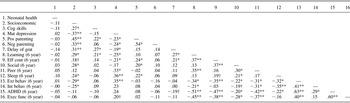
In an LPA, all indicators are weighted equally in developing profiles. Thus, in order to have the different domains of resilience more equally represented in the LPA, a number of composites were calculated. The domains of resilience are illustrated in Table 2. A general measure of ADHD symptomatology was calculated by standardizing and taking the average of the inattention and hyperactivity/impulsivity subscales on the Conners' Rating Scale (Cronbach α = 0.87); higher scores indicated more ADHD symptomatology. Next, a measure of learning was created. This was done by standardizing and reverse-coding the learning problems subscale on the Conners Rating Scale, standardizing the school competence subscale on the CBCL, and then averaging the two subscales (Cronbach α = 0.76). Higher scores indicated better learning and school performance. Finally, a measure of social activity was created by standardizing and taking the average of the social and activity competence subscales on the CBCL (Cronbach α = 0.58); higher scores indicated more social engagement. The remaining indicators in LPA (e.g., internalizing behavior, externalizing behavior, executive functioning, effortful control, peer relations, and sleep) were standardized in order to aid in interpretation and have consistency in scaling. The correlations among variables are presented in Table 3.
Correlation table of study variables

Note: Higher scores on the Parent Child Early Relational Assessment indicate more positive and less negative parenting, whereas lower scores indicate more negative, critical, and less positive parenting. Higher scores on Neonatal Health indicate more health complications during the NICU stay.
†p < .08. *p < .05. **p < .001.
Identification and description of LPA for resilience
The LPA was conducted using nine indicators to define the classes. Learning/school ability, effortful control, social activity, peer relationships, and sleep quality were scored such that higher scores indicated stronger abilities, while externalizing behavior, internalizing behavior, ADHD symptomatology, and executive functioning deficits were scored with higher scores indicating greater symptomatology. Model comparison for one- through four-class solutions are reported in Table 4. The three-class solution emerged as the best fit for the data, based both on the statistical criteria and the interpretability with respect to substantive theory on resilience. The three-class solution had the lowest BIC and ABIC values, an acceptable entropy value, and a significant p value on the BLRT. The BLRT tests whether the selected class model fits the data significantly better than the model with one fewer class.
Model fit indices for number of class solutions

Note: BIC, Bayesian information criterion; ABIC, adjusted BIC; LMR LRT, Lo–Mendell–Rubenstein likelihood ratio test; BLRT, bootstrapped LRT. Lower BIC and ABIC indicate better fit. The closer the entropy values are to 1, the better. LMR LRT and BLRT p values are ideally p < .05.
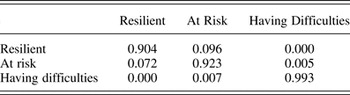
The results for the three-class solution are displayed in Figure 2. Based on the class profiles, Class 1 is interpreted/labeled a resilient class (31%), Class 2 as an at-risk class (57%), and Class 3 as a having difficulties class (12%). The profiles for the three classes were fairly parallel, indicating that the groups maintained their relative degree of symptomatology across domains of resilience. Children in the resilient group had the lowest symptomology, while maintaining the highest levels of school performance and social and peer relationships. Due to the high entropy value and large diagonal values in Table 5, children were classified into the latent class of highest probability, and estimated class membership was modeled in subsequent analyses.
Average of latent class probabilites for most likely latent class membership

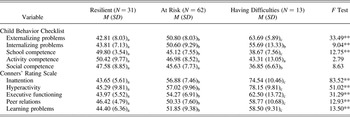
Table 6 provides a comparison of the classes on multiple CBCL and Conners' Rating Scales, using the t score equivalents for clearer clinical interpretation. Comparisons of the classes were made using one-way analyses of variance, with post hoc comparsison made using Tukey tests. Sleep quality and effortful control were analyzed using measures that do have standardized t score equivalent, and they are not included in the table. On the CBCL, t scores greater than 63 are considered clinically significant, while t scores of 60–63 are in the borderline range. On the Conners' Rating Scale, t scores of 60 or higher are considered to be elevated and clinically significant. Children in the having difficulties class had averages in the clinical range for externalizing, inattentive, hyperactive, and executive functioning problems. Further, when using t scores in the borderline or clinical range (t ≥ 60), 30% of the entire sample had significant inattentive difficulties, 37% had significant hyperactivity, and 20% had significant externalizing behaviors.
Child characteristics by class

Note: Numbers represent mean t scores (standard deviations). Means in the same row with different subscripts are significantly different from one another. Higher t scores reflect more problematic behavior, with the exception of school, activity, and social competence on the Child Behavior Checklist. In those three scales, higher t scores reflect greater competence.
**p < .001.
There were also significant differences between the resilient and at-risk classes. Using one-way analyses of variance with Tukey tests conducted post hoc, the at-risk class had significant decreases in functioning in comparison to the resilient class on externalizing behavior, internalizing behavior, school competence, inattention, hyperactivity/impulsivity, learning problems, executive functioning, and peer relations.
Multinomial and binary logistic regressions to predict class membership
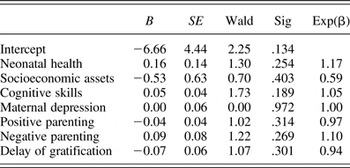
Initially, models were run comparing the risk of being in the at-risk or having difficulties class to the resilient class. However, the results were fairly similar across the two classes that were more at risk, due to the small size (n = 13) and lack of power in the having difficulties class. Table 7 indicates that none of the predictors significantly distinguished between the having difficulties and the at-risk classes. Therefore, the having difficulties and at-risk groups were collapsed into a single combined at-risk group. Gender was examined as a potential covariate. However, it was not significantly correlated with any of the predictor variables or class membership, and thus was not included in the final analyses.
Logistic regressions of likelihood to be in the having difficulties class in comparison to the at-risk class

Note: Higher scores on the Parent Child Early Relational Assessment indicate more positive and less negative parenting. Higher scores on Neonatal Health indicate more health complications during the NICU stay.
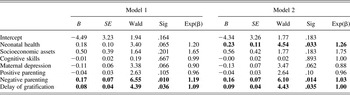
As noted, we ran models predicting class membership in two ways to evaluate the potential effects of attrition. The model was first run using a complete case analysis, such that children who were lost to attrition were identified as a separate group of children (n = 68). This was completed to have a better understanding of the children lost to attrition. Thus, the three-group comparison compared resilient versus combined at-risk versus missing children, with the combined at-risk group as the referent group. Table 8 presents the results from this initial logistic regression model. There were no significant differences on neonatal health, socioeconomic assets, cognitive skills, maternal depression, or positive parenting. However, children in the resilient group were more likely to have less negative parenting in early childhood and better delay of gratification.
Logistic regressions of likelihood to be in the resilient group in comparison to the combined at-risk group

Note: The first model represents a complete case analysis, where the full model compared the resilient group to both the combined at-risk group and the group of children missing from analyses. The second model is a two-group comparison of the resilient group as compared to the combined at-risk group. Bold scores indicate significant predictors (p < .05). Higher scores on the Parent Child Relational Assessment indicate more positive and less negative parenting. Higher scores on Neonatal Health indicate more health complications during the NICU stay.
The second model omits the missing children and considers a two-group comparison of the resilient and combined at-risk groups, with the combined at-risk group as the referent group (Table 8). Children in the resilient group were more likely to have more neonatal health problems, less negative parenting in early childhood, and better delay of gratification at 24 months. For every unit increase in neonatal health complications, the odds of being in the resilient group increased by 26% in comparison to the combined at-risk group.
Discussion
Although individual variation in well-being is a hallmark that defines preterm infant outcomes, there has been a dearth of information regarding what promotes resilience in preterm infants. In this prospective longitudinal study of preterm infants born without significant neurological complications, we provide some emerging evidence on resilience across several domains during children's transition to school and the identification of individual, family, and contextual factors that may contribute to resilience.
Patterns of risk and resilience
Many studies have documented deficits in multiple areas of developmental functioning in school-age children born preterm (e.g., Bhutta et al., Reference Bhutta, Cleaves, Casey, Cradock and Anand2002; Bul & van Baar, Reference Bul and van Baar2012; Taylor et al., Reference Taylor, Klein and Hack2000; van Baar, Vermaas, Knots, de Kleine, & Soons, Reference van Baar, Vermaas, Knots, de Kleine and Soons2009). In addition, studies have reported that preterm children are less socially active (Jaekel, Wolke, & Chernova, Reference Jaekel, Wolke and Chernova2012) and more likely to be verbally victimized by peers (Nadeau, Tessier, Lefebvre, & Robaey, Reference Nadeau, Tessier, Lefebvre and Robaey2004). Children born preterm are also more likely to engage in more active, variable, and inconsistent sleep than children born at term, although these differences typically wane after the first year (Anders & Keener, Reference Anders and Keener1985; Asaka & Takada, Reference Asaka and Takada2010; Vergara & Bigsby, Reference Vergara and Bigsby2004). However, none of these studies examined individual variability within preterm samples. It is unknown what proportion of school-age preterm children experience more optimal developmental outcomes across multiple developmental domains. Theorists argue that resilience processes that result in adaptive outcomes despite experiences of risk are common, and that research should expand beyond a deficit-based perspective to uncover potential sources of resilience (Masten, Reference Masten2001). This study suggests that a sizable minority of children born preterm not only achieve competent functioning but do so across several developmental domains.
We identified three patterns of risk and resilience among preterm children at age 6: a group of children who exhibited resilience across multiple developmental domains, a group of children who remained at-risk for developmental concerns, and a group of children who experienced significant difficulties. Children classified as resilient (31%) exhibited significantly more parent-reported prosocial activity and better peer relations, effortful control, learning abilities, and sleep habits than children classified as at-risk or as having difficulties. These children also exhibited significantly lower levels of maladaptive outcomes such as ADHD symptomology and externalizing and internalizing behavior when compared with children not classified as resilient. Bradley et al. (Reference Bradley, Whiteside, Mundfrom, Casey, Kelleher and Pope1994) found that only 12% of PT LBW infants living in poverty were identified as functioning in the normal range for cognitive, social/adaptive, health, and growth measures at age 3, although 40% of PT LBW children living in more affluent homes were found to be resilient. Similarly, the majority of children in the present sample (57%) were classified in the at-risk group, indicating they experienced more externalizing and internalizing symptoms, inattention, hyperactivity, learning problems, and deficits in peer relations and executive functioning than children classified as resilient. A small percentage of children in the current study (12%) exhibited clinically significant scores on externalizing behaviors, inattention, hyperactivity, and lower executive functioning. When compared with the resilient and at-risk groups, the having difficulties group had the most problems with effortful control, learning, social activities, peer relations, and sleep.
Given the relatively high correlation between ADHD symptomology and executive functioning in the current study, it may be possible that the impaired executive behaviors present in both the at-risk and the having difficulties groups actually represent impairment secondary to ADHD. The same could be theorized regarding learning problems and symptoms associated with ADHD. Executive functioning and learning difficulties are often comorbid with ADHD symptomology and rely on similar brain structures, such as the prefrontal cortex (Hinshaw, Carte, Fan, Jassy, & Owens, Reference Hinshaw, Carte, Fan, Jassy and Owens2007; Willcutt, Doyle, Nigg, Faraone, & Pennington, Reference Willcutt, Doyle, Nigg, Faraone and Pennington2005). To that end, some conceptions of ADHD see it as a disorder of underdeveloped executive functions (Barkley, Reference Barkley1997), suggesting that both domains rely on sustained attentional skill. However, there remains an empirical morass regarding whether improved executive function performance decreases ADHD symptomology (Halperin, Trampush, Miller, Marks, & Newcorn, Reference Halperin, Trampush, Miller, Marks and Newcorn2008; Miller, Ho, & Hinshaw, Reference Miller, Ho and Hinshaw2012). Thus, while our results imply that children in the resilient group evidenced better effortful control and early ability to delay, components of self-regulation with considerable overlap with executive function (Zhou, Chen, & Main, Reference Zhou, Chen and Main2012), an alternative explanation may be that these children simply had higher executive functioning, along with better peer relations, sleep habits, and lower levels of problem behaviors. Future research could examine executive function as a mediator of the relation between prematurity and school-age resilience.
Although some children were classified as resilient, rates of maladaptive outcomes remained high in this sample of preterm children. Many children had clinical or borderline attention difficulties (30%), hyperactivity (37%), and externalizing behavior (20%). This finding is consistent with the literature regarding maladaptive behavior in school-age children born preterm. In one study examining preterm and full-term children aged 9 to 16 years, preterm children had higher total behavior problems and internalizing scores and higher attention problems on the CBCL compared with children born full-term, although there was no difference in regard to externalizing behaviors (Loe, Lee, Luna, & Feldman, Reference Loe, Lee, Luna and Feldman2011). Similar findings detailing the presence of internalizing and externalizing behavior have been found with school-age preterm children (Aylward, Reference Aylward2005; Sommerfelt, Ellertsen, & Markestad, Reference Sommerfelt, Ellertsen and Markestad1993; van Baar et al., Reference van Baar, Vermaas, Knots, de Kleine and Soons2009). In addition, this finding highlights the high-risk status of children born preterm with respect to attention, behavior problems, hyperactivity, and developmental other issues with particular salience as children begin school.
Early contributions to resilience
In addition to the LPA, we examined early child and family factors associated with resilience across behavioral, social, and academic domains in 6-year-old preterm children. Over decades of resilience research, parenting quality, cognitive skills, self-regulation, and socioeconomic status have emerged as robust predictors of resilience in multiple samples and domains (Masten, Reference Masten2001; Masten & Reed, Reference Masten, Reed, Snyder and Lopez2002). Our findings partially support these reported links. Some aspects of parenting and self-regulation were associated with resilience in preterm children, although children's cognitive skills and family socioeconomic assets were not.
Less negative parenting, as defined by lower levels of anger and criticism, predicted children's likelihood of resilience across multiple domains of development. However, contrary to expectations, more positive parenting was not associated with more adaptive developmental outcomes. Parenting has long been recognized to be a robust indicator of future developmental outcomes in preterm infants (Lundqvist-Persson, Lau, Nordin, Bona, & Sabel, Reference Lundqvist-Persson, Lau, Nordin, Bona and Sabel2012), including increased stability in sleep (Ingersoll & Thoman, Reference Ingersoll and Thoman1999). Hostility and anger may be particularly dysregulating for children born preterm (Poehlmann, Schwichtenberg, Shlafer, et al., Reference Poehlmann, Schwichtenberg, Bolt, Hane, Burnson and Winters2011). It remains unclear if infants' higher self-control (as detailed below) made it possible for them to appropriately respond to parental cues or if less hostile parenting fostered greater self-regulation within this population, although our previous papers based on this data set indicate that early parenting is a robust predictor of self-regulation in preterm children. Bradley et al. (Reference Bradley, Whiteside, Mundfrom, Casey, Kelleher and Pope1994) found that PT LBW infants living in poverty were more likely to show resilience when they received more responsive, accepting, stimulating, and organized care. In vivo observational data utilizing dynamic systems might shed light on the transactional nature between parenting and infants' self-control, although currently the available literature is limited.
This is the first study to investigate early ability to delay gratification in relation to subsequent resilience across multiple domains in children born preterm. Children in the resilient group exhibited longer delay times at 24 months than did children in the combined at-risk group. This result is consistent with those found in other high-risk samples (e.g., Obradović, Reference Obradović2010). For example, Feldman (Reference Feldman2009) found that preterm infants who were able to delay at 24 months had fewer externalizing behavior problems at 5 years. In general, preterm children are more likely to exhibit problems with effortful control in their preschool years compared to their full-term peers (Sun, Mohay, & O'Callaghan, Reference Sun, Mohay and O'Callaghan2008; Voigt, Pietz, Pauen, Kliegel, & Reuner, Reference Voigt, Pietz, Pauen, Kliegel and Reuner2012). Delay is a particularly important skill for the development of resilience across multiple domains in children, including those born prematurely.
Although at first glance the finding seems counterintuitive, children in the resilient group were more likely to have experienced poorer neonatal health, as measured by gestational age, birthweight, and neonatal complications. However, little research has actually explored the within-class variations among children born preterm. General assumptions have been that children with more optimal neonatal health will fare better than children with more neonatal health problems, but recent studies have found that late preterm infants with fewer neonatal health risks may actually be at greater risk for developing parent-reported externalizing, oppositional, and aggressive behavior when compared to children born at earlier gestational ages (Gray et al., Reference Gray, Indurkhya and McCormick2004; Shah et al., Reference Shah, Robbins, Coelho and Poehlmann2013). Although the mechanisms through which this may occur are understudied, a few explanations are possible.
First, children born at lower neonatal health may have access to early intervention services more often and with greater intensity, which can be an important positive predictor of outcomes for children born preterm (Hill, Brooks-Gunn, & Waldfogel, Reference Hill, Brooks-Gunn and Waldfogel2003). Second, parents of children born with better neonatal health may have different perceptions and expectations for their children than for children born at lower risk. Parents of children born with fewer neonatal health problems may expect more normative development in their children and thus perceive behaviors as more problematic, whereas parents of children born with more neonatal health problems may perceive these behaviors as part of the child's medical profile. Specifically, this study found that more neonatal health complications were related to parental perceptions of components of resilience, because this study was only able to use parent-reported questionnaires to measure 6-year outcomes. It is unknown whether the same relation between neonatal health and resilience would be found if observational assessments of behavior, peer relations, and learning were utilized.
Contrary to expectations, cognitive skills and socioeconomic assets were not associated with membership in the resilience group. Cognitive skills are highly correlated with effortful control skills, and the inclusion of both in the logistic regression model may indicate that the effects of intellectual functioning on positive adaptation may primarily function through self-regulation. Similarly, socioeconomic assets represent a distal factor that may partially exert its influence through parenting quality (Bradley & Corwyn, Reference Bradley and Corwyn2002). The inclusion of parenting quality and socioeconomic assets in the same regression model may result in nonsignificant effects of socioeconomic assets if it is moderated by parenting quality. Further research is needed in this area.
The present study has several limitations. An important limitation of the present analyses is that all of the outcome measures used to establish group membership were based on maternal report. However, the inclusion of multiple observational methods at earlier time points is a strength of the study. In addition, it is difficult to ascertain whether parenting quality, delay of gratification, and neonatal health are functioning as protective factors or promotive factors or early indicators of children being on a positive developmental trajectory. Protective factors are those that buffer the effects of risk on positive outcomes, whereas promotive factors increase positive outcomes regardless of risk status (Luthar & Cicchetti, Reference Luthar and Cicchetti2000; Masten, Reference Masten, Glantz and Johnson1999). A low-risk, full-term comparison group could be used to explore whether some variables functioned as protective factors, although some variables, such as neonatal health, only show meaningful variation within higher risk groups. As mentioned earlier, it is important to consider children's age in determining how to conceptualize resilience; early indicators of resilience (e.g., ability to delay) may also be predictors of subsequent adaptation (e.g., school success). Finally, missing data at the 6-year time point limited the generalizability of the findings. Analyses were conducted predicting a group with missing 6-year data in order to more fully understand attrition.
Little research to date has examined resilience across multiple domains at school age in children born preterm, or child and family predictors of resilience. This study suggests that some preterm children are achieving broad adaptive behavioral and learning outcomes despite facing risks associated with preterm birth. Less negative early parenting, early ability to delay, and more neonatal health problems were predictive of subsequent resilience in children born preterm. Improving early parenting quality and ability to delay may be fruitful areas for future interventions aimed at improving school-age outcomes in children born preterm. In addition, the current findings and previous work (Gray et al, Reference Gray, Indurkhya and McCormick2004; Shah et al., Reference Shah, Robbins, Coelho and Poehlmann2013) could guide practitioners and providers when considering resources for families with preterm infants with fewer neonatal health problems, for example, administering closer surveillance of developmental outcomes and identifying children for early intervention services.