

INTRODUCTION
The destruction of Thebes by Alexander the Great in 335 bc was one of the most dramatic catastrophes to befall a major Greek polis: it marked the end of the Classical period and portended the era to come (Hurst Reference Hurst, Beister and Buckler1989; Worthington Reference Worthington, Heckel and Tritle2003). The venerable city of Thebes lay in ruins for almost twenty years, until Cassander refounded it in 316/315 bc.Footnote 1
The motives behind Cassander's decision were already perplexing to ancient commentators. For Diodorus Siculus, Cassander was inspired by the glory of Thebes, which, he hoped, was going to secure his own eternal reputation (Diodorus Siculus 19.53.2; see below section ‘Historical Interpretation’). Pausanias believed that Cassander had refounded the city because of his deep hatred for Alexander (Pausanias 9.7.1–2; see below section ‘Historical Interpretation’), but other explanations have been brought forward by modern scholars, such as the theory that Cassander wanted to secure an important strategic position in central Greece (Bearzot Reference Bearzot and Bintliff1997; Knoepfler Reference Knoepfler, Frei-Stolba and Gex2001).Footnote 2 Unsurprisingly, the other Boiotian poleis were not happy to see their old nemesis refounded, and Cassander had to persuade (πείσας) them of the cogency of his plan.Footnote 3 The majority of the Greeks, however, who had been dumbfounded at the violence of Thebes's annihilation, welcomed Cassander's initiative. We gain some insight into their sympathy for Thebes from an important inscription that has been understood as listing donations for the reconstruction of Thebes ever since Maurice Holleaux's classic article (Reference Holleaux1895), which is still justifiably hailed as one of the French school of epigraphy's finest moments.Footnote 4
As part of our ongoing work on the Theban fascicle of the new Boiotian corpus (IG VII2, 4), we provide here a new edition of the famous inscription that records contributions for the refoundation of Thebes. The inscription is preserved in two fragments. The first has been known since the nineteenth century. It was included in the Boiotian epigraphical corpus as IG VII 2419, and, following Holleaux's masterful analysis, in Sylloge Inscriptionum Graecarum as SIG 3 337 (Hiller). The second fragment was published very recently by Professor Buraselis (Reference Buraselis2014).
Naturally, the publication of the new fragment generated interest, and three concise treatments have already appeared offering helpful new insights. A major point of interest that has arisen as a result of this recent spate of publications is the correlation between the two fragments. In his editio princeps of fragment a, Buraselis (Reference Buraselis2014, 163) categorically claimed that the two fragments did not join. However, as Kalliontzis pointed out in his note in Grammateion, the two fragments have been physically joined in the Archaeological Museum of Thebes (Kalliontzis Reference Kalliontzis2014). Matthaiou further noted that there has not been a proper edition of the old fragment by autopsy since Dittenberger published his edition on the basis of a squeeze sent to him by Lolling (Matthaiou Reference Matthaiou2014). A similar call for a new parallel study of the two fragments was made by Knoepfler, BÉ (2014) no. 204, in whose company we had the privilege to inspect them in the Museum of Thebes. After reexamining both fragments we have produced a new critical epigraphic and historical edition in which we have tried to show clearly which scholar contributed what to the study and interpretation of this major document.Footnote 5
THE ASSOCIATION OF THE TWO FRAGMENTS
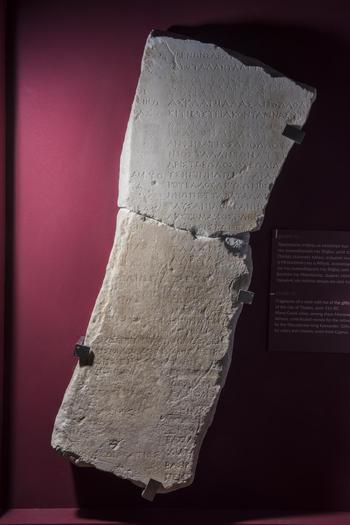
Photographs from the archive of the Ninth Ephorate of Prehistoric and Classical Antiquities suggest that at some point around 2007 someone attempted a join between the two fragments. Unfortunately, the identity of the man or woman in question has not been recorded. The photos present what appears to be a reasonably acceptable join. In 2012, conservators at the Archaeological Museum of Thebes proceeded with a fully recorded association and joining of the two fragments with the aim of having them exhibited in the new Museum. Indeed, the two joined fragments are currently firmly attached to the wall of the ‘Hellenistic’ hall in the new Archaeological Museum of Thebes (Fig. 1).Footnote 6
Photograph of the inscription by I. Miari (Ecole française d'Athènes).

Ideally, we would like to have inspected the two fragments before they were joined but this is no longer an option: the conservators have already used titanium clamps. Disassembling the two fragments would probably cause irreparable damage to the stone. We have therefore carried out autopsy of the fragments in their present condition.
As displayed in the new Museum of Thebes the two fragments give the impression that they do indeed join. However, because the stones were probably already damaged in antiquity, the match is not perfect and the conservators were therefore forced to use plaster. As a result, the lower fragment, that is, the old fragment, has been placed slightly to the right. This can be observed in the alignment of the entries in the second column. More specifically ll. 20–37 of col. II of the new composite text are about 0.004m to the right in relation to ll. 1–19. This has caused us some concern and we have spent hours in the Museum trying to figure out whether this small disparity speaks against the join. However, as already noted, the physical evidence, i.e. the broken lower edge of fragment a and the broken upper edge of fragment b, are compatible along almost the entire surviving width of both fragments. We believe that this correspondence is unlikely to be accidental. Besides, there is another piece of evidence in favour of the association. Contrary to what some scholars have believed so far, the entries were not all cut by one stone-cutter (see below ‘Identifying Hands’). We are certain that the same stonecutter carved col. I, l. 18, which belongs to the new fragment, and col. I, ll. 20–2 of the old fragment. There is also a good possibility that one stonecutter carved the entries in col. II, ll. 11–19 and ll. 20–2, which are preserved on the new and old fragments respectively (see below section ‘Identifying Hands’). This evidence is corroborative, albeit not conclusive. On balance the join of the two fragments seems acceptable, an inference that permeates our edition below.
THE INSCRIPTION
Description
White marble stele composed of two joining fragments; broken on all sides. Height (maximum): 1.17 m; width (max.): 0.44 m; thickness: 0.096 m (up)–0.100 m (down). Τhe height of the letters varies significantly since different cutters worked on the stele at different points in time (see below section ‘Identifying Hands’): col. I: 0.08–0.12 m; col. II, ll. 2–3: 0.008–0.013 m; ll. 4–6: 0.011–0.013 m; ll. 7–8: 0.015–0.016 m; ll. 9–12: 0.08–0.013 m; ll. 13–22: 0.011–0.015 m; ll. 23–31: 0.013–0.014 m; ll. 32–end: 0.10–0.13 m.
Fragment a was found ‘in 1992 during works for the water supply system of the modern city’ in Kadmeia’ (Buraselis Reference Buraselis2014, 159). Ed. Buraselis Reference Buraselis2014 (= SEG LXIV 403). Cf. Kalliontzis Reference Kalliontzis2014; Matthaiou Reference Matthaiou2014; Knoepfler, BÉ (2014) no. 204.
Fragment b, Museum of Thebes, inv. no. 213, was found in the house of Andreas Moularis at 53 Pelopidou Street (Buraselis Reference Buraselis2014, 161). Ed. W. Dittenberger in IG VII 2419; Holleaux Reference Holleaux1895; F. Hiller Syll. 3 337. Cf. Gullath Reference Gullath1982, 89–97; Bringmann and von Steuben Reference Bringmann and Steuben1995, 131–3, Cat. no. 83.
Text

Epigraphical notes
Underlined letters are no longer visible. In this section, we only comment on epigraphical points.
Column I
2. At the end of this line we see traces of what we think is an omega; Buraselis did not read anything here.
18. [– – – ]Π̣ΙΚ̣Α Buraselis. Autopsy of the stone has produced the reading [– – – στατ]ε̣ῖρας̣.
25. Lambda is faded, and we have dotted it.
29. This is the first instance in this column where a word is unambiguously divided across lines. This looks all the stranger because the obvious shortness of l. 30 means that the stone-cutter had plenty of space to transfer the word στατεῖρας to the (missing) start of l. 30.
32. In his facsimile, which was based on Kambanis’ drawing, Holleaux reproduced the loop of a rho before the sequence of letters ΟΥΣΙΟΙ, even though he provided a bracketed rho in his restoration. We can no longer see such a trace, but it would provide a good supplement (see our analysis of this line below).
40. Only the vertical of the kappa is preserved and we have dotted it. We see no trace of the preceding alpha.
Column II
11. We have corrected Buraselis’ Ἀπολλοφά[νους].
13. We have corrected Buraselis’ Εὐβωλίδ[α].
29. Φιλοκλεῖς. The sigma is no longer visible.
37. We can discern the upper left corner of the epsilon of the word Βασιλε̣[ύς], which had not been seen by previous editors.
Commentary
Column I
General remark: The extant traces in this column in conjunction with the picture emerging from the new fragment emphasise something briefly observed by Hiller in the apparatus criticus of SIG 3 337, which has been by and large overlooked: not all lines have the same length. In some cases, we should even assume uninscribed lines, as in col. II.
8. [σουμμα]χικῶ. This is the restoration hesitantly suggested by Buraselis (Reference Buraselis2014, 160 n. 2).Footnote 7 Matthaiou also accepts the restoration as feasible, while proposing as a less likely alternative the ending of a personal name (Matthaiou Reference Matthaiou2014). Given that all the entries in this column without exception end in monetary sums, we consider it almost certain that we have here a reference to [ἀργουρίω σουμμα]χικῶ. The argurion symmachikon has long been known from a series of inscriptions from Kolophon and Didyma. In a recent and thorough examination, Descat has identified it as royal coinage minted in Miletus in c. 320–310 bc (Descat Reference Descat, Bremen and Carbon2010). This date would fit well with the chronological context of the Theban inscription. However, more recently Salvatore Vacante (Reference Vacante2015, 564–71) advocated a drastic downdating of the argurion symmachikon to 297/296 bc.Footnote 8 Although we cannot possibly revisit the complicated arguments behind the debate we find Vacante's proposal untenable, and we prefer the traditional dating of the argurion symmachikon to the closing decades of the fourth century bc. The crucial question is whether the unknown contributor in this line could be the city of Miletus (cf. col. II, ll. 23–8), a Milesian citizen or some other participant in the enigmatic alliance that issued the coinage. We raise these possibilities without being able to provide a definitive answer.
15. Although Buraselis’ [– – – τάλαν]τ̣α δύο seems tempting, it should be noted that in the monetary sums preserved elsewhere in the inscription the numeral appears to precede the currency unit.
16. Buraselis’ [τάλαν]τα must be right.
20. Holleaux tentatively printed [– – – ἑκατ]όν?, but [– – – τάλαντ]ον is equally likely.
21. [– – – ἑκατ]όν?, Holleaux, but see our comment on l. 20 above.
31–4. An obvious peculiarity of this section is that words are divided across lines, something that first occurs in l. 29, as we have pointed out. It is, however, the arrangement of what survives that is most troubling. In l. 32, Holleaux briefly entertained the possibility that [– – –]ούσιοι was the ending of an ethnic, before opting for the restoration [χρ]ούσιοι χείλιο<ι> πεν[τ|ακάτιοι] (Holleaux Reference Holleaux1895, 11 n. 2).Footnote 9 He realised, of course, that this solution would diverge from the pattern consistently observed elsewhere in which monetary sums are in the accusative case. In l. 33, however, the restored ethnic, [Σαμοθρ]ᾷκες according to Holleaux (but see our reservations about the supplement below), patently does not begin the line. On balance, we think that an ethnic is more likely here. There seem to be two possible restorations, [Ἰαλ]ούσιοι and [Βερ]ούσιοι. One may be tempted to discount Ialysos, but recently scholars have emphasised that the constituent parts of Rhodes kept operating as independent poleis even after the synoecism of 408/407 bc (Gabrielsen Reference Gabrielsen, Flensted-Jensen, Nielsen and Rubinstein2000, 192–6). The alternative supplement [Βερ]ούσιοι, however, is more tempting, especially in light of Holleaux's reading of a partly preserved rho before the letters that survive today.Footnote 10 Birytis was arguably a small polis (Hansen and Nielsen Reference Hansen and Nielsen2004, no. 773), but it lay in the Troad, a contributing area, as can be seen in col. I, l. 42. Even more striking is the fact that its late-fourth to early-third-century bc silver coins featured Kabeiros on the obverse and Herakles on the reverse, two figures with strong Theban associations.Footnote 11 One suspects that the two places had deep links that might even have been expressed in terms of syngeneia. All in all, we consider the supplement [Βε]ρ̣ούσιοι very likely.
33-4. In l. 33 Holleaux restored [Σαμοθ]ρᾷκες. This reading cannot be sustained. Before epsilon there is a very clear low horizontal that could only belong to an epsilon or a delta. Indeed, a very faint diagonal starting at the left end of this stroke suggests a delta. In fact, that great servant of Boiotian epigraphy, H. G. Lolling, had read ΙΔΕΣ. We do not believe that there is an iota, but the rest is there. This may be the ending of the ethnic [Ἀρκά]δες, a Cretan polis (Hansen and Nielsen Reference Hansen and Nielsen2004, no. 948.).Footnote 12 At any rate, as aptly observed by Gullath (Reference Gullath1982, 91), one has to restore some numeral between ἑπτα̣κα|[τίως] and [στ]ατεῖρας since there is not enough space to restore another ethnic too. The slippery group of l. 33, perhaps Cretan Arkades, contributed 700+ staters but the exact sum eludes us.
38. [- - -]ε̣ιοι is almost certainly the ending of an ethnic.Footnote 13 The unknown community contributed something in gold. Golden coins are also attested in col. II, l. 1 (see ad loc.). In the late 350s bc the Thebans received a payment for the Third Sacred War from the Byzantines in golden Lampsakene staters;Footnote 14 golden staters should probably be understood here too.
41. For the restoration here, compare what can be read in col. II, l. 22.Footnote 15
42. The restoration [Ἀντιγονεῖες τοὶ ἐκ τᾶς Τ]ρ̣ωΐας was an ingenious attempt by Holleaux at identifying the contributors.Footnote 16 Schachter (Reference Schachter1981, 234 = SEG XXXI 502) proposed reading [Ὀφρουνεῖες τοὶ ἐκ vel οὑπὲρ τᾶς Τρ]ωΐας instead and associated this entry with the amply attested transfer of the bones of Hektor from Ophryneion to Thebes. Hornblower has now produced an exhaustive account of this extraordinary moment of Theban religious history, in the course of which he eventually accepts that the refoundation of Thebes by Cassander offers the best context for the transfer of the famous Trojan hero's bones to Boiotia (Hornblower Reference Hornblower2015, 422–9; cf. Gartland Reference Gartland and Gartland2016, 161). In this view, there is a strong religious and mythological element behind this specific contribution, a pattern that can also be discerned elsewhere in the inscription. Although we have a slight preference for Ophryneion, Antigoneia or some other city of the Troad cannot be excluded, and we have therefore left this line unrestored.
44. Dittenberger and Holleaux's [- - - ἑκα]τόν is too optimistic; [τάλαν]τον is a viable alternative.
Column II
1. Buraselis (Reference Buraselis2014, 163) suggested χρουσ[ίως] or χρούσ[ιοι] on the evidence of col. I, ll. 32 and 38. We strongly favour the accusative form.
2. The restoration Σαβατ̣[τάρα Εὐρωπῆος] was put forward by Matthaiou (Reference Matthaiou2014, 32), who rightly observed that Σαβατ̣[τάρα] is the only epigraphically acceptable supplement. Matthaiou went on to tentatively identify the contributor as the brother of Μαχάτας Σαβαττάρα of Europos, proxenos of Delphi in 300 bc.Footnote 17 The identification must be correct. At any rate, the name is patently Macedonian.
4–6. Θεμίσων Θεμιστ̣[αγόρω?] | Σολεὺς ἀπὸ Κύπρω τ[άλαν]|τον Ἀττικόν is Buraselis’ restoration, although he did not elaborate further. He was presumably inspired by SEG XX 309, a fourth/third-century bc dedication to Apollo Ayuates by a certain Themistagoras, thought to be a man from Soloi. Buraselis, however, admitted that Themison's father might have been called Θεμιστίας or Θεμίστιος, both names attested in Soloi of Cyprus. In other words, the patronym could be restored as Θεμιστ̣[ίαο] or Θεμιστ̣[ίω]. Nevertheless, as noted by Buraselis, names with the prefix Θεμισ(τ)– appear to have been extremely fashionable in Cyprus.Footnote 18 Thus we cannot a priori exclude other restorations, such as Θεμιστ̣[οκλείους], Θεμιστ̣[οκράτεος] etc. In view of the above we have left the patronym unrestored, although we would like to bring attention to Buraselis’ observation that a certain Θεμίσων was the king of an unknown Cypriot city in the lifetime of Aristotle (Buraselis Reference Buraselis2014, 166).
7–8. Ἀσκλαπιάδας Ἀπολλοδώ[ρω] | Κιτιεὺς τριάκοντα μνᾶς Ἀττ̣[ικάς]. Buraselis aptly observed that with its Phoenician cultural background Kition might have had a special mythological connection with Thebes via Cadmus (Buraselis Reference Buraselis2014, 167; cf. Knoepfler, BÉ (2014) no. 204), as was presumably the case with the Sidonian King Philokles, on whom see below.
9–10. Ἀρχίας Fαναξιδότω M[– – – ]. Buraselis has suggested either Μ[αριεύς] or Μ[ακεδών], expressing his preference for the former. We believe that the latter is preferable on prosopographic grounds. As already observed by Buraselis himself (Reference Buraselis2014, 168–9), the combination of the names Ἀρχίας and Fαναξίδοτος appears only once: Alexander's naval captain Ἀρχίας Ἀναξιδότου, who served under the command of Nearchos (cf. Tataki Reference Tataki1998, 151 no. 23). If the identification is correct, then the participation of a high-rank officer of Alexander the Great in a project initiated by Cassander, arguably the most anti-Alexander of the Successors, offers a fascinating glimpse into the shifting political allegiances of the tumultuous period that was the late fourth century bc.
11–12. Ἀντίπατρος Ἀπολλοφά[νεος – – –] | νιος τάλαντον Ἀττικ[όν]. Buraselis tentatively restored [Σαλαμί]νιος, based on his theory that the men recorded in ll. 4–12 comprise a geographical block, i.e. they come from Cyprus (Buraselis Reference Buraselis2014, 166–7). This is by no means certain. Both name and patronym are fairly common, with the result that it is difficult to build a good argument for or against the restoration. If, after all, Antipatros’ entry appears in the middle of a series of contributions made by Macedonians, a scenario that seems to be the most likely, then Antipatros could well have been a Macedonian himself. However, no Macedonian ethnic seems appropriate here, and Knoepfler, in BÉ (2014) no. 204, has provisionally put forward the restorations [Σικουώ]νιος or [Κολοφώ]νιος, the former on historical and the latter on onomastic grounds.
13–14. Ἀριστόβωλος Εὐβωλίδ[αο ?Κασσανδρε]|ύς. Buraselis (Reference Buraselis2014, 166–7) restored the ethnic on the evidence of an inscribed fragment of a Panathenaic amphora found in Kassandreia, which reads Ἀριστόβουλος | Εὐβουλίδου | [ἅρ]ματι [τελ]ε̣ίω̣[ι] (SEG XLV 801). This sounds cogent, and we think that the proposed identification may well be correct. If so, we end up with a rather long line of 29 letters. It is worth noting that according to this interpretation, a contributor to the refoundation of Thebes was himself a citizen of another city refounded by Cassander. Concerning the sum of four talents, Knoepfler rightly noted in ΒÉ (Reference Knoepfler and Papazarkadas2014) no. 204 that we should understand either Ἠγινήω ἀργουρίω or νομίσματος.
15. Βούβαλος Λεύκωνος [– – –]. After pondering the possibility that the contributor came from some region of the western Greek world, Buraselis (Reference Buraselis2014, 168) eventually expressed his preference for identifying Boubalos as a Macedonian on the evidence of the Arkadian list of victors, IG V.2.550, l. 29: κέλητι τελέωι Βούβαλος ἐκ Κασσανδρείας (cf. Tataki Reference Tataki1998, 87 no. 20). If so, it is interesting that the two individuals, Aristoboulos and Boubalos, are connected via their active involvement in hippic competitions, the artistocratic pastime par excellence.
17. Παυσανίαο Ἀθανηο[ς – – – ]. This is a difficult line. Elsewhere the names of the contributors start at the left of the column. The name in the beginning of this line is, however, in the genitive. Buraselis (Reference Buraselis2014, 168) simply commented on the fact that Ἀθανηο[ς] could be either an ethnic (Ἀθανῆο[ς]) or a personal name (Ἀθάνηο[ς]). The disturbance of the expected pattern was aptly observed by Matthaiou (Reference Matthaiou2014, 32–3), who took Ἀθανῆο[ς] to be the ethnic of Pausanias’ son. If so, the name of the unknown contributor would have been written at the end of l. 16, after the monetary sum offered by Boubalos. Matthaiou's observations are spot on. Other solutions, such as assuming an irregular genitive of origin (Παυσανίαο = ‘from Pausanias’), will not work, since in that case the following word, be it an ethnic or a patronym, would have been in the genitive, hence Ἀθανήω. If an ethnic, Ἀθανῆο[ς] would have been accompanied by a monetary sum, e.g. [τάλαντον], and the space seems too limited to designate the standard system used (τάλαντον Ἀττικόν or ᾽Ηγινήω τάλαντον), as elsewhere. If it is a personal name, Ἀθάνηο[ς], along with the son of Pausanias and the following individuals, would have been a member of a group of contributors (see next note). It is worth noting that an Athanaios, son of Damonikos, of Macedon had been honoured as proxenos of the koinon of the Boiotians when the confederacy was controlled by Thebes.Footnote 19 His son, Demonikos (Ionic form of Damonikos), was a trierarch of Alexander the Great. The man here could be a descendant, perhaps the trierarch's son, who would have renewed the goodwill of his family towards Thebes.
18–19. Ἀριστόμαχος Πλεισ̣[– – –] | […] Ἀνδρίσκω Πελλ̣[– – –]. These names and the ones around them raise problems of individual restorations and their relationship to one another. In his editio princeps Buraselis (Reference Buraselis2014, 168) printed Πλεισ̣[τάρχου?], which, at any rate, should have been Πλεισ̣[τάρχω], and claimed that the name is ‘well-attested in Macedonia’. In fact, the name has been found in Macedonia only twice (LGPN IV, s.v. Πλείσταρχος, nos. 2 and 3). In the corroborating footnote, Buraselis’ tantalising reference to the name Pleistias suggests that he also considered the restoration Πλεισ̣[τίαο] (Buraselis Reference Buraselis2014, 168 n. 34). Other possibilities include Πλεισ̣[θένεος] and Πλεισ̣[τιάδαο]; outside Macedonia, the possibilities proliferate: Πλεισ̣[τώνακτος], Πλείσ̣[τωρος], etc.
It is likely that Buraselis favoured the name Πλείσταρχος because one of the two Macedonian attestations is thought to refer to a man from Pella. Indeed, in l. 19 Buraselis (Reference Buraselis2014, 168) suggested Πελλ̣[αῖος] or Πελλ̣[αῖοι], rather than Πελλ̣[αναῖος]/Πελλ̣[αναῖοι], which, of course, should have been Πελλ̣[ῆος]/Πελλ̣[ῆοι] and Πελλ̣[ανῆος]/Πελλ̣[ανῆοι] respectively in the Boiotian dialect. Knoepfler, in BÉ (2014) no. 204, proposed reading Πελλ̣[αῖος] (but one should read Πελλ̣[ῆος]) and identified this man with Pausanias, son of Andriskos, who is attested in a lavish funerary stele from Pella (Cormack Reference Cormack1973, 203–4 no. 1).Footnote 20 The identification is tempting. The Macedonian stele in question is one of the earliest and finest examples from Pella. The family must have been of some means.Footnote 21
At any rate, the extant space in l. 19 seems insufficient to restore both an ethnic and a monetary sum, all the more so since the name of Andriskos’ son, whatever that might be, most likely started at the end of l. 18. It must therefore be assumed that Aristomachos and the son of Andriskos shared the same ethnic. This could have been Πελλ̣[ῆοι], as we saw, but Matthaiou (Reference Matthaiou2014, 33) also raised the possibility that yet another personal name should be read in l. 19, such as Πελλ̣[ίτης], Πέλλ̣[ιτος], Πέλλ̣[ιχος], or even Πελά̣[γων]. In other words, he assumed that Aristomachos, the unknown son of Andriskos, Pell[- - -] and perhaps even Philo[kleis] (or whatever name we restore in l. 20; see below) could have comprised one single group of contributors. In fact, building on Matthaiou's observation that Pausanias’ son's name was inscribed at the end of l. 16, and assuming that Ἀθάνηο[ς] in l. 17 is a personal name, we might even suggest that we have here a group of at least five, if not six (with the addition of the man recorded in l. 20), contributors. We have tried to expound the various possibilities as clearly as possible, but we do not think that any solution stands out from the others.
20–2. Φιλο[κλεῖς?]. Ever since Dittenberger, it has been thought that this contributor is the same as Φιλοκλεῖς of l. 29. Moreover, it has been almost unanimously accepted that this Philokles is the king of Sidon in Phoenicia.Footnote 22 We think, however, that the restoration of l. 20 is rather generous, especially in light of the fact that the onomastic element Φιλο– is common and can produce numerous names.Footnote 23 Furthermore, no other piece of internal evidence suggests that contributors were recorded on more than one occasion. As noted above, Matthaiou even suggested that the Philo[kleis] of l. 20 is just one member of a group of contributors recorded in ll. 18–22, and in turn we suggested that the group in question might have been even larger, starting in l. 16. Ultimately, we cannot endorse Holleaux's restoration Φιλο[κλεῖς Ἀπολλοδώρω] | τάλαντ[α … ἀργουρίω] | Ἀλεξανδ[ρείω] in ll. 18–20, at least not in its first part.Footnote 24
23. The preceding vacat indicates that this line marks the beginning of a new section. Indeed in ll. 23–9 one can recognise four entries whose common trait is that they record contributions from cities rather than individuals. The grouping has been described as geographic (Buraselis Reference Buraselis2014, 166), but the relevant area (Central and Southern Aegean) is too wide to be conceptually significant. Holleaux (Reference Holleaux1895, 41–2) believed that Ptolemy I inspired, or even compelled, Cos, Melos and perhaps Aigina to contribute to Thebes’ refoundation and dated these entries to between 310 and 308 bc. Although the idea of some high-level political prodding cannot be dismissed, we think that other, additional explanations should be sought.
23–4. The traditional reading has been Ἐρετριεῖς̣. However, this is not the expected Boiotian form of the ethnic,Footnote 25 and we suspect that the letter traces previously transcribed as a dotted sigma belong to an epsilon. We put forward Ἐρετριεῖε̣[ς]. Otherwise, scholars have followed Holleaux in restoring [… δραχμὰς] | Ἀττικάς. The new fragment, especially col. II, ll. 8–10 of our text, shows that [μνᾶς] | Ἀττικάς is a legitimate, perhaps even preferable, alternative. In any case the motivation behind Eretria's contribution has hitherto proved elusive. Knoepfler, in BÉ (2014) no. 204, rightly observed that the admission of Thebes and the Euboean cities to the Boiotian koinon, thought at the time of Holleaux's article to date to the late fourth century bc, in fact happened much later and is therefore irrelevant to the issue at hand.Footnote 26 Thebes and Eretria, however, had something else, something much more gruesome, in common. Like Thebes, in 490 bc Eretria was razed to the ground by the Persians, who went on to enslave the entire population (Walker Reference Walker2004, 271–3). We would therefore like to argue that the Eretrians contributed to the reconstruction of Thebes out of empathy.Footnote 27
25. The contribution of the Coans cannot be explained by reference to any specific event. In general, the island was on good terms with the Ptolemies throughout the early Hellenistic period, though at times it also found itself in the Antigonids’ zone of influence (Sherwin-White Reference Sherwin-White1978, 82–90). We would like, however, to suggest a possible, albeit speculative, mythological connection between Thebes and Cos. A largely overlooked, fragmentary hymn by Pindar contains references to a host of Theban heroes, the birth of Apollo at Delos and, more pertinently for our discussion, the story of Herakles’ attack on Cos.Footnote 28 Although the details are by and large elusive, we think that this obscure incident in the life of Thebes’ archetypal demigod could potentially allude to a more profound mythological connection between Cos and Thebes, which might in turn explain the Coans’ appearance in the inscription under consideration. As concerns the sum proper, πέτταρ[α τάλαντα ?Ἀττικά] is very likely.Footnote 29
26. Little of the ethnic survives today, but Dittenberger read Ṃάλ̣ιοι with little hesitation. Since sums of multiple talents are preceded by a cardinal number it is most plausible to assume that the Melians contributed just one talent. Hence τά[λαντον], followed by a description of the currency system, e.g. Ἀττικόν, Ἠγινῆον vel sim., commends itself. We know too little of Melos in the early Hellenistic period to make any historical guesses about the island's inclusion in the list here. As in the case of Eretria, we prefer to see here the empathetic response of a people who, like the hapless Thebans in 335 bc, had, in 416 bc, been stripped of their families, their homes and even their liberty by a ruthless imperialistic power.Footnote 30
27–8. That the Aiginetans’ contribution is in their own currency should cause no surprise. We believe that their motivation was probably religious, as, presumably, in the case of the entry of col. I, l. 42. Aigina and Thebes already appear mythologically closely connected in the works of Bacchylides, Pindar and Herodotus: the Aiginetans might have felt obliged to contribute towards the restoration of their Theban kin (συγγενεῖς).Footnote 31
29-31. Φιλοκλεῖς. As first recognised by Dittenberger in 1892 (IG), a reference to Philokles, the king of the Sidonians, is very likely here, but, we should caution, is by no means certain. We may start with two points that have so far passed unnoticed. One of the reasons behind the identification of this individual with the Sidonian king was the fact that his name appears immediately before the ‘royal section’ of the list (col. II, ll. 32–42).Footnote 32 But this seemingly cogent argument has been effectively refuted by the new fragment, which shows that non-royal individuals also contributed to the refoundation of Thebes. The second argument in support of the identification of Philokles as the Sidonian king has been the enormous contribution allegedly recorded in these lines. Merker (Reference Merker1970, 144) put it bluntly: ‘Moreover, how would a private citizen have obtained the enormous sum of 100 talents?’ But some caution is in order here. The traditional restoration [τάλαν]|τα ἑκατ[όν] has long been taken as all but certain.Footnote 33 However, as far as we can tell from the preserved entries, numerals normally preceded rather than followed the word τάλαντα. Thus, some other restoration, such as [δύο τάλαν]|τα, ἑκατ[ὸν δραχμὰς Ἀλεξανδρείας vel sim.], is epigraphically tenable, in which case the whopping sum of 100 talents disappears, along with the allegedly undisputed identification of Philokles as the Sidonian King, whatever his exact title might have been.
Nevertheless, circumstantial evidence —the relative rarity of the name, the placement of Philokles after a series of poleis and before royal entries, the possibility (rather than certainty) that the amount contributed was at least 100 talents, and the verb used in l. 30— do speak in favour of identifying Philokles with the king of the Sidonians. Now, scholars have mulled over the alleged double contribution of Philokles and his exact motivations, especially in relation to his dependency on Ptolemy I.Footnote 34 As we have already argued, it is by no means certain that Philokles contributed twice. Nor do we find it implausible that Philokles might have acted on his own initiative. In fact, as was suggested a long time ago, Philokles might have been motivated by the strong mythological links that connected the Thebans with the Phoenician Sidonians via Cadmus (Hauben Reference Hauben and Lipiński1987, 416 n. 18).Footnote 35 Such links are nowadays taken much more seriously than they were in the past, and we therefore believe that a syngeneia link would be a perfectly plausible motivation behind such a gesture.Footnote 36
In our view, the syngeneia-link is further corroborated by the use of the verb ἀνέθεικε in l. 30. Holleaux reasonably suggested that the verb singled out this contribution as pertaining to the sacred realm. Admittedly, in the Hellenistic period the verb was occasionally used for private (usually, but not exclusively, royal) donations aimed at supporting both religious and civic needs.Footnote 37 However, the context makes it likely that in this specific case the verb ἀνέθεικε preserves its original religious overtones.Footnote 38
In view of all this, instead of Holleaux's Φιλοκλεῖς [Ἀπολλοδώρω] we prefer, following Dittenberger in IG and Merker (Reference Merker1970, 144), Φιλοκλεῖς [βασιλεὺς Σιδωνίων], which, we may add, would have made the kinship link between the two peoples, the Thebans and the Sidonians, evident to everyone.
32–6. Holleaux ingeniously saw these lines as a reference to a sum contributed by Demetrios on the occasion of his epoch-making siege of Rhodes that earned him the moniker ‘Besieger’ (Holleaux Reference Holleaux1895, 28–31) and restored [Βα]σι[λεὺς Δαμάτριος] | δραχμὰ[ς – – – ἐν τὸ] | ἐληοχ[ρίστιον ἀπὸ τῶν] | πὰρ Ῥοδ[ίων λαφύρων] | δεκάτ[αν τοῖς θεοῖς ἀνέθεικε].Footnote 39 Despite the fact that the siege was ultimately unsuccessful,Footnote 40 Holleaux argued that the gesture was propagandistic (Holleaux Reference Holleaux1895, 29–30).Footnote 41 The reconstruction is, of course, speculative, but for want of better alternatives it is very tempting. Besides, l. 32 was intentionally erased already in antiquity, a fact that Holleaux attributed to the damnatio memoriae that Demetrios presumably suffered after his expulsion from Boiotia in the late 290s following Boiotia's and Thebes’ revolts against him.Footnote 42 This theory allowed the French epigraphist to consider 304 as the terminus post quem, since it was only in that year that Demetrios assumed the royal title.
Some further observations are in order here. Seibert wanted to restore l. 32 as [Β]α̣σιλ̣[εῖες Ἀντίγονος καὶ Δαμάτριος]. His proposal has not met with approval because it produces an allegedly long line of 30 letters (Seibert Reference Seibert1970, 341 n. 16; contra Gullath Reference Gullath1982, 96). Yet on the basis of the discussion above it should be clear that this is not a problem. After all, one can counterclaim that Holleaux's restoration produces a very short line. We do, however, think that the absence of the definite article before ⟦[Β]α̣σιλ̣[εύς]⟧/⟦[Β]α̣σιλ̣[εῖες]⟧ (contrast l. 37) speaks against Seibert's proposal. Moreover, it seems more reasonable to use the space after the name [Δαμάτριος] to restore a reference to the currency standard, or, even better, a number, for instance, ⟦[Β]α̣σιλ̣[εὺς Δαμάτριος⟧ μουρίας] | δραχμὰ̣[ς Ἀλεξανδρείας ἐν τὸ] | ἐληοχ[ρίστιον] etc. Besides, the entry for Demetrios is peculiar in that it specifies the destination of the donation, namely olive oil for those frequenting the gymnasium. This type of earmarking became very popular later in the Hellenistic period,Footnote 43 but ours appears to be the earliest such case. We wonder whether this specific contribution by Demetrios was important enough to create a pattern worthy of emulation by the Hellenistic monarchs. It is certainly striking that funds for the purchase of gymnasium oil became especially fashionable in Boiotia.Footnote 44
37–8. Holleaux (Reference Holleaux1895, 14) suggested τοὶ βασιλ[εῖες τάδε ἔδωκαν] | τῆ πόλ[ι – – – ] and speculated that this was a repetition of the (now lost) heading of the inscription. We note that this section is clearly marked by the use of a paragraphos. Such paragraphoi are rare, albeit not unheard of, in epigraphical texts.Footnote 45 Its use here was probably meant to highlight the ‘royal section’ of the contributions.
39. Holleaux restored Βασιλ[εὺς Κάσσανδρος].Footnote 46 Gullath (Reference Gullath1982, 96) observed that either here or in l. 41, the unknown king might well have been Ptolemy I. Knoepfler (Reference Knoepfler, Frei-Stolba and Gex2001, 18, 24 n. 73) argued that the two kings in ll. 39 and 41 should be the allies Lysimachos and Pyrrhos and provisionally dated the entries to after 287 bc. We explore other possibilities in our commentary on the following line.
40. Holleaux had troubles with this line. Autopsy has shown that the sequence of letters ΧΙΑ is certain, and that there are traces of a fourth letter, compatible with the upper half of a sigma. As we have seen, the ‘royal’ section of this inscription has several unusual features, and the same holds true here. At first sight, two words commend themselves: ναυμαχία and σουμμαχία. We considered a reference to the naval battle of Cypriot Salamis of 306 bc, a major Antigonid victory over the Ptolemies, and tentatively restored Βασιλε̣[ὺς Δαμάτριος ἀπὸ τᾶς ναυμα]|χίας̣. However, this would mean that the siege of Rhodes and the battle of Salamis were recorded in reverse chronological order in the list under consideration, a difficult scenario. An alternative supplement would be Βασιλε̣[ὺς Δαμάτριος οὑπὲρ τᾶς σουμμα]|χίας̣. If so, this would be the so-called Hellenic League, founded by Antigonos and Demetrios in 302.Footnote 47 In this case, we would gain a very specific chronological point of reference. The Hellenic League proved to be short-lived: it was promptly dissolved in 301 bc, following the battle of Ipsos. The problem with this supplement is that we would expect this ‘Demetrian’ entry to have suffered from damnatio memoriae, as is the case in l. 32.Footnote 48 There is a third possibility, namely a reference to [δραχμὰς Λουσιμα]|χίας̣.Footnote 49 This third supplement,Footnote 50 which we favour slightly, would provide a terminus post quem of 297 bc, the year that Lysimachus struck his first royal tetradrachms (Thompson Reference Thompson, Kraay and Jenkins1968, 165–6), and it might offer further support to Knoepfler's theory that one of the kings of ll. 39–41 was Lysimachus.
41. Holleaux restored Βασιλ[εὺς Λυσίμαχος] but this is by no means certain (Holleaux Reference Holleaux1895, 46; cf. Gullath Reference Gullath1982, 96).Footnote 51 Pyrrhos, as per Knoepfler, might have been the royal contributor here, but so little survives that we should simply refrain from any further speculations.
42. πέντ[ε], πεντ[ακατίως], vel sim. should be restored here.
IDENTIFYING HANDS
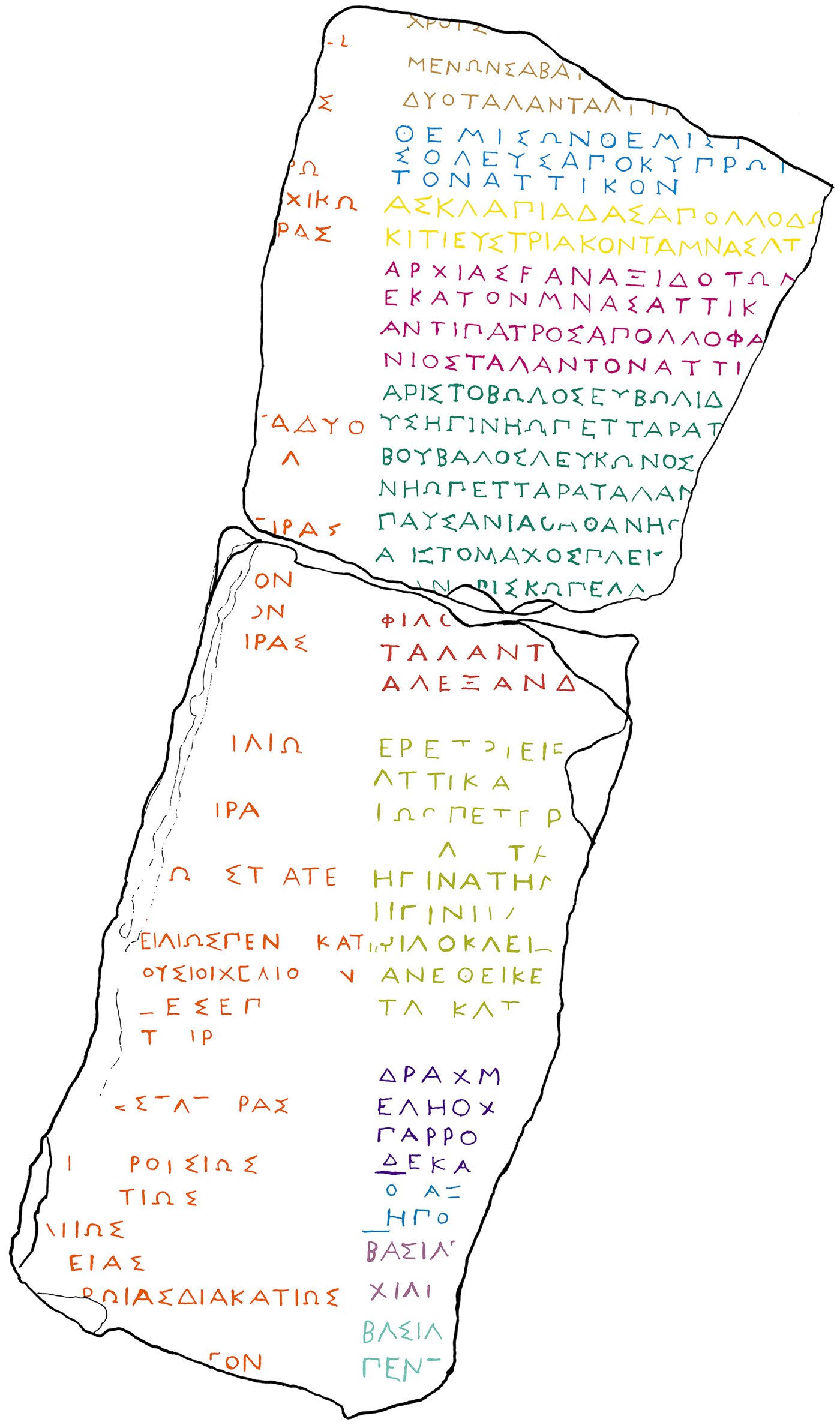
Autopsy of the two fragments has allowed us provisionally to identify several stone-cutters (Fig. 2). Identifying individual hands was easier in the case of the new fragment because it is better preserved. Conversely, we found it rather difficult to isolate the main traits of the cutters who worked on the left column because of the limited number of well-preserved letters. What little survives, however, seems to have been inscribed in rather fine letters that only occasionally show nascent serifs or take a more ornate form, as evident in the sigma with slightly curved strokes slanting outwards. We hesitantly suggest that all the entries in this column were carved by one single cutter. As noted above, we are fairly certain that the same cutter carved the word [στατ]ε̣ίρας in col. I, l. 18, and the word [στατε]ίρας in col. I, l. 22 (l. 3 of the old fragment).
Drawing of the inscription by Y. Kalliontzis and I. Patiri (Ecole française d'Athènes).

In col. II (the right column), one cutter seems to have worked on the entry for Menon's donation (ll. 2–3). This entry is carved in rather small letters, yet the interlinear space is relatively wide. A second cutter worked on the entry for Themison's donation (ll. 4–6). He employed larger, more regular letters that are rather thin and have deep round apices at their ends. A third cutter worked on the next entry (ll. 7–8). His letters are considerably larger, almost monumental, and appear to be more ‘classical’ than the letters of his two predecessors. This cutter might well have developed his style earlier in the fourth century. The lettering of the fourth entry (ll. 9–12) is smaller and visibly shallow. We believe that a fourth stonecutter should be identified here. The following donations, starting with that of Aristobolos son of Eubolidas (l. 13) down to the donation of the son of Andriskos (l. 19), seem to be the work of one single cutter. His lettering is typically Hellenistic, with apices and, overall, a considerable range of ornamental elements. In any case, we believe that ll. 13–19 were carved on the same occasion.
Although the surface of the older fragment is badly worn, we have already noted that it is possible, albeit not certain, that the cutter of ll. 20–2 (col. II) is the same man who carved ll. 13–19. Unfortunately, the surviving sample is rather small, so we cannot categorically affirm the identification. The lettering of ll. 23–31 does show similarities with the lettering of the cutter of ll. 20–2, but we are under the impression that different cutters carved these lines. Finally, from l. 32 down to the end of the surviving text, the letters appear to be less well-cut. They are also smaller than those of the preceding entries. Either a new cutter worked on these lines, or the same cutter reduced the size of his letters considerably as he approached the end of the inscription and was forced to work within a limited space.
THE MONUMENT AND ITS LOCATION
All that survives of the original monument is a fragment of a tall white marble stele. The marble seems to be Pentelic. If so, one is reminded of the Athenians who, after all, started helping the Thebans build their fortification wall early on.Footnote 52 It is conceivable that on that occasion the Athenians not only contributed money and manpower, but also donated the precious raw material that the Thebans used to record the contributions they received.
It is impossible to say how much of the original stele we are missing or whether there could have been more than one. The project excited enthusiastic contributions from cities as far away as Sicily, as our literary sources attest, and one can imagine that ample space would have been necessary to record them all.Footnote 53 The existence of two or even three stelai cannot therefore be ruled out, and in fact we consider that it is a likely scenario. Multiple stelai could have been attached to each other to create a thin epigraphic wall of a type not unknown in Boiotia.Footnote 54 A single stele, however, might have sufficed. On present evidence, it is impossible to provide a definitive answer.
Moreover, we do not know where the stele (or the multi-stelai wall) would have been erected, though it is reasonable to assume that it was set up in some conspicuous location. It could, for example, have been set up in some prominent shrine or in the agora of Thebes.Footnote 55 Nevertheless, our evidence cannot firmly support any hypothesis, and the issue should remain open.
HISTORICAL INTERPRETATION
The few sources for the reconstruction of Thebes have been well analysed by modern scholars, and we will refrain from dealing with them extensively here.Footnote 56 The Parian Marble unequivocally places Cassander's refoundation of Thebes in the archonship of Demokleides, that is, in 316/315 bc.Footnote 57 Our two main literary accounts can be found in the work of Diodorus Siculus and Pausanias, respectively. The former introduces the theme of Cassander's arrival in Boiotia in 316/315 bc in his account:
Cassander crossed Thessaly without loss, but when he found the pass at Thermopylae guarded by Aetolians, he with difficulty dislodged them and entered Boeotia. Summoning from all sides those of the Thebans who survived, he undertook to re-establish Thebes; for he assumed that this was a most excellent opportunity to set up once more a city that had been widely known both for its achievements and for the myths that had been handed down about it; and he supposed that by this benevolent act he would acquire undying fame.Footnote 58 (translation by Geer Reference Geer1947)
After providing an overview of Theban history culminating in the destruction of Thebes by Alexander the Great, Diodorus concludes: ‘In the twentieth year thereafter Cassander in his desire for glory, after first obtaining the consent of the Boeotians, rebuilt the city for those of the Thebans who survived’ (translation by Geer Reference Geer1947).Footnote 59 Modern historical analysis has established that Thebes’ reconstruction probably began in 315 bc (Gullath Reference Gullath1982, 86–9; Anson Reference Anson2014, 118).
Thankfully, Pausanias’ account offers more information:
On this occasion the Thebans were removed from their homes by Alexander and straggled to Athens; afterwards they were restored by Cassander, son of Antipater. Heartiest in their support of the restoration of Thebes were the Athenians, and they were helped by Messenians and the Arcadians of Megalopolis. My own view is that in building Thebes Cassander was mainly influenced by hatred of Alexander.Footnote 60 (translation by Jones Reference Jones1918)
As rightly observed by Holleaux, none of the cities that Pausanias explicitly said contributed to the refounding of Thebes appear in the old fragment of the monument. The new fragment has not altered this picture. Holleaux's theory that Pausanias mentions the cities that were the first to help Thebes and whose entries would have appeared at the top of the stele, which is now missing, may well be correct (Holleaux Reference Holleaux1895, 23).Footnote 61
A similar dissonance between the literary sources and the epigraphic document arises from the absence of the Sicilian and Italian cities mentioned by Diodorus.Footnote 62 This may be mere happenstance,Footnote 63 although we suspect that Diodorus may have overemphasised the contributions of Italians and Sicilians because of biased localism.
An important question that remains is what motivated these various groups and individuals to contribute to Thebes’ refoundation. Athens’ support is readily explicable. The Athenians had given shelter to the hapless Thebans after the destruction of their city; it was only natural to complete the good deed by assisting with the rebuilding of Thebes. Nor is it difficult to gauge what prompted the Messenians and the Megalopolitans. The two Peloponnesian poleis had only come into existence as a result of Thebes’ initiative at the peak of her hegemony, and their contribution was certainly their way of returning the favour (cf. Moggi and Osanna Reference Moggi and Osanna2010, 257). Messene, in particular, honoured Epaminondas not only as its liberator, but also as its οἰκιστής, its founder.Footnote 64 Likewise, the contributions of Philokles, king of the Sidonians, and of some Cypriot individuals might be seen in the framework of syngeneia and the mythological links that connected Thebes and the Phoenicians via Cadmus.Footnote 65 Aigina, we have argued, might have been motivated by similar considerations. A religious connection may underlie the single (or double, should the restoration [Βε]ρ̣ούσιοι in l. 32 of col. I stand) contribution from Troas. Finally, mythology might also have motivated the otherwise unexpected contribution from the Coans.
A recently published early Hellenistic inscription from Aigai of Aiolis might offer new and exciting insights into the topics examined here. The first editors (Malay and Ricl Reference Malay and Ricl2017, 31–5 no. 1) interpreted the inscription as a third-century bc decree of Aigai initiating the conclusion of a treaty with an unknown city. Yet, in their concise analysis of the inscription in BÉ (2018) no. 372, Hamon and Minon showed that the dialect of the new inscription is almost certainly Boiotian and further argued that the document might record Aigai's response to the Thebans’ request for financial assistance with the reconstruction of Thebes.Footnote 66 The request, according to Hamon and Minon, would have been conveyed by Theban ambassadors and backed up by the evocation of preexisting links between the two cities.Footnote 67 The French scholars’ brilliant interpretation, if correct, reveals for the first time the mechanism whereby the refoundation of Thebes was effected: an official decree issued by the Theban polis ordering the appointment of ambassadors to convey the official request for financial assistance. Most importantly, it proves that syngeneia was indeed a major factor behind the scheme for the refoundation of Thebes.Footnote 68
Nevertheless, throughout our analysis we have put forward a novel interpretation to explain several contributions that have long perplexed scholars. We believe that many cities were primarily motivated by emotional considerations, or, to be more precise, empathy. What connects the likely case of Cretan Arkades and the securely attested cases of Eretria and Melos is that all of them had experienced calamity similar to the fate that befell Thebes in 335 bc: they had been utterly destroyed and subsequently refounded.Footnote 69 Echoes of this interpretation can be detected in the literary sources on the topic, even though they have largely passed unnoticed, presumably because scholars have seen them as historically inconsequential. Diodorus, as we have noted, mentions the Greeks’ ἔλεος, and Polybius, who took a persistently critical view of Alexander's destruction of Thebes, even goes as far as suggesting that ‘everyone pitied the Thebans for having suffered unjustly and harshly.’Footnote 70 All in all, the emotional response of those involved provides perfectly legitimate grounds for historical interpretation, which, we may add, has been unjustifiably overlooked in modern accounts.Footnote 71
It is obvious that numerous individuals and poleis contributed to the rebuilding of Thebes, and one should not automatically assume that they all shared the same agenda. Some of the individuals who appear in the new fragment and who can be identified as members of the Macedonian aristocracy on prosopographical grounds might well have been anxious to position themselves favourably in the changing political circumstances of the early Hellenistic period (Gartland Reference Gartland and Gartland2016, 163). The various kings might simply have been pursuing prestige and/or attempting to acquire political influence. Rather ironically, Cassander's initiative was endorsed by his rivals in that typical Hellenistic fashion of royal patronage. As Diodorus Siculus put it in his interpretation of Cassander's motivation, the Macedonian king-to-be was aiming at ἀθάνατος δόξα, or, in the sophisticated scholarly jargon of our times, ‘symbolic capital’.
The presence of numerous members of the Macedonian aristocracy and royalty could offer a key to understanding and contextualising a tantalising piece of literary evidence, the so-called Testament of Alexander.Footnote 72 This enigmatic text, or rather collection of texts, portrays Alexander as deciding, in what appears to be a dramatic reversal of his own earlier policy, to undertake a lavish rebuilding of Thebes. The date of the Testament's fabrication has long been debated, although Bosworth has made a compelling case that the document could be Ptolemaic propaganda (Bosworth Reference Bosworth, Bosworth and Baynham2000, with an overview of earlier attempts at interpretation). Whatever the truth is, we believe that the Testament could only have been invented after Cassander's decision to refound Thebes, and the fact that the source of the fabrication has proved so elusive is readily explicable once we realise that Cassander's plan was eventually appropriated by his rivals.
The terminus post quem for the entry in col. II, ll. 32–40 is 306 bc since that was the year when Alexander's successors assumed the title βασιλεύς. The association of ll. 32–6 with Demetrios’ siege of Rhodes offers a more specific date of 304 bc. And if our proposed restoration of a reference to the Hellenic League in ll. 39–40 of the same column is sound, we have another entry that can be accurately dated, this time to 302–301 bc. Conversely, the alternative restoration of Lysimachian drachmas would lower the date of the last surviving entries even further, to the 290s or the 280s. The erasure of l. 32, justifiably believed to have resulted from the damnatio memoriae of Demetrios Poliorcetes in the late 290s,Footnote 73 unequivocally shows that the stele continued to be tampered with well into the third century bc. Since the ‘royal’ entries appear at the very bottom of the second column and since we do not think that there could have been much text missing from the lower part of the stele (see our comments in the section ‘Identifying Hands’), it is fair to assume that these are some of the latest entries. The refoundation of Thebes started in 315 bc and, it seems, was still in progress more than a decade later, perhaps even two or three decades. The process of rebuilding a city almost ex nihilo would have been slow. Indeed, recent investigations of some of Thebes’ ancient cemeteries have shown that until c. 300 bc the city remained impoverished (Charami Reference Charami, Aravantinos and Kountouri2014, 311; Reference Charami2018): the refoundation of Thebes did not take place overnight.
By way of a conclusion, we would like to pose a question of wider historical significance: what is entailed in the refoundation of a city? Polities are first and foremost physical entities consisting of people, walls, buildings and land. Most of these features either explicitly emerge from or tacitly underlie the literary and epigraphical sources hitherto analysed. The contributions recorded in our document would have been channelled into reconstructing Thebes’ defensive wall, temples and public buildings, but also into other types of expenses. We have already seen the oil-anointment fund established by King Demetrios. This seems like a singular undertaking, but the impression is probably misleading. Diodorus Siculus wrote of contributions aimed at covering the ‘pressing needs’ (κατεπειγούσας χρείας) of Thebes, and although he ascribed such contributions to the Sicilian cities, it is very likely that he was thinking of the type of needs exemplified by Demetrios’ ἐληοχρίστιον-fund.
Nor was the construction of Thebes’ defensive structures the only building project that needed financial support. In his wonderful account of third-century bc Boiotia, Herakleides Kritikos described Thebes as a modern city.Footnote 74 He was clearly thinking of a town built on the so-called Hippodamian grid-system that scholars tend to associate with the foundation of Hellenistic cities by Alexander and his successors.
Human agents are the other major component of a city. In Pausanias’ account Cassander gathered the Theban survivors who were scattered throughout the Greek world.Footnote 75 Herakleides Kritikos again made an observation that has passed unnoticed: Theban women were strikingly beautiful and elegant (εὐσχημονέσταταί τε καὶ εὐπρεπέσταται) and had blond hair (τὸ δὲ τρίχωμα ξανθόν).Footnote 76 Beauty is in the eye of the beholder, but in pre-modern societies hair colour is a genetic feature. We do not claim to be able to draw the racial profile of Hellenistic Thebans, but scholars maintain that the Greeks by and large had the typical dark Mediterranean complexion and tended to associate blond and auburn hair with non-Greeks.Footnote 77 Herakleides’ fleeting remark might indirectly reflect the fact that after the city's refoundation, the population of Thebes received a new pool of non-Greek inhabitants.
Archaeology appears to strengthen this view. Bonanno-Aravantinos (Reference Bonanno-Aravantinos and Adembri2006, 167–9; Reference Bonanno-Aravantinos and PapazarkadasFootnote 2014, 257–8) has recently submitted the hypothesis that an idiosyncratic class of Theban monuments, inscribed tombstones that have painted decoration and/or imitate Doric friezes, might have been inspired by the facades of monumental Macedonian tombs.Footnote 78 With the publication of the new fragment of the contributions for the refoundation of Thebes, Bonanno-Aravantinos’ theory acquires further strength. Macedonians, we contend, not only contributed to the rebuilding of Thebes, but might even have seized the opportunity to move to the refounded city and become Theban citizens.Footnote 79
But polities also need a functioning ideological apparatus. Some overlooked literary sources lucidly demonstrate this need and its effects in the case of Thebes. One of the Thebans’ first acts upon returning to their ancestral land in 315 bc was to dig in the ruins of the acropolis and salvage the statue of Pronomos, the greatest musical star of antiquity.Footnote 80 Along with it they set up a statue of Epaminondas, their legendary military commander.Footnote 81 This was probably also the occasion for the erection of the famous Lion of Chaironeia, ‘a very visible homage to the Theban past’.Footnote 82 The salient point is that the returning Thebans were anxious to resurrect the key determinants of their collective identity.Footnote 83
New and old epigraphical evidence appears to reinforce our contention. Recent excavations in Thebes brought to light a Late Archaic epigram that refers to Croesus’ famous dedication to Amphiaraos (Papazarkadas Reference Papazarkadas and Papazarkadas2014, 233–47 no. II). Remarkably, the original epigram in the epichoric script was later reinscribed on the same column in the Ionic alphabet. In his editio princeps the first editor briefly registered Schachter's tentative interpretation that the reinscription should probably be associated with the refoundation of Thebes in 315 bc (Schachter apud Papazarkadas Reference Papazarkadas and Papazarkadas2014, 246 n. 87). In light of our discussion above, Schachter's interpretation seems sounds. A longer-known inscription, the inscribed monument for the famous battle of Leuktra of 371 bc (Rhodes – Osborne, GHI 30), has also recently been associated with Thebes’ refoundation. It has long been thought that the Leuktra epigram was erected shortly after the battle, but with its unmistakably Hellenistic lettering it certainly belongs to the period of the Successors (Papazarkadas Reference Papazarkadas and Gartland2016, 142–6). Much like the statues described above, these two reinscribed epigrams bear witness to Thebes’ eagerness to reappropriate key moments of her glorious past.Footnote 84 Both are relics of the lengthy and complex process of recreating the polis of Thebes that started at the instigation of Cassander in 315 bc, was supported by numerous agents, each one of them with idiosyncratic motivations, and was only completed with the final reintegration of Thebes in the koinon of the Boiotians in 287 bc (Knoepfler Reference Knoepfler, Frei-Stolba and Gex2001).
ACKNOWLEDGEMENTS
We are grateful to Dr Aravantinos and Dr Charami, former and current directors of the Ephorate of Boiotia, for unimpeded access to the Museum of Thebes and for all sorts of help. We are equally grateful to Dr Matthaiou and Professor Knoepfler for discussing various aspects of the inscription under examination with us. Our thanks go also to Mrs Garre (Paris) for promptly clarifying some subtle linguistic points, and Mr Vance (Berkeley) for his careful, critical reading of our treatment. The two anonymous referees offered important suggestions that considerably improved our analysis. Our article is part of the project ‘Corpus des Inscriptions de la Béotie centrale’ of the Inscriptiones Graecae, BBAW and the Ecole française d'Athènes, financed by the Agence Nationale de Recherche and the Deutsche Forschungsgemeinschaft. The project has also been independently supported by the Aleshire Center for the Study of Greek Epigraphy, University of California (Berkeley).
 ΙΙ, ἄρχοντος Ἀθήνησι Δημοκλείδ[ου] (From the time when Cassander returned to Macedon, and Thebes was resettled, and Olympias died, and Cassandreia was founded, and Agathokles became tyrant of Syracuse, 52 years, in the archonship of Demokleides at Athens; translation by Rotstein
 en Béotien