We learnt a word at school called stigma. I think it's when the stories and stuff that people tell you about another person. . .it sticks to them. So if there's a bad stigma on you, don't let that be who you are and just be your own person. . .I know some people who have gone through the same stuff (as me), like violence in their house and stuff. . . And they kind of let that become who they are. . . They're always angry and get into lots of trouble. . . No one wants to be that kid.
‘Blue’ (pseudonym) – aged 14
As Blue suggests, stigma is a powerful word. It can place a divide between people and often involves making assumptions about their limited capacities and, in Blue's words, ‘it sticks to them’. The context of homelessness and family violence is riddled with negative attitudes, multiple oppressions and misunderstandings surrounding these experiences. The local and international literature regarding children is abundant with descriptions of the possible physical, social and psychological impacts of homelessness and family violence, predominantly reporting individual and family deficits with a lack of acknowledgement of children's strength and resilience during times of adversity. We believe it is timely to critically reflect on the influence of academic language when describing and representing children, to ensure we do not further stigmatise and disempower those who are already experiencing marginalisation.
Regardless of how careful and well meaning we are with our choice of language in academic writing, the process of representing others’ experiences remains challenging and paradoxical (Ellingson, Reference Ellingson2011). The presentation of research typically follows prescribed models across various disciplines; however, feminist researchers have warned about the potential risks of appropriating participants’ voices to meet academic standards (Ellingson, Reference Ellingson2011). The scientific divide between the ways in which ‘truth’ is discerned in research impacts on how knowledge is sought and subsequently how participants are represented (Roof, Reference Roof and Hesse Biber2012). Within our field of music therapy, authors have been challenged to consider the privilege and power from which knowledge has been obtained (Edwards & Hadley, Reference Edwards and Hadley2007), and reflexivity and discussions of ontological positions are increasingly playing an integral role in academic writing (McFerran, Hense, Medcalf, Murphy, & Fairchild, Reference McFerran, Hense, Medcalf, Murphy and Fairchild2016). Irrespective of the level of collaborative approaches in research and practice, the author ultimately holds a sense of authority and responsibility about how knowledge and the participants will be represented throughout these descriptions.
In Australia, children accompanying their families make up a significant proportion of the population accessing homelessness and family violence services (Homelessness Australia, 2016). There is a growing number of researchers stressing that children are a diverse group with complex and individual needs, and early intervention is crucial to reduce intergenerational impacts (Kirkman, Keys, Bodzak, & Turner, Reference Kirkman, Keys, Bodzak and Turner2010; Moore, McArthur, & Noble-Carr, Reference Moore, McArthur and Noble‐Carr2011). Despite this, the systemic and therapeutic responses for these children are inconsistent, sparse and even non-existent in some contexts (Mudaly, Graham, & Lewis, Reference Mudaly, Graham and Lewis2014). In order for researchers, policy makers and practitioners to better contribute to making a difference in children's lives, a greater commitment to providing appropriate therapeutic and practical responses is needed. However, of equal importance is the dire need to address numerous systemic issues that contribute to children's exposure to these challenging circumstances in the first place (Hart, Gagnon, Eryigit-Madzwamuse, Cameron, & Aranda, under review).
There are myriad approaches for working with children experiencing homelessness and family violence. Group work is a common response to these children's experiences; however, the nature, aims and theoretical orientation of the programmes differ greatly across national and international contexts. Malekoff (Reference Malekoff2014) describes positive group experiences as a protective factor for children in vulnerable contexts, with a focus on enhancing strengths and capacities within a safe and nurturing environment. Akin to strengths-based approaches in social work, resource-oriented practice within music therapy involves identifying and celebrating personal strengths of participants and building upon existing resources, rather than focussing on deficits and pathology (Rolvsjord, Reference Rolvsjord2010). Similarly, the latest theories of resilience focus on what is going right for children and striving to understand the internal and external resources they draw upon throughout life's challenges (Hart et al., under review; Liebenberg & Ungar, Reference Liebenberg and Ungar2009).
Despite the increasing focus on strengths-based approaches across disciplines in this context, the way we write does not always fully represent how we work in collaborative and mutually empowering ways with children and their families. Considering the influence of the academic discourse, through which we consistently strive to ‘prove’ that the work and research we are doing is meaningful and worthwhile, we argue for the need to acknowledge the wider impact of the ways we write about and represent children. Therefore, the aim of this paper is twofold: (1) To describe a critical interpretive synthesis (critical review of the literature) (McFerran et al., Reference McFerran, Hense, Medcalf, Murphy and Fairchild2016) exploring the ways children's needs and capacities are described and represented in the homelessness and family violence literature regarding programmes, and (2) to stimulate ongoing dialogue and reflexivity about the power of language and representation of children in academic writing and discussion.
Method
Critical Interpretive Synthesis
The Critical Interpretive Synthesis (CIS) is a critical approach to a literature review, first described by Dixon-Woods et al. (Reference Dixon-Woods, Cavers, Agarwal, Annandale, Arthur, Harvey, Hsu and Sutton2006). It is an inductive and exploratory approach, with the searching of articles, critique and analysis occurring concurrently (Dixon-Woods et al., Reference Dixon-Woods, Cavers, Agarwal, Annandale, Arthur, Harvey, Hsu and Sutton2006). The CIS involves researchers undertaking secondary analyses of the literature by focussing on how authors have shaped the construction of knowledge (McFerran et al., Reference McFerran, Hense, Medcalf, Murphy and Fairchild2016). The approach acknowledges the researcher's interpretations and subjectivity as an integral part of the process, and necessitates constant reflexivity and questioning of the data (Dixon-Woods et al., Reference Dixon-Woods, Cavers, Agarwal, Annandale, Arthur, Harvey, Hsu and Sutton2006).
The process we have developed for conducting a CIS comprises four key steps. These include: approaching the data through the generation of research intentions, gathering the data in a systematic way, interrogating the assumptions that can be demonstrated in the data through the analysis and interpreting the findings into a synthesis that incorporated the key learnings (McFerran et al., Reference McFerran, Hense, Medcalf, Murphy and Fairchild2016, p. 5).
Approaching the Literature
We began with a guiding question for the literature search, which was: What types of programmes are described for children in the homelessness and family violence literature? The search of the literature involved identifying articles and book chapters using combinations of the following key words: ‘homelessness’, ‘family and/or domestic violence’, ‘groups’, ‘therapy’, ‘programmes’, ‘children’, ‘young people and/or adolescents’ and ‘families’. Rather than relying on electronic databases to identify literature, as is usually the case in conventional systematic reviews, we approached the literature in a more exploratory way that fitted with the emergent nature of the critical interpretive synthesis (Dixon-Woods et al., Reference Dixon-Woods, Cavers, Agarwal, Annandale, Arthur, Harvey, Hsu and Sutton2006). Papers were identified through a variety of mediums starting with Google scholar and university databases, and supplemented by reading through the reference lists in all the literature retrieved and hand searching for book chapters. As suggested by Dixon-Woods et al. (Reference Dixon-Woods, Cavers, Agarwal, Annandale, Arthur, Harvey, Hsu and Sutton2006), literature was selected based on its relevance to the aims of the synthesis as well as its capacity to contribute to the interpretation and development of concepts, rather than to provide a comprehensive overview of all literature in the field. Therefore, we chose to only include literature that had a specific focus on children experiencing homelessness and/or domestic or family violence, and broader traumatic experiences such as abuse and bereavement were excluded from the analysis. In order to provide a broad understanding of the literature we included articles from Australian authors as well as international authors (only articles written in English). We specifically searched for literature that included case studies and programme descriptions, as opposed to quantitative research, as we were most interested in the ways children were being described and represented in the context of everyday practice rather than the perceived outcomes of the programmes.
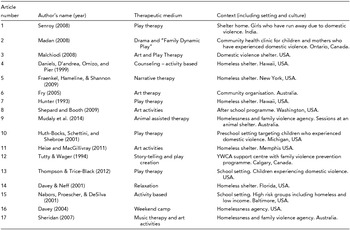
A total of 17 articles were selected for inclusion (as listed in table 1). The date of publication ranged from 1993 to 2014 and included papers published by authors from Australia (3), the United States of America (11), Canada (2) and India (1). The authors represented a variety of disciplines including art therapy, social work, music therapy, counselling and play therapy. The age of the articles included in the review, with almost half of them being more than 10-years old, represents the limited availability of contemporary papers describing programmes for children in this context. A summary of the authors, approaches and settings can be found in Table 1.
Articles and book chapters included in the synthesis.

The critical review was a way to challenge our perceived biases about children's representation in homelessness and family violence programmes. Reflexivity was integral in these early stages to ensure that we were interrogating the data carefully and being mindful of how our own perspectives were influencing the analysis process (Finlay, Reference Finlay2014). As a way of tracking our own influences and documenting the development of our ideas, extensive note taking was embedded throughout the analysis process (Charmaz, Reference Charmaz2014). Regular research supervision exploring how our emotional responses were contributing to the analysis process was essential, and this ongoing cycle of reflexivity allowed us to continually check whether our assumptions were present in the actual data (McFerran et al., Reference McFerran, Hense, Medcalf, Murphy and Fairchild2016).
Systematically Gathering the Data
Initially, we extracted information under the following subheadings: author details and publication year, dominant play strategy, description of the group, type of crisis experienced, setting, culture, gender, age of participants, goals, theoretical orientation, role of the child throughout the programme, assumed degree of expertise by the writer, evaluation strategies and perceived outcomes of the programme. However, in the early stages of analysis, we found ourselves experiencing a sense of discomfort and anger each time we read about the ways children were being described at the beginning of the articles. There seemed to be a heavy emphasis on describing family deficits and bleak statistics for children's futures, and this seemed incongruent with our experiences of working musically with children in this context. Therefore, our emotional responses were a result of feeling uncomfortable that children were being described in such negative ways as well as the profound lack of discussion about children's strengths and capacities. As we have described previously (McFerran et al., Reference McFerran, Hense, Medcalf, Murphy and Fairchild2016), tuning into and responding to these emotional responses was an essential part of the analytic process. Reflexivity, supervision and time away from the data were crucial as a way of understanding why our emotional responses were so intense. This process shifted the focus of the critical review, which became: To explore the types of programmes that are described for children who are experiencing homelessness and family violence with their families, with a focus on critically analysing the ways that children's needs and capacities are represented. New categories were inductively generated throughout the entire process, including language to describe children in the homelessness and family violence system, language to describe children and what children need, programme goals and the therapeutic qualities of programme facilitators.
Interrogating the Literature
Data analysis occurred simultaneously alongside the iterative and recursive processes of mining and categorising the data (Smith, Reference Smith2011). We continually interrogated and made comparisons across the data, regularly returning to earlier articles to obtain additional information by viewing the data through a different lens.
Our emotional responses continued to be integral to the creation of new questions and challenging our own assumptions, with the constant refinement and generation of questions being an integral part of the process (Zaza et al., Reference Zaza, Wright-De Aguero, Briss, Truman, Hopkins, Hennessy, Sosin and Pappaioanou2000). For example, our decision to take some time away from the analysis in response to feelings of anger and sadness about the negative ways children were being described provided time to move beyond simple reactivity and generalised assumptions. The use of reflexivity and supervision helped us to clarify that the issue was our emotional response to the underlying assumption that all children in the homelessness and family violence system will be irretrievably damaged in these difficult circumstances, which was incongruent with our own experiences of working creatively with children in this context.
Interpreting the Analysis into a Synthesised Form
Interpreting the analysis involved collating the findings into synthesised forms such as tables and figures (Dixon-Woods et al., Reference Dixon-Woods, Cavers, Agarwal, Annandale, Arthur, Harvey, Hsu and Sutton2006; McFerran et al., Reference McFerran, Hense, Medcalf, Murphy and Fairchild2016). After careful consideration of the ways children were being described and represented, we decided to focus specifically on the language that was being used throughout the articles. This process involved collating key phrases and words from the literature, and considering the positions authors were adopting when choosing to use these phrases. We noticed that children's needs were being described from systemic, individual and relational positions, and subsequently used these categories to collate the data relating to these ideas. The next section will present the synthesised results and discussion of the findings.
Results
Descriptions of Children's Experiences in the Homelessness and Family Violence System
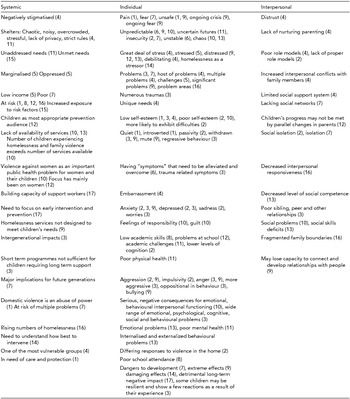
The type of language used to describe children in the homelessness and family violence system appeared to be important from the beginning of the analysis. All of the articles provided descriptions of children in the homelessness and family violence system, usually in the early stages of the articles, to portray their needs and to represent the significance of the programmes to be described. These descriptions included statistics about the number of children and families in the system as well as generalised statements about how these children might be impacted upon by their experiences. We collated the words and phrases used to describe children's experiences’ (Table 2), and attempted to categorise them as systemic, individual or interpersonal in order to consider children's experiences from an ecological perspective.
Words to describe children's experiences in the homelessness and family violence system.

Note: Bracketed numbers correspond with article number in Table 1.
Systemic
The systemic category refers to the overarching social structures and systems that contribute to children's experiences of homelessness and family violence. We chose to place these descriptions under the systemic category because we believe the increasing exposure to risk factors for these children are a primary result of systemic issues, such as inequality and power imbalances.
Children were often described as having ‘unaddressed’ and ‘unmet’ needs within the homelessness and family violence system, which was seen to be a result of a ‘lack of availability of services’ specifically for children. Gaps in the service system were noted, with one of the Australian authors discussing how homelessness services are not designed to meet the needs of children, working mostly in a case management capacity with families rather than offering direct therapeutic and child-centred support for individual children.
As Table 2 illustrates, children were labelled as ‘marginalised’, ‘oppressed’ and ‘negatively stigmatised’ within the homelessness and family violence context. Six of the articles described children as ‘at risk’ due to their exposure to adversity, which we interpreted as a risk that was placed on them due to a lack of systemic response to children's experiences. As a result of the lack of services and support for these children, they were considered to be ‘one of the most vulnerable groups’ and to be ‘in need of care and protection’.
Individual
The individual category refers to the personal experiences and characteristics associated with the ways children might present in the system. The children's individual experience of homelessness and family violence were characterised by feelings of ‘pain’, ‘fear’, ‘ongoing crisis’ and ‘insecurity’. Impacts of these experiences on children were sometimes described using strong language such as having ‘extreme’ and ‘damaging’ effects on children's functioning, with one article labelling these as ‘dangers’ to development. Seven of the authors used language such as ‘problems’ and ‘challenges’ to describe children's presentation in the system.
Children were described as having ‘unique needs’ or ‘symptoms’ that need to be ‘alleviated or overcome’. Impacts on mental health included feelings of ‘anxiety’, ‘depression’, ‘sadness’, ‘worries’ and ‘guilt’. Academic challenges included ‘poor school attendance’, ‘low academic skills’, ‘problems at school’ and ‘lower levels of cognition’. Some children were described as presenting as ‘withdrawn’, ‘introverted’ or ‘mute’. Negative behaviour such as ‘aggression’, ‘oppositional behaviour’ and ‘impulsivity’ was seen as a consequence of adverse experiences.
Despite all the articles describing children's negative responses to their experiences of homelessness and family violence, only one article acknowledged how ‘some children may be resilient’ in the face of adversity. Although several of the authors adopted strengths-based approaches in their programmes, the ways the children were represented in the early stages of the articles were often not congruent with the aims and outcomes described at later stages.
Interpersonal
The interpersonal category centres on relationships between children and their families, as well as their wider support networks. Interpersonal relationships were seen as key contributors to children's negative presentation and challenges. Children were described as having a lack of exposure to ‘nurturing parenting’ and ‘proper role models’, resulting in feelings of ‘distrust’ and ‘increased interpersonal conflict’. Socially, children were thought to have ‘social problems’ and ‘deficits’ in their interactions with peers, and one author considered that children ‘may lose the capacity to connect and develop relationships’ following their experiences of transience and violence. As a result, children were said to have ‘limited social supports’ and a ‘decreased level of social competence’.
Descriptions of what Children in the Homelessness and Family Violence System Need
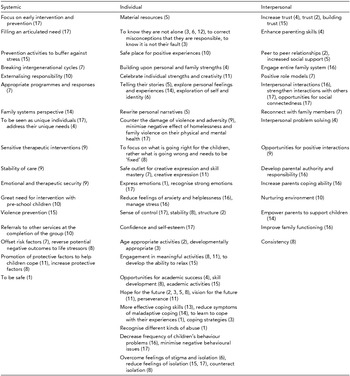
Alongside our collation of the language used to describe the children themselves, we also documented how authors described their perceptions of what children need in the context of homelessness and family violence. Again using the systemic, individual and interpersonal categories, we extracted key phrases and words used in the articles to describe children's needs (Table 3). At times we grappled with which category most suited the need being described, as some of the needs could have fitted across all of the categories. The decision was ultimately based on who was responsible for responding to these children's needs.
Words to describe what children in the homelessness and family violence system need.

Note: Bracketed numbers correspond with article numbers in Table 1 .
Systemic
A number of systemic needs were identified when looking for language describing what children in the homelessness and family violence system need. Primary needs such as ‘to be safe’, ‘violence prevention’ and ‘early intervention’ were seen as the responsibility of the system in order to protect and support children. Opportunities for children to be ‘seen as unique individuals’ and to have their ‘unique needs’ addressed were identified as integral for intervention programmes. ‘Emotional and therapeutic stability’ was interpreted as something that should be provided by the system in order to ‘reverse potential negative outcomes to life stressors’, ‘offset risk factors’ and ‘promote protective factors’.
Individual
From an individual perspective, children were described as needing a safe and supportive space to ‘express emotions’, ‘explore personal feelings’ and ‘rewrite personal narratives’. Strengths-based approaches acknowledged the need to ‘focus on what is going right for children, rather than what needs to be fixed’ and to ‘celebrate personal strengths and creativity’. On the other hand, children were thought to need to ‘decrease the frequency of behaviour problems’ and ‘minimise negative behavioural issues’.
Children were described as needing to ‘learn to cope’ and ‘reduce symptoms of maladaptive coping’ in response to their traumatic experiences. Similarly, programmes also needed to minimise ‘negative effects’ and ‘counter the damage’ of violence and adversity. Children were thought to need ‘hope’ and ‘vision’ for the future, and to learn skills of perseverance through times of adversity. Reducing feelings of self-blame was also seen as important, with authors recognising that children needed to ‘know they are not alone’ and to ‘know it is not their fault’.
Interpersonal
Children were described as needing ‘opportunities for positive interaction’ and ‘social connectedness’. Building ‘trust’ was described as important so that children were able to develop their interpersonal skills and ‘strengthen their interactions with others’. ‘Engaging the entire family system’ was viewed as a way of building upon family relationships and responding to children's interpersonal needs. By ‘empowering parents’ and ‘enhancing parenting skills’, they may be better equipped to provide ‘consistency’ and a ‘nurturing environment’ for children throughout transient times. Although some authors identified that children need ‘peer to peer relationships’ and ‘social support’, the interpersonal needs tended to focus mostly on family relationships rather than the need for children to feel connected to their peers, school and the wider community.
Descriptions of what Programmes Offer
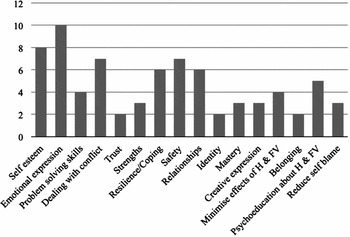
Programme descriptions and goals were collated (see Figure 1) and compared with the list of identified needs. All of the programmes adopted one or more of the following goals: (1) emotional expression through creative mediums such as art, play, storytelling, drama and music, (2) making plans for staying safe, (3) increasing self-esteem and positive identity, (4) developing conflict resolution and problem solving skills, (5) de-stigmatisation through psychosocial-education about homelessness and family violence and reducing children's feeling of self-blame, (6) fostering relationships between participants and family members and (7) building upon strengths and coping strategies.
Programme goals.

The goals of the programmes mostly aimed at addressing the individual and interpersonal needs identified in the early stages of the articles. Even though a number of systemic needs were emphasised in the early stages of the articles, it became clear that the goals of the programmes did not explicitly address these needs. Rather than responding to the numerous systemic issues contributing to children's exposure to adversity, the programmes were primarily designed to focus on changing children's behaviours, planning ways of staying safe and developing strategies for processing and overcoming their experiences.
Descriptions of the Facilitator's Role
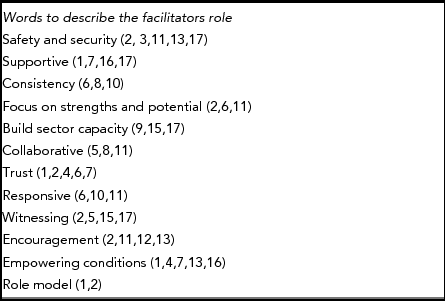
The ways that the authors described their own (or other facilitator's) therapeutic qualities shows their well-meaning intentions to offer valuable programmes for children in this context (Table 4). Many of the facilitators were informed by strengths-based approaches, through which they focused on building upon the existing strengths of children and fostering their potential. Yet, these approaches were not always congruent with the ways authors were representing the children in the write up of the children's needs and programme descriptions.
Qualities of the facilitators.

Note: Bracketed numbers correspond with article numbers in Table 1 .
Programme facilitators were thought to offer ‘safety’ and ‘security’ by providing a ‘supportive’ environment for children to feel comfortable and secure. Facilitators were described as providing ‘encouragement’ to children to talk about, express and process their emotions and being a ‘witness’ to these often-traumatic experiences. Empowering conditions and collaborative approaches were discussed in many of the articles. While these approaches were represented in many of the programme descriptions, the language used to describe children did not always reflect the same values.
Programmes and facilitators were described as being ‘responsive’ to children's changing needs. ‘Building sector capacity’ to engage with and respond to children was mentioned in three of the articles as an underlying motivator for running the programmes, however this was not always discussed in terms of programme goals and subsequent outcomes. In order to fully contribute to changing the trajectory for children in this system in the future, further consideration and implementation about the ways to build capacity of workers and families to respond appropriately to children is needed.
The programme goals and descriptions of the facilitators provide an insight into the ways the children were viewed within programmes; however, this was not always congruent with the ways they were described in the early stages of the articles. Although we assume that the authors had the best intentions in delivering high-quality services for these children, this was not always represented in the ways they wrote about them.
Discussion
Perhaps in order to demonstrate the importance and need for direct work with children experiencing homelessness and family violence, many authors emphasised the numerous challenges faced by these children. We are not denying the importance of acknowledging children's experiences and the possible impacts these have on their present and future functioning, and we acknowledge that there is a vast amount of research showing how early-life stress may contribute to a range of difficulties. However, we felt that the emphasis on these descriptions does not adequately represent the whole picture for these children. Most of the articles were critically missing descriptions of how many children show the capacity to adapt to stressful environments and experiences within themselves, and with the support of their wider systems.
Finding a Better Balance
The language used throughout the articles seemed to emphasise what is ‘wrong’ with children and portray the assumption that children were in need of being ‘fixed’, often unintentionally subscribing to what Valencia (Reference Valencia1997) described as the ‘deficit model’. In doing so, an incongruence emerged between the ways children were being represented and the ways the same authors described their strengths-based approaches to working with these children. Within our field of music therapy, we have been challenged to consider how the way we write can more accurately represent the work that we actually do (Procter, Reference Procter2001). We argue that what is needed in this discourse is a better balance in representing children's strengths and challenges in order to represent children in mutually empowering ways.
Resilience as a Theoretical Lens
The possible negative effects associated with the experience of homelessness and family violence are a reality for many children and should not be underestimated (Humphreys, Houghton, & Ellis, Reference Humphreys, Houghton and Ellis2008). However, some authors have described the ways that many children who experience homelessness and family violence show resilience despite their exposure to adversity (Cutuli et al., Reference Cutuli, Desjardins, Herbers, Long, Heistad, Chan and Masten2013; Masten, Cutuli, Herbers, & Reed, Reference Masten, Cutuli, Herbers, Reed, Snyder and Lopez2009; Obradović, Reference Obradović2010). Resilience researchers seek to understand why some children thrive and succeed despite life's challenges, whereas others struggle immensely. The strengths and resources that a child adopts, often called protective or promotive factors, contribute to their ability to avoid the negative implications that are often associated with exposure to risk (Masten et al., Reference Masten, Cutuli, Herbers, Reed, Snyder and Lopez2009). Though many of the articles in this critical review described strengths-based approaches, they did not always explore how these strengths may contribute to children's abilities to do well despite their experiences of transience and violence.
Many resilience theorists posit that both internal and external resources are needed to assist children to successfully deal with stress. Byrd (Reference Byrd2010) identified two integral factors that contribute to successful adaptation in the face of adversity: children's internal characteristics such as academic abilities and social skills, along with environmental factors such as positive parenting and a safe and structured home environment. Similarly, Cutuli and Herbers (Reference Cutuli and Herbers2014) identified positive parenting and child self-regulation as positive resources in children's lives that assist them to bounce back from adverse experiences. Having a close relationship with a competent adult, especially a caregiver, is viewed as crucial for children who have experienced homelessness and family violence (Luthar, Reference Luthar, Cicchetti and Cohen2006). Several interpersonal needs were identified in the analysis of articles, including engaging the entire family, building upon parenting skills and assisting families to provide consistency and security to children in their home environment. However, the programmes described in the critical review were not always designed to build upon the interpersonal needs identified.
Uniting Principles of Resilience and Social Justice
Resilience as a concept has been critiqued due to the responsibility it often places on individuals to overcome experiences of adversity, rather than adults taking responsibility for preventing those adversities from occurring in the first place. Friedli (Reference Friedli2012) asserts, “A focus on resilience cannot adequately explain inequalities in [health] and wellbeing and may serve to disguise or distract from analysis of social structures that result in and maintain inequalities in power, wealth and privilege” (p. 1). Similarly, Taylor, Mathers, Atfield and Parry (Reference Taylor, Mathers, Atfield and Parry2011) have said that building resilience is nothing more than “putting a sticking plaster over the wound caused by macro-structural inequalities in power and resources” (p. 6). In response to these critiques, Hart et al. (under review) have spearheaded a so-called fifth wave of resilience, which is an overarching approach that aims to unite principles of resilience with social justice. In addition to helping children to overcome experiences of adversity, the focus is equally on transforming aspects of that adversity.
The articles included in this critical review focused substantially on improving children's behaviour, providing opportunities to express themselves and assisting children to cope with their experiences. In contrast, there was little focus on addressing the numerous systemic needs identified in the early stages of the articles. Although direct work with children is essential in order to assist them to process their experiences and develop healthy coping strategies, we consider whether there is capacity for practitioners to take on an advocacy role in delivering these programmes. For example, practitioners might provide further opportunities for children's voices to be heard by their families and external systems through creative arts methods such as songwriting, poetry, creating artwork and performances. As adversities such as homelessness and family violence are linked to societal issues such as inequality and social disadvantage, we need to consider how resilience informed approaches might contribute towards social change and make a greater impact on the wider systems.
The Power of Language
Within the field of academia, authors represent the power and privilege within their own institutions, as well as within the way scholarly knowledge is obtained and represented (Muhammad et al., Reference Muhammad, Wallerstein, Sussman, Avila, Belone and Duran2015). Critical theory and feminist scholars have challenged the power traditionally held by authors in deciding the ways to represent participants and the subsequent findings (Ellingson, Reference Ellingson2011; Roof, Reference Roof and Hesse Biber2012). As the majority of authors included in the critical review were also practitioners, it is likely that they were trying to prove that the programmes they were describing were meaningful and worthwhile in an attempt to secure funding and approval for programmes to continue. Therefore, they may have felt compelled to emphasise the ‘problems’, ‘risks’ and ‘challenges’ faced by children in this context. Including discussions about strengths and resilience does not suggest that if children are coping or drawing upon their existing resources to manage challenges in their lives that they do not have a right to process their experiences of homelessness and family violence through the types of programmes described in the literature. However, we consider whether the strong and powerful language used to emphasise the need for the intervention was congruent with the strengths based approach that many authors adopted when describing the programmes and therapeutic qualities of the facilitators.
The language that we use to describe people can shape the way that others perceive them, and subsequently influence the development of predetermined assumptions and cognitive processes (Wolff & Holmes, Reference Wolff and Holmes2011). Using broad language and defining groups of people by their challenges have potential pitfalls for how they will be viewed by professionals and community members. Most of the articles included in the critical review privileged descriptions of hopelessness, rather than messages of hope and resilience, in the early stages of articles. Therefore, it is likely that the order information is presented in is likely to influence the ways that practitioners working in the field understand children's needs and capacities. As a result, we encourage practitioners and authors to be reflexive, purposeful and make conscious decisions about the ways they choose to represent children in this context.
Conclusions and Recommendations
Although our critical review was limited by the age and cultural influences of some of the papers, the findings represent some key considerations for future research and practice. Our emotional responses to the predominantly disempowering language used throughout many of the articles served as a vehicle for interrogating existing discourse and then generating new knowledge about the ways we view, understand and represent children's experiences. In the early stages of the analysis, we attempted to set these emotions aside and took time away from the data in order reflect on why these reactions were so strong. As we came to realise the extent to which children were defined by their challenges in order to emphasise the need for support, we could no longer ignore our feelings of sadness, anger and frustration. Bourdieu describes how in-depth and careful analysis can help to uncover knowledge that has previously been invisible (Navarro, Reference Navarro2006). In this way, what was once unseen has now become known and this has become the new lens through which knowledge is viewed and understood and is the motivator for striving to change the ways children are described and represented in the academic discourse. Within our own research, we are now conducting a project that focusses on changing perceptions of children in the homelessness and family violence system by engaging children in a collaborative song writing method that explores children's strengths and capacities in times of adversity.
The deficit focus subconsciously underpinning many of the articles in the critical interpretive synthesis provides a narrow depiction of children's experiences and presentation in homelessness and family violence programmes. Labelling children as ‘at risk’ places an emphasis on their assumed individual deficits, rather than challenging the systems surrounding the child that are supposed to be supporting them (te Riele, Reference te Riele2006). If we, as authors, spend the majority of our time focussing only on the problems faced by children, we run the risk of contributing further to the stigmatisation and labelling of these children as somehow broken. We consider there are many dangers inherent in identifying challenges without also acknowledging strengths and believe what is needed is a better balance in representing children within this context.
Regardless of how well intentioned we are in our collaborative and mutually empowering approaches with children when delivering programmes, we need to consider how we can more accurately reflect the significance of these contexts without compromising our values and strengths-based approaches in the process of writing about them. We recommend a shift away from broad and generalised descriptions of children's needs and challenges at the beginning of articles and chapters, and a step towards more contextualized and personalised representations so that we can provide more illustrative accounts of children's experiences within their individual contexts. We believe that in doing so, we would still be able to demonstrate the need for services in this area, while providing more accurate and fair representations of the children with whom we work and conduct research.