A central problem in democratic politics revolves around the capacity of voters and electorates to make meaningful judgments regarding elections, governments, and public policy. If democracies are to be guided by the will of the people, are the people capable of exercising a meaningful role? The answer to the question is central to the public’s confidence in democratic institutions. Lacking such confidence, citizens will be less willing to defer to the democratic process. And they will be less likely to participate in the “consent of the governed” because they have lost faith in the capacity of the governed to yield meaningful consent.
An underlying issue relates to where the democratic faith should reside. Should friends of the democratic process place their faith in the capacities of individual voters, or is their faith better placed in the performance of democratic electorates? The earliest modern studies of individual citizens did not provide comforting reassurance regarding the capacity of most voters to reach informed decisions, and this limited capacity became a central element of both the early Michigan studies as well as the early Columbia studies (Berelson, Lazarsfeld, and McPhee Reference Berelson, Lazarsfeld and McPhee1954; Converse Reference Converse and Apter1964). At the same time, a variety of efforts have made the argument that electorates typically outperform individual voters in forming meaningful responses to the public policy challenges of the day. That is, while the limited capacity of the individual voter continues to be an underlying principle of American voting research (Lodge and Taber Reference Lodge and Taber2013), public opinion in the aggregate has been documented as a comprehensible response to contemporary public-policy challenges (Erikson, MacKuen and Stimson Reference Erikson, MacKuen and Stimson2002; Page and Shapiro 1992).
The central question thus becomes: what accounts for these seemingly wondrous effects of aggregation? Is it simply a matter of clueless citizens distributing themselves randomly, while the attentive citizens create a meaningful signal that shines through the void? Or might groups and electorates be self-educating? In the words of Durkheim (1951 [1897]: p 320), is it the case that “the group formed by associated individuals has a reality of a different sort from each individual considered singly”? If so, then belonging to a group or an electorate might mean something more than the existence of individual-level characteristics held in common. Indeed, if groups are created through patterns of interdependence among associated individuals, then we must take a very different observational approach to understanding citizens versus groups and electorates.
This aggregation problem is addressed here, based on a series of research efforts that my colleagues and I have undertaken. These studies have been aimed, in one way or another, at understanding the political judgment and engagement of individual citizens within the social and political contexts and networks where they are located. Hence we will be addressing a persistent question that is central to democratic politics: what makes political groups and electorates different from the sum of their parts?
THE AGGREGATION PROBLEM
How should we think about the translation of voters into groups, and groups into electorates? A common response to this question is that, in order for groups to play a consequential role in democratic politics, individuals must identify their interests with the larger shared interests of particular groups. The problem is that this view leaves several questions unanswered. In particular, how do individuals come to identify their own interests with those of relevant groups? If individuals have difficulty sorting out appropriate responses to the political issues of the day, would we expect individuals to be able to determine the groups with which their interests align, as well as the policy choices that are implicit with these group loyalties? The argument offered here is that meaningful groups within the electorate are more than collections of discrete individuals with shared interests (Dogan and Rokkan Reference Dogan and Rokkan1974).
Our own perspective points to the importance of concrete ongoing patterns of social and political interaction among individuals (Granovetter Reference Granovetter1973; Granovetter Reference Granovetter1978; McPherson and Smith-Lovin Reference McPherson and Smith-Lovin1987; Burt Reference Burt1992). Thus “belonging” to a group is more than identification—it is instead a pattern of relationships that connects the individual to other members of the groups in question. And hence the electorate becomes an aggregation of intersecting and diverging groups that are, in turn, built on patterns of relationships among the individual citizens.
The problem is made more complex because individuals belong to more than one group. A fundamentalist Christian who works at a factory, pays labor union dues, and regularly goes hunting with friends has a complex pattern of relationships which may reinforce some group ties and compromise others. The important point is not that she locates her political opinions and loyalties based on a careful cost-benefit calculation, but rather that these activities bring her into a set of relationships that encourages some views and opinions while discouraging others. The electorate, in turn, is the aggregate consequence not simply of the individuals who nominally compose it, but also of their communication ties to politically relevant groups.
These aggregation problems create a significant challenge for political analysis. If the behavior of individual voters depends on their location within particular patterns of relationships, making sense of public opinion and voting behavior becomes a substantial undertaking. Indeed it requires a different set of observational technologies.
THE INDIVIDUALISTIC REVOLUTION IN PUBLIC OPINION RESEARCH
Before the observational revolution that made a focus on individuals possible, empirical analyses typically focused on aggregates. High quality surveys had not yet become available, and thus observation typically took place at the level of counties, precincts, or some other aggregation unit. This era began in earnest during the late nineteenth century and accelerated during the first half of the twentieth century. Durkheim (1951 (1897)) studied suicide rates based on aggregate statistics and made inferences regarding the types of individuals who were likely to commit suicide. Heberle (Reference Heberle1943a; Reference Heberle1943b) studied Nazi voting in Schleswig-Holstein based on aggregate data taken from constituent geographic units. Key (Reference Key1949) studied levels of racial hostility among southern whites based on aggregate data, typically at the county level. Tingsten (1963 [1937]) studied working class turnout and support for socialist parties in Stockholm precincts during the early 1930s.
The use (and abuse) of aggregate data for studying elections quickly fell into disfavor at the middle of the twentieth century for two reasons. First, the advent of modern polling techniques made individual level data increasingly attractive and ultimately widely available. George Gallup began producing high quality survey data in 1936. Lazarsfeld and his colleagues (Lazarsfeld, Berelson, and Gaudet 1948; Berelson, Lazarsfeld, and McPhee Reference Berelson, Lazarsfeld and McPhee1954) employed survey data to conduct community election studies in Elmira, New York and Erie County, Ohio. Most importantly, the first of what would become the American National Election Study series began at the University of Michigan in 1948. These were all highly fortuitous events and marked a great leap forward in a more complete understanding of voters and elections.
At about the same time, W.S. Robinson (Reference Robinson1950) published his influential paper warning of the dangers due to the ecological fallacies that arose when using aggregate correlations to study individual behavior. Quite simply, he demonstrated that a positive correlation between X (the proportion of population sharing some social characteristic) and Y (the proportion of a population demonstrating some behavior) did not necessarily demonstrate that the behavior was more likely to occur as a consequence of the social characteristic. Indeed, the likelihood of the behavior might even be inversely related to the social characteristic at the individual level. This was an important corrective that has led to important progress in the quality of empirical social and political research (Goodman Reference Goodman1953; Przeworski Reference Przeworski1974; Sprague Reference Sprague1976; Achen and Shiveley Reference Achen and Phillips Shively1995; Freedman Reference Freedman1999).
In this context, Leo Goodman (Reference Goodman1953) called attention to an important insight: ecological fallacies arise when the behavior of individual group members is not constant across j relevant contexts. For present purposes, let B be the proportion of voters in southern counties who voted for George Wallace in the 1968 presidential election and let S be the proportion of voters in the county who were white. When group behavior is constant:
 $${B_j}\, = \,{p_1}\left( {{S_j}} \right)\, + \,{p_2}\left( {1 - {S_j}} \right)\, = \,{p_2}\, + \left( {{p_1} - {p_2}} \right){S_j}$$
and hence one can recover the individual probabilities of the behavior across groups based on a simple regression of the behavior on the social densities. The problem is, of course, that lacking sufficient information to estimate the parameters of interest within the relevant contexts, one has no way of knowing whether the parameter is contextually contingent.
The lingering problem is, thus, that ecological fallacies are the flip side of individualistic fallacies. If our goal is to arrive at an explanation for individual behavior that depends on some individually held social or political characteristic, the existence of an ecological fallacy suggests that the relationship varies across contexts.
Goodman’s insight carries further significance, however. It suggests that ecological fallacies arise when individual level parameters vary across contexts due to sorting, self-selection, or contextual effects (Achen and Shively Reference Achen and Phillips Shively1995). The lingering problem is, thus, that ecological fallacies are the flip side of individualistic fallacies. If our goal is to arrive at an explanation for individual behavior that depends on some individually held social or political characteristic, the existence of an ecological fallacy suggests that the relationship varies across contexts. Hence, if we turn to individual level data for the solution to arrive at a single parameter, we are failing to recognize that the parameter is contingent and variable across space. This does not necessarily mean that the context is affecting the behavior. Contextual variation in the parameter might be due to some impersonal or institutional sorting process; it might be due to self-selection processes; or it might be due to a contextual dependency. The problem remains that, if we have a problem with an “ecological fallacy,” neither simple aggregate correlations nor simple individual level correlations will necessarily solve the problem.
Consider Key’s (Reference Key1949) argument that white political hostility toward blacks was motivated by higher black concentrations at the local level. Wright (Reference Wright1976) used individual level survey data with county data attached to show that white southerners were more likely to support George Wallace’s 1968 presidential candidacy if they lived in rural counties with higher black population concentrations. In this case, a simple aggregate correlation of vote and race in southern rural counties would have given rise to a naive ecological fallacy, and a simple individual level correlation of race and vote would have overestimated white support for Wallace in white rural counties and underestimated it in black rural counties.
Another powerful demonstration comes in Gelman’s (2009) Red State, Blue State, Rich State, Poor State. He employs survey and aggregate data to show that rich states are more likely to vote Democratic, but rich people are more likely to vote Republican, even in the rich states. Here again, neither individual level data nor aggregate data provide an adequate picture. An entirely aggregate analysis runs the risk of generating an ecological fallacy, and an entirely individual analysis runs the risk of generating an individualistic fallacy.
The problem certainly cannot be blamed on the rapid advances in data collection that were made possible by the efforts of Campbell, Converse, Miller, and Stokes (Reference Campbell, Converse, Miller and Stokes1960). Indeed, the Michigan election study authors made remarkable contributions related to imbedding individual behavior within particular spatial contexts. Warren Miller’s (Reference Miller1956) paper on one-party politics and the voter was a stunning contribution that encourages us to reconsider the potentially debilitating effects of democratic politics for political minorities. Philip Converse’s (Reference Converse1969) paper on time and partisan stability places the individual in a context defined by both time and place to offer a powerful explanation for democratic stability. Miller and Stokes (Reference Miller and Stokes1963) shed new light on representation by locating voters within constituencies. And the Butler and Stokes (Reference Butler and Stokes1969) effort showed that working class support for the British Labour Party was contingent on the density of working class populations within British constituencies. Indeed, these contributions point to the importance of locating individual behavior within social, political, and temporal contexts.
The solution to the political aggregation problem is ultimately anchored in observational practice. Not only are electorates composed of individuals who are located in time and space, but these individuals are also tied together in concrete patterns of social interactions that are temporally and spatially specific. Hence, the construction of social networks among voters both exposes them to some environments while shielding them from others. At the same time, people exercise choice in the construction of their communication networks, and the exercise of choice is as interesting and important as the contexts within which choice operates. The Salt Lake City Democrat who has never encountered a Republican in political conversation is likely to be as interesting as the Los Angeles Republican who has never encountered a Democrat!
A DOUBLY STOCHASTIC MODEL OF NETWORK FORMATION
The question thus arises, how selective do people need to be in order to construct networks which are independent of their surrounding contexts? The typical Utah Republican lives among a high density of Republicans and has many opportunities to communicate with Republicans, just as the typical California Democrat lives among a high density of Democrats and has many opportunities to communicate with Democrats. There are of, of course, Democratic enclaves in Utah just as there are Republican enclaves in California, and these more immediate environments change the odds of encountering fellow partisans. The important point is that individuals carry out their lives within various contexts, defined along multiple dimensions, thereby loading the odds of interaction within and across social and political boundaries.
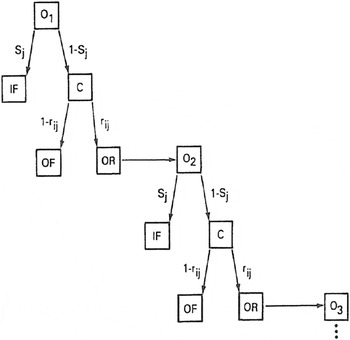
Figure 1 is a reformulation of a model set forth by James Coleman (1964, chapter 16) that addresses selectivity in associational patterns. People have serial (repeated) opportunities (Ot) to interact with others, and the probabilities of randomly encountering someone within or beyond their own social or political group is set by the respective densities of the own group (Sj) and of those outside their own group (1-Sj). Hence, we are assuming that these encounters are stochastic functions of the underlying population densities.
The Serial Logic of Long Odds: A Doubly Stochastic Process of Social Interaction
Ot = opportunity to form relationship at t
Sj = in-group social density in jth context, or the probability of in-group encounters
IF = an ingroup relationship is formed
C = choice to communicate
rij = outgroup rejection probability
OF = outgroup relationship is formed
OR = outgroup rejection with continuing search
P* = equilibrium probability of forming an ingroup relationship = Sj/(1-rij(1-Sj))
Source: Huckfeldt (Reference Huckfeldt1983).

At the point of a more-or-less random social encounter within a particular context, we assume that an individual will be readily willing to communicate with members of their own “in-group,” but that they reject communication with members of an “out-group” with probability r ij —a probability or a rate that varies across “i” individuals and “j” contexts. Hence, the process is doubly stochastic—encounters are stochastic functions of underlying population densities, and communication beyond their own group is a stochastic function that is idiosyncratic both to individual selection priorities as well as to local interaction opportunities.
Why would we not expect an individual to automatically reject association beyond their own group? This assumption is, of course, situationally specific. In a highly polarized setting, rejection might indeed be automatic, but individuals located within a diverse democratic society might still find attractive features to be present among individuals who hold divergent political preferences. For example, if you are a Democrat and an avid St. Louis Cardinals’ fan, you might be willing to associate with a Republican who is also a Cardinals’ fan. In short, the model assumes that, given the opportunity, individuals readily communicate with members of their own group, but reject association outside their own group with some non-zero probability. Hence the search for an associate continues either until one encounters someone from their own group, or until they agree to associate with someone outside their own group. The process converges on an equilibrium value (P*) representing the probability of associating with a member of one’s own group over repeated opportunities.
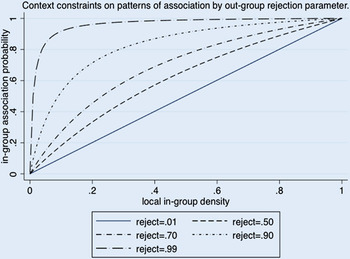
Figure 2 maps this equilibrium probability of in-group communication as a function of the out-group rejection parameter across the range of local in-group densities within relevant contexts. Each curve, in turn, represents a different out-group rejection probability. Hence, when the rejection probability is at its lowest level (.01), the in-group association probability is a nearly direct translation of the local in-group density. At the opposite extreme, when the rejection parameter is particularly high (.99), the in-group association probability rapidly converges on 1.
How Much Control Do Individuals Exercise Over Patterns of Association?

The interesting response patterns lie between these extremes. Introverted patterns of communication fall off rapidly as the rejection parameter declines in size. Even when the rejection parameter is set at .5, the resulting in-group association probabilities do not diverge dramatically from the local in-group density. The important point is that, even at substantial levels of associational introversion, the resulting patterns of association reflect the local population within which associational networks are constructed.
Laumann’s (Reference Laumann1973) study of Detroit men based on the 1966 Detroit Area Study employed a network name generator that asked respondents to identify three friends as well as those friends’ occupations. In a later analysis, Huckfeldt (Reference Huckfeldt1983) combined the survey with neighborhood occupational data defined at the level of the census tract. The analysis produced several results. First, both working class and middle class individuals are more likely to have working class friends if they live in working class neighborhoods. And working class respondents are more likely to have working class friends at all levels of working class neighborhood density.
Hence the ability of individuals to custom design the composition of their own communication networks is constrained by the supply of various social and political groups within their various social contexts—workplace, neighborhood, church, retirement village, and so on.
The question thus arises, how selective are these respondents in rejecting association with the opposite class? Both working class individuals and middle class individuals demonstrate substantial out-group rejection parameters, and the parameter increases in size as their own occupational class takes on minority status. These results suggest that individuals become more socially introverted as their own group takes on minority status. Just as important, and in spite of rejection parameters that vary from less than .1 to more than .8, the patterns of association are quite clearly structured by contextually imposed opportunities for association. Hence the ability of individuals to custom design the composition of their own communication networks is constrained by the supply of various social and political groups within their various social contexts—workplace, neighborhood, church, retirement village, and so on. Parallel results arise in the 1984 South Bend Study, where groups are defined in terms of candidate support in the 1984 presidential election (Huckfeldt and Sprague Reference Huckfeldt and Sprague1995).
These results are central to our understanding of aggregation effects. We do not argue that people fail to exercise associational choice (Bishop Reference Bishop and Cushing2008). Our argument is rather that choice is constrained by opportunity, and opportunity is a function of surrounding social contexts defined at various levels.
AGGREGATION EFFECTS AT THE LEVEL OF THE NATION STATE
One might reasonably question whether there are issues of scale that play an important role in aggregation effects. That is, while neighborhood composition produces these sorts of effects in Detroit in the mid-1960s and South Bend in the mid-1980s, are similar compositional effects present at higher levels of aggregation—perhaps at the level of the nation-state? If not, one might reasonably question whether they are politically consequential.
A cross-national election project undertaken in the late 1980s and early 1990s involved three national studies: the German national election of 1990, occurring shortly after German re-unification; the American national election of 1992; and the 1993 Japanese national election. The German election was based on two independently drawn samples—one from the former West Germany and one from the former East. Each study employed a network battery to obtain the first names of the main respondents’ associates, and each respondent was asked a battery of questions about the people they had named, including the associate’s party choice in the 1990 election.
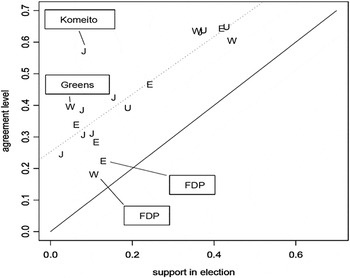
Figure 3 shows the level of agreement regarding voting choices experienced by party supporters within their discussion networks on the y-axis and the level of support for their party (or candidate) within the national electorate on the x-axis (Huckfeldt, Ikeda, and Pappi Reference Huckfeldt, Ikeda and Pappi2005). Each plotting symbol represents a particular party in a particular country: W is West German; E is East Germany, J is Japan, U is the United States, and several parties are specifically identified. The solid diagonal line represents a random mixing assumption—any party falling on the line would have a level of national support equal to the level of agreement within party supporters’ discussion networks. First note that all the parties have plotting symbols that lie above the line, and hence a simple random mixing assumption, would fail to capture the aggregation process. Clearly some combination of sorting, self-sorting, and influence create discussion networks that sharply and consistently diverge from random mixing.
The Problem of Scale: Levels of Shared Preferences Within Party Supporters’ Communication Networks in Germany, Japan, and The United States in the Early 1990s
Source: Huckfeldt, Ikeda, and Pappi (Reference Huckfeldt, Ikeda and Pappi2005).

The dotted line that lies above and roughly parallels the solid diagonal line is the ordinary least squares regression line. In general, higher levels of support are associated with higher levels of agreement within supporters’ discussion networks. The cluster of plotting points at the upper right hand corner of the plot are the major party coalitions: the West German Social Democrats and Christian Democrats; the US Republicans and Democrats; the Japanese LDP, and the East German Christian Democrats. (The Social Democrats did poorly among the East German voters in 1990.) In short, the major parties realize the persistent reinforcing advantage of supporters who are least likely to encounter political disagreement regarding vote choice within their discussion networks.
The Komeito Party of Japan is the most extreme outlier among all the party coalitions within all three national elections, represented in the upper left hand corner of the plot. The party received less than 10% of the popular vote in the election, but the interviewed party supporters reported that nearly 60% of their discussion partners were fellow Komeito supporters. This interesting case can be at least partially explained by the origins of the party, which were based within a Buddhist organization.
Several other cases are particularly interesting. The American Perot supporters are represented by the U plotting symbol at an agreement level of approximately .4 and a support level of approximately .2, illustrating the disadvantage experienced by minor party candidates in American politics. FDP support in both east and west Germany comes closest to the random mixing line, while the west German Greens demonstrate an agreement level substantially higher even though the support level is somewhat lower than the FDP in both the east and the west.
Taken together, these results sustain the importance of an aggregation process, anchored within discussion networks and creating patterns of interdependence among party supporters. While there are interesting party and system level variations, the resulting social dynamic works to the advantage of larger political parties. Supporters of minority parties are not only minorities within the electorate; they typically constitute a minority within their own discussion networks!
SURVIVAL OF HETEROGENEITY WITHIN COMMUNICATION NETWORKS
A common assumption in the popular press is that voters are sequestered within homogeneous networks of agreement. That is, it is frequently asserted that citizens only rarely associate with others who do not share their political preferences (Bishop Reference Bishop and Cushing2008). Figure 1 calls this assumption into question, and additional supporting evidence is available from ANES survey regarding the composition of political discussion networks in the 2000 election—one of the most competitive and polarized elections in recent American history.
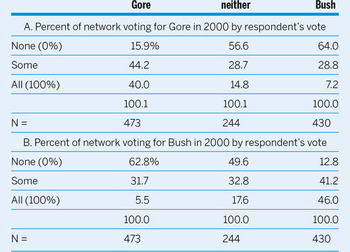
The 2000 ANES survey included a network battery of questions that asked respondents to identify up to four political discussants and the presidential candidate each of the discussants supported, as well as a number of other questions. As table 1 shows, 46% of Bush supporters identify all their discussants as fellow Bush supporters, and 40% of Gore supporters identify all their discussants as fellow Gore supporters. In short, less than a majority report unanimous support for their own preference, and more than one third of Bush and Gore supporters identify at least one person in their discussion network supporting the opposite party candidate.
Heterogeneity within Networks during a Polarized American Presidential Election Campaign

Source: 2000 American National Election Study; Huckfeldt, Johnson, and Sprague Reference Huckfeldt, Johnson and Sprague2004.
Moreover, these results parallel those found in various other studies: the 1984 South Bend Study (Huckfeldt and Sprague Reference Huckfeldt and Sprague1995); the 1996 Indianapolis-St. Louis Study (Huckfeldt, Johnson and Sprague Reference Huckfeldt, Johnson and Sprague2004); and the previously discussed Cross National Election Studies. In this context, an important question arises: what are the factors that sustain diverse preferences within discussion networks?
One explanation is that political communication networks are quite different from people’s more generalized networks of discussion and social interaction, with politics being segregated from everyday social encounters. To the contrary, the Indianapolis-St. Louis study showed only modest differences between the two. A random half of the respondents were asked with whom they talked about “important matters”—a name generator frequently used in the General Social Survey. The other half was asked with whom they talked about “government, elections, and politics.” Most differences were minor. The effect on whether the discussant shared the respondent’s vote preference were small and not statistically discernible. The biggest difference was related to political discussion frequency, but even here the differences were fairly minor. In short, political discussion is not a highly specialized or socially sequestered activity. To the contrary, it permeates the everyday activities of citizens in democratic societies (Huckfeldt and Mendez Reference Huckfeldt and Mendez2008).
At the same time, the Indianapolis-St. Louis study demonstrates that the configuration of networks is especially important to the survival of political disagreement and diversity. At one extreme, it is rare to see individuals who fail to hold the majority voting preference within their self-identified (closely held) networks. Hence we expanded the size of the potential network by including a network battery in the interview with the main respondent’s discussants. In this way we can assess the presence or absence of agreement within a dyad relative to the each of the two dyad members’ remaining networks of communication (Huckfeldt, Johnson, and Sprague Reference Huckfeldt, Johnson and Sprague2004).
These measurement procedures produce several important results. As part A of figure 4 illustrates, the socially heroic hold-out is a rare event. Individuals are less likely to hold political preferences that are rare within their communication networks because these preferences are infrequently reinforced. As part B of the figure suggests, disagreement is more likely to survive within a communication dyad when each member of the dyad receives support for their preference from individuals in the remainder of their network. In short, agreement within a dyad is contingent on the distribution of preferences within the remainder of the individuals’ networks. Hence the process of communication and influence is autoregressive—opinions and messages are more likely to be influential if they are reinforced (Huckfeldt, Johnson, and Sprague Reference Huckfeldt, Johnson and Sprague2004, chapter 2).
If Sorting, Self-Selection, and Social Influence are so Important, How Does Heterogeneity Survive within Networks?
A. Conformity and the socially heroic holdout: an unlikely event.
B. Influence is not automatic: Autoregressive influence and socially sustained disagreement.
Source: Huckfeldt, Johnson, and Sprague (Reference Huckfeldt, Johnson and Sprague2004).

While figure 4 summarizes evidence taken from the Indianapolis-St. Louis study, it also leads to a dynamic specification regarding the survival of diverse political preferences within social networks. In particular, the implicit autoregressive component of figure 4 has been incorporated into an agent-based model of communication and influence (Johnson and Huckfeldt Reference Johnson, Huckfeldt and Zuckerman2005; Huckfeldt, Johnson, and Sprague Reference Huckfeldt, Johnson and Sprague2004). If agents in the computer-based model evaluate every new message within the context of their previous stream of incoming messages, diverse preferences survive. Absent the autoregressive component, diversity is replaced by unanimity (Axelrod Reference Axelrod1997).
Solomon Asch would not be surprised. Indeed, we have too frequently taken the wrong lesson from the Asch conformity studies (Asch Reference Asch1955). The conclusion has typically been that, if the bogus reports of others can persuade people to deny their own sensory perception regarding the relative length of lines on a piece of paper, then they can be persuaded of anything. In fact, if just one of the bogus subjects accurately assessed the lines, the true subjects consistently provided the correct answer (also see: Ross, Bierbauer, and Hoffman Reference Ross, Bierbauer and Hoffman1976). In terms of political communication through social networks, the autoregressive nature of influence means that the political guidance of each messenger is evaluated within the context of past messages and messengers. While individuals are certainly subject to being misled through social communication, each communication partner’s message is filtered through other messengers and their messages.
THE VALUE ADDED PROBLEM IN POLITICAL COMMUNICATION
The related value added problem is simply stated: do people recognize political expertise among others? In addressing the informational limitations of individual voters, Downs (Reference Downs1957) suggested that it was entirely sensible for individual voters to obtain information from other individuals, so long as they took the information from individuals who were (1) well informed and (2) shared their own interests.
The related value added problem is simply stated: do people recognize political expertise among others?
Several problems arise. First, a quite reasonable assumption is that people’s perceptions of expertise are filtered through their own political preferences. That is, if Joe supports the Democrat and his coworker Tom supports the Republican, one might expect that Joe would form a negative judgment regarding Tom’s political judgment and expertise, thereby providing Joe with a justification for rejecting Tom’s views. Second, potential informants do not come tailor made! Some are politically expert with divergent preferences, while others are politically naive with shared preferences. How do individuals respond in these circumstances?
In order to address this issue, interviewers asked main respondents to the Indianapolis-St. Louis Study to assess each of their discussants’ levels of political expertise (Huckfeldt, Johnson, and Sprague Reference Huckfeldt, Johnson and Sprague2004). When the discussants were interviewed in the snowball survey, the interviewers administered a short three-item knowledge battery (Delli Carpini and Keeter Reference Delli Carpini and Keeter1993) to obtain an objective estimate regarding the discussants’ levels of knowledge, as well as asking the discussants how interested they were in the 1996 election campaigns. These procedures provided an opportunity to consider the factors that determine the main respondent’s assessment of the discussant’s political competence, as well as its implications for political communication (Huckfeldt Reference Huckfeldt2001; Ryan Reference Ryan2011), and the results are quite important for our understanding of opinion leadership.
Individuals accurately recognize higher levels of political expertise and report higher frequencies of political discussion with those whom they judge to be expert, regardless of divergent preferences. They also report more frequent political discussion with discussants who express higher levels of interest in the political campaign. In short, these results point toward the greater potential influence of the experts and activists whom citizens encounter in everyday life.
At the same time, numerous efforts—based on both social network surveys and small group experiments—demonstrate that citizens do not automatically genuflect in the face of other citizen experts. People surrounded by supporters of a particular cause are seldom persuaded by one person with a contrary opinion. Moreover, people with stronger attitudes—defined either in terms of extremity or accessibility (Huckfeldt et al. Reference Huckfeldt, Levine, Morgan and Sprague1999; Huckfeldt, Sprague, and Levine Reference Huckfeldt, Sprague and Levine2000)—are less likely to be persuaded as well.
This suggests two different, but not incompatible, models of opinion leadership. One is based on the recipient of a message and focuses both on the individual’s own knowledge and opinion strength, as well as the individual’s location within a larger network supporting the preference. The other model is based on the messenger and the importance of activists—those messengers who are interested, well informed, and do not censor their conversations to avoid disagreement. Addressing these issues pushes us beyond opinion surveys and snowball surveys to alternative observational platforms.
SMALL GROUP EXPERIMENTS
The network surveys provide enormous external validity advantages. Individuals respond to questions about actual political candidates, parties, and issues in a real election. And interviewers follow up on these surveys to interview the individuals’ actual associates, asking many of the same questions regarding the same parties, issues, and political candidates.
The problem is that these studies inevitably bump up against internal validity limits. In particular, we are unable to observe the communication and influence process directly, in real time, as the communication and decision-making proceed. In order to overcome these internal validity problems, we have adopted an observational strategy that incorporates an experimental design. The problem is that most of the progress in experimental studies within political science has involved single subjects responding to political stimuli. Our goal, in contrast, has been to employ incentivized small group experiments inspired by the work of McKelvey and Ordeshook (Reference McKelvey, Ordeshook, Hinich and Enelow1990) and Fehr and Gächter (Reference Fehr and Gächter2002), among others.
In these experiments, highly stylized electoral environments are created in which 7 to 14 undergraduate receive a small monetary incentive to elect one of two imaginary political candidates. These candidates have unknown positions on a seven-point scale, and each participant also has a position on the scale. The participant payoff depends on the electing the candidate with a position that is closer to their own position (Ahn, Huckfeldt, Ryan Reference Ahn, Huckfeldt and Ryan2014). The participants obtain information regarding the candidate positions from a modest amount of unbiased public information that is available to all for free. They also purchase information that is noisy and unbiased with a cost that is variable across participants, and hence some participants are better informed than others.
The amounts of information purchased by participants, as well as their positions on the seven-point scale, are made known to all other participants. Within this context, a limited number of information requests can be made to other participants regarding their judgments regarding candidate positions. This socially communicated information is typically free, but participants are aware that strategic participants may not communicate truthfully. Hence the problem with socially communicated information is that its quality depends on both the level of private information obtained by the potential informant, as well as any bias that is passed along with the information.
First, participants are more likely to obtain information from “experts”—other participants who have purchased more information. Moreover, this reliance on the expertise of others occurs independently of whether the particular expert holds a preference that is similar to their own.
Second, and as a consequence, the subjects regularly request information from individuals with preferences that diverge from their own, even though they are aware that informants are free to bias the information they send to other subjects.
Third, subjects form priors based on their own individually acquired information, but the influence of their prior judgments decays across updates that are made in response to socially communicated information (Huckfeldt, Pietryka, and Reilly Reference Huckfeldt, Pietryka and Reilly2014).
Finally, the rate of decay is contingent on the private acquisition of information. Those who have invested in more information become the experts whose beliefs have more staying power—they decay more slowly in time. In short, the experts demonstrate the courage of their convictions!
In summary, the primary results of these experiments mirror those of the network surveys. The main advantages of these experiments are twofold. First, they provide a higher level of internal validity. Second, and in particular, they provide dynamic insight regarding the processes underlying the social communication of political expertise.
INTO THE FUTURE: MAPPING ENTIRE NETWORKS
The networks we have addressed might be referred to as network fragments. Either they are egocentric networks with a structure based primarily on a single respondent and her discussants, or they are complete (but very small) networks based on small group experiments. While the approaches we have considered thus far help explain the implications of interdependence for the aggregation process, they fail to take full advantage of network methods. More importantly, they do not provide an opportunity to capture some of the larger scale consequences of the aggregation process that turns individual voters into electorates.
The primary problem has been data availability. With several notable exceptions (Lazer et al. Reference Lazer, Rubineau, Chetkovich, Katz and Neblo2010; Song and Eveland Reference Song and Eveland2015) students of interdependence have typically been unable to map the political communication networks of larger populations to study the large scale transformation of individuals into electorates. In this context, Prof. Ronald Rapoport of the College of William and Mary undertook a novel study of a local municipal election within the context of the self-contained population of the William and Mary undergraduate student body.
The city council of Williamsburg passed an ordinance that limited the number of unrelated individuals who could live in a dwelling, as well as adopting a more restrictive noise ordinance. The adoption of these measures led to the mobilization of a significant portion of the William and Mary student body. Rapoport quite presciently seized the moment and conducted an online survey targeting all the students, with a name generator that asked for the names of the respondent’s five closest friends within the student body. Since the friends had also been asked to respond to the initial survey, no separate snowball survey was required. As with any survey, the effort has to contend with missing data problems, but the William and Mary study adds significantly to our understanding, not only substantively, but also with respect to the future steps necessary for continued progress (Pietryka et al. Reference Pietryka, Reilly, Maliniak, Miller, Huckfeldt and Rapoport2016).
Not only does such a study make it possible to examine an entire social network, but it is also possible to extract and compare more extensive egocentric networks at higher degrees of separation from the main respondent. For example, an initial report compared an individual in a high density egocentric network, where most friends of the primary respondent were also friends of each other, to an individual in a low density egocentric network, where friends were largely unassociated. The high density egocentric network with redundant social relationships (more edges per node) carries the potential to create a powerful process of autoregressive influence by reinforcing common messages. In contrast, the low density egocentric network lacking redundant relationships (fewer edges per node) carries the potential to propagate the spread of information more widely and efficiently.
In short, a primary challenge in the study of political communication and electoral aggregation is to develop measurement procedures for studying larger network structures, thereby making it possible to consider important political communication processes that have not yet been addressed. We are currently at a point where a well developed set of network tools have been developed to study network based communication processes. The problem is not the limitation of analytic tools, but rather the availability of the appropriate evidence and observational platforms. Hence the next steps forward depend on creating new observational strategies for addressing large networks in the context of voters being transformed into groups and electorates.
SUMMARY AND CONCLUSION
Not all citizens are equal in the collective deliberations of democratic politics. The most influential individuals are those motivated to become well informed and hence to influence others. While interest and knowledge matters in the process, the locations of individuals within the communication process matters as well. The interested and well-informed isolate is not in a position to play an outsized role in the process of political communication. Indeed, the influence of everyday experts and activists is proportional to the range, extent, and structure of their social relationships. The reach of influential informants carries the potential to extend well beyond their own immediate acquaintances to second and higher order relationships.
None of this is intended to present the warm glow of an aggregation process that necessarily leads to an enlightened electorate. Electorates are self-educating, but the quality of education varies dramatically across groups and individuals. Political information can lead as well as mislead, and the end result of social communication in politics ultimately reflects the quality, sophistication, and bias of the information being communicated. Citizen activists take their information from sources as disparate as the PBS News Hour, MSNBC, FOX News, the New York Times, the New York Post, the Drudge Report, the Daily Beast and more. The consequence of the experts and activists in the corridors of everyday life is that they diffuse this political information far and wide, thus extending the reach of the political communication process. The information content of the social communication process ultimately reflects the range of competing information sources providing input, but the content often evolves. Perhaps more important, the path of the information is extended as well as channeled through a social communication process that is contingent on complex networks of social communication (Watts Reference Watts1999).
ACKNOWLEDGMENTS
Voters are not the only ones who depend on aggregation processes. I have benefitted from my own aggregation of outstanding collaborators in the efforts represented in this paper. Many of their contributions become obvious in the citations, but I want to call out my long-term fellow traveller, John Sprague. He has been a continuing source of inspiration, as a thesis advisor, a collaborator, and as a friend.