Introduction
In developing countries, the sexual behaviours of young people are largely influenced by religion, parental attitudes and lifestyles (Kabiru & Orpinas, 2009), and contraceptive use is often inadequate (Hiltabiddle, Reference Hiltabiddle1996), increasing risk of unwanted pregnancies and sexually transmitted diseases (Carvalho et al., Reference Carvalho, Sant’Anna, Coates and Omar2008; Rahamefy et al., Reference Rahamefy, Rivard, Ravaoarinoro, Ranaivoharisoa, Rasamindrakotroka and Morisset2008; Vivancos et al., Reference Vivancos, Abubakar and Hunter2008). The latter are a worldwide public health problem, with AIDS and hepatitis B being serious diseases with a high burden (World Health Organization, 2013). In Lebanon, sexually transmitted diseases are commonly reported, particularly among patients visiting community pharmacies, but the issue has not been studied. Moreover, a low level of HIV prevalence has been documented in the whole region, but this has probably been underestimated due to under-reporting for social, religious and political reasons (Rosenthal et al., Reference Rosenthal, Elinav, Ramlawi, Shasha, Olshtain-Pops and Korem2011; Alkaiyat et al., Reference Alkaiyat, Schaetti, Liswi and Weiss2014).
Young people do not always have the information they need to take responsibility for their sexual health, delay sexual activity or practise safe sex (Lally et al., Reference Lally, Nathan-V., Dunne, McGrath, Cullen, Meagher, Coffey and Dunne2014). They perceive risk differently from older adults (Quadrel et al., Reference Quadrel, Fischhoff and Davis1993), and are generally more influenced by their peers and the media (Primack et al., Reference Primack, Switzer and Dalton2007; Salamé et al., Reference Salamé, Barbour and Salameh2013). They adopt certain risky behaviours, in particular risky sexual activity, in parallel with modern urban lifestyles, and more frequently at a young age (UNAIDS, 2011; Ismael & Sabir Zangana, Reference Ismael and Sabir Zangana2012).
Little is known about sexual behaviours among youth in Lebanon. In a previous study conducted among Lebanese university students in 2007, the majority of males (73.3%) and a few females (21.8%) declared previous sexual relations, and the majority of males had used condoms (86.1%), but females had generally not used any contraceptives (75.6%) (Barbour & Salameh, Reference Barbour and Salameh2009). However, attitude towards sexuality and correlates of sexual behaviours were not evaluated in this study. This information would be useful to target interventions at specific subgroups leading to safer sexual behaviours, as demonstrated in other countries (Amazaki & Shimizu, Reference Amazaki and Shimizu2008; Brakel, Reference Brakel2008). The ultimate goal is to decrease sexually transmitted diseases and improve reproductive health in Lebanon. In this study, the objective was to evaluate attitudes towards and practice of sexuality among university students in Lebanon and assess their respective correlates to allow for tailored interventions among Lebanese youth.
Methods
General study design
A cross-sectional study was carried out using a proportionate cluster sample of Lebanese students in public and private universities. From each university, a sample proportionate to its size was selected. Each group of students, chosen from one university, defined the cluster. A list of universities in Lebanon, provided by the Centre for Pedagogic Research, was used to adjust the sample size (Center for Educational Research & Development, 2009). A sample size of at least 3000 individuals was the target to allow for adequate power for bivariate and multivariate analysis to be carried out, taking into account the proportionate cluster sampling method (factor design=2), even if there is no previous information about the variable distribution in the population (assumed to be 50% per subgroup) (Center for Disease Control, 2012). Seventeen universities agreed to participate in the study: the Lebanese public university (40% of university students in Lebanon), and sixteen private universities, including the biggest in each of the Lebanese regions. Additional information about the sample description is available in a previous publication (Salameh et al., Reference Salameh, Jomaa, Issa, Farhat, Zeghondi and Gerges2012).
Data collection
Most of the university administrative offices in Lebanon that were approached did not allow a random sample of enrolled students to be drawn to participate in the study. They did not provide lists of students and permission was not granted to enter classrooms and search for students nominatively. Thus, the research group had to work with a non-random sample of students outside their classes. Students were approached on campus during break times between courses by a fieldworker, who equally targeted males and females. No specific quota was used during data collection. The only inclusion criterion was to be registered as a student in the targeted university, while the exclusion criterion was to be currently married.
The fieldworker explained the study objectives to the student, and after obtaining an oral consent, the student was handed the anonymous and self-administered questionnaire. Students were asked not to discuss the questions and answers of the questionnaire until after they had submitted it to the fieldworker.
On average, the questionnaire was completed by participants within approximately 20 minutes. At the end of the process, the completed questionnaires were placed in closed boxes and sent for data entry. During the data collection process, the anonymity of the students was guaranteed. Out of 4900 distributed questionnaires, 3384 (69.1%) were returned to the fieldworker.
Questionnaire and variables
The anonymous questionnaire was in Arabic and was composed of different sections: socio-demographic characteristics, a screening section for all risky behaviours and a thorough cigarette and waterpipe smoking history. Moreover, the Alcohol, Smoking and Substance Involvement (ASSIST) score for problematic use of toxic substances, defined by the World Health Organization as ‘at risk of developing problems related to their substance use in the future’ (World Health Organization, 2010), and the Risk Involvement & Perception Scale (RIPS) for risk involvement attitudes assessment (excitement, apprehension and motives) were used (Siegel et al., Reference Siegel, Cousins, Rubovits, Parsons, Lavery and Crowley1994; Shapiro et al., Reference Shapiro, Siegel, Scovill and Hays1998; Mantzouranis & Zimmermann, Reference Mantzouranis and Zimmermann2010). The latter scale had already been validated among Lebanese university students by the team (Salameh et al., Reference Salameh, Salamé, Waked, Barbour, Zeidan and Baldi2014). In addition, the socioeconomic status of respondents was assessed using the declared household monthly income divided by the number of individuals per household as a surrogate measure. The obtained number was subsequently divided into quartiles, according to which individuals were classified as: very high, intermediate and low socioeconomic status.
Sexual practice was assessed using the following question: ‘Have you ever had full sexual intercourse?’, where possible answer options were: ‘Yes, and I am still regularly sexually active’; ‘Yes, I have tried it’ and ‘No, I have never had sex in my life.’ No further questions were added about the nature of the intercourse (vaginal or anal), or about the number and sex of sexual partners: these questions were considered too audacious, and could subsequently jeopardize the answers of participants (see below). Condom use was assessed with the question: ‘If you are sexually active, how often do you use condoms?’ Possible answers were: ‘Yes, in all intercourses,’ ‘Yes, sometimes’ or ‘No, I never used condoms during intercourse.’ The last two modalities were considered as ‘non-regular condom use’ in analyses. No questions were asked about other contraceptives to avoid lengthening the questionnaire and subsequent missing answers.
To measure attitudes towards sexuality, items from a scale measuring attitudes towards sexual health among university students were used (Nemcic et al., Reference Nemcic, Novak, Maric, Novosel, Kronja, Hren, Marušic and Marušic2005). However, any items related to personal sexual health care were removed based on cultural considerations, because it was considered too intimate and irrelevant to the study objectives (see below). Only items related to attitude towards sex (principles of sexual behaviours and safe sex) were kept in the questionnaire. These were translated into Arabic and back-translated by two independent translators and then verified by two researchers; discrepancies were resolved by consensus. The questionnaire was then pilot-tested on 20 individuals to ensure adequate understanding of the composing items. The pre-test directed the researchers to remove the questions that were unanswered by the majority of the pre-tested individuals, i.e. the hygiene, sexual partner’s gender and sexual intercourse type related questions. None of the questions was modified after this step.
Validation of sexuality related scale among university students
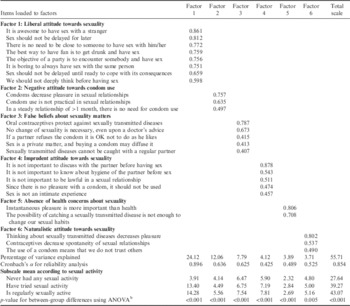
Data were entered and analysed using SPSS version 19.0. A validation step of the sexuality related scale used was first carried out: a factor analysis using the principal component analysis method was used to construct a validity assessment. The final structure of the scale was retained after sample adequacy was ensured, in addition to inverse image, communalities and items loading over factors evaluation. A Promax rotation was selected because factors were inter-related. Furthermore, reliability analysis using Cronbach’s α coefficient was also verified.
The factor analysis using principal components analysis explained 55.71% of the total variance. The reliability analysis of the total scale was 0.854, indicating a good internal consistency. The analysis of included items gave a structure of six factors: liberal attitude towards sexuality, negative attitude towards condom use, false beliefs about sexuality matters, imprudent attitude towards sexuality, absence of health concerns about sexuality, and naturalistic attitude towards sexuality (Table 1). Only one item was removed due to low loading on all factors (necessity to trust someone before having sexual relationship with them). The scale was judged to have adequate construct validity and reliability. In addition, external nomological validity was also assessed: individuals who were regularly sexually active scored significantly higher on the total scale and on subscales than individuals who had tried sexual activity, who also scored higher than those who have never had any sexual activity (p<0.01 for all).
Factor analysisFootnote a of sexuality scale responses among university students in Lebanon

a Kaiser-Meyer-Olkin measure of sampling adequacy=0.908; p<0.001. Results are presented after Promax rotation with Kaiser normalization; the extraction method is by principal component analysis.
b Post-hoc differences of means were significant using Bonferroni tests for all two-by-two comparisons, except: means of factor 3 and of factor 6 between individuals who had never had sexual activity and those who have tried; means of factor 5 and factor 6 between individuals who had tried sexual activity; and those who were regularly sexually active.
Additional statistical analyses
In the descriptive analysis, means and standard deviations were presented for continuous variables, while percentages were presented for categorical variables. In bivariate analysis, correlation coefficients, ANOVA and Bonferroni post-hoc tests for means comparison between groups and the chi-squared test for comparing percentages were used. A p-value of less than 0.05 was considered significant.
Finally, multivariate analyses were carried out: when the dependent variable was dichotomous (ever had sexual activity/regular condom use among sexually active individuals), a stepwise descending logistic regression was used; when the dependent variable was continuous (attitude towards sexuality), a stepwise descending multiple regression was used. This backward regression type allowed removal from the model of all independent variables that have no significant effect on the dependent variable, leading to a more parsimonious model of sexual behaviours and attitude correlates (simpler and easier to understand). Sample adequacy to data and other conditions was verified for both types of analyses before the final models were accepted.
Independent variables included sex, age class, dwelling region, private (versus public) university, socioeconomic status, problematic smoking, cigarette and waterpipe consumption, problematic alcohol consumption, risk involvement, excitement, motives and apprehension, and attitude towards sexuality. To assess the correlates of ever having sexual activity, two models were constructed, taking attitude towards sexual activity as a major independent variable in one model and its subscales in another one. Although the interactive terms of sex with sexual attitude and with risk-taking motives were introduced, all interactions were subsequently removed from the analysis because of non-consistent results and models inadequacy to data.
Results
Declared sexual activity among university students
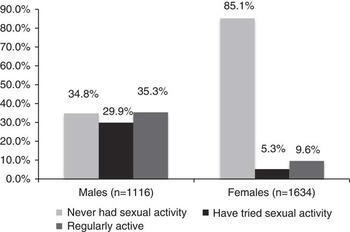
Among 3384 students, 88 (2.6%) were married and therefore removed from the analysis. Of the non-married individuals, 2750 (83.4%) answered the questions on sexuality: 1116 males (40.6%) and 1634 females (59.4%). Males’ mean age was slightly higher than that of females (20.80 versus 20.53 years; p<0.001). Around 15% had engaged in sexual activity, while 20% were regularly sexually active. Among males, 34.8% had never engaged in sexual activity, 29.9% had tried it and 35.3% were regularly sexually active. Among females, the results were 85.1%, 5.3% and 9.6% respectively (p<0.001) (Fig. 1).
Declared sexual activity among university students in Lebanon (p<0.001). Among those who ever had sex, 36.3% had always used condoms, 36.5% had used them irregularly and 27.2% had never used them.

Among those who had ever had sex, 36.3% had always used condoms, 36.5% had used them irregularly and 27.2% had never used them. For males, these figures were 41.3%, 38.7% and 20.1%, respectively; for females, they were 26.6%, 34.9% and 38.4% (p<0.001).
Age of first relationship was 13 years or below for 4.8%, 15 years or below for 22.6%, 17 years or below for 66% and 20 years or below for 92% of individuals. This age was significantly lower for males (mean=16.5 years; SD=202) than for females (mean=18.6 years; SD=2.5) (p<0.001).
Socio-demographic characteristics and risky attitudes, behaviours and activities
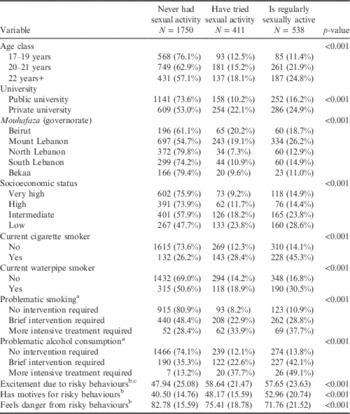
Higher age groups included significantly more individuals who had tried sex and who were engaged in regular sexual activity (p<0.001). The same was true of individuals from private universities, Mount Lebanon region, those of higher socioeconomic status, current cigarette and waterpipe smokers and problematic alcohol and tobacco consumers (p>0.001). Moreover, individuals with regular sexual activity had significantly higher means of excitement and motives for risky behaviours, with lower apprehension of risky behaviours (p<0.001) (Table 2).
Socio-demographic characteristics and risky attitudes, behaviours and activities among university students in Lebanon

a Measured by the ASSIST score
b Measured by RIPS score.
c No significant difference between the means for individuals who have tried sexual activity and those who are regularly active; all other post-hoc two-by-two comparisons are significant according to Bonferroni testing.
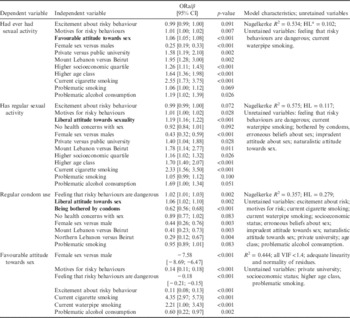
Multivariate analyses of sexuality attitudes and practice among university students in Lebanon

a Hosmer and Lemeshow's goodness-of-fit test.
Multivariate analyses
A favourable attitude towards sexual activity (adjusted odds ratio, ORa=1.06; p<0.001), and a liberal one in particular (ORa=1.19; p<0.001), was associated with ever having had sexual activity. Moreover, male sex, Mount Lebanon dwelling, higher socioeconomic status and age group, motives for risky behaviours, current cigarette smoking and problematic alcohol consumption were also associated with ever having had sexual activity. Among those who ever had sexual activity, realizing that risky behaviours are dangerous (ORa=1.02; p=0.002) and a liberal attitude towards sex (ORa=1.06; p=0.002) were associated with regular condom use. However, declaring being bothered by condoms (ORa=0.62; p<0.001) and female sex (ORa=0.44; p=0.003) were inversely associated with condom use.
Finally, the study suggested that participants who had motives (β=0.14; p<0.001) and those who feel excited about risky behaviours (β=0.11; p<0.001), current cigarette (β=4.35; p<0.001) and waterpipe smoking (β=2.21; p<0.001) and problematic alcohol consumption (β=0.600; p=0.002) embraced a more liberal attitude towards sex. It is noted that female participants (β=−7.58; p<0.001) and individuals who consider risky behaviours as dangerous (β=−0.18; p<0.001) reported an unfavourable attitude towards sexuality.
Discussion
The study found that a substantial proportion of Lebanese university students had tried sexual activity (15%) or were regularly sexually active (20%). These results are similar to those previously found in Lebanon (Barbour & Salameh, Reference Barbour and Salameh2009) and in other countries witnessing health transition, such as China (Zhang et al., Reference Zhang, Pan, Cui, Law, Farrar and Ba-Thein2013), but lower than those reported in developed countries such as Ireland (Lally et al., Reference Lally, Nathan-V., Dunne, McGrath, Cullen, Meagher, Coffey and Dunne2014). That males are more involved in sexual activity has also been found in a previous study in Lebanon (Barbour & Salameh, Reference Barbour and Salameh2009) and in the literature, since girls’ virginity is generally considered more important worldwide (Wilson et al., Reference Wilson, Smith and Menn2013; Fernandez et al., Reference Fernández, Celis-Atenas, Córdova-Rubio, Dufey, Corrêa Varella and Benedetti Piccoli Ferreira2013; Moore et al., Reference Moore, Barr and Johnson2013), in Arab countries (Barbour & Salameh, Reference Barbour and Salameh2009; AlQuaiz et al., Reference AlQuaiz, Kazi and Al Muneef2013) and in Muslim countries in particular (Shirazi & Morowatisharifabad, Reference Shirazi and Morowatisharifabad2009; Al-Shdayfat & Green, Reference Al-Shdayfat and Green2012; Wong, Reference Wong2012; Awwad et al., Reference Awwad, Nassar, Usta, Shaya, Younes and Ghazeeri2013).
A liberal attitude towards sex, motives for risky behaviours, current cigarette smoking and problematic alcohol consumption were all found to be associated with ever having sexual activity. A liberal attitude towards sex is known to increase risky sexual activity (Zou et al., Reference Zou, Yan, Wu, Chen, Huang and Li2013), with subsequent vulnerability to unwanted pregnancies and sexually transmitted diseases. An association of risky sexual behaviour with substance and alcohol abuse has also been demonstrated (O’Hare, Reference O’Hare2001). In fact, evidence suggests that in young people risky behaviours are inter-correlated in a synergistic way, with numerous risky behaviours including substance abuse, delinquency, violent and aggressive behaviours and unplanned and unprotected sexual intercourse due to the disinhibitory effect of abuse substances (Coker et al., Reference Coker, Richter, Valois, McKeown, Garrion and Vincent1994; Sibai et al., Reference Sibai, Tohme, Beydoun, Kanaan and Sibai2009). Moreover, studies have demonstrated that having motives for risky behaviours in general is associated with higher engagement in risky sexual intercourse (Kloep et al., Reference Kloep, Guney, Cok and Simsek2009), even in females (Shapiro et al., Reference Shapiro, Siegel, Scovill and Hays1998).
Among those who had sex, only a third regularly used condoms during intercourse, males more than females. This finding is similar to previous study results (Barbour & Salameh, Reference Barbour and Salameh2009) and to those of other studies, where females were found to be less likely to use condoms than males (Hoque & Ghuman, Reference Hoque and Ghuman2012). Realizing that risky behaviours are dangerous, health concerns related to sexual relationships and a liberal attitude towards sex were associated with regular condom use. However, being bothered by condoms was inversely associated with condom use. These results were mostly expected and are quite similar to those found by other researchers. In Italy for example, condoms were not used by 46.4% of the participants in the case of sex with a regular partner and by 9.5% with casual partners (liberal sex) (Bergamini et al., Reference Bergamini, Cucchi, Guidi, Stefanati, Bonato, Lupi and Gregorio2013). Similar results were found in Zimbabwe (Nkomazana & Maharaj, Reference Nkomazana and Maharaj2013). An interesting result was that having a liberal attitude towards sex was correlated with regular condom use, which could indicate that this high-risk group is being reached by health-related promotional activity. It could explain the difference in condom use frequency between males and females, given that a more liberal attitude could entail less taboo, more seeking of counselling from health professionals and more explicit requirement for condom use by the sexual partner. This remains to be established in future research.
Finally, participants who have motives and feel excited about risky behaviours, current cigarette and waterpipe smoking and problematic alcohol consumption embrace a more liberal attitude towards sex; it is noted that female participants and individuals who consider risky behaviours as dangerous did not report favourable attitudes towards sexuality. The same correlates seem to apply to a favourable attitude towards sex and to its practice, confirming the link between attitude and practice (Askun & Ataca, Reference Askun and Ataca2007). However, there are still other factors that could affect attitude and practice of sexual activity, such as ethnic group and religion, level of religiosity, peer pressure and norms, and parental monitoring, which were not measured in this study. These remain to be studied in future projects.
This study may have several limitations. First, there is a risk of selection bias because of the substantial refusal rate (16.5%) to answer questions related to sexuality. This was expected due to the intimate nature of the questions, and probably caused an underestimate of sexual activity declaration, in females in particular. In fact, declaring engagement in sexual activity is still a cultural taboo in oriental countries, which can result in a further underestimate the rates of sexual intercourse occurrence among females (Awwad et al., Reference Awwad, Nassar, Usta, Shaya, Younes and Ghazeeri2013). Conversely, males tend to exaggerate reporting their sexual activity because of its cultural association with masculinity, leading to an overestimation of their declared sexual activity. Thus, information biases are possible, although the questionnaires were self-administered and all precautions were made to preserve participants’ anonymity and privacy; an overestimation of the difference in attitude and behaviours between males and females is expected. A selection bias is also possible, because of the convenient sampling and since there was no way of assessing the profiles of non-participants in the study: the non-random nature of the sampling could lead to an over-representation of students who skip classes and may have higher risky behaviours. On the other hand, the length of the questionnaire may also have led to an under-representation of this student category, leading to compensation of the latter phenomenon. Residual confounding is also a possibility, although several factors known to affect sexual attitude and practice were taken into account. An additional limitation results from the inability to take into account the interaction of attitude towards sexuality and the RIPS subscale with sex. These types of interaction gave inconsistent results along the multivariate models and were thus not considered adequate for adjustment. Additional studies taking into account all these limitations would be necessary to confirm the results.
Despite these limitations, interventions to improve attitudes towards sexual activity, and safe sex in particular, are suggested. In other countries such interventions have been shown to decrease sexually transmitted diseases and improve reproductive health (Amazaki & Shimizu, Reference Amazaki and Shimizu2008; Ismael et al., Reference Ismael and Sabir Zangana2012). Whether the same applies in the Lebanese context of conservative values (Awwad et al., Reference Awwad, Nassar, Usta, Shaya, Younes and Ghazeeri2013) remains to be established in future studies. Meanwhile, health promotion may be achieved by education, with teachers’ and parents’ support, as shown in some other developing countries (Shrestha et al., Reference Shrestha, Otsuka, Poudel, Yasuoka, Lamichhane and Jimba2013). Parental and peer support is expected to be particularly important since it has been shown to affect other risky behaviours such as problematic alcohol drinking among Lebanese university students (Salamé et al., Reference Salamé, Barbour and Salameh2013). Separate and different interventions among male and females in Lebanon are suggested: while the former need to have better knowledge about the health risks of disorganized, unprotected sex and other risky behaviours to further improve their safety status, the latter should be encouraged to use protective measures if they ever engage in sexual activity.
In conclusion, it was found that a substantial proportions of university students in Lebanon have regular sexual activity, but only a small percentage use condoms for protection. These practices were affected by an overall favourable attitude towards sexuality, and liberal sex in particular. Interventions are required among males in particular in view of these attitude and behavioural changes.
Acknowledgments
The authors represent the Lebanese National Conference for Health in University Research group, which also includes: L. Jomaa, C. Issa, G. Farhat, H. Zeghondi, N. Gerges, M. T. Sabbagh and M. Chaaya.