


1. Introduction
The evolution process for spatial distribution of cells or animals in one-dimensional homogeneous habitat can be modelled by quasilinear advection-diffusion equations of the form,

where $u=u(x,\,t)$ denotes the population density of a single species at position $x$
 and time $t$
 , and the derivative $\sigma (s)=\rho '(s)$
 of a given flux function $\rho (s)$
 represents the diffusivity of equation (1.1).
In zoological studies, as an improvement to the $\Delta$ -model by Taylor & Taylor [Reference Taylor and Taylor15] for adhesive movement, Turchin [Reference Turchin16] proposed equation (1.1), based on a random walk approach [Reference Okubo13], as a model of individual movement, which is not only reflecting adhesion or repulsion between conspecific organisms but also avoiding some defects in their model. In his model, the flux function $\rho$
 is given by

where $k_0>0$ is the maximum degree of gregariousness, $\omega >0$
 is the critical density at which movement switches from adhesive to repulsive, and $\mu \in (0,\,1]$
 is the motility rate. With this flux function $\rho$
 , he considered the initial-Dirichlet boundary value problem

where $\Omega =(0,\,L)\subset \mathbb {R}$ is a favourable habitat of size $L>0$
 , $u_0=u_0(x)$
 is the initial density of a single species, and $\delta _0\ge 0$
 is a constant for the Dirichlet (or absorbing) boundary condition. Here, the constant $\delta _0$
 reflects the intensity of hostility of the surrounding habitat and/or the migration rate towards there. For example, when $\delta _0=0$
 , animals touching the border $\partial \Omega =\{0,\,L\}$
 are permanently lost to the population, either because they move away from the habitat $\Omega$
 or because they are killed by predators residing in the very hostile surrounding area. In this case, it is expected that the total population eventually vanishes as time approaches infinity.
In mathematical biology, Anguige & Schmeiser [Reference Anguige and Schmeiser1] obtained equation (1.1), based also on the random walk approach, as a model of cell motility which incorporates the effects of cell-to-cell adhesion and volume filling. In their model, the flux function $\rho$ is given by

where $\alpha \in [0,\,1]$ is the adhesion constant. With this flux function $\rho$
 , they studied the initial-Neumann boundary value problem

where $\Omega =(0,\,1)\subset \mathbb {R}$ is a habitat of unit size. Here, the Neumann (or reflecting) boundary condition should imply that the total population remains the same for all time.
In both models of [Reference Anguige and Schmeiser1, Reference Turchin16], when the species in question are highly adhesive (that is, $k_0\omega >\mu$ in (1.2) and $\alpha >\frac {3}{4}$
 in (1.4), resp.), the diffusivity $\sigma (s)=\rho '(s)$
 admits a nonempty open interval in which it is negative so that the equation $u_t=(\rho (u))_{xx}$
 becomes backward parabolic for the population density values $s=u$
 lying in that interval. So when the range of the initial population density $u_0$
 overlaps with the interval of backward regime, problems (1.3) and (1.5) may be ill-posed. This awkward situation was regarded as a clue for the authors of [Reference Anguige and Schmeiser1, Reference Turchin16] to expect a certain pattern formation in the population density $u$
 as time goes by. However, there have not been any existence results on the highly adhesive random walk models since the usual methods of parabolic theory are no longer applicable to this case.
Regardless of the expectation stated above, there has been scepticism on the random walk models of adhesive population dynamics due to their limited practicality and inability of displaying complicated behaviour such as sorting [Reference Chen, Painter, Surulescu and Zhigun5, Reference Hillen, Painter and Winkler8]. Meanwhile, many nonlocal adhesion models have been suggested and studied actively to reflect various phenomena in population dynamics. For an overview, one may refer to the review article [Reference Chen, Painter, Surulescu and Zhigun5].
Nonetheless, in this paper, we generalize the adhesion population model of Anguige & Schmeiser [Reference Anguige and Schmeiser1] and classify the resulting equation into the six types. Among such types, we fix one that yields a class of advection-diffusion equations of forward-backward-forward type and prove the existence of infinitely many global-in-time weak solutions to the initial-Dirichlet boundary value problem when the maximum value of the initial population density $u_0$ exceeds a certain threshold. Although our solutions may not exhibit expected behaviour of adhesion such as clustering and sorting, they capture some interesting phenomena: fine-scale density mixtures between the high and low density regimes, smoothing after a finite time, and smooth extinction of the species at an exponential rate due to the absorbing boundary condition. On the other hand, in the same initial value problem under the Neumann boundary condition, we expect to obtain global weak solutions showing quite different behaviours from the Dirichlet case. This will be explored in the subsequent paper as a sequel.
Plan of the paper: In the rest of this section, we derive a continuum model of adhesion, which is a generalization of [Reference Anguige and Schmeiser1], and then justify the definition of a global weak solution to the corresponding initial-Dirichlet boundary value problem. In § 2, depending on the choice of a pair of adhesion and volume filling constants, we classify the resulting equation from continuum modelling into the six types. Then the main result of the paper, theorem 3.2, is sophisticated in § 3 along with a strategy to obtain solutions. As an independent section, in § 4, we formulate a differential inclusion problem and present its special solvability result as theorem 4.2, which serves as an essential ingredient for a proof of theorem 3.2 in § 5. Sections 6 and 7 carry out a long proof of theorem 4.2, which can be regarded as the core analysis of the paper.
Notations: Hereafter, let $L>0$ denote the size of a favourable habitat ${\Omega =(0,\,L)\subset \mathbb {R}}$
 . For $\tau \in (0,\,\infty ],$
 we write

Let $k$ , $m$
 , and $n$
 be positive integers, let $0< a<1$
 , and let $U\subset \mathbb {R}^n$
 be an open set.
(i) We denote by $C^k(U)$
 the space of functions $u:U\to \mathbb {R}$ whose partial derivatives of order up to $k$ exist and are continuous in $U$.
(ii) Let $C^k(\bar {U})$
be the space of functions $u\in C^k(U)$ whose partial derivatives of order up to $k$ are uniformly continuous in every bounded subset of $U$.(iii) Let $n=2$
; so $U\subset \mathbb {R}^2=\mathbb {R}_x\times \mathbb {R}_t.$ We define $C^{2,1}(U)$ to be the space of functions $u:U\to \mathbb {R}$ such that $u_x$, $u_{xx}$, and $u_t$ exist and are continuous in $U$. Also, let $C^{2,1}(\bar {U})$ denote the space of functions $u\in C^{2,1}(U)$ such that $u_x$, $u_{xx}$, and $u_t$ are uniformly continuous in every bounded subset of $U$.(iv) We denote by $C^{2+a}(\bar \Omega )$
the space of functions $u\in C^{2}(\bar \Omega )$ with
\[ \sup_{x,y\in\Omega,\,x\ne y}\frac{|u_{xx}(x)-u_{xx}(y)|}{|x-y|^a}<\infty. \]
(v) Let $0< T<\infty.$
We define $C^{2+a,1+\frac {a}{2}}(\bar \Omega _T)$ to be the space of functions $u\in C^{2,1}(\bar \Omega _T)$ whose quantities
\begin{align*} & \sup_{x,y\in\Omega,\,x\ne y,\,0< t< T}\frac{|u_{xx}(x,t)-u_{xx}(y,t)|}{|x-y|^a},\\ & \sup_{x\in\Omega,\,0< s,t< T,\,s\ne t}\frac{|u_{xx}(x,s)-u_{xx}(x,t)|}{|s-t|^\frac{a}{2}},\\ & \sup_{x,y\in\Omega,\,x\ne y,\,0< t< T}\frac{|u_{t}(x,t)-u_{t}(y,t)|}{|x-y|^a},\; \sup_{x\in\Omega,\,0< s,t< T,\,s\ne t}\frac{|u_{t}(x,s)-u_{t}(x,t)|}{|s-t|^\frac{a}{2}} \end{align*}are all finite.
(vi) We denote by $\mathbb {M}^{m\times n}$
the space of $m\times n$ real matrices.(vii) For a Lebesgue measurable set $E\subset \mathbb {R}^n,$
its $n$-dimensional measure is denoted by $|E|=|E|_n$ with subscript $n$ omitted if it is clear from the context.(viii) We use $W^{k,p}(U)$
to denote the space of functions $u\in L^{p}(U)$ whose weak partial derivatives of order up to $k$ exist in $U$ and belong to $L^{p}(U)$.(ix) A sequence $\{U_\ell \}_{\ell \in \mathbb {N}}$
of disjoint open subsets of $U$ is called a Vitali cover of $U$ if $|U\setminus \cup _{\ell \in \mathbb {N}}U_\ell |=0$; in this case, $\{U_\ell \}_{\ell \in \mathbb {N}}$ is said to cover $U$ in the sense of Vitali.


1.1. Continuum model
For any fixed $n\in \mathbb {N}$ with $n\ge 2$
 , let us consider a discrete distribution of homogeneous cells residing on the endpoints of the $2^n$
 uniform subintervals

of the spatial domain $\bar {\Omega }=[0,\,L]$ , where $h_n:=L/2^{n}$
 . Assume that $N_{cap}\in \mathbb {N}$
 is the maximum number of cells that can stay at each position $x_{ni}:=ih_n$
 $(i=0,\,1,\,\ldots,\,2^n)$
 . For $i=0,\,1,\,\ldots,\,2^n,$
 let $\tilde {u}_{ni}(t)\in \{0,\,1,\,\ldots,\,N_{cap}\}$
 denote the number of cells at position $x_{ni}$
 and time $t\ge 0$
 , and write

called the discrete cell density at position $x_{ni}$ and time $t\ge 0$
 . We assume that the dynamics of such cells is governed by the system of ordinary differential equations,

where $i=2,\,3,\,\ldots,\,2^n-2.$ Here, for $i=1,\,2,\,\ldots,\,2^n-1,$
 we denote by $\mathcal {T}^\pm _{ni}$
 the transitional probabilities per unit time of a one-step jump from $ih_n$
 to $(i\pm 1)h_n$
 that are given by

where $\alpha,\,\beta \in [0,\,1]$ are the adhesion and volume filling constants, respectively. Note here that only the maximal volume filling constant $\beta =1$
 is considered by Anguige & Schmeiser [Reference Anguige and Schmeiser1]. We also write $I_n:=\{ih_n\,|\,i=0,\,1,\,\ldots,\,2^n\}$
 , the $n$
 th discrete habitat; then $I_2\subset I_3\subset I_4\subset \cdots.$

Inserting (1.7) into (1.6), we obtain that for $i=2,\,3,\,\ldots,\,2^n-2$ ,

where

for $j=1,\,2,\,\ldots,\,2^n-1$ , and

for $k=0,\,1,\,\ldots,\,2^n-1$ .
To derive the continuum equation, assume that there exists a function $u=u(x,\,t)\in C^{2,1}(\Omega _\infty ;[0,\,1])\cap C(\bar {\Omega }_\infty ;[0,\,1])$ such that

for all $n\in \mathbb {N},$ $i=0,\,1,\,\ldots,\,2^n,$
 and $t\ge 0$
 .
Now, fix any $n\in \mathbb {N}$ with $n\ge 2$
 . Then for $j=1,\,2,\,\ldots,\,2^n-1$
 , $k=0,\,1,\,\ldots, 2^n-1$
 , and $t\ge 0$
 , we have

In this regard, for $t\ge 0$ , define

for $h_n\le x\le L-h_n$ and

for $0\le x\le L-h_n;$ then

Next, fix any $x_0\in (\cup _{n\ge 2}I_n)\setminus \{0,\,L\}\subset \Omega$ and $t_0>0.$
 Let $n_0$
 denote the smallest positive integer with $x_0\in I_{n_0};$
 then

for some odd integer $i_0\in \{1,\,3,\,\ldots,\,2^{n_0}-1\}$ . Choose any integer $n>n_0$
 . Then

where $i_{0n}:=2^{n-n_0}i_0\in \{2,\,4,\,\ldots,\,2^n-2\}.$ From (1.8) and the mean value theorem, we have

for some $x_{1n},\,x_{2n}\in ((i_{0n}-1)h_n,\,(i_{0n}+1)h_n)=(x_0-h_n,\,x_0+h_n)$ and $x_{3n}\in ((i_{0n}-2)h_n,\,i_{0n}h_n)=(x_0-2h_n,\,x_0)$
 . Thus,

as $n\to \infty ;$ that is,

where $\sigma (s)=\sigma _{\alpha \beta }(s):=3\alpha \beta s^2-4\alpha s+1$ $(s\in \mathbb {R}).$
 By continuity, we conclude that

where $\rho (s)=\rho _{\alpha \beta }(s):=\alpha \beta s^3-2\alpha s^2+s$ $(s\in \mathbb {R}).$
 For later use, let us denote

In this paper, we study equation (1.9), coupled with the initial condition,

and the Dirichlet boundary condition,

where $u_0\in L^\infty (\Omega ;[0,\,1])$ is a given initial population density.
1.2. Global weak solutions
To derive a natural definition of a weak solution to problem (1.9)–(1.11), let $u_0\in C^2(\bar \Omega ;[0,\,1])$ be such that

Assume that $u\in C^{2,1}(\bar \Omega _\infty ;[0,\,1])$ is a global classical solution to problem (1.9)–(1.11). Fix any $T>0$
 , and choose a test function $\varphi \in C^\infty (\bar \Omega \times [0,\,T])$
 such that

Then from the integration by parts,

Conversely, assume that $u\in C^{2,1}(\bar \Omega _\infty ;[0,\,1])$ is a function satisfying that

for each $T>0$ and each $\varphi \in C^\infty (\bar \Omega \times [0,\,T])$
 with

We will check below that $u$ is a global classical solution to problem (1.9)–(1.11) provided that

To show that (1.9) holds, fix any $\varphi \in C^\infty _c(\Omega _\infty ).$ Choose a $T=T_\varphi >0$
 so large that $\mathrm {spt}(\varphi )\subset \subset \Omega \times (0,\,T).$
 Then from the integration by parts,

Thus, (1.9) is satisfied.
Next, to check that (1.10) holds, fix any $\psi \in C^\infty _c(\Omega )$ . Choose a function $\omega \in C^\infty (\mathbb {R})$
 such that

and define $\varphi (x,\,t)=\psi (x)\omega (t)$ for $(x,\,t)\in \bar {\Omega }_\infty.$
 Then with $T=2,$
 it follows from (1.9) that

Thus, (1.10) is true.
Finally, to see that (1.11) holds, fix any $\omega \in C^\infty _c((0,\,\infty )).$ Let $T=T_{\omega }>0$
 be chosen so large that $\mathrm {spt}(\omega )\subset \subset (0,\,T)$
 . Choose two functions $\psi _0,\,\psi _1\in C^\infty (\mathbb {R})$
 such that

For $i=0,\,1$ , define $\varphi _i(x,\,t)=\psi _i(x)\omega (t)$
 for $(x,\,t)\in \bar \Omega _\infty.$
 Then we have from (1.9) that for $i=0,\,1$
 ,

that is, $\rho (u(x,\,t))=0$ for all $(x,\,t)\in \partial \Omega \times (0,\,\infty )$
 . Thus, (1.11) follows from (1.12) and the definition of $\rho (s)$
 .
Summarizing the previous discussion, we have the following.
Proposition 1.1 Let $u_0\in C^2(\bar \Omega ;[0,\,1])$ satisfy the compatibility conditions,

Assume that $u\in C^{2,1}(\bar \Omega _\infty ;[0,\,1])$ is such that

Then $u$ is a global classical solution to problem (1.9)–(1.11) if and only if

for each $T>0$ and each $\varphi \in C^\infty (\bar \Omega \times [0,\,T])$
 with

Motivated by this observation, we fix the definition of a global weak solution to problem (1.9)–(1.11) as follows.
Definition 1.2 Let $u_0\in L^\infty (\Omega ;[0,\,1])$ and $u\in L^\infty (\Omega _\infty ;[0,\,1]).$

(i) Assume $Z_\rho =\emptyset.$
Then we say that $u$ is a global weak solution to problem (1.9)–(1.11) provided that for each $T>0$ and each $\varphi \in C^\infty (\bar \Omega \times [0,\,T])$ with
\[ \varphi=0\ \mbox{on }(\partial\Omega\times[0,T])\cup (\Omega\times\{t=T\}), \]one has
(1.13)\begin{equation} \int_0^T\int_0^L (u\varphi_t +\rho(u)\varphi_{xx})\,{\rm d}\,x\,{\rm d}t+\int_0^L u_0(x)\varphi(x,0)\,{\rm d}\,x=0. \end{equation}
(ii) Assume $Z_\rho \ne \emptyset$
so that $|Z_\rho |\in \{1,\,2\}$. Then we say that $u$ is a global weak solution to (1.9)–(1.11) provided that for each $T>0$ and each $\varphi \in C^\infty (\bar \Omega \times [0,\,T])$ with
\[ \varphi=0\ \mbox{on }(\partial\Omega\times[0,T])\cup (\Omega\times\{t=T\}), \](1.13) holds and that there exists a number $0<\delta <\frac {L}{2}$
with $\min Z_\rho -\delta >0$ such that for each $s_z\in Z_\rho$,
\[ u\not\in[s_z-\delta,s_z+\delta]\ \mbox{a.e. in }((0,\delta)\cup(L-\delta,L))\times(0,\infty). \]


Although

the adhesion-volume filling pairs $(\alpha,\,\beta )\in [0,\,1]^2$ that we mainly consider in this paper satisfy that $Z_{\rho }=Z_{\rho _{\alpha \beta }}=\emptyset$
 (see § 3). Thus, we only have to keep in mind definition 1.2(i) even if definition 1.2(ii) is included for the sake of completeness.
2. Classification of equation
In this section, we classify the types of equation (1.9) as follows. To do so, for any fixed adhesion-volume filling pair $(\alpha,\,\beta )\in [0,\,1]^2$ , let us write

Case $\beta =1$ : In this case,

(a) If $0\le \alpha <\frac {3}{4}$
, then $\sigma (s)\ge 1-\frac {4}{3}\alpha >0$ for all $s\in [0,\,1]$; hence, equation (1.9) is forward parabolic on $[0,\,1]$. We may call this case as (F).(b) If $\alpha =\frac {3}{4},$
then $\sigma (s)> 1-\frac {4}{3}\alpha =0$ for all $s\in [0,\,1]\setminus \{\frac {2}{3}\}$ and $\sigma (\frac {2}{3})= 1-\frac {4}{3} \alpha =0$; that is, equation (1.9) is forward parabolic on $[0,\,1]\setminus \{\frac {2}{3}\}$ and degenerate at $s=\frac {2}{3}$. We refer to this case as (FDF).(c) If $\frac {3}{4}<\alpha <1,$
then
\[ \sigma(s)\left\{ \begin{array}{@{}ll@{}} >0 & \mbox{for } s\in\left[0,\dfrac{2\alpha-\sqrt{4\alpha^2-3\alpha}}{3\alpha}\right)\cup\left(\dfrac{2\alpha+\sqrt{4\alpha^2-3\alpha}}{3\alpha},1\right]=I^+_{\alpha 1}, \\ <0 & \mbox{for }s\in\left(\dfrac{2\alpha-\sqrt{4\alpha^2-3\alpha}}{3\alpha},\dfrac{2\alpha+\sqrt{4\alpha^2-3\alpha}}{3\alpha}\right)=I^-_{\alpha 1}, \\ =0 & \mbox{for }s=\dfrac{2\alpha\pm\sqrt{4\alpha^2-3\alpha}}{3\alpha}; \end{array} \right. \]that is, equation (1.9) is forward parabolic on $I^+_{\alpha 1}$
, backward parabolic on $I^-_{\alpha 1}$, and degenerate at $s=\frac {2\alpha \pm \sqrt {4\alpha ^2-3\alpha }}{3\alpha }$. We refer to this case as (FDBDF).(d) If $\alpha =1,$
then
\[ \sigma(s)\left\{ \begin{array}{@{}ll@{}} >0 & \mbox{for }s\in\left[0,\dfrac{1}{3}\right)=I^+_{11}, \\ <0 & \mbox{for }s\in\left(\dfrac{1}{3},1\right)=I^-_{11}, \\ =0 & \mbox{for }s\in\big\{\dfrac{1}{3},1\big\}; \end{array} \right. \]that is, equation (1.9) is forward parabolic on $I^+_{11}$
, backward parabolic on $I^-_{11}$, and degenerate at $s=\frac {1}{3},\,1$. We refer to this case as (FDBD).


Case $\underline {\frac {2}{3} < \beta < 1 }$ : In this case,

(a) If $0\le \alpha <\frac {3}{4}\beta$
, then $\sigma (s)\ge 1-\frac {4\alpha }{3\beta }>0$ for all $s\in [0,\,1]$; hence, equation (1.9) is forward parabolic on $[0,\,1]$. We refer to this case as (F).(b) If $\alpha =\frac {3}{4}\beta,$
then $\sigma (s)> 1-\frac {4\alpha }{3\beta }=0$ for all $s\in [0,\,1]\setminus \{\frac {2}{3\beta }\}$ and $\sigma (\frac {2}{3\beta })= 1-\frac {4\alpha }{3\beta }=0$; that is, equation (1.9) is forward parabolic on $[0,\,1]\setminus \{\frac {2}{3\beta }\}$ and degenerate at $s=\frac {2}{3\beta }$. We refer to this case as (FDF).(c) If $\frac {3}{4}\beta <\alpha <\frac {1}{4-3\beta },$
then
\[ \sigma(s)\left\{ \begin{array}{@{}ll@{}} >0 & \mbox{for }s\in[0,\dfrac{2\alpha-\sqrt{4\alpha^2-3\alpha\beta}}{3\alpha\beta})\cup\left(\dfrac{2\alpha+\sqrt{4\alpha^2-3\alpha\beta}}{3\alpha\beta},1\right]=I^+_{\alpha \beta}, \\ <0 & \mbox{for }s\in\left(\dfrac{2\alpha-\sqrt{4\alpha^2-3\alpha\beta}}{3\alpha\beta},\dfrac{2\alpha+\sqrt{4\alpha^2-3\alpha\beta}}{3\alpha\beta}\right)=I^-_{\alpha\beta}, \\ =0 & \mbox{for }s=\dfrac{2\alpha\pm\sqrt{4\alpha^2-3\alpha\beta}}{3\alpha\beta}; \end{array} \right. \]that is, equation (1.9) is forward parabolic on $I^+_{\alpha \beta }$
, backward parabolic on $I^-_{\alpha \beta }$, and degenerate at $s=\frac {2\alpha \pm \sqrt {4\alpha ^2-3\alpha \beta }}{3\alpha \beta }$. We refer to this case as (FDBDF).(d) If $\alpha =\frac {1}{4-3\beta },$
then
\[ \sigma(s)\left\{ \begin{array}{@{}ll@{}} >0 & \mbox{for }s\in\left[0,\dfrac{1}{4\alpha-1}\right)=I^+_{\alpha\beta}, \\ <0 & \mbox{for }s\in\left(\dfrac{1}{4\alpha-1},1\right)=I^-_{\alpha\beta}, \\ =0 & \mbox{for }s\in\big\{\dfrac{1}{4\alpha-1},1\big\}; \end{array} \right. \]that is, equation (1.9) is forward parabolic on $I^+_{\alpha \beta }$
, backward parabolic on $I^-_{\alpha \beta }$, and degenerate at $s=\frac {1}{4\alpha -1},\,1$. We refer to this case as (FDBD).(e) If $\frac {1}{4-3\beta }<\alpha \le 1,$
then
\[ \sigma(s)\left\{ \begin{array}{@{}ll@{}} >0 & \mbox{for }s\in\left[0,\dfrac{2\alpha-\sqrt{4\alpha^2-3\alpha\beta}}{3\alpha\beta}\right)=I^+_{\alpha \beta}, \\ <0 & \mbox{for }s\in \left(\dfrac{2\alpha-\sqrt{4\alpha^2-3\alpha\beta}}{3\alpha\beta},1\right]=I^-_{\alpha\beta}, \\ =0 & \mbox{for }s=\dfrac{2\alpha-\sqrt{4\alpha^2-3\alpha\beta}}{3\alpha\beta}; \end{array} \right. \]that is, equation (1.9) is forward parabolic on $I^+_{\alpha \beta }$
, backward parabolic on $I^-_{\alpha \beta }$, and degenerate at $s=\frac {2\alpha -\sqrt {4\alpha ^2-3\alpha \beta }}{3\alpha \beta }$. We refer to this case as (FDB).


$\underline {\textbf{Case}~\beta =\frac {2}{3}}$ : In this case,

(a) If $0\le \alpha <\frac {1}{2}$
, then $\sigma (s)\ge 1-2\alpha >0$ for all $s\in [0,\,1]$; hence, equation (1.9) is forward parabolic on $[0,\,1]$. We refer to this case as (F).(b) If $\alpha =\frac {1}{2},$
then $\sigma (s)> 1-2\alpha =0$ for all $s\in [0,\,1)$ and $\sigma (1)=0$; that is, equation (1.9) is forward parabolic on $[0,\,1)$ and degenerate at $s=1$. We refer to this case as (FD).(c) If $\frac {1}{2}<\alpha \le 1,$
then
\[ \sigma(s)\left\{ \begin{array}{@{}ll@{}} >0 & \mbox{for }s\in\left[0,\dfrac{2\alpha-\sqrt{4\alpha^2-2\alpha}}{2\alpha}\right)=I^+_{\alpha \dfrac{2}{3}}, \\ <0 & \mbox{for }s\in\left(\dfrac{2\alpha-\sqrt{4\alpha^2-2\alpha}}{2\alpha},1\right]=I^-_{\alpha\dfrac{2}{3}}, \\ =0 & \mbox{for }s=\dfrac{2\alpha-\sqrt{4\alpha^2-2\alpha}}{2\alpha}; \end{array} \right. \]that is, equation (1.9) is forward parabolic on $I^+_{\alpha \frac {2}{3}}$
, backward parabolic on $I^-_{\alpha \frac {2}{3}}$, and degenerate at $s=\frac {2\alpha -\sqrt {4\alpha ^2-2\alpha }}{2\alpha }$. We refer to this case as (FDB).


Case $\underline {0<\beta <\frac {2}{3}}$ : In this case,

(a) If $0\le \alpha <\frac {1}{4-3\beta }$
, then $\sigma (s)\ge 3\alpha \beta -4\alpha +1>0$ for all $s\in [0,\,1]$; hence, equation (1.9) is forward parabolic on $[0,\,1]$. We refer to this case as (F).(b) If $\alpha =\frac {1}{4-3\beta },$
then $\sigma (s)> 3\alpha \beta -4\alpha +1=0$ for all $s\in [0,\,1)$ and $\sigma (1)=0$; that is, equation (1.9) is forward parabolic on $[0,\,1)$ and degenerate at $s=1$. We refer to this case as (FD).(c) If $\frac {1}{4-3\beta }<\alpha \le 1,$
then
\[ \sigma(s)\left\{ \begin{array}{@{}ll@{}} >0 & \mbox{for }s\in\left[0,\dfrac{2\alpha-\sqrt{4\alpha^2-3\alpha\beta}}{3\alpha\beta}\right)=I^+_{\alpha \beta}, \\ <0 & \mbox{for }s\in\left(\dfrac{2\alpha-\sqrt{4\alpha^2-3\alpha\beta}}{3\alpha\beta},1\right]=I^-_{\alpha \beta}, \\ =0 & \mbox{for }s=\dfrac{2\alpha-\sqrt{4\alpha^2-3\alpha\beta}}{3\alpha\beta}; \end{array} \right. \]that is, equation (1.9) is forward parabolic on $I^+_{\alpha \beta }$
, backward parabolic on $I^-_{\alpha \beta }$, and degenerate at $s=\frac {2\alpha -\sqrt {4\alpha ^2-3\alpha \beta }}{3\alpha \beta }$. We refer to this case as (FDB).


Case $\underline {\beta = 0}$ : In this case,

(a) If $0\le \alpha <\frac {1}{4}$
, then $\sigma (s)\ge -4\alpha +1>0$ for all $s\in [0,\,1]$; hence, equation (1.9) is forward parabolic on $[0,\,1]$. We refer to this case as (F).(b) If $\alpha =\frac {1}{4},$
then $\sigma (s)> -4\alpha +1=0$ for all $s\in [0,\,1)$ and $\sigma (1)=0$; that is, equation (1.9) is forward parabolic on $[0,\,1)$ and degenerate at $s=1$. We refer to this case as (FD).(c) If $\frac {1}{4}<\alpha \le 1,$
then
\[ \sigma(s)\left\{ \begin{array}{@{}ll@{}} >0 & \mbox{for }s\in\left[0,\dfrac{1}{4\alpha}\right)=I^+_{\alpha 0}, \\ <0 & \mbox{for }s\in\left(\dfrac{1}{4\alpha},1\right]=I^-_{\alpha 0}, \\ =0 & \mbox{for }s=\dfrac{1}{4\alpha}; \end{array} \right. \]that is, equation (1.9) is forward parabolic on $I^+_{\alpha \beta }$
, backward parabolic on $I^-_{\alpha \beta }$, and degenerate at $s=\frac {1}{4\alpha }$. We refer to this case as (FDB).


In short, we can summarize the classification of equation (1.9) as in Fig. 1.
Classification of equation (1.9).

3. Main result
From this section, we mainly study problem (1.9)–(1.11) of type (FDBDF); that is, the initial-Dirichlet boundary value problem in one space dimension,

where $u_0:\Omega \to [0,\,1]$ is a given initial population density, $u(x,\,t)\in [0,\,1]$
 represents the population density at a space-time point $(x,\,t)\in \Omega _\infty$
 , the diffusivity $\sigma :\mathbb {R}\to \mathbb {R}$
 is given by

for some constants $\frac {2}{3}<\beta \le 1$ and $\frac {3}{4}\beta <\alpha <\frac {1}{4-3\beta }$
 , and

Letting

we observe that $0< s^-_0< s^+_0<1$ and that

We check below that

hence, our global weak solutions to problem (3.1) should be as in definition 1.2(i). Note from $\frac {2}{3}<\beta \le 1$ that

so that

thus, $\alpha ^2-\alpha \beta =\alpha (\alpha -\beta )<0$ . This implies that the equation $\rho (s)=s(\alpha \beta s^2-2\alpha s +1)=0$
 has precisely one zero $s=0$
 in $\mathbb {R}$
 ; hence, inequality (3.3) holds.
Let

then from (3.2) and (3.3), we have

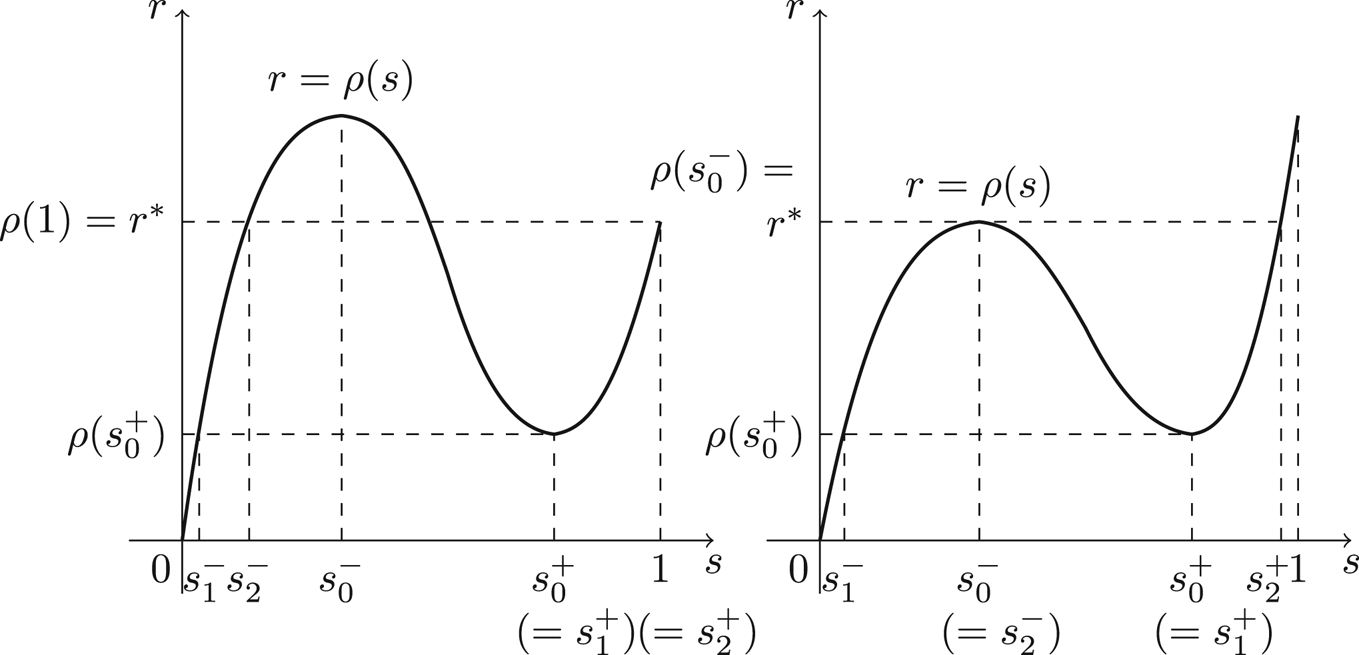
For each $r\in [\rho (s^+_0),\,r^*],$ let $s^+(r)\in [s^+_0,\,1]$
 and $s^-(r)\in (0,\,s^-_0]$
 denote the unique numbers with

Let us write

then

and

(see Fig. 2).
Two possible graphs of $r=\rho (s)$ $(0\le s\le 1)$
 .

Initial population density: We assume that the initial population density $u_0$ to problem (3.1) fulfils the regularity condition,

and the compatibility conditions,

We write

From the classical parabolic theory, we can handle the following case that the maximum value $M_0$ of the initial population density $u_0$
 is strictly less than the infimum $s^-_0$
 of the backward regime $(s^-_0,\,s^+_0)$
 .
Theorem 3.1 Case $M_0< s^-_0$: smooth extinction

Assume $M_0< s^-_0.$ Then there exists a unique global classical solution $u\in C^{2,1}(\bar \Omega _\infty ;[0,\,1])$
 to problem (3.1) such that

for all $T>0$ and that $0\le u\le M_0$
 in $\Omega _\infty$
 . Moreover, it follows that

for all $x\in \Omega$ and $0\le s\le t$
 and that there exist two constants $C\ge 0$
 and $\gamma >0$
 , depending only on $M_0$
 , $L$
 , $\alpha$
 , and $\beta$
 , such that

for all $t\ge 0$ .
Proof. Let $M_1=\frac {M_0+s^-_0}{2}.$ By elementary calculus, we can choose a function $\rho ^\star \in C^3(\mathbb {R})$
 such that

for some constant $c_0>0.$ Then from [Reference Lieberman11, Theorem 12.14], the modified problem,

admits a unique global classical solution $u^\star \in C^{2,1}(\bar \Omega _\infty ;[0,\,1])$ with

Also, it follows from [Reference Kim10, Theorem 1.1] that

and that

for some constants $C\ge 0$ and $\gamma >0$
 , depending only on $M_0$
 , $L$
 , $\alpha$
 , and $\beta$
 . In particular, $0\le u^\star \le M_0< M_1$
 in $\Omega _\infty ;$
 thus, from the choice of $\rho ^\star,$
 we see that $u:=u^\star$
 is a global classical solution to problem (3.1).
Suppose $\tilde {u}\in C^{2,1}(\bar \Omega _\infty ;[0,\,1])$ is a unique global classical solution to problem (3.1) such that

for all $T>0$ and that $0\le \tilde {u}\le M_0$
 in $\Omega _\infty$
 . Then from the choice of $\rho ^\star,$
 $\tilde {u}$
 is also a global classical solution to the modified problem above. By uniqueness of the modified problem, we have $\tilde {u}=u^\star =u$
 in $\Omega _\infty$
 .
As the main result of the paper, we present the following theorem on the case that the maximum value $M_0$ of the initial population density $u_0$
 exceeds the threshold $s^-_1$
 . A proof of this theorem is given in § 5.
Theorem 3.2 Case $M_0>s^-_1$: density mixtures and smooth extinction

Assume $M_0>s^-_1.$ Let $r_1\in [\rho (s^+_0),\,r^*)$
 be any number such that

and let $r_2\in (r_1,\,r^*]$ . Then there exist a function $u^\star \in C^{2,1}(\bar \Omega _\infty ;[0,\,1])$
 with

a nonempty bounded open set $Q\subset \Omega _\infty$ with

and infinitely many global weak solutions $u\in L^{\infty }(\Omega _\infty ;[0,\,1])$ to problem (3.1) satisfying the following:
(a) Smoothing in finite time:
\[ u=u^\star\ \mbox{in }\Omega_\infty\setminus \bar{Q}; \]
(b) Density mixtures:
\[ u\in[s^-(r_1),s^-(r_2)]\cup[s^+(r_1),s^+(r_2)]\ \mbox{a.e. in }Q; \]
(c) Fine-scale oscillations: for any nonempty open set $O\subset Q,$
\[ \underset{O}{\mathrm{ess\,osc}}\, u:=\underset{O}{\mathrm{ess\,sup}}\, u-\underset{O}{\mathrm{ess\,inf}}\, u \ge s^+(r_1)-s^-(r_2)>0; \]
(d) Nonincreasing total population:
\[ \int_\Omega u(x,t)\,{\rm d}\,x= \int_\Omega u^\star(x,t)\,{\rm d}\,x\quad\forall\ t\ge 0, \]and the function $t\mapsto \int _\Omega u^\star (x,\,t)\,{\rm d}\,x$
is nonincreasing on $[0,\,\infty );$(e) Maximum principle:
\[ 0\le u^\star(x,t)\le\|u^\star({\cdot},s)\|_{L^\infty(\Omega)}\le 1\quad\forall\ x\in\bar\Omega, \quad\forall\ t\ge s\ge0; \]
(f) Exponential and smooth extinction: there exists two constants $C>0$
and $\gamma >0$ such that
\[ \|u^\star({\cdot},t)\|_{L^\infty(\Omega)}\le C e^{-\gamma t}\quad\forall\ t\ge0. \]


Since $Q\ne \emptyset$ is a bounded subset of $\Omega _\infty$
 , it follows from (a) that the solutions $u$
 are smooth and identical on $\bar \Omega \times [t^*,\,\infty )$
 , where

So properties (e) and (f) are valid for the solutions $u$ when $t\ge t^*.$
 Since $\bar {Q}\subset \Omega \times [0,\,\infty )$
 , observe from (a) that the solutions $u$
 are smooth and identical near the cylindrical boundary $\partial \Omega \times [0,\,\infty )$
 ; thus, $u=0$
 pointwise on $\partial \Omega \times [0,\,\infty )$
 . From (b), (c), and $\bar {Q}\cap (\Omega \times \{0\})\ne \emptyset,$
 the solutions $u$
 experience immediate fine-scale density mixtures in $Q$
 between low density regime $[s^-(r_1),\,s^-(r_2)]$
 and high density regime $[s^+(r_1),\,s^+(r_2)]$
 . Observe also from (d), (e), and (f) that the total population in $\Omega$
 decreases exponentially in time:

Instead of the initial-Dirichlet boundary value problem (3.1), one may consider the Cauchy problem with the diffusivity $\sigma :\mathbb {R}\to \mathbb {R}$ as in (3.1) and initial population density $u_0\in C^{2+a}_c(\mathbb {R};[0,\,1]).$
 In this case, it is essential to study first the existence and properties of a global classical solution to the modified Cauchy problem as in (5.3) with $\Omega$
 replaced by $\mathbb {R}$
 . On the other hand, in a biological viewpoint, it is also interesting to consider in problem (3.1) a Dirac delta distribution as the initial population density $u_0$
 . This may be regarded as the case of describing population dynamics of a species, concentrated initially at a single point. Likewise, one then needs to establish first the existence and properties of a global classical solution to the modified (initial-boundary value or Cauchy) problem under the initial Dirac delta distribution $u_0$
 .
Approach by differential inclusion: Let us take a moment here to explain our approach to prove theorem 3.2. To solve the equation in (3.1), we formally put $v_x=u$ in $\Omega _\infty$
 for some function $v:\Omega _\infty \to \mathbb {R}$
 ; so we consider the equation,

To solve the previous equation in the sense of distributions in $\Omega _\infty,$ we may try to find a vector function $z=(v,\,w)\in W^{1,\infty }(\Omega _\infty ;\mathbb {R}^{1+1})$
 with $v_x\in L^\infty (\Omega _\infty ;[0,\,1])$
 such that

If there is such a function $z=(v,\,w),$ we take $u=v_x \in L^\infty (\Omega _\infty ;[0,\,1])$
 ; then from the integration by parts, for each $\varphi \in C^\infty _c(\Omega _\infty )$
 ,

where $T_\varphi :=\sup _{(x,t)\in \mathrm {spt}(\varphi )}t +1$ . Hence, $u$
 is a global weak solution of the equation in (3.1) in the sense of distributions in $\Omega _\infty.$

On the other hand, for each $b\in \mathbb {R},$ define

then system (3.4) is equivalent to the inhomogeneous partial differential inclusion,

where $\nabla =(\partial _x,\,\partial _t)$ is the space-time gradient operator. In this regard, utilizing the method of convex integration by Müller & Šverák [Reference Müller and Šverák12], we aim at solving this inclusion for certain sets $K(b)\subset \Sigma (b)$
 $(b\in \mathbb {R})$
 in a generic setup (section 4) while reflecting the initial and Dirichlet boundary conditions in (3.1).
After the successful understanding of homogeneous partial differential inclusions in the study of crystal microstructures by Ball & James [Reference Ball and James2] and Chipot & Kinderlehrer [Reference Chipot and Kinderlehrer6], the methods of convex integration in differential inclusions have been extensively applied to many important problems; see, e.g., elliptic systems [Reference Müller and Šverák12], the Euler equations and Onsager’s conjecture [Reference De Lellis and Székelyhidi7, Reference Isett9], the porous media equation [Reference Córdoba, Faraco and Gancedo3], active scalar equations [Reference Shvydkoy14], and the Muskat problem [Reference Castro, Córdoba and Faraco4].
4. Generic problem
In this section that is independent of the previous sections, we develop a generic inclusion problem that can be applied to the main problem (3.1) as a special case. Since the core analysis part is essentially the same for both the Dirichlet problem and Neumann problem, we take the generic approach instead of studying the convex integration in a special setup to avoid repetition when we deal with the Neumann problem in a subsequent paper.
4.1. Two-wall inclusions
As a setup, we fix some generic notations and introduce a two-wall partial differential inclusion of inhomogeneous type.
4.1.1. Related sets.
Let $r_1< r_2$ , and let $\omega _1,\,\omega _2\in C([r_1,\,r_2])$
 be any two functions such that

For each $b\in \mathbb {R}$ , define the matrix sets

and $K(b)=K_{\omega _1,\omega _2}(b)=K^+(b)\cup K^-(b)$ . Let

and $K=K_{\omega _1,\omega _2}=K^+\cup K^-$ . Also, let

4.1.2. Two-wall inclusions.
Let

where $t_1< t_2$ are any two fixed real numbers, and let $Q\subset \Omega _{t_1}^{t_2}$
 be a nonempty open set. Consider the inhomogeneous partial differential inclusion,

where $z=(v,\,w):Q\to \mathbb {R}^2$ . Regarding this, we fix some terminologies.
Definition 4.1 Let $z=(v,\,w)\in W^{1,\infty }(Q;\mathbb {R}^2).$ Then the function $z$
 is called a solution of inclusion (4.1) if

a subsolution of (4.1) if

and a strict subsolution of (4.1) if

respectively.
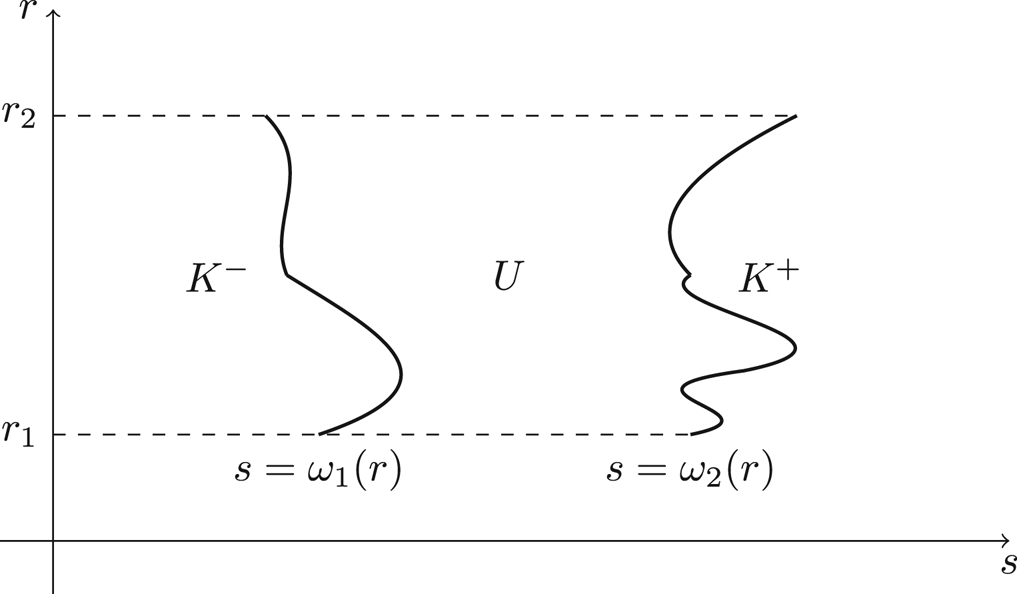
Observe that if $z=(v,\,w)\in W^{1,\infty }(Q;\mathbb {R}^2)$ is a solution of (4.1), then

that is, $(v_x,\,w_t)$ lies either in the ‘right wall’ $K^+$
 or in the ‘left wall’ $K^-$
 almost everywhere in $Q$
 (see Fig. 3).
The right wall $K^+$ and left wall $K^-$
 .

4.2. Special solutions to generic problem
Continuing the previous setup, we present an important existence result on inclusion (4.1) that will serve as the main ingredient for proving theorem 3.2.
Assume that $z^\star =(v^\star,\,w^\star )\in C^1(\bar {\Omega }_{t_1}^{t_2};\mathbb {R}^2)$ is a function such that in $Q,$


From the definition of $U(b)$ $(b\in \mathbb {R})$
 ,

that is, $z^\star$ is a strict subsolution of inclusion (4.1). In particular, we have

Assume further that

for all sufficiently small $\delta >0.$
We are now ready to state the main result of this section whose proof is given in § 6.
Theorem 4.2 Let $\epsilon >0.$ Then there exists a function $z=(v,\,w)\in W^{1,\infty }(\Omega _{t_1}^{t_2};\mathbb {R}^2)$
 satisfying the following:
(i) $z$
is a solution of inclusion (4.1),(ii) $z=z^\star$
on $\bar {\Omega }_{t_1}^{t_2}\setminus Q,$(iii) $\nabla z=\nabla z^\star$
a.e. on $\Omega _{t_1}^{t_2}\cap \partial Q,$(iv) $\|z-z^\star \|_{L^\infty (\Omega _{t_1}^{t_2};\mathbb {R}^2)}<\epsilon,$
(v) $\|v_t-v^\star _t\|_{L^\infty (\Omega _{t_1}^{t_2})}<\epsilon,$
(vi) for any nonempty open set $O\subset Q,$
\[ \underset{O}{\mathrm{ess\,osc}}\, v_x \ge d_0, \]where $d_0:=\min _{[r_1,r_2]}\omega _2-\max _{[r_1,r_2]}\omega _1>0.$


5. Application of theorem 4.2: proof of main result
In this section, we turn back to § 3 and prove the main result of the paper, theorem 3.2, by applying theorem 4.2. For the reader’s convenience, we underline the arguments in theorem 3.2 that are proved along the way.
To start the proof, assume

and fix any two numbers $r_1< r_2$ in $[\rho (s^+_0),\,r^*]$
 such that

In order to fit into the setup in § 4, for $r_1\le r\le r_2$ , define

then $\omega _1,\,\omega _2\in C([r_1,\,r_2])$ , and

Next, using elementary calculus, we can choose a function $\rho ^\star \in C^3(\mathbb {R})$ such that

Define $\sigma ^\star =(\rho ^\star )'\in C^2(\mathbb {R});$ then $\exists c_0>0$
 such that $\sigma ^\star \ge c_0$
 in $\mathbb {R}$
 . Now, from [Reference Lieberman11, Theorem 12.14] and [Reference Kim10, Theorem 1.1], the modified problem,

possesses a unique global solution $u^\star \in C^{2,1}(\bar \Omega _\infty ;[0,\,1])$ with $u^\star \in C^{2+a,1+\frac {a}{2}}(\bar \Omega _T; [0,\,1])$
 for each $T>0$
 such that

and that

for some constants $C> 0$ and $\gamma >0$
 , depending only on $M_0$
 , $L$
 , $\sigma ^\star$
 , and $(\sigma ^\star )'$
 . Thus, (e) and (f) in theorem 3.2 are satisfied. Note also from (5.2) and (5.3) that for each $t\ge 0$
 ,

as $u^\star (x,\,t)\ge 0$ for $0< x< L.$
 So the second of (d) in theorem 3.2 holds.
We define

then from (5.3) and the choice of $\rho ^\star$ , $v^\star \in C^{3,1}(\bar \Omega _\infty )$
 satisfies that for all $(x,\,t)\in \Omega _\infty$
 ,

Hence, $v^\star$ is a global solution to the problem,

where

In turn, we define


$v^\star _x=u^\star \in C^{2,1}(\bar \Omega _\infty ;[0,\,1])$ , and $z^\star :=(v^\star,\,w^\star )\in (C^{3,1}\times C^{4,2})(\bar \Omega _\infty ).$

Define

Fix a number $T_0>0$ so large that $Ce^{-\gamma T_0}< s^-(r_1)$
 . Then from (5.4) and (5.5),

thus,

Since $u_0(0)=u_0(L)=0$ and $M_0>s^-(r_1)$
 , we can take a point $x_0\in \Omega$
 such that

Then by continuity, we can take an $r_0\in (0,\,T_0)$ with $r_0<\min \{x_0,\,L-x_0\}$
 so small that

thus, $\Omega _\infty \cap B_{r_0}(x_0,\,0)\subset Q\ne \emptyset$ so that

Note here that $Q$ is a nonempty bounded open subset of $\Omega _\infty.$
 Observe also that

as $\bar {Q}$ is compact and $v^\star _x(0,\,t)=v^\star _x(L,\,t)=0$
 for all $t\ge 0$
 .
Following the notations in § 4, note from the choice of $\rho ^\star$ , the definition of $Q$
 , (5.1), (5.7), and (5.8) that (4.2) holds in $Q$
 and (4.4) holds for all sufficiently small $\delta >0$
 . Thus, for any fixed $\epsilon >0,$
 we can apply theorem 4.2 (with $t_1=0$
 and $t_2=T_0$
 in the current case) to obtain a function $z=z_\epsilon \in W^{1,\infty }(\Omega ^{T_0}_0;\mathbb {R}^2)$
 satisfying the following, where $z=(v,\,w)$
 :
(i) $z$
is a solution of inclusion (4.1);(ii) $z=z^\star$
on $\bar {\Omega }^{T_0}_0\setminus Q;$(iii) $\nabla z=\nabla z^\star$
a.e. on $\Omega ^{T_0}_0\cap \partial Q;$(iv) $\|z-z^\star \|_{L^\infty (\Omega ^{T_0}_0;\mathbb {R}^2)}<\epsilon ;$
(v) $\|v_t-v^\star _t\|_{L^\infty (\Omega ^{T_0}_0)}<\epsilon ;$
(vi) for any nonempty open set $O\subset Q,$
\[ \underset{O}{\mathrm{ess\,osc}}\, v_x \ge d_0, \]where $d_0=\min _{[r_1,r_2]}\omega _2-\max _{[r_1,r_2]}\omega _1=s^+(r_1)-s^-(r_2)>0.$


For each $(x,\,t)\in \bar {\Omega }\times [T_0,\,\infty )$ , define

then from (ii), $z=(v,\,w)\in W^{1,\infty }(\Omega _T;\mathbb {R}^2)$ for all $T>0$
 .
For each $t\ge 0,$ define

then $u\in L^\infty (\Omega _T)$ for all $T>0$
 . First, from (vi), (c) in theorem 3.2 is fulfilled. Also, note from (ii) and (5.6) that for every $t\ge 0,$


hence, the first of (d) in theorem 3.2 holds. From (ii), (5.6), and (5.9), we have

and from (iii) and (5.6), we get

In particular, (a) in theorem 3.2 is satisfied. From (i), we have

that is, a.e. in $Q$ ,

In particular, we see that $u\in [0,\,1]$ a.e. in $\Omega _\infty$
 , that is, $u\in L^\infty (\Omega _\infty ;[0,\,1])$
 and that (b) in theorem 3.2 holds.
Now, we check that $u$ is a global weak solution to problem (3.1). To do so, fix any $T>0$
 and any test function $\varphi \in C^\infty (\bar \Omega \times [0,\,T])$
 with

Observe from (ii), (5.7), (5.9)–(5.12), the choice of $\rho ^\star$ , and the integration by parts that

Thus, according to definition 1.2(i), $u$ is a global weak solution to (3.1).
Since $u^\star$ itself is not a global weak solution to problem (3.1), it follows from (iv) that there are infinitely many global weak solutions to (3.1) that satisfy properties (a)–(f) in theorem 3.2.
The proof of theorem 3.2 is now complete.
6. Proof of theorem 4.2
Following § 4, this section presents a proof of theorem 4.2 with the help of the key lemma, lemma 6.1, to be proved in § 7.
6.1. Selection of an in-approximation to $K$

For each $b\in \mathbb {R}$ and $0\le \lambda <\frac {1}{2}$
 , define the matrix set $U^\lambda (b)=U^\lambda _{\omega _1,\omega _2}(b)\subset \mathbb {M}^{2\times 2}$
 by

and let $U^\lambda =U^\lambda _{\omega _1,\omega _2}\subset \mathbb {R}^2$ be given by

Observe that $U^0(b)=U(b)$ for every $b\in \mathbb {R}$
 and that $U^0=U.$

Since $|Q|<\infty$ , we can select a sequence $\{\lambda _i\}_{i\in \mathbb {N}}$
 in $\mathbb {R}$
 with

such that for every $i\in \mathbb {N},$

Thanks to (4.4), we may assume

where $U^{\lambda _0}:=\emptyset ;$ then from (4.3), $\{Q_i\}_{i\in \mathbb {N}}$
 is a sequence of disjoint open subsets of $Q$
 whose union has measure $|Q|.$

For each $i\in \mathbb {N},$ let $\lambda _i'=\frac {\lambda _i+\lambda _{i+1}}{2}$
 . Observe from (6.1) that for all $i\in \mathbb {N},$


and that

From these observations, we deduce that for each $i\in \mathbb {N},$

and that

Fix a number $\kappa _0\in (1,\,1/\ell _0)$ , and define

then

In turn, for each $i\in \mathbb {N}$ , define

then the sequence $\{\beta _i\}_{i\in \mathbb {N}}$ fulfils that

and

For each $i\in \mathbb {N},$ let

Next, for each $i\in \mathbb {N},$ let

and

6.2. Main lemma
Define

where $\theta _0\in C^\infty ([0,\,\infty ))$ is a cutoff function such that $0\le \theta _0\le 1$
 on $[0,\,\infty ),$
 $\theta _0=1$
 on $[0,\,d_0/4],$
 and $\theta _0=0$
 on $[d_0/2,\,\infty ).$
 Then we can choose an integer $i_0\ge 2$
 so large that for all $i\ge i_0,$


respectively.
We present here the key lemma to finish the proof of theorem 4.2. A proof of this lemma is provided in § 7.
Lemma 6.1 Let $\epsilon >0.$ Then there exist a sequence $\{z_i\}_{i\in \mathbb {N}}=\{(v_i,\,w_i)\}_{i\in \mathbb {N}}$
 in $W^{1,\infty }(\Omega _{t_1}^{t_2};\mathbb {R}^2)$
 , three sequences $\{\mathcal {F}_i\}_{i\in \mathbb {N}}$
 and $\{\mathcal {F}^\pm _i\}_{i\in \mathbb {N}}$
 as follows, and three positive constants $c_1$
 , $c_2$
 , and $c_3$
 such that for each $i\in \mathbb {N},$
 the following are satisfied:
(a) $\mathcal {F}_i=\{D_{ij}\,|\, j\in \mathbb {N}\}$
is a countable collection of disjoint rhombic domains in $Q_1\cup \cdots \cup Q_i;$(b) $\mathcal {F}^+_i=\{T_{ij}\,|\, j\in \mathbb {N}\}$
is a countable collection of disjoint triangular domains in $Q_1\cup \cdots \cup Q_i;$(c) $\mathcal {F}^-_i=\{R_{ij}\,|\, j\in \mathbb {N}\}$
is a countable collection of disjoint rhombic domains in $Q_1\cup \cdots \cup Q_i;$(d) $(\cup _{j\in \mathbb {N}}T_{ij})\cap (\cup _{j\in \mathbb {N}}R_{ij})=\emptyset$
and
\[ |Q_1\cup\cdots\cup Q_i|=|\cup_{j\in\mathbb{N}}D_{ij}|=|\cup_{j\in\mathbb{N}}(T_{ij}\cup R_{ij})|; \]
(e) for each $D\in \mathcal {F}_i$
, there are four disjoint triangular domains $T^1_D,\,T^2_D,\,T^3_D,\,T^4_D\in \mathcal {F}^+_i$ and one rhombic domain $R_D\in \mathcal {F}^-_i$ such that
\[ T^1_D\cup T^2_D\cup T^3_D\cup T^4_D\cup R_D\subset D\;\;\mbox{and}\;\; |D|=|T^1_D\cup T^2_D\cup T^3_D\cup T^4_D\cup R_D|; \]
(f) one has
\[ \sup_{j\in\mathbb{N}}\mathrm{diam}\,D_{ij}\le\frac{1}{2^{i}}; \]
(g) one has
\[ \left\{ \begin{array}{@{}l@{}} \mbox{for each }T\in \mathcal{F}^+_i, z_i\in C^1(\bar{T};\mathbb{R}^2), \ \text{and} \ ((v_i)_x,(w_i)_t)\in U^+_i \ \text{in} \ T, \\ \mbox{for each }R\in \mathcal{F}^-_i, z_i\in C^1(\bar{R};\mathbb{R}^2), \ \text{and} \ ((v_i)_x,(w_i)_t)\in U^-_i \ \text{in} \ R, \\ z_i=z_0\ \text{on}\ \bar{\Omega}_{t_1}^{t_2}\setminus (Q_1\cup \cdots\cup Q_i), \\ \nabla z_i=\nabla z_0 \ \text{a.e. on }\Omega_{t_1}^{t_2}\cap\partial Q, \end{array} \right. \]where $z_0=(v_0,\,w_0):=z^\star ;$
(h) one has
\[ \left\{ \begin{array}{@{}l@{}} (w_i)_x=v_i \ \text{a.e. in} \ Q; \\ \|(v_i)_t-(v_{i-1})_t\|_{L^\infty(\Omega_{t_1}^{t_2})}\le\dfrac{\epsilon}{2^{i+1}}; \\ \|z_i-z_{i-1}\|_{L^\infty(\Omega_{t_1}^{t_2};\mathbb{R}^2)}\le\dfrac{\epsilon}{2^{i+1}}; \\ |z_i(x,t)-z_i(y,s)|\le c_1|(x,t)-(y,s)|\ \forall\ (x,t),(y,s)\in \Omega_{t_1}^{t_2}; \end{array} \right. \]
(i) if $i\ge 2,$
then
\[ \int_{\Omega_{t_1}^{t_2}}|\nabla z_i-\nabla z_{i-1}|\,{\rm d}\,x\,{\rm d}t\le c_2((\beta_i-\beta_{i-1})|Q|+|Q_i|); \]
(j) if $i\ge i_0$
and $D\in \mathcal {F}_{i-1}$, then
\begin{align*} \int_D \zeta^\pm_0((v_i)_x,(w_i)_t)\,{\rm d}\,x\,{\rm d}t & \ge c_3(\beta_i-\beta_{i-1})|D|\quad\mbox{and}\\ \int_D \zeta^\pm_0((v_i)_x,(w_i)_t)\,{\rm d}\,x\,{\rm d}t & \ge (1-(\beta_i-\beta_{i-1}))\int_D \zeta^\pm_0((v_{i-1})_x,(w_{i-1})_t)\,{\rm d}\,x\,{\rm d}t. \end{align*}


6.3. Completion of proof
Utilizing lemma 6.1, we now complete the proof of theorem 4.2.
From the third of (h) in lemma 6.1, it follows that for all $i> j\ge 1$ ,

thus, $\{z_i\}_{i\in \mathbb {N}}$ is a Cauchy sequence in $L^\infty (\Omega _{t_1}^{t_2};\mathbb {R}^2)$
 so that from the fourth of (h) in lemma 6.1,

for some $z=(v,\,w)\in W^{1,\infty }(\Omega _{t_1}^{t_2};\mathbb {R}^2)$ satisfying

Convergence (6.4) together with the third of (g) and third of (h) in lemma 6.1 implies that

and

that is, (ii) and (iv) in theorem 4.2 hold.
From (i) in lemma 6.1, we have

as $i,\,j\to \infty ;$ thus, after passing to a subsequence if necessary, for a.e. $(x,\,t)\in \Omega _{t_1}^{t_2},$


In particular, this pointwise convergence holds for a.e. $(x,\,t)\in \Omega _{t_1}^{t_2}\cap \partial Q.$ Thus, (iii) in theorem 4.2 follows from the fourth of (g) in lemma 6.1.
From (6.4), (6.5), and the first and second of (h) in lemma 6.1, we have

and

that is, (v) in theorem 4.2 is fulfilled.
For each $i\in \mathbb {N},$ observe from (b), (c), (d), and the first and second of (g) in lemma 6.1 and from the definition of $U^\pm _i$
 and $K=K^+\cup K^-$
 that

where $d_1:=\mathrm {diam} \,U$ and

Here, letting $i\to \infty,$ we obtain from (6.5) that

that is,

as $K\subset \mathbb {R}^2$ is compact. This inclusion together with (6.6) and the definition of $K(b)$
 $(b\in \mathbb {R})$
 implies that

hence, (i) in theorem 4.2 holds.
Finally, to verify (vi) in theorem 4.2, choose an integer $i_1\ge i_0$ so large that for all $i\ge i_1,$


Fix any integer $i\ge i_1$ , and let $D\in \mathcal {F}_{i-1}.$
 Then note from (6.5) and (j) in lemma 6.1 that

Next, let $O\subset Q$ be any nonempty open set. Since $\{Q_i\}_{i\in \mathbb {N}}$
 is a Vitali cover of $Q$
 , we have $O\cap Q_{i_2}\ne \emptyset$
 for some $i_2\in \mathbb {N}.$
 Thus, from (a), (d), and (f) in lemma 6.1, there exist an $i_3>\max \{i_1,\,i_2\}$
 and a $D_3\in \mathcal {F}_{i_3 -1}$
 such that

This inclusion and the above positivity estimate imply that

So from the definition of $\zeta _0^\pm$ , there are two disjoint sets $O^\pm \subset O$
 of positive measure such that

thus, with (6.7), we conclude that

Therefore, (vi) in theorem 4.2 follows from the definition of $K^\pm.$
The proof of theorem 4.2 is now complete.
7. Proof of lemma 6.1
This final section is entirely devoted to a proof of lemma 6.1. First, we begin with an elementary lemma in subsection 7.1 that provides us with a building block for our constructions. Then we perform inductive surgeries in subsection 7.2 that complete the proof of lemma 6.1.
7.1. Piecewise affine maps with boundary trace $0$

Although the following theorem is essential in our constructions, its proof is so elementary that we omit it (see [Reference Zhang17] and Fig. 4).
Lemma 7.1 Let $\tau ^\pm$ and $\delta$
 be any three positive numbers, and let $D=D_{\delta }$
 be the interior of the convex hull of the four points $(\pm \delta,\,0)$
 and $(0,\,\pm 1)$
 in $\mathbb {R}^2;$
 that is,

Let $\varphi =\varphi _{\tau ^+,\tau ^-,\delta }: \bar {D}\to \mathbb {R}$ be the piecewise affine map defined as follows: for each $0\le t\le 1,$
 define

and for each $(x,\,t)\in \bar {D}$ with $t\le 0,$
 define $\varphi (x,\,t)=\varphi (x,\,-t).$
 Then $\varphi$
 satisfies the following:
(i) $\varphi \in W^{1,\infty }_0(D);$
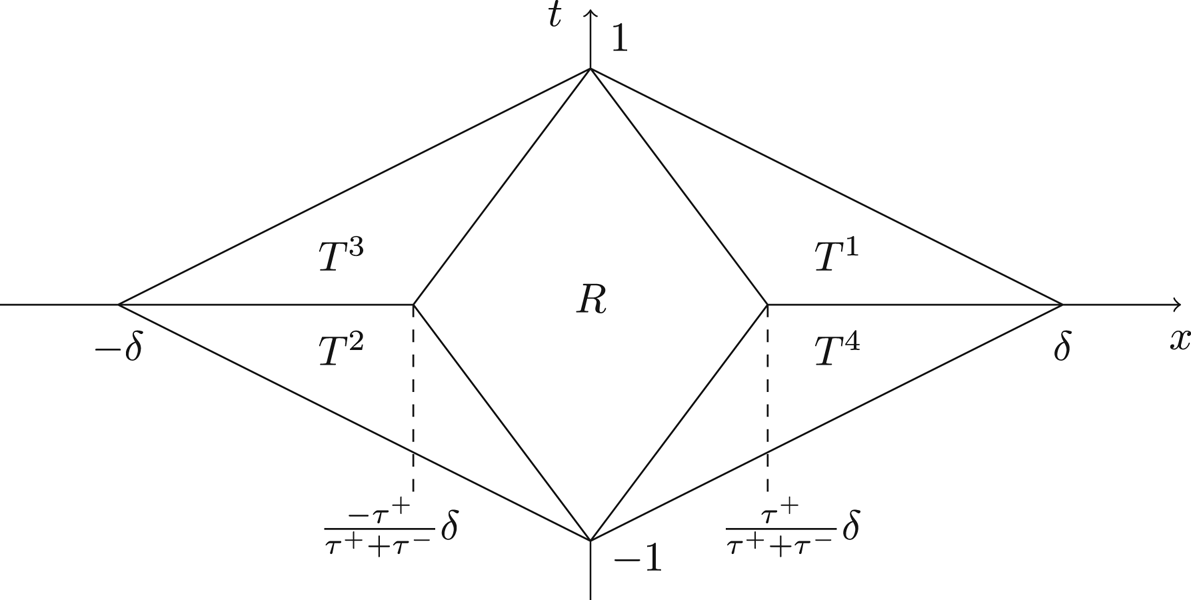
(ii) there are five disjoint domains $T^1,\,T^2,\,T^3,\,T^4,\,R\subset D$
which cover $D$ in the sense of Vitali, and $\varphi$ is affine in each of $T^1,\,T^2,\,T^3,\,T^4,\,R;$(iii) after a proper ordering of $T^1,\,T^2,\,T^3,\,T^4,\,R,$
\[ \nabla\varphi = \left\{\begin{array}{@{}ll@{}} (\tau^+,\delta\tau^+) & \mbox{in }T^1\cup T^2, \\ (\tau^+,-\delta\tau^+) & \mbox{in }T^3\cup T^4, \\ (-\tau^-,0) & \mbox{in }R ; \end{array} \right. \]
(iv) for each $t\in [-1,\,1],$
\[ \int_{-\delta+\delta|t|}^{\delta-\delta|t|}\varphi(x,t)\,{\rm d}\,x=0; \]
(v) $\|\varphi \|_{L^\infty (D)}=\frac {\tau ^+\tau ^-}{\tau ^++\tau ^-}\delta ;$
(vi) $\left \{\begin{array}{@{}l@{}} \big |\{(x,\,t)\in D\,|\,\varphi _x(x,\,t)=\tau ^+ \} \big |=\dfrac {\tau ^-}{\tau ^++\tau ^-}|D|,\, \\ \big |\{(x,\,t)\in D\,|\,\varphi _x(x,\,t)=-\tau ^- \} \big |=\dfrac {\tau ^+}{\tau ^++\tau ^-}|D|. \end{array} \right.$


Five disjoint domains $T^1,\,T^2,\,T^3,\,T^4,\,R\subset D$ in lemma 7.1.

7.2. Inductive surgeries
In this subsection, we prove lemma 6.1 by utilizing affine maps in lemma 7.1.
Fix any $\epsilon \in (0,\,1].$ Then we perform the first two surgeries in order that fulfil (a)–(h) for $i=1$
 and (a)–(j) for $i=2$
 . We do not proceed with the $n$
 th surgery under the assumption that we have performed the surgeries up to the $(n-1)$
 th one as it is essentially the repetition of the second one under the fulfilment of the first surgery.
7.2.1. The first surgery.
In this first step, we construct a function $z_1=(v_1,\,w_1)\in W^{1,\infty }(\Omega _{t_1}^{t_2};\mathbb {R}^2)$ , three countable collections $\mathcal {F}_1$
 and $\mathcal {F}_1^\pm$
 , and a constant $c_1>0$
 satisfying (a)–(h) for $i=1$
 , where $c_1$
 is independent of the index $i$
 .
Let $\delta _1\in (0,\,1]$ be such that

where the constant $S_M>0$ is as in subsection 6.3. Since $\nabla z_0$
 is uniformly continuous in $Q_1,$
 there exists a number $\gamma _1\in (0,\,\frac {1}{2^{1+1}}]$
 such that

Consider the diamond $D_{\delta _1}$ . From the Vitali covering lemma, we can choose a sequence $\{(x_{1j},\,t_{1j})\}_{j\in \mathbb {N}}$
 in $Q_1$
 and a sequence $\{\nu _{1j}\}_{j\in \mathbb {N}}$
 in $(0,\,\gamma _1]$
 such that the sequence $\{\tilde {D}_{1j}\}_{j\in \mathbb {N}}$
 forms a Vitali cover of $Q_1,$
 where $\tilde {D}_{1j}:=(x_{1j},\,t_{1j})+\nu _{1j} D_{\delta _1}\subset \subset Q_1$
 $(j\in \mathbb {N})$
 .
For each $j\in \mathbb {N},$ let


and

Also, for each $j\in \mathbb {N},$ let $T^{1}_{1j},\,T^{2}_{1j},\,T^{3}_{1j},\,T^{4}_{1j}\subset \tilde {D}_{1j}$
 denote the four disjoint triangular domains in each of which $\varphi _{1j}$
 is affine and has spatial derivative $\tau ^+_{1j}$
 , and let $R^5_{1j}\subset \tilde {D}_{1j}$
 denote the rhombic domain in which $\varphi _{1j}$
 is affine and has spatial derivative $-\tau ^-_{1j}$
 ; then

We write

here, let $\{D_{1j}\}_{j\in \mathbb {N}}$ , $\{T_{1j}\}_{j\in \mathbb {N}},$
 and $\{R_{1j}\}_{j\in \mathbb {N}}$
 be enumerations of $\mathcal {F}_1,$
 $\mathcal {F}^+_{1},$
 and $\mathcal {F}^-_{1}$
 , respectively.
Since $\mathcal {F}_1$ is a Vitali cover of $Q_1$
 , it follows from the definition of $\mathcal {F}^\pm _1$
 , (7.7), and $2\nu _{1j}\le 2\gamma _1\le \frac {1}{2^1}$
 $(j\in \mathbb {N})$
 that (a), (b), (c), (d), (e), and (f) for $i=1$
 hold.
To check the rest, define

Also, let $N\in \mathbb {N}$ and

Then note from the definition of $\varphi _{1j}$ $(j\in \mathbb {N})$
 and (iii) in lemma 7.1 that

for all $(x,\,t),\,(y,\,s)\in \Omega _{t_1}^{t_2}$ and from $\tilde {D}_{1j}\subset \subset Q_1$
 $(j\in \mathbb {N})$
 that

Observe from (v) in lemma 7.1 that

as $N\to \infty$ ; thus, it follows from (7.8) that

that is, $\varphi _1\in W^{1,\infty }(\Omega _{t_1}^{t_2}),\,$ and from (7.9) that

From (iii) in lemma 7.1,

as $N_2>N_1\to \infty$ ; thus, from (7.10),

so that (7.9) implies that

Next, for every $(x,\,t)\in \bar {\Omega }_{t_1}^{t_2},$ define

and

Then $\psi _1\in W^{1,\infty }(\Omega _{t_1}^{t_2})$ ,

from (iv) and (v) in lemma 7.1,

as $N\to \infty$ , and from (iii) in lemma 7.1,

as $N_2>N_1\to \infty$ ; thus,

Note from the definition of $\psi ^N_1$ $(N\in \mathbb {N})$
 and (iii) and (iv) in lemma 7.1 that for each $N\in \mathbb {N}$
 ,

thus, letting $N\to \infty$ , it follows from (7.14) and (7.15) that

In turn, define

then $z_1\in W^{1,\infty }(\Omega _{t_1}^{t_2};\mathbb {R}^2)$ as $(\varphi _1,\,\psi _1)\in W^{1,\infty }(\Omega _{t_1}^{t_2};\mathbb {R}^2)$
 . From (7.11) and (7.16), we have

hence, the third of (g) for $i=1$ holds. Also, the fourth of (g) for $i=1$
 follows from (7.12), (7.16), and $Q_1\subset Q$
 . The first of (h) for $i=1$
 is a consequence of (4.2) and (7.13).
From (7.2)–(7.6), (7.17), the definition of $U^\pm _1$ , $\lambda _1'$
 , $\eta _1$
 , and $\mathcal {F}^\pm _1$
 , and lemma 7.1, the first and second of (g) for $i=1$
 are fulfilled.
From (7.1), (7.17), and (iii) in lemma 7.1, we have

hence, the second of (h) for $i=1$ holds.
From (7.1), (7.6), (7.17), $\nu _{1j}\le \gamma _1\le \frac {1}{2^{1+1}}$ $(j\in \mathbb {N})$
 , and (v) in lemma 7.1, we have

thus, the third of (h) for $i=1$ is fulfilled.
Finally, to check the fourth of (h) for $i=1$ , note from the first and third of (h) for $i=1$
 , (7.12), (7.16), (7.17), and (7.18) that

where $C_U:=\sup _{(s,r)\in U}|(s,\,r)|$ and

Therefore, the fourth of (h) for $i=1$ follows.
The first step is now finished.
The second surgery: In the second step, we construct a function $z_2=(v_2,\,w_2)\in W^{1,\infty }(\Omega _{t_1}^{t_2};\mathbb {R}^2)$ , three countable collections $\mathcal {F}_2$
 and $\mathcal {F}_2^\pm$
 , and two positive constants $c_2$
 and $c_3$
 satisfying (a)–(j) for $i=2$
 , where the constant $c_1>0$
 is as in the first step, and the two constants $c_2$
 and $c_3$
 are independent of the index $i$
 .
Let $\delta _2\in (0,\,1]$ be such that

Since $\nabla z_1$ is uniformly continuous in $Q_2,$
 there exists a number $\gamma _2\in (0,\,\frac {1}{2^{2+1}}]$
 such that

For each $j\in \mathbb {N},$ since $\nabla z_1$
 is uniformly continuous in $T_{1j}$
 and in $R_{1j}$
 , there exists a number $\gamma _{1j}\in (0,\,\frac {1}{2^{2+1}}]$
 such that

and that

Consider the diamond $D_{\delta _2}$ . From the Vitali covering lemma, we can choose a sequence $\{(x_{2j},\,t_{2j})\}_{j\in \mathbb {N}}$
 in $Q_2$
 and a sequence $\{\nu _{2j}\}_{j\in \mathbb {N}}$
 in $(0,\,\gamma _2]$
 such that the sequence $\{\tilde {D}_{2j}\}_{j\in \mathbb {N}}$
 forms a Vitali cover of $Q_2,$
 where $\tilde {D}_{2j}:=(x_{2j},\,t_{2j})+\nu _{2j} D_{\delta _2}\subset \subset Q_2$
 $(j\in \mathbb {N})$
 .
Let $j\in \mathbb {N}.$ Also, from the Vitali covering lemma, we can choose a sequence $\{(x^+_{1jk},\,t^+_{1jk})\}_{k\in \mathbb {N}}$
 in $T_{1j}$
 and a sequence $\{\nu ^+_{1jk}\}_{k\in \mathbb {N}}$
 in $(0,\,\gamma _{1j}]$
 such that the sequence $\{\tilde {D}^+_{1jk}\}_{k\in \mathbb {N}}$
 forms a Vitali cover of $T_{1j}$
 , where $\tilde {D}^+_{1jk}:=(x^+_{1jk},\,t^+_{1jk})+\nu ^+_{1jk} D_{\delta _2}\subset \subset T_{1j}$
 $(k\in \mathbb {N})$
 . Likewise, we can choose a sequence $\{(x^-_{1jk},\,t^-_{1jk})\}_{k\in \mathbb {N}}$
 in $R_{1j}$
 and a sequence $\{\nu ^-_{1jk}\}_{k\in \mathbb {N}}$
 in $(0,\,\min \{\gamma _{1j},\,\lambda _1 S_M\}]$
 such that the sequence $\{\tilde {D}^-_{1jk}\}_{k\in \mathbb {N}}$
 forms a Vitali cover of $R_{1j}$
 , where $\tilde {D}^-_{1jk}:=(x^-_{1jk},\,t^-_{1jk})+\nu ^-_{1jk} D_{\delta _2}\subset \subset R_{1j}$
 $(k\in \mathbb {N})$
 .
For each $j\in \mathbb {N},$ let


and

Also, for each $j\in \mathbb {N},$ let $T^{1}_{2j},\,T^{2}_{2j},\,T^{3}_{2j},\,T^{4}_{2j}\subset \tilde {D}_{2j}$
 denote the four disjoint triangular domains in each of which $\varphi _{2j}$
 is affine and has spatial derivative $\tau ^+_{2j}$
 , and let $R^5_{2j}\subset \tilde {D}_{2j}$
 denote the rhombic domain in which $\varphi _{2j}$
 is affine and has spatial derivative $-\tau ^-_{2j}$
 ; then

Let $j,\,k\in \mathbb {N},$ and let


and

Observe from (7.28) that

and that

Note also that

Here, we claim that

To check this, we start from the inequality $\lambda _1>\lambda _2'$ . Since $\ell _0<\kappa _0\ell _0<1,$
 we have $\frac {1}{\kappa _0\ell _0}-1>0$
 so that

that is,

As $1-2\lambda _2'>0$ , we now have

hence the claim holds.
Let $T^{+,1}_{1jk},\,T^{+,2}_{1jk},\,T^{+,3}_{1jk},\,T^{+,4}_{1jk}\subset \tilde {D}^+_{1jk}$ denote the four disjoint triangular domains in each of which $\varphi ^+_{1jk}$
 is affine and has spatial derivative $\tau ^{++}_{1jk}$
 , and let $R^{+,5}_{1jk}\subset \tilde {D}^+_{1jk}$
 denote the rhombic domain in which $\varphi ^+_{1jk}$
 is affine and has spatial derivative $-\tau ^{+-}_{1jk}$
 ; then

Let $j,\,k\in \mathbb {N},$ and let


and

Observe from (7.37) that

and that

As above, we also have

Let $T^{-,1}_{1jk},\,T^{-,2}_{1jk},\,T^{-,3}_{1jk},\,T^{-,4}_{1jk}\subset \tilde {D}^{-}_{1jk}$ denote the four disjoint triangular domains in each of which $\varphi ^{-}_{1jk}$
 is affine and has spatial derivative $\tau ^{-+}_{1jk}$
 , and let $R^{-,5}_{1jk}\subset \tilde {D}^{-}_{1jk}$
 denote the rhombic domain in which $\varphi ^{-}_{1jk}$
 is affine and has spatial derivative $-\tau ^{--}_{1jk}$
 ; then

We write

and

here, let $\{D_{2j}\}_{j\in \mathbb {N}},$ $\{T_{2j}\}_{j\in \mathbb {N}},$
 and $\{R_{2j}\}_{j\in \mathbb {N}}$
 be enumerations of $\mathcal {F}_{2}$
 , $\mathcal {F}^+_{2},$
 and $\mathcal {F}^-_{2}$
 , respectively.
Since $\mathcal {F}_2$ is a Vitali cover of $Q_1\cup Q_2,$
 it follows from the definition of $\mathcal {F}^\pm _2,$
 (7.27), (7.36), (7.43), $2\nu _{2j}\le 2\gamma _2\le \frac {1}{2^2}$
 $(j\in \mathbb {N})$
 , and $2\nu ^\pm _{1jk}\le 2\gamma _{1j}\le \frac {1}{2^2}$
 $(j,\,k\in \mathbb {N})$
 that (a), (b), (c), (d), (e), and (f) for $i=2$
 hold.
To check the rest, define

then as in the first step, we can see that

that is, $\varphi _2\in W^{1,\infty }(\Omega _{t_1}^{t_2})$ ,

and

Next, for every $(x,\,t)\in \bar {\Omega }_{t_1}^{t_2},$ define

then as in the first step, we can check that $\psi _2\in W^{1,\infty }(\Omega _{t_1}^{t_2})$ ,


In turn, define

then $z_2\in W^{1,\infty }(\Omega _{t_1}^{t_2};\mathbb {R}^2)$ as $(\varphi _2,\,\psi _2)\in W^{1,\infty }(\Omega _{t_1}^{t_2};\mathbb {R}^2)$
 . From (7.45), (7.48), and the third of (g) for $i=1$
 , we have

hence, the third of (g) for $i=2$ holds. Also, the fourth of (g) for $i=2$
 follows from (7.46), (7.48), and $Q_1\cup Q_2\subset Q$
 . The first of (h) for $i=2$
 is implied by (7.47) and the first of (h) for $i=1$
 .
From (7.20)–(7.26), (7.28)–(7.31), (7.37)–(7.40), (7.49), the definition of $U^\pm _2$ , $\lambda _2'$
 , $\eta _2$
 , and $\mathcal {F}^\pm _2$
 , and lemma 7.1, the first and second of (g) for $i=2$
 are satisfied.
From (7.19), (7.49), and (iii) in lemma 7.1, we have

hence, the second of (h) for $i=2$ holds.
From (7.19), (7.26), (7.31), (7.40), (7.49), $\nu _{2j}\le \gamma _2\le \frac {1}{2^{2+1}}$ $(j\in \mathbb {N})$
 , and $\nu ^\pm _{1jk}\le \gamma _{1j}\le \frac {1}{2^{2+1}}$
 $(j,\,k\in \mathbb {N})$
 , we have

thus, the third of (h) for $i=2$ is satisfied.
To check the fourth of (h) for $i=2$ , note from the first and third of (h) for $i=2$
 , (7.18), (7.46), (7.48), (7.49), and (7.50) that

Hence, the fourth of (h) for $i=2$ is true.
We now verify (i) for $i=2.$ Note from (7.44), (7.46), (7.48), and (7.49) that

Let $j,\,k\in \mathbb {N}.$ Then from (6.1), (6.3), (7.31), (7.32), (7.47), and (iii), (v), and (vi) in lemma 7.1,

where $S_m:=\min _{[r_1,r_2]}(\omega _2-\omega _1)>0.$ Similarly, from (6.1), (6.3), (7.31), (7.41), (7.47), and (iii), (v), and (vi) in lemma 7.1,

Also,

Combining these estimates, we obtain that

where

Thus, (i) for $i=2$ holds.
In this final stage, we show that if $i_0=2$ , then (j) for $i=2$
 holds. So we assume $i_0=2.$
 Hence, for all $i\ge i_0=2,$


Let $D\in \mathcal {F}_{1}.$ Then from (b), (c), and (e) for $i=1$
 , there are five numbers $j_1,\,\ldots,\, j_5\in \mathbb {N}$
 with

such that

We now observe that

Let $k\in \mathbb {N}.$ Then from (7.28), (7.51), the first of (g) for $i=2$
 , and (vi) in lemma 7.1,

for $j=j_1,\,\ldots,\,j_4$ , and

Thus, from (6.2), (6.3), (7.33), and (7.42),

where $c_3:=\frac {\kappa _0\ell _0}{36}>0$ . Likewise, one can check that

Hence, the first inequalities in (j) for $i=2$ hold.
Next, for $k\in \mathbb {N}$ and $j=j_1,\,\ldots,\,j_4$
 , it follows from (7.34) and (7.35) that

thus,

On the other hand, from (7.51) and the first of (g) for $i=1$ ,

so that

Similarly, one can check that

Hence, the second inequalities in (j) for $i=2$ hold.
The second step is now complete.
Acknowledgements
The authors would like to thank the anonymous referees for valuable suggestions that greatly improved the presentation of the paper. H. J. Choi was supported by the National Research Foundation of Korea (grant RS-2023-00280065). S. Kim was supported by the National Research Foundation of Korea (grant NRF-2022R1F1A1063379, RS-2023-00217116) and Korea Institute for Advanced Study(KIAS) grant funded by the Korea government (MSIP). Y. Koh was supported by the National Research Foundation of Korea (grant NRF-2022R1F1A1061968) and Korea Institute for Advanced Study(KIAS) grant funded by the Korea government (MSIP).
Ethical statement
The manuscript has not been submitted to more than one journal for simultaneous consideration. The manuscript has not been published previously.
Competing interest
None.