Introduction
Severe feather-pecking (SFP) is defined as a detrimental behaviour, whereby birds vigorously peck at and pull out the feathers of other birds (Savory, Reference SAVORY1995). It has been identified as one of the most significant risks to animal welfare in the egg industry (Bestman et al., Reference BESTMAN, KOENE and WAGENAAR2009). Considered to be a multi-factorial behaviour, SFP has many influential factors including early-life experiences (Janczak and Riber, Reference JANCZAK and RIBER2015), the environment (Rodenburg et al., Reference RODENBURG, VAN KRIMPEN, DE JONG, DE HAAS, KOPS, RIEDSTRA, NORDQUIST, WAGENAAR, BESTMAN and NICOL2013), genetics (Jensen et al., Reference JENSEN, KEELING, SCHUTZ, ANDERSSON, MORMEDE, BRANDSTROM, FORKMAN, KERJE, FREDRIKSSON, OHLSSON, LARSSON, MALLMIN and KINDMARK2005; Rodenburg et al., Reference RODENBURG, KOMEN, ELLEN, UITDEHAAG and VAN ARENDONK2008), fearfulness (Rodenburg et al., Reference RODENBURG, BUITENHUIS, ASK, UITDEHAAG, KOENE, VAN DER POEL, VAN ARENDONK and BOVENHUIS2004; Uitdehaag et al., Reference UITDEHAAG, RODENBURG, BOLHUIS, DECUYPERE and KOMEN2009), diet and feeding behaviour (Kjaer and Bessei, Reference KJAER and BESSEI2013), and individual bird variation (Bessei and Kjaer, Reference BESSEI and KJAER2015; Daigle et al., Reference DAIGLE, RODENBURG, BOLHUIS, SWANSON and SIEGFORD2015). Despite extensive research, the underlying mechanism(s) and developmental causes of SFP are not fully understood, and it is often unpredictable in commercial situations (Bessei and Kjaer, Reference BESSEI and KJAER2015).
Currently, SFP is managed largely by remedial measures such as reduced ambient lighting and beak-trimming (Petek and McKinstry, Reference PETEK and MCKINSTRY2010), which attenuate, but do not address the cause of the behaviour. Beak-trimming, whereby the tip of the beak is removed, is a controversial practice which is banned in countries such as Switzerland, Sweden, Norway and Finland, and is due to be banned in others, including the UK, Denmark, Germany and The Netherlands (Gilani et al., Reference GILANI, KNOWLES and NICOL2013; De Haas et al., Reference DE HAAS, BOLHUIS, DE JONG, KEMP, JANCZAK and RODENBURG2014a; Janczak and Riber, Reference JANCZAK and RIBER2015).
Many studies have suggested that SFP develops as a redirected behaviour, due to the inability to satisfactorily express foraging behaviours (Blokhuis and Arkes, Reference BLOKHUIS and ARKES1984; Blokhuis, Reference BLOKHUIS1986; Huber-Eicher and Wechsler, Reference HUBER-EICHER and WECHSLER1997). Environmental enrichment (EE) has been reported to enhance the behavioural repertoire and decrease injurious behaviours such as SFP (McAdie et al., Reference MCADIE, KEELING, BLOKHUIS and JONES2005; Rodenburg et al., Reference RODENBURG, VAN KRIMPEN, DE JONG, DE HAAS, KOPS, RIEDSTRA, NORDQUIST, WAGENAAR, BESTMAN and NICOL2013). However, studies assessing the impact of EE in the housing of domestic fowl and its effect on SFP have yielded equivocal results (Jones et al., Reference JONES, MCADIE, MCCORQUODALE and KEELING2002; De Jong et al., Reference DE JONG, GUNNINK, ROMMERS and BRACKE2013; Bessei and Kjaer, Reference BESSEI and KJAER2015).
Feeding behaviour has been implicated in the expression of SFP and a positive relationship has been found between feather-eating and SFP (McKeegan and Savory, Reference MCKEEGAN and SAVORY1999; Harlander-Matauschek et al., Reference HARLANDER-MATAUSCHEK, BAES and BESSEI2006a). Further, some have suggested that feather-eating may be the primary motivation for the expression of SFP (Bessei, Reference BESSEI2011; Bessei and Kjaer, Reference BESSEI and KJAER2015). However, more research is required to investigate the specific role of feather-eating in SFP. Research investigating EE and the rearing period, individual bird variation, and feather-eating is at the forefront of the efforts aiming to identify the underlying mechanisms and causal factors implicated in the expression of SFP. This review aims to focus on these research topics in a critical analysis.
Gentle feather-pecking
There are two types of feather-pecking; gentle and severe. They are thought to be distinct behaviours with different underlying neural mechanisms and motivations (Hughes and Buitenhuis, Reference HUGHES and BUITENHUIS2010). As well as deriving from different causes, they result in varying outcomes, whereby gentle feather-pecking does not cause damage to the recipient. The relationship between gentle and SFP and their causes are not fully understood. There is therefore a need to distinguish between the two types of feather-pecking in research in order to gain an improved understanding of feather-pecking, facilitate accurate data collection, and also to ascertain whether gentle feather-pecking may be a precursor to SFP (Rodenburg et al., Reference RODENBURG, VAN KRIMPEN, DE JONG, DE HAAS, KOPS, RIEDSTRA, NORDQUIST, WAGENAAR, BESTMAN and NICOL2013).
The re-directed pecking theory
The dominant hypothesis to explain the behavioural cause of SFP is that the pecking is misdirected from the environment. Foraging behaviour consists of two main components; food-searching (the appetitive phase) and food consumption (the consummatory phase). In poultry, although feed may be provided ad libitum, thereby satisfying the motivation for the consummatory phase, birds still exhibit food-searching behaviours, such as ground-pecking and ground-scratching, where the appetitive phase has not been fulfilled (Keeling, Reference KEELING2002). Where food-searching behaviours are inhibited, ground-pecking may be replaced with SFP (Blokhuis, Reference BLOKHUIS1986; Huber-Eicher and Wechsler, Reference HUBER-EICHER and WECHSLER1998). In support of this theory, Dixon et al. (Reference DIXON, DUNCAN and MASON2008) found similar motor patterns between foraging pecks and pecks associated with SFP. This indicated similar morphologies between the two types of pecking, and that SFP may result from frustrated motivations to forage.
While the theory of redirected pecking is still relevant (Rodenburg et al., Reference RODENBURG, VAN KRIMPEN, DE JONG, DE HAAS, KOPS, RIEDSTRA, NORDQUIST, WAGENAAR, BESTMAN and NICOL2013), Newberry et al. (Reference NEWBERRY, KEELING, ESTEVEZ and BILCIK2007) found that birds which were more likely to perform SFP as adults were those that exhibited more foraging as chicks. Hartcher et al. (Reference HARTCHER, TRAN, WILKINSON, HEMSWORTH, THOMSON and CRONIN2015) reported that groups of birds with more plumage damage at 43 weeks of age exhibited more ground-pecking and SFP between 3 and 14 weeks of age. Similarly, Bilčı́k and Keeling (2000) found a positive correlation between SFP and ground-pecking during the laying period. Channing et al. (Reference CHANNING, HOCKING and JONES1998) found that birds characterised as feather-peckers, pecked at inanimate objects sooner and more often than birds characterised as non-peckers. These findings suggested that active birds were more likely to perform pecking behaviours, both at other birds and the environment. In line with this, Kjaer (Reference KJAER2009) found that birds from a genetic line which had been selected for high levels of SFP (Kjaer et al., Reference KJAER, SORENSEN and SU2001) had higher locomotor activity than birds selected for low levels of SFP, and suggested a hyperactivity disorder model for SFP. The hyperactivity model suggests that birds performing more SFP are also those which are more active. Kjaer et al. (Reference KJAER, WÜRBEL and SCHRADER2015) subsequently investigated recurrent perseveration in the lines which had been selected for high and low SFP. Recurrent perseveration is the tendency for an animal to repeat responses in an inappropriate manner, and is related to stereotypic behaviour (Kjaer et al., Reference KJAER, WÜRBEL and SCHRADER2015). This experiment was conducted because SFP is thought to be a persistent, compulsive behaviour (Kops et al., Reference KOPS, DE HAAS, RODENBURG, ELLEN, KORTE-BOUWS, OLIVIER, GUNTURKUN, BOLHUIS and KORTE2013). Kjaer et al. (Reference KJAER, WÜRBEL and SCHRADER2015) found that birds selected for SFP showed lower recurrent perseveration behaviour. The hyperactivity model of SFP was supported.
So, while many previous studies have agreed with the redirection hypothesis (Blokhuis, Reference BLOKHUIS1986; Blokhuis and Van der Haar, Reference BLOKHUIS and VAN DER HAAR1992), another theory has emerged, which suggests a positive association between SFP and ground-pecking (Hansen, Reference HANSEN1994; Bilčı́k and Keeling, 2000; Newberry et al., Reference NEWBERRY, KEELING, ESTEVEZ and BILCIK2007). These two theories may not be conflicting (Rodenburg et al., Reference RODENBURG, KOMEN, ELLEN, UITDEHAAG and VAN ARENDONK2008); individual birds may have a higher motivation to perform pecking behaviours in the form of ground-pecking and SFP. However, on a group level, birds may still direct proportionally more of these pecks to the environment than the feathers of conspecifics, if they are provided with an environment in which foraging is stimulated (Rodenburg et al., Reference RODENBURG, KOMEN, ELLEN, UITDEHAAG and VAN ARENDONK2008; Reference RODENBURG, VAN KRIMPEN, DE JONG, DE HAAS, KOPS, RIEDSTRA, NORDQUIST, WAGENAAR, BESTMAN and NICOL2013).
The rearing environment and environmental enrichment
In contrast to non-captive or ‘wild’ environments, in which there are, inherently, a variety of ever-changing sensory stimuli, captive environments offer relatively fewer opportunities for stimulation (Wells, Reference WELLS2009). Since the assertion was made that SFP is redirected foraging, the type of EE which may be relevant to study with the aim to reduce SFP, is EE which stimulates foraging behaviour. Indeed, a number of studies have investigated the provision of EE, with the aim to enhance sensory stimuli and foraging behaviours and reduce the expression of SFP (Rodenburg et al., Reference RODENBURG, VAN KRIMPEN, DE JONG, DE HAAS, KOPS, RIEDSTRA, NORDQUIST, WAGENAAR, BESTMAN and NICOL2013). Wells (Reference WELLS2009) suggested that EE which targets the dominant sense for a particular species would yield the most beneficial outcomes in terms of animal welfare. Despite this, a recurring issue in the provision of EE is the lack of functional relevance of the stimuli to animals, and an improved understanding of behaviour performed in captivity would improve research on EE (Newberry, Reference NEWBERRY1995). However, stimuli which are specific to the natural habitat of the species should not be exclusively considered as beneficial. Indeed, studies have investigated the effectiveness of EE devices which do not occur naturally. The provision of music or the presence of radios has had beneficial effects on a range of species, including chickens (Wells, Reference WELLS2009), and has been shown to reduce feather damage in laying hens (De Haas et al., Reference DE HAAS, BOLHUIS, DE JONG, KEMP, JANCZAK and RODENBURG2014a). However, these effects require further investigation, as others have found radios and specific noise stimuli to increase fearfulness in hens (Campo et al., Reference CAMPO, GIL and DAVILA2005).
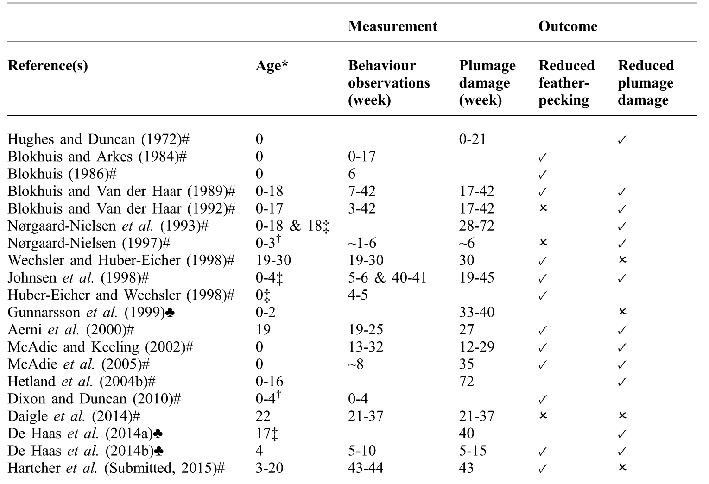
Trials have been conducted to identify practical and effective forms of EE for poultry. While one type of EE may be effective in one trial, this does not guarantee consistent effectiveness across all flocks, or conversely, an ineffective treatment may be effective in alternate settings. There is a need to repeatedly trial differing types of EE to determine which consistently reduce abnormal behaviours (Mason et al., Reference MASON, CLUBB, LATHAM and VICKERY2007). There have been equivocal findings relating to the provision of EE and the resultant incidence of SFP, some of which are reported in Table 1. It should be kept in mind that there may be a skew in publications on the effects of EE, where studies which report negative results may be less likely to be published.
Summary of publications, in chronological order, which investigated environmental factors predominantly designed to stimulate foraging behaviours, and their effect on feather-pecking and plumage damage. Additional effects on behaviours such as foraging or dustbathing are not reported here.

*Week(s) of age at which environmental enrichment was provided. One number denotes that enrichment was provided from that age onwards. Zero weeks denotes the provision of enrichment from 0, 1 or 2 days of age. Enrichment was pecking stimuli or foraging material including wood shavings, grain, straw, pecking strings etc., compared to a control treatment without access to a foraging substrate or pecking stimuli.
† Enrichment was a substrate attractive for dust bathing i.e. peat moss or sand.
‡ A foraging, or pecking stimulus as well as a non-foraging enrichment (e.g. sand) were provided.
# Denotes a study using small group sizes, whereas ♣ denotes a study which was conducted in commercial settings, with larger group size(s).
An aspect to consider in experiments investigating the effects of EE is group size. SFP may not occur to the same extent in small-groups kept in experimental settings compared to commercial situations, and EE may elicit different responses in birds kept in different group sizes. The majority of studies in Table 1 were conducted in small-groups in experimental situations. These experiments have benefits in that treatment effects may be investigated in controlled settings, with a number of replicates. However, there is a need for further studies to investigate EE in larger group sizes, in commercial or semi-commercial settings. The findings by De Haas et al. (Reference DE HAAS, BOLHUIS, DE JONG, KEMP, JANCZAK and RODENBURG2014a; Reference DE HAAS, BOLHUIS, KEMP, GROOTHUIS and RODENBURG2014b) suggested that different strains may require different management strategies, due to differing levels of sensitivity to stress and environmental stimuli. Hence the genetic background of the birds should be taken into consideration when testing EE, and when considering why the effects may vary between flocks.
McAdie et al. (Reference MCADIE, KEELING, BLOKHUIS and JONES2005) found that the provision of pecking strings from one day of age reduced SFP and improved plumage condition at 35 weeks of age. Jones et al. (Reference JONES, MCADIE, MCCORQUODALE and KEELING2002) concluded that bunches of white string are attractive pecking stimuli, but Hartcher et al. (Reference HARTCHER, TRAN, WILKINSON, HEMSWORTH, THOMSON and CRONIN2015) found no effect of pecking strings provided from 12 days of age on plumage damage at 43 weeks of age. Nørgaard-Nielsen et al. (Reference NØRGAARD-NIELSEN, VESTERGAARD and SIMONSEN1993) reported that the provision of sand and peat from one day of age, and straw during the laying period both reduced plumage damage. More recently, a study by De Haas et al. (Reference DE HAAS, BOLHUIS, DE JONG, KEMP, JANCZAK and RODENBURG2014a) on commercial farms found that the provision of pecking blocks, round bell drinkers, radios, roosters, good litter quality, and aviary housing compared to floor housing resulted in lower levels of feather damage. However, while Wechsler and Huber-Eicher (Reference WECHSLER and HUBER-EICHER1998) found that foraging material, in the form of polystyrene blocks, reduced the rate of feather-pecking, there was no effect on plumage damage. Similarly, Hartcher et al. (Reference HARTCHER, TRAN, WILKINSON, HEMSWORTH, THOMSON and CRONIN2015) found no effect of increased litter depth and the provision of whole oats in the litter during rearing on plumage damage later in life.
The rearing environment and early life experiences play important roles in the development of SFP (Rodenburg et al., Reference RODENBURG, VAN KRIMPEN, DE JONG, DE HAAS, KOPS, RIEDSTRA, NORDQUIST, WAGENAAR, BESTMAN and NICOL2013; De Haas et al., Reference DE HAAS, BOLHUIS, KEMP, GROOTHUIS and RODENBURG2014b; Janczak and Riber, Reference JANCZAK and RIBER2015). Complexity in the rearing environment may reduce fearfulness and SFP later in life (De Haas et al., Reference DE HAAS, BOLHUIS, KEMP, GROOTHUIS and RODENBURG2014b; Janczak and Riber, Reference JANCZAK and RIBER2015). Some studies have suggested that the first 10 days of a bird's life may be a critical period in which EE should be provided in order for birds to learn to interact with it (Sanotra et al., Reference SANOTRA, VESTERGAARD, AGGER and LAWSON1995; Huber-Eicher and Wechsler, Reference HUBER-EICHER and WECHSLER1997; McAdie and Keeling, Reference MCADIE and KEELING2002; Janczak and Riber, Reference JANCZAK and RIBER2015). Indeed, Johnsen et al. (Reference JOHNSEN, VESTERGAARD and NØRGAARD-NIELSEN1998) found that the substrate in the first four weeks of life had a major influence on SFP and plumage damage later in life. Nørgaard-Nielsen (Reference NØRGAARD-NIELSEN1997) found that the presence of sand in the first 21 days of life reduced plumage deterioration, while there was no effect on SFP when sand was provided from 41 days of age. Conversely, Gunnarsson et al. (Reference GUNNARSSON, KEELING and SVEDBERG1999) did not find that access to litter in the first two weeks of life affected plumage damage later in life. Similarly, De Jong et al. (Reference DE JONG, GUNNINK, ROMMERS and BRACKE2013) found no effect of the provision of substrate in the first 21 days of life on feather-scores at 40 weeks of age, although all rates of SFP and incidence of plumage damage were low in the experiment. Dixon and Duncan (Reference DIXON and DUNCAN2010) found a reduction in SFP when chicks had access to peat moss in the first four weeks of life, but did not find a correlation between substrate availability during the first two weeks of life and subsequent SFP at three and four weeks of age.
While it has been suggested that the rearing period, and particularly the first 10 days of life are important, the long-term effects of particular types of enrichment provided at different ages has yet to be determined. The current substrate is also of great importance (Blokhuis and Arkes, Reference BLOKHUIS and ARKES1984; Nicol et al., Reference NICOL, LINDBERG, PHILLIPS, POPE, WILKINS and GREEN2001; Rodenburg et al., Reference RODENBURG, VAN KRIMPEN, DE JONG, DE HAAS, KOPS, RIEDSTRA, NORDQUIST, WAGENAAR, BESTMAN and NICOL2013; Janczak and Riber, Reference JANCZAK and RIBER2015). Research is needed to identify the effects of particular types of enrichment, and the best age at which to provide it in order to prevent subsequent SFP. Various aspects and different forms of EE should be investigated (Tarou and Bashaw, Reference TAROU and BASHAW2007). For example, Sambrook and Buchanan-Smith (Reference SAMBROOK and BUCHANAN-SMITH1997) suggested that controllability of an enrichment device by animals may be more important than the device's complexity. Huber-Eicher and Wechsler (Reference HUBER-EICHER and WECHSLER1998) found that the quality and availability of foraging materials has a significant effect, and De Haas et al. (Reference DE HAAS, BOLHUIS, KEMP, GROOTHUIS and RODENBURG2014b) found that litter restriction around five weeks of age led to high levels of SFP. Key aspects to consider in the provision of EE are: the age at which it is provided, the group size to which it is provided, the type and form in which it is provided, the availability throughout the lives of the birds as well as on a daily basis, the effects on the behavioural repertoire and SFP, the practical feasibility of installing and managing EE in commercial settings, and ultimately, whether there are consistent effects of particular types of EE on bird behaviour.
Feeding behaviour and feather-eating
Redirected pecking prevails as the dominant theory to explain the cause of SFP, although conversely, SFP occurs in environments which appear to provide adequate stimuli. This has led to the suggestion that feather-eating may be a prime causal factor driving the expression of SFP (Harlander-Matauschek et al., Reference HARLANDER-MATAUSCHEK, BAES and BESSEI2006a; Bessei, Reference BESSEI2011; Bessei and Kjaer, Reference BESSEI and KJAER2015). Ethology and nutrition are both important to consider when addressing SFP, and theories relating to redirected foraging behaviour, nutritional deficiencies and feather-eating may not be mutually exclusive. Dietary deficiencies can stimulate exploratory behaviour, which may result in redirected pecking and hence the occurrence of SFP (Kjaer and Bessei, Reference KJAER and BESSEI2013). In addition to this, feather-eating may represent a form of redirected pecking. McKeegan and Savory (Reference MCKEEGAN and SAVORY1999) concluded that if feather-eating becomes established, a low availability of feathers on the floor may incite SFP.
Levels of insoluble fibre in the diet are thought to affect SFP (Hetland et al., Reference HETLAND, CHOCT and SVIHUS2004a), and feather-eating may increase in the absence of structural components or ‘roughage’ in the feed (Hetland et al., Reference HETLAND, SVIHUS and CHOCT2005; Kalmendal and Bessei, Reference KALMENDAL and BESSEI2012). Feathers increase the speed of feed passage, similar to the effects of insoluble fibre (Harlander-Matauschek et al., Reference HARLANDER-MATAUSCHEK, PIEPHO and BESSEI2006b), and Kriegseis et al. (Reference KRIEGSEIS, BESSEI, MEYER, ZENTEK, WURBEL and HARLANDER-MATAUSCHEK2012) found that the inclusion of 10% feathers in the diet reduced the amount of SFP and improved plumage condition. Birds from high SFP lines show significantly more feather-eating than birds from low SFP lines (Harlander-Matauschek and Bessei, Reference HARLANDER-MATAUSCHEK and BESSEI2005; Harlander-Matauschek et al., Reference HARLANDER-MATAUSCHEK, BENDA, LAVETTI, DJUKIC and BESSEI2007; Harlander-Matauschek and Häusler, Reference HARLANDER-MATAUSCHEK and HÄUSLER2009), and work harder for feathers (Harlander-Matauschek et al., Reference HARLANDER-MATAUSCHEK, BAES and BESSEI2006a). Additionally, birds selected for high SFP (Kjaer et al., Reference KJAER, SORENSEN and SU2001) differ in their bacterial metabolites and therefore their intestinal microbial metabolism, due to feather degradation in the gut, when compared with birds selected for low SFP activity (Meyer et al., Reference MEYER, ZENTEK and HARLANDER-MATAUSCHEK2013).
Studies have found that olfactory (McKeegan and Savory, Reference MCKEEGAN and SAVORY2001), visual (McKeegan and Savory, Reference MCKEEGAN and SAVORY1999; McAdie and Keeling, Reference MCADIE and KEELING2000; Bright, Reference BRIGHT2007), gustatory (Harlander-Matauschek et al., Reference HARLANDER-MATAUSCHEK, WASSERMANN, ZENTEK and BESSEI2008; Reference HARLANDER-MATAUSCHEK, BECK and RODENBURG2010), and tactile (Harlander-Matauschek and Feise, Reference HARLANDER-MATAUSCHEK and FEISE2009) cues may play a role in the selection of feathers for consumption. Additionally, feather characteristics may influence the selection of body areas for SFP (Harlander-Matauschek et al., Reference HARLANDER-MATAUSCHEK, BENDA, LAVETTI, DJUKIC and BESSEI2007). Feather-eating appears, in some cases, to be learnt (Ramadan and Von Borell, Reference RAMADAN and VON BORELL2008). However, the temporal relationship between SFP and feather-eating is not clear. De Haas et al. (Reference DE HAAS, BOLHUIS, DE JONG, KEMP, JANCZAK and RODENBURG2014a) found that flocks with severe plumage damage at 40 weeks of age tended to perform more feather-eating during rearing compared to flocks with no severe damage at 40 weeks, although some SFP had also developed during rearing. More information is required in order to understand the relationship between feather-eating and SFP, whether feather-eating may predict SFP, and what feathers offer to birds in terms of their role in exploration, foraging, and dietary function. It is important to elucidate the function of feather-eating, and whether it may be nutritionally driven, a behavioural need for environmental stimulation, or both.
Individual bird variation
While changes to the environment in commercial settings are made on a group level, individual bird variation is important in the expression of SFP (Jensen et al., Reference JENSEN, KEELING, SCHUTZ, ANDERSSON, MORMEDE, BRANDSTROM, FORKMAN, KERJE, FREDRIKSSON, OHLSSON, LARSSON, MALLMIN and KINDMARK2005; Brunberg et al., Reference BRUNBERG, JENSEN, ISAKSSON and KEELING2011; Rodenburg et al., Reference RODENBURG, VAN KRIMPEN, DE JONG, DE HAAS, KOPS, RIEDSTRA, NORDQUIST, WAGENAAR, BESTMAN and NICOL2013). Individual characteristics, such as levels of fearfulness, social motivation, and ability to cope with stress are implicated in the expression of SFP (Jensen et al., Reference JENSEN, KEELING, SCHUTZ, ANDERSSON, MORMEDE, BRANDSTROM, FORKMAN, KERJE, FREDRIKSSON, OHLSSON, LARSSON, MALLMIN and KINDMARK2005; Rodenburg et al., Reference RODENBURG, VAN KRIMPEN, DE JONG, DE HAAS, KOPS, RIEDSTRA, NORDQUIST, WAGENAAR, BESTMAN and NICOL2013). Wechsler et al. (Reference WECHSLER, HUBER-EICHER and NASH1998) identified 12% of birds in their experiment as ‘high rate peckers’, which initiated 39% of all feather-pecking. It was concluded that some individual birds may be characterised as performing higher rates and more severe forms of feather-pecking. Uitdehaag et al. (Reference UITDEHAAG, RODENBURG, BOLHUIS, DECUYPERE and KOMEN2009) suggested that more fearful birds may be predisposed to becoming victims of SFP, and that there is evidence for two distinct types of birds, those with a low expression of SFP and those that may have a higher susceptibility to develop SFP. In addition, some birds are more responsive to environmental conditions.
Recently, Daigle et al. (Reference DAIGLE, RODENBURG, BOLHUIS, SWANSON and SIEGFORD2015) investigated not only individual behavioural profiles, but also the consistency of birds to remain in those behavioural profiles between 21 and 37 weeks of age. Of the birds identified as severe feather-peckers at 21 weeks of age, 5% of these remained as severe feather-peckers, while 53.8% exhibited inconsistent behavioural patterns across the observation periods (during two 30 min periods at 21, 24, 27, 32, and 37 weeks of age). Kops et al. (Reference KOPS, DE HAAS, RODENBURG, ELLEN, KORTE-BOUWS, OLIVIER, GUNTURKUN, BOLHUIS and KORTE2013) reported differences between behavioural phenotype (severe feather-peckers, victims, and non-peckers) and serotonergic neurotransmission in the dorsal thalamus and striatum, leading to the hypothesis that birds initiating SFP may be more likely to do so due to genetic, neurochemical ‘deficits’, which may underpin the differences in coping strategies in behavioural tests (Rodenburg et al., Reference RODENBURG, VAN KRIMPEN, DE JONG, DE HAAS, KOPS, RIEDSTRA, NORDQUIST, WAGENAAR, BESTMAN and NICOL2013).
It has been thought for some time that there is a small number of individuals within a flock that account for the majority of SFP (Savory, Reference SAVORY1995). Additionally, it has been suggested that there may be ‘primary feather-peckers’ in a flock with genetic predispositions to perform SFP, which have an increased appetite for feathers and fibre due to their intestinal microbiota (Meyer et al., Reference MEYER, ZENTEK and HARLANDER-MATAUSCHEK2013; Bessei and Kjaer, Reference BESSEI and KJAER2015). Chickens are able to learn from each other in a number of different ways (Nicol, Reference NICOL2006), and studies have suggested that once established, SFP behaviour may readily spread throughout a flock (Zeltner et al., Reference ZELTNER, KLEIN and HUBER-EICHER2000; Rodenburg et al., Reference RODENBURG, VAN KRIMPEN, DE JONG, DE HAAS, KOPS, RIEDSTRA, NORDQUIST, WAGENAAR, BESTMAN and NICOL2013). Smaller group sizes can constrain the spread of SFP (De Haas et al., Reference DE HAAS, BOLHUIS, DE JONG, KEMP, JANCZAK and RODENBURG2014a; Bessei and Kjaer, Reference BESSEI and KJAER2015) and may also play a role in mitigating stress (Rodenburg et al., Reference RODENBURG, VAN KRIMPEN, DE JONG, DE HAAS, KOPS, RIEDSTRA, NORDQUIST, WAGENAAR, BESTMAN and NICOL2013).
Individual and strain differences imply a strong genetic component to SFP (Jones and Hocking, Reference JONES and HOCKING1999), and it is thought that genetic markers may facilitate the identification of birds that are predisposed to perform SFP. Genetic selection may be required to aid the control of SFP, by eliminating the particular physiological and genetic characteristics associated with SFP from the breeding stock (Savory, Reference SAVORY1995; Kjaer and Bessei, Reference KJAER and BESSEI2013; Bessei and Kjaer, Reference BESSEI and KJAER2015). However, more information is required on the potential relationships between SFP and other associated traits (Jones and Hocking, Reference JONES and HOCKING1999).
Conclusions
SFP is a complicated behaviour, with a number of influential factors to consider when aiming to control its expression. While the rearing period and EE are thought to be important, the most effective type of EE has yet to be determined. In addition, the full effect of EE on birds is not completely understood. That is, how the rearing environment and different types of EE affect behaviour at the time EE is provided, as well as the effects later in life. Feather-eating is thought to be related to SFP, but little is known about the specific role it plays and whether it may predict SFP. Individual variation between birds is important to consider in all elements of animal behaviour, including the propensity for birds to interact with their environment and other members of the flock, their underlying behavioural characteristics, and dietary requirements. Understanding the behavioural repertoires of birds on an individual and group level, and how different behaviours interrelate, is of great consequence in determining the most appropriate housing conditions in which to optimise bird welfare, particularly when aiming to reduce a detrimental behaviour such as SFP in commercial settings.
The environment has major effects on bird behaviour. EE should be provided while taking into account housing system, group size, and strain of bird. However, individual bird variation may be overriding, and a particular appetite for feathers may contribute to the occurrence of SFP. The role of feather-eating and individual variation should be understood in order to cater for birds’ behavioural and nutritional needs, optimise management, and investigate the potential for genetic selection programs. Therefore, future research in this area should comprise an integrated approach incorporating work on EE, feather-eating, and individual bird variation. Studies need to 1) apply various forms of EE consistently across flocks in commercial and experimental settings to identify EE that meets birds’ biological needs, and effectively abates SFP, 2) determine how feather-eating is implicated in the expression of SFP, and 3) investigate whether birds may be categorised due to their involvement in SFP, and whether phenotypic traits may be associated with SFP for future selection programs. An integrated approach has the potential to result in birds with lower genetic predispositions to perform SFP, housed in environments that address their behavioural requirements, thereby reducing the risk of SFP.
Acknowledgements
The authors gratefully acknowledge financial support in the form of a postgraduate stipend, awarded to Kate Hartcher by the Poultry Cooperative Research Centre, established and supported under the Australian Government's Cooperative Research Centres Program. The authors also thank the insightful contributions of an anonymous reviewer.