Radiofrequency-assisted valvotomy and balloon dilatation has become standard technique in many institutions as the primary procedure in neonates with pulmonary atresia with intact septum, provided that the atresia is membranous in nature and that the subvalve infundibulum is well developed. Early in the era of transcatheter intervention for this disease, the stiff end of the coronary guidewire, apart from laser and radiofrequency wires, has been used to successfully perforate the atretic pulmonary valve. The dictates of safety, efficacy, practicality, and cost have led the radiofrequency wire as the predominant technique in use today. In coronary interventions, the development of stiffer wires has enabled successful revascularisation of lesions with chronic total occlusion. The objective of this study was to determine the feasibility and safety of the Conquest Pro wire as an alternative to radiofrequency wire for perforation of atretic pulmonary valve and subsequent balloon dilatation and patent ductus arteriosus stenting in patients with pulmonary atresia with intact ventricular septum.
Methods
Between October, 2010 and May, 2011, consecutive patients with pulmonary atresia with intact ventricular septum who would otherwise have been eligible for transcatheter perforation of the atretic pulmonary valve by radiofrequency wire were subjected to similar initial intervention using the Conquest Pro coronary guidewire (Asahi Intecc Company Limited, Aichi, Japan). In the first patient, the radiofrequency generator malfunctioned at the time of the procedure. We successfully used the Conquest Pro wire for perforation and subsequent balloon dilation. In subsequent patients, we used the Conquest Pro wire electively. Verbal parental consent was obtained before the study.
As for the standard procedure with radiofrequency perforation, the essential criterion for selection was the presence of patent, well-formed infundibulum and membranous atresia of the pulmonary valve. During standard right heart catheterisation, particular attention was paid to the right ventricle, right ventricular outflow tract, and pulmonary valve. The right ventricle was classified into bipartite and tripartite according to the classification proposed by Bull et al.Reference Bull, De Leval, Mercanti, Macartney and Anderson 1 The characteristics and diameter of the right ventricular outflow tract were noted. The pulmonary valve annulus and thickness of the valve plate were also measured. As previously described for perforation with radiofrequency wire, the tip of a guide catheter, usually 4 or 5 French Judkins right catheter, was placed beneath and perpendicular to the atretic valve plate.Reference Justo, Nykanen, Williams, Freedom and Benson 2 Once the tip position was deemed to be optimal, instead of a radiofrequency wire, a 0.014″ Conquest Pro guidewire – tapered tip of 0.009″ and tip load of 9 grams, highly radio-opaque distal 20 centimetres – was pushed forward with a gentle force to perforate the valve plate and have the distal tip of the wire within the lumen of the main pulmonary artery. Once this was confirmed by biplane angiography, the wire was gently pushed and manipulated to anchor its tip in a distal branch of the left or right pulmonary artery. Over this same wire, initial balloon dilatation was then performed using a 3.0-millimetre diameter 2-centimetre length coronary balloon, followed by the appropriate sized balloon for annulus, which, in general, would be an 8-millimetre diameter Tyshak balloon (Numed Canada Incorporation, Cornwall, Ontario, Canada). Should the tip of the Conquest Pro fail to be manipulated into a distal branch pulmonary artery owing to its stiffness, a Choice PT guidewire (Boston Scientific, Miami, Florida, United States of America) would be passed alongside it through the same perforation for the above purpose.
In patients in whom the right ventricle was deemed to be of “intermediate” morphology, that is, bipartite right ventricle, tricuspid valve Z-score of −2.5 to −5.0, and tricuspid to mitral valve ratio of 0.52–0.75, the patent ductus arteriosus was electively stented.Reference Alwi, Choo, Radzi, Samion, Pau and Hew 3 The transvenous route was preferred, where a 5 French Judkins right guiding catheter is placed across the patent ductus arteriosus and the same Conquest Pro wire was used to deliver the balloon and stent assembly. The details of technique and selection of stent size and length were as previously described.Reference Gewillig, Boshoff, Dens, Merten and Benson 4 In cases where the duct was large despite cessation of prostaglandin (⩾2.0 millimetres at its narrowest diameter) at the time of the initial procedure, patent ductus arteriosus stenting was deferred until sufficient constriction had occurred.
If perforation with the Conquest Pro wire was unsuccessful, the standard technique using radiofrequency wire and subsequent balloon dilatation with patent ductus arteriosus stenting was employed. Post-procedure care and follow-up were as previously described.Reference Humpl, Söderberg and McCrindle 5
Results
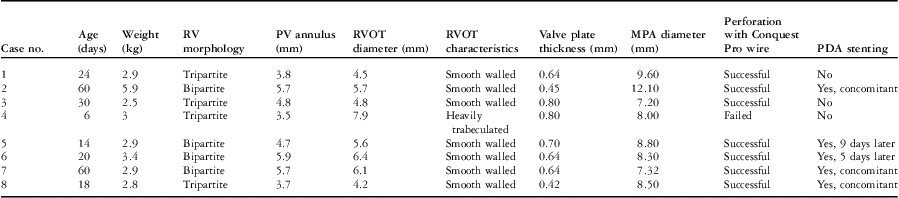
The details of eight consecutive patients are listed on Table 1. The mean age and weight at the time of the procedure were 29 plus or minus 20.4 days and 3.3 plus or minus 1.1 kilograms, respectively – the relatively late referral accounted for the mean age at which the procedure was performed, a reflection of inadequacy of paediatric cardiac service in parts of the country. The right ventricular outflow tract mean diameter was 5.6 plus or minus 1.2 millimetres. In seven patients, the right ventricular outflow tract was relatively smooth walled, and in one patient it was heavily trabeculated. The mean pulmonary valve annulus was 4.7 plus or minus 1.0 millimetre in diameter. The mean pulmonary valve plate thickness was 0.6 plus or minus 0.1 millimetre. None had valve plate thickness greater than 1.0 millimetre. None of the patients had major coronary sinusoids.
Patient data, RVOT characteristics, procedures, and outcome.

MPA = main pulmonary artery; PDA = patent ductus arteriosus; PV = pulmonary valve; RV = right ventricle; RVOT = right ventricular outflow tract
The mean intensive care ward stay and hospital stay were 5 (3–10) days and 12 (9–18) days, respectively. In two patients in whom the ducts were too large to enable ductal stenting, stenting was deferred to allow sufficient ductal tissue constriction. The intensive care ward stay was also prolonged as they were in the intensive care ward until the subsequent procedures. No mortality and no significant morbidity were noted in all patients except in patient number 5, who stayed a total of 18 days in the hospital owing to infection.
In seven patients, perforation of the atretic pulmonary valve using the Conquest Pro wire was achieved without difficulty. Subsequent balloon dilation with 3.0 millimetre coronary balloon and 8.0 millimetre valvuloplasty balloon was performed over the same wire. In one patient, the Conquest Pro wire could not be manipulated into either of the branch pulmonary arteries. Subsequently, a Choice PT wire was passed alongside the Conquest Pro, its tip manipulated and anchored in distal branch pulmonary arteries for the balloon dilations. Patent ductus arteriosus stenting was additionally performed in three patients over the Conquest Pro wire.
In one patient (patient number 4), the Conquest Pro wire failed to perforate the pulmonary valve. In this patient, the right ventricular outflow tract was large (7.9 millimetres) relative to the pulmonary valve plate (3.5 millimetres) and heavily trabeculated. The guide catheter was positioned in the right ventricular outflow tract with difficulty. The Conquest Pro wire was unable to perforate the valve, and recoiled and displaced the catheter tip out of the right ventricular outflow tract. The guide catheter was manipulated back into the outflow tract and perforation was successfully achieved with a radiofrequency wire. Subsequent balloon dilations were performed in the usual manner. On re-reviewing the angiograms, the guide catheter tip was not correctly placed beneath the valve plate but was lodged in an inter-trabecular recess. The valve plate thickness was 0.8 millimetre.
Discussion
Transcatheter pulmonary valvotomy and balloon dilatation for pulmonary atresia with intact ventricular septum has become established as the procedure of first choice in many major centres over the past decade.Reference Justo, Nykanen, Williams, Freedom and Benson 2 , Reference Humpl, Söderberg and McCrindle 5 , Reference Agnoletti, Fiechaud and Bonhoeffer 6 In some patients where the right ventricle is insufficiently developed to support the pulmonary circulation, concomitant patent ductus arteriosus stenting may be performed to avoid the need for emergent aortopulmonary shunt early in the post-procedure period.Reference Alwi, Choo, Radzi, Samion, Pau and Hew 3 , Reference Alwi 8 However, radiofrequency valvotomy is not without risk and complications such as right ventricular outflow tract perforation leading to tamponade, dissection of pulmonary artery and sepsis following the procedure.Reference Cheatham 7 In this disease with wide morphologic variation, only patients with membranous valvar atresia and a well-developed right ventricular outflow tract, in the setting of a non-right ventricle-dependent coronary circulation, should be considered for this procedure.Reference Alwi 8
Successful perforation of the atretic pulmonary valve can be achieved by radiofrequency wire, laser wire, or the stiff end of a coronary guidewire.Reference Qureshi, Rosenthal, Tynan, Anjos and Baker 9 – Reference Rosenthal, Qureshi and Chan 11 The three methods were first reported at nearly about the same time. Today, however, only the radiofrequency wire is in wide usage. In countries where it is not available or has not received regulatory approval, the sharp stiff end of the coronary wire continues to be used. Laser wire, although effective, never came into wide usage because of the high cost of initial outlay, the large bulky equipment, and perhaps most importantly the risk of retinal damage that it poses to catheter laboratory staff.Reference Cheatham 7 , Reference Gibbs, Blackburn, Uzun, Dickinson, Parsons and Chatrath 12 On the other hand, the radiofrequency method is equally effective and does not have the above disadvantages. Hence, it has become the preferred method today.
Although successful perforation of the atretic valve can be achieved with the sharp stiff end of a coronary guidewire, this is a technically demanding method.Reference Justo, Nykanen, Williams, Freedom and Benson 2 , Reference Cheatham 7 The wire stiffness may displace the more compliant guide catheter – usually a Judkin's right catheter – and may lead to perforation of the right ventricular outflow tract wall, sometimes with disastrous consequences. Furthermore, the thickness and fibrous nature of the atretic valve in some patients may require considerable force to achieve perforation, which may also risk perforating the right ventricular outflow tract wall instead. Hence, this has been rendered largely obsolete with the availability of the radiofrequency wire and generator.
One of the advances in technology for percutaneous coronary interventions in coronary artery disease is the development of guidewires for revascularisation of chronic totally occluded vessels. These wires have stiffer tips than guidewires used for general coronary interventional work. We used the Conquest Pro for perforation of pulmonary valve in this small group of patients. This is one of the stiffer guidewires available, having a tip load of 9 grams. Tip load is the weight, measured electronically, at which the tip of the guidewire buckles. For comparison, frontline guidewires for coronary work – “Workhorse” wires – have tip loads of 0.8–1.0 gram, whereas wires of intermediate stiffness such as the Choice PT have tip loads of 3.0 grams. In addition, the Conquest Pro has a tapered tip (0.009″ tip, 0.014″ body) and is slip-coated (hydrophilic) for lubricity, which we felt would serve the purpose of perforation of an atretic pulmonary valves safely, at least in the more straightforward cases. In addition, the smaller diameter of the Conquest Pro compared with commonly used radiofrequency wires (Baylis wire 0.024″ body and tip 0.021″, Osypka wire 0.018″) confers possible advantage of lower risk of serious pericardial effusion in the event of unintended perforation of the right ventricular outflow tract. Furthermore, a hole created by mechanical force is likely to be smaller than that created by burning of tissue by a hot wire tip as in the radiofrequency method.
In our study, we observed that the Conquest Pro wire was able to perforate the atretic pulmonary valve in seven of the eight cases. In these seven cases, the wire tip did not displace the guide catheter as it was being pushed across the valve plate. Perforation was also achieved without requiring an unduly large force, although this is very subjective.
In patient 4 in whom perforation could not be achieved with the Conquest Pro, the standard procedure with radiofrequency wire and subsequent balloon dilation was successful. In this particular patient, the right ventricular outflow tract appeared more complex. The wall was heavily trabeculated, but ending in a large recess (7.9 millimetres), whereas the pulmonary valve annulus was relatively small (3.5 millimetres). The valve plate also appeared thicker and this was thought to be the factor for failure. However, on re-reviewing the angiogram, we felt that it could have been due to the malposition of the guide catheter due to the large and trabeculated right ventricular outflow tract relative to the pulmonary valve.
Stiffer guidewires such as the Conquest Pro 12 has a tip load of 12 grams, whereas Conquest Pro 8–20 has a tip load of 20 grams and tapered tip of 0.008″ are available. These wires may have utility in cases where the valve plate is thick and fibrotic. However, it is advisable to have familiarity with the standard Conquest Pro wire (9 gram tip load) before using these stiffer wires for the more difficult situation. However, there is a potential problem with using a stiff coronary wire for balloon dilation once perforation of the valve is accomplished. It may be difficult to direct the stiff tip of the Conquest Pro wire into a distal lower lobe branch for a stable wire position, and excessive force may lead to dissection or perforation of the fragile vessel in the neonate. If such resistance is encountered, it is perhaps safer to change to a less stiff wire such as the Choice PT (3.0 gram tip load) for subsequent balloon dilation. This may be done by passing the wire alongside the Conquest Pro, as our practice is when using radiofrequency wire for perforation. An alternative method is to use a microcatheter to change to a less stiff wire once perforation is successful.
The use of Conquest Pro and, by extension, other wires for chronic total occluded vessels simplifies the procedure by doing away with radiofrequency wire and generator. It offers the prospect that in laboratories that do not have the radiofrequency generator, a less invasive method of managing pulmonary atresia with intact ventricular septum is still possible. It also has a significant cost advantage over the radiofrequency wire and system. However, it is wise to equip a paediatric catheterisation laboratory with radiofrequency generator and wire for the more difficult cases.
Conclusion
The Conquest Pro, a stiff coronary guidewire normally employed in revascularisation of chronic totally occluded coronary vessels, is an effective and safe method for perforation of atretic pulmonary valve in pulmonary atresia with intact ventricular septum. This, however, should be reserved for those with straightforward anatomy. This simplifies the procedure by doing away with radiofrequency wire and performing the entire procedure of valve perforation, balloon dilation, and patent ductus arteriosus stenting, if necessary, using a single wire. The utility of this technique merits further investigation. Meanwhile, radiofrequency generator and wires should be available in a paediatric intervention laboratory to deal with the more difficult cases. Figs 1–5
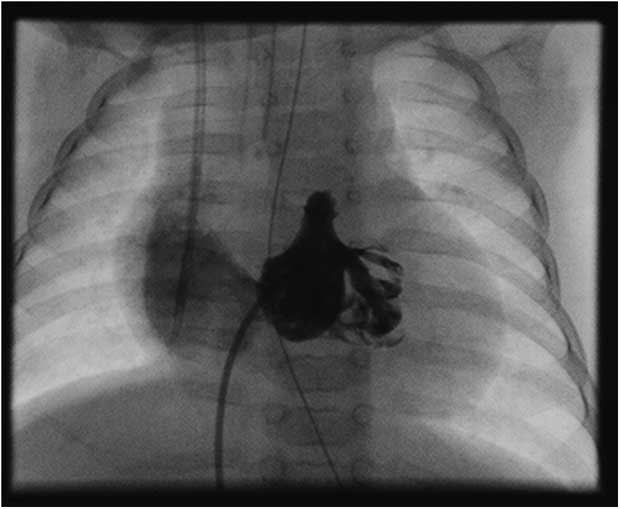
RV angiogram in AP projection. Bipartite RV- well formed inlet and outlet component. Apical trabecular component, almost obliterated by muscle with mild tricuspid regurgitation.

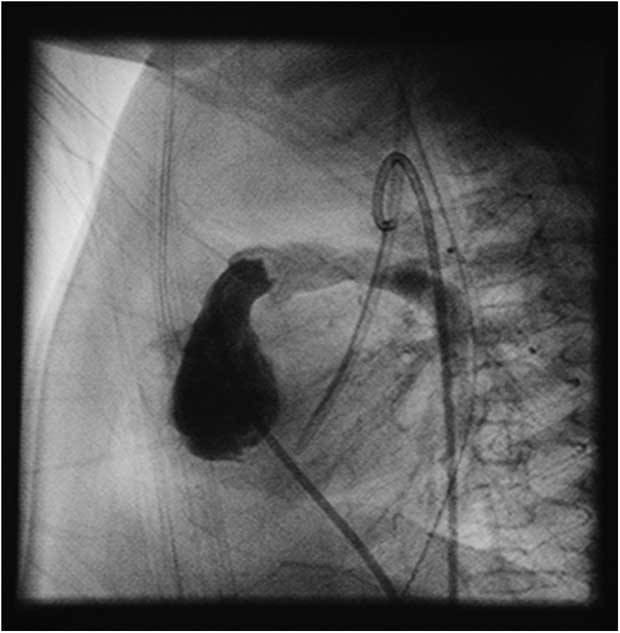
Simultaneous angiogram in RV and ascending aorta in lateral projection showing moderate RV hypoplasia and widely open, smooth walled RVOT. RVOT diameter 6.1 millimetres, pulmonary valve annulus diameter 5.7 millimetres, MPA diameter 7.3 millimetres. Membraneous atresia of pulmonary valve. Very thin valve plate (0.6 millimetre).
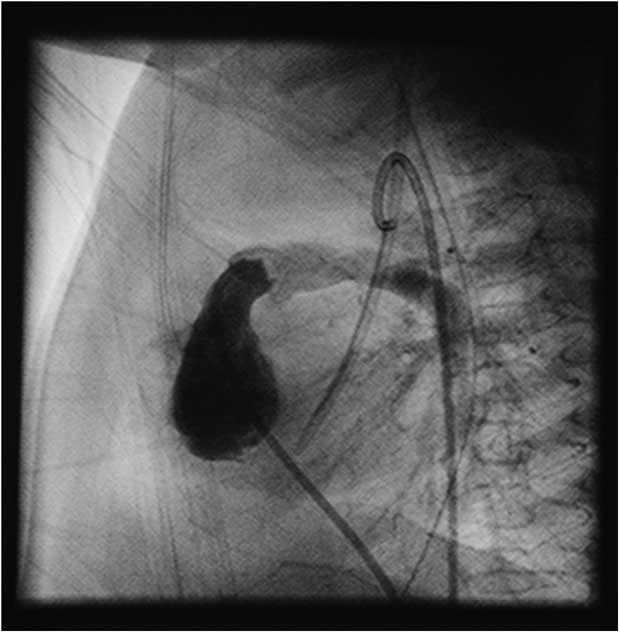
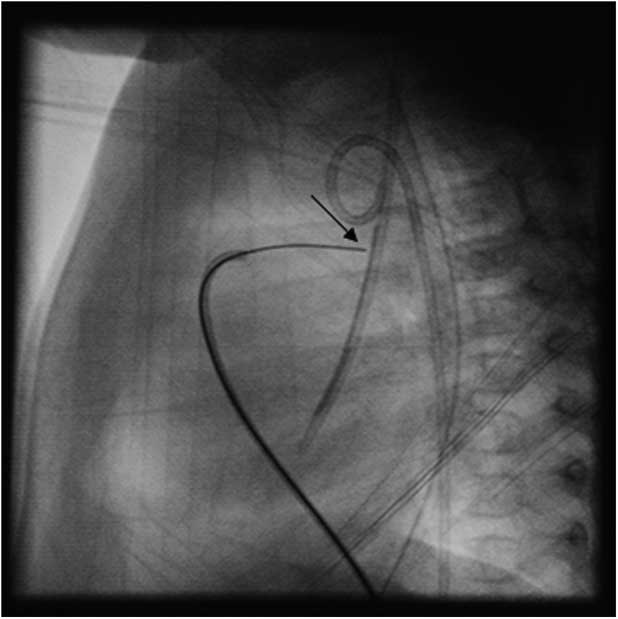
Conquest Pro wire over 4Fr Judkins Right catheter perforated the atretic pulmonary valve, its tip in MPA (arrow).

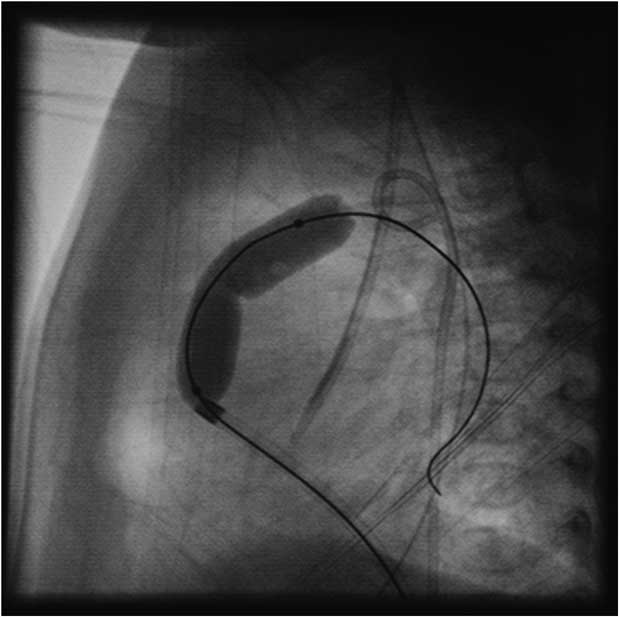
Final dilation with 8 millimetres Tyshak balloon.

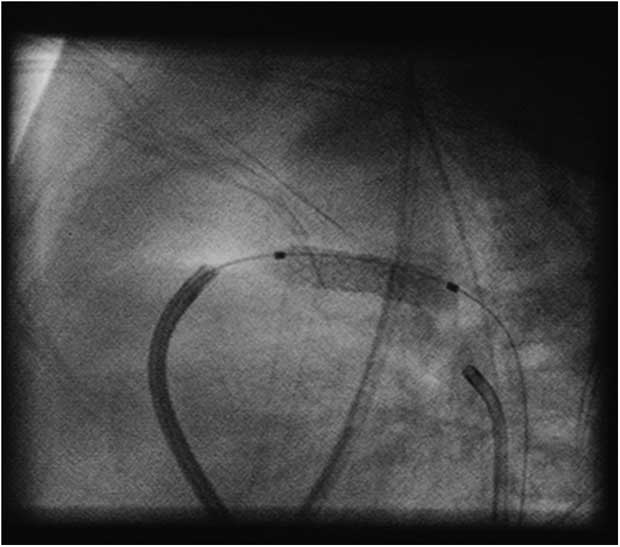
PDA stenting by antegrade method. Balloon and stent delivered via 5Fr Judkins Right Guiding catheter over Conquest Pro wire. 4.0 millimetres coronary stent expanded.