Cardiomyopathies are classified by the World Health Organisation as dilated, hypertrophic, restrictive, and right ventricular dysplasia –cardiomyopathies.Reference Richardson, McKenna and Bristow 1 The incidence of childhood cardiomyopathy is described to be 1.13–1.24 per 100,000 children in two population-based registries.Reference Lipshultz, Sleeper and Towbin 2 , Reference Nugent, Daubeney and Chondros 3 Among children with cardiomyopathy, 51–59% suffer from dilated cardiomyopathy.Reference Lipshultz, Sleeper and Towbin 2 , Reference Nugent, Daubeney and Chondros 3
Dilated cardiomyopathy is a heterogeneous group of diseases linked by a common phenotype of cardiac chamber dilation. Although children and adults share this phenotype, the underlying aetiologies might be different. In children, the leading cause of dilated cardiomyopathy is idiopathic, whereas other aetiologies are acute or chronic myocarditis, myocardial non-compaction, metabolic disorders, and neuromuscular disorders.Reference Lipshultz, Sleeper and Towbin 2 , Reference Nugent, Daubeney and Chondros 3 The degree of left ventricular dilation, left ventricular dysfunction, and mitral regurgitation has been associated with worse outcomes in paediatric dilated cardiomyopathy.Reference Canter, Shaddy and Bernstein 4 Right ventricular function is often less impaired than left ventricular function.Reference Meyer, Filippatos and Ahmed 5
Overall, dilated cardiomyopathy carries a guarded prognosis. The published one-year survival free from death or transplantation is consistent between studies at around 72%,Reference Daubeney, Nugent and Chondros 6 69%,Reference Towbin, Lowe and Colan 7 or 65%.Reference Arola, Tuominen, Ruuskanen and Jokinen 8
In contrast to the severely disappointing short-term outcome data, the prognosis improves over time and mortality declines to 1%/year. Complete recovery of heart function is seen in numerous patients.Reference Alexander, Daubeney and Nugent 9 In children, heart failure therapy consists mainly of the use of diuretics (~85%), a less frequent use of angiotensin-converting enzyme inhibitors (~68%), and infrequent use of β-blockers (<20% of patients). Overall, the treatment for paediatric dilated cardiomyopathy has changed little over the previous 25 years.Reference Harmon, Sleeper and Cuniberti 10
Many commentators argue that children may display a preserved cardiac regenerative capacity. If this is the case, then it becomes imperative to give maximum therapeutic support to promote recovery and to avoid the need for transplantation in the critical period in the first few months after diagnosis.
Methods
Patients
From 1 January, 2006, to 31 December 2012, 43 patients below the age of three years with dilated cardiomyopathy were referred to our Paediatric Heart Centre. Among them, five patients were excluded: two patients with arrhythmogenic dilated cardiomyopathy and three patients who were only seen once for a second opinion. Therefore, 38 patients (21 male, 17 female) with dilated cardiomyopathy below the age of three years were included in this study.
Our medical strategy for the long-term treatment of patients with dilated cardiomyopathy was summarised recently.Reference Recla, Steinbrenner and Schranz 11 The cornerstone for long-term treatment of chronic heart failure consists of a triple drug regime as follows: the angiotensin-converting enzyme inhibitor lisinopril, the β1-selective blocker bisoprolol, and the aldosterone receptor antagonist spironolactone. By reducing and avoiding chronic diuretic treatment, the goal was to achieve effective dosages of lisinopril and bisoprolol, both given once per day in a final dosage of 0.1–0.2 mg/kg. In the presented patients, lisinopril and bisoprolol were mostly started at a dose of 0.05 mg/kg. Drugs were adjusted according to heart rate and blood pressure control.
An off-pump open chest reversible pulmonary artery banding was offered for patients referred for heart transplantation with severe left ventricular dilated cardiomyopathy and preserved right ventricular function. Mononuclear bone marrow cell therapy was offered in the case of localised wall motion abnormalities or biventricular dilated cardiomyopathy. The entry criteria for pulmonary artery banding or cell therapy were as follows: a left ventricular end-diastolic diameter z-score above 4.5 and an ejection fraction <30% despite inotropic support. On-pump pulmonary artery banding was performed in case of an additional surgical approach such as mitral valve repair or other intra-cardiac surgery. On the basis of a compassionate treatment, informed consent was obtained before inclusion into the studies involving these invasive therapies. Some of these data have been previously published.Reference Schranz, Rupp and Muller 12 , Reference Rupp, Jux and Bonig 13
Some patients with proven mitochondrial disease or with idiopathic dilated cardiomyopathy were treated with supplementary medication consisting of Coenzyme Q10, Riboflavin, l-Carnitin, Biotin, Creatin, and antioxidative vitamins alone or in combination.
The analysis of myocardial biopsies was performed by an independent specialist pathology service.Reference Bock, Klingel and Kandolf 14
Statistical analysis
Variables are presented as mean±standard deviation, except for age and follow-up, which are presented as median. Statistical comparisons within the groups were made by paired Student’s t-test if data were distributed normally. Otherwise, comparisons were made by the non-parametric Wilcoxon two-sample test. Statistical significance was assumed at a value of p<0.05. All statistical analyses were performed with Statistica (Version 10.0).
Results
Causes for dilated cardiomyopathy
A cause for dilated cardiomyopathy was identified in 66% of the patients. Only 34% of the patients were classified as idiopathic. The rate of endomyocardial biopsies in the group of idiopathic dilated cardiomyopathy, myocarditis, and mitochondriopathies was 75%. Myocarditis was diagnosed in eight patients by cardiac biopsy sampling. Only one patient had an acute myocarditis, three patients an on-going myocarditis, and four patients had chronic myocarditis. In seven of the eight patients, a virus could be quantified with polymerase chain reaction: Parvovirus B19 in four cases, Human Herpes Virus-6 in two, and Coxsackie B3 virus in one case. A mitochondrial disease was confirmed in five patients by skeletal muscle biopsies and was highly suspected in one patient. A left ventricular non-compaction cardiomyopathy was documented in nine patients, two patients had a cardio-specific troponin mutation,Reference Luedde, Ehlermann and Weichenhan 15 and one patient had a storage disease.
Clinical presentation
The median age at presentation was six months, with the youngest child admitted on the day of birth and the oldest presenting at 26 months of age. Altogether, 95% of the children presented with congestive heart failure (Ross III–IV) corresponding with a B-type natriuretic peptide level of 3330±3840 pg/ml, an ejection fraction of 19±11%, and a left ventricular end-diastolic diameter z-score of 4.6±2.4.
Among the referred patients, 82% received inotropic therapy. Inotropic therapy was lowered and discontinued as soon as feasible. Angiotensin-converting enzyme inhibitor and β-blocker therapies were started and adjusted to a strictly low normal blood pressure. At the time of discharge, 94% of patients were established on angiotensin-converting enzyme inhibitor therapy and 94% on β-blockers. At the time of admission, 95% of patients had been prescribed furosemide by the referring institution. At discharge, diuretic therapy had been discontinued in 28% of the patients.
On the basis of the severity of presentation – Ross III–IV in 95% of the patients, listing for heart transplantation in 47% of the patients – additional compassionate therapeutical approaches were offered to 18 children and their parents. Pulmonary artery banding was performed in cases of isolated left ventricular cardiomyopathy (n=14),Reference Schranz, Rupp and Muller 12 and was associated with an additional surgical approach like mitral valve repair in five patients. A total of four patients with localised cardiac dysfunction received bone marrow-derived cell therapy.Reference Rupp, Jux and Bonig 13
Outcome
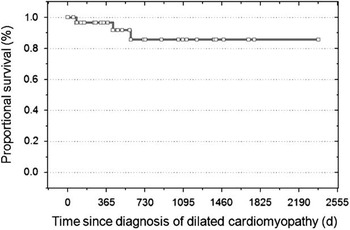
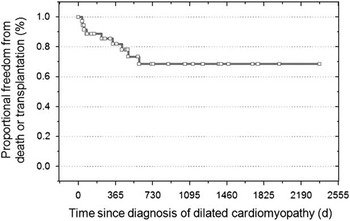
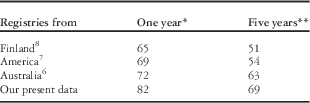
The median follow-up was 16 months (range 2–80 months). The Kaplan–Meier survival curve after the diagnosis of dilated cardiomyopathy revealed a one-year survival of 97% and a five-year survival of 86% (Fig 1). The rate of freedom from death or transplantation was 82% at one year and 69% at five years (Fig 2). Excluding a confirmed diagnosis of myocarditis, the rate of freedom from death or transplantation was 83% at one year.
Estimated survival and freedom from death for patients with dilated cardiomyopathy (DCM). Kaplan–Meier estimated freedom from death for patients after the diagnosis of DCM (n=38)

Freedom from death or transplant for patients with dilated cardiomyopathy (DCM). Kaplan–Meier estimated freedom from death or transplantation for patients after the diagnosis of DCM (n=38).

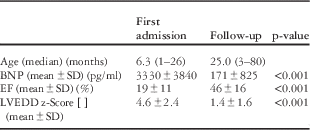
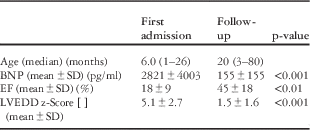
The surviving patients, who had not undergone heart transplantation, showed a significant improvement in left ventricular ejection fraction (from 19±11 to 46±16%) and left ventricular end-diastolic diameter (z-score from 4.6±2.4 to 1.4±1.6). In addition, B-type natriuretic peptide levels improved significantly (from 3330±3840 to 171±825 pg/ml) (Table 1). Although these patients with proven myocarditis (Follow-up values: B-type natriuretic peptide level 245±321 pg/ml, Ejection fraction 47±13%) were excluded, the outcome variables still show significant improvement: The B-type natriuretic peptide values decreased from 2821±4003 to 155±155 pg/ml, and the ejection fraction increased from 18±9 to 45±18% (Table 2).
Follow-up of all surviving patients with dilated cardiomyopathy (n=29).

BNP=B-type natriuretic peptide; EF=ejection fraction; LVEDD=left ventricular end-diastolic diameter
Follow-up of surviving patients with dilated cardiomyopathy (myocarditis excluded) (n=22).
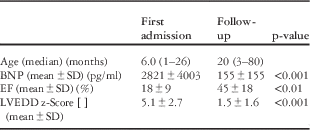
BNP=B-type natriuretic peptide; EF=ejection fraction; LVEDD=left ventricular end-diastolic diameter
Discussion
Dilated cardiomyopathy in children is a very serious disorder with a one-year rate of death or transplantation of about 30%,Reference Towbin, Lowe and Colan 7 , Reference Arola, Tuominen, Ruuskanen and Jokinen 8 and a mortality of ~1% per year thereafterReference Alexander, Daubeney and Nugent 9 ; however, given the known possibility of recovering of the heart function, which does occur in numerous surviving patients, there is a need to promote recovery and avoid heart transplantation, especially in the first few critical months after diagnosis. By using an intensive therapeutic approach, we report a transplant free one-year survival rate of 82% from diagnosis. It was not only patients with myocarditis who showed improvement, but also all other forms of dilated cardiomyopathy showed a significant improvement during follow-up. Left ventricular end-diastolic diameter, left ventricular ejection fraction, and B-type natriuretic peptide levels improved significantly.
We believe that changes of medical therapy based on pathophysiological reasons were the cornerstones of our strategy and that we can attribute the encouraging results to this. We used a long-acting angiotensin-converting enzyme inhibitor (lisinopril) and a highly specific β1-receptor blocker (bisoprolol) as an anticongestive therapy instead of the long-term use of loop-diuretics, which can stimulate the neuro–humoral axis further.
A previously reported multicentre trial showed that angiotensin-converting enzyme inhibitors and β-blockers have only a transient survival advantageReference Kantor, Abraham, Dipchand, Benson and Redington 16 , Reference Shaddy, Boucek and Hsu 17 ; however, we speculate that outcome may be improved in comparison with that previously reported trial by altering the drug choice, optimizing dosing, and reducing loop-diuretic therapy. It is generally accepted that chronically elevated stimulation of the cardiac β1-adrenergic system is toxic to the heart and contributes to the pathogenesis of congestive heart failure. Miyamoto et alReference Miyamoto, Stauffer and Nakano 18 showed the differences of β-adrenergic receptor pathophysiology between paediatric and adult patients by analysing explanted hearts of children and adult patients with dilated cardiomyopathy. They also underlined the use of β1-selective β-blockers for children in contrast to adults, in whom even an unselective β-blockade might be effective. Miyamoto et al further explained that β1-receptor stimulation in heart failure is pathological in both populations, but some preservation of β2-receptor function is beneficial. As the β2-receptor is already downregulated in chronic failure in children, further inhibition may override the benefits of β1-receptor inhibition. This may explain why clinical trials failed to demonstrate any benefit from non-specific β-blockade.
Additional to the changes in medical therapy, invasive therapeutic options were employed in selected patients with terminal heart failure. This included reversible pulmonary artery banding in patients with isolated left ventricular cardiomyopathy. Previous studies have shown beneficial effects of pulmonary banding on the systemic function of the failing right systemic ventricle in patients with congenitally corrected transposition of the great arteries or patients with d-transposition after atrial switch operation.Reference Winlaw, McGuirk and Balmer 19 Our group has previously described similar effects on the failing left ventricle in left ventricular dilated cardiomyopathy by banding of the pulmonary artery.Reference Schranz, Rupp and Muller 12 In addition, we used intracoronary bone marrow-derived cell therapy for patients with biventricular cardiomyopathy or for patients with localised wall motion abnormalities. This concept has become a promising therapy to treat myocardial infarctionReference Assmus, Honold and Schachinger 20 , Reference Jeevanantham, Butler, Saad, Abdel-Latif, Zuba-Surma and Dawn 21 and dilated cardiomyopathyReference Fischer-Rasokat, Assmus and Seeger 22 in adult patients.
Our regimen of Coenzyme Q10, Riboflavin, L-Carnitin, Biotin, Kreatin, and antioxidative vitamins was not consistent during the time period from 2006 to 2012. In fact, we do not have any clear propositions for the use of the supportive medication – Coenzyme Q10, Riboflavin, L-Carnitin, Biotin, Kreatin, and antioxidative vitamins. Further studies are clearly warranted in the future.
Of course, treating patients with standardised evidence-based medicine should always be the gold standard. This will not only guarantee the best outcome for the patients, it also allows a comparison between treatment regimens and allows the conception of clinical trials; however, because of the different underlying causes for dilated cardiomyopathy and the relatively low number of patients, new treatment strategies were considered serially in the cohort of patients with terminal heart failure. Unfortunately, this use of individualised strategies limits the statistical value of this study. Statistical analysis based on each of these interventions would result in such small numbers in each group that it is not possible to determine the independent effect of any of these therapies. A prospective study to evaluate pulmonary artery banding in dilated cardiomyopathy was, however, started at our centre, and a multicentre study is currently in preparation.
We compared our data to the results from the Pediatric Cardiomyopathy Registry from New England and Central Southwest Regions of the United States,Reference Towbin, Lowe and Colan 7 the National Australian Childhood Cardiomyopathy Study,Reference Daubeney, Nugent and Chondros 6 and with data from Finland.Reference Arola, Tuominen, Ruuskanen and Jokinen 8
Laboratorial data like that for B-type natriuretic peptide are not assessed in the cited studies. The only factor that is provided in all studies at the time of diagnosis is the left ventricular end-diastolic diameter, which was 3.3±1.2 inReference Arola, Tuominen, Ruuskanen and Jokinen 8 4.17±2.70 inReference Towbin, Lowe and Colan 7 , 4.4 (2.5–6.3) inReference Daubeney, Nugent and Chondros 6 , and 4.6±2.4 in our cohort. The higher left ventricular end-diastolic diameter in our cohort might be explained by the fact that the number of severely ill patients might be higher in our cohort, as several children were referred from other paediatric heart centres with the aim of heart transplantation. The comparable endpoint, “transplantation free survival”, is shown in Table 3.
Outcome of dilated cardiomyopathy in children.

* One-year rate of transplant-free survival (%) is given from a retrospective population study from Finland,Reference Arola, Tuominen, Ruuskanen and Jokinen 8 from the American Pediatric Cardiomyopathy Registry,Reference Towbin, Lowe and Colan 7 from the National Australian Childhood Cardiomyopathy Study,Reference Daubeney, Nugent and Chondros 6 and from our cohort
** Five-year rate of transplant-free survival (%) is given from a retrospective population study from Finland,Reference Arola, Tuominen, Ruuskanen and Jokinen 8 from the American Pediatric Cardiomyopathy Registry,Reference Towbin, Lowe and Colan 7 from the National Australian Childhood Cardiomyopathy Study,Reference Daubeney, Nugent and Chondros 6 and from our cohort
Limitations
A major limitation of the present study is the retrospective analysis with a limited number of patients. In addition, the patient cohort consists of a relatively high number of patients with proven myocarditis, with a low number of patients with idiopathic cardiomyopathy. Our goal is to perform endomyocardial biopsies, even in very small patients, to confirm the underlying aetiology of dilated cardiomyopathy. Therefore, we performed biopsies in 75% of patients with idiopathic dilated cardiomyopathy, myocarditis or mitochondriopathy, which is significantly higher than published in other reports. One could argue that the lower number of myocarditis in other studies is due to a low number of biopsies leading to false-negative data.
Unfortunately, because of the individualised treatment, stratification of each treatment is beyond the scope of this report. We propose that clinicians should treat each child with dilated cardiomyopathy and end-staged heart failure on the basis of the underlying pathophysiology until sufficient prospective randomised studies are conducted and published. We propose that available therapeutic options should be considered very carefully and instituted promptly for young children with terminal heart failure.
Acknowledgements
None.
Financial Support
This research received no specific grant from any funding agency, commercial or not-for-profit sectors.
Ethical Standards
The authors assert that all procedures contributing to this work comply with the ethical standards of the relevant national guidelines on human experimentation and with the Helsinki Declaration of 1975, as revised in 2008. The Ethics Committee of the Justus Liebig University of Giessen granted approval for this retrospective study.