Introduction
Haplosplanchnus pachysomus (Eysenhardt, 1829) Looss, 1902 is the type species for the genus Haplosplanchnus, which comprises gastro-intestinal trematodes of marine and estuarine fish species. Characteristics of H. pachysomus include the presence of a ventral sucker deeply immersed in the body, with a muscular sphincter around its opening. This species was detected mainly from mullet fish species from the Mediterranean and Black Sea, the Nile estuary, Vietnam, Australia, Fiji and Japan (Radujkovic et al., Reference Radujkovic, Orecchia and Paggi1989; Gajevskaja & Dmitrieva, Reference Gajevskaja and Dmitrieva1992; Nahhas et al., Reference Nahhas, Rhodes and Seeto1997; Besprozvannykh et al., Reference Besprozvannykh, Atopkin, Ngo, Ermolenko, Ha, Tang and Nikitenko2016; Huston et al., Reference Huston, Cutmore and Cribb2017). Conspecificity of H. pachysomus specimens from these territories was proposed based on morphometric data and analysis of several ribosomal DNA (rDNA) sequences of H. pachysomus from Vietnam and Australia and single sequence from Spain (Blasco-Costa et al., 2008, unpublished; Besprozvannykh et al., Reference Besprozvannykh, Atopkin, Ngo, Ermolenko, Ha, Tang and Nikitenko2016; Huston et al., Reference Huston, Cutmore and Cribb2017). This data set is not enough for the adequate estimation of fixed substitutions between rDNA of trematodes from geographically distant regions. Moreover, within Haplosplanchnidae, trematodes with similar morphology and considerable molecular differences are known (Atopkin et al., Reference Atopkin, Besprozvannykh, Ha, Nguyen and Nguyen2020a). Here we present morphometric and molecular data for adult trematodes that are morphologically similar to H. pachysomus, which were extracted from the intestine of Mugil cephalus Linnaeus, 1758, collected in the Black Sea (Sevastopol, Kerch). Using 28S rDNA sequence data, we considered taxonomic membership of trematodes denoted as H. pachysomus specimens from distant geographic regions.
Material and methods
Collection of trematodes
During 2001–2019, M. cephalus were collected in two different biotopes – the water area of Sevastopol (44°35′19.7″N, 33°31′20.6″E) and off the coast of Kerch (45°21′11.2″N, 36°28′27.5″E), Black Sea. Using a complete helminthology autopsy (Bykhovskaya-Pavlovskaya, Reference Bykhovskaya-Pavlovskaya1969), 99 specimens of M. cephalus measuring 24–53.5 cm in length were analysed. The intestines of fishes were examined by the compressor method (Bykhovskaya-Pavlovskaya, Reference Bykhovskaya-Pavlovskaya1969) between two glass slides. Detected trematodes were fixed in 70% ethanol. Adult worms (n = 15) were stained with acetocarmine according to the standard method (Roskin & Levinson, Reference Roskin and Levinson1957). The degree of colour was differentiated by ‘iron water’ (H2O + Fe2O3) and acidified alcohol (70% ethanol + 3% hydrochloric acid). After dehydration in ethanol of various concentrations (70, 80, 90 and 100°) and clarification in clove oil, trematodes were mounted in Canadian balsam (Roskin & Levinson, Reference Roskin and Levinson1957). The found trematodes were studied using an Olympus CX41 microscope equipped with a CX50 camera with the software Infinity Analyze (Shinjuku, Tokyo, Japan). All measurements are given in μm, presented as a range followed by the mean and standard deviation in parentheses. One sample was also fixed in 96% ethanol for molecular analysis. All voucher mounts of H. pachysomus from M. cephalus in the Black Sea were deposited in the Collection of Marine Parasites (CMP) in the A.O. Kovalevsky Institute of Biology of the Southern Seas, Sevastopol; sample data are available at http://marineparasites.org (Dmitrieva et al., Reference Dmitrieva, Lyakh, Kornyychuk, Polyakova and Popyuk2015). Deposition numbers CMP: 15 vouchers (registration numbers 1331.Tr.3k.v1-3; 1332.Tr.3k.v4-6; 1333.Tr.3k.v7-10; 1334.Tr.3k.v11; 1335.Tr.3k.v12-13; 1337.Tr.3k.v14-15).
After the parasites were detected, we assessed the following indicators of infection in M. cephalus: invasion extensity (IE), invasion intensity (II) and abundance index (AI).
DNA extraction, amplification and sequencing
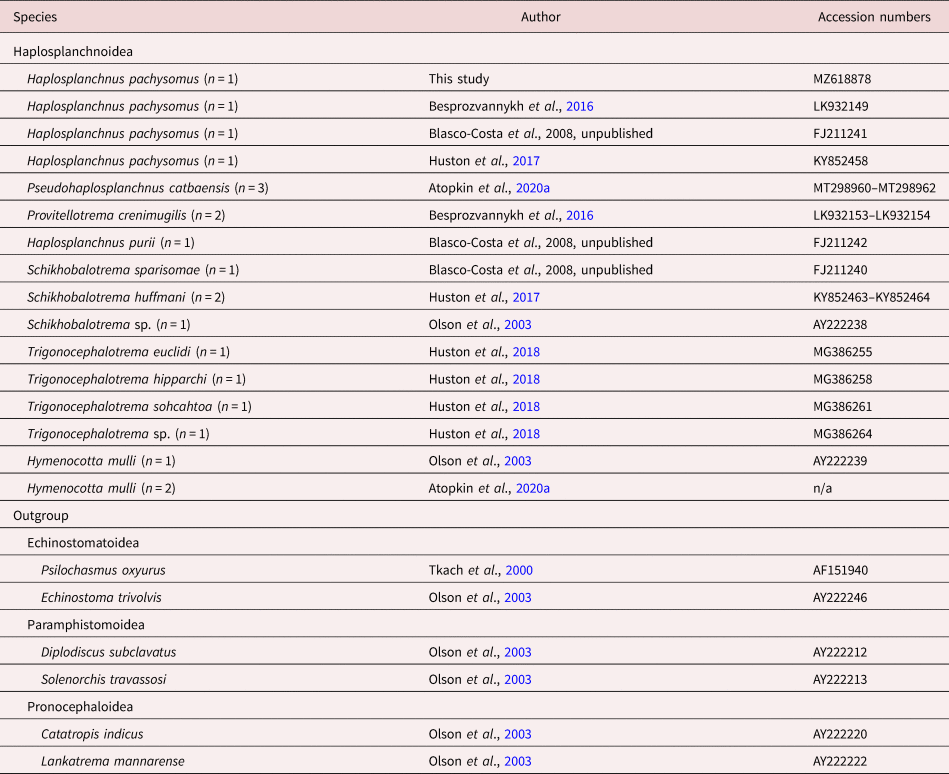
An adult specimen of H. pachysomus (n = 1) from the Black Sea was used for molecular analysis (table 1). Total DNA was extracted using the innuPREP Mini Kit (Analytik Jena, Jena, Germany). A worm was incubated in 100 μl of lysis buffer with 5 μl of Proteinase K at 56°C for two hours, and subsequently mixed by vortex for 20 s. DNA extraction was carried out according to the manufacturer's protocol. The elution volume was 30 μl. The DNA was stored at −20°C.
List of taxa incorporated in the molecular analysis of the superfamily Haplosplanchnoidea with the number of 28S rDNA sequences given in parentheses.

The 28S rDNA was amplified using U178 forward primer (5′ GCA CCC GCT GAA YTT AAG 3′) (Lockyer et al., Reference Lockyer, Olson and Littlewood2003) and LSU1500R (5′ GCT ATC CTG AGG GAA ACT TCG 3′) (Tkach et al., Reference Tkach, Grabda-Kazubska, Pawlowski and Swiderski1999, Reference Tkach, Pawlowski and Mariaux2000). The polymerase chain reaction (PCR) was performed in a total volume 20 μl mix, consisting of 5xPCR Screen Mix (Evrogen, Moscow, Russia) with magnesium chloride, 0.5 μM of each primer and 2 μl template DNA. The 28S rDNA was amplified using the following conditions: initial denaturation at 95°C for 3 min, followed by 35 cycles of denaturation at 94°C for 40 s, annealing at 56°C for 30 s and extension at 72°C for 45 s, the final extension at 72°C for 4 min.
PCR products were directly sequenced using an ABI Big Dye Terminator v.3.1 Cycle Sequencing Kit (Applied Biosystems, Waltham, Massachusetts, USA), as recommended by the manufacturer, with the internal sequencing primers, described by Tkach et al. (Reference Tkach, Littlewood, Olson, Kinsella and Swiderski2003) for 28S rDNA. PCR products were analysed using an ABI 3500 genetic analyser at the Federal Scientific Center of the East Asia Terrestrial Biodiversity FEB RAS. Sequence date were submitted to the National Center for Biotechnology Information (NCBI) database with the accession number MZ618878. .
Alignment and phylogenetic analysis
The rDNA sequences were assembled with SeqScape v.2.6 software (Applied Biosystems, Waltham, Massachusetts, USA). Alignments and estimation of the number of variable sites and sequence differences were performed using MEGA 7.1 (Kumar et al., Reference Kumar, Stecher and Tamura2016).
Phylogenetic analysis of nucleotide sequences was undertaken using maximum likelihood (ML) and Bayesian inference (BI) methods. Prior to analysis, the nucleotide substitution model was estimated using Akaike's information criterion for ML (Akaike, Reference Akaike1974) and Bayesian information criterion for BI (Huelsenbeck et al., Reference Huelsenbeck, Ronquist, Nielsen and Bollback2001) using jModeltest v.3.07 software (Darriba et al., Reference Darriba, Taboada, Doallo and Posada2012). The model TVM + I+G (Posada, Reference Posada2003) was estimated as those best fitting the 28S rDNA sequence data for both ML and BI analyses. Phylogenetic trees were reconstructed with PhyML 3.1 (Guindon & Gascuel, Reference Guindon and Gascuel2003) and MrBayes v.3.1.2 software (Huelsenbeck et al., Reference Huelsenbeck, Ronquist, Nielsen and Bollback2001). A Bayesian algorithm was performed using the Markov chain Monte Carlo option with ngen = 10,000,000, nruns = 2, nchains = 4 and samplefreq = 100. Burn-in values were 250,000 for ‘sump’ and ‘sumt’ options. Phylogenetic relationship significance was estimated using posterior probabilities for both ML and BI analyses (Huelsenbeck et al., Reference Huelsenbeck, Ronquist, Nielsen and Bollback2001).
Phylogenetic relationships were inferred from our data and the nucleotide sequences of 28S rDNA from other trematode specimens from the superfamily Haplosplanchnoidea, obtained from the NCBI GenBank database (table 1).
Results
Haplosplanchnus pachysomus (Eysenhardt, 1892)
Taxonomic summary
Type host. Mugil cephalus Bleeker.
Type locality. Black Sea coastal water, (1) near Sevastopol (44°35′19.7″N, 33°31′20.6″E) and (2) near Kerch (45°21′11.2″N, 36°28′27.5″E)
Site of infection. Intestine.
Intensity of infection. II = 138 ± 45, AI = 57 ± 20 ind., IE = 41%. Sevastopol: II = 262 ± 103 ind./specimen, AI = 76 ± 33 ind., IE = 29%. Kerch: II = 51 ± 9, ind./specimen, AI = 30 ± 7 ind., IE = 60%.
Description
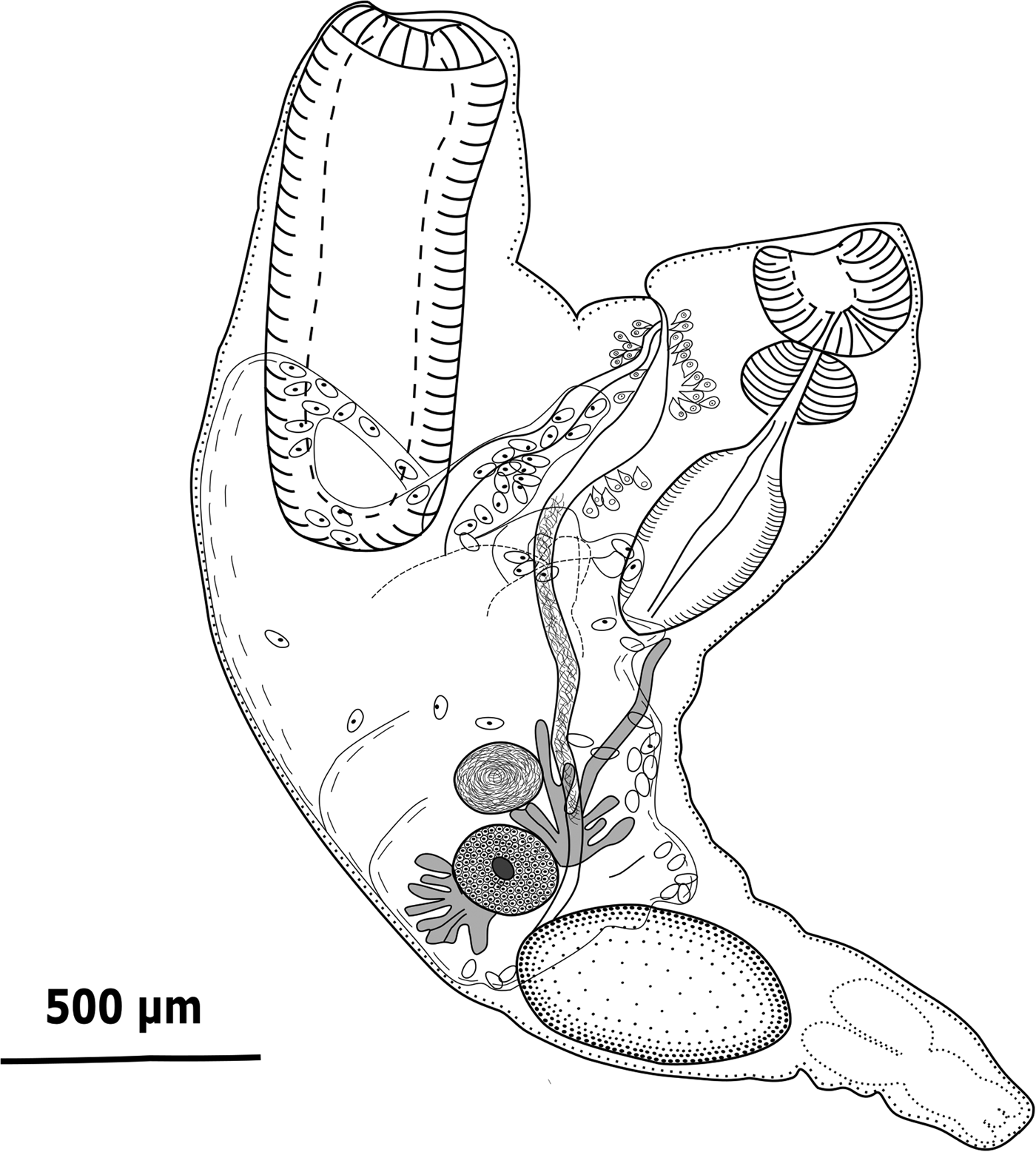
Based on 15 specimens (fig. 1; table 2). Body oval-shaped in the dorso-ventral position, Y-shaped in the lateral position. Body width 445–787 (575 ± 30) at pharynx level (width 29–23% of body length), 683–1909 (1206 ± 78) at ventral sucker level (44–57%) and 214–565 (382 ± 24) at testicle level (14–17%). Oral sucker spherical, muscular, subterminal. Ventral sucker with thick muscular walls and a deep cavity with a muscular sphincter (sucker length ratio 1:0.25–0.28; width ratio 1:0.85–0.96), in second quarter of body. Forebody long, 35–45% of body length. Prepharynx absent or short, pharynx round or oval, adjacent to the oral sucker. Oesophagus shorter than pharynx (oesophagus-length-to-pharynx-length ratio 1:0.69–0.7). Caecum singular, reaches posteriorly, to the level of the posterior margin of the ventral sucker, ends blindly at 55–69% from posterior extremity; post-caecal field length 846–2333 (1550 ± 98). Cirrus-sac absent. Prostatic part elongated with thickened walls, surrounded by prostatic cells. Prostatic cells large, lie free in parenchyma. Hermaphroditic duct short. Genital pore at the level of pharynx between oral and ventral sucker. Vitelline follicles few, elongated, extend from testis to lower end of caecum. Testis single, round or oval, in the posterior third of body. Post-testicular portion 227–582 (375 ± 23); post-testicular field 15–17% of body length. Ovary pre-testicular, seminal vesicle tubular. Uterus well developed, between testis and ventral sucker. Eggs numerous, operculate; developed miracidia with two eyespots (n = 125). Excretory bladder Y-shaped.
Haplosplanchnus pachysomus ex Mugil cephalus from the Black Sea. Lateral view.

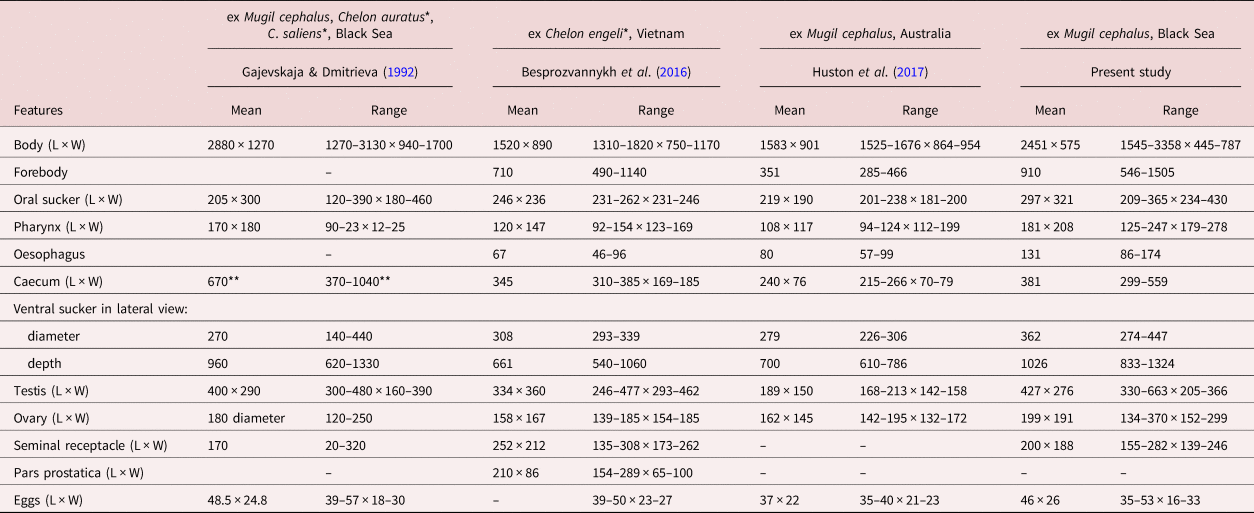
Morphometrics (measurements in mm) of Haplosplanchnus pachysomus after Gajevskaja & Dmitrieva (Reference Gajevskaja and Dmitrieva1992) and the present study.

L, length; W, width.
* Mentioned as genus Liza in respective publications. Measurements are given in μm.
** measurements from Gajevskaja & Dmitrieva (Reference Gajevskaja and Dmitrieva1992) given for oesophagus + caecum.
Molecular data
The alignment consisted of 1093 bp for the 28S ribosomal RNA (rRNA) gene of H. pachysomus, including a single individual from M. cephalus from the Black Sea basin. The nucleotide composition of the 28S rDNA fragment was 27.6% for T(U), 21.0% for C, 21.9% for A and 29.6% for G bases, which was typical for Haplosplanchnus and closely related genera (Pseudohaplosplanchnus, Provitellotrema, Hymenocotta). A 1093 bp 28S rDNA sequence from this study was identical to that for H. pachysomus from Spain (FJ211241) and differed from H. pachysomus from Vietnam (LK932149–LK932152) and Australia (KY852458) by eight variable sites.
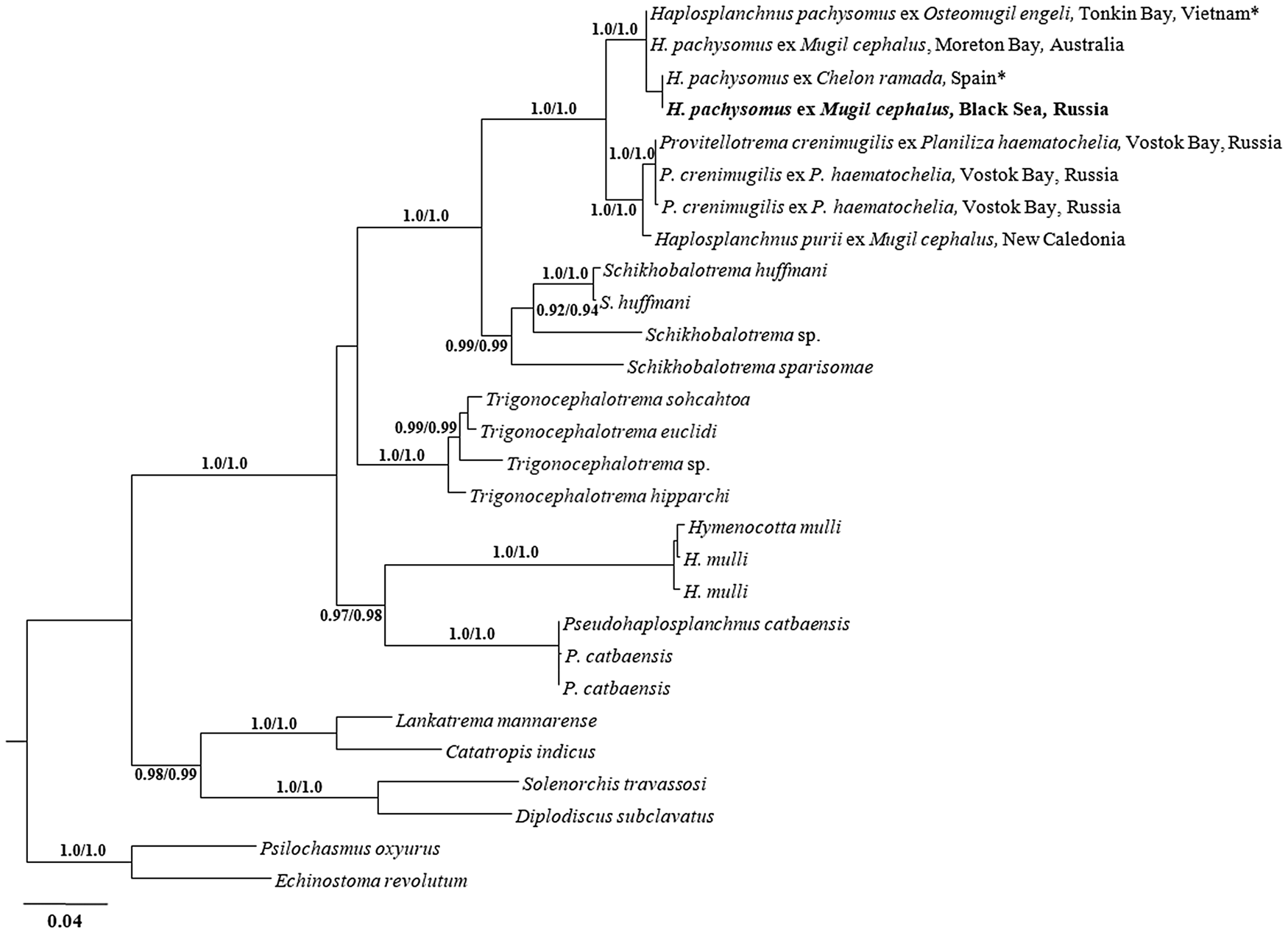
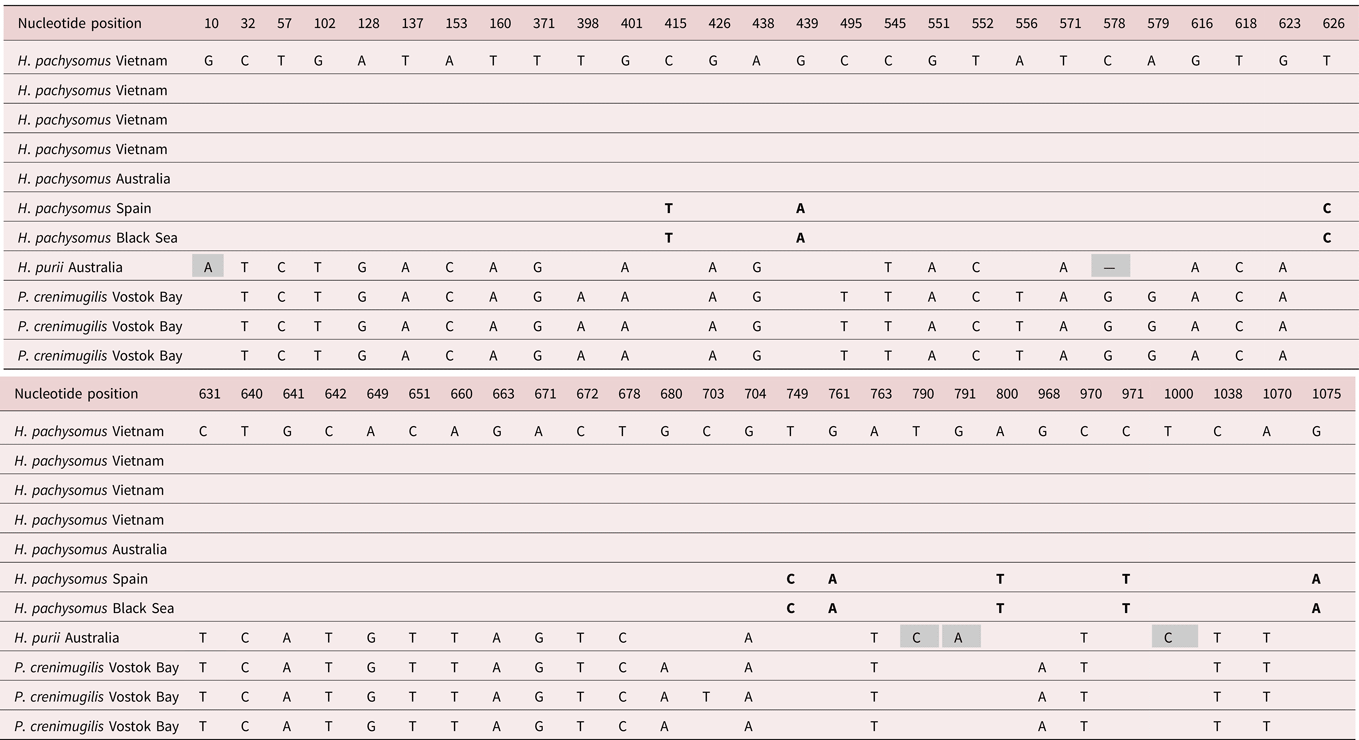
Phylogenetic analysis from our study, based on 1093 bp 28S rDNA sequence data, generated identical tree topology with ML and BI algorithms, and showed that H. pachysomus from the Black Sea was in the same clade as other sequences from the specimens sampled in Spain, Vietnam and Australia (fig. 2). However, within this clade, specimens from the Black Sea formed a distinct branch with H. pachysomus from Spain. Detailed analysis of sequence differentiation showed that specimens from the Black Sea and Spain were identical to each other and differed from trematodes from Vietnam and Australia by eight fixed substitutions, including four A/G and four T/C transitions (table 3), representing 0.75 ± 0.25% differentiation.
Phylogenetic tree of the family Haplosplanchnidae based on the analysis of partial 28S rRNA gene sequences; nodal numbers indicate posterior probabilities for ML/BI algorithms. Sequence from the present study is bolded. *Mentioned as genus Liza in respective publications. Scale bar shows the percentage of genetic variation.

Variable nucleotide positions of 1093-bp fragment of 28S rDNA sequences of some Haplosplanchnidae species. Nucleotide positions with fixed substitutions of different Haplosplanchnus pachysomus specimens are bolded. Nucleotide positions with species-specific substitutions of Haplosplanchnus purii are marked in gray.

Discussion
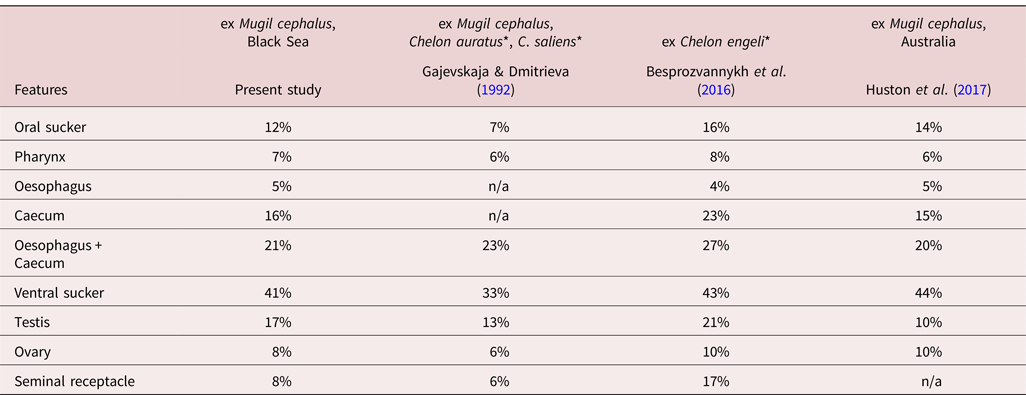
Adults of H. pachysomus from our material were morphologically indistinguishable with specimens of H. pachysomus reported from fish species of the genera Liza and Mugil from the Black Sea basin; of Charon engeli from Tonkin Bay, Vietnam; and of M. cephalus from Moreton Bay, Australia (Gajevskaja & Dmitrieva, Reference Gajevskaja and Dmitrieva1992; Besprozvannykh et al., Reference Besprozvannykh, Atopkin, Ngo, Ermolenko, Ha, Tang and Nikitenko2016; Huston et al., Reference Huston, Cutmore and Cribb2017). General morphological characteristics included the presence of a cannulated ventral sucker, which was deeply immersed in the body with a thick-walled sphincter around its opening. At the same time, H. pachysomus from our study possessed higher maximal values of body length, oral sucker, diameter and depth of ventral sucker, oesophagus, testis and ovary, in comparison to trematodes from Vietnam and Australia (table 2). Specimens from the Black Sea from the study of Gajevskaja & Dmitrieva (Reference Gajevskaja and Dmitrieva1992) were similar to our specimens, using most of these maximal metric parameters. Metric data on H. pachysomus ex Liza saliens (Caspian Sea) and M. cephalus from Lake Borullus, the Nile estuary and Japan, provided by Radujkovic et al. (Reference Radujkovic, Orecchia and Paggi1989), possessed considerably smaller ventral sucker depth size, which was comparable with that of specimens from Vietnam and Australia. Besprozvannykh et al. (Reference Besprozvannykh, Atopkin, Ngo, Ermolenko, Ha, Tang and Nikitenko2016) reported that H. pachysomus from Vietnam had the greatest morphometric similarity with specimens of H. pachysomus from fish of the genera Liza and Mugil from the Black Sea basin. Later, Huston et al. (Reference Huston, Cutmore and Cribb2017) reported that Australian H. pachysomus from their study were identical to Vietnamese specimens by morphology and 28S rDNA sequence data. Additionally, we performed an analysis of general metric parameters relatively to overall body size (table 4). The results of this analysis indicate that there are no agreements between morphological features and geographical origin of H. pachysomus samples, except ovary size, which represents 6% relative to body size for H. pachysomus from the Black Sea and 10% for trematodes from Vietnam and Australia. However, this single difference is not enough for proposing differentiation of H. pachysomus at interspecific level.
Features (length) relative to overall body size, %.

In the present study, the H. pachysomus specimen ex M. cephalus from the Black Sea was identical to one from Spain and differs from specimens from Vietnam and Australia by eight fixed substitutions, representing 0.75 ± 0.25% of differentiation. For comparison, genetic p-distance values between two sequences of Schikobalotrema huffmani from East and North-East Australian coasts was 0.38 ± 0.18%, resulting from four substitutions, including two T/C transitions and two different transversions.
Interspecific values of genetic p-distances for other genera of Haplosplanchnidae ranged from 1.03 ± 0.33% to 2.82 ± 0.49% in Trigonocephalotrema, and from 6.76 ± 0.74% to 8.83 ± 0.82% in Schikhobalotrema. Molecular studies of Haploporidae, another group of intestinal parasites of mullet fish, indicate interspecific divergence levels from 0.9 to 4.8% for Saccocoelium and from 0.8 to 3.4% for Forticulcita (Blasco-Costa et al., Reference Blasco-Costa, Balbuena, Kostadinova and Olson2009; Andrade-Gómez & García-Valera, Reference Andrade-Gómez and García-Varela2021) for Mediterranean and Nearctic species. Concerning Palaearctic and Indo-West Pacific trematodes, at least four fixed nucleotide substitutions with genetic divergence values 0.37 ± 0.19% can characterize morphologically different species of Parasaccocoelium (Besprozvannykh et al., Reference Besprozvannykh, Atopkin, Ermolenko and Nikitenko2015a, Atopkin et al., Reference Atopkin, Besprozvannykh, Ha, Nguyen and Nguyen2020a) and 4.77 ± 0.6% for Vietnamese Pseudohaploporus (Atopkin et al., Reference Atopkin, Besprozvannykh, Ha, Nguyen and Nguyen2020b). Additionally, studies of another haploporiid trematode Skrjabinolecithum spasskii indicated that fixed substitutions can occur on morphometrically identical specimens from the same location and the shared definitive host specimen (Atopkin et al., Reference Atopkin, Beloded and Ngo2015; Besprozvannykh et al., Reference Besprozvannykh, Atopkin, Ngo, Beloded, Ermolenko, Ha and Tang2015b). In that case, specimens with five fixed substitutions of the 28S rDNA fragment were recognized as conspecific. Proceeding from our data and analogous studies, H. pachysomus trematodes from Spain and the Black Sea and from Vietnam and Australia can be considered as representatives of one or two different species. On the one hand, geographically isolated H. pachysomus from the West Palaearctic and Indo-West Pacific regions differs by eight fixed substitutions of 28S rDNA sequences, resulting in genetic divergence values 0.75 ± 0.25%, which correspond to interspecific levels for some haploporid and haplosplanchnid genera. Moreover, specimens from the Black Sea and Vietnam were collected from different host species (M. cephalus and O. engeli, respectively), which may provide an additional means for separating these populations besides geographical isolation. Although Australian H. pachysomus were also extracted from M. cephalus, this mullet species may represent a complex of multiple species spanning different biogeographic regions (Heras et al., Reference Heras, Roldan and Castro2009; Whitfield et al., Reference Whitfield, Panfili and Durand2012) and, thus, host may represent an actual difference between the Black Sea and Indo-West Pacific populations. On the other hand, the 28S-rDNA-based phylogenetic tree does not provide good resolution for H. pachysomus specimens. Moreover, recent complex studies of Gogrocephalidae show that one species, Gorgocephalus yaaji, can be distributed overall Indo-West Pacific region in association with definitive hosts distribution (Huston et al., Reference Huston, Cutmore, Miller, Sasal, Smit and Cribb2021). In light of this, we conclude that specimens of H. pachysomus from Mediterranean and Indo-West Pacific regions can be considered as two cryptic species, although it is possible that these populations represent one widespread species. Final taxonomical interpretation of this divergence level is difficult within this study, because of the significance of fixed substitutions in 28S rDNA sequences for species delimitation within Haplosplanchnidae, which needs to be estimated with additional representative molecular data across geographic range.
Eight nucleotide positions, affected with fixed substitutions, of 28S rDNA of H. pachysomus specimens from different locations, contained identical bases in Australian and Vietnamese H. pachysomus and H. purii from New Caledonia. Hypothetically, this result indicates species-specific molecular differentiation because of geographical isolation characterized by site-specific nucleotide substitutions at least for 28S rDNA sequences. The 28S rDNA sequences of H. pachysomus and H. purii contain 38 to 46 substitutions, depending on their geographic origin, including eight transversions: T/A (5), T/G (2), A/C (1) (table 3). Haplosplanchnus purii was genetically similar to Provitellotrema crenimugilis ex Planiliza haematochelia, collected in Vostok Bay, Russia. Genetic differentiation between these two species ranged from 0.94 ± 0.28% to 1.03 ± 0.3% by 28S rDNA sequences, containing 11 substitutions, including two transversions T/A (table 3). Notably, T/A transversions are more frequent in 28S rDNA sequences of studied species, ascribing it as a perspective molecular marker for species delimitation within this group of trematodes. Interestingly, H. purii differed simultaneously from both H. pachysomus and P. crenimugilis with five nucleotide positions, including four substitutions and one gap (table 3). However, four of the nucleotide positions contained the same bases in H. pachysomus and P. crenimugilis. Thus, only a single gap at position 578 of 1093 bp 28S rDNA can be considered as a unique species-specific molecular characteristic for H. purii on the basis of available molecular data at present. Separately, H. purii was more similar to P. crenimugilis, demonstrating only ten (excluding one gap) sites with different bases, whereas between H. purii and H. pachysomus six of the same ten sites contained identical nucleotides vs. 41 from other variable sites for these two species. These results provide a good molecular base for including H. purii into the genus Provitellotrema. However, the availability of only single 28S rDNA sequence of H. purii hinders the adequate estimation of fixed substitutions between nucleotide sequences of this species with H. pachysomus and P. crenimugilis. On the other hand, genetic differentiation values range between [H. pachysomus] and [H. purii + P. crenimuglis] clades (3.78 ± 0.6% to 4.09 ± 0.59%) are intermediate relatively to internal values for Trigonocephalotrema (1.03 ± 0.33% to 2.82 ± 0.49%) and Schikhobalotrema (6.76 ± 0.74% to 8.83 ± 0.82%) and considerably lower intergeneric values, proposing belonging of H. purii, P. crenimugilis and H. pachysomus to the same genus. Thus, we agree with Huston et al. (Reference Huston, Cutmore and Cribb2017) and Besprozvannykh et al. (Reference Besprozvannykh, Atopkin, Ngo, Ermolenko, Ha, Tang and Nikitenko2016) that additional data are needed for final taxonomical conclusions to be made about P. crenimugilis and H. purii.
Acknowledgements
We express our deep gratitude to the head of the parasitology lab of FSC Biodiversity FEB RAS, V.V. Besprozvannykh, PhD for valuable advice and comments regarding the form and content of this article.
Financial support
This work was supported by the federal budget of the Russian Academy of Sciences (project numbers 121030100028-0, 0207-2021-0008 and 0228- 2019-0002).
Conflicts of interest
None.
Ethical standards
The authors assert that all procedures contributing to this work comply with the ethical standards of the relevant national and institutional guides on the care and use of laboratory animals.