1 Introduction
“Learning is not something that happens to students; it is something that happens by students.” (Zimmerman, Reference Zimmerman1989: 21)
It is reported that Japanese university students spend few hours outside of class preparing for classes and doing study related to their courses. Yamada (Reference Yamada2009) found that approximately 72% of Japanese university students spend ten hours or fewer per week on outside-of-class study. Moreover, even though about 44% of students had twenty or more class hours per week, fewer than 8% of students spent sixteen hours or more per week studying outside of class.
According to a survey carried out with 48,233 university students, one out of four university students believe that everything necessary to learn should be taught in class and they should not have to learn independently outside of class (Center for Research on University Management and Policy, 2007).The reliance of students on in-class study may account for findings that teacher intervention plays a dominant role in the learning of Japanese university students (Kondo, Reference Kondo2009; Takeuchi, Reference Takeuchi2008). Thus, if a high portion of the hours spent on outside-of-class study were usually spent on teacher-directed assignments, students might find it difficult to manage their own learning opportunities.
In the study reported in this paper, MALL practices were used to encourage, in the long term, a form of self-study called self-instruction, which is defined as “a deliberate long-term learning project instigated, planned, and carried out by the learner alone, without teacher intervention” (Jones, Reference Jones1998: 378). Those who can initiate and maintain self-instruction engage in SRL. Boekaerts, Pintrich and Zeidner (Reference Boekaerts, Pintrich and Zeidner2000) stated that self-regulation involves a number of integrated micro-processes which include goal-setting, strategic planning, the use of effective strategies to organize, code, and store information, the ability to monitor and talk about learning, action and volitional control, effective time management, and ability to sustain self-motivational beliefs in order to create a long-term congenial learning environment.
A number of studies have reviewed the literature on the effectiveness of SRL (see for example: Azedo & Crowley, Reference Azedo and Crowley2004; Zimmerman, Reference Zimmerman2008); however, the question regarding Japanese EFL university students is why, in spite of attempts to teach learning strategies for self-study, so little time is devoted by students to out of class learning. This is not only a Japanese phenomenon. Pressley and McCormick (Reference Pressley and McCormick1995) found that students seldom used strategies taught in experimental studies spontaneously in non-experimental learning contexts, such as when studying at home. An explanation may be that experimental contexts are a short step away from conventional teacher-directed learning, at least in the students’ minds. This is indeed a pity because in classroom teaching, teachers typically hope to create, through their mediation, an ideal SRL-environment where students generate the ideas, feelings, and behaviors required to reach the class's learning goals (Zimmerman & Schunk, Reference Zimmerman and Schunk2001).
Kukulska-Hulme and Shield (Reference Kukulska-Hulme and Shield2008), in an overview of mobile assisted language learning, define MALL as formal or informal learning mediated via handheld devices which are potentially available for use anytime, anywhere. Handheld devices include mobile phones and tablet computers with Internet capability and other devices without Internet access such as electronic dictionaries, MP3 players, and game players.
A review of mobile learning projects funded by the European Union since 2001 (Pęcherzewska & Knot Reference Pęcherzewska and Knot2007) confirms that mobile phones are the most frequently used device in these projects, followed by PDAs and other handhelds, with personal listening devices (e.g. iPods) receiving little attention. In Japan, mobile phones have become an indispensable part of young people's lifestyle. Mobile phone ownership among high school students is now 97.1% (Cabinet Office, 2011a). This situation and the development of the ubiquitous learning platform have encouraged universities to create mobile phone MALL opportunities.
A survey of Japanese university students (Thornton & Houser, Reference Thornton and Houser2005) showed that a majority of students preferred to receive study materials on mobile phones rather than on PCs. The students said the mobile phones were easy to use and they believed it was an effective learning method. Stockwell (Reference Stockwell2010), however, has found that some learners at universities in Japan do not take advantage of mobile phone MALL opportunities created by teachers. Stockwell's findings (Reference Stockwell2008) that even though more than two-thirds of the learners in his study were interested in using mobile phones for language learning, the actual overall use of mobile phones for vocabulary learning tasks was low. This could possibly be explained by the likelihood that claims to a preference for using mobile phones to access the Internet are based on experiences of gathering information to make personal travel plans, reading background information on topics of personal interest, and self-selected school learning projects. It is important to find out in what ways learners might be willing to use mobile phones for teacher-mediated language learning.
Other studies (e.g., Kunori, Reference Kunori2005; Honma, Reference Honma2002) report the following disadvantages of the educational use of mobile phones: high user fees, variability in the data processing rate among devices, variability of signal quality, limited battery life, complications related to URL or ID entry, and on-campus Internet security issues.
In order to investigate the potential of MALL to encourage SRL behavior without having to find solutions to problems raised by mobile phones, we framed the research aims and chose the mobile device accordingly.
2 The MALL project
Two studies were carried out in an attempt to verify the following two hypotheses.
1. The use of a MALL device with a learning module, designed within a principled SRL framework called ‘Academic learning cycle phases’, will result in students spending more time on self-study.
2. Students will continue to engage in independent self-study with the MALL device after they complete the learning module.
2.1 The MALL device
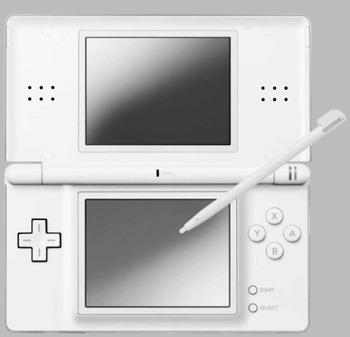
In our study, the handheld device for MALL was the Nintendo DS Lite (see Figure 1). The Nintendo DS Lite is a dual-screen handheld game console. It has two separate LCD screens, the lower of which is a touch screen designed to accept input from a stylus pen which is a component of the device. It also features a built-in microphone with a wireless capability which allows players to interact with each other within a short range, and online with the Nintendo Wi-Fi Connection service.
Nintendo DS Lite

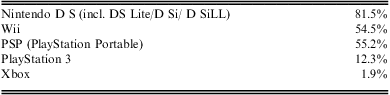
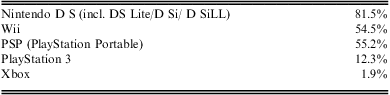
The device was chosen for three reasons. First, among the options it was the least costly mobile device, an important consideration if we were to purchase mobile devices in future. In addition, the IE Institute, a company which produces software for the Nintendo DS, was generously willing to provide the mobile devices at no cost for the study. Second, using the Nintendo DS would not be a novel experience as it was the most familiar of mobile devices. According to a government report on the use of game consoles by young people (Cabinet Office, 2011b), the Nintendo DS is the most popular game console (see Table 1). One hundred percent of the students in the present study had had at least some experiences with the Nintendo DS, and their experiences were positive. Third, this device did not have the distracting multiple functions and costly Internet access of mobile phones. Moreover, we could also avoid dealing with privacy issues related to teacher imposition of learning materials on private phones.
2.2 The MALL learning module
The TOEIC MALL project, reported in this paper, explored ways to incorporate experimental MALL practices for improving students’ scores on the TOEIC Listening and Reading Tests with existing compulsory language skill-building courses by developing a new module for one of these courses for first-year university students at Kyoto University of Foreign Studies. This module did not consist of conventional teacher-led teaching materials that students would study as part of their course in conventional lesson assignments or in-class activities. The learning module was intended to be used by students independently outside of class. The MALL project aimed to transfer the responsibility for taking action to learn from the teacher to the students themselves.
A five-step learning module was designed and implemented by the authors in order to foster a beginning form of self-study – self-directed study in which students made their own decisions about whether to study or not – and then, in the long term to support students’ gradual transition to a more independent subset of self-study, self-regulated learning. The learning module was used with a Nintendo DS mobile device and its software, DS More Training for the TOEIC Listening and Reading Tests. It was hoped that the close match of this device with current student lifestyles would prove it to be a motivating MALL vehicle.
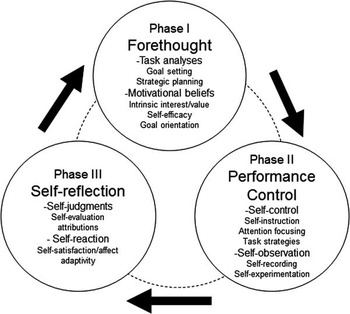
The five-step learning module was organized according to SRL principles of a continuous academic learning cycle (see Figure 2) described in the work of Schunk and Zimmerman (Reference Schunk and Zimmerman1998) which was further developed by Cleary and Zimmerman (Reference Cleary and Zimmerman2004). The three phases of the cycle are a process which we anticipated would facilitate the transfer of a sense of ownership of the learning from the teacher to the student.
Academic learning cycle phases

The first phase of the cycle is forethought, intended to be self-motivating, in which students analyze their tasks, set goals, and plan strategies to achieve their goals. The second phase is termed performance control. In this phase, self-instruction is based on self-determined focuses of attention in order to plan learning task strategies. Self-observation of the processes and products of learning aims at achieving a sense of personal control. The third phase, intended to restart the cycle, is self-reflection in which students make self-judgments by evaluating their own learning and attributing the various results to consequences of their own needs and their own actions. The aim of the third phase is to achieve a feeling of satisfaction that may lead to the development of adaptability as the students learn how to deal with unexpected, as well as expected, consequences of their learning.
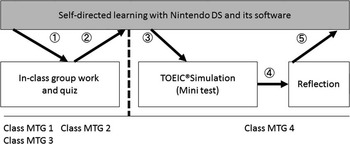
The five steps of the learning module are described in Figure 3 below:
The five steps of the learning module

For our purposes we defined SRL as learning in which students would use the Nintendo DS mobile device and the selected software in order to accomplish independently-set personal goals by doing self-selected learning activities that the students deemed to be appropriate for their preferred learning styles. The SRL could occur either in the class, elsewhere in the university, or outside the university.
2.3 Learning Programs on the Nintendo DS
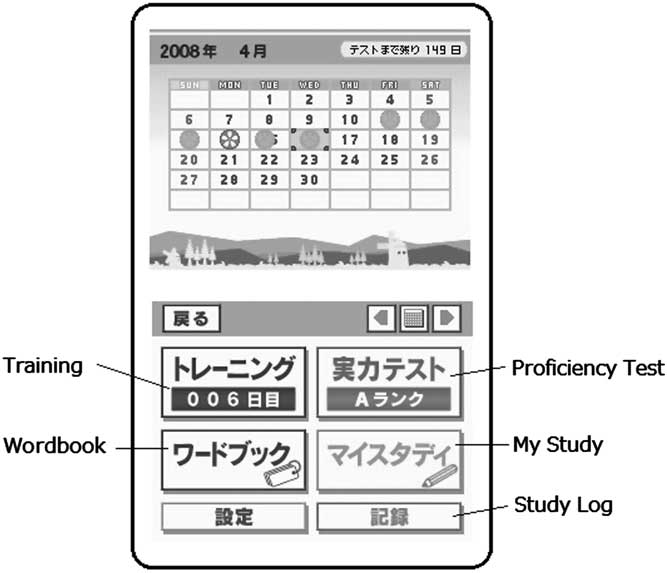
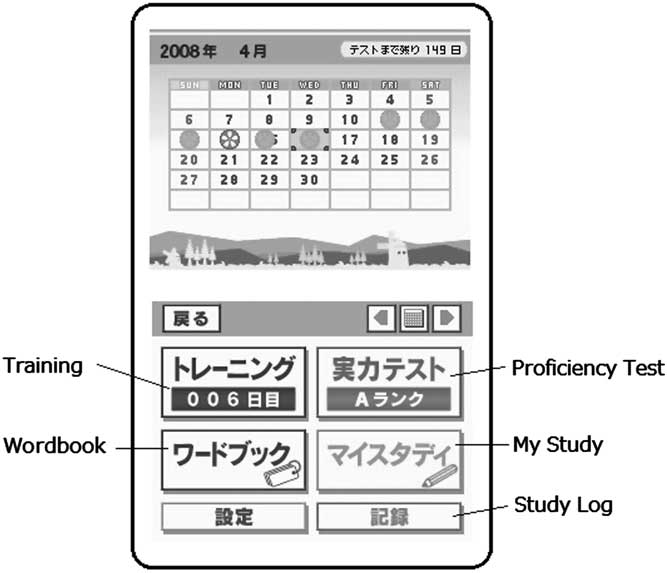
Figure 4 is the main menu screen of the learning software, ‘DS More Training for the TOEIC Listening and Reading Tests’. Explanations of the functions follow.
Main menu screen
2.3.1 Training
The Training function provides learners with practical exercises that are similar to an actual TOEIC test (Parts 1 to 7). Each part is divided into four difficulty levels. Each test item is accompanied by an explanation so that learners have an opportunity to learn what knowledge and skills they need to correctly answer the questions. Learners can also review their incorrect answers.
2.3.2 Wordbook
The Wordbook function helps learners to learn vocabulary which may be useful for TOEIC. All of the words included in this application were carefully selected by researching recent TOEIC trends in vocabulary use. Wordbook provides three ways to build up vocabulary: memorizing words by writing them, listening to the words, and using flash cards. As Wordbook works in conjunction with Training, learners can improve their vocabulary by focusing on the words that they have trouble with in answering the questions in the Training section.
2.3.3 Proficiency Test
The Proficiency Test includes twenty items (ten Reading section items and ten Listening section items) to assess learners’ English proficiency levels After the test it provides learners with an estimate of the score they would get on the TOEIC test. All the results are displayed as graphs. In the present study, this section was used as simulation for the actual full test (see step 4 in Figure 3).
2.3.4 My Study
My Study allows learners to develop skills and knowledge in four areas: reading, listening, grammar and vocabulary. Learners can choose the area that they want to work on. Each area is divided into five difficulty levels.
During the MALL project, whether they studied or not and what they studied was left entirely up to the students. They worked on self-selected items in order to meet their own objectives.
3 Study 1
Study 1 was conducted to investigate our first hypothesis: The use of a MALL device with a learning module, designed within a principled SRL framework called ‘Academic learning cycle phases’, will result in students spending more time on self-study.
3.1 Participants
Eighty-eight first-year students in four sections of a compulsory language skill-building course for first-year students at Kyoto University of Foreign Studies, participated in Study 1 in the first semester. Students were assigned to one of four sections by the alphabetical order of their surnames by the Office of Educational Affairs. Each section was taught by a different teacher. In order to minimize the effect of having four different teachers involved in the study, the teachers held regular planning and reflection meetings.
Forty-two students were included in the MALL group and 46 students were included in a control group. All of the participants in both the MALL group and the control group were also taking two other compulsory and two elective language skill-building courses.
3.2 Methods
Five steps of a 30-minute learning module were designed to be used with the Nintendo mobile device with the MALL group of students. For the control group, a 30-minute learning module was designed to be used with a popular TOEIC self-study textbook. The control group was not given a mobile device. Pre- and post-tests were conducted before the course started and at the end of the course. The students also completed course evaluations.
3.3 Results and discussion
3.3.1 Pre- and post-tests
In order to discover whether the students’ scores on the TOEIC tests improved, pre- and post-testing was conducted at the beginning of April before the first semester started and at the end of July at the end of the semester.
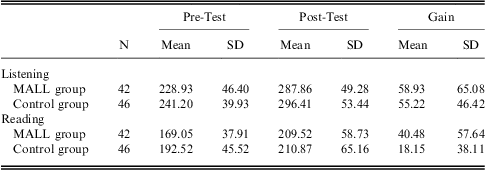
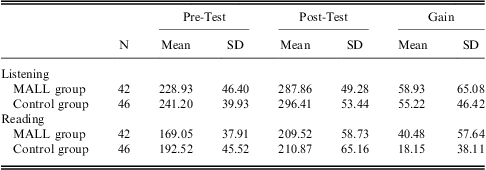
Since the participants divided into the MALL and control groups had not been placed in their classes according to their English proficiency levels, the participants’ English abilities were not homogeneous by class. Therefore, the increase in scores between the two groups was compared by the Mann-Whitney U test. The increase in scores in the MALL group was 99.4 and that in the control group was 73.4. The scores of the students in the MALL group showed a significant increase (p = .0389).
Students in the MALL group increased their scores in both the listening and reading sections (Listening: 58.93, Reading: 40.48), as shown in Table 2. Students in the control group increased their scores by 18.15 in the reading section. The increase in scores in the listening section by the MALL group, compared to the control group, was not significant (Mann-Whitney U test, p = .5361), whereas the increase in scores in the reading section of the MALL group, compared to the control group was significant (Mann-Whitney U test, p = .0310).
A comparison of the increase of the scores of the two groups in the listening and reading sections of the TOEIC Listening and Reading Tests
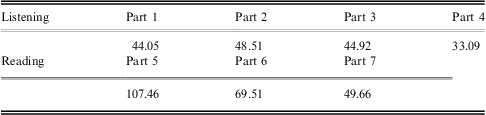
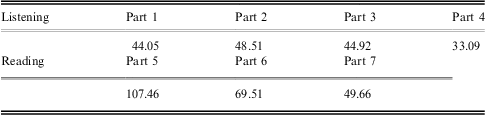
This may have resulted from the fact that the MALL participants studied for the reading section of the TOEIC Test with the mobile device outside of class more than they did for the listening section, as shown in Table 3. Moreover, as shown in Figure 3, in one step of the learning module the students in the MALL group held discussions in class, before they did the quizzes and the TOEIC simulations, about how they had prepared for the quizzes and the simulations with the mobile device outside of class. They also talked about how they solved the questions. This opportunity to share their learning experiences and to analyze language learning is considered constructive for language learners (Swain, Reference Swain1998); it may have been more helpful for the reading section because some of the problems with the listening section may have been related to pronunciation issues which may take more time to overcome.
Number of minutes the participants studied for the TOEIC Listening and Reading Tests
3.3.2 Post Course Evaluation
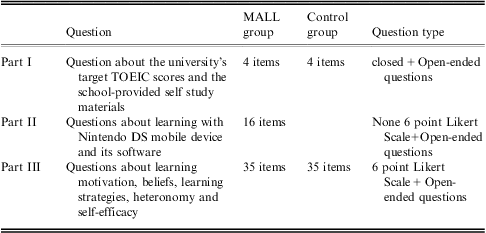
In order to investigate whether studying with the five-step learning module based on an SRL framework influenced students’ self-study behavior, a post-course student evaluation was conducted. The questionnaire for the post course evaluation consisted of three parts. The details are shown in Table 4.
Questionnaire

Of the 35 questions in Part III, five questions about self-efficacy are from the Strategies for Learning Questionnaire (Pintrich & De Groot, Reference Pintrich and De Groot1990); five questions about learning motivation are from the Attitude/Motivation Test Battery (Dörnyei, Reference Dörnyei1990; Gardner, Reference Gardner2004); nine questions about learning strategies are from the Strategy Inventory for Language Learning (Oxford, Reference Oxford1990) and the Metacognitive Awareness Inventory (Schraw & Dennison, Reference Schraw and Dennison1994: Kubo, Reference Kubo1999); six questions about heteronomy are from Kondo (Reference Kondo2009); and ten questions about beliefs are from the Beliefs about Language Learning Inventory (Horwitz, Reference Horwitz1985, Reference Horwitz1987; Kondo, Reference Kondo2009).
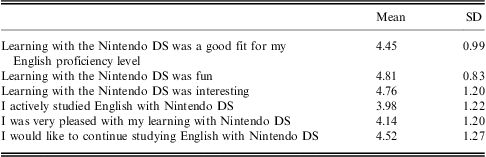
As shown in Table 5, the participants in the MALL group were interested in learning with the mobile device. Note the responses to two items, ‘Learning with the Nintendo DS was fun’ (Mean: 4.81, SD: 0.83) and ‘Learning with the Nintendo DS was interesting’ (Mean:4.76, SD: 1.20) indicate a high degree of student interest. Further evidence of the students’ interest can be found in the fact that all the participants in the MALL group used the mobile device and its software, and it was used an average of 104.18 minutes per week (Table 3). Moreover, 81% of the participants gave a rating of 4 or higher (ratings of 4, 5, and 6 respectively correspond to the ratings of agree, somewhat agree, and strongly agree) with the item, ‘I would like to continue studying English with the Nintendo DS.’
Self-evaluation of learning with the Nintendo DS
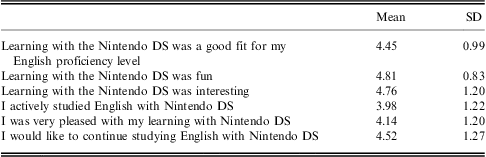
The mean rating for the question, ‘The Nintendo DS mobile device is very useful because it can be used anywhere, anytime’ was 5.0 (SD: 1.21). This result indicates that the students placed a high value on its mobility. This view is further supported by the participants’ comments in the open-ended questions in Part II of the post-course evaluation (Table 4): Student 1 – “It's nice to study with the Nintendo DS because I always have it with me and I can use any place I want.” Student 2 – “I often feel like using it during the break between classes because it starts up very quickly.”
On the item, ‘I didn't study with the Nintendo DS device unless we had quizzes in class,’ 61% of the participants gave ratings lower than 3 (the ratings of 3, 2 and 1 respectively correspond to disagree, somewhat disagree, and strongly disagree). This result reveals that the participants were motivated to use the mobile device by factors other than quizzes.
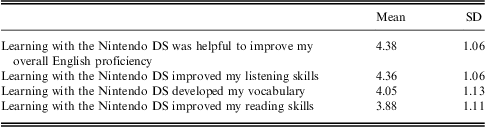
As for the MALL participants’ writing, speaking, and listening skills in English, they believed that they had improved their skills, as shown in Table 6. Many of the participants felt that they improved their listening skills more than their reading skills. This is inconsistent with the comparison of the pre- and post-tests (Table 2). The reason why the participants did not feel that they improved their reading skills as much (when in fact they had) may have been due to the small size of the touch screen of the mobile device: the participants accessed the reading comprehension section, Part 7, for a much shorter time compared to the other parts of the reading test (see Table 3) and it may have been difficult for them to read the long text passages on the small screen. This may have compounded a normal fatigue factor for the last section of the test.
Participants’ beliefs about improvements in their language skills
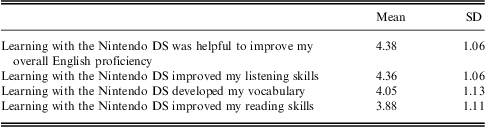
The mean score of the item, ‘Learning with the Nintendo DS improved my reading skill’ was relatively low compared with the other mean scores. This may have been because the participants considered the term ‘reading skill’ to mean the ability to read the passages in Part 7 and not to complete the grammar and vocabulary questions in Parts 5 and 6.
3.4 Summary of findings
According to Tables 2, 3 and 5, the use of the MALL device and learning materials facilitated students’ self-directed learning, an early stage of self-study. The MALL group who were free to use the mobile device as they wished had improved scores on the reading section of the TOEIC Tests, and they also claimed to be interested in continuing to learn with the mobile device.
4 Study 2
Study 2 was conducted to investigate our second hypothesis: Students will continue to engage in independent self-study with the MALL device after they complete the learning module.
4.1 Participants
Fifteen students out of the 42 students in the MALL group in Study 1 willingly chose to participate in Study 2. There was no control group. The Nintendo DS mobile device with its software was given to the participants during the fall semester. The device and its software were the same materials used in Study 1 during the spring semester.
4.2 Methods
The 35 items of the students’ post-course evaluations, referred to in Table 4, conducted at the end of the course in the spring semester were given to the students in the fall semester. The scores on the TOEIC Tests are from the three tests taken by the MALL participants in April, July and January. In addition, the Students Thinking About Problem Solving Scale (STAPSS) which consists of 37 6-point Likert scale items (Armour-Thomas & Haynes, Reference Armour-Thomas and Haynes1988) was given to the students at the end of the course in the fall semester. To find out how often the students used the mobile device, the learning log data from the Nintendo DS mobile device were analyzed. All of the students were interviewed at the end of the fall semester.
4.3 Results and discussion
4.3.1 The TOEIC tests
The TOEIC tests were taken three times, at the beginning of the spring semester in April, at the end of the spring semester in July and at the end of the fall semester in January. Table 7 reveals that the average score of the TOEIC tests in April was 428.67, and 514.67 in July, whereas the average score of the TOEIC tests taken in January was 497.33. Six participants out of fifteen increased their scores on the TOEIC tests. The average increase in their scores was 50.83. The TOEIC scores of nine participants did not increase from July. The average difference of all fifteen students, comparing the results of the July test with the January test, was −17.34. There was a four-month break between the pre-test and the post-test, and almost a six-month break between the post-test and the delayed post-test. The two month longer break could have led to a reduction of the practice effect and lower scores for some students.
The average score of the TOEIC Tests (n = 15)

4.3.2 Learning log data
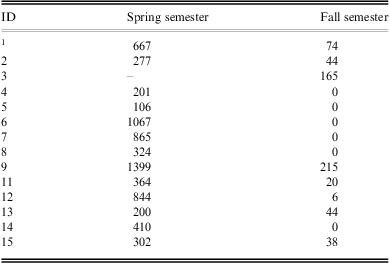
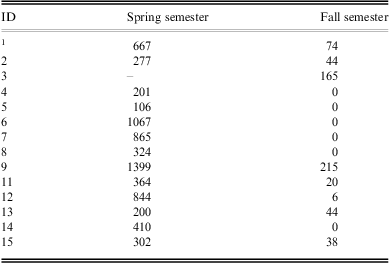
The average total time students spent using the Nintendo DS mobile device in the spring semester was 700.00 minutes, and in the fall semester it was 158.13 minutes. Student 3 erased the learning log data. However, six participants out of fifteen did not use the Nintendo DS mobile device at all in the fall semester. The TOEIC scores of these six participants did not increase between July and January. Thus, six of the nine participants whose scores were lower in January than in July stopped using the mobile device. These six participants used the device and its software in the spring semester and five of the six participants scored higher in July than in April. The average increase of their scores between April and July was 95.83. Table 8 shows the time the students spent using the mobile device in the spring and in the fall semesters.
The time spent using the Nintendo DS mobile device (n = 14)
The interviews conducted at the end of the fall semester revealed some of the reasons why the students did not use the mobile device in the fall semester as often as in the spring semester. The following are representative comments from four students. The first two are from students who improved their scores and the last three comments were made by students whose TOEIC scores showed no improvement.
Student 1: I studied with the Nintendo very often. I sometimes used it just to listen to Parts 2, 3 and 4. I think it was good practice for me to listen to English sounds and try to improve my listening skills. (Similar comments were made about using it mainly for listening by two other students.)
Student 2: I used the DS and I bought a TOEIC textbook and used it for the reading parts. It was good for me to study for the reading part in two ways, the Nintendo and pencil and paper. (A similar comment about finding an additional personal learning strategy was made by one other student.)
Student 3: I had quizzes in the spring semester so I felt I should study with the Nintendo DS. In the fall semester, we didn't have any quizzes or tests. That's why I didn't use it. I can't study unless I am forced to. If it's totally up to me, I don't study.
(Comments about not being able to study without some imposed course structure or schedule were made by two other students.)
Student 4: I had a lot of things to do in the fall semester besides studying. I was really busy so I didn't study as much as I did in the spring semester. It wasn't just for TOEIC, it was for all of my courses. (Comments which indicated differences in motivation, or available time, or study patterns between the spring and fall semesters were made by three other students.)
Student 5: After I did the TOEIC Test in summer, I lost interest because my friends were not using it much at first in the fall so I didn't use it much either. (Two other students referred to the negative influence of friends.)
4.3.3 Correlation between the scores of the January TOEIC tests, the STAPSS, and the time spent using the mobile device
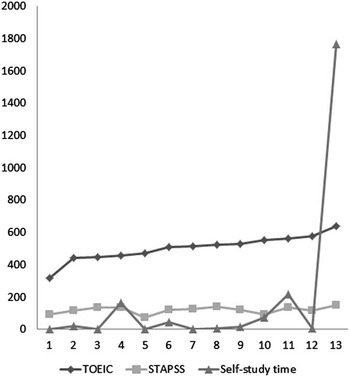
The correlations between the scores of the January TOEIC tests and the STAPSS (p = .249), the correlation between the STAPSS and the time spent using the mobile device (p = .158), and the correlation between the time spent using the mobile device and the scores of the January TOEIC tests (p = .072) were not significant. Figure 5 shows the relationships between the scores of the delayed post-test, the STAPSS, and the time spent using the Nintendo DS mobile device for each participant. Two participants did not take the STAPSS and their results are not included. Participant 13 used the mobile device longer than the other students –1,766 minutes in the second semester, had the highest score on the TOEIC Tests and the highest STAPSS score.
Relationship between the scores of the January TOEIC test, the STAPSS, and the time spent using the mobile device (n = 13)

4.3.4 Differences between the spring and fall semesters in self-efficacy, motivation, metacognition, heteronomy and the time spent using the mobile device
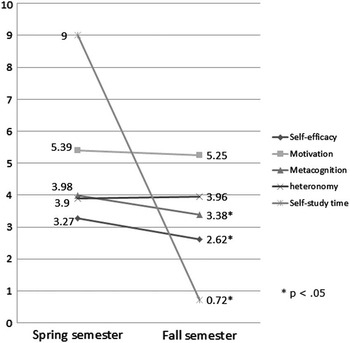
Figure 6 shows the differences between the spring and fall semesters in self-efficacy, motivation, metacognition, heteronomy and time spent using the mobile device.
Differences between the spring and fall semesters in self-efficacy, motivation, metacognition, heteronomy, and the time spent using the mobile device (n = 13)

At the end of the spring semester ratings for motivation, self-efficacy, and metacognition were relatively high and that may be the reason why the participants spent a lot of time using the mobile device. It was anticipated that the participants who had high ratings would sustain the amount of time they spent using the mobile device in the fall semester. However, this did not occur. Self-efficacy, metacognition and the time spent using the mobile device significantly decreased in the second semester, although motivation levels were sustained.
Heteronomy differed between the semesters very little; in fact, the participants were a little more heteronomous in the fall semester than they were in the spring semester. In the spring semester, there was more teacher intervention than in the fall semester and this may be a reason why the heteronomy increased. The participants showed high ratings for motivation, self-efficacy and metacognition in the spring semester and it was assumed that they would independently learn effectively in the fall semester but this did not happen.
Further research is needed to discover why there were differences between the spring and fall semesters. However, anecdotal reports on usual first-year student classroom behavior indicate a general consensus among teachers that first-year students generally may experience a second-semester learning slump because initial high motivation levels prove difficult to sustain as they make the transition from highly-regulated high school study to a much freer university life. In addition, teachers believe that the two month summer break between semesters, two 3- and 4-day mid-semester breaks from lessons in November for the school festival and the university's entrance examinations, and the two-week winter holiday from late December to early January have a negative influence on learning behavior. This may mean that fall semester learning materials should be designed with particular fall study factors in mind.
4.4 Summary of findings
All of the fall semester participants chose to continue with the study and they did remain motivated. Why did they not continue using the mobile device effectively for the same amount of time in the fall semester? The heteronomy ratings may be indicators of differences in learning experiences and in self-study capabilities. Appropriate teacher intervention may have helped some of the students. Some participants may have been waiting for a teacher to tell them what exactly they should do. Furthermore, since the device and the learning materials were the same as in the spring semester, students may have believed that using the materials again was not necessary. Forms of on-going teacher-mediation for self-study with mobile devices, especially after the spring semester, should be experimented with to overcome student-teacher misunderstandings and other problems the students may be experiencing.
Teacher mediation, improvements in materials, or changes in the mobile device itself may be necessary if a novelty effect (Clark & Sugrue, Reference Clark and Sugrue1990), i.e., a short-term interest in new learning experiences, explains negative changes in the students’ use of mobile devices in the fall semester; however, since the learners were familiar with the Nintendo DS mobile device, the novelty effect was likely diminished. Moreover, although the novelty effect has been observed in CALL studies, the authors assumed that sufficient long-term motivation would come from the students’ own intimate familiarity with mobile devices that has grown throughout the past decade. The fact that motivation was sustained may indicate that even if the students are willing to engage in MALL activities, teachers need to conduct needs analyses to give them the support they need to study independently.
The interviews at the end of the fall semester showed that some students were making good use of the MALL learning opportunity in personalized ways with the extra freedom they had to make their own study decisions. More teacher intervention might have helped some students who were not ready to study on their own, even though they had wanted to try. On the other hand, there may be differences in students’ lifestyles and study patterns that need to be investigated.
Nevertheless, if an initiative which introduces students to new means of learning, or to new learning strategies, is successful for even a few students, it is worthwhile to carry on, if at the same time teachers continue their efforts to investigate how best to help students and to implement new plans.
5 Conclusion
The group of students who used the MALL methods was compared with a control group of students who did not use the Nintendo DS mobile device and its software. Features of self-study in the MALL group were stronger than in the control group, on average, in terms of time spent on learning tasks, levels of satisfaction derived from the tasks, and self-measured achievement. Self-regulated learning was also more evident in the MALL group than in the control group in terms of the specificity of the students’ goals, the customized creation of learning tasks, and in-class applications compared with the students’ self-reported previous learning behavior.
Our MALL project did improve students’ self-study behavior. They spent more time on studying outside of class, they improved their English, and self-efficacy was enhanced. The educational personal growth which our students experienced, however, was not enough for them to move from a general self-directed form of self-study to a more sophisticated form of self-study known as self-regulated learning. Once the teacher's intervention was eliminated, their self-study behavior decreased both qualitatively and quantitatively. If MALL is to encourage students to spend more time on self-study, teacher mediation in learning may have to go beyond the preparation of MALL study materials.
In an early stage of MALL development, attention was focused on the mobility of the technology; however, the current trend, in response to the impact of mobile phones on students’ lifestyles, is to emphasize the mobility of the learner, rather than that of the device (Sharples, Reference Sharples2006). This is an emphasis that is compatible with MALL as a means of self-regulated learning with mobile devices. Kukulska-Hulme and Shield (Reference Kukulska-Hulme and Shield2008: 282) say, “As yet, however, few researchers appear to have considered how to use mobile devices to support a pedagogical approach that is not teacher-led; those devices, such as mobile phones, that might be expected to encourage collaboration, seem to have been employed primarily to support a teacher-learner rather than learner-learner/collaborative approach.”
How can we realize the potential of MALL to create MALL SRL learner-learner collaboration? Our next task as teachers as we continue to design MALL materials will be to replace conventional forms of teacher intervention with more sensitive forms of teacher mediation that will support learner-learner collaborative development of SRL knowledge and behavior.