


Introduction
This article offers the first evidence-based explanation of Scott’s fifth-man arrangement grounded in primary expedition records, challenging the prevailing narrative shaped by Cherry-Garrard and Huntford. The story about Scott adding a fifth man to his Polar Party in early January 1912 appears in many works about the Terra Nova Expedition with a reasonable degree of uniformity from one work to the next. Unlike some of those works, this article is not concerned with post-factum hypotheses seeking a better (hypothetical) outcome for the expedition by suggesting different individuals for the Polar Party.
Following his 8 May 1911 presentation (when he first briefed his men about plans for the Southern Journey), Scott consistently stated that nobody would be promised a place in the Polar Party:
And here and now let me correct any misconception there may be on an important point — I have carefully avoided making any promises as to their service of the future. There is no one who can say he has any promise to be a member of the advance party or anything of that sort — I have kept my hands free & shall continue to do so until the necessity for decision arises (Scott, Reference Scott1911, p. 2).
The entire polar journey, from the Cape Evans base to the South Pole and back, was planned for four-man sledging parties. Food rations, fuel allowances, tents, cookers, and other equipment were all planned and provisioned for four-man teams. This model was followed for over two months until the two remaining teams were about 150 miles from the South Pole. Scott then made an unexpected announcement – five men would go forward to the Pole with almost all the provisions brought south by both parties, while Lieutenant Edward “Teddy” Evans’ returning support party would have just three men. Ultimately, Evans’ party reached the Cape Evans base, but the Polar Party perished about 144 geographical miles short.
Scott did not explain his reasons for adding the fifth man to anybody at the time, nor did he record any reasons in his journal. Upon the expedition’s return to England, British newspapers did not investigate Scott’s reasons for the fifth man. Returning expedition members were silent about Scott’s reasons. Few writers have looked beyond Scott’s silence.
A significant gap therefore exists in the literature about this aspect of the Terra Nova Expedition.
Scott’s decision
A far-reaching announcement was made on 3 January 1912 (at 87° 32′ south) with Scott stating that five men would go to the Pole instead of the planned four. The evening before, he had decided the last support team (led by Evans) would retire ahead of plan: “Last night I decided to reorganise” (Scott, Reference Scott and Jones2006, p. 365). The five men were Scott, Doctor Edward “Bill” Wilson, Captain Lawrence “Titus” Oates, and Petty Officer Edgar “Taff” Evans (i.e. all the members of his own sledging team, his tent-mates), with the addition of Lieutenant Henry “Birdie” Bowers. Bowers was the expedition’s “depot-maker” and was also able to relieve Scott of navigation duties, which made him the most suitable candidate to strengthen Scott’s team.
It is important to differentiate Scott’s announcement of his strengthened (five-man) Polar Party from the month-long process he utilised to form and evaluate his own four-man team. He began on 2 December 1911, a few days before the ascent of the Beardmore Glacier (“Glacier”), by swapping Oates into his tent and swapping out Cherry-Garrard. “Oates came into my tent yesterday, exchanging with Cherry-Garrard” (Scott, Reference Scott and Jones2006, p. 336). Scott’s own team was now Wilson, P.O. Evans, Oates, and himself, with Oates the fourth man. Over the following month, Scott closely monitored and evaluated his tent-mates under heavy workloads and difficult surface conditions. His team was undoubtedly the fastest and most reliable when ascending the Glacier. He saw no need to swap anybody out of his own high-performance team (Figure 1, photographed prior to the fifth-man announcement) when he reorganised the other two teams on 21 December 1911 and 3 January 1912. There is no evidence that Scott sought medical advice from Dr Wilson regarding the fitness of any individual (Doctor Atkinson was already on his way back to base). Bowers joined the Polar Party on 3 January 1912, when Evans’ team was dismissed and is often referred to by secondary writers as the fifth man.
Scott’s team with the shortened 10–foot sledge, leaving Three Degree Depot on 1 January 1912 (left to right: Evans, Oates, Wilson, Scott). Photograph by Bowers, downloaded from https://www.coolantarctica.com/Antarctica%20fact%20file/History/biography/leaving-the-3-degree-depot.webp.

Ranulph Fiennes commented on the composition of the Polar Party:
Scott chose his [Polar] team on one main criterion and that was his burning desire to reach the Pole, complete certain science work en route, and return to Cape Evans as quickly as was humanly possible [emphasis added]. It has been suggested, based on a single second-hand comment (reported years later by Cherry-Garrard and attributed to Wilson), that Scott said he wanted the Army represented at the Pole. But there is no other written evidence that he wished his Pole group to be broadly representational of the Forces and the lower ranks and so included a token soldier and a token petty officer (Fiennes, Reference Fiennes2003, p. 303).
Lieutenant Evans later wrote, “This day [3 January 1912] the excitement was intense, for it was obvious that with five fit men – the Pole being only 140 geographical miles away – the achievement was merely a matter of 10 or 11 days’ good sledging” (Evans, Reference Evans1961, p. 207).
Once underway, Scott was extremely pleased with his team, “It is quite impossible to speak too highly of my companions” (Scott, Reference Scott and Jones2006, p. 369). He had kept his own four-man team together during two reorganisations and in due course took them to the South Pole, ably assisted by Bowers.
Scott was not the first
Scott was not the first polar explorer to make a last-minute transfer of one man from a returning support party to the forward party. Umberto Cagni, leader of the sledging party in the Duke of Abruzzi’s Italian Arctic Expedition of 1899–1900, added a man to his forward party. An English-language translation of the book On the Polar Star in the Arctic Sea by Luigi Amedeo di Savoia, Duca degli Abruzzi, was held in Scott’s Cape Evans library, as evidenced by Bowers’ table Sledging Allowances – Arctic & Antarctic (Scott, Reference Scott1968). This suggests Scott may have known Cagni transferred one man from a support party and dismissed the rest early, gaining rations for the forward party. Cagni wrote on 21 March 1900:
I have thought of sending back only three men in the first detachment, and of adding one to mine. Thus, if we should meet with the smooth ice on which our hopes of success are founded, we shall be able to make up more easily for lost time.
[…]
To support a fourth man until May, I would require about sixty [daily] rations. By making the first and second detachments return two days and four days earlier respectively, I would gain thirty-six rations as well as the ten rations for the return of the man I would keep with me, and by economising the provisions of my own detachment, which I consider easy to accomplish, my plan becomes feasible. (di Savoia, Reference di Savoia1903, p. 419).
That is indeed how Cagni proceeded. The expedition was successful, and there was no criticism of Cagni’s decision to transfer an extra man to the forward party. Scott employed a similar technique. He sent his last support party back ahead of plan, gaining at least twenty days’ worth of provisions for one man, as described in Understanding Scott’s decision (below).
Anxiety about time on the plateau
In Scott’s speakers’ notes for the Cape Evans lecture on 8 May 1911, he wrote himself a prompt, “Greater time on plateau – will men stand it?” (Scott, Reference Scott1911, p. 10) Perhaps his concern was driven by his month-long first-hand experience of the plateau gained during the Discovery Expedition:
For me the long month which we spent on the Victoria Land summit remains as some vivid but evil dream. I have a memory of continuous strain on mind and body lightened only by the unfailing courage and cheerfulness of my companions.
From first to last, the month was a grim struggle with adversity, and never a trouble was overcome but some fresh one arose … (Scott, Reference Scott2009, p. 550).
Scott’s prompt was cryptic, and notes made by attendees are helpful. Thomas Griffith Taylor wrote:
He [Scott] said the great difficulty would be on the plateau. “Shackleton was five weeks there and was nearly done, while the Pole Party will have to spend ten weeks on the plateau. If we have bad weather” he added, “no one can stick it. One last point: you will see that this will take 144 days. If we start on November 3rd — any earlier will kill the ponies — we can’t get back till March 27th” (Griffith Taylor, Reference Griffith Taylor1916, pp. 241–242).
Frank Debenham wrote:
Then he [Scott] approached the question of endurance. So far he, Evans and Lashly have experienced 35 days on the plateau and were done up completely [Discovery Expedition]. Shackleton and his party were about the same time. To get to the Pole the party will have to be 75 days on that plateau. “I don’t know whether it is possible for men to last out that time. I almost doubt it.” (Debenham, Reference Debenham1988, pp. 103–104)
Scott’s anxiety persisted until the Polar Party left the plateau in early February 1912. On 23 January 1912, he wrote, “One way and another, I shall be glad to get off the summit!” (Scott, Reference Scott and Jones2006, p. 383). On 2 February 1912, he wrote, “It is time we were off the summit – Pray God another four days will see us pretty well clear of it” (Scott, Reference Scott and Jones2006, p. 389).
Health and fitness of the Polar Party
This section reviews contemporary records about the health and fitness of the Polar Party at the time of Scott’s announcement.
Royal Navy medical standards in Scott’s era were stringent, shaped by the Queen’s/King’s Regulations and Admiralty Instructions. The 1862 Admiralty Circular expanded disqualifying conditions for recruits, emphasising physical development, a sound heart and lungs, good vision, full joint mobility, absence of past disease (e.g., tuberculosis or syphilis), or a poor constitution, along with good hearing, intelligence, and dental health (Queen’s Regulations and Admiralty Instructions for the Government of Her Majesty’s Naval Service 1153: 1899, p. 514). Because Terra Nova was a private yacht, the expedition was not bound by naval standards.
Seven of the twelve men in the final two teams (Scott, Lieutenant Evans, Petty Officer Evans, Atkinson, Crean, Lashly, and Keohane) were serving Royal Navy personnel and presumably met naval fitness requirements. Of the remaining five, Oates (British Army) and Bowers (Royal Indian Marine) presumably met their services’ standards. Fitness anomalies existed, however, among the three civilians. Scott exercised discretion in overriding adverse medical recommendations. Wilson had previously failed a naval medical examination for the Discovery Expedition: “His lungs… showed traces of old scars, and the Board reported unfavourably … Scott … confirmed the appointment in spite of the adverse medical report” (Seaver, Reference Seaver1933, p. 75). Cherry-Garrard was severely myopic and would have failed the naval eyesight test. Wright was also myopic, though less so; whether he would have passed is unclear.
Wilson, as the expedition’s senior medical authority, conducted no formal medical assessments prior to Scott’s fifth-man announcement. Instead, he had monitored the men informally during the Southern Journey, treating frostbite, snow blindness, and digestive issues. His diary notes were observational rather than diagnostic. On 10 December 1911, Wilson and Atkinson apparently discussed Evans’ party and briefed Scott: “Wright is getting played out and Lashly is not so fit as he was owing to the heavy pulling since the blizzard” (Scott, Reference Scott and Jones2006, p. 344). Scott’s journal records no further medical advice before the Polar Party was named 24 days later. No expedition document indicates that any of the final twelve were judged medically unfit or that Scott received formal advice to exclude anyone.
Polar hygiene and environmental physiology were poorly developed, and no framework existed for assessing calorific needs, cold-weather endurance, vitamin deficiency, or altitude effects. Scott prioritised character, experience, and sledging performance over medical criteria.
All those present expressed confidence in the fitness and health of the Polar Party. On 3 January 1912, Wilson noted, “All fit and well” (Wilson, Reference Wilson and King1972, p. 229), and in his letter to Ory, he added, “All fit and strong and well … only 148 more miles to go … Our five are all very nice together and we shall be a very happy party” (Seaver, Reference Seaver1933, p. 277). Bowers wrote the same day: “We are certainly all fit & strong – if thin and often weary” (Strathie, Reference Strathie2012, p. 228). Oates wrote, “I am very fit indeed and have lost condition less than anybody else almost” (Limb & Cordingley, Reference Limb and Cordingley1983, pp. 153–154). Although he had a noticeable limp, there is nothing in any expedition member’s diary about Oates’ limp being perceived as a disability – that came from secondary writers. On 8 January 1912, Scott praised his four companions without noting any health concerns (Scott, Reference Scott and Jones2006, p. 369).
Understanding Scott’s decision
Scott’s journal entries from 22 December 1911 to 3 January 1912 (Scott, Reference Scott and Jones2006, pp. 356–365), when read alongside his Summit Journey Plan (Figure 2), provide a sound framework for understanding the fifth-man decision.
Scott’s plan for the Polar Plateau. Final version, transcribed from Wilson’s sketchbook (Wilson, Reference Wilson1912, p. 12).

Scott’s plan for the Polar Plateau
The diagram shows Scott’s scheme for travelling on the plateau. An initial version was presented at Cape Evans during Scott’s lecture on 8 May 1911 (Scott, Reference Scott1911, p. 6). A refined version was presented at Cape Evans on 13 September 1911, with Wilson copying Scott’s diagram into his sketchbook on 20 September 1911 (Wilson, Reference Wilson and King1972, p. 169). This article treats that version as definitive.
The initial version involved three four-man parties leaving Point A at the foot of the Glacier with 21 weekly ration units. After two weeks, the first support party was to transfer its cargo to the other two parties and turn back at Point B. Two weeks later, the last support party was to hand over its cargo to the Polar Party at Point C and turn back. The Polar Party would then have six weeks’ provisions to reach the Pole and return to Point C. The final version omitted the glacier stage and extended the last support party’s advance by two days beyond Point C before transferring cargo. Figure 2 shows that Scott hoped to return over the plateau at double the speed of the outward leg, presumably driven by his desire to get off the plateau as soon as possible, as discussed in Anxiety about time on the plateau (above).
The four-day storm at the foot of the Glacier had forced consumption of two days’ Summit Ration Units (fourteen men for two days, which equals one ration unit), meaning the ascent began with twenty ration units rather than the planned 21. Point B was reached on 22 December 1911 at 85° 07′ south, where the Upper Glacier Depot of two ration units was created. This was thirteen days after leaving the foot of the Glacier and only three miles short of target.
After Atkinson’s first support party departed from Point B, Scott wrote that Evans’ sledge “came close behind us, showing that we have weeded the weak spots and made the proper choice for the returning party” (Scott, Reference Scott and Jones2006, p. 356). His focus was on the Pole, and he simply discharged those no longer involved in the polar push.
The last support party faded
For several days beyond Point C, progress was excellent. On 23 December 1911, Scott wrote, “Our goal seems really in sight. We can pull our loads and pull them much faster and farther than I expected” (Scott, Reference Scott and Jones2006, p. 358). By 27 December 1911, however, Evans’ party could no longer keep up with Scott’s party. Various attempts on 28 December 1911 to improve their speed produced no lasting benefit. Scott’s frustration was evident: “The party are not done [not worn out], and I have told them plainly that they must wrestle with the trouble and get it right for themselves. There is no possible reason why they should not get along as easily as we do” (Scott, Reference Scott and Jones2006, p. 362). On 30 December 1911, despite having caught up with the schedule, Scott’s patience had reached its limit: “Everything would be cheerful if I could persuade myself that the second party were quite fit to go forward” (Scott, Reference Scott and Jones2006, p. 363). Wilson recorded that day, “Had a long talk with the other tent, which is not at all satisfactory” (Wilson, Reference Wilson and King1972, p. 221). Evans’ party was now limiting daily mileage, which Scott could not ignore [unlike many secondary writers].
In summary, progress had been good until a few days beyond Point B, but Evans’ party then faded and could no longer keep up, despite various attempts to improve their speed. In response to this unexpected development, two changes were made to the Summit Journey Plan.
First change of plan – reduce the load
The first change reduced the load on Evans’ party, aiming to prevent further delays for the Polar Party. Scott created Depot C on Day 10 (31 December 1911), four days early. This new depot at 86° 56′ south (“Three Degree Depot”) let each sledge offload about 74 pounds. With this reduction, the planned shortening of sledges from twelve feet to ten feet became feasible, reducing weight and improving running. In addition, Scott instructed Evans’ party to leave every non-essential item – about 100 pounds, including skis, ski boots, ski sticks, and alpine rope – to further lighten their load.
Scott’s journal entry of 30 December 1911 (the day before issuing his instructions) suggests the reasoning beneath the first change: “The second party is certainly tiring; it remains to be seen how they will manage with the smaller sledge and lighter load” (Scott, Reference Scott and Jones2006, p. 363). The Summit Journey Plan required the last support party to continue until at least Day 16 (6 January 1912), and Scott clearly doubted this was possible. The lighter load did not improve Evans’ party sufficiently: their performance on 1 January 1912 was mediocre and, on 2 January 1912, poor. The first change had failed to restore the required pace, so Scott decided on reorganisation.
Second change of plan – team reorganisation
On the evening of 2 January 1912, Scott decided a further change to the Summit Journey Plan was necessary as Evans’ party was clearly unable to keep pace: “Last night I decided to reorganise, and this morning told off Teddy Evans, Lashly, and Crean to return […] Bowers is to come into our tent, and we proceed as a five-man unit tomorrow” (Scott, Reference Scott and Jones2006, p. 365). Evans’ party (minus Bowers) was dismissed early and would depart after one more day’s work. Scott’s wording, “I decided” rather than “according to plan,” is significant. Although often portrayed as a rash last-minute decision, it was a necessary tactical response to a failing support party. Earlier in the Southern Journey, Scott had kept support parties on beyond their planned return dates while they remained useful: with Evans’ party, this was not tenable.
Three factors appear to have influenced Scott’s decision to take a fifth man. First, Evans’ party was already weakening; their capacity for strenuous work up to Day 16 was doubtful, and the possibility of physical collapse on the plateau was a serious concern. Second, surface conditions were deteriorating, and Scott had no means of knowing what lay ahead. On 29 December 1911, he noted, “The worst surface we have struck, very heavy pulling; but we came 6½ miles (geo.). It will be a strain to keep up distances if we get surfaces like this” (Scott, Reference Scott and Jones2006, p. 362). Third, as discussed in Anxiety about time on the plateau, Scott was anxious to leave the plateau as soon as possible.
Scott’s four-man team lacked the surplus pulling power required either to compensate for the shortfall in Evans’ party or to manage any further deterioration in surface conditions. He had only two workable options: (1) transfer a man from Evans’ party to increase the Polar Party’s pulling power, or (2) abandon the polar attempt and retreat with both parties. A “do nothing” approach – adhering to the original plan despite changing circumstances – would have resolved nothing. Scott chose Option 1. Option 2 is discussed in Scott’s option to retreat (below).
Evans’ party had brought rations to continue 16 days south of Point B. Their early return left the Polar Party with four days’ surplus rations from the three returning men plus Bowers’ allowance to get to Day 16 and back to Point B. Evans’ team also handed over about 190 pounds of rations (Wilson, Reference Wilson1912, p. 13), the central purpose of their role in the three-team Southern Journey. Evans noted, “On 4th January we took four days’ provision for three men and handed over the rest of our load to Scott” (Evans, Reference Evans1961, p. 206).
Scott worried whether even five men could haul the substantial initial load under prevailing conditions: “Very anxious to see how we shall manage to-morrow; if we can march well with the full load, we shall be practically safe” (Scott, Reference Scott and Jones2006, p. 365). Lashly wrote, “The Captain told us this morning we should return tomorrow. That is if they can get along with the load” (Ellis, Reference Ellis1969, p. 134). We can only speculate about Scott’s response if five men could not “get along with the load.”
Benefits and drawbacks
As with most changes to any expedition’s plans, there would be multiple benefits and drawbacks arising, but Scott left no record of the benefits and drawbacks he expected. The following benefits and drawbacks were identified in the literature review described in the post-Huntford era (below). Each item is assessed by noting the party affected (Scott’s or Evans’), then explaining the origin, nature, and duration of the benefit/drawback. Relevant evidence is presented. Finally, the significance of each drawback (i.e. its impact on the affected party) is explored.
Benefit 1: more pulling power
With five men in harness, the Polar Party could haul the initial heavy load at a speed acceptable to Scott. By the time they reached the Pole, with five men in harness, they were nine days ahead of schedule. Fiennes summed up the advantage of five men:
There is but one clear advantage to five over four men to a sledge and that is the mathematical fact that far more pulling power is available without a corresponding increase in weight. Such heavy items as the tent, the sledge, the navigation and medical gear do not increase, so their weight is shared more easily by five rather than four man-haulers. (Fiennes, Reference Fiennes2003, pp. 305–306)
Exact timings of each camp and lunch halt are logged [in Bowers’ meteorological records], as is the daily mileage which, with five men in the tent and on the harness, actually improves dramatically overall [possibly an exaggeration] (Fiennes, Reference Fiennes2003, p. 309)
The Polar Party soon encountered worsening surface conditions:
[7 January 1912] Marching again, I found to my horror we could scarcely move the sledge on ski; the first hour was awful owing to the wretched coating of loose sandy snow. […] we began to make better progress, but the work is still awfully heavy (Scott, Reference Scott and Jones2006, p. 368)
[10 January 1912] Yesterday I should have said certain to see us through, but now the surface is beyond words, and if it continues, we shall have the greatest difficulty to keep our march long enough. The surface is quite covered with sandy snow (Scott, Reference Scott and Jones2006, p. 371)
[11 January 1912] Can we keep this up for seven days? It takes it out of us like anything. None of us ever had such hard work before. (Scott, Reference Scott and Jones2006, p. 371)
Areas of sandy snow often caused extreme friction, stressing the five-man party to their limit. The worst instances would have thwarted a four-man party – with insufficient pulling power to move the sledge at all in some areas, “relay hauling” would be required. In other high-snow-friction areas, a four-man party could perhaps advance at low speed, requiring longer periods at maximum exertion levels than a five-man party. The result in either scenario would be less distance covered with a more rapid decline in physical fitness when compared with a five-man party.
Without Bowers, the Polar Party would have spent more days on the Polar Plateau, exposed to the harshness of high-altitude work. More days on the plateau also meant they would have encountered the onset of extreme cold weather farther from their Cape Evans base than they did, possibly as far south as the lower-glacier region. After Oates became unable to pull the sledge, the situation would have been even worse without Bowers.
Benefit 2: greater resilience against human failure
The Polar Party experienced accidents and human frailty as they returned across the plateau and down the glacier. On 29 January 1912, Wilson wrote, “I got a nasty bruise on the tib ant. [Tibialis anterior] which gave me great pain all the afternoon” (Wilson, Reference Wilson and King1972, p. 238). The next day, he recorded, “My left leg exceedingly painful all day so I gave Birdie my ski and hobbled alongside the sledge on foot” (Wilson, Reference Wilson and King1972, p. 238). Wilson was not able to resume his normal workload until 2 February 1912. By this time, Evans’ fingers were in a bad state, and his general decline was about to become noticeable. The fifth man maintained progress when another could not pull the sledge. When Wilson was unable to pull because of his leg injury, Bowers kept going strongly. Likewise with Evans.
Drawback 1: concern about Polar Party food shortages
Cherry-Garrard was concerned there might not be enough food for a five-man Polar Party: “There were more disadvantages in this five-man party than you might think. There was 5½ weeks’ food for four men: five men would eat this in about four weeks” (Cherry-Garrard, Reference Cherry-Garrard2010, p. 513). His concern was picked up and emphasised by Huntford and other secondary writers.
Primary evidence does not substantiate this concern. Scott and Bowers had assessed the provisions at hand, finding sufficient food and fuel to sustain five men on full allowances for a month. Scott intended to reach the Pole and return to Three Degree Depot on full rations within that month. He wrote on 3 January 1912, “We have 5½ [four-man] units of food – practically over a month’s allowance for five men – it ought to see us through” (Scott, Reference Scott and Jones2006, p. 365). Bowers recorded on 4 January 1912, “Packed up sledge with 4 weeks and 5 days food for 5 men [5.9 Summit Ration Units], 5 sleeping bags etc.” (Bowers, Reference Bowers1912, 4 January 1912).
Adding the fifth man brought a 25 percent increase in the fuel allowance for the Polar Party, which provided an immediate benefit. More fuel would be burned in the tent each evening (compared with a four-man party), making the tent warmer for longer and helping to dry wet foot gear and clothing hanging in the peak of the tent. This was fortunate and particularly important for Oates, whose feet were becoming frost-damaged. Bowers wrote on 8 January 1912, “Socks, mitts and finnesko dry splendidly up here [on the plateau] during the night. We have little trouble with them compared with spring and winter journeys” (Bowers, Reference Bowers1912, 8 January 1912). Improved drying came from burning additional fuel in the primus cooker – in stark contrast to later stages on the Ross Ice Shelf (“Barrier”) when fuel shortages led to foot gear freezing overnight, causing early-morning delays when foot gear had to be thawed with body heat before dressing.
History shows that Scott and Bowers did indeed assess the situation correctly. The five-man Polar Party reached the Pole and returned to Three Degree Depot on full rations within the month (actually 28 days) with surplus provisions. At Three Degree Depot, they picked up their planned allocation plus Bowers’ share from Evans’ reallocation.
In summary, the concern expressed by secondary writers about the quantity of food and fuel available to the Polar Party on the plateau is not supported by primary evidence.
Drawback 2: discomfort of five men in a four-man tent
The five-man Polar Party shared a single four-man tent from 4 January 1912, the day after Scott announced his fifth-man arrangement, until the death of P.O. Evans on 17 February 1912. Cherry-Garrard wrote:
There were more disadvantages in this five-man party than you might think. […] there was a certain amount of discomfort involved, for everything was arranged for four men as I have already explained; the tent was a four-man tent, and an inner lining had been lashed to the bamboos making it smaller still: when stretched out for the night the sleeping-bags of the two outside men must have been partly off the floor-cloth, and probably on the snow … (Cherry-Garrard, Reference Cherry-Garrard2010, p. 513)
Fiennes commented:
There were of course many adverse features to five men in a team, the most obvious being the confined space of the standard four-man pyramid tent. […] but Scott was focused on success and, if a certain degree of discomfort was necessary to achieve that end, so be it. (Fiennes, Reference Fiennes2003, p. 306)
The common point in these interpretations is the absence of any specific shortcoming or inefficiency. It was a matter of inconvenience and personal hardship, nothing more.
This was not the first time Scott had shared a tent with four others. On 13 February 1911, during the Depot Journey, five men slept in a single four-man tent for at least one night, almost a year before the Southern Journey. Scott wrote, “We are five in a tent yet fairly comfortable” (Scott, Reference Scott and Jones2006, p. 123). Cherry-Garrard explained, “The Dog Party [with the second tent] had not started, so we camped and slept five in the four-man tent, and it was by no means uncomfortable. Probably this was the time when Scott first thought of taking a five-man party to the Pole” (Cherry-Garrard, Reference Cherry-Garrard2010, p. 118). Well before his fifth-man announcement, Scott knew that five men in a tent would be a workable scheme.
History shows it was indeed a workable scheme. There were no complaints about the discomfort of five men in the tent – discomfort was a fact of sledging life on the Southern Journey. On a positive note, five men would complete morning and evening campsite chores more quickly than four men could.
In summary, Scott already knew that five men could be accommodated in a four-man tent and chose to repeat the experience. This arrangement was not a significant drawback for the Polar Party.
Drawback 3: only four sets of skis for five men
The Polar Party had only four sets of skis for five men from 3 January 1912 until 31 January 1912. Bowers lacked skis because on 31 December 1911 Scott had instructed Evans’ party to depot absolutely every non-essential item to minimise their load.
Scott described the Polar Party’s working arrangement as follows: “Bowers on foot pulls between, but behind, Wilson and myself; he has to keep his own pace and luckily does not throw us out at all” (Scott, Reference Scott and Jones2006, pp. 365–366). The Polar Party continued with this layout for almost a month, until Bowers’ skis were retrieved on 31 January 1912.
Some secondary writers apparently perceive Bowers’ lack of skis as a terrible mistake with far-reaching consequences for Bowers and the others. Perhaps they have a mental picture of four men gliding effortlessly forward on skis, with Bowers struggling behind in knee-deep snow. In fact, with five men (four on skis) hauling for all they were worth, the best speed achievable at this time was 1–2 miles per hour. For example, on 5 January 1912, Scott wrote, “We go little over a mile and a quarter an hour now” (Scott, Reference Scott and Jones2006, p. 367). Evidently, Bowers’ pulling power was essential for hauling the heavy initial load, and his temporary lack of skis did not unduly hamper the team.
Skis can be very useful on Antarctic journeys but are not essential. Shackleton did not use skis when advancing to within 100 miles of the Pole. There were days when the Polar Party could not use skis because of the danger of breakage over challenging sastrugi (Scott, Reference Scott and Jones2006, p. 367). Individuals had differing personal preferences at times, for example, “Wilson and I pulled in front on ski, the remainder on foot” (Scott, Reference Scott and Jones2006, p. 385). Scott himself seemed indecisive about skis: “It is very difficult to know what to do about the ski; their weight is considerable and yet under certain circumstances they are extraordinarily useful” (Scott, Reference Scott and Jones2006, p. 351).
There is no suggestion in expedition records that Bowers’ temporary lack of skis was ever a problem. Conceivably, five men on skis could have travelled faster at times during that period, but there is insufficient information to quantify the difference. Bowers’ fitness was not noticeably impaired by his temporary lack of skis, and although he complained of tiredness caused by the enforced “high-step” gait in deep snow, he remained as fit as anybody until the very end.
There was no noticeable speed increase after Bowers picked up his skis on 31 January 1912. He was apparently slow to develop the required rhythm, with Scott complaining as late as 25 February 1912, “The pulling is tiring us, though we are getting into better ski drawing again. Bowers hasn’t quite the trick and is a little hurt at my criticisms, but I never doubted his heart” (Scott, Reference Scott and Jones2006, p. 402).
In summary, Bowers’ lack of skis did not seem to be a substantial drawback for the Polar Party.
Drawback 4: increased cooking time and extra fuel
This affected only the Polar Party. On 5 January 1912, Scott recorded his surprise at an unexpected consequence of his fifth-man arrangement: “Cooking for five takes a seriously longer time than cooking for four; perhaps half an hour on the whole day. It is an item I had not considered when re-organising” (Scott, Reference Scott and Jones2006, p. 367). We have no information about its duration – whether cooking time was successfully managed downwards over the next few days (and to what extent) or whether it remained at the initial level and for how long. Scott never wrote about increased cooking time again, and neither did any other member of the Polar Party.
Some secondary writers portray extended cooking time as an ongoing problem, without offering any evaluation or analysis. Some, however, notably Fiennes and Crane, suggest its significance soon became marginal. Fiennes argued that concerns about increased cooking time for five men have been over-stated:
Only two days after taking a fifth man into his tent, Scott stated that cooking times increased by some thirty minutes daily and thus used a lot more fuel. That is, from my experience, an excessive time and can only have been due to an unsettling of the group’s tent routine. As Scott’s group grew accustomed to their new five-man regime and learnt the best ways of coping with the extra man they would very soon have compensated and, at most, would have added ten minutes per day of extra boiling time [The fact that Scott never again mentioned increased cooking time adds credibility to Fiennes’ assessment] (Fiennes, Reference Fiennes2003, p. 309)
Crane argued that after a few days the impact became marginal:
The one complication he had not envisaged was the extra cooking time and fuel that the change would involve, but after the first few days, the exact duration of stop times recorded by Bowers, when set against the increased daily mileage that the extra man made possible, suggests that even this was only a marginal drawback (Crane, Reference Crane2007, p. 481).
The Polar Party had a full food allowance for five men for a month, as noted in Drawback 1: Concern about Polar Party food shortages (above). There were no reports of fuel shortage on the plateau, and Bowers’ journal indicates that plateau depots were stocked with the correct quantity of fuel for five men (Alp, Reference Alp2025, p. 8). Extra cooking time, whether subsequently reduced or not, did not cause any fuel shortage for the Polar Party on the plateau. There was an advantage to extended cooking times – the more fuel burned by the primus cooker inside the tent, the more hot air was generated to warm the tent and dry footwear.
In summary, while cooking time did increase initially, we have no evidence about its severity or duration. Increased cooking time was not a significant drawback for the Polar Party.
Drawback 5: increased danger for Evans’ three-man return party
Scott’s decision to transfer Bowers to the Polar Party left Evans’ party one man short, which brought significant risks to Evans, Lashly, and Crean for their return journey of 750–800 statute miles (Evans, Reference Evans1961, p. 207). Three men hauling one sledge would require more effort per man than with four men. They would travel more slowly, with the possibility of a complete breakdown if any of the three failed. A further drawback for Evans’ party was the lack of any sledge meter (one had been broken), ruling out ready reckoning as their preferred navigation method, having to rely instead on Evans’ theodolite – more precise, but requiring greater expertise, taking longer, and requiring clear visibility of celestial bodies.
Scott had been parsimonious with provisions for other returning parties (Day and Hooper, Dog Party). He set a demanding target for Evans: “We had to make average daily marches of 17 miles in order to remain on full provisions whilst returning over that featureless snow-capped plateau” (Evans, Reference Evans1961, p. 208). This was the same daily target Scott set for his own five-man party, despite having two more men. Evans understood the situation and increased their marching hours beyond Scott’s “I handicapped my watch after first day’s homeward march, putting the hands on one hour each morning before rising, and back when I got the chance, so that we marched from 10 to 12 hours a day” (Evans, Reference Evans1961, p. 212).
There was yet another drawback for Evans’ returning party. They had to split their provisions at return depots in a 3:1 ratio (i.e. put aside one quarter for Bowers). This has been wrongly perceived by some secondary writers as an onerous burden and an opportunity for miscalculation. Despite difficult circumstances, Evans’ party demonstrated the necessary resourcefulness to split depot provisions without scales or measures. They did not record their routine process and commented only on exceptions.
Evans began displaying symptoms of scurvy in late January 1912, and his two tent-mates eventually had to haul him on the sledge, barely making it back to base. Fortunately, they had descended to Barrier level by this time, and the two seamen were able to navigate by following the line of cairns, pony walls, and campsites created on the southward journey without calling on Evans’ navigational expertise.
With four men in Evans’ party, their return journey would have been much less perilous and much less stressful, but Scott had left them with little more than “best wishes” for their return. Presumably, a four-man party would have reached base sooner, possibly with Evans’ scurvy in a less advanced state and not requiring constant medical attention. In that (hypothetical) case, Atkinson might have been able to undertake the Dog Journey as originally planned by Scott, taking the dogs further south than One Ton Depot.
In summary, this was a perilous, stressful journey that came close to disaster for Evans’ party. It was the most dangerous of the six drawbacks discussed in this article.
Drawback 6: burden of redistributing provisions
This affected only Evans’ party. Several secondary writers have claimed that splitting provisions in 3:1 proportions disrupted depot organisation. For example, Huntford wrote, “he [Scott] had disturbed the whole organization of the depots. The return parties had been forced to broach stores and redistribute quantities instead of taking prepared rations. They had neither measures nor scales; it was an unfair burden” (Huntford, Reference Huntford2002, p. 518). Diana Preston noted, “The food had been packed in units for four. The rations therefore had to be broken open and reapportioned – a time-consuming, as well as tiring, operation which left room for error” (Preston, Reference Preston1997, p. 302) and Max Jones wrote about “his [Scott’s] disruptive decision to take five men to the Pole” (Scott, Reference Scott and Jones2006, p. xl).
As discussed in the post-Huntford era (below), the idea that redistribution was a disruptive burden originates with Huntford’s Scott and Amundsen (1979). No primary expedition record describes redistribution as disruptive, burdensome, or even inconvenient. This absence strongly suggests that Huntford introduced the notion as part of his broader critique of Scott.
In practice, the task was simple. The ration system itself was designed for ease of handling. Biscuits travelled in fifty-pound wooden boxes, and all other items (termed “bagged food”) were packed into wooden ration unit boxes. After opening a depot, the party’s rations were transferred into their “ready provisions bag” (basically a canvas sack) for convenient access during the coming week. At each return depot, Evans’ party simply had to set aside one quarter of their own ration unit – Bowers’ share – and leave it for the Polar Party. Depots were spaced roughly a week apart, and ration units contained food for four men for one week. Setting aside seven days’ worth for Bowers would have taken minutes, not hours. Crucially, this was work for Evans’ party alone, not for the Polar Party – a distinction Huntford blurred and some later writers overlooked, leading to a mistaken belief that the Polar Party was burdened by redistribution. Scott had been quite comfortable with the multiple redistributions that had already occurred on the Southern Journey: “It has been a complicated business to redistribute stores at various stages of re-organisation, but not one single mistake has been made” (Scott, Reference Scott and Jones2006, pp. 369–370).
Neither Evans nor Lashly mentioned redistribution being onerous, despite recording difficulties that included Evans’ worsening scurvy and the challenge of navigating without a sledge meter. Naval conventions of loyalty may partly explain their silence, yet Evans’ private letter to J. P. Irven (Evans, Reference Evans1912) – written before the Polar Party’s fate was known – openly criticised Scott on several points without mentioning redistribution of provisions. This strongly indicates that the task was not perceived by Evans as a grievance.
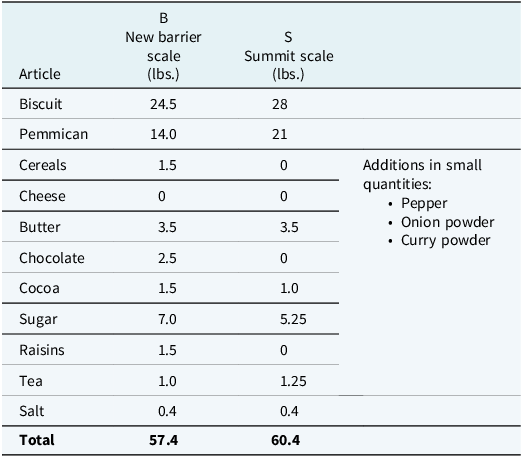
Figure 3 shows the daily food allowance for one man. Plainly, it would not be onerous to set aside a week’s worth for Bowers. Summit Ration Units had only seven items, and Barrier Ration Units had only ten items. Details from Wilson’s sketchbook (Wilson, Reference Wilson1912, p. 3) are transcribed as Table 1.
Daily summit ration for one man (S scale, salt omitted). Downloaded from: https://www.coolantarctica.com/Antarctica%20fact%20file/science/food.php.

Ration scales. Weekly weight per ration unit (4 men)

Table 1. Long description
A table comparing daily food allowance for one man between two scales, New Barrier and Summit. The table has 12 rows and 4 columns. The columns are labeled Article, B New barrier scale (lbs.), and S Summit scale (lbs.). The row labels are Biscuit, Pemmican, Cereals, Cheese, Butter, Chocolate, Cocoa, Sugar, Raisins, Tea, Salt, and Total. The table also includes additions in small quantities: Pepper, Onion powder, and Curry powder. Row 1: Biscuit, 24.5, 28. Row 2: Pemmican, 14.0, 21. Row 3: Cereals, 1.5, 0. Row 4: Cheese, 0, 0. Row 5: Butter, 3.5, 3.5. Row 6: Chocolate, 2.5, 0. Row 7: Cocoa, 1.5, 1.0. Row 8: Sugar, 7.0, 5.25. Row 9: Raisins, 1.5, 0. Row 10: Tea, 1.0, 1.25. Row 11: Salt, 0.4, 0.4. Row 12: Total, 57.4, 60.4.
Some writers claim that redistribution of provisions required opening and resealing of fuel cans, introducing risk and delay, but they overlook Scott’s provisioning practices. Upper Glacier Depot already held one gallon of fuel to be shared between two parties, and Lower Glacier Depot already held two gallons for sharing between three parties. Barrier depots back as far as Mount Hooper already held two gallons for sharing between three parties. The fifth-man arrangement altered only proportions, not the number of depots requiring fuel sharing.
In summary, there is little evidence to support Huntford’s claim that redistribution of provisions was “an unfair burden.”
Was there a causal link to the demise of the Polar Party?
Scott’s decision – whatever its merits or disadvantages – was not directly responsible for the deaths of five men. No evidence directly links the crowded tent, the increased cooking times, or Bowers’ (temporary) lack of skis with the deaths of five men. Further, the increased danger for Evans’ returning party and their new task of redistributing provisions did not contribute to the eventual demise of the Polar Party.
However, there were unique circumstances with Bowers. He would not have died with the others if he had not been added to the Polar Party. It is possible, therefore, to argue that Scott’s fifth-man decision caused Bowers’ death 86 days later.
Many secondary writers have accepted Cherry-Garrard’s personal judgement that Scott should not have disrupted long-standing plans by adding the fifth man. They then (erroneously) extrapolate that judgement into a belief that such disruption contributed significantly to the demise of the Polar Party. See Cherry-Garrard’s legacy (below) for discussion of Cherry-Garrard’s judgement. This article argues the extrapolation lacks supporting evidence.
Scott’s option to retreat
As noted in Understanding Scott’s decision (above), Scott had an option to abandon the polar mission and retreat to base. If all eight men of the last two parties had travelled back together, starting around 3 January 1912, it is likely that at least seven would have survived. History shows that Lieutenant Evans, Crean, and Lashly survived, reaching Hut Point on 22 February 1912, despite reduced speed and delays caused by Evans’ scurvy. Scott, Bowers, and Wilson were at least as fit as Crean and Lashly, with a high likelihood of survival after retreating. If Oates, who had been fit enough to pull the Polar Party sledge until about 4 March 1912, could have marched for the same number of days after turning back, then he should have been fit to travel until well after 22 February 1912. But P.O. Evans died on 17 February 1912, so it is possible he might not have survived, unless he recovered at least some of his strength and did not injure his head in a fall.
This reasoning assumes they would have experienced similar weather and surface conditions to those experienced by Evans’ party. It also assumes that P.O. Evans’ decline would not have slowed them more than Lieutenant Evans’ scurvy.
With more men to share the workload – and even haul both Oates and Lieutenant Evans, if need be (or leave them with provisions and one other minder until the Dog Party came out for them) – there was a good chance that at least seven would have returned safely. They would still have to economise on fuel until reaching One Ton.
Initial reception of the expedition narrative
Contemporary press and official reaction after the discovery of the Polar Party in 1912 emphasised heroism and sacrifice, not tactical fault-finding. The immediate public narrative was overwhelmingly sympathetic to Scott and his men. Early published accounts and official reports focused on the tragedy and scientific results rather than investigating the Polar Party’s composition or tactics.
There was no clear, widely reported contemporary British newspaper criticism of Scott’s decision to take a fifth man to the Pole immediately after the Terra Nova Expedition’s tragedy. The British press of 1913 largely framed the fifth-man story as a heroic loss rather than an error of judgement.
Cherry-Garrard’s legacy
Cherry-Garrard (Figure 4) wrote his memoir in 1922, The Worst Journey in the World (Cherry-Garrard, Reference Cherry-Garrard2010). It is notable for its frank, reflective tone. Although others had already discussed the disaster, his memoir was the first by an expedition member to criticise Scott’s character and decision-making so openly. It moved beyond the public mourning of 1913, analysing logistics, leadership, and planning. George Bernard Shaw (Figure 5), Cherry-Garrard’s neighbour, assisted and influenced the memoir’s development.
Apsley Cherry-Garrard in the early 1920s. Photograph by Shaw, scanned from Rhyming picture guide to Ayot Saint Lawrence (Shaw, Reference Shaw1950).

Portrait of George Bernard Shaw by John Ruskin, 1927. Image downloaded from: https://commons.wikimedia.org/wiki/File:Portrait_of_George_Bernard_Shaw_.PNG.

Carl Murray’s PhD thesis describes the impact Cherry-Garrard’s memoir was to have on later writers:
On 23 March 1923 … Shaw had written a long letter justifying the book to Kathleen Scott …. He criticises Scott and his running of the expedition, eulogises Amundsen, and makes it plain that he [Shaw] had influenced how they were portrayed. […] The master [Shaw] sums up his view of the text: “there is no doubt in my mind that it is by it [the memoir] that History will judge Scott.” Shaw was largely correct. Cherry’s was the most complete account of the expedition, because he was in a position to interview surviving members, collect documents and construct a narrative of the expedition as a whole, and the book has always been cited as an authoritative source. But it needs to be recognised for what it is: a highly ‘authored’ version of events, and not documentary evidence [emphasis added]. […]
And so, as Shaw warned Kathleen Scott, “History” has judged Scott’s last expedition and its leader through Cherry’s eyes (Murray, Reference Murray2006, pp. 109–110).
Cherry-Garrard’s was a lone voice when he first expressed disapproval of Scott’s fifth-man arrangement:
In the event of one man crocking a five-man party may be better able to cope with the situation, but with this doubtful exception Scott had nothing to gain and a good deal to lose by taking an extra man to the Pole. That he did so means, I think, that he considered his position a very good one at the time. He was anxious to take as many men with him as possible (Cherry-Garrard, Reference Cherry-Garrard2010, p. 512).
His disapproval of Scott’s fifth-man arrangement was strong and persisted throughout his lifetime, but minimal justification was ever provided. This is surprising because he was a gifted and enthusiastic writer. His 1951 Postscript, in which he revealed several previously unpublished facts and opinions, is surprisingly silent on the matter of Scott’s fifth-man arrangement. His assertion that Scott “had a good deal to lose” appears to reflect a deeply personal perspective, rather than an evidence-based assessment. For him, the fifth-man arrangement was inseparable from the death of Bowers, his deeply loyal companion. His critique therefore can be interpreted less as an evidence-based analysis and more as an expression of grief, shaped by the emotional weight he attached to Bowers’ inclusion in the Polar Party. It is quite likely that Cherry-Garrard’s disapproval was a personal expression of grief and loss, compounded by survivor guilt and depression, rather than a statement of historical fact. This interpretation appears consistent with Cherry-Garrard’s being the lone voice disapproving of Scott’s fifth-man arrangement at the time. One can almost hear Cherry-Garrard’s anguished cry: “Come back, Birdie – I miss you terribly!”
His memoir does not engage with Scott’s underlying strategic concern about minimising time on the plateau, nor does it address the fading and early retirement of the last support party. There is no mention of Polar Party pulling power. Cherry-Garrard does not explore Scott’s reasoning, and the basis for his assertion that “Scott had nothing to gain” remains unclear.
Several conclusions may be drawn from Cherry-Garrard’s treatment of the fifth-man arrangement. He put forward what initially appears to be a balanced assessment, with clearly articulated pros and cons, but upon closer examination, it becomes apparent that the cons are strongly advocated while the pros are either omitted or weakly advocated. His assessment cannot therefore be seen as evenly balanced or well informed. Cherry-Garrard saw the consequences of the fifth-man arrangement, but he did not see Scott’s strategy or reasons. His reaction was a personal expression of grief and loss, rather than a statement of historical fact – emotionally honest and morally sincere but strategically incomplete.
Huntford’s legacy
Roland Huntford’s book Scott and Amundsen, first published in 1979, marked a turning point in the trajectory of Scott’s story. It sharply polarised subsequent debate and has often been used as almost the sole source of information and interpretation of Scott’s story. It compares and contrasts the British and the Norwegian expeditions that attained the geographic South Pole in the southern summer of 1911–12. Huntford’s interpretation has been widely criticised for favouring the Norwegian team and has been challenged on matters of fact.
Huntford (Figure 6) insisted that his aim was not to destroy Scott but to elevate Amundsen, whose achievements he felt had been wilfully diminished in Britain (The Observer, 30 January 2026, Obituary). He was a skilful writer, and his book was part of a new novelistic and journalistic approach to Scott’s story. It has appealed to a wide audience, including historians and biographers. Murray commented on its uptake as a ready source of information about the Terra Nova Expedition:
The 1990s produced several studies of “Scott of the Antarctic” very limited in their approach. In this period the story was co-opted as a case study in fields other than literature or history. In general these discussions are characterised by being poorly informed about Antarctic exploration in the heroic era, and the Terra Nova Expedition in particular, and by their use of Huntford’s book as the original, sole source rather than as merely an interpretation. (Murray, Reference Murray2006, p. 15)
Roland Huntford in the late 1970s. Downloaded from: https://observer.co.uk/profile/obituary/article/obituary-roland-huntford-polar-historian.

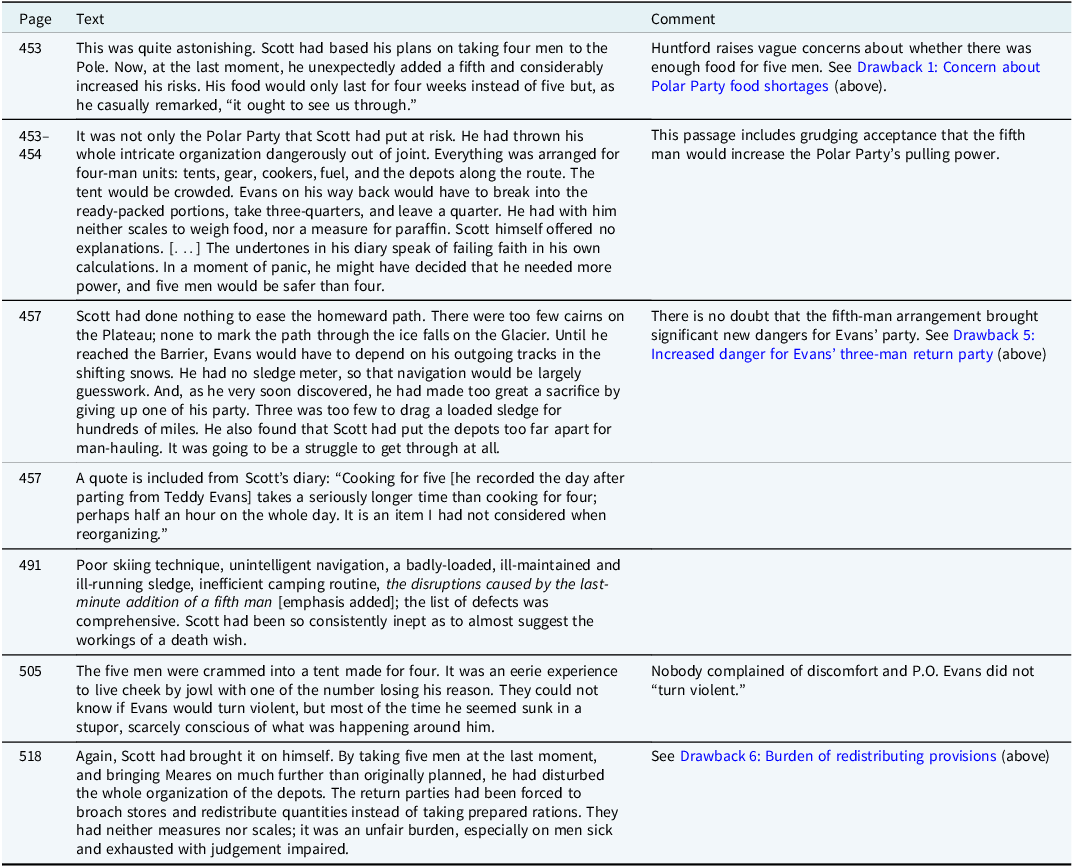
Analysis of Huntford’s entire book (Huntford, Reference Huntford2002) falls outside the scope of this article. It is essential, however, to identify everything the book states or implies about Scott’s fifth-man arrangement and to examine how subsequent writers have adopted and adapted Huntford’s interpretations. A text search has been undertaken to identify passages of potential relevance to this article. Search terms were “five men,” “fifth,” “decision,” “3 January,” “January 3,” “last minute,” “last-minute,” “addition,” “disruption,” and “shortage.” Only seven search results (approximately 530 words in total) appear pertinent to the fifth-man arrangement and are listed in Table 2. It may be noted that six of the seven passages are critical of Scott and his expedition.
Passages in Scott and Amundsen that relate to Scott’s fifth-man arrangement

Table 2. Long description
A table summarizing passages from Huntford’s book about Scott’s fifth-man arrangement and its implications. The table has 7 rows and 3 columns. The columns are labeled Page, Text, and Comment. Row 1: Page 453, Text This was quite astonishing. Scott had based his plans on taking four men to the Pole. Now, at the last moment, he unexpectedly added a fifth and considerably increased his risks. His food would only last for four weeks instead of five but, as he casually remarked, it ought to see us through., Comment Huntford raises vague concerns about whether there was enough food for five men. See Drawback 1: Concern about Polar Party food shortages (above). Row 2: Page 453-454, Text It was not only the Polar Party that Scott had put at risk. He had thrown his whole intricate organization dangerously out of joint. Everything was arranged for four-man units: tents, gear, cookers, fuel, and the depots along the route. The tent would be crowded. Evans on his way back would have to break into the ready-packed portions, take three-quarters, and leave a quarter. He had with him neither scales to weigh food, nor a measure for paraffin. Scott himself offered no explanations. [...] The undertones in his diary speak of failing faith in his own calculations. In a moment of panic, he might have decided that he needed more power, and five men would be safer than four., Comment This passage includes grudging acceptance that the fifth man would increase the Polar Party’s pulling power. Row 3: Page 457, Text Scott had done nothing to ease the homeward path. There were too few cairns on the Plateau; none to mark the path through the ice falls on the Glacier. Until he reached the Barrier, Evans would have to depend on his outgoing tracks in the shifting snows. He had no sledge meter, so that navigation would be largely guesswork. And, as he very soon discovered, he had made too great a sacrifice by giving up one of his party. Three was too few to drag a loaded sledge for hundreds of miles. He also found that Scott had put the depots too far apart for man-hauling. It was going to be a struggle to get through at all., Comment There is no doubt that the fifth-man arrangement brought significant new dangers for Evans’ party. See Drawback 5: Increased danger for Evans’ three-man return party (above). Row 4: Page 457, Text A quote is included from Scott’s diary: Cooking for five [he recorded the day after parting from Teddy Evans] takes a seriously longer time than cooking for four; perhaps half an hour on the whole day. It is an item I had not considered when reorganizing., Comment. Row 5: Page 491, Text Poor skiing technique, unintelligent navigation, a badly-loaded, ill-maintained and ill-running sledge, inefficient camping routine, the disruptions caused by the last-minute addition of a fifth man [emphasis added]; the list of defects was comprehensive. Scott had been so consistently inept as to almost suggest the workings of a death wish., Comment. Row 6: Page 505, Text The five men were crammed into a tent made for four. It was an eerie experience to live cheek by jowl with one of the number losing his reason. They could not know if Evans would turn violent, but most of the time he seemed sunk in a stupor, scarcely conscious of what was happening around him., Comment Nobody complained of discomfort and P.O. Evans did not turn violent. Row 7: Page 518, Text Again, Scott had brought it on himself. By taking five men at the last moment, and bringing Meares on much further than originally planned, he had disturbed the whole organization of the depots. The return parties had been forced to broach stores and redistribute quantities instead of taking prepared rations. They had neither measures nor scales; it was an unfair burden, especially on men sick and exhausted with judgement impaired., Comment See Drawback 6: Burden of redistributing provisions (above).
Several observations may be made about Huntford’s treatment of the fifth-man arrangement. There is no recognition of Scott’s imperative to get the Polar Party off the plateau as soon as possible. Huntford apparently ignored the fading and early retirement of the last support party. There is only grudging acceptance that adding a fifth man would increase pulling power. There is no investigation into why Scott added the fifth man, and the only consequences noted are drawbacks, with little supporting evidence.
The post-Huntford era
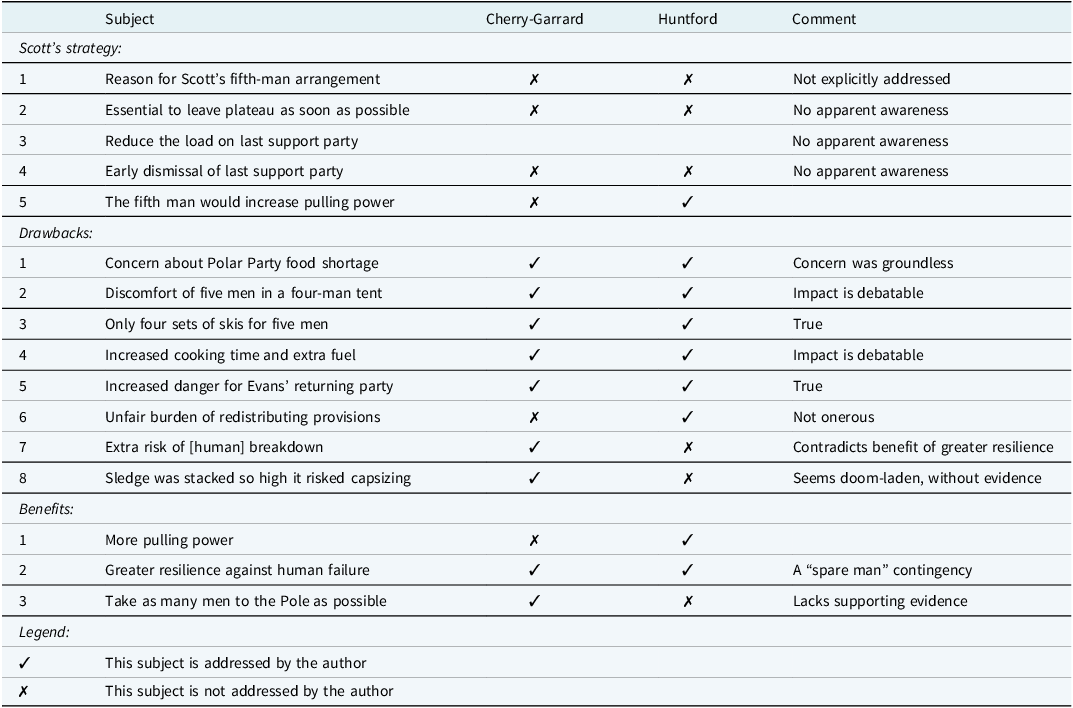
This section addresses the development, since the 1980s, of the narrative of Scott’s fifth-man arrangement. As noted in the previous two sections, the narrative has been heavily influenced by Cherry-Garrard and Huntford. Cherry-Garrard had disapproved of Scott’s arrangement ever since learning of Bowers’ death. The new orthodoxy about Scott’s Terra Nova Expedition, which was established by Huntford’s book, does not address Scott’s reasons. It identifies a few benefits and focuses on multiple drawbacks – essentially portraying Scott’s arrangement as a bad idea. Table 3 summarises and compares the interpretations of the two main influencers. It serves as a baseline for comparison with later works.
Scott’s fifth-man arrangement, as interpreted by Cherry-Garrard and Huntford

Table 3. Long description
A table comparing Cherry-Garrard and Huntford’s interpretations of Scott’s fifth-man arrangement. The table has 13 rows and 4 columns. The columns are labeled Subject, Cherry-Garrard, Huntford, and Comment. The rows are grouped under Scott’s strategy, Drawbacks, and Benefits. Row 1: Subject, Reason for Scott’s fifth-man arrangement; Cherry-Garrard, X; Huntford, X; Comment, Not explicitly addressed. Row 2: Subject, Essential to leave plateau as soon as possible; Cherry-Garrard, X; Huntford, X; Comment, No apparent awareness. Row 3: Subject, Reduce the load on last support party; Cherry-Garrard, X; Huntford, X; Comment, No apparent awareness. Row 4: Subject, Early dismissal of last support party; Cherry-Garrard, X; Huntford, X; Comment, No apparent awareness. Row 5: Subject, The fifth man would increase pulling power; Cherry-Garrard, X; Huntford, check mark; Comment, (empty). Row 6: Subject, Concern about Polar Party food shortage; Cherry-Garrard, check mark; Huntford, check mark; Comment, Concern was groundless. Row 7: Subject, Discomfort of five men in a four-man tent; Cherry-Garrard, check mark; Huntford, check mark; Comment, Impact is debatable. Row 8: Subject, Only four sets of skis for five men; Cherry-Garrard, check mark; Huntford, check mark; Comment, True. Row 9: Subject, Increased cooking time and extra fuel; Cherry-Garrard, check mark; Huntford, check mark; Comment, Impact is debatable. Row 10: Subject, Increased danger for Evans’ returning party; Cherry-Garrard, check mark; Huntford, check mark; Comment, True. Row 11: Subject, Unfair burden of redistributing provisions; Cherry-Garrard, X; Huntford, check mark; Comment, Not onerous. Row 12: Subject, Extra risk of [human] breakdown; Cherry-Garrard, check mark; Huntford, X; Comment, Contradicts benefit of greater resilience. Row 13: Subject, Sledge was stacked so high it risked capsizing; Cherry-Garrard, check mark; Huntford, X; Comment, Seems doom-laden, without evidence. Row 14: Subject, More pulling power; Cherry-Garrard, X; Huntford, check mark; Comment, (empty). Row 15: Subject, Greater resilience against human failure; Cherry-Garrard, check mark; Huntford, check mark; Comment, A ’spare man’ contingency. Row 16: Subject, Take as many men to the Pole as possible; Cherry-Garrard, check mark; Huntford, X; Comment, Lacks supporting evidence.
Table 3 shows that Huntford adopted five of the seven drawbacks recorded by Cherry-Garrard. The two he did not adopt are “extra risk of [human] breakdown” (ignoring this is understandable alongside the benefit of “greater resilience against human failure”) and “the stowage of the sledge with five sleeping bags was pretty high: this makes it top-heavy and liable to capsize in rough country” (Cherry-Garrard, Reference Cherry-Garrard2010, p. 513). Huntford promoted only one additional drawback that Cherry-Garrard did not mention, namely “unfair burden of redistributing provisions.” This indicates that Huntford did not invent or initially articulate most of the claimed drawbacks of the fifth-man arrangement – that was Cherry-Garrard’s handiwork.
A literature review has been undertaken on twenty post-1980 works that relate to Scott’s Terra Nova Expedition. Material relevant to Scott’s fifth-man arrangement was identified in each work and compared against Table 3 to identify fresh research or interpretations within those later works. Overall, the results were disappointing. Most of the works reviewed did not venture outside of the interpretations summarised by Table 3. This suggests that those writers relied heavily on the works of Cherry-Garrard or Huntford as their primary source of information about the fifth-man arrangement. Two notable exceptions are discussed below.
David Crane: Scott of the Antarctic (2007)
Crane stands apart from other secondary writers by clearly stating the purpose of Scott’s fifth-man arrangement, “a ruthless determination to bag the Pole.” He presents a forceful and balanced argument:
There was nothing whimsical, nothing sentimental, about the inclusion of a fifth man — nothing whimsical or sentimental about Scott at all at this juncture, in fact. He would clearly never have ordered Bowers to depot his skis if he had already made his decision, but when the time came to confirm the final party, everything from Evans’ interests and the safety of the returning team to the convenience, comfort, tent-craft and logistical “tidiness” of his own team were sacrificed to the ruthless determination to bag the Pole. The arguments against a fifth man, when rations and all else had been arranged with four in mind, are so blindingly obvious that no one can possibly imagine that Scott did not think of them himself. The one complication he had not envisaged was the extra cooking time and fuel that the change would involve, but after the first few days, the exact duration of stop times recorded by Bowers, when set against the increased daily mileage that the extra man made possible, suggests that even this was only a marginal drawback (Crane, Reference Crane2007, p. 481).
Crane’s assessment of the situation and Scott’s motivation are logically sound and are well supported by available evidence, but he does not comment on the last support party no longer keeping up and retiring early. Evidence suggests that Scott’s true priority was to get off the plateau as soon as possible after bagging the Pole. Crane dismisses the drawbacks embedded in the orthodox narrative as overstatements of difficulty, not germane to Scott’s decision-making.
Ranulph Fiennes: Captain Scott (2003)
Fiennes’ approach to Huntford’s Scott and Amundsen was one of forceful rebuttal and, at times, open disdain. Fiennes found Huntford’s portrayal of Scott as a “recklessly incompetent” anti-hero to be a form of “inaccurate character assassination.” Fiennes identified benefits and drawbacks arising from Scott’s fifth-man arrangement with research that appears to have been thorough, identifying benefits missed by most other writers and convincingly refuting several of the drawbacks embedded in the orthodox narrative (Table 3) that had been widely adopted by others.
Fiennes stated the main benefit of having a fifth man was more pulling power, although he did not comment on Scott’s possible reason(s) for wanting more pulling power. He claimed the greater pulling power of five men led to dramatically improved daily mileages but did not quantify the gains.
Fiennes was confident that the fifth-man arrangement did not cause any food shortages for the Polar Party (Drawback 1):
Rations for the Pole group and the other returning group would not be affected. If an extra man had been added (by parachute!) to the expedition after the depots were laid, then there would have been a deficiency, but Scott added no one, he merely shuffled the rations between two different groups, his and that of Teddy Evans. (Fiennes, Reference Fiennes2003, p. 306).
Fiennes was dismissive of concerns expressed about the discomfort of having five men in a four-man tent (Drawback 2): “Scott was focused on success and, if a certain degree of discomfort was necessary to achieve that end, so be it” (Fiennes, Reference Fiennes2003, p. 306). He pointed out that this arrangement had already been proved workable during the previous season’s Depot Journey.
Fiennes argued that concerns about increased cooking time for five men were over-stated, as discussed in Drawback 4: Increased cooking time and extra fuel (above). He also argued that concerns about the burden of redistributing provisions between the two final parties (Drawback 6) were an overstatement of the work involved:
Of course Evans’ group had the extra nuisance, on the few occasions when they reached a depot, of taking only three-quarters of their original allotment of food and fuel, but this was hardly an onerous task, bearing in mind that there were sixty-mile gaps between depots. (Fiennes, Reference Fiennes2003, p. 306).
In summary, Fiennes successfully challenged many aspects of the new orthodoxy brought by Huntford’s book.
Conclusions
Scott was extremely anxious about human capability to survive an extended period on the Polar Plateau. Previous expeditions had barely survived 35 days on the plateau, while his plan called for at least 70 days.
Matters came to a head in late December 1911 when the last support party faded and, despite attempts to improve their performance, were no longer able to keep up with the Polar Party. This was an unexpected development Scott could not ignore. He was also worried their fitness to continue was in doubt, deciding to dismiss them several days ahead of plan, which would increase the initial load for the Polar Party.
Scott was concerned that with the increased initial load, compounded by possible worsening surface conditions (sandy snow in particular), a four-man Polar Party might struggle to move their sledge at times. The decision to take a fifth man was a considered response to critical issues, at the expense of Evans’ party. The additional pulling power enabled the Polar Party to cope with their increased initial load and also cope with worsening surface conditions. It supported the imperative to get off the plateau as soon as possible. The additional man also improved the team’s resilience when individuals became incapacitated.
Scott’s arrangement left Evans’ party one man short for the entire trip back to base, a considerable disadvantage for them. Evans began displaying symptoms of scurvy in late January 1912, and his two teammates (Crean and Lashly) eventually had to haul him on the sledge, barely making it back to base. This was a perilous journey that came close to failure. With four men in Evans’ party, their return journey would have been much less dangerous.
Multiple benefits and drawbacks came from Scott’s fifth-man arrangement. Several of the drawbacks assessed under Benefits and drawbacks (above) hampered the party involved, partly offsetting benefits. Those drawbacks should be weighed against benefits for the party when deciding whether Scott’s change of plan was a good idea. For the Polar Party, it is suggested the extra pulling power outweighed the combined drawbacks by a healthy margin. There were no benefits for Evans’ party, only drawbacks.
Cherry-Garrard had strongly disapproved of Scott’s fifth-man arrangement ever since learning of Bowers’ death. This is apparent in his memoir, which does not address Scott’s reasons for the fifth-man decision and highlights its drawbacks, without mentioning benefits.
Huntford’s treatment of Scott’s fifth-man decision is largely based on Cherry-Garrard’s memoir. Later writers, influenced by Huntford, tended to emphasise drawbacks. However, the biographies of Scott by Crane and by Fiennes include excellent new material that advances our understanding of Scott’s fifth man arrangement.
Appendices
Two appendices, loosely related to the subject matter of this article, contain original research material that some readers may find interesting. They have been published as Supplementary Material, accessible from the Polar Record web page for this article. Appendix I investigates the allegation that Oates concealed certain health problems so he would not be excluded from Polar Party. Appendix II investigates the tale of Oates’ Boer wound re-opening.
Supplementary material
The supplementary material for this article can be found at https://doi.org/10.1017/S0032247426100400.
Competing interests
The author declares none.






 Open access



