

The aim of this article is to demonstrate the potential for conducting a systematic quantitative literature review (SQLR) to answer archaeological questions. A traditional narrative literature review relies on the credibility of the author's reputation as a recognized expert in the field, whereas the SQLR focuses on the method's reliability and whether the results are consistent, quantifiable, and repeatable. Systematic reviews have been gaining popularity in the natural and social sciences. (See Griffith University School of Environment and Science 2018 for a list of more than 100 publications in different disciplines that utilize SQLR.) We demonstrate how to adapt this well-established method for archaeological studies and produce what may be the first systematic quantitative literature review of rock art.
A traditional narrative review is still a valid approach because it is comprehensive, covers a wide range of issues, and is usually more readable than an SQLR because it is narrative driven (Collins and Fauser Reference Collins and Fauser2005). However, the highly subjective nature of traditional narrative reviews exposes them to potential bias (Petticrew and Roberts Reference Petticrew and Roberts2006; Pickering and Byrne Reference Pickering and Byrne2013). In contrast, the SQLR is useful in addressing specific questions because it incorporates keyword data searches, has a transparent nature that exposes bias, and provides a quantitative summary that allows for evidence-based inferences (Collins and Fauser Reference Collins and Fauser2005; Cook et al. Reference Cook, Mulrow and Brian Haynes1997). Traditional narrative reviews may be more appropriate for comprehensive topics, whereas systematic reviews are more effective for focused topics (Collins and Fauser Reference Collins and Fauser2005). Therefore, the systematic quantitative approach is suitable for a literature review of Philippine rock art, which is an obscure topic in a subdiscipline of archaeology.
The work presented in this article is adapted from a chapter of the doctoral thesis of one of the authors (AJ) on Philippine rock art. The SQLR was used to compare the rock art in the Philippines with the neighboring areas and to expose gaps in the research. It was not intended to be a comprehensive account of all the rock-art research in Southeast Asia. We will not elaborate on the specifics of rock-art sites and motifs of the region; instead, we demonstrate how quantifying the information in an SQLR can increase understanding of rock art in the Philippines. We also discuss prominent elements of the region's rock art that are not found in the Philippines and why rock art is absent in parts of Southeast Asia and Micronesia.
The next section provides the context of rock-art research in Southeast Asia and Micronesia. Afterward, the method, limitations, and results of the SQLR are discussed. Finally, the potential for increasing the usability of the SQLR in collaborative semantic web applications is considered. While an SQLR is a powerful tool to analyze the literature, its fundamental weakness is that it is static, whereas a collaborative semantic web application is dynamic.
BACKGROUND
The rock art of Southeast Asia is not well known, and the amount of research done across the region is disparate (Tan Reference Tan2014a; Tan and Taçon Reference Tan, Taçon, Donna Gillette, Hayward and Murray2014). Even less rock-art research has been generated in Micronesia. Moreover, the research is often not published in international peer-review journals but is restricted material in museum papers or is published in local languages. These issues make the rock art of Southeast Asia and Micronesia difficult to generalize.
Summaries of Southeast Asian rock art have been produced by several specialists (Scott and Tan Reference Scott, Tan, Bahn, Franklin and Strecker2016; Taçon Reference Taçon, David and McNiven2017; Taçon et al. Reference Taçon, Tan, O'Connor, Xueping, Gang, Curnoe, Bulbeck, Hakim, Sumantri, Than, Sokrithy, Chia, Khun-Neay and Kong2014; Tan Reference Tan2014b; Tan and Taçon Reference Tan, Taçon, Donna Gillette, Hayward and Murray2014). Taçon (Reference Taçon, David and McNiven2017) cited all the seminal work in the region. Tan (Reference Tan2014a) synthesized the known rock art of mainland Southeast Asia and island Southeast Asia. Taçon et alia (Reference Taçon, Tan, O'Connor, Xueping, Gang, Curnoe, Bulbeck, Hakim, Sumantri, Than, Sokrithy, Chia, Khun-Neay and Kong2014) focused on the painted sites of the region, including China, in understanding a shared rock-marking legacy with the rest of the world. Scott and Tan (Reference Scott, Tan, Bahn, Franklin and Strecker2016) provided a general update on the rock-art research for Southeast Asia. In-depth discussion on the rock art of specific locations is best found in PhD dissertations that go into detail on mainland Southeast Asia (see Taha Reference Taha2000; Tan Reference Tan2014a), Borneo (see Hoerman Reference Hoerman2016), and the Philippines (see Jalandoni Reference Jalandoni2018) and books on West Papua and Indonesia (see Arifin and Delanghe Reference Arifin and Delanghe2004; Permana Reference Permana2015). The seminal summary of Micronesian rock art is found in Jalandoni (Reference Jalandoni2018).
Cruz Berrocal and Millerstrom (Reference Cruz Berrocal and Millerstrom2013) noted that similarities in rock art motifs do not necessarily demonstrate interaction on a large scale. Commonalities in rock art first need to be identified before they can be considered associated.
Rock art has been an unexploited archaeological resource for understanding Austronesian migration until the recent efforts of Hoerman (Reference Hoerman2016), Jalandoni (Reference Jalandoni2018), O'Connor (Reference O'Connor2015), O'Connor and colleagues (Reference O'Connor, Mahirta, Kealy and Brockwell2018), and Tan (Reference Tan2016a). Tan (Reference Tan2016a) outlined the geographic boundaries of the rock art theories about Austronesian migration, and Hoerman (Reference Hoerman2016) and O'Connor (Reference O'Connor2015) tested the validity of the two rock art theories that relate to Austronesians in discrete Southeast Asian contexts. The first rock art theory put forward concerns the spread of what has been called the Austronesian Engraving Style as proposed by Specht (Reference Specht and Mead1979) in the western Pacific. The second theory focuses on the movement of the Austronesian Painting Tradition identified by Ballard (Reference Ballard1988, Reference Ballard1992) in Indonesia and East Timor. The results provided by the SQLR are limited; however, the SQLR can answer the question of where these rock art theories have been mentioned in the literature. Therefore, the SQLR can provide a delineation of where these rock art theories have been applied.
SYSTEMATIC QUANTITATIVE LITERATURE REVIEW
The Rock Art Studies: A Bibliographic Database compiled by Marymor (Reference Marymor2018) is an invaluable resource for rock-art researchers and is perhaps an example of a systematic literature review if the methodology of compilation were more explicit. The study reported in this article is different because the search parameters are clearly provided. If another researcher were to duplicate the method, the results should be virtually identical. By providing the search parameters, creating categories, and tabulating data, this study provides a literature review that is both systematic and quantitative.
The methodology employed for the systematic literature review followed Petticrew and Roberts (Reference Petticrew and Roberts2006) and the quantitative aspect from Pickering and Byrne (Reference Pickering and Byrne2013). For a detailed step-by-step instruction on conducting an SQLR, refer to Pickering and Byrne (Reference Pickering and Byrne2013).
Parameters
The data were primarily collected from the online databases of Google Scholar™, Project Muse®, ProQuest® and ProQuest Dissertations & Theses Global, and Trove. Every combination of a geographical location and rock art terminology was searched through each database. The geographical locations included Southeast Asia, Indonesia, Malaysia, the Philippines, Thailand, Vietnam, Cambodia, Laos, Brunei, Myanmar, and East Timor/Timor-Leste, Taiwan, Hong Kong, Marianas/Mariana Islands, Guam, Saipan, Tinian, Rota, Palau, Federated States of Micronesia/FSM, Yap, Pohnpei, Chuk/Truk/Chuuk, Kosrae, Marshall Islands, and Kiribati. Hong Kong and Taiwan were included, even though they are not officially part of Southeast Asia, because of their proximity to the Philippines. The rock art terminology included the following: rock art, rock-art, cave art, painted site, pictograph, pictogram, stencil, engravings, and petroglyph. While there may be other terms used for rock art, these are the most common for the region and should be sufficient for catching all relevant published information.
JSTOR, Science Direct, Scopus, and Web of Knowledge databases were tested but did not provide additional references. Other sources of data were from personal libraries and reference sections of publications. While atypical for systematic reviews of this kind, masters’ theses and PhD dissertations, books, abstracts, and conference proceedings that were available through the online databases were included, in addition to the standard peer-reviewed articles. Furthermore, only papers published in English were included. While these exclusions might limit the scope, they were necessary because a comprehensive list of all the literature available on the rock art of Southeast Asia and Micronesia would have required physically visiting museums and historic preservation offices across the region. It may also necessitate months of waiting to gain access to restricted information. Even if copies could be obtained, they would have required translation from, for example, Bahasa Indonesian, Bahasa Malayan, Thai, Vietnamese, Khmer, and Mandarin languages to English. We did not include museum papers because they would bias the counts in favor of areas where we have worked extensively, such as the Philippines, Palau, Guam, and Saipan.
The data were collected between May 19 and June 15, 2017. Publications uploaded or released after that were not included. Since search engine algorithms change periodically and without warning, it was best to do the searches within a short period. The database, contained in a spreadsheet, is housed in Griffith University's digital network data storage facility.
Workflow
A flowchart of the method is presented in Figure 1. Every record identified in the database search was added to a spreadsheet. Duplicated records were removed, and each record was screened for access and language. The remaining abstracts, presentations, books, book chapters, theses, and journal articles were read. Entries that were out of scope regionally or did not mention rock art were excluded at this stage. The remaining eligible entries were tabulated in an Excel spreadsheet based on author location affiliation, year of publication, journal title (if applicable), geographic region, kind of rock art, artist, sites discussed, and study methods used. Some categories—for example, geographic region—remained fixed from the conceptualization of the study. Other categories were revised when needed during tabulation (as suggested by Pickering and Byrne Reference Pickering and Byrne2013). For example, “material culture” was added as a category under “symbols” when several were written in as notes in the spreadsheet.
Flowchart using PRISMA (preferred reporting items for systematic reviews and meta-analyses) statement for the systematic review (adapted from Moher et al. Reference Moher, Liberati, Tetzlaff, Altman and Group2009).

Limitations
The SQLR quantifies references to rock art in geographic regions. Counts can become biased when several references exist for one site (e.g., Tan Reference Tan2009; Tan and Chia Reference Tan and Chia2010, Reference Tan and Chia2011, Reference Tan and Chia2012 for Gua Tambun in Malaysia), giving the impression that there is more rock art in that area. Conversely, there are references that discuss several rock-art sites in one geographical area yet are only counted once (e.g., Fage and Chazine Reference Fage and Chazine2010 for Kalimantan; Faylona et al. Reference Faylona, Lising and Dizon2016 for Peñablanca in the Philippines). Therefore, the summations produced by the SQLR should not be interpreted as quantity of sites but as quantity of research with no indication of quality.
Results and Metrics
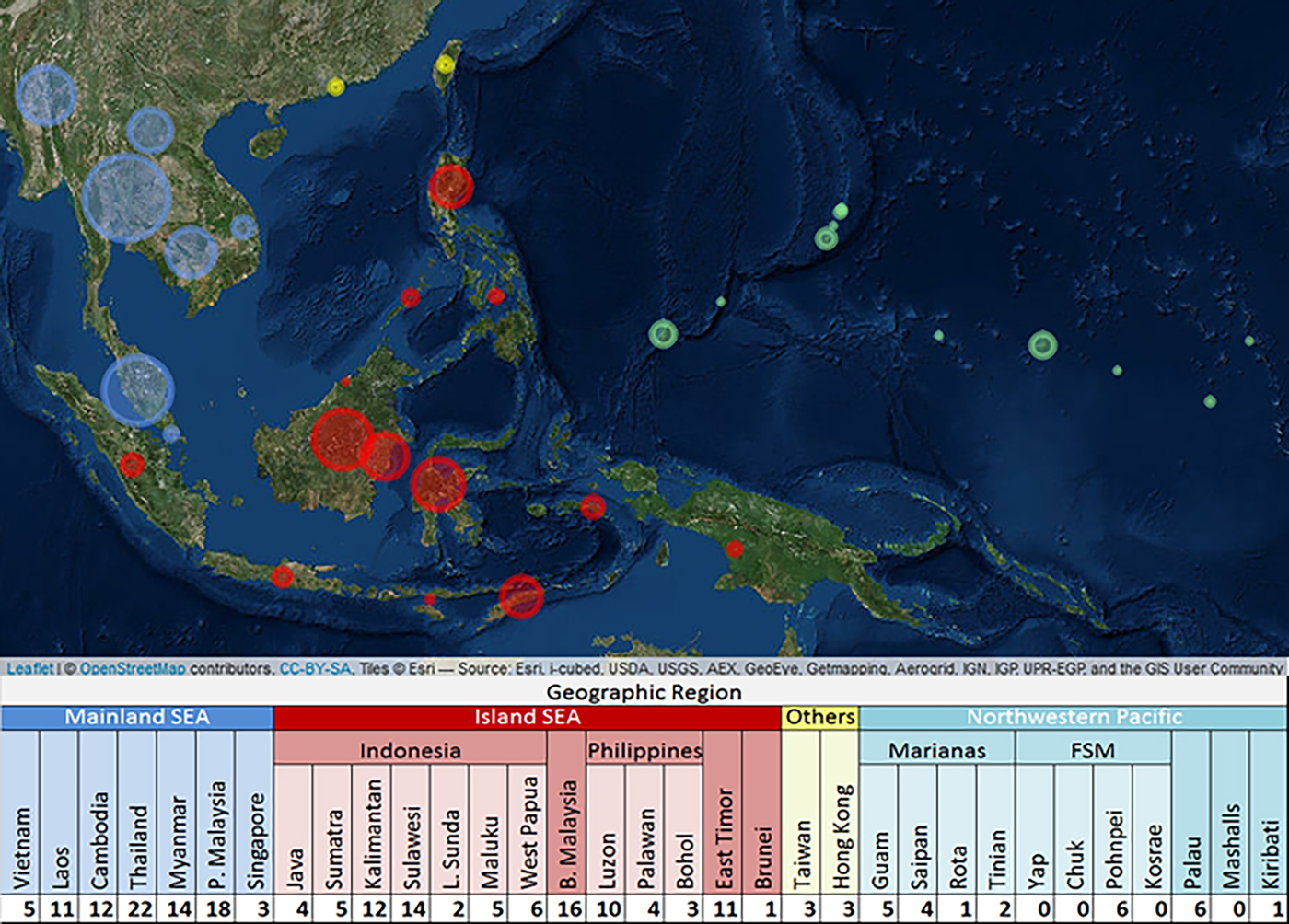
The search through all the databases returned 404 entries, and an additional 10 were unsearched personal sources. After duplicates were removed and the entries screened for language and access, 277 references remained. Those references were further analyzed, and 151 were excluded because they were not related to rock art, they only peripherally mentioned it, or their topics were not within our scope. A total of 126 references were included in the systematic review. The density of research per geographic region is presented in Figure 2.
Density of research by geographic region. Source: Maria Kottermair and Andrea Jalandoni. The code used to create this graphic can be found at https://www.r-graph-gallery.com/182-add-circles-rectangles-on-leaflet-map/.

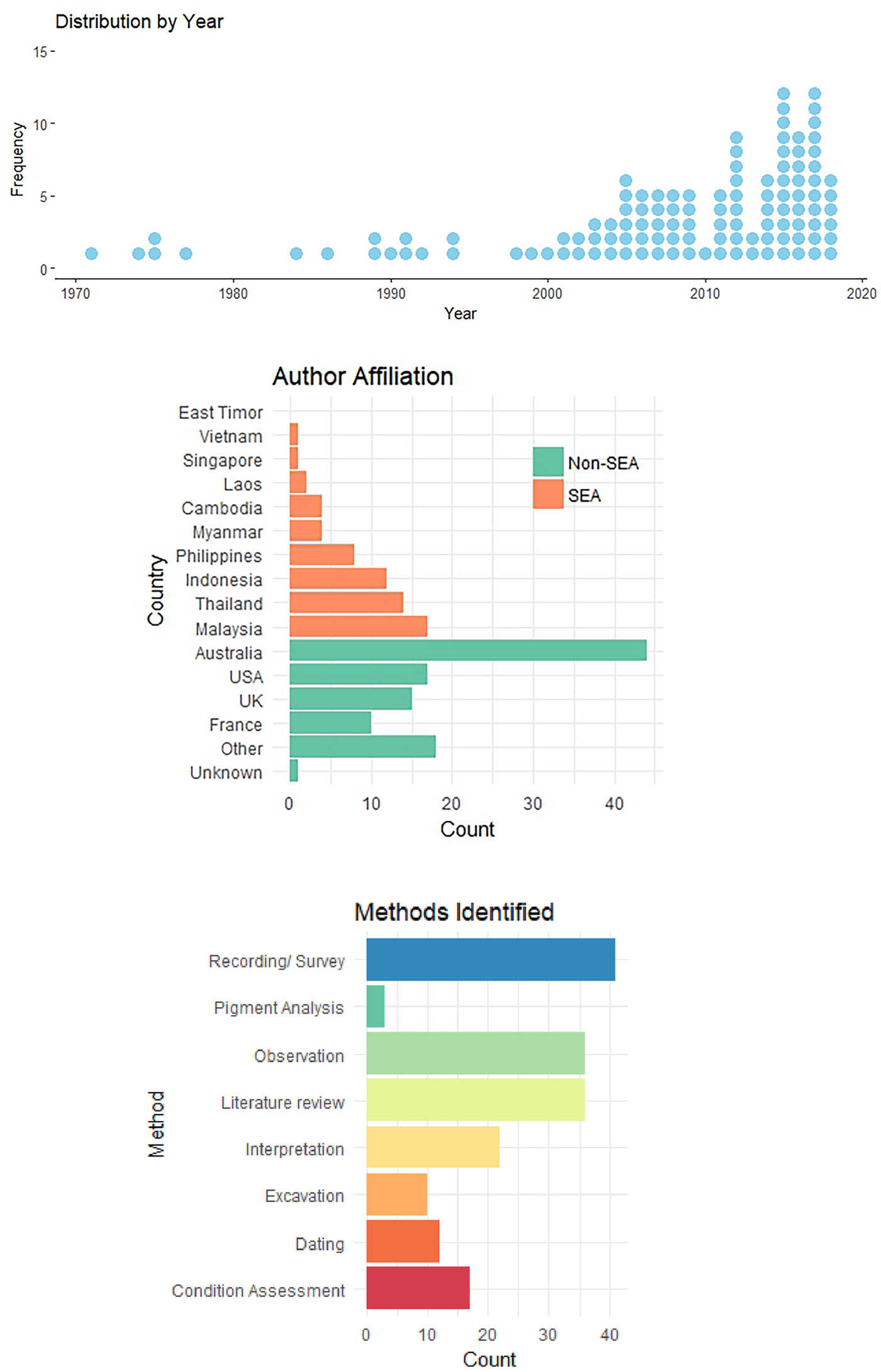
The SQLR also confirmed that the amount of research produced in the region is generally experiencing an upward trend (Figure 3). Our search was conducted midyear; therefore, the results for 2017 were only up to mid-June. Regardless, it showed a similar trend of high frequency to previous years. Author affiliation included all authors but did not double count in a single publication (Figure 3). For example, one article may have five Australian authors and one Indonesian but would only be counted as one Australia and one Indonesia. The category of “other” included Hong Kong, Taiwan, the Netherlands, New Zealand, China, Russia, and Micronesia with no dominant country. This metric indicated where the funding originated and perhaps where the expertise could be found. Australia dominated the rock-art research of the region, specifically in Southeast Asia. Furthermore, there is a significant subset of Southeast Asians who have written doctoral theses and published their work while affiliated with Australian universities. Finally, a count of the methods identified demonstrated that rock-art research in Southeast Asia and Micronesia is still in its incipient stage. The method in the majority of the publications is the basic level of literature review, observation, and recording (Figure 3). There has not been much dating, pigment analysis, or interpretation.
Distribution by year until mid-2017. Every dot represents a publication (top). Author affiliation by country as listed on publication (middle). Methods identified in publications (bottom).

PHILIPPINE ROCK ART AS THE FOCAL POINT
The systematic quantitative literature review of Southeast Asian and Micronesian rock art was conducted to understand the context of Philippine rock art. The following sections demonstrate how the data can be used to describe the rock art of the region and in relation to Philippine rock art.
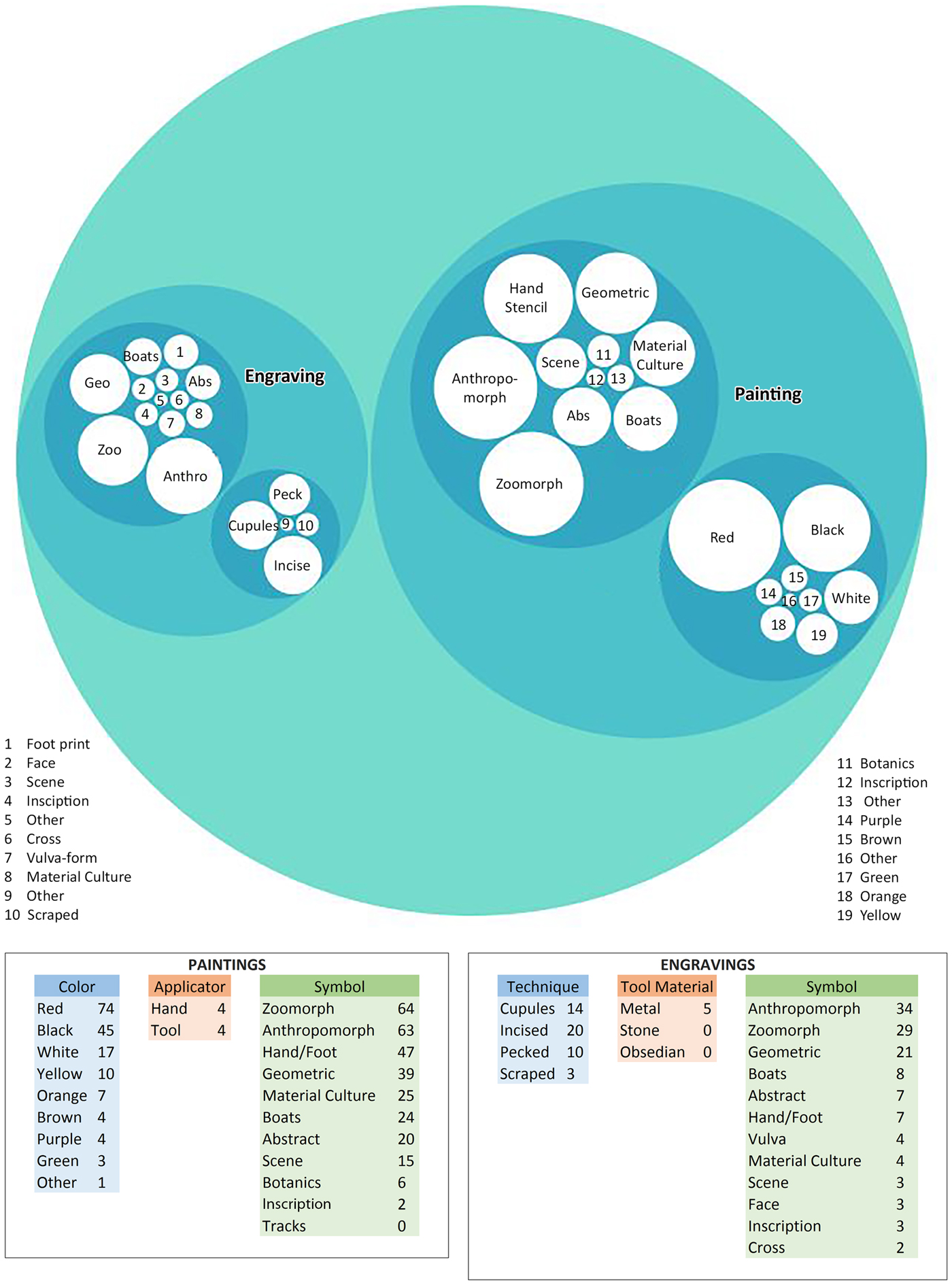
Tan and Taçon (Reference Tan, Taçon, Donna Gillette, Hayward and Murray2014:68) observed that paintings were the most dominant form of rock art in Southeast Asia, and they were predominantly done in red. Using the data from the SQLR, it is easy to conclude that much more research has been done on painted sites than engraved sites, perhaps indirectly indicating that there are indeed more painted sites (Figure 4). Of the painted sites, red (n = 74) was mentioned almost as many times as all other colors combined. It would appear that red was the dominant pigment, especially combined with colors on a similar palette (e.g., orange, brown, and purple) where differences may be due to semantics. Black (n = 45) was next most prevalent after red, while white (n = 17) paintings seemed more dominant proportionally in the Marianas than in Southeast Asia. Black, presumed to be charcoal, and polychromatic paintings were presumed to be more recent than red (Tan and Taçon Reference Tan, Taçon, Donna Gillette, Hayward and Murray2014:68). Interestingly, Specht (Reference Specht and Mead1979) noted similar dominance of red followed by black in the southwestern Pacific.
Progressive circle packing of the SQLR. An interactive version is available at http://www.rockartdatabase.com/v2/author/andrea-jalandoni (top). Tabulations of references made to elements of paintings and engravings (bottom). Source: Maria Kottermair and Andrea Jalandoni. The code used to create this graphic can be found at https://www.r-graph-gallery.com/338-interactive-circle-packing-with-circlepacker/.

The most commonly mentioned painted motifs were zoomorphs (n = 64) and anthropomorphs (n = 63), while plenty of hand stencils (n = 47) and geometrics (n = 39) were also mentioned (Figure 4). Painted boats (n = 24) and other material culture (n = 25), usually weapons, were noted at several research areas. Interestingly, the most common engraved motifs in the literature were anthropomorphs (n = 34) and then zoomorphs (n = 29), indicating some importance that transcended the type (i.e., painting or engraving) of rock art. Geometrics (n = 21) were the third most mentioned engraved motif.
Tools for producing the art were rarely mentioned in the body of literature analyzed (Figure 4). Three of the five times metal was mentioned described the engravings in Angono and Palawan, Philippines (see Novellino Reference Novellino1999; Peralta Reference Peralta1973, Reference Peralta2000). Inadvertently, Fage and Chazine (Reference Fage and Chazine2010:42) indicated metal was used when they noted that some of the engraved lines could be the result of weapon sharpening. The sole painted site where tools were mentioned was one with pigment splash-marks in Myanmar that could only be made with tools and resembled a style of rock art produced in Australia (Aung Reference Aung2013; Taçon et al. Reference Taçon, Yee Aung and Thorne2004).
Numerous references were made to painted boats in sites throughout Southeast Asia (e.g., Aubert et al. Reference Aubert, Brumm, Ramli, Sutikna, Saptomo, Hakim, Morwood, van den Bergh, Kinsley and Dosseto2014; Ballard Reference Ballard1988; Ballard et al. Reference Ballard, Bradley, Myhre and Wilson2004; Lape et al. Reference Lape, O'Connor and Burningham2007; O'Connor Reference O'Connor2003; Pyatt et al. Reference Pyatt, Wilson and Barker2005; Szabó et al. Reference Szabó, Piper and Barker2008). Sites with engraved boats in Southeast Asia were less common, but there were examples of engraved boats in Borneo (see Hoerman Reference Hoerman2016; Saidin et al. Reference Saidin, Taçon, Decong, Nash, May and Lewis2008; Szabó et al. Reference Szabó, Piper and Barker2008; Taçon et al. Reference Taçon, Sauffi and Datan2010), Maluku (see Spriggs et al. Reference Spriggs, Veth and O'Connor1998; Spriggs et al. Reference Spriggs, Veth, O'Connor, Mohammad, Jatmiko, Nayati, Saleh and Witjaksono2005), West Papua (see Arifin and Delanghe Reference Arifin and Delanghe2004), Thailand (see Sukkham et al. Reference Sukkham, Taçon, Tan and Muhamad2017), and Philippines (see Dizon et al. Reference Dizon, Santiago and Ornillaneda2008). In Micronesia, engraved boats were reported only in Pohnpei (see Rainbird Reference Rainbird2008).
Differences between Southeast Asian and Philippine Rock Art
Instead of listing every motif, color, and style of rock art identified in Southeast Asia that were not found in the Philippines, only the prominent absences are mentioned here. Hand stencils were conspicuously absent from Philippine rock art, though they were quite prominent in the region, such as in Borneo (Chazine and Noury Reference Chazine and Noury2006; Fage Reference Fage2005; Fage and Chazine Reference Fage and Chazine2010), Sulawesi (Oktaviana et al. Reference Oktaviana, Bulbeck, O'Connor, Hakim, Wibowo and Pierre2016), East Timor (O'Connor Reference O'Connor2003), and Maluku (Latinis and Stark Reference Latinis and Stark2005). Few zoomorphs were reported in Philippine rock art, and they were all small animals (e.g., interpreted as insects or birds), while large zoomorphs were recorded in many sites in Southeast Asia, such as Malaysia (Tan Reference Tan2009), Cambodia (Heng Reference Heng2011; Taçon et al. Reference Tan, Taçon, Donna Gillette, Hayward and Murray2014), Thailand (Tan Reference Tan2016b), Sulawesi (Aubert et al. Reference Aubert, Brumm, Ramli, Sutikna, Saptomo, Hakim, Morwood, van den Bergh, Kinsley and Dosseto2014), Borneo (Plagnes et al. Reference Plagnes, Causse, Fontugne, Valladas, Chazine and Fage2003), and West Papua (Arifin and Delanghe Reference Arifin and Delanghe2004).
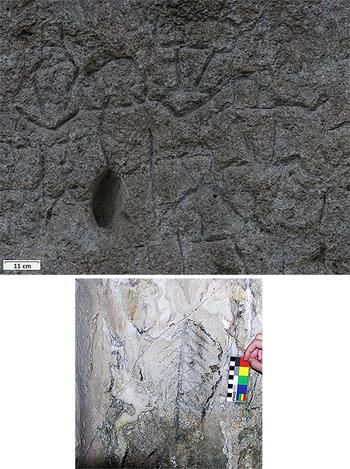
Examples of Philippine rock art: engraved anthropomorphs from Angono (top) and black painted botanics from Penablanca (bottom). Photographs by Andrea Jalandoni.

Engraved faces, a component of the Austronesian Engraving Style described by Specht (Reference Specht and Mead1979), were also not found in the Philippines but were present in Borneo (Fage and Chazine Reference Fage and Chazine2010; Hoerman Reference Hoerman2016), East Timor (O'Connor et al. Reference O'Connor, Aplin, Pierre and Feng2010), West Papua (Arifin and Delanghe Reference Arifin and Delanghe2004), Vietnam (Nguyen Reference Nguyen, Kaifu, Izuho, Goebel, Sato and Ono2014), and Taiwan (Ching Reference Ching2009; Kao Reference Kao1991). Although two red painted rock-art sites were identified in the Philippines, the majority of the currently known sites displayed black figures, unlike the proportion of red dominant sites in Southeast Asia overall.
Austronesian Painting Tradition and Austronesian Engraving Style
The possible ethnicity of artists was scarcely mentioned in the available literature. Aside from seven references to Negritos and Indigenous People, the literature mentioned modern artist groups four times, Austronesians with no reference to rock-art theories four times, Austronesian Painting Tradition 13 times, and Austronesian Engraving Style five times. All references to Austronesian Painting Tradition appeared in research conducted around the Banda Sea, including Borneo (e.g., Aubert et al. Reference Aubert, O'Connor, McCulloch, Mortimer, Watchman and Richer-LaFlèche2007; Ballard Reference Ballard1988; Chazine and Setiawan Reference Chazine and Setiawan2005; O'Connor Reference O'Connor2015; Oktaviana et al. Reference Oktaviana, Bulbeck, O'Connor, Hakim, Wibowo and Pierre2016; Wilson Reference Wilson2004). Tan and Chia (Reference Tan and Chia2010) mentioned Austronesian Painting Tradition in passing while discussing a site in Malaysia but not as a classification for the site. Therefore, this SQLR corroborates the conclusion of Bulbeck (Reference Bulbeck2008), O'Connor (Reference O'Connor2015), and O'Connor and colleagues (Reference O'Connor, Louys, Kealy and Mahirta2015) that the Austronesian Painting Tradition was limited to the Banda Sea area. Since none of the currently known sites in the Philippines conform to the parameters of Austronesian Painting Tradition, the style does not seem to have extended north or has not been recognized in other areas.
While some studies suggest that the Austronesian Engraving Style was prolific in the Pacific (O'Connor Reference O'Connor2015; Specht Reference Specht and Mead1979; Wilson Reference Wilson2002), Micronesia is an exception. Aside from one site in Tinian and a confirmed site in Pohnpei, there are no other exclusively engraved rock-art sites in Micronesia. The other known sites with engravings in the Marianas only had a few figures. However, Wilson (Reference Wilson2004) included Pohnpei in her analysis and concluded through statistical analysis that a large number of motifs likely resulted from local innovation. There is also significant overlap across the region.
The rock art of Wanshai, Taiwan (Ching Reference Ching2009), corresponds with all three criteria of the Austronesian Engraving Style provided by Specht (Reference Specht and Mead1979). The engraved motifs are curvilinear geometric, concentric spirals and faces. The rock art is on open-faced boulders and similar exposed bedrock and not in caves. Furthermore, the art is located near aboriginal Taiwanese who are Austronesian speakers—perhaps the most genetically and linguistically pure Austronesians, though the Taiwanese researchers deny that the aboriginals are the artists. We must consider whether the description of Austronesian Engraving Style as “curvilinear geometrics” and “face-like forms” is too broad and encompassing, though they are also defined by location on exposed rocks and in Austronesian-speaking areas. Still, curvilinear geometric forms like spirals and concentric circles are found all over the world, such as in England (Mazel Reference Mazel2017), the United States (Loendorf Reference Loendorf and Whitley2001), and Spain (Bradley et al. Reference Bradley, Boado and Valcarce1994). Face-like forms are also found worldwide. For examples in many parts of the world, see Watson (Reference Watson2015); for Russia, see Ponomareva (Reference Ponomareva2018); for North America, see Lenik (Reference Lenik2002); for China, see Dematte (Reference Dematte2011); for Australia, see Brady and Carson (Reference Brady and Carson2012), McDonald (Reference McDonald, Veth, Smith and Hiscock2005), and Mulvaney (Reference Mulvaney2010). Perhaps the rock art of Taiwan fits the criteria of Austronesian Engraving Style because the criteria of the style is too general. More specific descriptions of the face styles could narrow the definition. There are only a handful of sites in Southeast Asia with engraved faces, and they are widely distributed.
The known sites in the Philippines do not conform to Austronesian Engraving Style. Perhaps other sites will be found in the Philippines that could be classified as Austronesian Painting Tradition or Austronesian Engraving Style, but at present, those theories do not apply to Philippine rock art. Furthermore, the dominance of vulva forms in the known engraved sites in the Philippines and their relative absence in the rest of Southeast Asia and Micronesia suggest a local evolution for a universal motif (Jalandoni Reference Jalandoni2018). Alternatively, there is also evidence of temporal and regional rock art traditions across Southeast Asia, as proposed by Taçon and colleagues (Reference Tan, Taçon, Donna Gillette, Hayward and Murray2014), and that is supported by the similarities in some rock art styles found in the Philippines and elsewhere in Southeast Asia.
Micronesia should not be underestimated as a resource for determining an Austronesian art style. Unlike Southeast Asia, the migration into Micronesia is well understood. Austronesians were the first to arrive in Micronesia, as early as 3500 BP in the Marianas, just 500 years after they arrived in the Philippines (Hung et al. Reference Hung, Carson, Bellwood, Campos, Piper, Dizon, Bolunia, Oxenham and Chi2011). It is extremely likely that Austronesians are the artists of the rock art in Micronesia, but how long ago they fashioned it is still unknown.
Localities with Little to No Rock Art
According the SQLR, Brunei is only mentioned once (see Tan Reference Tan2014b), and that is in reference to having no rock art. Singapore is mentioned in two publications and a PhD dissertation that provide overviews of the region (Taçon Reference Taçon, David and McNiven2017; Tan Reference Tan2014a, Reference Tan2014b) because the only known rock-art site was demolished, but a section remains in the National Museum of Singapore. These are the only two countries in Southeast Asia without rock art, which indicates the futility of grouping rock art by political boundaries. Singapore, on the tip of the Malay Peninsula, and Brunei, on Borneo, are tiny countries on landmasses with copious rock art. Therefore, researchers like Chazine and Setiawan (Reference Chazine and Setiawan2005) and Hoerman (Reference Hoerman2016) correctly address rock art beyond political boundaries by considering Indonesian Kalimantan and Malaysian Borneo as one island rock art province in their analyses.
The rock art across Micronesia is sporadic. There is rock art on every currently inhabited island of the Marianas (Guam, Rota, Saipan, and Tinian), but the uninhabited islands may not have been surveyed for rock art. In Micronesia, no rock art has been reported on the Marshall Islands, Chuuk, Yap, and Kosrae. In the Federated States of Micronesia, only Pohnpei has recorded rock art. There may be an additional site in Pohnpei and another site on Kosrae (Historic Preservation Office archaeologist J. Lebehn, personal communication 2017). The geology of the atolls in Micronesia is not conducive to rock art creation or preservation. However, an in-depth study is needed to understand why some inhabited islands in Micronesia have rock art and others do not before it can be completely attributed to geology.
CONCLUSION
While the analysis of the data for this article focused on the Philippines, the database could be easily adapted to a different country or material culture. For example, it can also be used to answer the following questions:
• Where are the known engraving sites in Southeast Asia?
• Which countries have been funding and conducting research in Indonesia?
• Where are there known painted hands?
The word “known” in those questions is equivalent to “published and available online in English.” The questions and answers are limited by the parameters of the search and the variables noted during the processing phase.
The strength of the SQLR is in identifying research gaps and trends, but answering or explaining the results is beyond its scope and may require further investigation. For example, while the SQLR in this study identified and quantified the dominance of Australia in Southeast Asian rock-art research, it did not explain why that is. The SQLR, like all literature reviews, is excellent at answering the questions of who, what, where, and when but is limited in answering why.
In summary, the SQLR's reliability comes from the systematic way data were collected, and its usefulness is in quantifying the data. The SQLR is a powerful method for conducting literature reviews, and it is suitable for quantitatively focused archaeologists.
Improving SQLR through Collaborative Semantic Web Applications
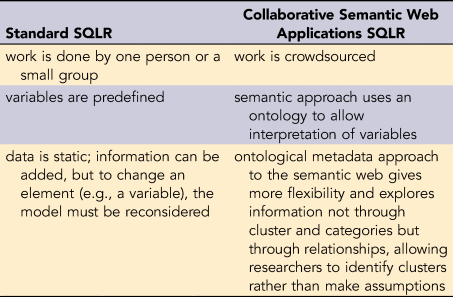
The SQLR has proven useful for assessing information about rock-art sites in the region by quantifying data from a list of publications. Managing the information in Excel was an effective way to analyze the data, but the process could be optimized by improving a) collection, b) management, and c) extraction methods. Therefore, a collaborative semantic web application could provide an organic approach of combining and working the data collection and management tasks into the usual day-to-day work routine. The differences between the standard SQLR, such as the one conducted for this article, and an SQLR that uses Collaborative Semantic Web Applications are summarized in Table 1.
Differences between Standard SQLR and Using Collaborative Semantic Web Applications

Although collecting the data for the SQLR took just under one month, a more collaborative approach through a central repository for rock art data would speed up the search for rock-art publications. It would also allow for the database to be organically updated, compared to the standard SQLR that is compiled from a static, predefined period by one person or a small group. In the example presented here, any rock-art publications for the region released after June 15, 2017, were not included. Updating the database would require defining new date parameters and retabulating the data.
The Global Rock Art Database (Haubt and Taçon Reference Haubt and Taçon2016) is a first attempt toward centralizing rock art data. Currently the publications listed there are limited, and users cannot search publication content or extract data. However, it is a proof-of-concept of the potential for a centralized rock-art database powered by collaborative data collection.
A new project, www.wikidemia.info, has been developed by one of the authors (RH). Wikidemia.info is a collaborative research platform that allows researchers to upload their research profiles (similar to LinkedIn) and their publications (similar to ResearchGate and Academia.edu). The platform allows researchers to semantically annotate and tag in-text information in publications on Wikidemia.info without the need for separate external files such as Excel spreadsheets. The tagged and annotated information can then be compared to other data in publications in the database, allowing researchers to explore and analyze relationships in complex research datasets. Similar to Wikipedia, all data within Wikidemia.info is shared with the community and contributes to the development of a global research knowledge base by sharing research profiles, publications, and structured data through the semantic tagging and annotation approach that can, in turn, be used by other researchers for further studies. Future research will consider testing Wikidemia.info to improve the data collection, management, and extraction process for the SQLR method so that it can be applied in other rock-art regions as well as more generally for archaeological and heritage research.
Acknowledgments
We thank Professor Catherine Pickering and the Griffith University School of Environment and Science for providing the resources to independently conduct systematic quantitative literature reviews. Anonymous reviewers, copyeditor Amy Phillips, and editors Sarah Herr, Christina Reith, and Julia Musha are acknowledged for constructive comments that improved the quality of this paper. Marcela Ortega is thanked for translating the abstract into Spanish. Research for this publication was partially funded by a Griffith University Publication Assistance Scholarship to Jalandoni and an Australian Research Council Laureate Fellowship (FL160100123) to Taçon. The Griffith Centre for Social and Cultural Research and the Place, Evolution and Rock Art Heritage Unit are thanked for hosting our research.
Data Availability Statement
The datasets generated and analyzed during this study are housed in Griffith University's digital network data storage facility and are available from Place, Evolution and Rock Art Heritage Unit (perahu@griffith.edu.au).