Surgical site infections (SSIs) are associated with significant morbidity. Furthermore, they are expensive: an SSI can add as much as $300,000 to a patient’s healthcare costs because of repeat operations, increased length of stay, and increased rates of readmission.Reference Jenks, Laurent, McQuarry and Watkins 1 Currently, preoperative predictors of spine surgery SSI are hampered by complexity and are limited in utility. The Centers for Disease Control and Prevention/National Healthcare Safety Network (CDC/NHSN) provides a method for comparing internal SSI outcomes to an external benchmark,Reference Mu, Edwards, Horan, Berrios-Torres and Fridkin 2 but this standardized infection ratio (SIR) calculator is cumbersome to implement for spine surgery because of the level of detail of procedural information required. In addition, the SIR cannot be calculated preoperatively because it requires knowledge of surgery duration. An improved spine surgery SSI risk assessment tool may improve preoperative risk assessment and patient selection. It may also provide more accurate SSI comparisons between institutions and among individual surgeons.
Among patients undergoing spine surgery, rates of SSI have been reported to range between 0.22 and 11 infections per 100 procedures.Reference Mu, Edwards, Horan, Berrios-Torres and Fridkin 2 – Reference Tenney, Vlahov, Salcman and Ducker 7 The wide range in reported infection rates likely reflects differences in procedure and patient comorbidities, inconsistent SSI definitions, and differences in infection control practices over time that were not specifically measured in the studies. Previous studies have assessed risk factors for SSI after spine surgery. Among the studies that employed multivariate regression for statistical analysis, the following factors have all been identified as independent risk factors for spine SSI: age over 65,Reference Tenney, Vlahov, Salcman and Ducker 7 , Reference Klein, Hey and Yu 8 morbid obesity,Reference Cizik, Lee and Martin 4 , Reference Pull ter Gunne and Cohen 6 , Reference Olsen, Mayfield and Lauryssen 9 , Reference Friedman, Sexton, Connelly and Kaye 10 level of surgery,Reference Watanabe, Sakai, Matsuyama, Yamamoto, Sato and Mochida 5 , Reference Klein, Hey and Yu 8 , Reference Friedman, Sexton, Connelly and Kaye 10 use of spinal instrumentation,Reference Klein, Hey and Yu 8 , Reference Levi, Dickman and Sonntag 11 surgery duration,Reference Pull ter Gunne and Cohen 6 , Reference Tenney, Vlahov, Salcman and Ducker 7 , Reference Boston, Baraniuk, O’Heron and Murray 12 diabetes,Reference Pull ter Gunne and Cohen 6 , Reference Friedman, Sexton, Connelly and Kaye 10 unexpected preoperative delay of >1 hour,Reference Radcliff, Rasouli and Neusner 13 preoperative diagnosis of urinary incontinence,Reference Olsen, Mayfield and Lauryssen 9 nutritional status,Reference Klein, Hey and Yu 8 male sex,Reference Klein, Hey and Yu 8 non-white race,Reference Friedman, Sexton, Connelly and Kaye 10 hypertension,Reference Cizik, Lee and Martin 4 renal disease,Reference Cizik, Lee and Martin 4 use of iodine skin preparation,Reference Boston, Baraniuk, O’Heron and Murray 12 previous history of spine infection,Reference Pull ter Gunne and Cohen 6 colonization with Staphylococcus aureus,Reference Thakkar, Ghobrial and Maulucci 14 and high invasiveness index.Reference Cizik, Lee and Martin 4 , Reference Xing, Ma and Ma 15 These variables typically fit into the categories of “patient risk factors” or “procedural risk factors” (variables intrinsically attributable to the procedure itself).Reference McGregor and Harris 16 By accounting for these risk factors, the measurement of variability between surgeons or hospitals becomes more accurate.
Because the infection rate is lowReference Mu, Edwards, Horan, Berrios-Torres and Fridkin 2 and because many factors contribute to an individual patient’s risk, it is challenging to accurately assess the contribution of all variables to spine SSIs. Indeed, in the largest study of its kind, Mu et alReference Mu, Edwards, Horan, Berrios-Torres and Fridkin 2 analyzed all surveillance data reported to the NHSN and found that only a small number of variables were significantly associated with SSI after fusion, revision fusion, or laminectomy. This finding likely relates to limitations in sample size, even though the sample contained nationwide surveillance data including 41,161 spinal fusion procedures, 40,513 laminectomies, and 991 revision fusion procedures. Additionally, some risk factors for SSI are conceivably collinear (ie, morbid obesity and diabetes or surgical duration and procedure type), and this limitation has not been specifically addressed in previous studies.
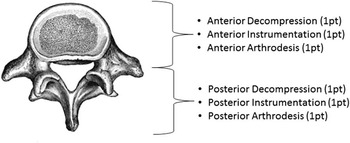
It would be helpful to identify effective screening tools that incorporate multiple risk factors into fewer variables, thereby simplifying risk assessment, improving power, reducing confounding, and ultimately allowing improved estimation of the risk that is attributable to the surgeon or institution performing a procedure. Cizik et alReference Cizik, Lee and Martin 4 reported that a novel invasiveness index score composed of the number of surgical vertebra treated, procedure type, and surgical approach predicted SSIs better than other variables (see Figure 1 for definition and point scoring calculation). Although this score is potentially a powerful tool in SSI prediction, the study was limited in that the inclusion criteria and SSI definitions were not consistent with NHSN definitions. As such, the generalizability of this score is unknown.
The invasiveness Index is a sum of surgical approach, procedure, and number of spine levels treated, and it has been independently associated with increased risk for surgical site infection. At each spinal level treated, points are assigned for anterior decompression, instrumentation and arthrodesis and posterior decompression, instrumentation, and arthrodesis. Results are summed to generate an invasiveness index score. This measure can be calculated preoperatively based on planned procedure or retrospectively through case review or electronic review of billing codes. Image reproduced courtesy of “Regional Vertebral Characteristics,” Boundless Anatomy and Physiology. Boundless, July 3, 2014.

In this retrospective cohort study, we assessed the invasiveness index as a predictor of SSI after spine surgery. Use of standard NHSN definitions for SSI and measurement of other putative risk factors should increase the generalizability of this score for potential use by infection control practitioners. Additionally, multiple regression models were created and compared, and we aimed to identify combinations of variables that are available preoperatively and comparable in accuracy to the NHSN SIR calculator.
METHODS
Identification of Study Subjects and Extraction of Electronic Data
We retrospectively collected all fusion, revision fusion, and laminectomy procedures between October 1, 2007, and September 30, 2013. This cohort was identified from the hospital’s operating room database using International Classification of Diseases, 9 th edition (ICD-9) codes for fusion, revision fusion, or laminectomy procedures as defined by the NHSN. 17 For patients who underwent >1 procedure type in a single operation, we assigned the surgical procedure to the NHSN category that would have received the SSI attribution if infection would have occurred (revision fusion > fusion > laminectomy), per NHSN definitions. Cases of deep and organ-space SSI were extracted from the infection control surveillance database, which was created by infection control practitioners using standard NHSN definitions as part of routine surveillance. A case was counted if it met NHSN criteria for SSI following a fusion, revision fusion, or laminectomy. Patients were excluded from the study if they were aged <18 years or if invasiveness index, body mass index (BMI), or other variables could not be calculated because of incomplete electronic information.
Cohort Description and Validation of the Hospital Databases
For all patients in the cohort, we collected age, sex, demographic information, medical comorbidities, procedure variables, and indication for surgery. Data were extracted from hospital databases including the Anesthesia Information Management System (AIMS), the Perioperative Information Management Systems (PIMS), billing claims data, the Admission Discharge Transfer database (ADT), as well as pharmacy, laboratory, and microbiology databases. We validated the data collected electronically using manual chart review on every fifteenth chart in the database.
Invasiveness Index Calculations
An invasiveness index for each case was calculated using CPT codes as previously describedReference Mirza, Martin, Goodkin, Hart and Anderson 18 and was validated with manual chart review of the operative reports. To calculate the invasiveness index, points were assigned for the following conditions at each level involved in the procedure: anterior decompression, anterior arthrodesis, anterior instrumentation, posterior decompression, posterior arthrodesis, and posterior instrumentation. The points at each spine level were summed to create the invasiveness index score. A single researcher (B.H.) performed all manual validation by chart review for the variables extracted from databases, including validation of the invasiveness index. For staged procedures, we used the sum of the invasiveness index and surgery duration from each surgery.
Statistical Analysis
All putative risk factors for infection were subjected to univariate analyses using χ2 or t test for categorical variables and the Wilcoxon rank-sum test for continuous variables. All variables with P≤.20 were considered for inclusion in the multivariate models. Multivariate stepwise regressions were performed for the whole cohort of patients and for each procedure type.
Collinearity among variables was assessed using Spearman collinearity coefficients. When the collinearity coefficient was ≥0.3, models were fit with each variable independently and combined with an interaction term to determine the model with the best fit. Regression models were fit using the NHSN SIR variables alone, the invasiveness index alone, and invasiveness index with other variables found to be significant in univariate analyses. Model comparisons were performed for the whole cohort and for each subset of procedural type.
Patient-Level SSI Risk Calculations
Using the NHSN models for fusion, revision fusion, and laminectomy,Reference Mu, Edwards, Horan, Berrios-Torres and Fridkin 2 we fit the following formulas for each patient in the cohort, as appropriate for his or her surgical procedure:
-
a) log(YFusion)=−6.4+0.94XApproach +0.60XASAscore +0.39XDiabetes +0.03Xduration10 +0.34Xmedschoolaffiliation +0.82Xlevel1 +0.49Xlevel2
-
b) log(YLaminectomy)=−6.89+0.52XASAScore +0.03Xduration10 +0.66Xmedschoolaffiliation +0.61Xbedsize
-
c) log(YRevison Fusion) =−4.59 +1.37XDuration
NHSN SIR calculations were generated using the following formula: Risk % = e Y/1 + e Y, where Y = the right side of the equation shown above for each procedure type and e is the natural log constant. We used graphical representation and Spearman correlation test to assess the association between the percent risk predicted by NHSN models and the risk predicted by the invasiveness index.
This study was approved by the Committee on Clinical Investigation at Beth Israel Deaconess Medical Center.
RESULTS
Cohort Description
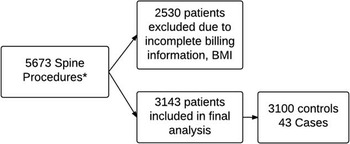
A total of 6,602 fusion, revision fusion, and laminectomy procedures were identified over the study period, and 81 SSI cases were included. Overall, we identified 49 fusion SSIs (0.80 per 100 procedures), 8 revision fusion SSIs (0.13 of 100 procedures), and 12 laminectomy SSIs (0.20 per 100 procedures). The most commonly isolated organisms were S. aureus, coagulase-negative Staphylococcus spp., and Enterococcus spp. After combining staged anterior/posterior procedures into a single patient encounter, excluding patients for whom billing data were unavailable and excluding superficial infections, the cohort consisted of 3,143 individuals, 43 of whom developed deep or organ/space SSIs (Figure 2). There were 221 staged procedures in the cohort. The excluded patients had a lower infection rate (0.63 per 100 procedures) than the included patients (1.36 per 100 procedures), but we could not otherwise account for differences between these groups because variables obtained from billing codes and hospital databases were not available for excluded patients.
Patient disposition. There were 5,673 patient encounters (*including staged anterior/posterior procedures). A total of 2,530 patients were excluded because of incomplete billing information used to calculate invasiveness index and other variables. Patients with superficial infection were excluded from the final analysis (n=22). The cohort under analysis consisted of 3,100 controls and 43 deep or organ/space infections.

Validation of Hospital Database Variables
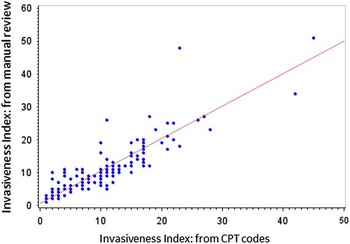
The final cohort of 3,143 patients was subject to manual review of every fifteenth chart to validate the electronically collected variables. The following variables were excluded from further review based on a κ score of ≤0.7: history of prior spine surgery (separate from revision fusion), renal disease, hypertension, ethnicity, tobacco use, alcohol use, and compliance with chlorhexidine bath before surgery. The invasiveness index score calculated from CPT codes correlated well with the invasiveness index calculated using a manual review of the operative reports (Figure 3). The invasiveness index scores were divided into low (<10), medium (10–19), and high (≥20) scores, and in this format demonstrated a weighted kappa value of 0.77 (0.71–0.83) compared with manual chart review.
The invasiveness index calculated by manual chart review (Y-axis) versus the invasiveness index calculated using current procedural terminology (CPT) codes (X-axis). When divided into tertials (low invasiveness [<10], medium invasiveness [10–20], high invasiveness [>20]), the 2 measures demonstrated good reliability with κ=0.72 (95% CI, 0.65–0.80) and weighted κ=0.77 (95% CI, 0.71–0.83).

Full Cohort Study
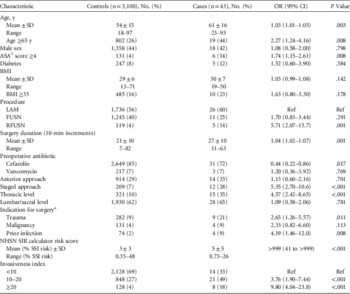
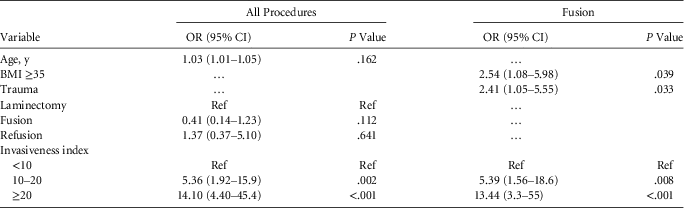
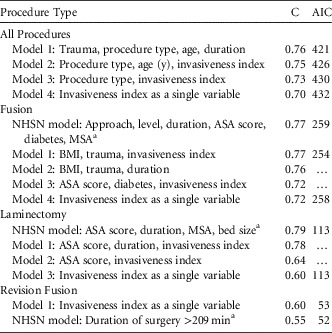
The baseline characteristics of the study cohort and the results of univariate analyses are shown in Table 1. The invasiveness index was collinear with surgery duration, surgery approach, spine level, staged surgery, and procedure type (Supplement 1). Stepwise multivariate logistic regression showed that advanced age (odds ratio [OR], 1.03; 95% confidence interval [CI], 1.005–1.05, for each year of life) and invasiveness index (medium invasiveness index OR, 5.36; 95% CI, 1.92–14.96); high invasiveness index OR, 14.1; 95% CI, 4.38–45.43) were significant predictors of infection (Table 2). A separate regression model replacing invasiveness index with its collinear variables showed that advanced age (OR, 1.028; 95% CI, 1.006–1.051), trauma (OR, 2.546; 95% CI, 1.146–5.659), and duration of surgery (OR, 1.047; 95% CI, 1.030–1.049, for each additional 10 minutes of surgery) were independently associated with SSI. These models performed similarly to the NHSN models (see Table 3, all procedures, models 1 and 2).
Univariate Comparisons of Demographic, Clinical and Procedural Characteristics of Cases and Controls

NOTE. SD, standard deviation; SSI, surgical site infection; ASA, American Society of Anesthesiology; BMI: body mass index; LAM, laminectomy; FUSN, fusion; RFUSN, revision fusion; NHSN SIR, National Healthcare Safety Network Standardized Infection Ratio.
a Selected indications for surgery shown here. (Degenerative and congenital conditions not shown.)
Multivariate Models of Predictors for SSI Among the Full Cohort (All Procedures) and Stratified by Fusion Procedures

NOTE. CI, confidence interval; OR, odds ratio; BMI, body mass index; Ref, reference.
Goodness-of-Fit of Surgical Site Infection Prediction Models for All Procedures and Stratified by Procedure Type

NOTE. Age in years; duration in 10-min intervals; invasiveness index in tertiles (<10, 10–20, ≥20).
a NHSN model variables are described in Mu et al.Reference Mu, Edwards, Horan, Berrios-Torres and Fridkin 2 AIC, Akaike information criterion; BMI, Body Mass Index; ASA, American Society of Anesthesiologists; C, Concordance Statistic; MSA, medical school affiliation.
Fusion Subgroup Analysis
In stepwise multivariate logistic regression of patients undergoing fusion procedures, morbid obesity (OR, 2.542; 95% CI, 1.08–5.99), trauma (OR, 2.41; 95% CI, 1.05–5.55), and invasiveness index (medium invasiveness index OR, 5.39; 95% CI, 1.56–18.61; high invasiveness index OR, 13.44; 95% CI, 3.28–55.01) were significant predictors of SSI (Table 2). This model (Table 3, fusion model 1) and the NHSN model performed comparably.
Laminectomy and Revision Fusion Subgroup Analyses
For laminectomy cases, the NHSN model was the most predictive model, followed closely by a model utilizing invasiveness index and NHSN risk factors (see Table 3, laminectomy, model 1). For revision fusion cases, the invasiveness index score was more predictive of SSI risk than the NHSN model (Table 3), although both models were limited by low sample size. Sample size prohibited accurate assessment of individual SSI risk factors for these procedure types.
Patient-Level SSI Risk Calculations
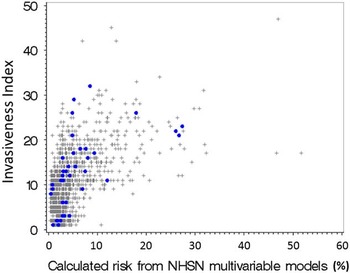
Median risk of SSI predicted by NHSN model was 3.11% and ranged from 0.35% to 51.7%. Risk was lower among laminectomy cases (median, 1.59%; range, 0.76%–10.73%) than fusion cases (median, 3.1%; range, 0.35%–51.7%). Higher SSI risk (as predicted by the NHSN model) was positively correlated (Spearman correlation coefficient, 0.42) with higher invasiveness index (Figure 4). In subanalyses by procedure type, this positive association remained consistent for fusion and revision fusion procedures, but no association was observed for laminectomy procedures. Among SSI cases, 29 of 43 (67%) were identified as medium or high risk by the invasiveness index, and 24 of 43 (55%) were identified as above average risk by the NHSN model. Of 43 SSI cases, 9 (20%) were identified as medium or high risk by the invasiveness index but below average risk by the NHSN calculator.
Risk predicted by the National Healthcare Safety Network Standardized Infection Ratio (NHSN SIR) (X-axis) versus invasiveness index (Y-axis) for all procedures. Dots represent surgical site infection cases; grey crosses represent controls. Spearman correlation coefficient demonstrated modest positive correlation between the variables (correlation coefficient=0.42).

DISCUSSION
The risk of SSI increased with higher invasiveness index after controlling for other variables. Across the 3 spine procedures considered here, odds of SSI were 14.1 times greater in the high invasiveness index group than in the low invasiveness index group and 5.36 times greater in the medium invasiveness index group than in the low invasiveness index group, after controlling for other variables.
Invasiveness index was collinear with surgery duration, surgery approach, spine level, staged surgery, and procedure type, and it likely also overlapped with instrumentation (which we did not measure). These collinear variables have been independently associated with SSI in prior studies.Reference Watanabe, Sakai, Matsuyama, Yamamoto, Sato and Mochida 5 – Reference Radcliff, Rasouli and Neusner 13 Thus, invasiveness index may be especially predictive of SSI because it incorporates multiple “procedural” risk factors into a single measurement. In addition, invasiveness index is a measurement only of procedural risk, in contrast to surgery duration, which takes into account procedural risk (eg, more extensive surgery takes longer), patient risk (eg, prior surgery or obesity may prolong an operation), and surgeon-specific risk (eg, less skilled surgeons may take longer to complete the same procedure).Reference McGregor and Harris 16 Thus, if the goal is to accurately allow hospitals to benchmark their SSI outcomes to other hospitals, then adjusting for surgery duration may skew the results toward the null. Substitution of invasiveness index for surgery duration and other procedural variables has the potential to simplify risk adjustment and simultaneously increase power to calculate surgeon or institution variability or to allow measurement of other interventions that may further the evidence-based approach to SSI prevention. In addition, the invasiveness index also has the benefit of being available before surgery to aid in preoperative risk assessment.
In the fusion subgroup analyses, the invasiveness index remained a strong predictor of SSI risk. Among fusion procedures, the odds of infection among the high-invasiveness-index group were 13.44 times greater than the odds of infection in the low-invasiveness-index group after controlling for other variables. These findings are consistent with the study by Cizik et al,Reference Cizik, Lee and Martin 4 the only other published study to assess infection risk using the invasiveness index. The invasiveness index was created using data from patients in the University of Washington hospital system and then validated with different patients from the same hospital system and the same surgeons. Using an unrelated healthcare system, our study provides additional validation of the findings of Cizik et al. Morbid obesity and trauma were also identified as independent risk factors for infection, with odds ratios of 2.54 (95% CI, 1.08–5.98) and 2.41 (95% CI, 1.05–5.55), respectively. Morbid obesity has been identified in multiple other analyses as a risk factor for SSI after spine surgeryReference Cizik, Lee and Martin 4 , Reference Pull ter Gunne and Cohen 6 , Reference Olsen, Mayfield and Lauryssen 9 , Reference Friedman, Sexton, Connelly and Kaye 10 and deserves attention as a possible target for risk factor modification or patient selection prior to elective fusion. Trauma has not been included in most prior studies, but when it is included, trauma has been predictive of SSI.Reference Watanabe, Sakai, Matsuyama, Yamamoto, Sato and Mochida 5 Trauma cases are included in NHSN surveillance reporting, so accounting for trauma in this and future studies is important to fully understanding SSI risk in this population.
The laminectomy subgroup analysis consisted of a large number of patients (56% of the full cohort) within a narrow range of low-invasiveness-index surgery (mostly <10). As such, the slightly better fit seen with a model using surgical duration (in place of invasiveness index) may be because duration accounts for intraoperative variation and complications better than the invasiveness index for patients undergoing laminectomy.
In this study, we reviewed a relatively small number of cases; therefore, our study had limited power to detect minor differences in risk that might be present in this population. The potential for type II error due to inadequate power is a limitation of all similar retrospective studies in this field. It is likely that these small, statistically insignificant differences are, in fact, important for some individual patients. Additionally, the current study is limited in that several previously described risk factors for SSI, including hypertension and renal disease, could not be accurately measured in our study because of limitations in our electronic hospital databases. Colonization with S. aureus was not measured during the study timeframe at our institution, and this information also may also be important in assessing the preoperative risk of infection. Finally, after the data collection for this study was completed, NHSN definitions changed. The invasiveness index relationship with SSI risk was seen in both fusion and revision fusion groups (now taken together as 1 procedure type in NHSN), and as such, we believe that the results of this study remain applicable.
The NHSN currently uses data submitted through surveillance programs to generate an SIR calculator to compare rates of infection between institutions.Reference Mu, Edwards, Horan, Berrios-Torres and Fridkin 2 In this study, the NHSN formulas generally fit the data better than other models that we created. Nonetheless, we found that in 20% of SSI cases, the NHSN model predicted a below-average infection risk when the invasiveness index was medium or high (Figure 4)—suggesting that, for a subset of patients, the invasiveness index adds additional information to the existing risk assessment tool. The existing NHSN SIR calculator requires knowledge of spine surgery that may not be readily available to infection control practitioners. As such, a combination of current NHSN risk factors with the invasiveness index (perhaps calculated from billing codes, as was the case in this study) may provide additional simplicity and accuracy to future SIR equations.
In summary, the invasiveness index was shown to be a powerful predictor of SSI in this study, perhaps because of collinearity with multiple additional well-described SSI risk factors. The invasiveness index could be used preoperatively to generate an individual patient’s estimated risk of infection and thereby aid in perioperative infection prevention, informed consent, and counseling. In addition, these findings highlight the importance of limiting surgical interventions to the smallest necessary procedure for a desired treatment effect. Finally, the invasiveness index could simplify physician and hospital comparison of quality without compromising accuracy and warrants consideration by healthcare quality agencies for this purpose.
ACKNOWLEDGMENTS
We would like to thank Brook I. Martin, MD, MPH, for supplying the algorithm used to calculate invasiveness index from CPT codes, Graham Snyder, MD, MPH, for assistance with data analysis, Linda Baldini, RN, CIC, for identifying all SSI cases, and Harold Calderon for assistance with data extraction.
Financial support: No financial support was provided relevant to this article.
Potential conflicts of interest: All authors report no conflicts of interest relevant to this article.
SUPPLEMENTARY MATERIAL
For supplementary material/s referred to in this article, please visit https://doi.org/doi:10.1017/ice.2016.244